





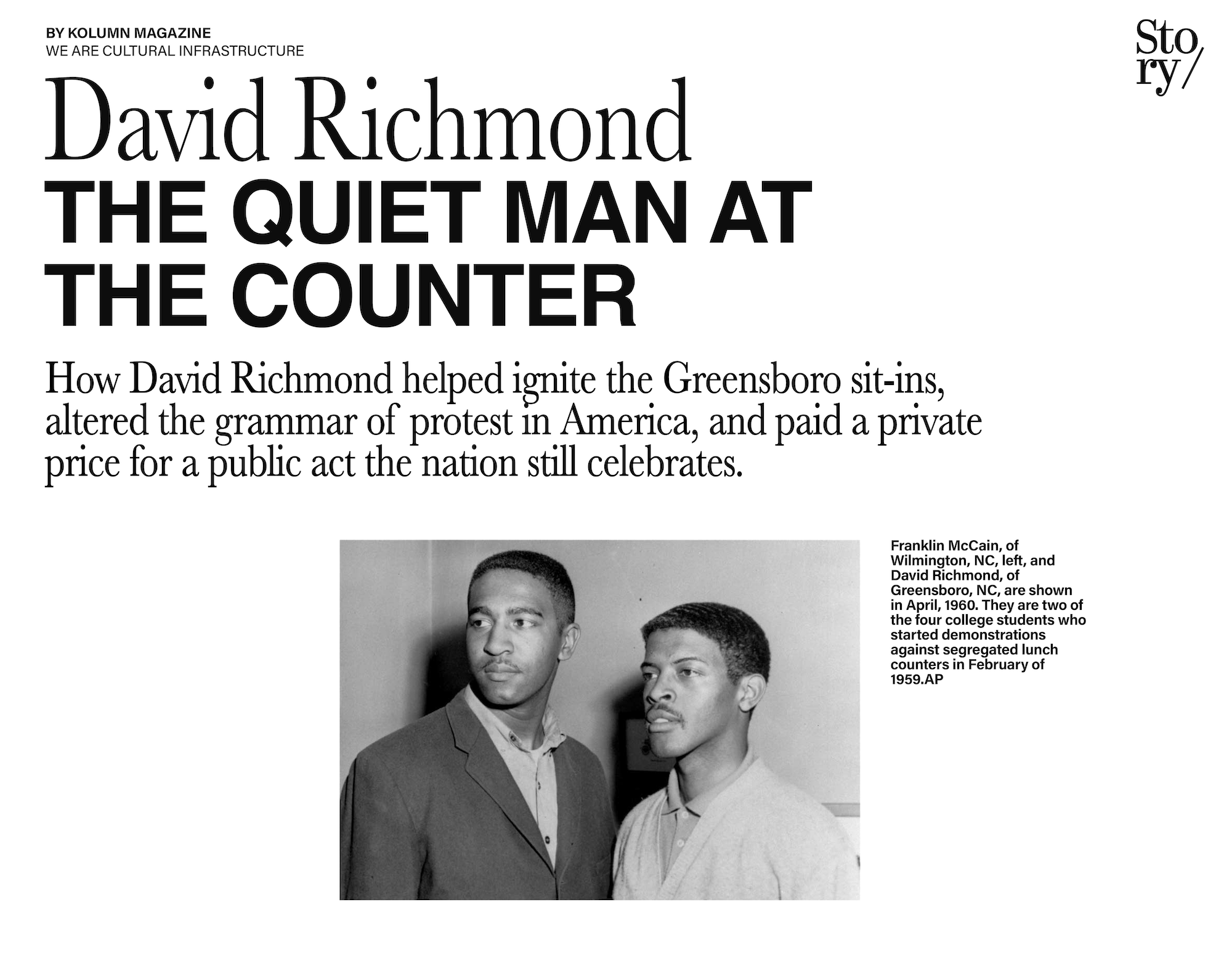
History remembers the stool. It should also remember the temperament required to stay on it.
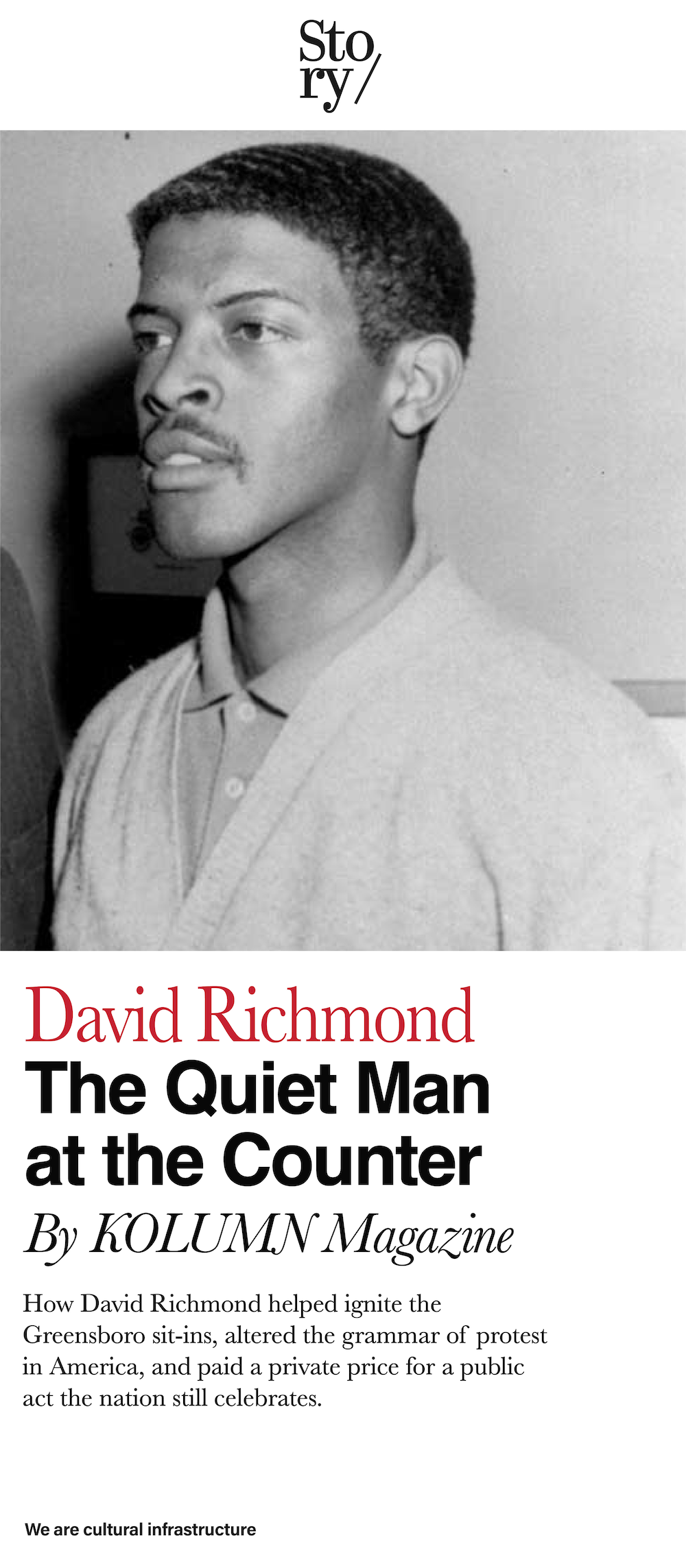
History remembers the stool. It should also remember the temperament required to stay on it.
By KOLUMN Magazine
There are some photographs in American history that do not merely document a moment. They reorganize it. They take what the country has been trying to treat as ordinary and pin it, suddenly, under unforgiving light. The image of the Greensboro Four leaving the F.W. Woolworth store in Greensboro, North Carolina, on February 1, 1960, is one of those pictures. Four young Black men in jackets and ties, composed and unflinching, stepping out of a white world that had just refused to serve them, and into an American future that had not yet decided what to do with their audacity. David Leinail Richmond was one of those young men. History has often remembered him as one quarter of a collective. What it has not always done, at least not carefully enough, is sit with him as a person: a Greensboro son, a gifted athlete, a freshman at North Carolina A&T, a man widely described as gentle and compassionate, and an activist whose life was shaped—elevated, burdened, complicated—by the fact that he helped move the country before the country was ready to be moved.
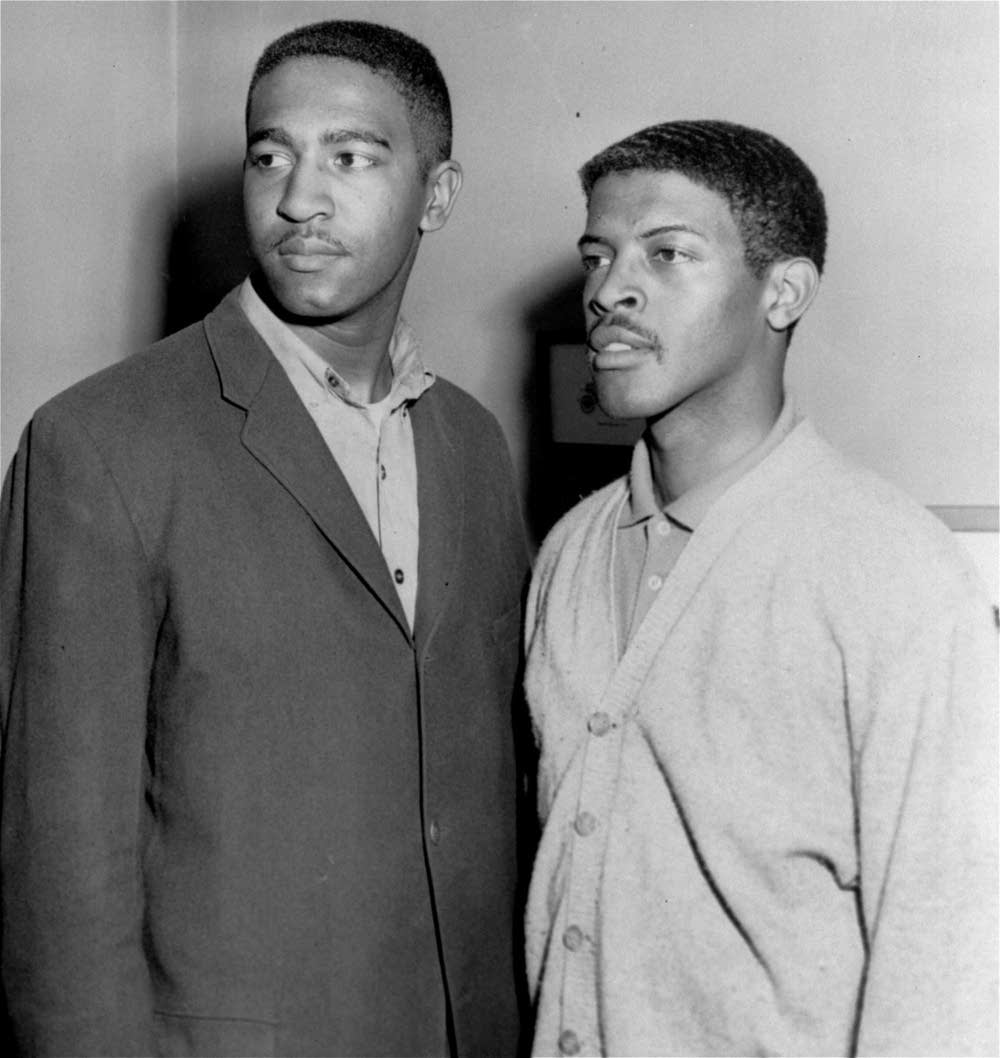
That distinction matters. The mythology of the civil rights movement often compresses individual lives into emblematic scenes. A bus seat. A bridge. A lunch counter. The simplification is understandable; symbols travel. But symbols also flatten. In David Richmond’s case, flattening has obscured the emotional and material reality of what happens when a teenager performs an act of moral clarity that the nation later sanctifies, even as the local world around him continues to punish him for it. Richmond’s significance lies not only in the fact that he helped launch one of the most consequential student protests in U.S. history. It lies in the way his life reveals the distance between public commemoration and private consequence. He stands, therefore, not simply as a co-author of the sit-in movement, but as an essential figure for understanding what the movement asked of young Black people—especially those whose names were made famous before their futures were secure.
KOLUMN has already treated one of Richmond’s comrades, Franklin McCain, as more than a frozen icon in a famous frame. In its recent feature on McCain, the magazine argued that the sit-in was not a miracle of spontaneous virtue but the product of student debate, HBCU culture, and strategic insistence. That framing is useful here too. Richmond’s story belongs in that same architecture. It belongs to the world of Black campus life, dorm-room argument, civic humiliation, church-trained endurance, and youthful impatience with the slow ceremonialism of American reform. If McCain’s story helps readers understand the intellectual and rhetorical force behind the Greensboro action, Richmond’s helps them understand its texture: the quiet steadiness, the local rootedness, and the cost of becoming, overnight, one of the young faces of a revolution.
A Greensboro child in a segregated world
David Leinail Richmond was born in Greensboro on April 20, 1941, and grew up inside the ordinary brutalities of Jim Crow North Carolina. He graduated from James B. Dudley High School in 1959, where accounts describe him as well-liked, active in school life, and an impressive athlete; he reportedly set a state high-jump record while competing on the track team. Those details are not incidental. They tell us that Richmond was not some marginal figure drifting accidentally into history. He was a fully legible product of Black Greensboro’s institutions: a young man formed by neighborhood, school, church culture, social discipline, and the ambitions that Black families and educators attached to talented children in a segregated state. That grounding matters because the sit-ins were not staged by outsiders. They were mounted by local sons who knew exactly what the city’s racial etiquette required, and who chose to violate it anyway.
When Richmond enrolled at North Carolina A&T State University, then known as the Agricultural and Technical College of North Carolina, he entered one of the most important political spaces in the Black South: the HBCU campus. Too often, mainstream civil rights memory treats colleges as backdrops rather than engines. But A&T was not scenery. It was an incubator. The postwar Black campus was a place where formal aspiration and radical dissatisfaction could coexist in productive tension. Students were expected to be respectable, upwardly mobile, and disciplined. They were also increasingly unwilling to inherit their elders’ obligation to endure humiliation in the name of caution. That contradiction produced energy. Richmond and his classmates were studying for careers, yes, but they were also studying the country—and concluding that citizenship without dignity was a fraud.
North Carolina A&T’s own archival material and anniversary commemorations continue to emphasize that the A&T Four were freshmen when they acted, and that their protest helped define a new role for students in the civil rights era. This point is not ceremonial fluff. It is historically central. The sit-ins in Greensboro did not merely challenge segregated service at one downtown store. They shifted the movement’s center of gravity toward young people who were no longer content to wait for courts, city councils, or polite interracial committees to move at the speed of justice. Richmond’s youth is part of his significance. He was not old enough to have accumulated institutional authority. He had almost nothing to leverage except discipline, nerve, and the willingness to let the public spectacle of refusal expose the irrationality of segregation.
The long talk before the walk downtown
The Greensboro action has often been remembered through its cleanest narrative line: four students sat down, asked to be served, and changed America. True, but incomplete. The sit-in was preceded by discussion—restless, searching, late-night conversation among Richmond, Franklin McCain, Joseph McNeil, and Ezell Blair Jr., later known as Jibreel Khazan. KOLUMN’s McCain feature rightly stresses that the act was argued into existence before it was performed. Smithsonian accounts and later recollections reinforce the same point. The protest emerged from talk sharpened by humiliation: the humiliation of travel through segregated bus stations, of everyday denial, of being able to spend money in the store but not sit to eat inside it. Richmond belonged to that circle of young men who had tired of describing injustice to one another and decided instead to dramatize it in public.
There is a tendency, in retrospect, to assign one personality trait to each member of the Greensboro Four: the strategist, the firebrand, the eloquent witness, the quiet one. Those categories can help, but they can also reduce. What seems more consistently supported is that Richmond was remembered by others as compassionate and less publicly theatrical than McCain, while remaining fully committed to the action they undertook together. Smithsonian material describing the men decades later notes that Richmond was remembered as “the quiet, compassionate one.” That description risks sentimentality if handled carelessly, but it also points to something important. Movements do not require only orators. They require presence. They require people whose steadiness holds a line. Richmond’s contribution seems to have been precisely that sort of moral composure: not secondary, not decorative, but structural.
On February 1, 1960, the four young men entered the Woolworth store in downtown Greensboro wearing coats and ties. Before approaching the lunch counter, they purchased ordinary goods from the non-segregated section of the store—small items such as toothpaste or notebooks—keeping their receipts. This mattered tactically. Having been served money-taking commerce at one counter, they could expose the absurdity of being denied human service at another. Then they sat down at the whites-only lunch counter and asked for coffee. They were refused. Staff called the police. The police did not arrest them, because the students had not broken a law merely by sitting and waiting. A white ally, Greensboro businessman Ralph Johns, had tipped off the press. The four remained until closing. In that gap between legality and custom—between what could be justified and what could only be enforced by racial habit—the sit-in found its leverage.
What happened next is why Greensboro became more than a local story. On the second day, the original four were joined by many more students; within days, participation swelled into the hundreds, including students from Bennett College, Dudley High School, and the Woman’s College of the University of North Carolina, now UNC Greensboro. SNCC Digital notes that the numbers grew from four to 27 on the second day and 63 on the third, with protesters occupying so many seats that white patrons had nowhere to sit. Smithsonian and Census summaries similarly describe the rapid escalation: over 300 participants by the fourth day, and well over a thousand students engaged by the first week’s end. The point is not simply scale. It is contagion. Greensboro showed what disciplined public inconvenience could do. The sit-in converted private grievance into collective method.
Why Greensboro mattered beyond Greensboro
The sit-ins in Greensboro were not the first direct-action protests against segregated accommodations in the United States. But historians and institutional accounts consistently treat them as catalytic because they were sustained, highly visible, rapidly replicable, and timed to a student generation increasingly prepared to lead. The National Park Service language cited by North Carolina A&T in 2025 is especially sharp on this point: the lunch-counter action “reinvigorated” the modern civil rights movement by shifting strategy toward nonviolent direct action, introduced new youthful leadership, and helped inspire the formation of SNCC. Stanford’s King Institute and the U.S. National Archives make the same broader argument. The sit-in campaigns of 1960 demonstrated the strength of grassroots militancy and enabled a generation of young people to trust its own leadership. Richmond helped ignite that shift.
That matters because civil rights history is often narrated through a small set of nationally canonized figures and speeches. Greensboro insists on another narrative: the movement as multiplication. One action, repeated. One refusal, imitated. One city, then dozens. Smithsonian reports that sit-ins spread quickly through North Carolina and across the South; by spring 1960 the tactic had been replicated in numerous cities and states. The Greensboro students, including Richmond, offered a model other students could borrow without waiting for permission. No great office had to approve it. No legislation had to pass first. Sit down. Ask to be served. Remain. Return. Bring more people. Make the contradiction unbearable to ignore. That democratic portability is one reason the action altered not only policy but political imagination.
The action also mattered because it exposed segregation not as a stable social order but as a theater of absurdity sustained by routine performance. The young men had money. They were clean-cut. They were paying customers. They were already allowed to purchase goods elsewhere in the store. What the lunch counter denied was not commerce but dignity—specifically the dignity of being publicly seated and served. Smithsonian curator William Yeingst put it neatly when he said the students were confronting less a statute than “a cultural system that defined racial relations.” Richmond’s role must be understood in that register. He was not merely protesting a sandwich. He was participating in a carefully staged revelation of how white supremacy worked in daily life: not only through terror and law, but through service rituals, seating arrangements, and the choreography of who had to stand while others sat.
Richmond inside the collective
Collective action creates a paradox for memory. The group becomes famous; the individuals risk becoming indistinct. In the case of the Greensboro Four, that danger is intensified by the power of the photograph and the grandness of the movement it helped set off. Yet Richmond’s particular place in the foursome deserves closer attention. He was the Greensboro native among them, deeply rooted in the city whose customs they were defying. He was also, by many later accounts, a stabilizing presence. While McCain would become especially known for his forceful recollections and unsparing clarity about white supremacy, Richmond seems to have occupied a different, quieter register. That difference should not be read as lesser importance. Collective courage is often built out of varied temperaments that make one another possible. Richmond’s calm appears to have been part of the chemistry that enabled action.
There is another reason to resist dissolving Richmond into the group. His post-1960 life did not follow the smoother arc of official memory. For some of the Greensboro Four, later public life included military distinction, high-profile speaking, or a more sustained role in institutional remembrance. Richmond’s later years were harder. Accounts collected by BlackPast, North Carolina A&T, and later regional essays describe a man who received threats, struggled to secure stable opportunity, left Greensboro for a period, returned to care for family, and dealt with depression, alcoholism, and the heavy residue of having been marked as a “troublemaker” in the city where he had become famous. The national memory placed him on a pedestal. Local life, as so often in the South, had other plans.
This is one of the hardest truths in Richmond’s story, and one of the most journalistically necessary. Public praise does not erase economic retaliation. Symbolic honor does not guarantee social ease. The same culture that now treats the A&T Four as civic saints once treated the men themselves as disruptive embarrassments to racial order. Richmond’s difficulty finding work after the sit-ins, and the sense that he had been blackballed, show how white backlash functioned beyond the headline. The punishment for dissent was not always immediate jail or mob violence. It could also be slower: foreclosed opportunity, damaged employability, emotional strain, hometown alienation. Richmond’s life reminds us that the aftermath of activism must be measured not only in legislative victories but in what movements cost the people who made them possible.
The burden of becoming a symbol too young
Richmond died in 1990, at just 49, of lung cancer. By then, he had lived long enough to see the sit-ins become part of national civil rights lore, but not long enough to enjoy the full flowering of the public memory that later surrounded the Greensboro Four. North Carolina A&T awarded him a posthumous honorary doctorate at his funeral. He had already received the Levi Coffin Award from the Greensboro Chamber of Commerce in 1980 for leadership in human rights, human relations, and human resources development. In 2010, the Smithsonian Institution awarded the Greensboro Four the James Smithson Bicentennial Medal, which Richmond’s son accepted on his behalf. These honors are meaningful. They should be noted. But they also underscore the strange chronology of American recognition: first stigmatize, then memorialize; first marginalize, then curate; first refuse service, then preserve the stool behind glass.
There is something almost unbearably American in that sequence. The state, the university, the museum, the chamber of commerce—all eventually arrive to certify that the dissident was right. Yet the timing reveals the country’s deeper pattern: moral courage is easiest to admire once it can no longer seriously inconvenience power. KOLUMN’s McCain piece observed that one section of the Woolworth counter is now preserved at the Smithsonian, turning what was once condemned as troublemaking into officially curated democratic memory. Richmond’s life sharpens the irony. He was young when he took the risk, vulnerable while he bore the consequences, and largely gone before the full institutional embrace arrived. The museum came later. The National Historic Landmark designation for the site came much later, in 2025. The nation is very good at retrospective gratitude. Richmond’s biography asks whether retrospective gratitude is enough.
This is where a serious magazine profile has to resist sentimentality. It would be easy to write Richmond as a tragic saint, overwhelmed by a country too slow to love its prophets. But that would miss the harder, more instructive truth. Richmond was neither saint nor mere victim. He was a young Black man who made a disciplined political choice, participated in a transformational act of direct action, and then had to live in the compromised world that choice helped improve but did not redeem. That is not tragedy in the theatrical sense. It is something more common and more revealing: the ordinary incompleteness of historical victory. The sit-ins helped transform public accommodations and inspire a national student movement; they did not abolish the emotional wear of racism, nor did they guarantee that every participant would be held securely by the world they helped change.
The student movement he helped make possible
To write about Richmond only as one of four men at one counter would still be too narrow. The larger significance of his action lies in what it unlocked. The sit-in wave of 1960 fed directly into the formation of SNCC, one of the most important organizations in modern American political history. The National Archives notes that Ella Baker convened young activists at Shaw University in April 1960, where SNCC emerged as an autonomous organization made up largely of Black college students committed to peaceful direct action. Stanford’s King Institute similarly frames the sit-ins and SNCC’s creation as evidence of grassroots militancy and youth leadership. Richmond did not found SNCC alone, and the Greensboro Four were not the only catalyst. But without Greensboro, the timing, confidence, and national visibility of the student turn in the movement would have looked different.
That student turn changed American politics. It created room for Diane Nash, John Lewis, Marion Barry, Charles Sherrod, Bernard Lafayette, and many others to treat youth not as apprenticeship but as authority. It validated direct-action protest as something more than local disruption. It demonstrated that Black students could seize national attention without waiting for older institutions to authorize their tactics. In that sense, Richmond’s place in history is larger than Greensboro and larger than lunch counters. He belongs to the genealogy of American student insurgency itself: the idea that young people can convert moral urgency into public crisis, and public crisis into structural change. North Carolina A&T’s 2025 language explicitly places the sit-ins in the lineage of later student-led protest movements involving women, Native Americans, free-speech campaigns, and antiwar activism. That is a large claim, but not an absurd one. Greensboro provided a template. Richmond helped draft it.
Why David Richmond still matters now
He matters, first, because his life keeps the movement from hardening into folklore. Once history becomes too polished, it becomes less useful. Richmond’s life restores friction. He reminds readers that the civil rights movement was not made only by those who were later easiest to celebrate. It was also made by people whose afterlives were messier, whose mental and material burdens were heavier, and whose communities did not always know how to honor them in real time. That is not peripheral to the story. It is the story. If one wants a more honest account of how democratic change happens, one has to look not only at the triumphant photograph but at the decades after the flashbulb fades.
He matters, second, because he illustrates how local Black institutions produced national history. Dudley High School. North Carolina A&T. Bennett College. The student networks around them. The city’s Black neighborhoods and churches. These places trained perception before they trained protest. They helped young people understand the difference between manners and justice, between survival and dignity. Contemporary political culture often speaks as though courage appears from nowhere. Richmond’s life says otherwise. Courage was socialized. It was argued into shape in campus rooms and community spaces. It was reinforced by Black institutional life that taught young people they were worth more than segregation said they were.
He matters, third, because the structure he confronted has not vanished; it has mutated. Public accommodations are no longer legally segregated, but the broader question that animated the sit-ins remains contemporary: who is permitted full belonging in supposedly public space, and on what terms? The sit-in’s genius was to expose exclusion not as private prejudice but as a public arrangement. That lesson still travels. One does not have to force a cheap analogy between 1960 and the present to see the continuity. Richmond’s example endures anywhere people confront rules, customs, or institutional designs that tell them they may spend, attend, consume, labor, or vote, but not belong equally. His action was historically specific. Its logic remains alarmingly durable.
He matters, finally, because he complicates heroism in a way that modern readers need. Too much commemorative writing asks historical figures to be either flawless icons or cautionary tales. Richmond resists both categories. He was brave at 18. He struggled later. He was honored, but not always protected. He was remembered, but not always deeply understood. That complexity does not diminish him. It enlarges him. It makes his courage more impressive, not less, because it locates that courage in a real human life rather than in bronze statuary. The most responsible way to honor David Richmond is not to smooth out the contradictions. It is to tell them plainly and let them stand.
Beyond the photograph
Today the old Woolworth site is home to the International Civil Rights Center & Museum, and a portion of the lunch counter remains there while another section is held by the Smithsonian’s National Museum of American History. In January 2025, the site was designated a National Historic Landmark. North Carolina A&T continues to commemorate the A&T Four through annual February One observances, public programming, and monument culture on campus. All of this is appropriate. Memory needs place. But place alone is not enough. The work of historical writing is to keep commemoration intellectually alive—to prevent it from becoming a ritual of admiration detached from analysis. Richmond deserves that level of treatment. He deserves to be remembered not just as one face in a quartet, but as a person through whom one can read the ambitions and contradictions of the nation itself.
What David Richmond did on February 1, 1960, was at once modest and radical. He sat down. He stayed seated. He made a city show its hand. With three friends, he transformed a lunch counter into a moral referendum and a student gesture into a national method. That alone would guarantee him a place in history. But his life means more than that famous afternoon. It means that movements are made by whole people, not just by their best-known moments. It means that the distance between civic praise and lived justice can be enormous. It means that a democracy often relies on its youngest citizens to force it into coherence. And it means that David Leinail Richmond, the quiet man at the counter, remains one of the clearest witnesses to both the power and the cost of asking America to become what it says it is.
More great stories
Afro Sheen, Wall Street, and the Architecture of Black Possibility
July 6, 2026
No Comments
The Fire Inside the Fourth
July 5, 2026
No Comments