


Nobody can ride your back if your back’s not bent.
Nobody can ride your back if your back’s not bent.
By KOLUMN Magazine
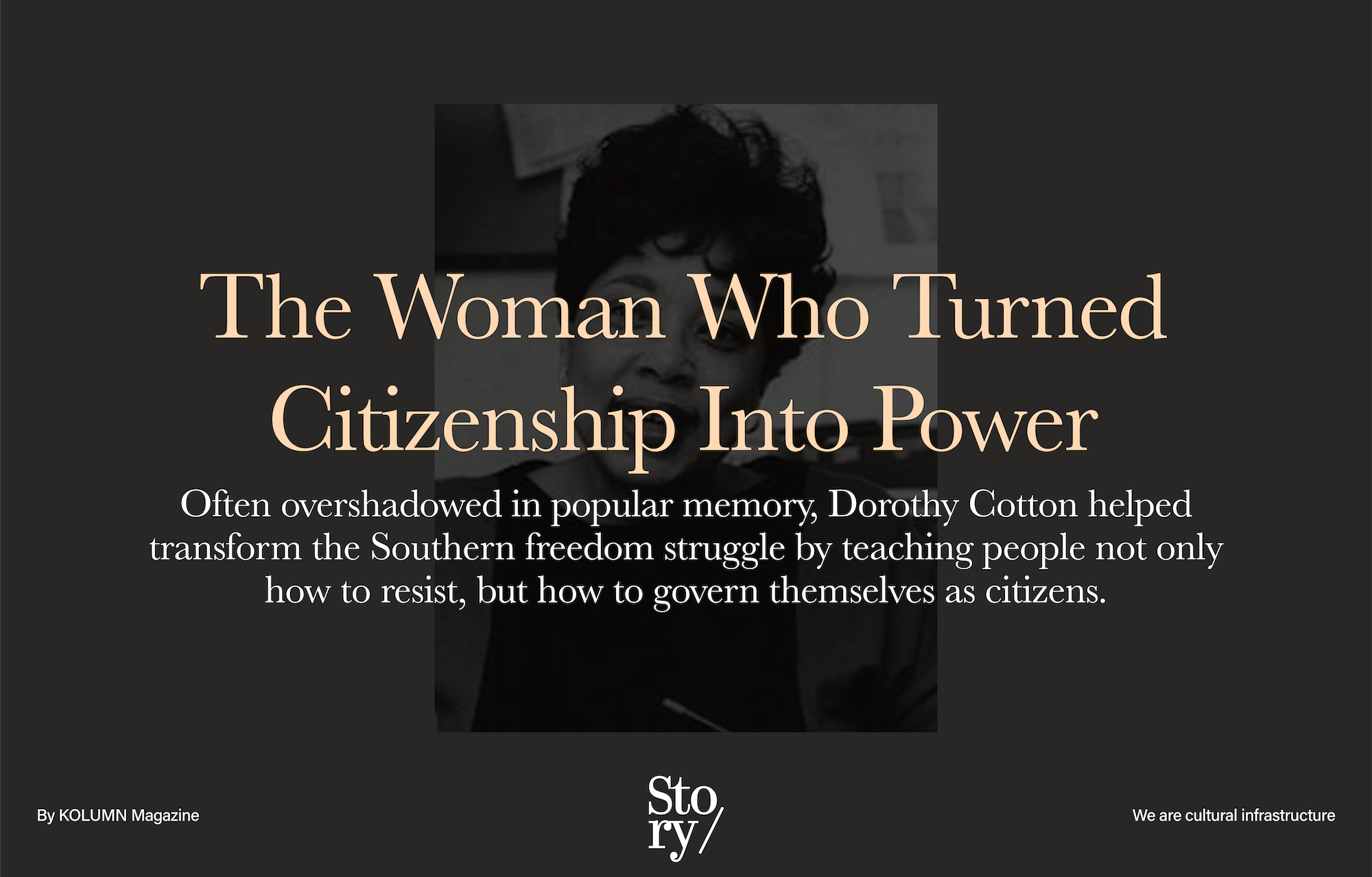
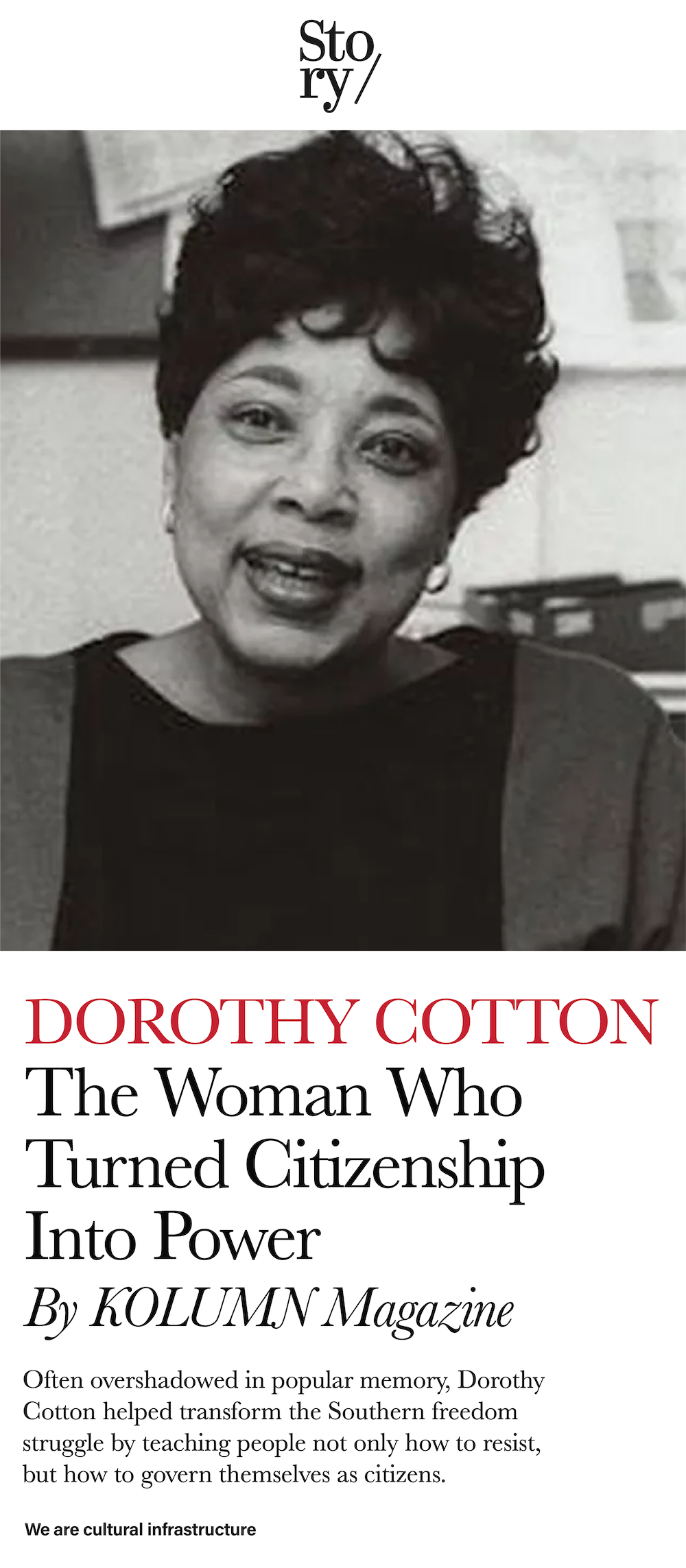
The public memory of the civil rights movement still has a habit of narrowing itself. It prefers podiums, march routes, a few towering male names, and a visual grammar of heroism that fits easily into documentaries and commemorations. Dorothy Cotton never really fit that shorthand. She was not unimportant to the movement because she was less visible. She was less visible because her work happened in the zone where movements either become durable or collapse: training, political education, discipline, morale, local leadership, and the slow conversion of fear into civic confidence. Cotton, who died in Ithaca, New York, in June 2018 at 88, spent years in Martin Luther King Jr.’s inner circle and directed the Southern Christian Leadership Conference’s Citizenship Education Program, one of the most consequential and under-credited engines of the Black freedom struggle.
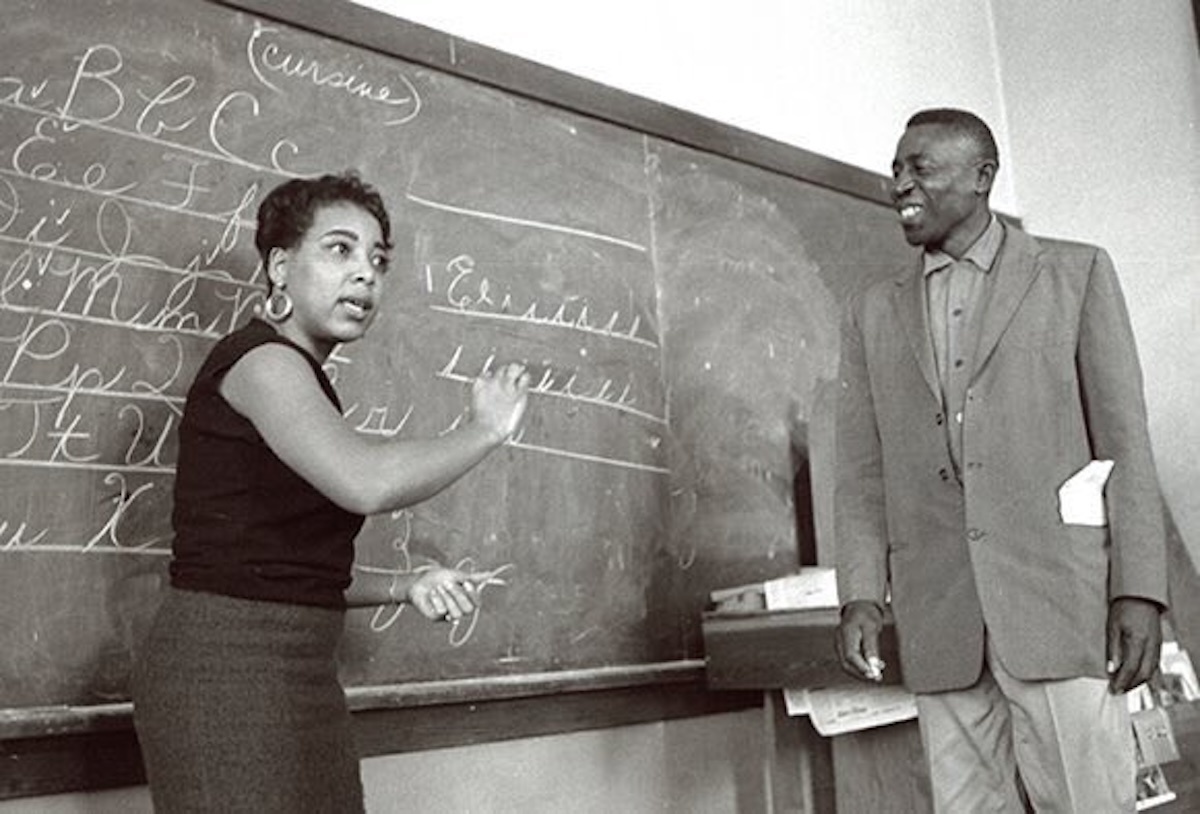
That matters because Cotton’s life helps correct one of the biggest distortions in how the movement is remembered. We often talk as if civil rights victories were won by moral eloquence alone. But Cotton’s career is a reminder that no speech—no matter how soaring—could have changed the South without people on the ground learning how power worked, how voter suppression worked, how local intimidation worked, and how collective action could break the spell of political helplessness. Cotton taught people to read literacy-test traps, to understand constitutional rights, to use nonviolent direct action, and to see themselves not as victims of a closed system but as citizens capable of remaking it.
She also embodied another truth the movement’s official mythology has too often obscured: Black women were not auxiliary to the struggle. They were planners, teachers, tacticians, recruiters, fundraisers, strategists, and the keepers of emotional and organizational continuity. Cotton was the highest-ranking woman in SCLC for much of the 1960s, the only woman on its executive staff, and a close colleague of King’s. Yet even now, her name is far less familiar than many men whose contributions were not necessarily larger—just more public.
That line, which Cotton recalled King using at a Citizenship Education Program workshop and which became the animating metaphor of her memoir, captures not only a movement ethic but also her particular political theology. The point was not simply endurance. It was uprightness. It was the refusal to remain bowed psychologically before a system that had spent generations teaching Black people to expect humiliation as a condition of survival.
A child from Goldsboro who knew something was wrong
Dorothy Lee Foreman was born on June 9, 1930, in Goldsboro, North Carolina. After her mother died in 1934, she and her sisters were raised by their father, Claude Daniel Foreman, a tobacco factory worker. The outlines of that childhood matter because Cotton’s political consciousness did not arrive as abstract ideology. It grew from intimate knowledge of racial hierarchy, scarcity, and the everyday compression of Black life in the Jim Crow South.
In a 2011 oral history for the Civil Rights History Project, Cotton described a feeling that had shadowed her from childhood: “From a very early age I had felt like I was in the wrong place.” She reflected that the sensation was “pervasive” before she had language for it, and that only later did she understand it as a response to the structure around her. That is a profound formulation. Cotton was naming, in effect, the psychic architecture of segregation—the way a child can register that a social order is false long before she can explain its statutes, customs, and enforcement mechanisms.
Cotton worked her way forward through education with a rigor that would later define her organizing style. According to the King Institute and the Civil Rights Digital Library, she attended Shaw University in Raleigh and supported herself by working as housekeeper to university president Robert Prentiss Daniel. When Daniel later moved to Virginia State College in Petersburg, Virginia, Cotton followed, eventually earning a degree in English and library science. She later received a master’s degree in speech therapy from Boston University in 1960. None of this was glamorous. It was disciplined, improvised, and hard-won—the kind of preparation that rarely gets celebrated as movement work, even though it often forms its backbone.
It was in Petersburg that the direction of her life changed. There she entered the orbit of Wyatt Tee Walker, the minister and NAACP organizer who would become one of the movement’s key field strategists. Cotton helped Walker with local protests, including picketing around segregation at public facilities and lunch counters. These were not yet the grand national chapters of the movement that schoolbooks prefer. They were smaller confrontations, practical lessons in discipline and public witness. But that was the point. Cotton was learning early that protest had to be taught.
From Wyatt Tee Walker’s protege to King’s inner circle
When Walker became executive director of SCLC in 1960, Cotton followed him to Atlanta. She later recalled that she told her husband the move would last only a few months. Instead, as she put it, “I stayed twenty-three years” and “The Movement became my life.” That sentence reads almost like a confession of total commitment, but it also hints at the cost. Cotton’s marriage ended in divorce. The work did not merely occupy her time; it reorganized her life.
At SCLC, Cotton entered a political world that was brilliant, improvisational, male-dominated, and often chaotic. She became director of education and, in effect, one of the organization’s central builders of internal capacity. The King Institute describes her as the highest-ranking woman in SCLC during most of the 1960s, a position that placed her in King’s executive circle. Cornell’s obituary similarly notes that she directed the Citizenship Education Program from 1960 to 1968, traveled with King to Oslo when he accepted the Nobel Peace Prize in 1964, and was staying next to him at the Lorraine Motel in Memphis during the period surrounding his assassination.
Her proximity to King has sometimes overshadowed the substance of her own work. It is easier, and lazier, to frame Cotton as an aide or confidante than as an architect of movement infrastructure. Yet even those who emphasized her closeness to King acknowledged that she was far more than a companion. The Washington Post, quoting historian David Garrow, reported that in the last years of King’s life “no one was closer to or more emotionally supportive” than Dorothy. But the same obituary also makes clear that she led SCLC’s education department and was the only woman on the organization’s executive staff. The emotional labor mattered. So did the administrative and political labor. In Cotton’s case, the two were inseparable.
This is where her story becomes especially instructive. Movements need public symbols, yes. They also need people who can think institutionally while operating under siege. Cotton was one of those people. She could sit in staff meetings, coordinate training, travel the South, recruit participants, manage pedagogy, and maintain morale. She could also read the room—whether the room was a workshop full of first-time activists or a leadership circle filled with strong egos. In her oral history, she described SCLC’s staff culture as something like a “team of wild horses.” It is hard to imagine a better phrase for a movement full of visionary personalities, improvisation, and friction. Cotton helped convert that energy into organized outcomes.
Dorothy Cotton’s political gift was not just courage. It was conversion: turning fear into agency, grievance into strategy, and “ordinary people” into organizers.
The Citizenship Education Program was the movement’s civic laboratory
If Dorothy Cotton deserves a larger place in American public memory, the Citizenship Education Program is the main reason. The program began with roots in Septima Clark and Esau Jenkins’s work through Highlander Folk School and later moved under SCLC’s umbrella when Highlander came under political attack. Cotton became one of the program’s chief leaders, helping scale it across the South. In practical terms, CEP taught disenfranchised Black people the literacy, political understanding, and organizing skills needed to register to vote and participate in public life. In strategic terms, it taught them that citizenship was not a ceremonial label. It was a form of practiced power.
Cotton’s own account of CEP’s origins gets at why the program mattered so much. In her oral history, she recounts a killing on John’s Island in South Carolina, where a white man shot a Black boy and the community, deprived of political power, could not effectively respond. “What I just said really is the germ of the Citizenship Education Program,” she explained. The point was not literacy for literacy’s sake. It was literacy connected to power, dignity, and the ability to act collectively against impunity.
That distinction is crucial. Too many retrospective accounts flatten the Citizenship Education Program into remedial instruction, as if it were only a civics class with reading exercises attached. It was much more radical than that. Cotton said that SCLC realized it could do more than help people read and write. It could help them “understand their political rights” and their rights “as citizen.” The Dorothy Cotton Institute, which later carried her legacy forward, distilled the same principle by describing citizenship as a verb—something enacted by engaging and influencing society.
The workshops were typically five-day residential sessions. Cotton, Andrew Young, Septima Clark, and others recruited people from across the South, trained them, and sent many back home to become teachers themselves. This multiplier effect is a major reason CEP mattered. It did not just produce participants. It produced local transmitters of democratic knowledge. The Dorothy Cotton Institute notes that figures such as Fannie Lou Hamer, Victoria Gray Adams, Amelia Boynton, Annie Devine, Lula Williams, Annell Ponder, and Bernice Robinson were among those connected to this educational network. In other words, Cotton’s work was not adjacent to movement leadership; it was part of the process through which leadership got made.
Cotton herself regarded CEP as SCLC’s best program. Highlander quotes her saying exactly that, adding that its participants were “ordinary people right off the farms and the plantations” who returned home transformed, and that “those home towns were never the same again.” That is as good a one-sentence summary of grassroots political education as you will ever find. Not because it is romantic, but because it is operational. The aim was not personal uplift alone. It was local structural change.
In her oral history, Cotton estimated that five or six thousand people—possibly more—came through these workshops. Other sources place the figure in roughly the same range, sometimes higher. Exact counts matter less than the scale principle: thousands trained directly, many more reached indirectly. Once you understand that, you also understand why the movement cannot be reduced to televised marches. The movement needed a civic supply chain. Dorothy Cotton helped run it.
Birmingham, Selma, St. Augustine—and the people behind the pictures
Cotton’s legacy is also tied to some of the movement’s most iconic campaigns, though usually in ways less visible than the camera-ready leadership roles the public remembers. Smithsonian noted that she helped organize the Birmingham marches and educated disenfranchised Black people about their rights. The Dorothy Cotton Institute goes further, linking CEP teachers to the Selma-to-Montgomery march and crediting Cotton and others with helping organize the Children’s Crusade in Birmingham and direct-action efforts in St. Augustine, Florida.
The Birmingham piece is especially revealing. In a 2019 WUNC segment, scholar Jason Miller argued that the famous images of children facing fire hoses and police dogs did not simply happen because history arrived on schedule. They happened because Cotton had spent weeks in Kelly Ingram Park working with young people, building readiness, discipline, and participation. That account should recalibrate how we think about mass protest. Even its most dramatic images rest on prior, usually invisible, labor. Someone had to teach. Someone had to persuade. Someone had to get kids and families to believe they were part of history and not merely collateral to it. Often, that someone was Dorothy Cotton.
The same applies to Selma and St. Augustine. We remember the bridge, the beatings, the beach wade-ins, the attacks, the federal showdown. Cotton’s contribution helps us see the connective tissue among those campaigns: nonviolent training, citizenship education, and the cultivation of local actors who could do more than appear in a march. They could organize one, sustain one, narrate one, and leverage it toward institutional change.
That is why Cotton’s story is not simply corrective biography. It is an argument about historical method. If you write civil rights history from the podium outward, you miss her. If you write it from grassroots capacity upward, she moves much closer to the center.
The movement’s gender politics never disappeared
Cotton’s ascent inside SCLC did not mean the movement had transcended sexism. It meant she learned to operate within it. Her oral history makes clear that her thinking about gender evolved over time, just as many women’s did, especially before the rise of the women’s movement in the 1970s. And public accounts of her life repeatedly stress how rare her institutional status was. She was exceptional inside an organization and a movement culture that often elevated women’s labor while minimizing women’s authority.
That tension matters because Cotton’s story can be flattened in two misleading ways. One version makes her a token exception, proof that women could rise if they were talented enough. The other renders her primarily as evidence of movement sexism. Both miss something. Cotton was neither a token nor only a victim of institutional gender bias. She was a strategist who maneuvered through structures that were indispensable and flawed at the same time. She did not need a sanitized movement to do serious work. She did the work anyway.
The anecdotal record captures that steel. One widely circulated recollection, repeated in later reporting, has Andrew Young remembering King asking Cotton for coffee and Cotton refusing; Young, he said, got the coffee instead. Whether one treats that as a symbolic story or a perfect transcript of an exchange, its interpretive value is clear. Cotton was not in SCLC to perform deference. She was there to lead.
Her importance also reveals a larger truth about Black women in movement history. They were frequently assigned the labor of holding organizations together while men received the greater share of public authorship. Cotton’s career demonstrates how wrong that division is as history. Teaching people how to understand power is not support work. It is front-line political labor.
The civil rights movement did not just need orators. It needed teachers who could make democracy legible to people deliberately excluded from it. Dorothy Cotton was one of the best.
After King’s death, she kept doing the work
Cotton did not vanish after the high-water years of the classical civil rights era. According to the King Institute and the Civil Rights Digital Library, she remained at SCLC until 1972, later worked in Birmingham as director of a federal Child Development/Head Start program, served in other public-service roles, worked briefly at the King Center, and in 1982 joined Cornell University as director of student activities.
This phase of her life is important partly because it resists the false idea that movement people either peaked in the 1960s or spent the rest of their lives merely commemorating what they had done. Cotton stayed engaged in the practical civic sphere. At Cornell, she worked with students in a very different institutional setting from SCLC, but the throughline remained visible: leadership development, public responsibility, and the insistence that democracy had to be learned, practiced, and defended.
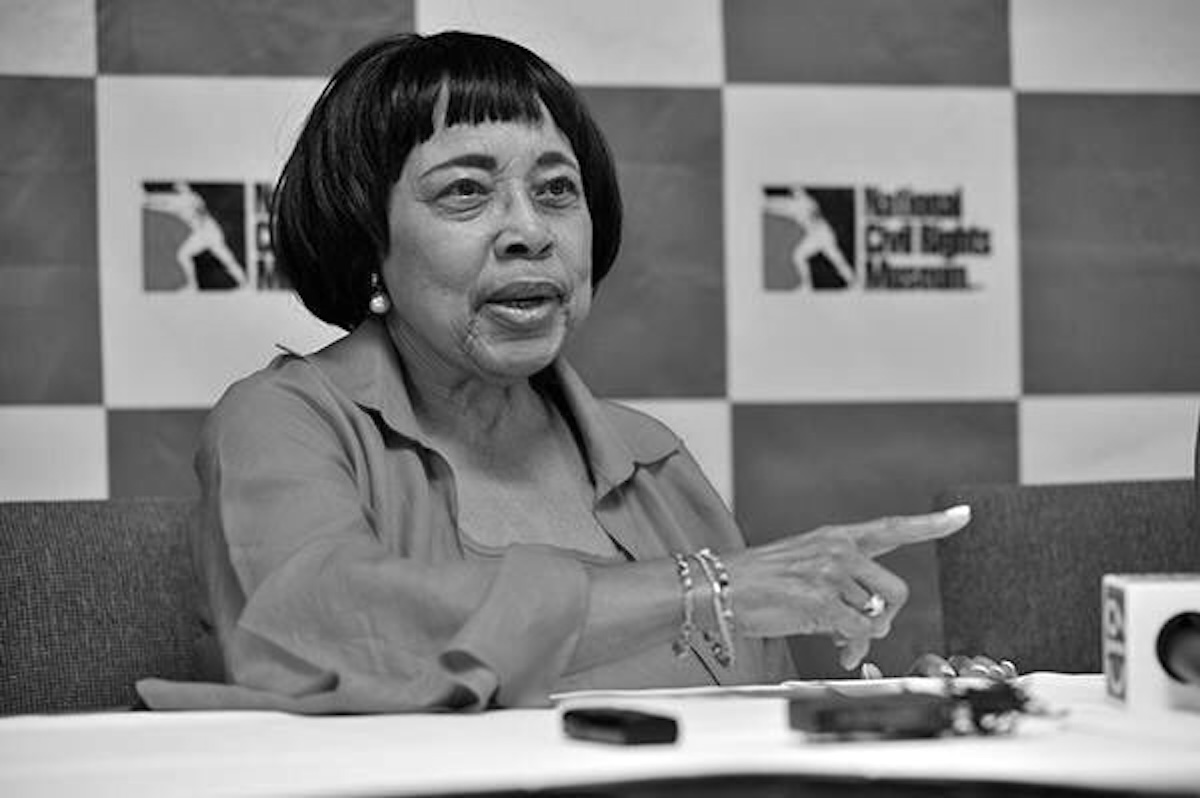
In the early 1990s, she returned more explicitly to civil-rights teaching through seminars and workshops on leadership and social change. By 2008, admirers and colleagues had helped establish the Dorothy Cotton Institute in Ithaca, dedicated to building leaders for human-rights work and adapting Cotton’s methods to new conditions. The institute’s language about citizenship as a verb is not a branding flourish. It is a distilled version of Cotton’s life’s work.
She also wrote her memoir, If Your Back’s Not Bent, published in 2012, to make sure the history of the Citizenship Education Program would not be swallowed by the movement’s celebrity narrative. In her oral history, she said plainly, “we did something other than march.” That may be the single most important Dorothy Cotton sentence for anyone who wants to understand not only her life, but the movement as a whole.
Why Dorothy Cotton feels especially urgent now
There is a temptation, when writing about figures like Cotton, to place them reverently in the past and leave them there. But Cotton’s political imagination is uncomfortably current. She worked in a context where democratic participation was obstructed by administrative trickery, terror, disinformation, uneven access to education, and the routine degradation of Black citizenship. The particulars are different today. The underlying struggle over who counts, who can participate, who is presumed competent for self-government, and how communities build political stamina is not so different.
Cotton understood that a movement cannot rely forever on charismatic peaks. It has to create informed people who can carry the work home. That insight speaks directly to the present era of viral politics, in which visibility often outruns organizational depth. Cotton’s model was slower, sturdier, and more demanding. It required that people learn not only how to oppose power, but how to inhabit their own.
It also helps explain why she remains less famous than she should be. America is often more comfortable with civil rights history when it can be consumed as moral theater. Cotton offers something more exacting. She points us toward the patient, collective, often feminized labor of building democratic competence. That kind of history is less cinematic. It is also closer to how change actually works.
Her own language cuts through the fog. The goal of CEP, as she described it, was to move people from victimhood to victory—not by denial, not by sentiment, but by training. That is an almost brutally practical idea. Do not wait for dignity to be conferred. Learn the system. Stand upright. Organize others. Go home changed, and change your town with you.
The measure of her significance
Dorothy Cotton’s significance lies partly in what she accomplished and partly in what her life reveals. She helped direct one of the movement’s most effective educational programs. She trained thousands. She helped shape campaigns in Birmingham and beyond. She stood within King’s closest circle while also preserving an independent political identity. She remained active long after the period that made the movement iconic in public memory. And she left behind a theory of democratic practice that still feels sharp: citizenship is not passive status; it is learned agency.
But her significance also lies in the historiographic correction she demands. To center Dorothy Cotton is to center the teachers, trainers, and political educators who made mass action sustainable. It is to recognize Black women not as supporting cast but as makers of strategy and structure. It is to understand that civil rights history did not move only through courts, pulpits, and national television. It moved through workshops, church basements, local schools, borrowed facilities, bus rides, kitchen-table conversations, and five-day trainings where ordinary people came in one way and left another.
That may be the most fitting way to remember her. Dorothy Cotton did not simply help people protest. She helped teach them how to become political subjects in a country that had spent generations denying they were fully citizens at all. Once you understand that, her life no longer sits at the margins of movement history. It looks much closer to the center.
More great stories
Afro Sheen, Wall Street, and the Architecture of Black Possibility
July 6, 2026
No Comments
The Fire Inside the Fourth
July 5, 2026
No Comments