





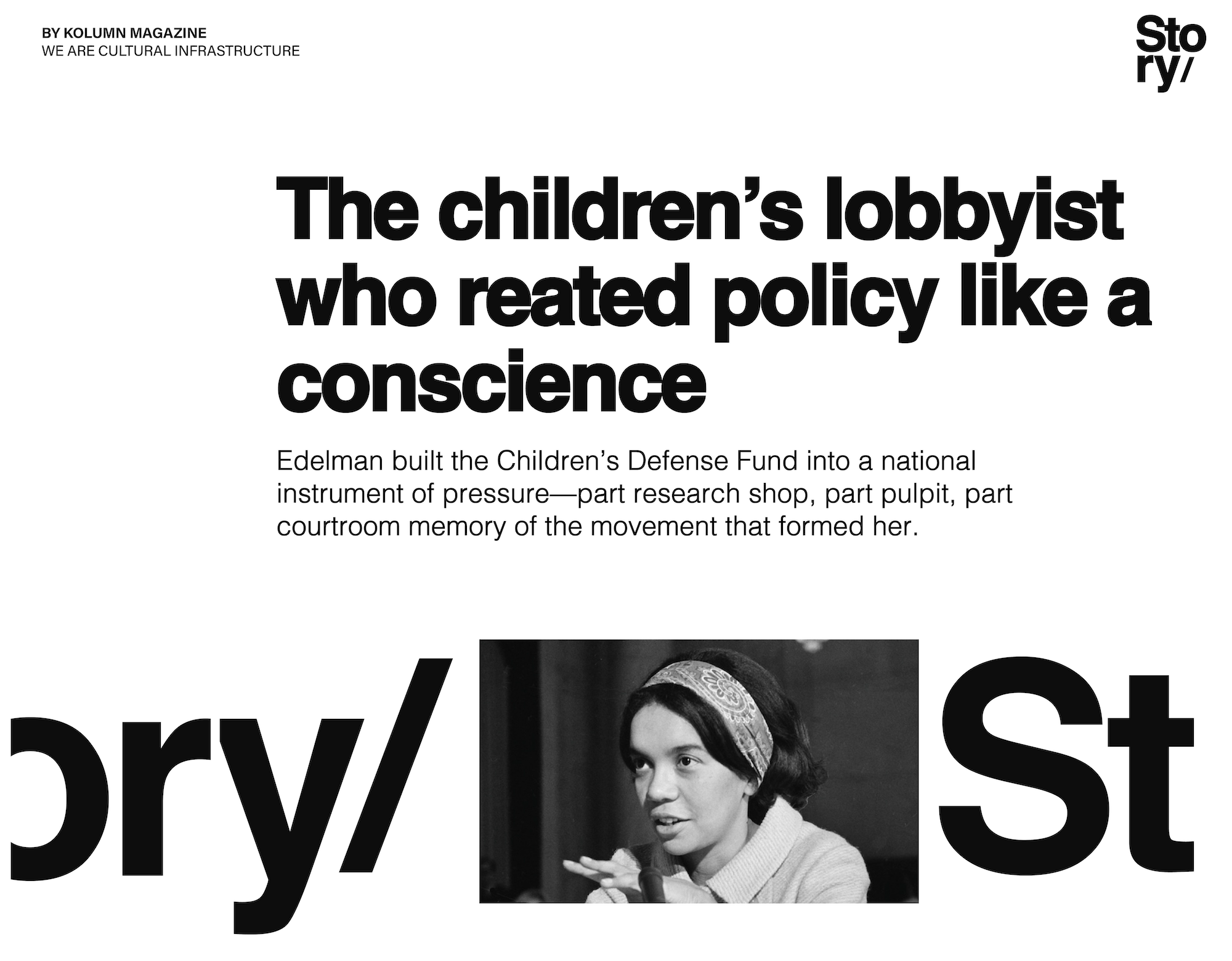
Marian Wright Edelman’s story is a repeated act of coming back to the same unglamorous question: what, exactly, does a nation owe its children?
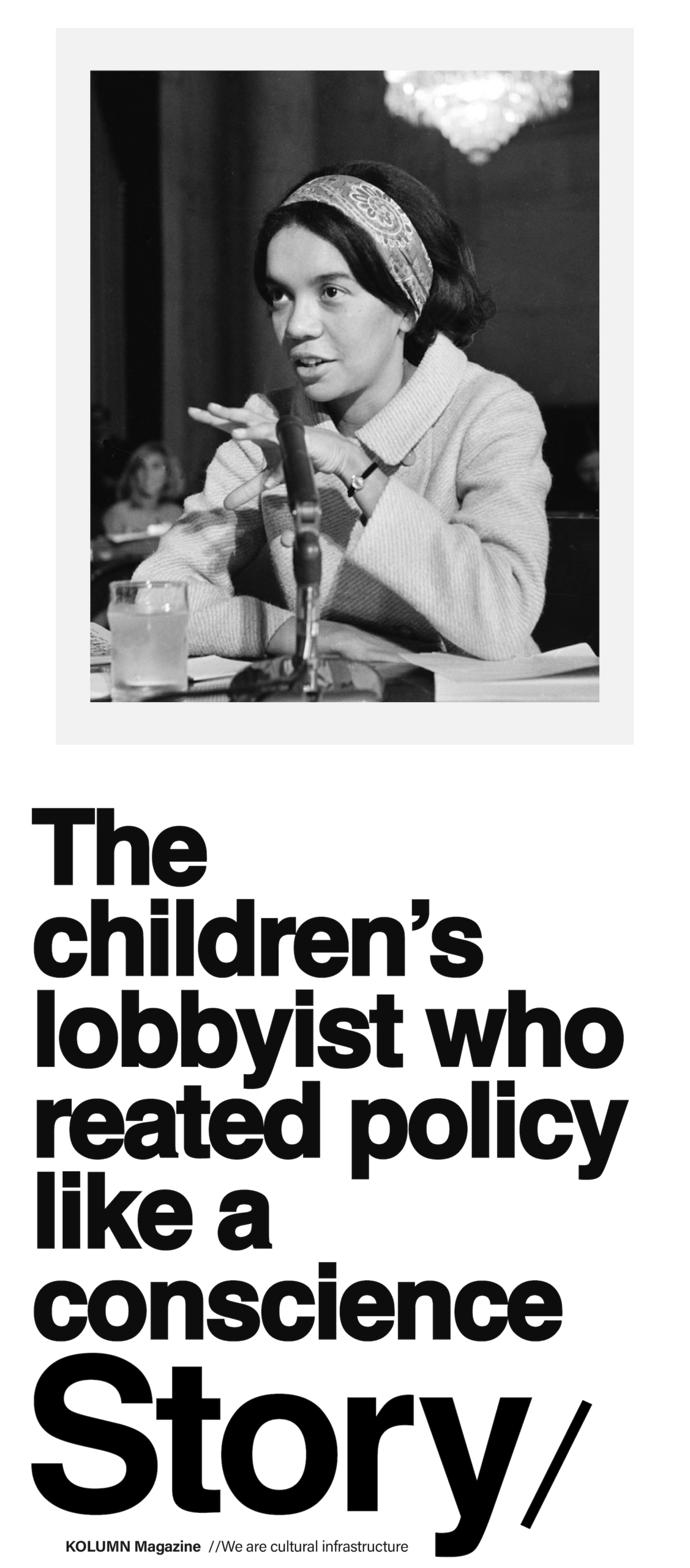
Marian Wright Edelman’s story is a repeated act of coming back to the same unglamorous question: what, exactly, does a nation owe its children?
By KOLUMN Magazine
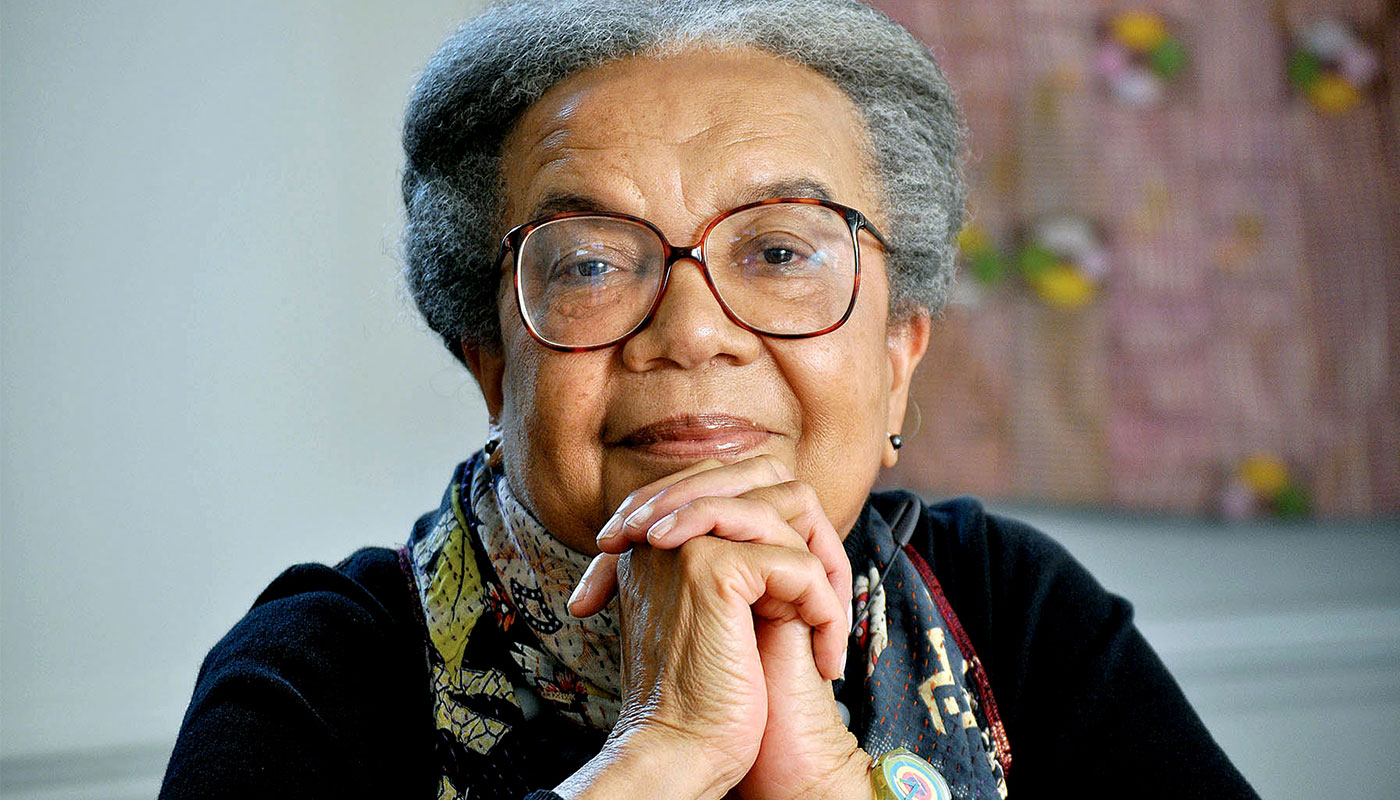
There are public figures whose careers can be plotted like a ladder—degree, job, promotion, title—and then there are the ones whose lives read less like ascent than like return. Marian Wright Edelman’s story is a repeated act of coming back to the same unglamorous question: what, exactly, does a nation owe its children? It is a question she has asked in courtrooms and sanctuaries, in policy memos and commencement speeches, across decades of administrations that have alternately embraced the language of family and starved the programs that keep families intact. It is the question beneath the institution she built—the Children’s Defense Fund—and beneath the moral posture she has practiced so consistently that even her critics concede her power: she does not simply argue. She indicts.
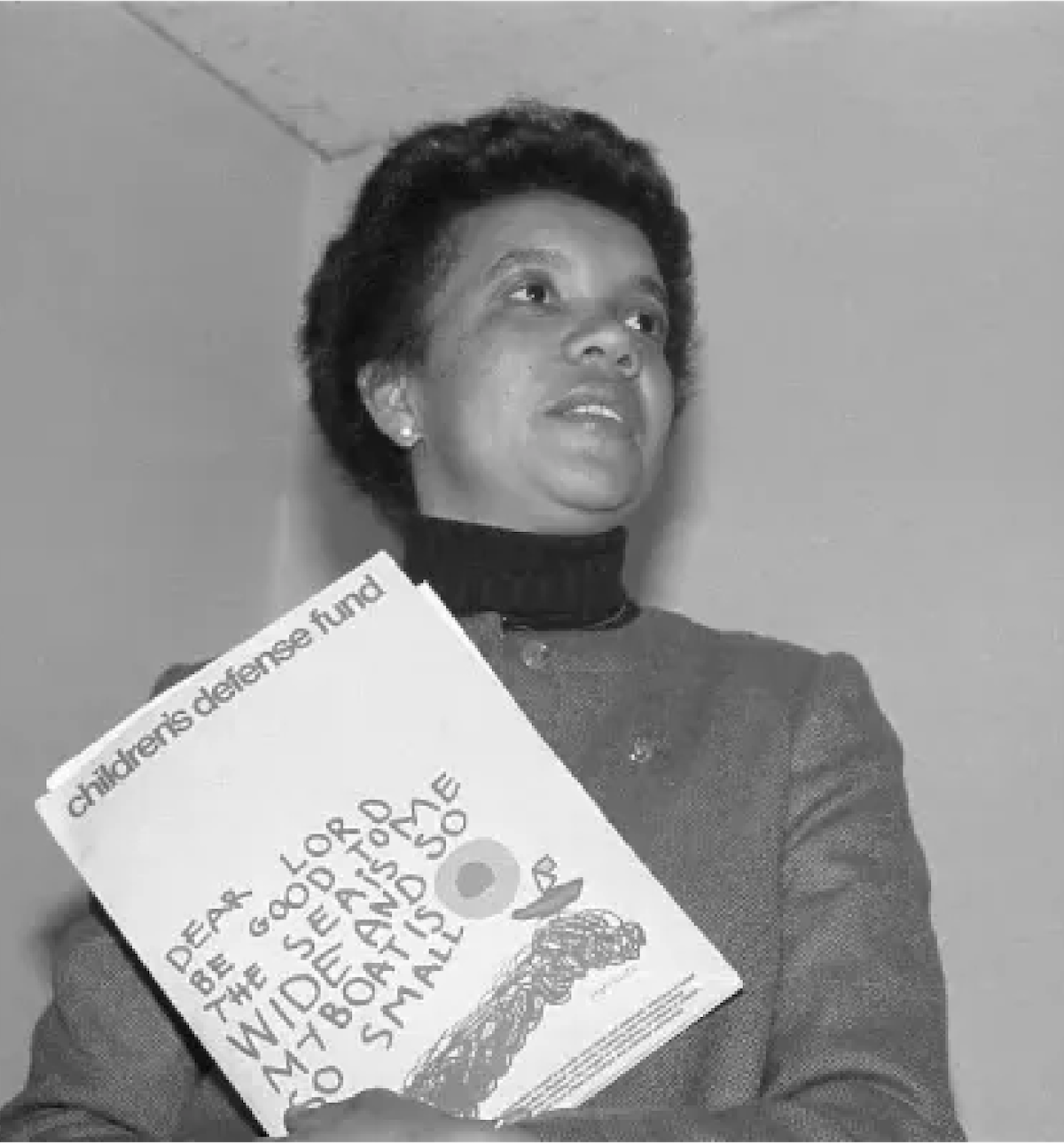
Edelman’s significance is not only that she helped move child welfare, health coverage, education equity, and anti-poverty policy into the center of mainstream debate. It’s also that she fused civil-rights movement sensibilities—discipline, coalition, urgency, a willingness to shame power—with the slow, grinding machinery of Washington advocacy. She carried the movement’s moral clarity into a city that trades in compromise, and she did so by choosing children as her organizing principle: the one constituency almost everyone claims to love, and therefore the one whose abandonment can be exposed as hypocrisy.
To write about Marian Wright Edelman is to write about a kind of American tension that never resolves: a country that mythologizes childhood innocence while permitting childhood deprivation at scale. Edelman has spent her life refusing to let that contradiction sit comfortably. Her work has been called prophetic and pragmatic, idealistic and politically sharp. She is a civil-rights lawyer who became, in effect, a permanent counsel for children—especially poor children, Black and brown children, disabled children, children whose lives are shaped by the policies and market forces they never voted for and can’t out-lobby.
A preacher’s daughter and the making of a moral vocabulary
Marian Wright Edelman was born Marian Wright on June 6, 1939, in Bennettsville, South Carolina, in a world where the meaning of citizenship was racially contingent and the meaning of safety was never guaranteed. Biographies often emphasize the “origin story” neatness: she was raised in the Black church, the daughter of a minister, surrounded by the language of obligation and community. But in Edelman’s case, that framing isn’t mere symbolism; it’s functional. The church—its social networks, its ethic of care, its insistence that faith is demonstrated through action—would become the scaffolding for how she later built organizations and confronted power.
In one Washington Post profile, Edelman describes childhood as shaped by Southern community and the kind of familial infrastructure that segregation-era Black communities, by necessity, assembled for themselves. She talks about the “sense of community” her parents preserved, contrasting it with what she observed among relatives in the North who, in her telling, “lost” some of that cohesion. Embedded in that memory is one of Edelman’s enduring themes: poverty is not only a shortage of money; it is a shortage of protection—of neighbors, institutions, and political will.
Education became her vehicle out, and then her vehicle back in. She attended Spelman College, graduating in 1960, and went on to Yale Law School. Those credentials placed her in a small cohort of Black women in elite legal spaces, a fact that matters not only as personal achievement but as context: she learned early how power is coded—who is presumed competent, who is presumed threatening, who is presumed invisible. Later, when she would popularize the line “You can’t be what you can’t see,” she was naming a structural reality she had already lived: representation is not an aesthetic issue; it is a pipeline of permission.
Mississippi: Law as shield, law as battleground
If Edelman’s Southern upbringing gave her a moral vocabulary, Mississippi gave her her method. In the mid-1960s, she became the first Black woman admitted to the Mississippi Bar—a milestone that, in a different era, might have been treated as a celebratory footnote. In the Mississippi of that moment, it was a decision to walk into the center of confrontation.
She worked with the NAACP Legal Defense and Educational Fund in Mississippi, a legal arm of the movement that understood the courtroom as both instrument and theater. The work placed her amid Freedom Summer–era organizing and the daily violence—overt and bureaucratic—that maintained segregation’s afterlife. It also placed her near a crucial lesson: legal victories mean little if the social infrastructure beneath people’s lives remains broken.
That is one reason Edelman’s early Mississippi work intersected with Head Start and the War on Poverty’s experiments in early childhood intervention. The Child Development Group of Mississippi, launched in 1965 with major federal funding, became one of the largest inaugural Head Start efforts in the country, operating across dozens of counties and serving thousands of children while employing large numbers of working-class people. Edelman’s involvement has been described as both advocacy and oversight—supporting the program’s mission while remaining attentive to how administrative vulnerability could be used by opponents and by federal authorities scrutinizing funds.
This matters because it shows an Edelman trait that later defined the Children’s Defense Fund: she did not treat compassion as incompatible with accountability. She understood that programs serving the poor are often judged by harsher standards than programs serving the middle class, and therefore must be defended on both moral and managerial terms. That dual focus—heart plus rigor—would become part of her credibility in Washington.
A movement lawyer in a capital city
In 1968, Edelman moved to Washington, D.C., as counsel for the Poor People’s Campaign that Martin Luther King Jr. had begun organizing before his assassination. The Poor People’s Campaign is often remembered as unfinished work, a movement moment interrupted. For Edelman, it became a bridge: it carried movement commitments—economic justice, multiracial coalition, attention to the poorest—into the federal policymaking ecosystem.
She helped build the Washington Research Project in 1969, a public interest law effort that monitored federal programs serving low-income families and developed legal strategies to benefit the poor. The name itself is telling. It signals a belief that in modern America, harm can be proved with data, and data can become leverage. Edelman did not abandon the language of justice; she augmented it with documentation.
The Washington Research Project would ultimately evolve into the Children’s Defense Fund, founded in 1973. In the institutional origin story offered by CDF, the organization is described explicitly as growing out of the Civil Rights Movement under Edelman’s leadership. That lineage is not rhetorical flair. It explains CDF’s posture: it is less a conventional nonprofit than a movement office translated into policy terms—built to persist across administrations, to pressure both parties, to act as a watchdog when children’s needs become bargaining chips.
Building the Children’s Defense Fund: A voice that wouldn’t be polite
The central claim of Edelman’s adult life is deceptively simple: children are “the only group” without a vote, without lobbyists of their own, and therefore without reliable protection unless adults choose to become their proxy. That conviction is echoed in profiles that trace how her Mississippi experiences led to the sense that children lacked an organized national voice.
CDF’s mission language—refined over time and widely repeated—captures Edelman’s framework: “leave no child behind” by ensuring a healthy start, head start, fair start, safe start, and moral start, with a successful passage to adulthood supported by families and communities. This isn’t just branding. It is a theory of what childhood requires: the interlocking systems of health care, early education, equitable schooling, safety from violence, and moral formation. Edelman’s genius was to frame these as starts—beginnings—because beginnings are where inequality compounds.
Over decades, CDF became known as a formidable advocate on issues including foster care, adoption, child health coverage, child care, education equity, juvenile justice, and poverty. Edelman’s leadership style—intense, insistent, unafraid of confrontation—was frequently remarked upon by journalists. In a Washington Post piece marking her decades of advocacy, she is described reacting to policy debates with visible anger, treating cuts to supports like food assistance as a kind of moral injury inflicted from the Capitol’s window.
That temperament is part of the Edelman story. Washington is full of “reasonable” people who, over time, become acclimated to unreasonable outcomes. Edelman has spent her life refusing acclimation. She made “shame” an acceptable policy word, not as performance but as tactic: if legislators want credit for loving children, then their votes must match the pose.
Her public influence extended beyond Congress. She shaped generations of advocates and public servants, including prominent political figures who have described her as mentor and lodestar. Even secondhand aggregations of reporting about her transition from leadership note her outsized role in popularizing the “leave no child behind” phrase, a testament to how movement language can migrate into mainstream politics—sometimes detached from its original moral demands.
Honors, recognition, and what respectability can and can’t do
Establishment honors accumulated, as they often do when a person’s moral clarity becomes too famous to ignore. Edelman received the Presidential Medal of Freedom in 2000, the nation’s highest civilian honor. In the Clinton White House statement announcing honorees, she is praised as “a powerful voice to those too often unheard,” and her biography is summarized in the language of civic virtue: first Black woman admitted to the Mississippi bar; founder who championed children’s needs from education to health.
This kind of recognition can flatten a life into a commemorative plaque. For Edelman, the point was never to become palatable. If anything, the Medal of Freedom illustrates a paradox she navigated repeatedly: the very institutions that celebrate her are often implicated in the conditions she condemns. Honors can amplify a message, but they can also domesticate it. Edelman’s career shows a sustained effort to use respectability as a platform without letting it become a cage.
The public intellectual as organizer: Columns, speeches, and a portable conscience
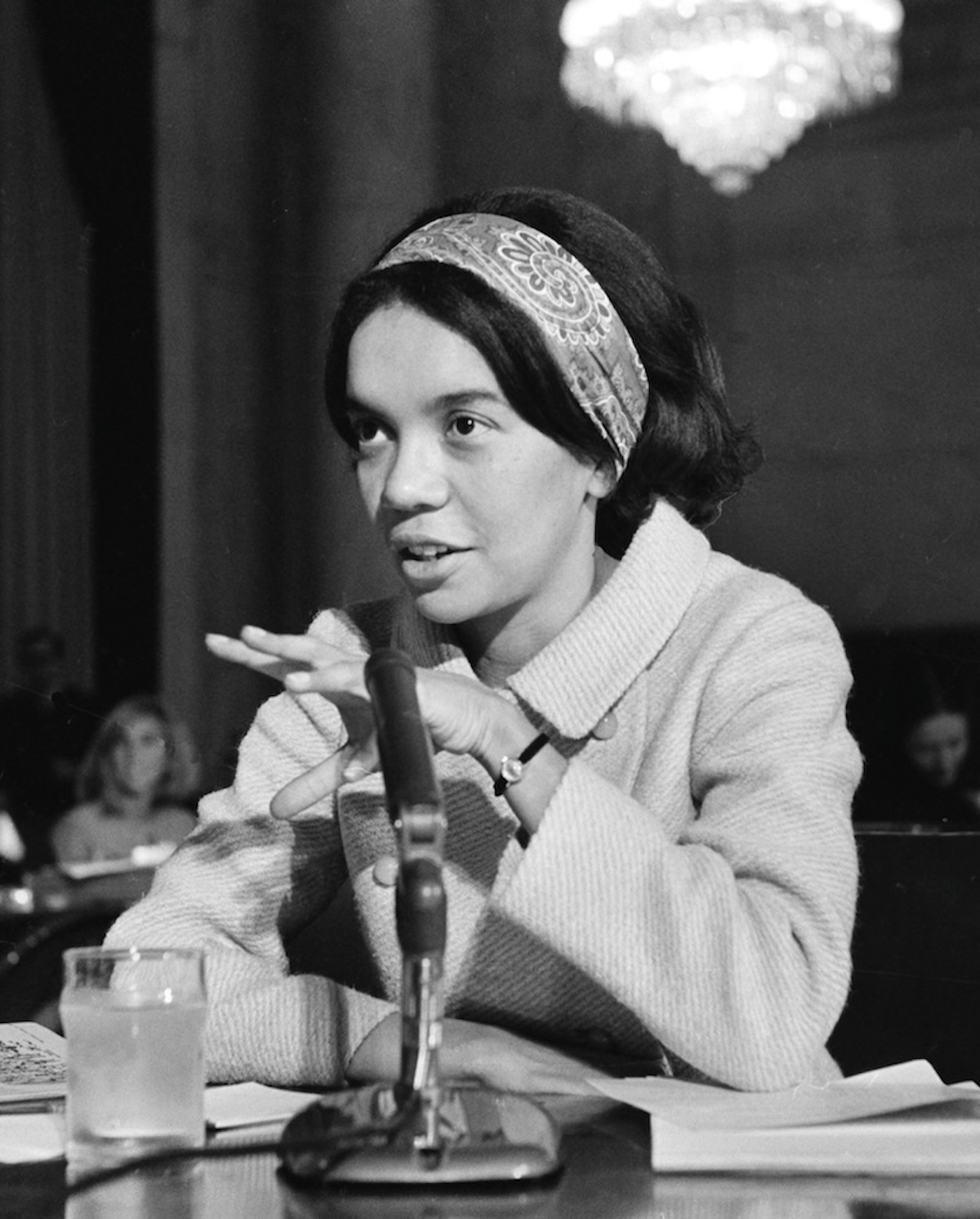
Edelman’s activism was never confined to policy meetings. She wrote and spoke with the cadence of someone trained by the pulpit and sharpened by the courtroom. For decades she authored “Child Watch,” a recurring column that served as a moral ledger of what the country was doing to its children; CDF notes that the column ran for roughly forty years and that the final installment was released in August 2025, creating an archive of her perspective across eras.
Her speeches—like commencement addresses—often function as both encouragement and warning, insisting that private success is insufficient if public injustice remains untouched. A transcript of a 2014 commencement address circulated by Lewis & Clark College captures her voice in that setting: celebratory but urgent, oriented toward service and responsibility rather than individual triumph.
And then there is the way her words travel. “You can’t be what you can’t see” appears as a quotation attributed to her in discussions of representation and opportunity. The line has been repurposed across gender and racial equity debates, a sign of how Edelman’s thought has moved into cultural infrastructure—repeated in classrooms, documentaries, leadership seminars—often by people who may not know its origins in a broader insistence: children require visible pathways to possibility.
Stepping aside without stepping away
When Edelman transitioned from day-to-day leadership of CDF after decades at the helm, the move was framed not as retirement but as transfer—passing the institution to a new generation while keeping her moral presence intact. CDF’s own announcement of her transition to President Emerita describes her continuing commitment to ending child poverty and inequality and reiterates her foundational biography: Spelman and Yale; Mississippi bar first; NAACP Legal Defense Fund leadership in Jackson; counsel to the Poor People’s Campaign.
Coverage in Black-led outlets treated the moment as historic, emphasizing both her longevity and the symbolic meaning of succession. The Root, reporting on her stepping down, described her name as nearly synonymous with social justice for the vulnerable and noted the forty-five years she spent leading the organization she founded.
The timing matters. Edelman’s transition came in an era of sharpened national debates over race, poverty, policing, and the definition of public responsibility. In a period when many institutions were being forced to reckon with legitimacy, her life offered a different model: legitimacy earned through decades of saying the same “inconvenient” thing, regardless of who held power.
Influence on policy: Victories, partial wins, and the grind of incrementalism
It is tempting, when writing about a figure like Edelman, to search for a single legislative triumph that can stand in for her entire career. But her influence looks more like accretion. She and CDF helped keep child poverty, child hunger, education inequity, and health coverage in the public eye, repeatedly pushing for expansions and defending existing protections from cuts. CDF’s advocacy language around children’s health coverage, including debates over CHIP funding, reflects that long-running insistence that child health is not discretionary.
Her advocacy also operated through pressure campaigns and agenda-setting. A CDF letter tied to its “State of America’s Children” reporting calls it a “national disgrace” that children are the poorest Americans and emphasizes the preventable nature of hunger, homelessness, health problems, and violence—framing these not as accidents but as policy outcomes. The significance is less the specific document and more the governing approach: make the harm measurable, then declare the measured harm immoral.
Still, the measurable achievements matter. Over decades, child-focused policy in the United States expanded in important ways—though never enough to satisfy Edelman’s ambitions. The country’s patchwork of child health insurance, nutrition assistance, early education funding, and child welfare reforms did not emerge in a vacuum. They were shaped by an ecosystem of advocacy, research, litigation, and political bargaining in which Edelman’s CDF was a persistent actor.
Edelman’s role can also be seen in how child policy is narrated. She helped push the idea that investment in children is not charity but national self-interest. A 1990 interview archived by the Government Accountability Office describes her argument in terms of federal responsibility to invest in children’s education, employment prospects, and health—and stresses early childhood education as preparation for competitiveness and life outcomes. This is Edelman’s strategic frame: the moral case is primary, but the pragmatic case is useful ammunition.
Critiques and contestations: When moral certainty meets political complexity
No serious account of Edelman can treat her as universally applauded. An advocate who makes policy arguments at scale will accumulate enemies—some ideological, some tactical, some rooted in genuine disagreements about what works.
One recurring area of contestation has been welfare reform and its consequences. Critics of anti-poverty advocates have argued that warnings issued by organizations like CDF about welfare reform’s impact on hunger and hardship were overstated or incorrect, pointing to certain metrics and later trends as rebuttal. These critiques often come from conservative policy institutions and should be understood within their worldview: a tendency to treat caseload reduction as success and to frame welfare dependence as the central harm.
But Edelman’s argument has never been reducible to caseload numbers. Her focus has been on children’s lived conditions and on the moral legitimacy of a society that tolerates large-scale child poverty. Even within academic and progressive analyses of welfare legislation, Edelman’s writings appear in bibliographies and debates as part of a broader critique of how policy can tighten hardship while claiming reform.
Education has also been a site of nuance. Edelman is sometimes assumed to be reflexively skeptical of charter schools or market-based reforms, but the record is more textured. An Education Week commentary discussing a 2011 speech attributed to Edelman frames her as recognizing charters as “an important part of the answer” while still emphasizing accountability and equity. This is a useful corrective to caricature: Edelman’s posture is not simply anti-innovation; it is anti-abandonment. If a policy experiment expands opportunity for children historically shut out, she is willing to engage it. If it becomes a vehicle for excluding or stratifying, she will fight it.
There are also critiques about advocacy style itself—about whether moral condemnation hardens opponents rather than converting them, whether shame is a blunt tool in a polarized era. Edelman’s career suggests her answer: politics is already harsh; what is lacking is not sharpness but accountability. Her approach treats discomfort as a feature, not a bug. She has often argued, in effect, that if children are hungry or uninsured, adults should not feel comfortable.
Marian Wright Edelman in the Black freedom tradition
To place Edelman properly, you have to locate her inside a particular American tradition: Black women’s political labor that sustains movements before, during, and after the headlines. She is sometimes portrayed as a “children’s advocate” in a soft-focus way that can obscure the radical nature of her project. But insisting on children as a site of justice is not soft. It is structural. It means confronting housing, wages, racism, environmental harm, schooling, policing, health care, and the administrative state—because childhood is where all of those forces show up first and with the least defense.
Black outlets and institutions that commemorate her tend to emphasize that structural view. Word In Black, for instance, includes Edelman in a list of Black women educators and civic figures, presenting her as a civil-rights activist who fought to end child poverty by founding CDF. Ebony has published her reflections connected to civil-rights memory—such as the Birmingham church bombing—reinforcing how her children-centered work is inseparable from the history of racial terror and the vulnerability of Black youth.
Her work also resonates globally in the way her phrases and frameworks circulate. When international organizations and cultural commentators quote her—often via “You can’t be what you can’t see”—they are borrowing not just a line but a worldview in which the presence or absence of role models is a policy issue, a design issue, a justice issue.
The Edelman paradox: A radical demand packaged as common sense
Edelman’s most effective rhetorical move has been to make radical demands sound like the obvious baseline. Who could oppose a “healthy start” for children? Who would publicly argue against safe passage to adulthood? Yet in practice, achieving those “starts” requires large public investment, redistribution, and institutional reform—precisely the things American politics treats as optional, suspect, or ideologically dangerous.
This is why Edelman is often described as both feared and revered. A Los Angeles Times profile from 1990 captures her as a “champion” whose indignation is part of her force, describing her as someone who cajoles and argues and pulls sleeves until someone listens. Even sympathetic portraits note that she makes people uncomfortable, because she insists on asking why a wealthy country permits avoidable suffering among children.
She also understood the power of narrative. Data can prove harm; stories make it intolerable. Her career bridged those modes: the policy report and the moral story, the statistic and the child’s name. CDF’s communications often pair policy claims with vivid moral language—disgrace, shame, preventable suffering—echoing the way Edelman speaks.
Legacy in an era of contested childhood
Edelman’s late-career relevance is not ceremonial; it is urgent. The United States continues to argue, sometimes viciously, about what children should learn, what they should be protected from, what kinds of families should be supported, and whether the state has any obligation beyond punitive surveillance of the poor. Edelman’s framework offers a diagnostic: when adults wage culture war over children, ask whether they are also willing to feed them, insure them, house them, and educate them equitably.
Her own recent writing in outlets affiliated with Black press ecosystems has addressed these fights directly, tying assaults on truthful teaching to broader assaults on Black life and democratic possibility. This is consistent with her life’s logic: childhood policy is never only about children. It is about the kind of society children are being trained—or abandoned—to inherit.
Edelman’s institutional legacy is also concrete. CDF remains an operational advocacy organization with offices and programs, a structure built to outlast its founder. That endurance is itself part of her significance. Movements often rely on charisma; institutions rely on design. Edelman helped convert movement energy into organizational permanence.
And yet, her most lasting legacy may be rhetorical: she changed what it is acceptable to say out loud about children in a rich country. She normalized the idea that child poverty is not a natural phenomenon but a policy choice. She treated children as a constituency whose suffering indicts the nation’s moral seriousness. That posture has influenced countless advocates, including those who do not share her politics in full but recognize the force of her central claim.
What Marian Wright Edelman teaches, even to people who disagree with her
Edelman’s critics might dispute her policy preferences, her predictions, or her methods. But her career leaves behind several hard-to-evade lessons.
First, children are a diagnostic tool. If you want to know what a society values, measure what it allows to happen to children who have the least. Edelman spent decades producing those measurements and then daring the country to look away.
Second, moral language is not the enemy of policy—it can be the engine of it. In a political culture that often treats compassion as naïve, Edelman demonstrated that moral urgency can coexist with institutional sophistication, research capacity, and legislative strategy.
Third, longevity is its own form of power. Edelman did not merely win fights; she stayed long enough to fight the next version of the same fight. When she ended her “Child Watch” column after decades, the archive stood as evidence that the country’s debates about children are cyclical—and that vigilance is the only antidote.
Finally, she shows the importance of choosing an organizing principle that cannot be easily dismissed. Children are not a special interest; they are the future electorate, workforce, and civic body. To neglect them is to mortgage everything. Edelman’s genius was to treat that as neither metaphor nor slogan, but as a prosecutable claim.
The measure she refused to change
Marian Wright Edelman is often described through superlatives—trailblazer, conscience, champion—and those are not wrong. She was the first Black woman admitted to the Mississippi Bar, a civil-rights lawyer shaped by the movement’s most demanding years, and the founder of a national institution that turned children’s welfare into a political litmus test. She received the Presidential Medal of Freedom, a recognition that symbolizes mainstream respect even as her work has consistently challenged mainstream comfort.
But the deeper story is not in the firsts or the awards. It’s in the measure she refused to change. In American politics, priorities shift with the news cycle; crises are declared and then forgotten. Edelman kept returning to children—not as abstraction, not as rhetoric, but as the living consequence of every budget, every cut, every expansion, every act of neglect dressed up as realism. She spent a lifetime insisting that the country’s greatness should be judged not by its wealth or its military power but by whether a child born with nothing is given a fair chance to live.
That insistence is her legacy: a kind of moral arithmetic that never stops adding up.
More great stories

Afro Sheen, Wall Street, and the Architecture of Black Possibility
July 6, 2026
No Comments
The Fire Inside the Fourth
July 5, 2026
No Comments