




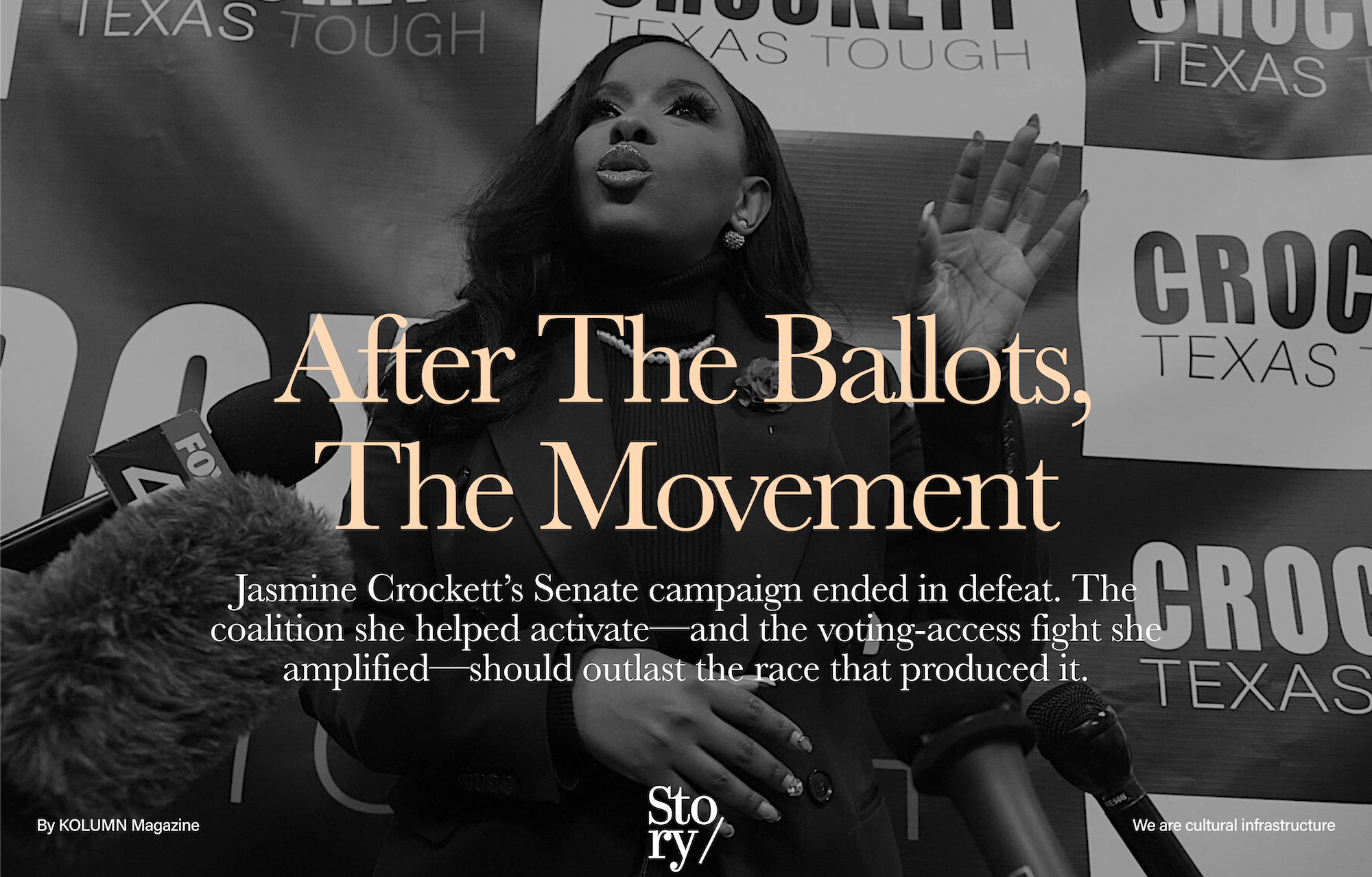
Campaigns are not only tallied in wins and losses. They are also measured in what they clarify.
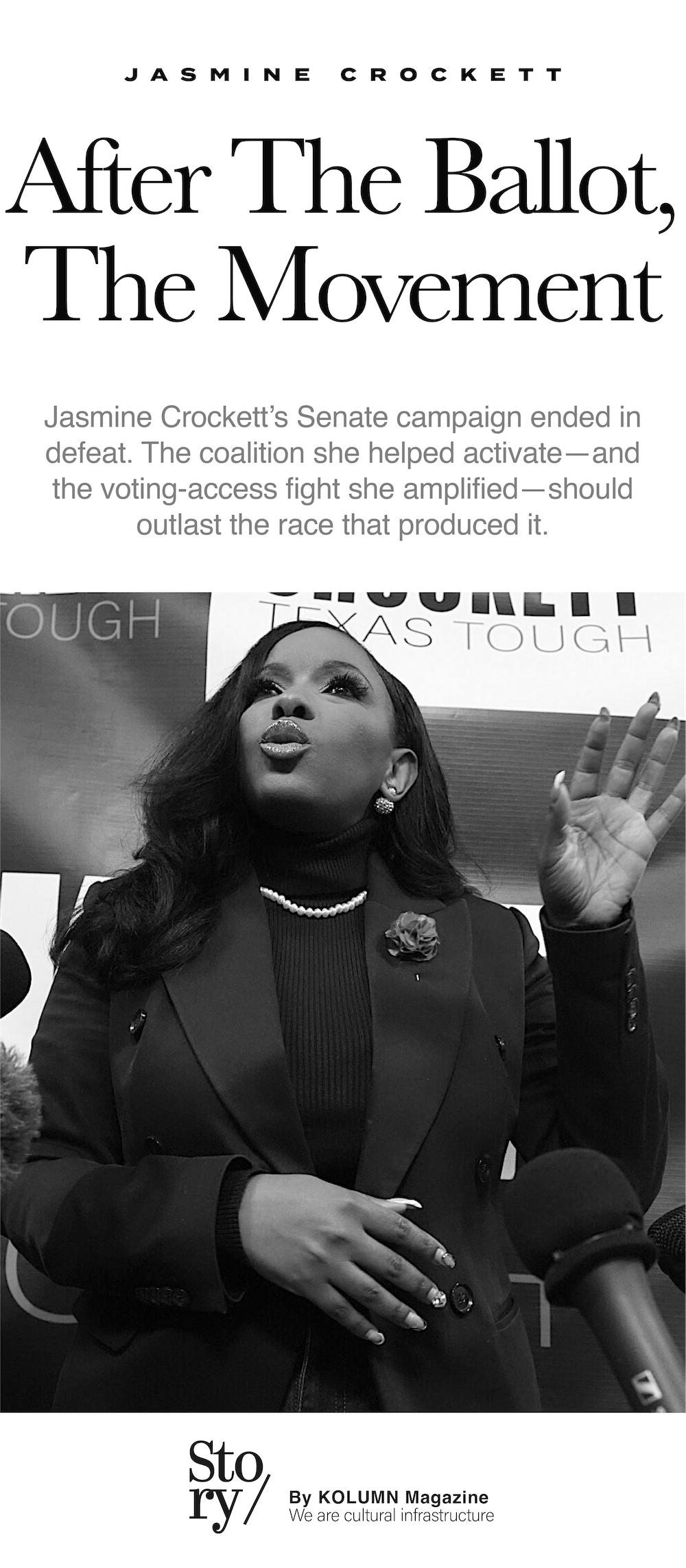
Campaigns are not only tallied in wins and losses. They are also measured in what they clarify.
By KOLUMN Magazine
On the morning after the votes began to settle, the 2026 Texas Senate race already had the feel of a political hinge-point: a contest between two versions of the Democratic future, unfolding against a Republican battlefield that is itself splitting down the middle. For Jasmine Crockett, the outcome was not the one her supporters had spent months willing into existence. The Associated Press called the Democratic nomination for state Rep. James Talarico early Wednesday, after Tuesday’s primary, ending Crockett’s bid to become Texas’ next U.S. senator.
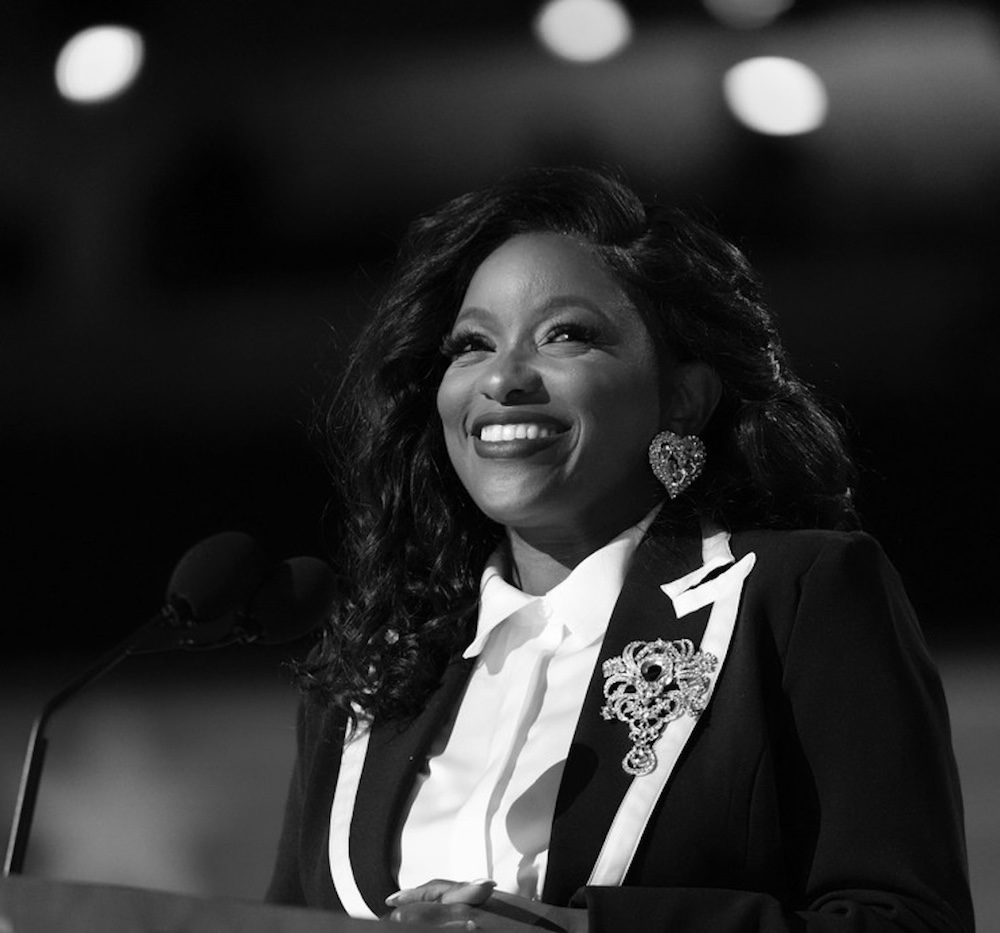
But campaigns are not only tallied in wins and losses. They are also measured in what they clarify. Crockett’s Senate run—audacious, nationally watched, and rooted in a life of courtroom combat and legislative agitation—made the argument that Texas Democrats do not have to apologize for wanting power, and that “electability” is too often a euphemism for shrinking. Even in defeat, she exits the race with something more durable than a single result: a reinforced identity as an advocate for equity and equality, and a broader platform from which to keep testing what political courage can look like in a state built to punish it.
A race shaped by two kinds of chaos
To understand what happened to Crockett, you have to hold two realities at once. One is the straightforward political math of a primary: a clash of styles, coalitions, and turnout, in which Talarico’s message—often framed as bridge-building and a “politics of love”—found enough purchase to clear the line first. The other reality is the more structural one: a voting day in which administrative decisions and last-minute legal fights sowed confusion in precisely the kinds of counties where Democratic margins matter, and where Crockett’s base is concentrated.
In Dallas and Williamson Counties, a shift away from countywide vote centers to precinct-based voting created widespread confusion, long lines, and voters showing up to the wrong places—disruption severe enough that Democrats sought extended hours, a judge intervened, and the Texas Supreme Court later ordered late ballots separated without clear public certainty, in the moment, about whether they would count. Crockett, never one to narrate politics as a calm administrative exercise, described the scene in the language she has always used when the stakes are civil rights: disenfranchisement.
This is the paradox that has followed her through every stage of her career. She is at once a skilled veteran of the institution—educated within it, elected by it, sworn into it—and a prosecutor of its failures, including the failures that hide behind procedure. That is why her Senate campaign, even before the votes, often felt like a referendum on what kind of advocate Texas Democrats want at the federal level: the diplomat who persuades, or the litigator who indicts.
Crockett as an equity advocate before she was a viral politician
Crockett’s public persona is frequently introduced through clips: a sharp exchange in a hearing, a line that trends, a confrontation with the theatrical rhetoric of the modern House. Yet the more instructive origin story is less cinematic and more procedural. She has insisted—consistently—that her politics were shaped not by ideological fashion but by proximity to systems that grind people down, and by the legal training that teaches you to name what you see.
Her official biography emphasizes the sequence she repeats like a moral credential: public defender, civil rights attorney, state representative, member of Congress—each rung a different vantage point on who the law is built to protect. She served as a public defender in Bowie County, then moved into work that included civil rights and criminal defense, later representing protesters and taking on cases tied to the fraught relationship between policing and public life in Texas’ cities. The specific details matter less than the pattern: she repeatedly chose roles in which the client is rarely the powerful one.
That pattern carried into her legislative life. She rose from the Texas House to Congress in a majority-minority district anchored in Dallas. In Washington, she framed her work on criminal justice as a continuous pursuit—justice not as a bill that passes once, but as a condition that must be rebuilt. Whether one agrees with her tactics, there is little ambiguity about the mission: the civil liberties of underrepresented communities, and the insistence that government can be forced—by organizing, by law, by noise—to treat equality as a practice rather than a slogan.
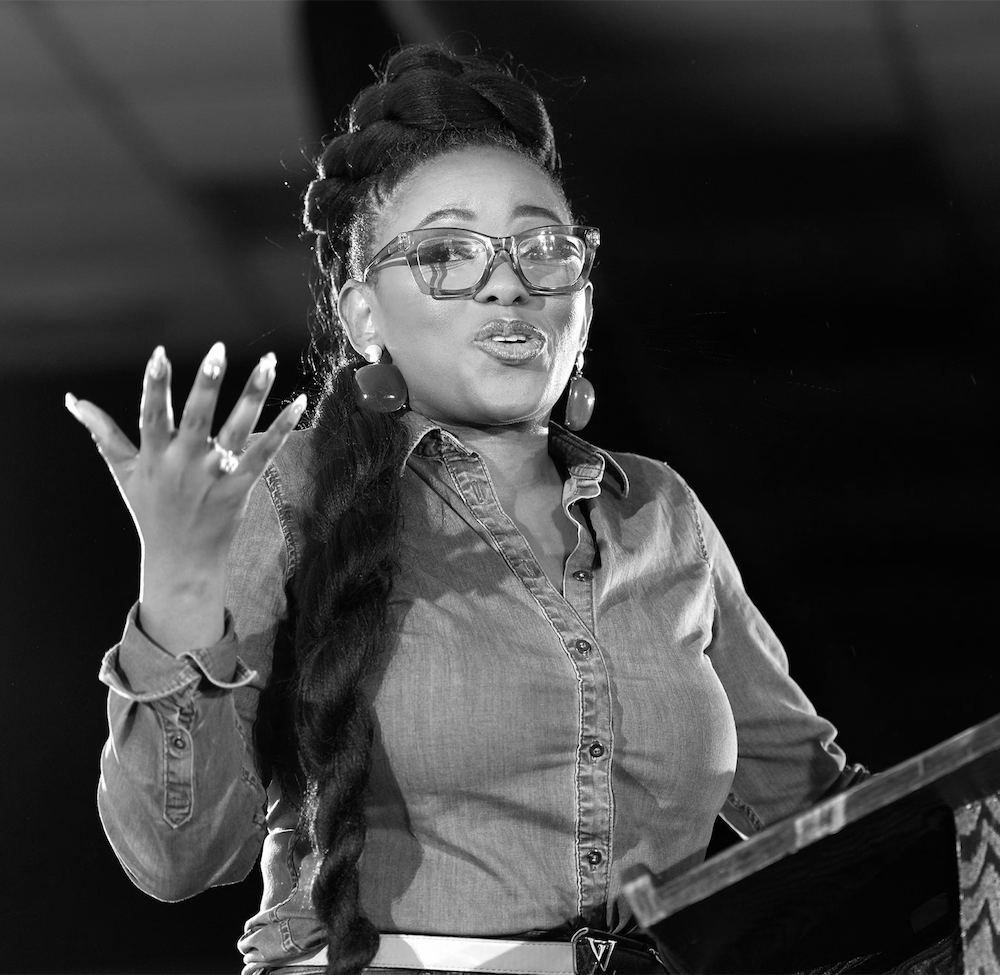
Why her style mattered so much in this primary
If Talarico represented an argument about persuasion—particularly persuading Texans who do not already vote Democratic—Crockett represented an argument about power: that the base is not an obstacle to be managed but the engine to be ignited. Their policy differences were often less dramatic than their theories of politics. The contest became, as the Texas Tribune framed it, a blockbuster primary watched as a signal of what Texas Democrats believe will finally work statewide.
Crockett’s supports argued that Texas has spent decades trying to win by sanding itself down, offering moderation as a substitute for mobilization. Her bet was that clarity—about reproductive rights, voting access, racial inequity, and the damage of MAGA governance—could be a turnout strategy, not just a moral stance. That view was echoed in Black press coverage that treated her candidacy as both a test of her personal ambition and a test of whether Texas’ electorate is being misunderstood by national consultants who keep expecting the same kind of Democrat to succeed.
Even the endorsements underscored the stakes. Former Vice President Kamala Harris backed Crockett ahead of the primary, lending establishment validation to a candidate whose brand is often insurgent. The combination was revealing: Crockett had become important enough that she could no longer be treated as merely a vocal member of the House; she was now a measurement—of the party’s appetite for confrontation, of its willingness to elevate a Black woman with a sharp tongue, and of its tolerance for a politics that refuses to perform deference.
The outcome, plainly stated—and what it does and does not mean
The headline fact is that Crockett lost the Democratic nomination to Talarico, as the AP call moved the race from “still counting” to “decided.” In a different political era, that might be the end of the story. In this one, it is more like a plot twist that opens a second act.
First, her loss does not erase what the campaign revealed about her reach. Crockett is not simply well-known in Dallas; she has built a national profile, with supporters who see her as a modern civil-rights advocate inside Congress—part legislator, part tribune. Publications that have profiled her have described a politician testing a more combative Democratic style in response to a Republican Party that has normalized political cruelty as entertainment. That profile cuts both ways, and Crockett’s critics—including some who worry about message discipline—have always argued that her approach risks alienating persuadables. But the fact that the argument exists at this volume is itself evidence of her stature: she is now an axis around which strategic debates spin.
Second, her loss does not end her influence on the broader 2026 Senate picture. On the Republican side, Sen. John Cornyn and Texas Attorney General Ken Paxton advanced to a runoff, a brutal internal contest that national Republicans fear could weaken the eventual nominee. Democratic hopes of competitiveness in November were always tied to Republican turbulence; that is still the case now. Crockett’s campaign helped turn the Democratic primary into a spectacle that pulled attention—and money—toward the state. Even in defeat, that infrastructure and attention do not simply vanish; they get redistributed.
Third, and most importantly for Crockett herself, her loss does not require a retreat from the throughline that got her here. If anything, it sharpens it. The voting confusion in Dallas and Williamson Counties gave her a stage to do what she has always done: treat access to the ballot as a civil-rights question, not a bureaucratic inconvenience. For a politician whose identity was forged in courtrooms, that instinct is not cosmetic—it is elemental.
The political future that remains open to her
A primary defeat can shrink a politician, forcing them into a quieter, safer version of themselves. Or it can clarify where their actual power lies. Crockett’s power has never been solely derived from holding the “next” office. It has come from combining legal fluency with moral insistence—an ability to move between the language of statutes and the language of injury, between the procedural and the personal. Her House work on criminal justice, framed explicitly as the ongoing pursuit of solutions that “uplift all,” is an extension of that worldview.
That is why a positive outlook for her political career is not wish-casting; it is a realistic assessment of how contemporary political influence works. Some politicians climb. Others accumulate leverage. Crockett has already demonstrated she can do the latter, by becoming a reliable national messenger for Democrats who want their party to stop acting like it is permanently on probation.
The more immediate question is not whether she “goes away.” It is how she metabolizes the loss into the next phase of advocacy. In Texas, where voting rules and election administration are themselves political battlegrounds, she is positioned to remain a central voice on voting access—especially after a primary day defined by confusion that disproportionately affected large, heavily Democratic counties. In Washington, she remains a member of Congress with a clear brand and a record that aligns with the coalition most likely to shape the party’s future: younger voters, Black voters, and progressives who want their representation to sound like urgency rather than focus-grouped moderation.
There is also a less discussed dimension of “future” that matters for a magazine story: Crockett’s career is a case study in how equity politics is narrated. When she speaks with bluntness, critics often code it as incivility; when others do the same, it can be praised as authenticity. That double standard is not new in American politics. But Crockett’s willingness to keep talking anyway—rather than reshaping herself into something more palatable—has become part of her equity argument. Equality is not simply policy; it is also who is permitted to be forceful in public life.
A Texas story that is also a national one
Texas is frequently treated as an immutable red fact. Every cycle, Democrats are told they are “one more election away.” What Crockett’s run exposed is that the fight is not only about ideology. It is about infrastructure, rules, turnout mechanics, and whether the electorate is allowed to vote without being forced through an obstacle course.
That is why the Dallas and Williamson County disruptions were not a side plot; they were an illustration of how a modern election can be shaped by administrative choices that appear neutral until you trace their impact. Crockett’s insistence on naming those impacts is precisely what connects her Senate bid back to her earlier career: she approaches politics like someone trained to recognize how systems create unequal outcomes while claiming to follow the same rules for everyone.
Her defeat, in that sense, is not a negation of the campaign’s purpose. It is a reminder of what advocacy looks like when it runs headlong into the reality of power in Texas: complicated, contested, and often decided by margins that are shaped long before Election Day.
More great stories

Afro Sheen, Wall Street, and the Architecture of Black Possibility
July 6, 2026
No Comments
The Fire Inside the Fourth
July 5, 2026
No Comments