




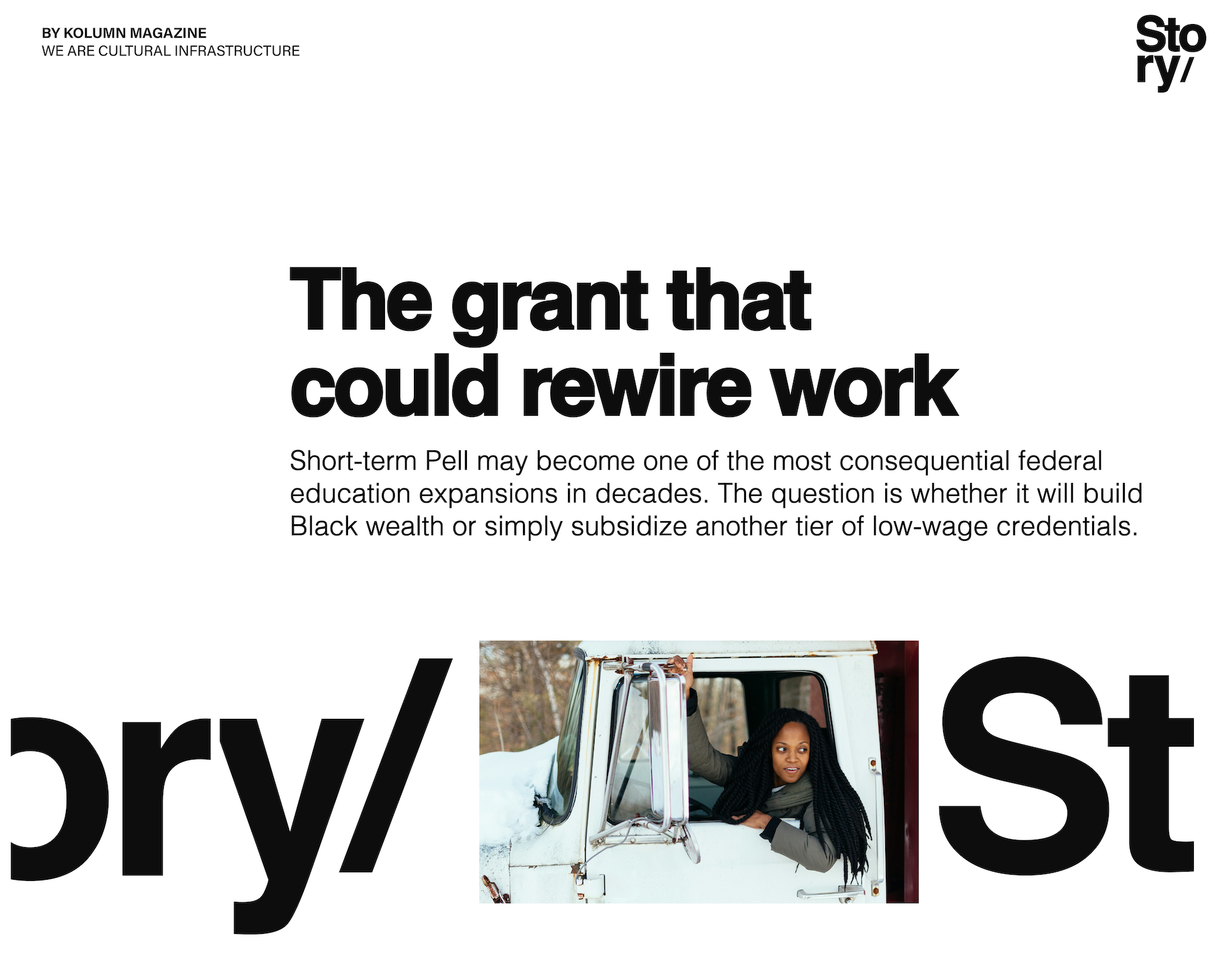
Workforce Pell is not merely an education policy. It is a labor-market test of whether public money can move Black workers toward power, not just placement.

Workforce Pell is not merely an education policy. It is a labor-market test of whether public money can move Black workers toward power, not just placement.
By KOLUMN Magazine
The most important sentence in federal higher education policy this year may not sound revolutionary at all. Beginning July 1, 2026, students will be able to use Pell Grants for certain short-term workforce programs, a shift the U.S. Department of Education described in its final rule creating the Workforce Pell Grant program. In bureaucratic language, it is an eligibility expansion. In real life, it is a door opening where one had long been closed: federal need-based aid reaching programs measured not in semesters and degrees, but in weeks, clock hours, industry credentials and the urgent arithmetic of getting to work.
For Black America, the stakes are larger than a new financial-aid category. Workforce Pell arrives at the intersection of several old American arguments: who deserves public investment, which forms of education count as respectable, whether training leads to power or merely compliance, and why Black workers have so often been invited into the economy only after the best rooms were already reserved. If designed well, the program could help Black adults, parents, displaced workers, veterans, justice-impacted learners and recent high school graduates enter high-demand fields without taking on new debt. If designed poorly, it could become a federally financed sorting machine, steering low-income Black students toward short credentials with thin wages while wealthier students continue to inherit the long runway of degree-based mobility.
That tension is the story. Workforce Pell is not just about HVAC, welding, logistics, cybersecurity, commercial driving, allied health or advanced manufacturing. It is about whether America can finally treat skill as a public good without recreating the racial hierarchy that has always shaped work.
The Pell Grant has always carried moral weight beyond its dollar value. Created in the 1970s and named for Senator Claiborne Pell, the grant became the federal government’s clearest statement that college access should not depend entirely on family wealth. But the traditional Pell architecture favored longer programs, leaving many short-term training pathways outside the main stream of federal aid. That exclusion mattered because Black students are disproportionately likely to need grant support. NCES data show that the share of students receiving Pell Grants has been especially high among Black undergraduates, with 72 percent of Black students receiving Pell Grants in the cited federal indicator. KOLUMN has previously examined that dependency in “Scholarships Under Fire,” noting that Black undergraduates rely heavily on Pell and grant aid because private wealth, family savings and institutional scholarship access remain unevenly distributed.
Workforce Pell expands the conversation from college access to career access. Under the new framework, qualifying programs must be short, job-focused and tied to high-skill, high-wage or in-demand employment. The American Institutes for Research summarized the coming change by noting that Workforce Pell will support programs running roughly eight to 15 weeks, including pathways in fields such as health care, information technology, skilled trades, transportation and early childhood education. The Urban Institute has described the eligible range as programs with 150 to 600 clock hours, a crucial adjustment for learners who cannot step away from income, caregiving or unstable schedules for a year or two.
That flexibility is the program’s most obvious promise. It is also where the danger begins.
The Long Shadow of Vocational Tracking
To understand why Workforce Pell matters in Black communities, it is necessary to remember the history of vocational education in America. The word “vocational” has often been sold as practical, democratic and efficient. But for Black students, it has also carried the odor of containment. Across much of the twentieth century, “practical education” was frequently used to justify racial limits: Black children were trained for labor markets that white policymakers considered appropriate for them, not for the full range of citizenship, leadership and ownership.
This history is older than modern financial aid. After Reconstruction, Black education became a battlefield over the meaning of freedom. Some Black educators and institutions emphasized industrial education as a survival strategy in a hostile economy; others insisted that liberal education, political education and professional training were essential to self-government. The famous debates around Booker T. Washington and W.E.B. Du Bois were never simply about curriculum. They were about power. Who would define Black aspiration? Who would decide whether Black students were being prepared for work, for citizenship or for command?
The answer was often imposed from outside. Southern school systems underfunded Black schools, limited academic offerings and treated vocational training as a tool for preserving the racial labor order. Even after Brown v. Board of Education, tracking systems inside ostensibly integrated schools often reproduced segregation by another name. Black students were pushed toward “hands-on” pathways while white students were more likely to be placed in college-preparatory courses. The problem was not trade education itself. The problem was coercion masquerading as guidance.
That history should make policymakers humble. A short-term credential can be a ladder. It can also be a ceiling. The difference lies in whether the credential is connected to wages, advancement, worker protections, employer accountability and continued education. The difference lies in whether Black students are offered real choice or merely cheaper choices.
KOLUMN’s recent labor-history work, including “The Men Who Carried A Movement,” traced how Pullman porters turned work that had been structured by racial subordination into a foundation for organizing, dignity and democratic power through the Brotherhood of Sleeping Car Porters and the long Black labor freedom struggle. That history matters here because job access alone has never been enough. Black workers have always needed the right to organize, the right to advance, the right to earn family-sustaining wages and the right to refuse economic arrangements dressed up as opportunity.
Why This Expansion Could Matter
Workforce Pell could be transformative because time and money are among the biggest barriers facing Black learners. A four-year degree can still be a powerful vehicle for economic mobility, but not every learner can pause life long enough to pursue one. Many Black adults are already working. Many are supporting families. Many are navigating unstable housing, transportation gaps, child care needs, health challenges, debt or prior educational interruptions. A program that can be completed in eight to 15 weeks, if genuinely high quality, can meet people where they are without pretending that poverty is a scheduling inconvenience.
The labor market also demands more than the old bachelor’s-or-bust framework can provide. Georgetown University’s Center on Education and the Workforce has identified 107 high-paying middle-skills jobs concentrated in fields such as blue-collar occupations, health care, protective services, STEM and management. These are not marginal jobs. They are the infrastructure of daily life: the people who wire buildings, maintain equipment, move goods, secure networks, care for patients and keep cities functioning. Yet the United States has struggled to align training supply with labor-market demand, and many communities with high unemployment remain disconnected from occupations facing shortages.
The Black unemployment rate has long moved with a cruel multiplier effect, rising faster in downturns and remaining higher even in recoveries. The problem is not a deficit of ambition. It is a structure of hiring discrimination, occupational segregation, uneven school funding, limited networks, transportation barriers and credential gatekeeping. Workforce Pell cannot solve all of that. But it can reduce one barrier: the cost of acquiring a recognized credential for a job that is actually hiring.
The best-case version is easy to imagine. A Black mother working a low-wage service job uses Workforce Pell to complete a certified nursing assistant, phlebotomy, medical coding, electrical, advanced manufacturing or IT support program at a trusted community college. The program has employer partnerships, transparent job-placement data, wraparound advising and credits that stack into an associate degree. She graduates without new debt, enters a job with benefits and later returns for additional credentials. Her son watches not just a career change, but a household trajectory shift.
There are thousands of variations of that story. A laid-off warehouse worker moves into commercial driving or logistics management. A veteran converts technical experience into cybersecurity certification. A returning citizen completes a state-approved credential tied to a union apprenticeship. A young adult who was never well served by traditional school discovers mastery in the trades. A Black rural learner gains access to a health-care role that stabilizes both family income and a local clinic. These are not fantasies. They are the practical shape of economic mobility when public aid meets real labor demand.
The Guardrails Will Decide the Outcome
The most serious supporters of Workforce Pell also understand the risk. Short-term programs have a mixed record. Some produce strong employment outcomes. Others overpromise, underdeliver and leave students with credentials that employers barely recognize. The for-profit training sector has a long history of targeting low-income students and students of color with aggressive marketing, inflated job-placement claims and weak labor-market returns. Expanding Pell into short-term programs without strong oversight would be an invitation to repeat old abuses with new money.
That is why accountability must sit at the center of the program. The Institute for College Access & Success has warned that states should act now to strengthen protections, arguing in its Workforce Pell model legislation that schools should not be allowed to use the promise of Pell to enroll students in programs that expose them to predatory financing or poor outcomes. The Urban Institute has found that many existing short-term vocational programs would not pass proposed economic-value tests, with public institutions far more likely than for-profit institutions to meet standards in one analysis of short-term Pell eligibility. That finding should be a warning flare: the program’s equity value depends on preventing low-quality providers from turning Black financial need into institutional revenue.
The federal framework attempts to address this by tying eligibility to program quality, state approval, earnings outcomes and labor-market demand. But rules on paper are not the same as enforcement in practice. States will have enormous influence over which programs qualify, which sectors are prioritized and how outcomes are measured. That means Black communities cannot afford to treat Workforce Pell as a distant federal matter. This is local policy. It will be shaped by state workforce boards, community colleges, accreditors, employers, governors, legislators and the quiet machinery of program approval.
Accountability must include disaggregated data. If Black learners enroll in Workforce Pell programs at high rates but are clustered into lower-wage occupations, the program will reproduce occupational segregation. If Black women are steered into low-paid care work while white men enter higher-paid construction, energy, technology and advanced manufacturing roles, the policy will have failed its equity test. If completion rates are reported without job-placement quality, wages, benefits or advancement, the public will know only that students finished something, not whether that something changed their lives.
The Joint Center for Political and Economic Studies has been especially clear on this point. In its work on Black workers and the public workforce system, the Joint Center has warned that workforce programs can reinforce occupational segregation when Black participants complete training but are channeled into lower-wage fields. Its principles for non-degree credentials emphasize that pathways for Black learners must be connected to good jobs, worker voice, transparency and accountability. That is the ethical frame Workforce Pell needs.
What “High Demand” Must Not Hide
“High demand” is a seductive phrase. It suggests urgency, opportunity and economic rationality. But high demand does not automatically mean high quality. Many low-wage jobs are in high demand because turnover is high, pay is low and working conditions are poor. A labor shortage can be a sign of opportunity. It can also be a sign that workers are refusing bad jobs.
For Black communities, this distinction is essential. Workforce Pell should not become a public subsidy for employers unwilling to raise wages or improve working conditions. If a credential leads to a job that pays too little to support housing, child care, transportation and health care, the policy has not produced mobility. It has merely moved a worker from one form of precarity to another. The program must privilege occupations with wage growth, benefits, advancement and bargaining power.
This is particularly important in health care and early childhood education, two sectors often described as high demand and socially essential. Black women are heavily represented in care work, yet many care occupations remain underpaid precisely because the labor has been racialized and feminized. Funding short-term credentials in these fields can be valuable, but only if the pathway leads beyond the lowest rungs. Certified nursing assistant programs, for example, should connect to licensed practical nursing, registered nursing, health administration or specialized allied-health roles. Early childhood credentials should connect to wage supplements, career ladders and public investment in the care economy. Otherwise, Workforce Pell may train Black women for jobs that America praises as essential while paying them as expendable.
The same principle applies to skilled trades. Construction, energy and infrastructure jobs can offer strong wages, but Black workers have historically faced exclusion from apprenticeship pipelines, job sites, supervisory roles and union networks. The Department of Labor’s apprenticeship system has made inclusion a stated goal, but access remains uneven. Workforce Pell should be coordinated with registered apprenticeships, pre-apprenticeships, community-based organizations and civil-rights enforcement so that Black learners are not merely trained for trades, but admitted into the networks where trades become careers.
Community Colleges, HBCUs and the Institutions We Trust
The institutions delivering Workforce Pell will matter as much as the eligibility rules. Community colleges are likely to play a central role because they already operate many short-term workforce programs and serve large numbers of low-income, adult and first-generation students. At their best, community colleges are democratic infrastructure: local, affordable, flexible, connected to employers and capable of serving students whose lives do not fit the residential college myth.
Historically Black colleges and universities also deserve attention in this conversation, even though many Workforce Pell programs may sit outside traditional bachelor’s-degree structures. HBCUs have long understood education as both formation and survival. They know how to serve students who have been underestimated. They know the cultural cost of institutions that treat Black learners as data points rather than full human beings. As federal and state leaders build short-term workforce pathways, HBCUs should be included as training providers, partners, advisors and regional workforce anchors, particularly in health care, technology, education, public administration and applied sciences.
But trust cannot be assumed. Even public institutions must prove outcomes. Programs should publish completion rates, licensure pass rates, job-placement rates, median wages, debt levels, employer partners and whether credits transfer into longer credentials. Learners should know whether a certificate is a terminal credential or the first rung of a ladder. They should know whether employers actually hire from the program. They should know whether graduates earn more than they did before.
Transparency is not a technocratic concern. It is a civil-rights concern. Black families have paid too much for institutions that promised mobility and delivered debt.
The Debt Question
One of Workforce Pell’s strongest arguments is that grants can prevent debt. This matters deeply in Black America, where student debt has become one of the defining burdens of the postsecondary era. Traditional college access expanded, but the racial wealth gap meant that Black students often had to borrow more, receive less family support and face more difficulty repaying. A federal grant for short-term training could help learners avoid private loans, credit-card debt or income-share agreements that turn ambition into long-term obligation.
But debt avoidance only matters if the credential has value. A free or low-cost program that leads nowhere still costs time, wages, transportation, child care and hope. For low-income students, time is not an abstract resource. Eight weeks spent in a weak program can mean missed work hours, unstable rent, delayed bills and family stress. The policy must therefore measure opportunity cost, not just tuition cost.
This is where the new program’s design should be judged against a simple standard: Does it leave Black learners better off within a measurable period of time? Better off means employed in the field of training, earning higher wages, holding a portable credential, positioned for advancement and not burdened by new debt. Anything less is not mobility. It is motion.
The Politics of Dignity
Workforce Pell also arrives during a broader political fight over the value of college. Some conservatives have framed short-term training as a corrective to elite higher education. Some progressives have supported it as a practical equity tool. Employers like it because it can fill vacancies. Community colleges like it because it recognizes work they have long been doing. Students may like it because it is fast, flexible and tied to jobs.
But Black communities should resist any framing that pits trade education against college education. The goal is not to push Black students away from degrees. The goal is to expand the number of real options available. A society serious about equity would fund certificates, apprenticeships, associate degrees, bachelor’s degrees and graduate education with equal seriousness, while allowing learners to move between them without penalty.
The danger is that America will rediscover the trades for poor and working-class students while preserving expansive education for everyone else. That is not reform. That is a familiar hierarchy with updated branding. Black students deserve access to welding and philosophy, cybersecurity and literature, nursing and political science, advanced manufacturing and law. Workforce Pell should be a bridge into the economy, not a quiet retreat from the broader promise of education.
This is where historiography matters. The history of Black education is not a straight line from exclusion to access. It is a record of struggle over the purpose of learning itself. Enslaved people risked punishment to learn to read because literacy was power. Freedpeople built schools because education was citizenship. Black colleges trained teachers, ministers, doctors, lawyers, scientists and organizers because the race needed institutions capable of producing leadership. Industrial education offered skills, but it also provoked debate over whether Black people were being trained for freedom or trained to remain useful to someone else’s economy.
Workforce Pell enters that lineage. It must be judged not only by enrollment numbers, but by whether it expands Black agency.
What Success Should Look Like
A successful Workforce Pell program in Black America would be visible in household stability, not just institutional dashboards. It would show up in more Black workers entering union apprenticeships, health-care ladders, public-sector technical roles, clean-energy jobs, logistics management, cybersecurity, building trades and advanced manufacturing. It would show up in fewer students borrowing for low-value programs. It would show up in community colleges partnering with churches, barbershops, workforce nonprofits, reentry organizations, HBCUs, unions and employers to recruit learners honestly and support them through completion.
It would also show up in policy design. States should require racial equity reviews before approving programs. They should require wage thresholds that reflect local cost of living. They should publish outcomes by race, gender, age and income. They should prevent programs from qualifying if graduates do not earn meaningful wage gains. They should ensure credits are stackable and transferable. They should fund supportive services because tuition is rarely the only barrier. Transportation, child care, tools, uniforms, exam fees and lost wages can derail even a free program.
Employers should not be passive beneficiaries. If public grants are training their future workers, employers should offer paid work-based learning, guaranteed interviews, transparent wage scales and advancement commitments. Unions should be at the table. Worker centers should be at the table. Black-led organizations should be at the table. The table itself should be redesigned so that learners are not merely served but heard.
The federal government should also watch for predatory behavior. The history of higher education is full of moments when new aid streams attracted institutions more interested in revenue than students. Workforce Pell must not become the next feeding ground. Quality control should be strict before money flows, not apologetic after harm is done.
The Community Test
The most honest way to evaluate Workforce Pell is to ask what it will mean in specific Black communities: the South Side of Chicago, North Tulsa, West Baltimore, Detroit, Jackson, the Mississippi Delta, rural Alabama, Memphis, Newark, Milwaukee, St. Louis, Oakland, Prince George’s County, the Black Belt, the Tidewater, the Lowcountry. These places do not need abstract opportunity. They need programs connected to actual employers, actual transit routes, actual child-care realities and actual wages.
A short-term credential in a region with no hiring pipeline is a false promise. A health-care certificate in a city with major hospital systems, union pathways and tuition-free advancement can be a life-changing first step. A logistics credential near a port may matter. A cybersecurity credential without employer recognition may not. Local context is everything.
That is why Black local media, civic organizations and policy advocates should track Workforce Pell implementation closely. Which institutions are applying? Which programs are approved? What are the wages? Who is enrolling? Who is completing? Who is being hired? Are graduates moving into better jobs or simply collecting certificates? Are Black men accessing high-wage trades? Are Black women being supported into leadership pathways? Are returning citizens included? Are rural Black learners served? Are disabled Black learners accommodated? Are veterans able to convert experience into credentials?
These questions are not secondary. They are the program.
A Door, Not a Destination
Workforce Pell has the potential to become one of the most consequential expansions of federal student aid in decades because it acknowledges a truth many working people already know: education does not only happen in lecture halls, and economic mobility does not always move on a four-year calendar. Skills matter. Credentials matter. Speed can matter. For people living close to the financial edge, a shorter route to a better job can be the difference between aspiration and survival.
But Black America has reason to be both hopeful and watchful. The nation has often offered Black workers training when it did not want to offer power, work when it did not want to offer wages, access when it did not want to offer equality. Workforce Pell can break from that pattern only if it is built with historical memory and enforced with modern accountability.
The promise is real. A federally funded pathway into high-demand work could help thousands of Black learners move faster, borrow less and earn more. It could strengthen community colleges, expand apprenticeship pipelines, support adult learners and give families a practical tool for mobility. It could make the Pell Grant not only a college-access program, but a work-and-dignity program.
The peril is just as real. Without guardrails, the program could fund low-value credentials, enrich weak providers and reproduce the racial sorting that has long shadowed vocational education. It could become another policy that speaks the language of opportunity while leaving Black workers clustered at the bottom of the wage ladder.
The measure of Workforce Pell will not be whether it is short. It will be whether it is strong. It will not be whether students enroll. It will be whether they advance. It will not be whether America can train Black workers quickly. It will be whether America can finally invest in Black skill without limiting Black possibility.
More great stories
Afro Sheen, Wall Street, and the Architecture of Black Possibility
July 6, 2026
No Comments
The Fire Inside the Fourth
July 5, 2026
No Comments