



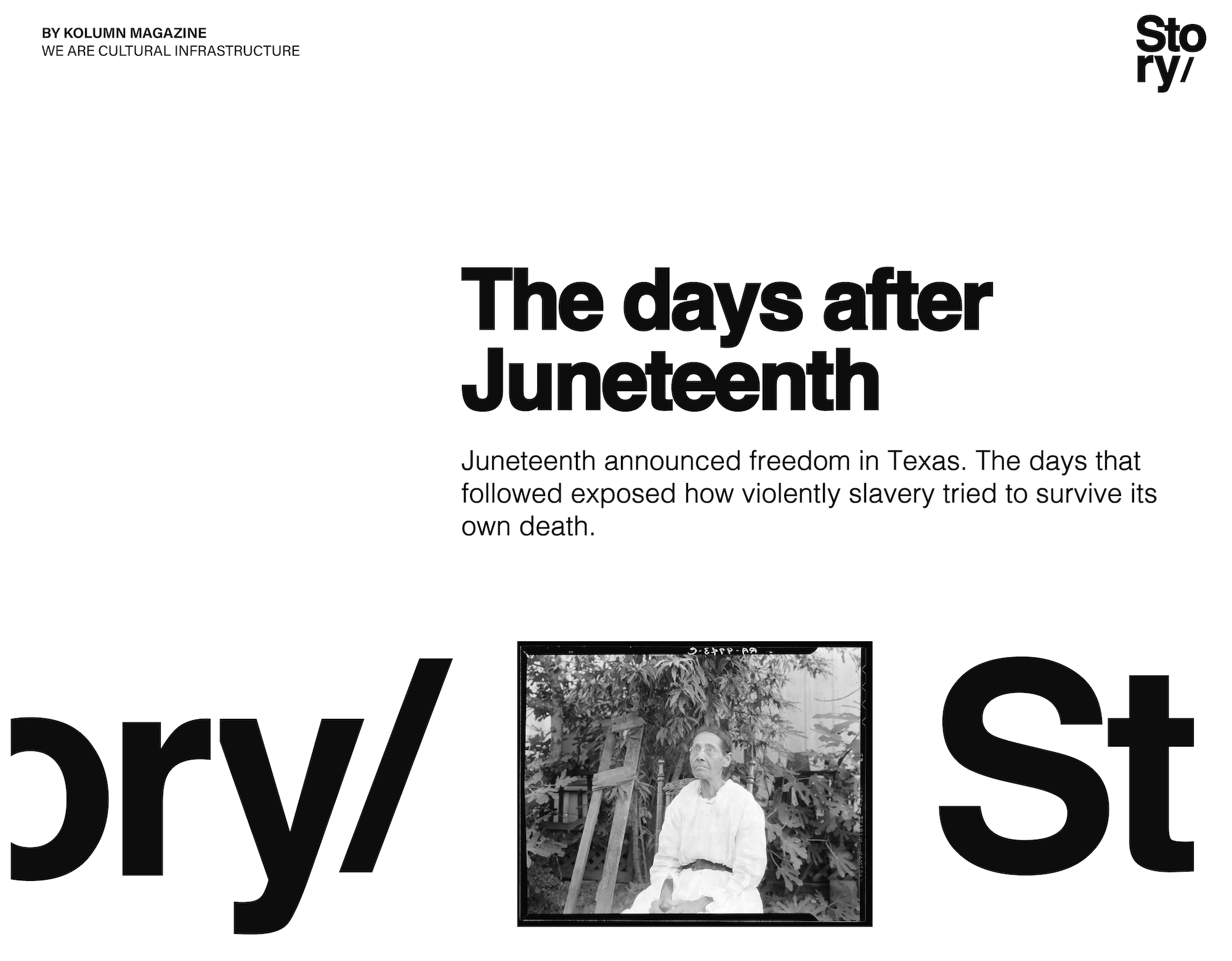
Juneteenth did not end the struggle over slavery in Texas. It changed the terrain on which that struggle was fought.
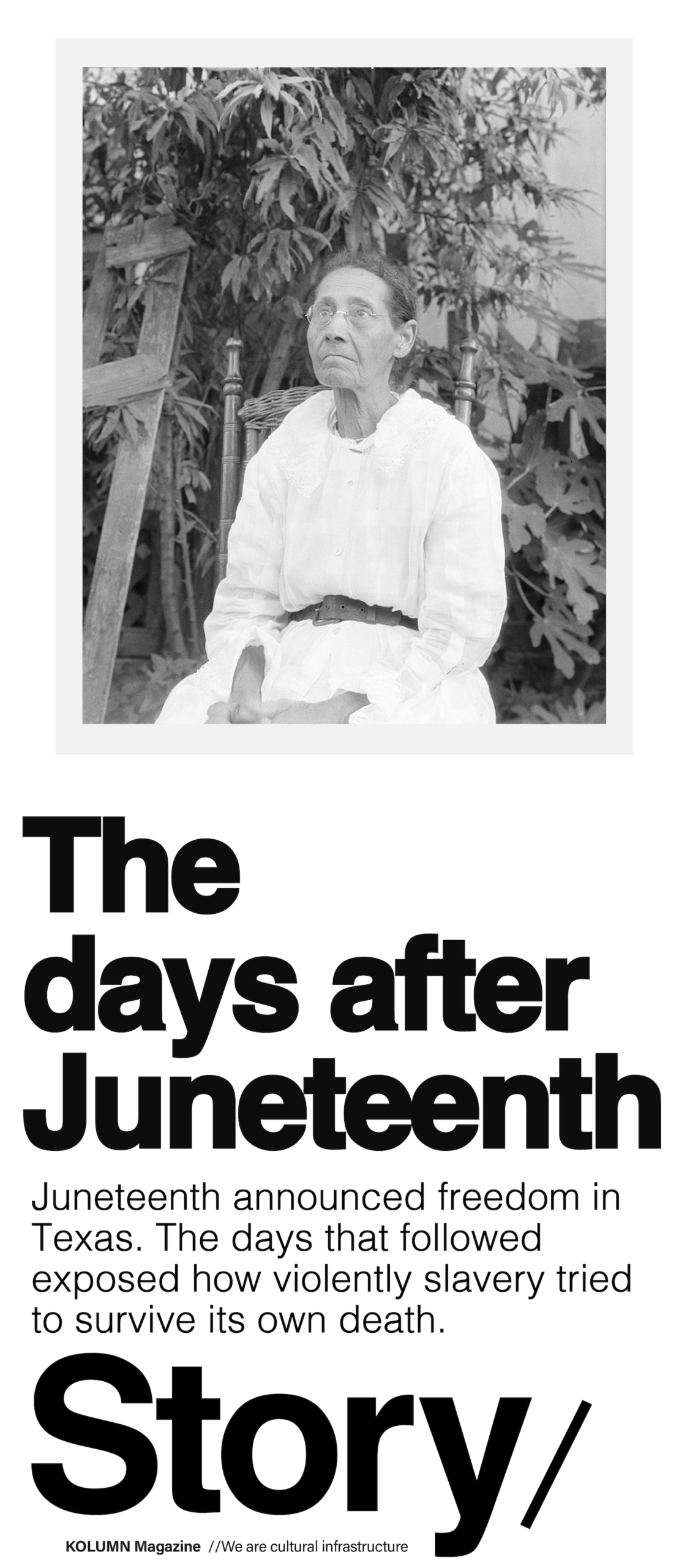
Juneteenth did not end the struggle over slavery in Texas. It changed the terrain on which that struggle was fought.
By KOLUMN Magazine
On June 19, 1865, Major General Gordon Granger stepped ashore in Galveston with approximately 2,000 Union troops and issued the declaration that would become one of the most consequential military orders in American history. General Order No. 3 informed Texans that “all slaves are free,” announcing that, under federal authority, the institution that had defined the state’s economy, politics, and social order for decades was officially over. The text of the order, preserved by the National Archives, was brief. Its consequences would not be.
The popular understanding of Juneteenth often ends at that moment. The image is familiar: a Union general reads an order, enslaved people learn they are free, celebrations erupt, and history moves forward. Yet the reality that followed was considerably more complex. The announcement in Galveston did not instantly transform conditions across a state larger than many nations. News moved slowly. Enforcement was uneven. Resistance was widespread. Freedom had been declared, but it still had to be implemented, defended, and claimed.
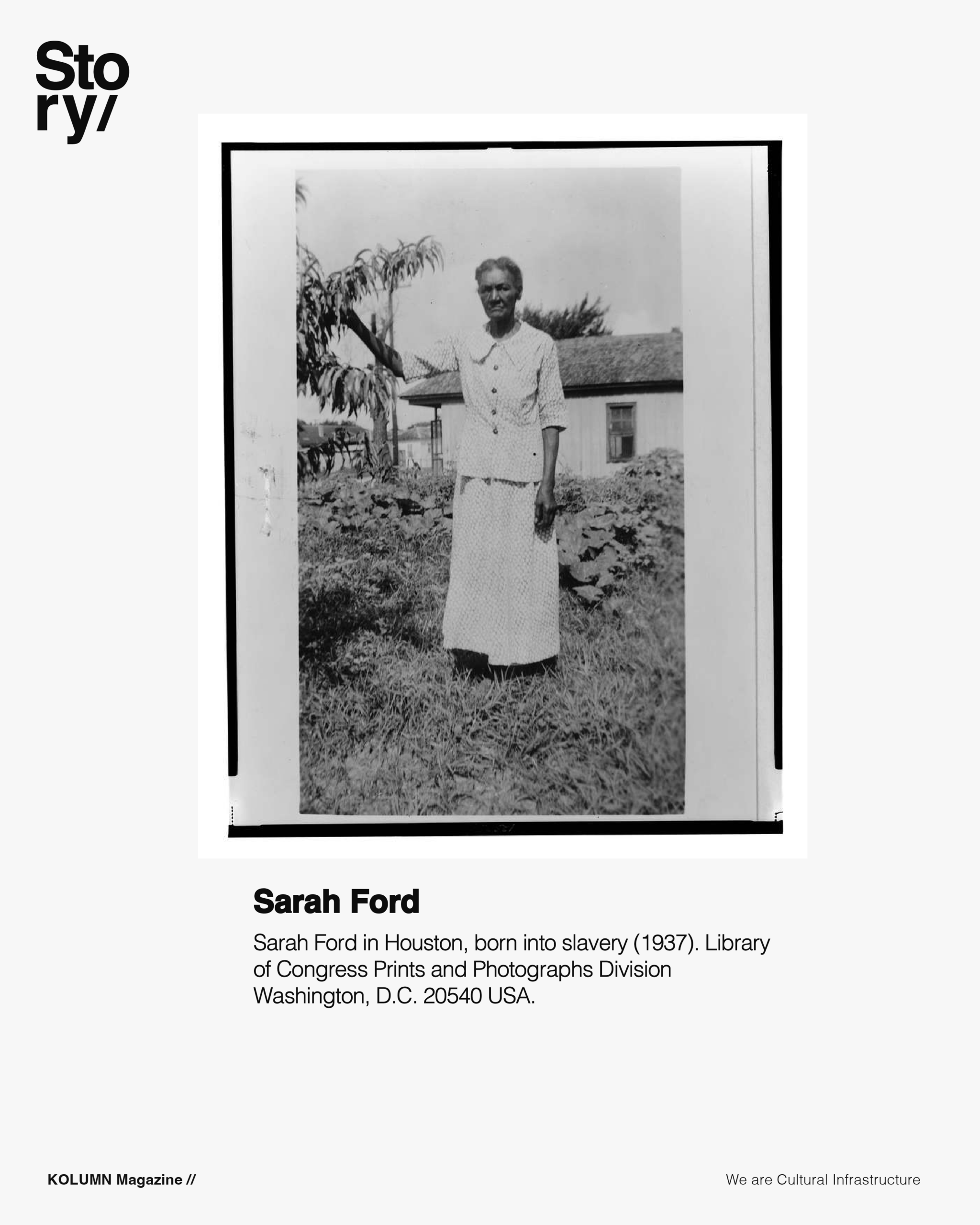
Texas occupied a unique place within the collapsing Confederacy. During the Civil War, slaveholders from Louisiana, Mississippi, Arkansas, and elsewhere moved thousands of enslaved people westward into Texas, believing distance from Union armies would preserve their wealth. Historians frequently describe the state as a refuge for slavery during the war’s final years. The National Museum of African American History and Culture notes that the arrival of Union troops in Galveston represented not simply the delivery of news but the arrival of federal power capable of enforcing emancipation.
The distinction matters. Enslaved Texans were not merely waiting for information. They were living under a system maintained through violence and coercion. Without federal troops, many slaveholders had little incentive to surrender their labor force. Freedom therefore arrived as both a legal declaration and a military occupation.
For newly freed Black Texans, June 19 opened a future filled with possibility and uncertainty. Many had heard rumors of emancipation long before Granger arrived. Others learned about the order through word of mouth days or weeks later. Some celebrated immediately. Others remained cautious, understanding that a proclamation on paper could be ignored by the people who still controlled land, food, housing, and local authority.
The question facing freedpeople was not whether they were free under federal law. The question was whether freedom could survive contact with the realities of Texas.
A Freedom Many Slaveholders Tried to Hide
One of the most enduring myths surrounding Juneteenth is that enslaved Texans simply did not know they were free until June 19, 1865. Historians increasingly challenge that interpretation. Evidence suggests many slaveholders were aware of emancipation and deliberately withheld information from enslaved workers.
As reported by The Washington Post, numerous accounts from formerly enslaved people describe owners who postponed announcing freedom in hopes of securing another harvest. Cotton remained king, and labor remained valuable. If enslaved workers learned they were free before crops were gathered, many planters feared they would leave immediately.
The delay was not simply a communications problem. It was an economic strategy.
Throughout the summer of 1865, stories circulated of plantation owners suppressing news, disputing Union authority, or attempting to negotiate continued labor under terms that closely resembled slavery. Some informed enslaved workers only after military officials arrived nearby. Others sought to reinterpret General Order No. 3 in ways that preserved their control.
The order itself reflected these tensions. While proclaiming freedom and equality, it also advised freedpeople to remain at their current homes and work for wages. Union authorities hoped to avoid economic collapse and humanitarian crisis. Former slaveholders viewed the language as an opportunity to preserve plantation labor.
The result was immediate conflict over what freedom actually meant.
For slaveholders, freedom often meant replacing slavery with a labor system that looked remarkably similar. For freedpeople, freedom meant the right to decide whether to stay at all.
The Great Black Migration
One of the first visible signs that slavery had truly ended was movement.
Across Texas, formerly enslaved people began leaving plantations in large numbers. Some traveled only a few miles. Others journeyed hundreds. The movement alarmed white landowners, who complained of labor shortages and social disorder. But for Black Texans, mobility represented something more profound than relocation. It represented autonomy.
For generations, slavery had regulated movement through patrols, passes, violence, and surveillance. To leave a plantation without permission was an act of resistance. To leave after emancipation was an act of citizenship.
Many freedpeople searched for family members separated by sale. Husbands looked for wives. Mothers searched for children. Brothers sought sisters they had not seen in decades. The records of the Freedmen’s Bureau contain countless examples of newly freed individuals attempting to reconstruct families shattered by slavery’s domestic trade.
Others migrated toward cities such as Galveston, Houston, Austin, and San Antonio. Urban areas offered greater access to Union troops, churches, schools, and emerging economic opportunities. For many, towns represented the possibility of living beyond direct planter control.
White observers frequently described this migration as disorder. Newspapers complained about labor shortages. Planters accused freedpeople of abandoning responsibilities. Yet migration was one of the clearest demonstrations that emancipation was real. Freedom included the ability to choose where to live, whom to work for, and how to define one’s future.
That simple right threatened the entire plantation economy.
The Battle for Black Labor
As freedpeople moved across Texas, a new struggle emerged over labor.
The collapse of slavery did not eliminate the demand for agricultural production. Cotton fields still required workers. Landowners still needed labor. The question was whether labor would now be voluntary and compensated or whether former slaveholders could recreate slavery through other means.
Congress had established the Freedmen’s Bureau in March 1865 to assist formerly enslaved people and oversee the transition to freedom. Bureau agents negotiated contracts, resolved disputes, established schools, and attempted to protect freedpeople from exploitation.
In practice, the agency faced enormous challenges. Texas was vast. Personnel were limited. Hostility toward federal intervention was widespread.
Many labor contracts favored landowners. Workers were promised wages but subjected to strict controls over movement and conduct. Some contracts included penalties that effectively bound laborers to plantations. Others allowed employers to withhold payment until harvest, creating opportunities for abuse.
Freedpeople frequently resisted these arrangements. They negotiated for better terms, demanded cash wages, left exploitative employers, and sought opportunities elsewhere. Their actions reflected a fundamental truth: emancipation was not merely about ending ownership. It was about gaining control over labor.
The economic implications were enormous. Slavery had served as the foundation of Texas wealth. Enslaved people represented labor, capital, collateral, and status. Emancipation destroyed that system. Former slaveholders therefore viewed Black autonomy not only as a social challenge but as a financial threat.
Confederate Defeat, White Resistance
The Confederate government had collapsed. Confederate ideology had not.
Throughout Texas, white resistance emerged almost immediately after emancipation. Some former Confederates refused to acknowledge federal authority. Others attempted to intimidate freedpeople who asserted their rights. Violence became a central feature of post-emancipation life.
The Journal of the Civil War Era has documented how white supremacist violence intensified during the months following Juneteenth. Freedpeople were assaulted for leaving plantations, demanding wages, establishing independent communities, or participating in political activity.
This violence was not random.
It served a strategic purpose: preserving racial hierarchy despite the formal abolition of slavery.
Former Confederates understood that Black freedom threatened their political and economic dominance. Terror became a means of maintaining control where law no longer provided it. Intimidation discouraged migration. Violence discouraged labor organizing. Attacks on schools and churches discouraged institution-building.
For many Black Texans, emancipation therefore produced a paradox. Freedom existed under federal law, but exercising it often carried serious risk.
Historians Reframe the Meaning of Juneteenth
For much of the twentieth century, Juneteenth was often presented as a regional celebration marking the delayed arrival of emancipation. Contemporary historians have expanded that interpretation considerably.
Among the most influential voices is historian Annette Gordon-Reed, whose book On Juneteenth argues that the holiday should be understood within the broader context of Black life in Texas and the unfinished nature of freedom. In an interview highlighted by KUOW, Gordon-Reed emphasizes that emancipation did not erase inequality. Instead, it inaugurated a new phase of struggle.
Similarly, historian W. Caleb McDaniel has examined early Juneteenth celebrations and their role in shaping Black civic identity. His research demonstrates that the holiday became a vehicle for public memory, political expression, and community building.
These scholars are part of a broader historiographical shift. Rather than viewing Juneteenth as the conclusion of slavery, historians increasingly treat it as the beginning of Reconstruction’s central conflicts: labor, citizenship, political participation, and racial violence.
In that sense, Juneteenth belongs not only to the history of emancipation but also to the history of Reconstruction.
Celebration as Resistance
The first anniversary of Juneteenth was itself an act of defiance.
According to research discussed by historian W. Caleb McDaniel in the Houston Chronicle, Black Texans gathered in June 1866 to commemorate emancipation through parades, church services, speeches, and communal celebrations.
These events were about far more than remembrance.
They represented public claims to citizenship.
At a time when white resistance remained widespread, gathering openly to celebrate freedom carried political significance. Churches became organizing centers. Public ceremonies became declarations of belonging. Community celebrations became assertions that emancipation would not be forgotten.
The development of Juneteenth traditions reflected a broader pattern within Black communities. Freedom required institutions capable of preserving memory. Schools, churches, civic organizations, newspapers, and commemorative events all helped sustain that effort.
The holiday survived because Black Texans protected it.
Freedom Without Land
One of the greatest limitations of emancipation was economic.
General Order No. 3 promised equality. It did not provide land.
For generations, enslaved people had created wealth while accumulating none of it themselves. When slavery ended, most emerged without significant property, capital, or political protection. Former slaveholders retained land and resources. Freedpeople retained labor and determination.
This imbalance shaped the postwar economy.
Without land redistribution, many freedpeople were forced to negotiate employment with the same individuals who had once claimed ownership over them. Dependency remained embedded within the economic structure.
The contradiction was profound. People were legally free but economically vulnerable.
Historians continue debating the long-term implications of this failure. What is clear is that the absence of meaningful economic redistribution limited the transformative potential of emancipation.
Freedom changed legal status. It did not immediately change wealth.
From Emancipation to Convict Leasing
The end of slavery did not end efforts to control Black labor.
Across the South, lawmakers developed Black Codes, vagrancy laws, and criminal penalties designed to restrict newly freed populations. The process eventually evolved into convict leasing, a system that exploited the exception clause within the Thirteenth Amendment.
The amendment abolished slavery and involuntary servitude except as punishment for crime.
That exception proved significant.
As documented by historians and discussed in analyses such as TIME’s examination of General Order No. 3, Southern states increasingly used criminalization to supply labor for public and private enterprises.
In Texas, convict leasing became one of the most brutal manifestations of post-emancipation labor exploitation. Black men were disproportionately arrested, convicted, and leased to employers under conditions many historians have described as slavery by another name.
The connection between Juneteenth and convict leasing is not incidental. It reveals how quickly systems of racial control adapted after emancipation.
What Black Texans Built
Despite violence, exploitation, and political resistance, Black Texans built institutions that transformed the state.
They established churches. They founded schools. They organized civic associations. They developed businesses and mutual aid societies. They pursued education, political participation, and economic advancement.
Most importantly, they preserved memory.
Juneteenth survived because communities treated it not merely as a holiday but as a civic tradition. Families passed stories across generations. Churches organized celebrations. Neighborhoods maintained commemorations even when official recognition was absent.
The holiday became an archive.
The story of the days following June 19, 1865, therefore extends beyond emancipation itself. It encompasses migration, labor, violence, institution-building, and political struggle. It is the story of people transforming legal freedom into lived freedom.
The Meaning of the Days After Juneteenth
The history of Juneteenth does not end with General Order No. 3.
It begins there.
The days that followed reveal the central tension of American freedom: rights proclaimed are not always rights protected. Black Texans learned this immediately. They encountered resistance, violence, economic insecurity, and political opposition. Yet they also built communities, reunited families, established institutions, and created traditions that endure today.
When Americans celebrate Juneteenth, they celebrate more than a military order delivered in Galveston. They celebrate the determination of formerly enslaved people who transformed an announcement into a movement, a holiday into a civic institution, and a promise into a continuing struggle for equality.
Freedom arrived in Texas on paper on June 19, 1865.
Its true history lies in everything that happened afterward.
More great stories
Afro Sheen, Wall Street, and the Architecture of Black Possibility
July 6, 2026
No Comments
The Fire Inside the Fourth
July 5, 2026
No Comments