


The August Wilson Center was never merely about preserving Black culture. It was about placing Black culture in the civic center of a city that had often pushed Black life to the margins.
The August Wilson Center was never merely about preserving Black culture. It was about placing Black culture in the civic center of a city that had often pushed Black life to the margins.
By KOLUMN Magazine
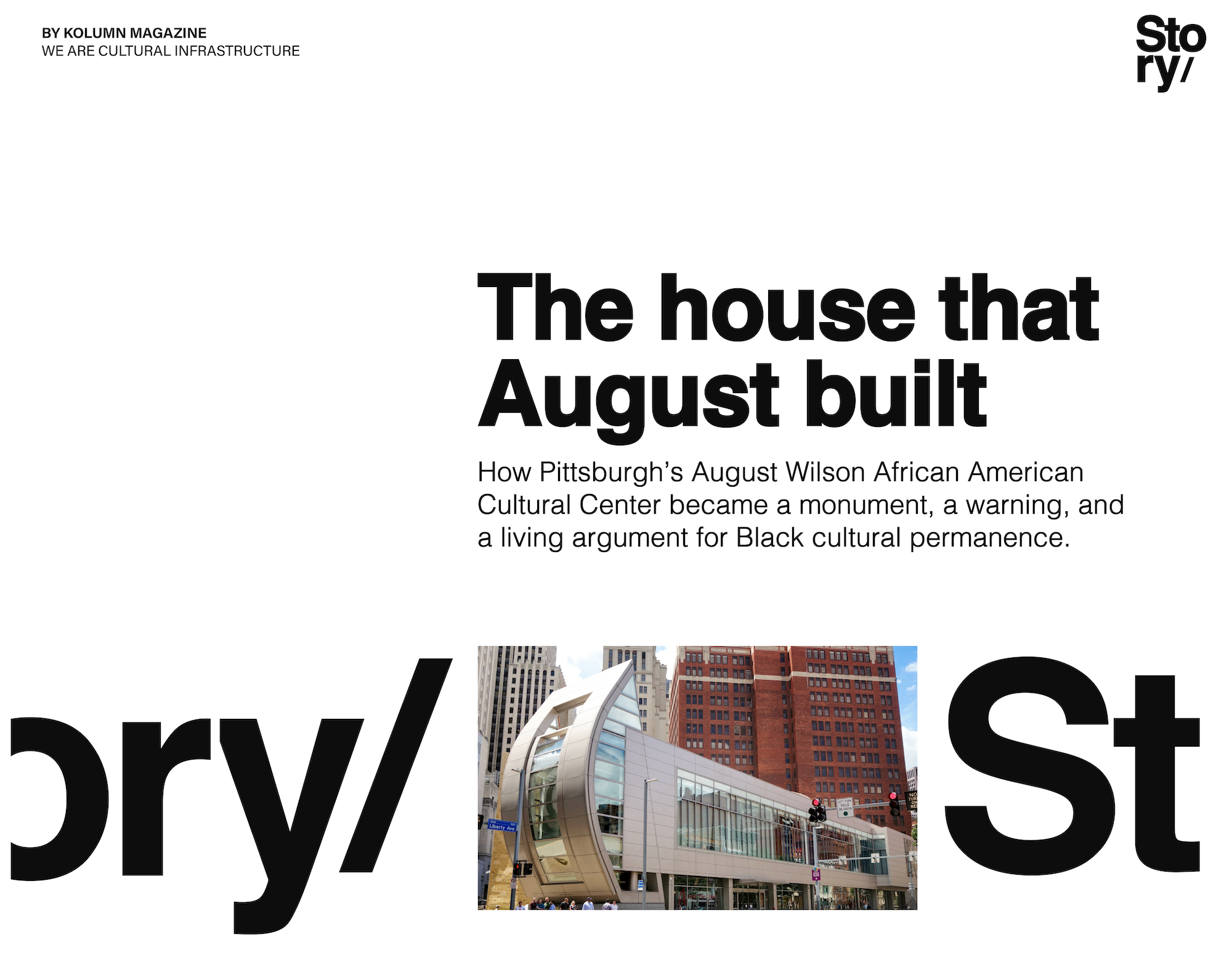
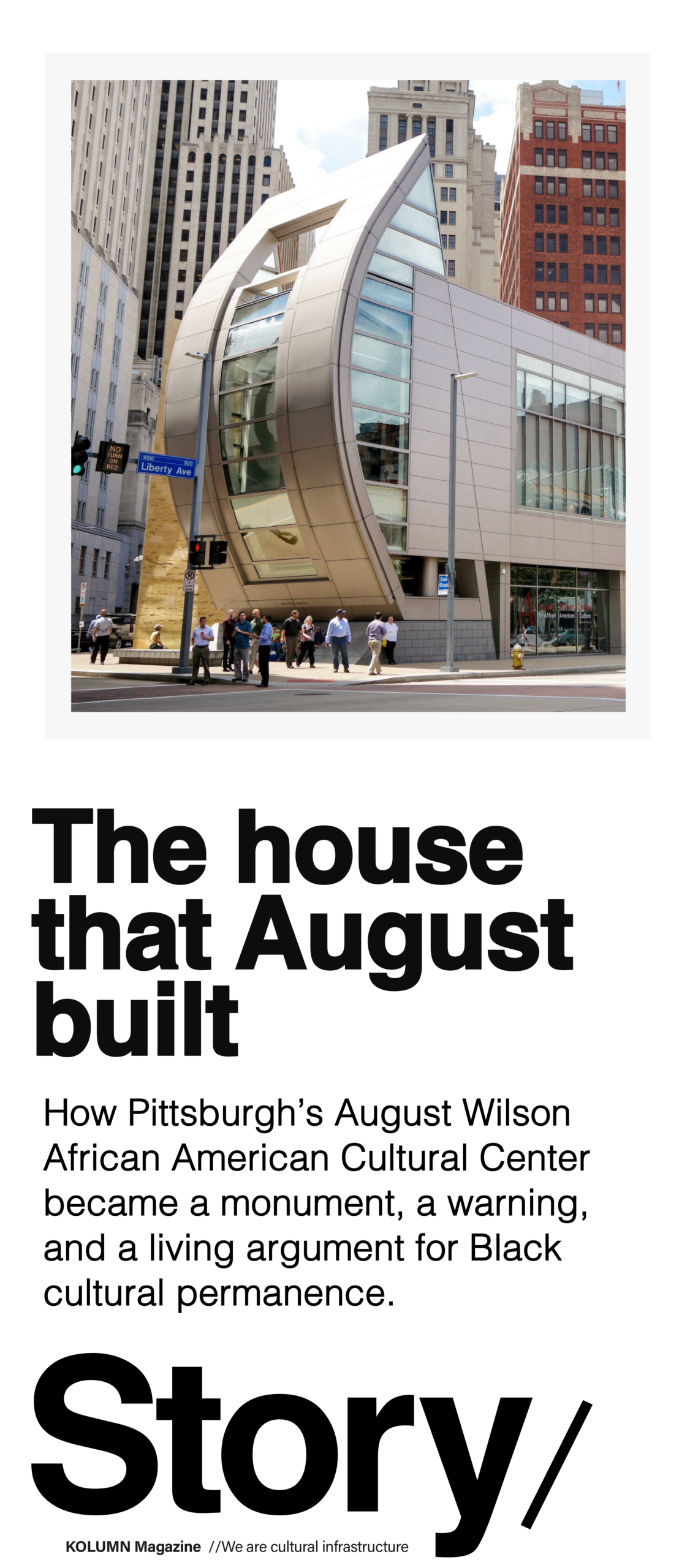
The building rises in Pittsburgh’s Cultural District like a vessel caught mid-voyage: glass, stone, steel, and sail. It is elegant but not neutral. The August Wilson African American Cultural Center was designed to announce presence, to make Black culture visible in the official architecture of a city that had too often treated Black memory as background scenery. According to the Center’s own history, the structure was inspired by Swahili trading ships that carried East African culture across waters and worlds, a metaphor that makes the building less a container than a carrier of stories.
The Center’s purpose has always been larger than programming. It is a civic claim. Opened in 2009, the institution was created as a multidisciplinary home for African American art, performance, education, and public gathering in the city that gave birth to August Wilson. Its mission, as the organization states in its official description of the Center, is to celebrate the African American journey and present its extraordinary role in American and global popular culture. That phrasing matters because it refuses the old museum habit of treating Black culture as a supplement to the national story. The Center’s premise is that Black life is one of the central engines of the American imagination.
A Pittsburgh Dream, Born From Civic Absence
The story begins before the building. In the 1990s, Pittsburgh leaders, artists, and civic organizers imagined an African American cultural facility that could stand in the city’s formal arts district rather than outside it. The Center’s official history describes a small group of community leaders who pursued the idea of a single African American arts facility where people across the region could gather to celebrate Black culture. That origin is important because it places the institution within a broader history of Black cultural infrastructure: the churches, lodges, schools, newspapers, theaters, settlement houses, and neighborhood centers that carried Black public life when mainstream institutions did not.
In that sense, the August Wilson Center belongs in the same historical frame as institutions KOLUMN has previously explored, including Detroit’s Wright Museum and other Black civic spaces that operate as archives, classrooms, and ceremonial grounds. These places are not luxuries. They are repositories of public memory. They keep the record when school curricula narrow, when neighborhoods are displaced, and when official commemorations reduce Black history to a seasonal gesture.
Pittsburgh was an especially charged site for such an institution. It is the city of steel and smoke, unions and ethnic enclaves, old money and working-class mythology. It is also the city of the Hill District, once one of the great Black cultural neighborhoods in America. The Hill was home to jazz clubs, political organizers, newspapers, barbershops, churches, storefront theaters, and the ordinary genius that August Wilson turned into literature. When Wilson wrote his ten-play American Century Cycle, he did not treat the Hill as a setting in the narrow sense. He treated it as an archive of American life.
The National Endowment for the Humanities recognized Wilson as one of the most important voices in modern theater, noting that his plays portrayed the African American experience in the twentieth century one decade at a time through its National Humanities Medal profile. The August Wilson African American Cultural Center extends that work beyond the page and stage. It asks what it means to build an institution around the proposition that Black memory is public knowledge.
The Name That Carries a Century
August Wilson was born Frederick August Kittel in Pittsburgh’s Hill District in 1945. He became, by critical consensus, one of the defining American playwrights of the twentieth century. His ten-play cycle, often called the American Century Cycle or Pittsburgh Cycle, chronicles Black life decade by decade across the 1900s. The Center’s biographical page on Wilson notes that all but one of the plays are set in the Hill District, the working-class neighborhood of his birth, and that Wilson himself once said, “Put them all together, and you have a history.”
That line is more than a literary boast. It is a historiographical statement. Wilson was arguing that Black domestic life, Black labor, Black music, Black speech, Black grief, Black humor, and Black spiritual struggle constituted history. He rejected the idea that history belonged only to presidents, wars, court rulings, and official documents. His plays turned kitchens, backyards, boardinghouses, diners, streets, and neighborhood thresholds into historical sites.
Scholars of Wilson’s work have long understood this. The University of Pittsburgh Press describes Laurence A. Glasco and Christopher Rawson’s August Wilson’s American Century: Life as Art as a study of a writer whose celebrated plays emerged from Pittsburgh’s vibrant Black culture, and the press frames the book’s account of Wilson as a portrait of a complex artist shaped by hometown memory. Sandra G. Shannon, one of the leading Wilson scholars, has likewise treated Wilson’s body of work as a cultural record, and her essay on the permanent exhibition, available through the Theatre/Practice journal archive, situates the Center’s interpretive project within the continuing construction of Wilson’s public legacy.
Wilson’s greatness makes the Center’s name powerful, but it also creates an obligation. To bear his name is to do more than present plays. It is to honor an artistic method rooted in witness. It is to make space for the fullness of African American life, not only its pain or triumph, but its language, contradictions, ritual, invention, and interiority.
Architecture as Cultural Declaration
When the Center opened on Liberty Avenue in September 2009, it entered Pittsburgh’s Cultural District as both a building and a statement. WPXI’s retrospective on the opening described the nearly $40 million facility as a 65,000-square-foot structure with a theater, gallery spaces, and educational halls, and noted that the building was designed by prominent African American architect Allison Grace Williams in a feature marking the Center’s anniversary. The Center’s own history identifies Williams, then of Perkins+Will, as one of the nation’s leading African American architects and credits her with designing a building inspired by Swahili trading ships.
Architecture matters in this story because Black cultural institutions have often been asked to operate in borrowed, inadequate, or symbolically marginal spaces. A purpose-built structure in a downtown arts district reverses that logic. It says that African American art deserves not only wall space, but architectural ambition. It deserves acoustics, galleries, classrooms, gathering rooms, technical capacity, and a public face.
Williams’ design gives the Center visual distinction without reducing Blackness to cliché. The building is not a replica of the Hill District, nor a nostalgic monument to an imagined Africa. It is a contemporary civic structure that draws from diasporic reference while asserting metropolitan presence. The result is a building that can host a jazz performance, a visual arts exhibition, a lecture, a community gathering, a film screening, a youth program, or a gala without losing its symbolic center.
That flexibility is part of the institution’s significance. The August Wilson African American Cultural Center is not simply a museum. It is a multidisciplinary arts center. That distinction allows it to function as a stage, gallery, classroom, civic forum, and cultural meeting ground. In a city where Black neighborhoods have endured disinvestment and displacement, that kind of institutional platform has social meaning.
The Crisis That Almost Took the Building
The Center’s early promise was shadowed by financial instability. Within a few years of opening, it faced debt, management challenges, and the possibility of liquidation. The Pittsburgh Post-Gazette chronicled the institution’s precarious early years in its account of the Center’s rise and fall, while Nonprofit Quarterly later described the rescue of the building as a case study in the difficulty of sustaining ambitious Black cultural institutions even when they begin with civic goodwill and philanthropic support.
The crisis exposed a hard truth: symbolic importance does not pay construction debt, operating costs, staffing expenses, utilities, insurance, maintenance, marketing, artist fees, or educational programming. Black cultural institutions are often praised in public and undercapitalized in practice. They are expected to carry communal memory, represent civic diversity, serve students, host artists, satisfy donors, attract tourists, and remain financially self-sufficient in markets that were not built for them.
The August Wilson Center’s near-collapse was not merely a local management story. It was part of a national pattern. Across the country, Black museums and cultural centers have had to navigate the gap between public demand and private funding, between ceremonial support and structural investment. The Center’s crisis forced Pittsburgh to answer a civic question: Was this building a dispensable asset, or was it part of the city’s cultural infrastructure?
A consortium of foundations and public entities ultimately moved to preserve it. The Pittsburgh Foundation’s account of the Center’s rebirth describes how foundations, local government, and community stakeholders rallied around the building with funding and arts-management expertise to plot a new course. Nonprofit Quarterly’s examination of the rescue similarly emphasized that the building was saved after a complicated struggle involving philanthropic institutions, public agencies, creditors, and community advocates in its analysis of saving the Center.
The rescue did not erase the earlier failure, but it changed the meaning of the institution. The Center became a monument not only to Black art, but to the fragile economics of cultural memory. Its survival demonstrated that legacy requires governance, capitalization, community accountability, and institutional imagination.
A Rebirth With a Broader Mandate
The Center’s second life has been defined by stabilization, rebranding, programming growth, and renewed public relevance. Its current identity as the August Wilson African American Cultural Center emphasizes both the playwright and the broader cultural field he represents. That phrasing was not incidental. In 2019, a proposed name change that appeared to remove “African American” from the institution’s identity drew criticism, and the organization restored the language after public backlash. The episode mattered because it clarified what stakeholders believed the Center must remain: not only a Wilson-branded venue, but an explicitly African American cultural institution.
That tension is instructive. Cultural institutions often face pressure to broaden language in pursuit of donors, tourists, or civic comfort. Yet specificity is not exclusion. The Center’s African American identity is precisely what gives it authority. Its mission is open to all, but it is not culturally generic. It stands in a lineage of Black institutions that understand particularity as a route to universality.
The Center now describes itself as one of the largest cultural organizations in the country focused exclusively on the African American experience and the arts of the African diaspora through its public mission language. That national scale matters. Pittsburgh is not New York, Chicago, Atlanta, Detroit, or Washington, D.C., but the Center gives the city a nationally significant Black arts institution rooted in local history. It positions Pittsburgh not only as Wilson’s birthplace, but as a site where African American culture continues to be produced, interpreted, and shared.
The institution’s programming reflects that range. It has hosted visual art, music, dance, theater, film, community conversations, educational programs, and public events. Its online presence highlights exhibitions, performances, and community gatherings, including current programming listed through the Center’s events platform. The range is important because Black culture cannot be responsibly represented through a single medium. It requires sound, image, movement, text, performance, memory, and debate.
The Writer’s Landscape and the Work of Permanent Memory
One of the Center’s most important recent developments is August Wilson: The Writer’s Landscape, a permanent exhibition dedicated to Wilson’s life and work. The Center describes the exhibition as a 3,600-square-foot installation exploring the people and places of Pittsburgh that shaped Wilson’s worldview and inspired his ten-play American Century Cycle on the exhibition page. VisitPittsburgh’s guide likewise frames the exhibition as an immersive encounter with Wilson’s life, the Hill District, and the continuing relevance of his themes through its visitor overview.
The permanent exhibition changes the Center’s institutional profile. A performance venue is episodic by nature. A permanent exhibition creates an anchor. It gives visitors a standing reason to enter the building even when they are not attending a ticketed event. It also turns the Center into a site of literary pilgrimage, connecting Wilson’s plays to the geography, people, and cultural atmosphere that formed him.
This is where historiography becomes public practice. The exhibition does not merely celebrate Wilson; it interprets him. It asks visitors to understand the Hill District not as background, but as archive. It positions Wilson’s characters within histories of migration, labor, segregation, family, music, urban renewal, and Black self-making. It turns biography into civic education.
The exhibition also arrives amid a broader Wilson renaissance. Film adaptations, revivals, academic studies, and the preservation of Wilson-related sites have kept his work in public circulation. Yet the Center occupies a distinct role because it stands in Pittsburgh, where Wilson’s language was born. It can connect the plays to streets, neighborhoods, and local memory in ways no distant institution can fully replicate.
The Hill District, Displacement, and the Burden of Representation
No serious account of the August Wilson Center can avoid the Hill District. Wilson’s work made the Hill internationally legible, but the neighborhood’s own history is marked by cultural brilliance and civic harm. Urban renewal, highway construction, disinvestment, and redevelopment fractured the Hill’s built environment and displaced residents. The Center, located downtown rather than in the Hill itself, sits within that unresolved geography.
That location gives the institution both visibility and tension. On one hand, the Cultural District placement declares that Black art belongs at the center of Pittsburgh’s civic identity. On the other, it raises questions about how a downtown institution remains accountable to the Black neighborhoods whose history it interprets. The Center’s challenge is not simply to present Black culture, but to maintain relationships with the communities that produce it.
This challenge is familiar to Black museums across the country. Institutions must negotiate donors, tourists, artists, scholars, elders, students, neighborhood residents, and city officials. They must be polished enough to attract philanthropic support and grounded enough to avoid becoming decorative diversity architecture. The August Wilson Center’s significance lies partly in how openly it embodies this tension.
It is both monument and workplace. It is both symbol and operating nonprofit. It must honor Wilson while serving artists who are not Wilson. It must preserve memory while staying contemporary. It must welcome broad audiences without diluting its African American center of gravity. Those are not contradictions to be solved once. They are the ongoing conditions of serious Black cultural work.
Expert Voices and the Meaning of Black Cultural Infrastructure
The scholarly conversation around August Wilson has long emphasized that his plays function as counter-archives. They recover ordinary Black lives from historical neglect and dramatize the structures that shape them. The NEH’s profile of Wilson places him among the most important voices in modern theater because his work makes African American experience central to American drama. PBS’s American Masters timeline describes Wilson as an award-winning playwright whose work illuminated the joys and struggles of African American life through its biographical account.
The Center translates that scholarly consensus into public culture. It gives Wilson’s historiographical achievement architectural form. It tells visitors that Black dramatic literature is not merely something to read or stage, but something to inhabit. It offers a civic answer to a scholarly insight: if Wilson created a dramatic archive of the twentieth century, Pittsburgh needed a public institution capable of carrying that archive into the twenty-first.
Cultural historians have increasingly understood museums and arts centers as producers of history, not just presenters of it. The August Wilson Center participates in that work by selecting what to exhibit, whom to commission, which artists to platform, which communities to convene, and which narratives to foreground. In doing so, it shapes public memory.
That role carries ethical obligations. A Black cultural center must resist simplification. It must avoid turning African American experience into uplift alone, trauma alone, entertainment alone, or heritage branding alone. Wilson’s own work provides the model. His plays are neither sentimental nor despairing. They are morally serious, musically alive, historically grounded, and full of difficult people. A center bearing his name must be willing to hold that complexity.
Why the Center Matters Now
The August Wilson African American Cultural Center matters because the battles over memory have intensified. Across the United States, school curricula, museum exhibitions, public monuments, archives, and diversity initiatives have become political battlegrounds. In such a climate, Black cultural institutions are not passive repositories. They are democratic infrastructure.
The Center offers a counterweight to erasure. It preserves the artistic record, supports contemporary creators, educates audiences, and keeps African American culture visible in civic space. Its existence insists that Black history is not confined to February, slavery, civil rights, or crisis. It includes theater, abstraction, jazz, fashion, family, migration, food, language, spirituality, protest, comedy, and the everyday acts by which people make meaning.
It also matters because regional Black history deserves national platforms. Too often, the geography of Black cultural memory is flattened into a few familiar cities. Pittsburgh’s Black history is distinctive: industrial, migratory, musical, literary, union-adjacent, neighborhood-rooted, and shaped by the particular violence of urban redevelopment. The Center makes that specificity legible without provincializing it.
The building’s survival is part of its message. It nearly disappeared into debt and redevelopment. It could have become another example of a Black cultural dream undone by undercapitalization. Instead, it became a case study in rescue, reinvention, and renewed purpose. That does not make the story tidy. It makes it useful.
The Living Argument
The August Wilson African American Cultural Center is significant because it refuses to let Black culture be treated as atmosphere. It gives it a building, a stage, a gallery, a curriculum, a public address, and a future. It is a monument to August Wilson, but it is also a test of Pittsburgh’s commitments. Will the city honor Black culture only when it is famous, or will it sustain the institutions that make fame possible? Will it celebrate Wilson while ignoring the living artists and neighborhoods that continue his work? Will it treat the Center as a destination, or as civic infrastructure?
The best answer is already embedded in the building’s form. A ship is not built to stand still. It carries people, memory, language, and goods across distance. The August Wilson African American Cultural Center carries the Hill District into the Cultural District, Pittsburgh into the Black diaspora, and Wilson’s dramatic century into a new and unsettled age.
Its history is not a simple success story. It is more valuable than that. It is a story of vision, overreach, rescue, correction, and renewed responsibility. It shows how difficult it is to build institutions worthy of Black genius, and how necessary it remains to try.
More great stories
Afro Sheen, Wall Street, and the Architecture of Black Possibility
July 6, 2026
No Comments
The Fire Inside the Fourth
July 5, 2026
No Comments