



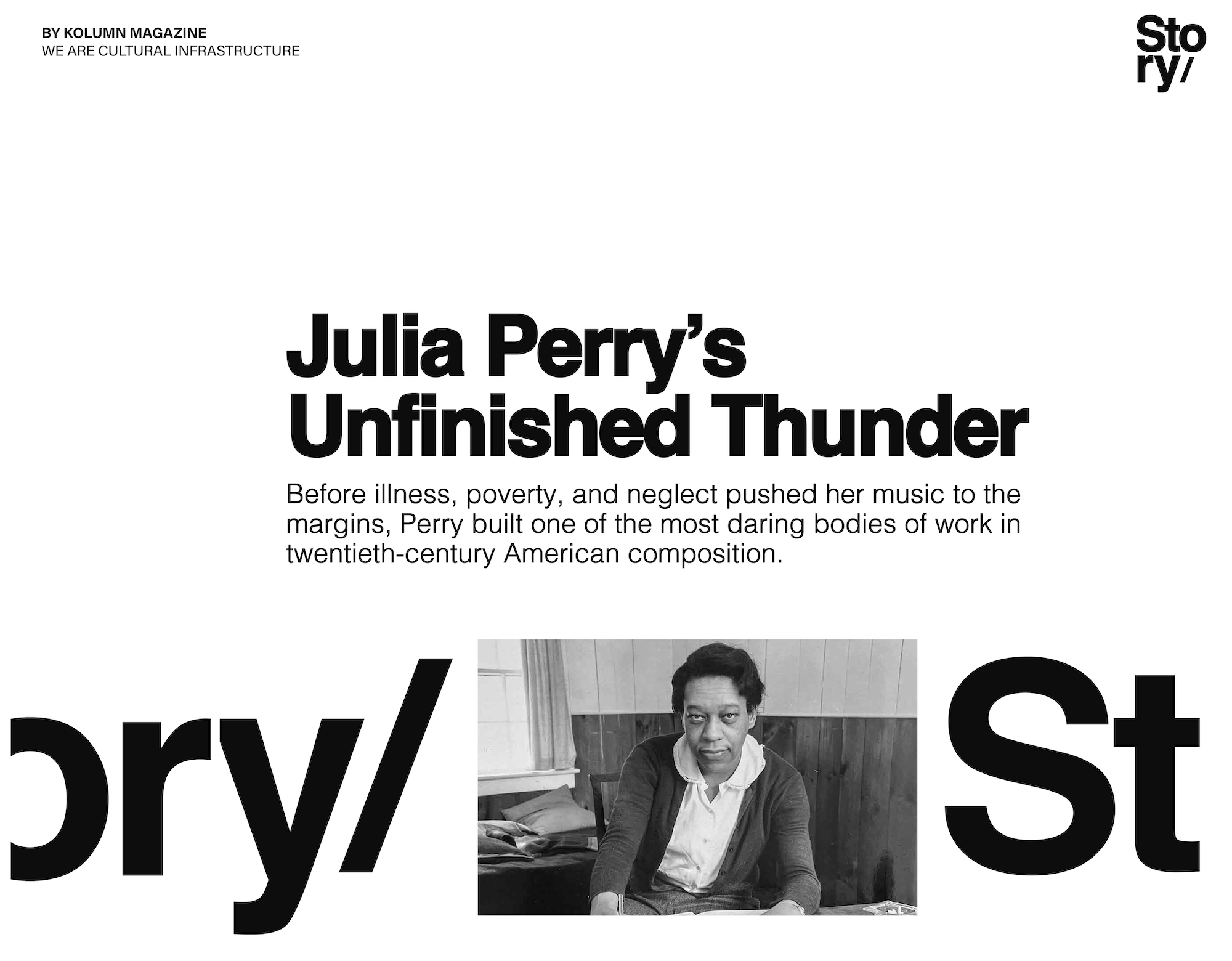
Julia Perry did not vanish. She was made difficult to find.
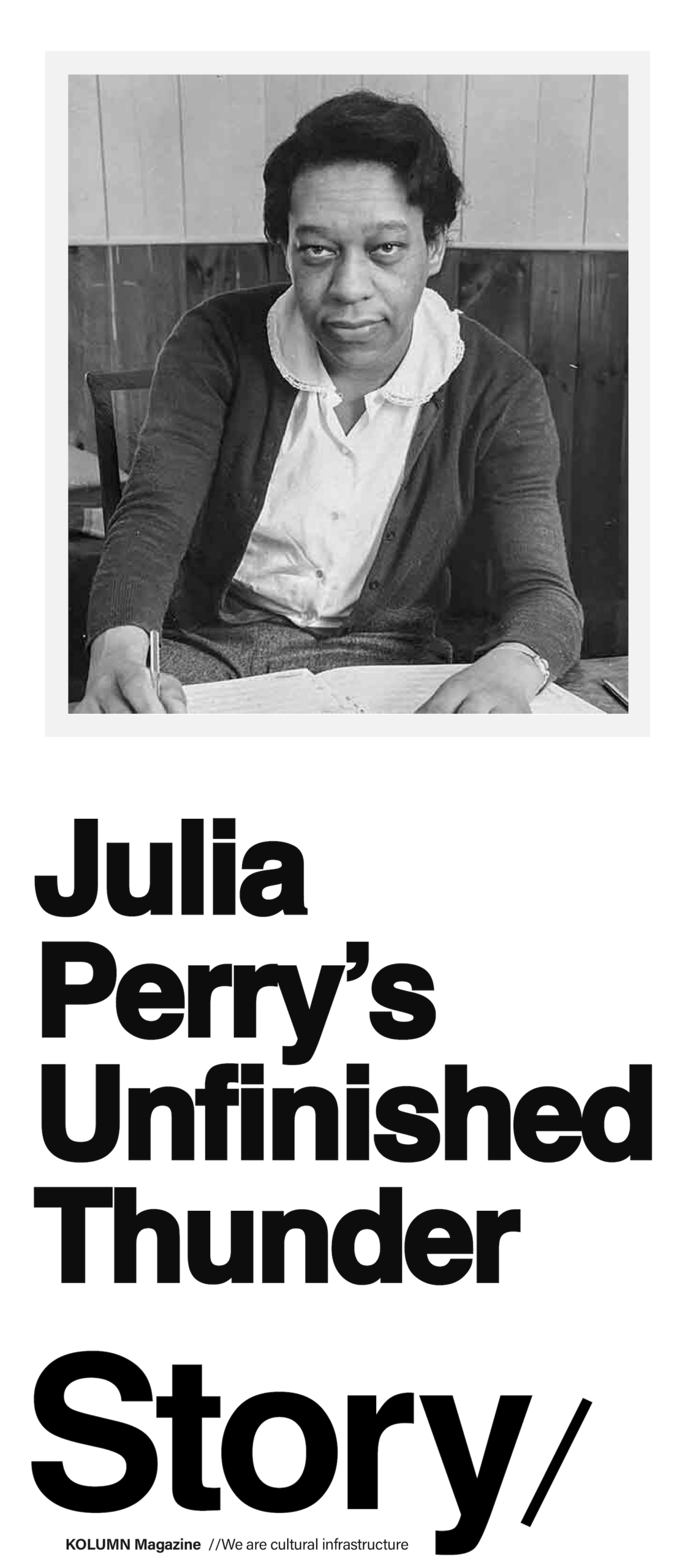
Julia Perry did not vanish. She was made difficult to find.
By KOLUMN Magazine
There is a particular silence that surrounds certain Black artists after death. It is not the silence of absence, because the work remains. It is not the silence of insignificance, because the record says otherwise. It is an institutional silence, a silence built by missing editions, inaccessible archives, unperformed scores, unprotected estates, hesitant orchestras, thin scholarship, and a canon that learned to mistake exclusion for judgment. Julia Perry lived inside that silence before she died, and then, for decades, her music was made to live there after her.
Yet Perry’s sound was never slight. It was concentrated, severe, lyrical, luminous, unsentimental, and frequently startling. She wrote sacred music without piety as decoration. She wrote modernist music without surrendering Black inheritance. She wrote for voice, orchestra, chamber ensemble, piano, choir, and stage with a discipline that makes the lazy categories collapse. To call her a “rediscovered” composer is accurate only if the phrase is held under pressure. Perry did not vanish. She was made difficult to find.
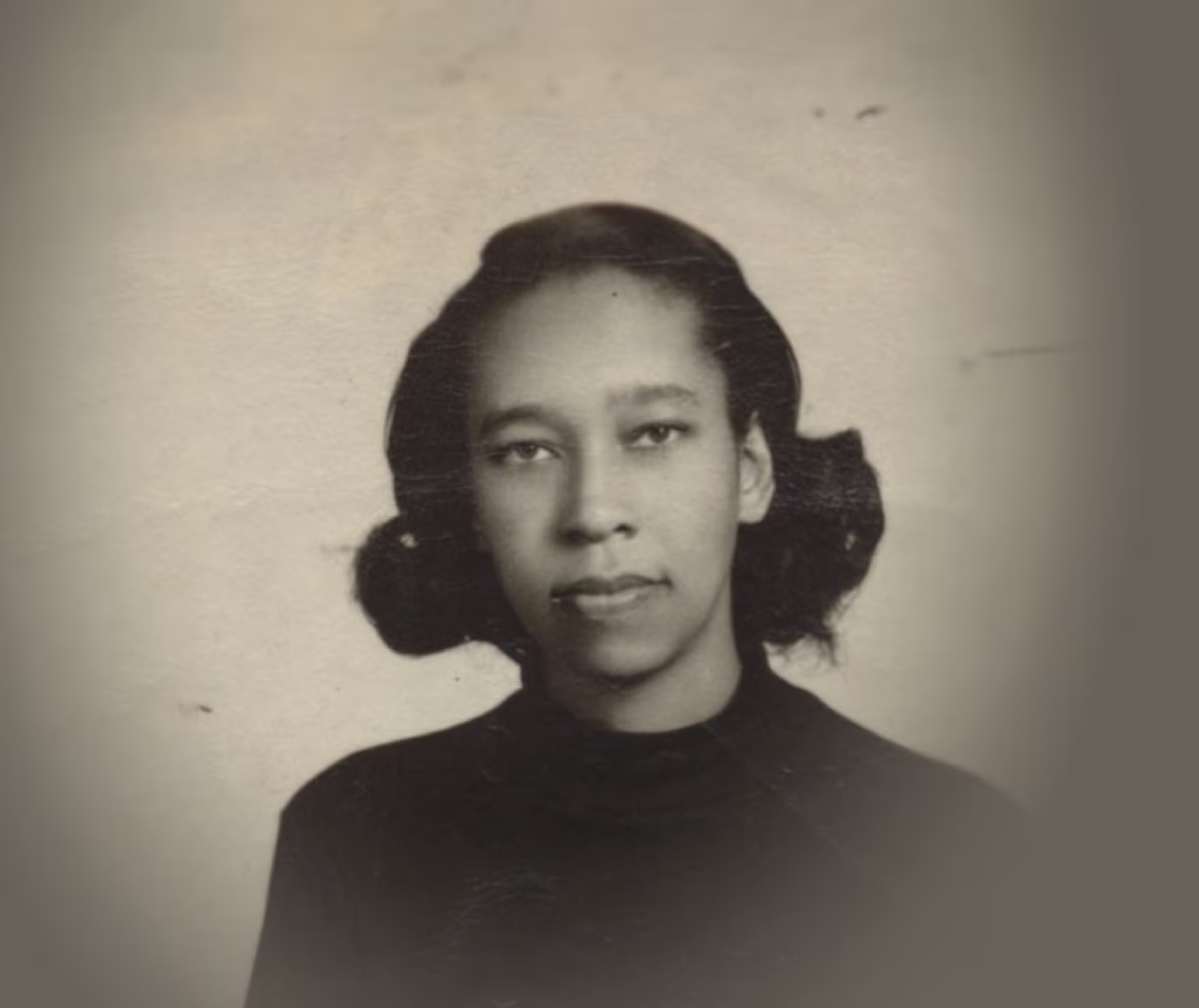
Born Julia Amanda Perry in Lexington, Kentucky, on March 25, 1924, and raised in Akron, Ohio, Perry emerged from a Black family of musicians, educators, doctors, and horse trainers, according to the Akron Symphony’s Julia Perry Project, which has become one of the most important public-facing preservation efforts devoted to her work. Her path carried her from Akron to Westminster Choir College in Princeton, from the Berkshire Music Center at Tanglewood to Europe, from study with Luigi Dallapiccola and Nadia Boulanger to performances and recognition in Italy, France, and New York. By her twenties and thirties, she had assembled the credentials of a major American composer: two Guggenheim Fellowships, prizes, European performances, orchestral attention, chamber music of unusual force, and a body of work that crossed the boundaries imposed on Black women artists of her generation.
Perry’s significance now lies in two intertwined truths. The first is musical: she was one of the most compelling American modernists of the mid-twentieth century, a composer whose best work refuses the segregated listening habits of the classical world. The second is historical: her career exposes how race, gender, illness, poverty, copyright law, and institutional neglect can conspire to make genius appear marginal. Her current revival is not merely a correction of taste. It is a correction of method.
A Child of Akron, A Student of Form
Perry’s early life resists the familiar myth that Black classical composers appeared from nowhere, carrying only “folk” inheritance and natural talent. She was trained, ambitious, disciplined, and cosmopolitan. Her musical education began in childhood and continued through formal study at Westminster Choir College, where she earned both undergraduate and graduate degrees. The Julia A. Perry Digital Collection at Westminster Choir College preserves traces of this formative period, reminding contemporary listeners that Perry’s artistry was rooted not only in inspiration but in institutional study, archival paper, and the daily labor of craft.
At Westminster, Perry studied voice, piano, and composition. That matters. Her later instrumental writing often behaves as if it knows the body from the inside: breath, attack, sustain, release. Even in austere textures, there is a vocal pressure beneath the notes. Her music does not merely proceed; it strains, ascends, contracts, opens, and testifies. The voice was not a preliminary phase in Perry’s development. It was a structural memory.
Her first major breakthrough, Stabat Mater, composed in 1951 for contralto and strings, remains the work through which many listeners first encounter her. Written with Marian Anderson in mind, as Samantha Ege and Garrett Schumann note in their centenary essay for I Care If You Listen, the piece gave Perry a platform beyond the narrow circuits where Black women composers were often confined. Stabat Mater is sacred, but it is not soft. It moves with intensity and compression, refusing the lush sentimentality often projected onto devotional music. It belongs to the Catholic liturgical tradition while also carrying the gravity of Black contralto singing, a tradition that knew suffering not as abstraction but as historic condition.
The work also helped Perry secure major recognition. Her early career was “filled with promise,” as the 2024 announcement from Concord, Boosey & Hawkes, and Videmus notes, including two summers at the Berkshire Music Center, study with Dallapiccola and Boulanger, the Prix Fontainebleau, and two Guggenheim Fellowships. These were not consolation prizes. They were markers of serious standing in elite musical circles.
Europe Heard Her Before America Knew What to Do With Her
Perry’s European years complicate the usual American story of artistic validation. In Europe, she found teachers, stages, and audiences more willing to engage the ambition of her work. She studied with Dallapiccola, whose twelve-tone modernism offered one route beyond tonal convention, and briefly with Boulanger, whose influence touched generations of American composers. She also conducted and performed abroad, building a reputation that made her, for a time, one of the most visible Black women in transatlantic classical composition.
The Akron Symphony’s biographical account observes that Perry enjoyed significant success in the late 1940s and 1950s “principally in Italy,” before returning to New York and Akron in the 1960s to find that American doors were less open than European ones. That reversal is essential. It was not that Perry lacked preparation. It was not that she lacked accomplishment. It was not that she lacked advocates. The problem was the American classical music establishment itself, which could admire Black brilliance in exceptional moments while refusing the sustained infrastructure that converts brilliance into career security.
Her career sits in conversation with the broader KOLUMN archive of Black musical authorship, particularly the magazine’s recent consideration of Will Marion Cook in “Before Harlem Was a Renaissance, There Was Will Marion Cook”, where Cook’s fluency in European training, Black vernacular music, and theatrical innovation disrupts narrow assumptions about where Black composition belongs. Perry disrupts a related assumption. She makes it impossible to treat Black classical musicians as peripheral to modernism. She was not borrowing the language of high modernism from elsewhere. She was speaking inside it, altering it, and forcing it to carry histories it had often refused to name.
The Music: Compression, Fire, and Refusal
To listen to Perry is to encounter a composer who believed in economy. Her music often says more by narrowing the field than by expanding it. She favored lean textures, dramatic contrasts, hard edges, and structures that feel carved rather than poured. Even when her work invokes spirituals or sacred texts, it avoids easy nostalgia. She understood Black musical inheritance not as ornament but as architecture.
The Atlanta Symphony Orchestra’s biography describes Perry as a composer whose music blended twentieth-century European techniques with the idioms of Black American heritage, and lists a remarkable output: three operas, fourteen choral works, twelve symphonies, vocal works, chamber works, and unusual instrumental combinations. The breadth alone is striking. But the deeper significance lies in her refusal to let genre discipline her imagination. Perry’s chamber works can sound orchestral; her vocal works can behave like compressed dramas; her spiritual arrangements can carry modernist angularity; her orchestral writing can feel intimate, even when the forces are large.
Garrett Schumann, writing for Chamber Music America, argues that Perry’s chamber music has been central to understanding her voice, particularly works such as Pastoral, Six Contrasts, Quinary Quixotic Songs, and Symphony No. 13 for Wind Quintet. His account of the 2024 centenary performances at The New School emphasizes how Perry’s music, though written decades earlier, could still sound newly urgent because it had been denied the repeated public hearings that allow a repertoire to become familiar. In other words, the music did not age into novelty. Neglect preserved its shock.
That point should unsettle the classical field. A canon is not merely a list of great works. It is a system of repetition. Music becomes “standard” because institutions keep placing it before audiences, critics, students, donors, and performers. Perry’s absence from that system was not proof of lesser value. It was the mechanism by which value was withheld.
The Archive as Battleground
The historiography of Julia Perry is inseparable from the conditions of archival recovery. For years, scholars, performers, and conductors had to work around incomplete access, unclear copyright status, unpublished scores, and scattered manuscripts. The story of Perry’s revival is therefore also a story about labor: musicologists identifying sources, performers preparing editions, conductors programming unfamiliar works, nonprofits negotiating rights, and institutions beginning to admit that preservation is not passive.
The major scholarly frame around Perry has been shaped by figures including Helen Walker-Hill, Mildred Denby Green, J. Michele Edwards, Louise Toppin, Samantha Ege, Gayle Murchison, Garrett Schumann, Christopher Wilkins, James Blachly, and Roger Zahab. Their work collectively challenges the older model in which Black women composers were appended to music history as exceptions. Perry’s life forces a different question: what would twentieth-century American music look like if its history had been written from the archive of those it excluded?
The Akron Symphony’s Julia Perry Project has become a crucial node in that work, combining research, preservation, recordings, oral history, and performance advocacy. Its resources include selected writings, recordings, a listing of published and unpublished works, and video reflections with people connected to Perry’s life and legacy. That kind of public scholarship matters because Perry’s case is not only academic. Her music needs performers, programmers, donors, publishers, and listeners. Recovery requires an ecosystem.
In 2024, Perry’s centennial year, the recovery effort crossed a major threshold. Videmus Inc., directed by Dr. Louise Toppin, announced through Concord and Boosey & Hawkes that Perry’s previously unavailable music would be published through a licensing partnership, after the Estate of Julia A. Perry assigned copyrights for her unpublished work to Videmus. The announcement stated that many of Perry’s roughly one hundred compositions remained unknown, and that only twenty-one had been published when she died without a will in 1979. This was more than a publishing update. It was a structural intervention.
The legal history is sobering. According to that same Boosey & Hawkes/Videmus announcement, Perry’s death without a will left no clear mechanism for securing permission to publish the rest of her music. Beginning in 2021, the Akron Symphony sought a legal solution; an estate was opened in Summit County, Ohio, in 2022; and by September 2024, the estate had transferred copyrights in Perry’s unpublished music to Videmus. For a composer of Perry’s stature, the fact that such basic access required decades of delay should be understood as part of the injury.
Expert Voices and a New Listening Public
The centennial did not simply produce celebration. It produced argument. At Washington University in St. Louis, the 2024 symposium “(Re)Discovering the Musical Legacy of Julia Perry” brought together performers and scholars including Lucia Bradford, Gayle Murchison, Samantha Ege, Louise Toppin, Ryan Dohoney, and Kendra Preston Leonard to examine Perry’s place in Black musical modernism, the legal challenges of access, gender, and Cold War-era political anxieties. The framing matters because Perry cannot be reduced to biography. She has to be heard as a composer working within—and against—the ideological pressures of her century.
Samantha Ege and Garrett Schumann, in I Care If You Listen, identify the paradox clearly: Perry was “extraordinarily accomplished,” crossed paths with major figures, won major awards, and had her music performed by leading ensembles, yet indigence, illness, and outsider status muted her career. That formulation is important because it refuses sentimental rescue. Perry’s marginalization was not a mystery. It was produced by knowable pressures.
Louise Toppin’s role has been especially important. Through Videmus and the African Diaspora Music Project, Toppin has spent decades expanding access to music by African American, women, and underrepresented composers. In the Boosey & Hawkes/Videmus announcement, she frames Perry’s erasure as both specific and representative, arguing that the neglect Perry faced is not unique and that the publication effort might become a model for restoring the work of other unjustly ignored composers. That is the ethical center of the revival: Perry is not being brought forward merely so the field can add one name to an old structure. Her case asks whether the structure itself can be changed.
Illness, Poverty, and the Cruelty of Timing
In 1970, Perry suffered a paralytic stroke. The event changed the final decade of her life, but it did not end her composing. The Akron Symphony’s biography notes that after strokes left her paralyzed on the right side and unable to speak, she learned to write with her left hand and continued composing. The Boosey & Hawkes/Videmus announcement quotes musicologist J. Michele Edwards on Perry’s letters, which reveal her effort to walk, talk, conduct again, and compose despite emotional and financial hardship.
This period should be handled carefully. Too often, stories of Black women artists are bent toward tragedy so completely that the work becomes secondary to suffering. Perry’s illness was real. Her financial hardship was real. The contraction of her opportunities was real. But the fact that she continued writing after catastrophic physical change is not merely inspirational. It is evidence of compositional will.
Her late works, including Quinary Quixotic Songs and the wind quintet version of Symphony No. 13, show a composer still experimenting with texture, instrumentation, and form. Schumann’s Chamber Music America essay describes Quinary Quixotic Songs, written in 1976, as nearly orchestral in effect despite its unusual chamber forces. That late inventiveness resists the flattening narrative of decline. Perry’s body was under siege; her imagination was not.
She died in Akron on April 24, 1979, at age fifty-five. Her age at death is one of the brutal facts of the story. So much had already been accomplished, and so much remained blocked, unfinished, unpublished, unheard.
Why Julia Perry Matters Now
The renewed attention to Perry arrives during a broader reassessment of Black classical music, women composers, and the racial politics of the canon. The rediscovery of Florence Price’s manuscripts in an abandoned Illinois house became one of the emblematic recovery stories of the twenty-first century. Margaret Bonds, Undine Smith Moore, William Grant Still, Florence Price, Coleridge-Taylor Perkinson, Joseph Bologne, and others have entered more concert programming than they once did, though still unevenly. Perry belongs in that conversation, but she should not be treated as interchangeable with it.
Her music brings a particular severity to the discussion. She was not primarily a composer of uplift in the simplified sense. She was not trying to reassure American audiences that Black artistry could be respectable. Her work already knew that. Instead, Perry wrote music that demanded attention on its own terms. It could be sacred and dissonant, Black and European, compact and monumental, formally strict and emotionally volatile. She belonged to no single recovery narrative because her music makes every category feel insufficient.
Her revival also raises a practical question for orchestras, conservatories, critics, and publishers: What does repair look like after decades of neglect? It cannot be satisfied by a centennial festival, a Black History Month performance, or a single recording. Repair requires publication, classroom inclusion, repeated programming, scholarly editions, doctoral work, public writing, and serious criticism. It requires orchestras to treat Perry not as symbolic repertoire but as repertoire. It requires music schools to teach her not as an exception to modernism but as one of its American authors.
The 2024 publication partnership between Videmus and Boosey & Hawkes is therefore a major turning point because access changes behavior. A conductor cannot easily program a score that cannot be licensed. A professor cannot easily teach a work that students cannot obtain. A critic cannot build a vocabulary around music that is rarely performed. Editions are not glamorous, but they are infrastructure. In Perry’s case, infrastructure may finally allow the music to do what it should have been doing all along: circulate.
The Sound of a Future Canon
Julia Perry’s story should make readers suspicious of the word “forgotten.” Forgetting sounds accidental. It implies a culture that misplaced something and now, with goodwill, has found it. But Perry was not forgotten in the same way a letter slips behind a desk. Her work was caught in systems that made Black women’s authorship precarious, made illness economically devastating, made unpublished music legally inaccessible, and made classical institutions comfortable with narrow definitions of genius.
The better word is withheld.
What is happening now is not the discovery of Perry’s value. It is the delayed recognition of value that was always there. The contemporary task is to resist turning that recognition into a fashion cycle. Perry does not need commemoration alone. She needs continuity. She needs to be heard until her music stops sounding like an event and starts sounding like part of the field.
That is where KOLUMN’s broader project of Black cultural memory becomes relevant. In the magazine’s writing on figures such as Will Marion Cook and Charlie Smalls, the recurring question is not simply who made the music, but who controlled the story of authorship after the music entered public life. Perry asks that question with almost unbearable clarity. Who gets repeated? Who gets archived? Who gets published? Who gets programmed? Who gets remembered as central rather than exceptional?
In the end, Julia Perry’s music survives because it was too rigorous to disappear completely and because a network of scholars, musicians, archivists, and advocates refused to accept silence as verdict. The new availability of her scores, the centenary performances, the recordings, the symposia, and the scholarship are not acts of charity. They are acts of historical accuracy.
To listen to Perry now is to hear a composer who understood pressure: the pressure of form, the pressure of race, the pressure of gender, the pressure of sacred text, the pressure of modernism, the pressure of a body altered by illness, the pressure of institutions that recognized her and still failed to sustain her. She compressed that pressure into sound. And the sound remains.
America is not discovering Julia Perry. It is catching up to her.
More great stories

Afro Sheen, Wall Street, and the Architecture of Black Possibility
July 6, 2026
No Comments
The Fire Inside the Fourth
July 5, 2026
No Comments