



The courthouse did not replace the mob so much as refined it.
The courthouse did not replace the mob so much as refined it.
By KOLUMN Magazine
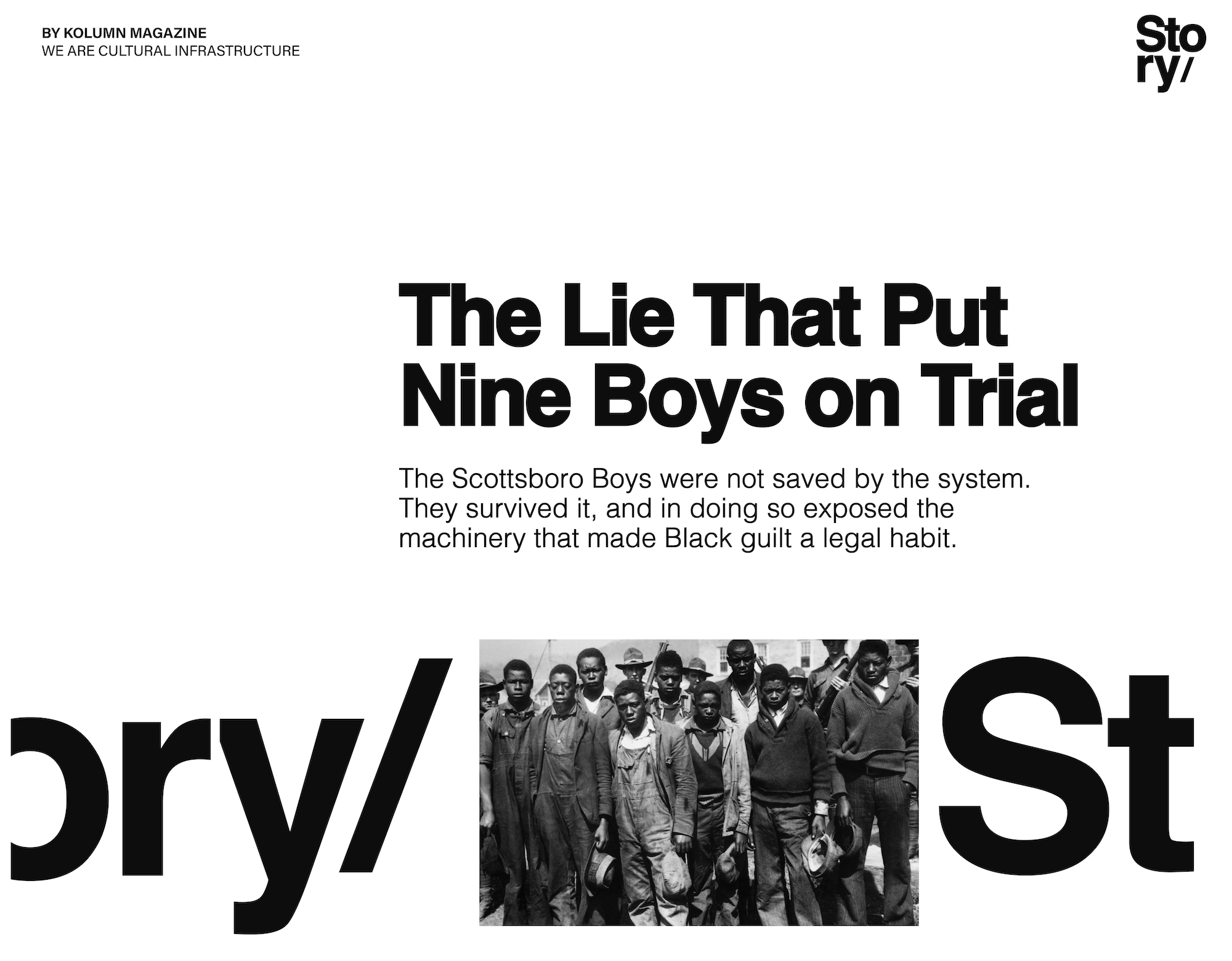
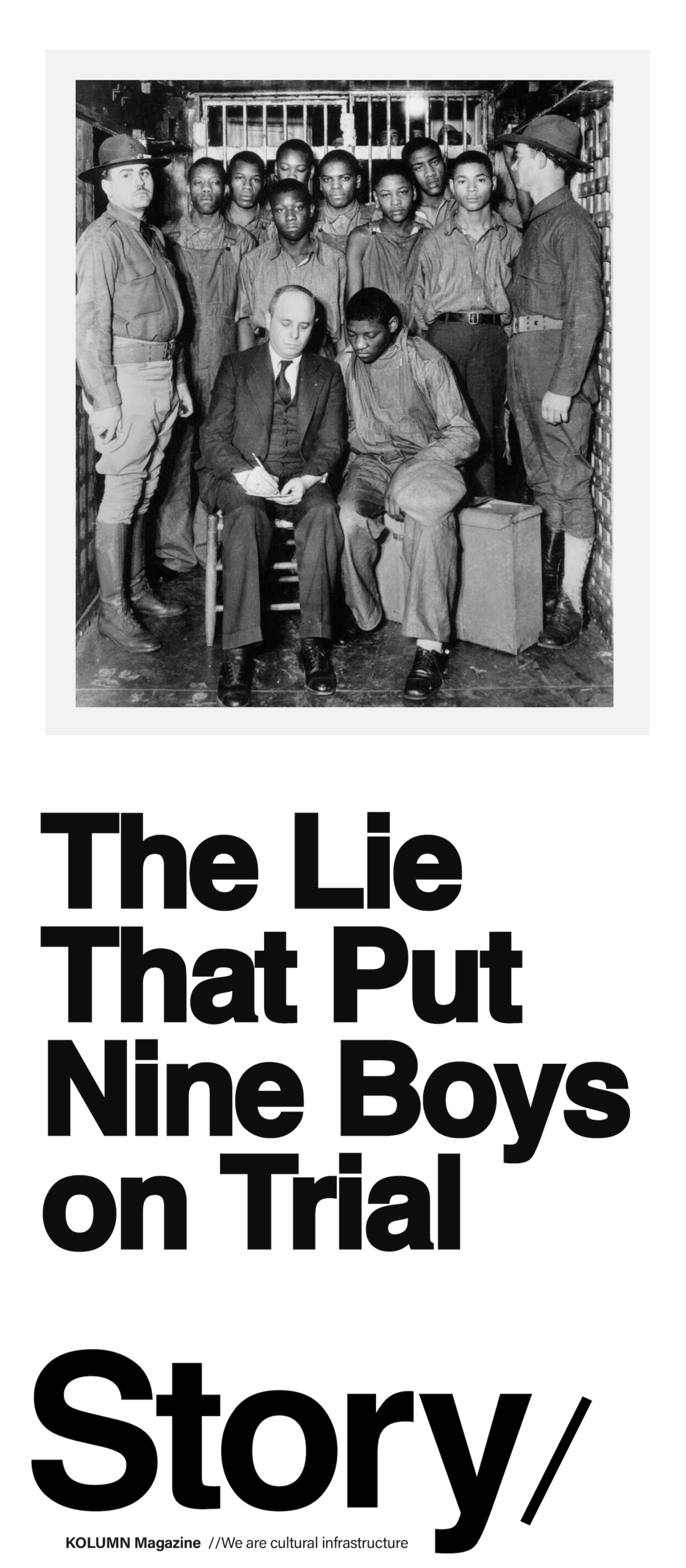
On March 25, 1931, a freight train moving through northern Alabama carried the raw material of the Great Depression: hunger, motion, suspicion, young people leaving one hard place for another, and a country so accustomed to Black disposability that a lie could become a death sentence before dinner. The nine Black teenagers who came to be known as the Scottsboro Boys—Haywood Patterson, Clarence Norris, Charlie Weems, Andy Wright, Roy Wright, Ozie Powell, Willie Roberson, Eugene Williams and Olen Montgomery—were not a political organization, a criminal gang or a single body moving through history with one intention. They were boys and young men riding the rails in search of work, caught in a racial order that could convert an encounter on a train into a spectacle of punishment.
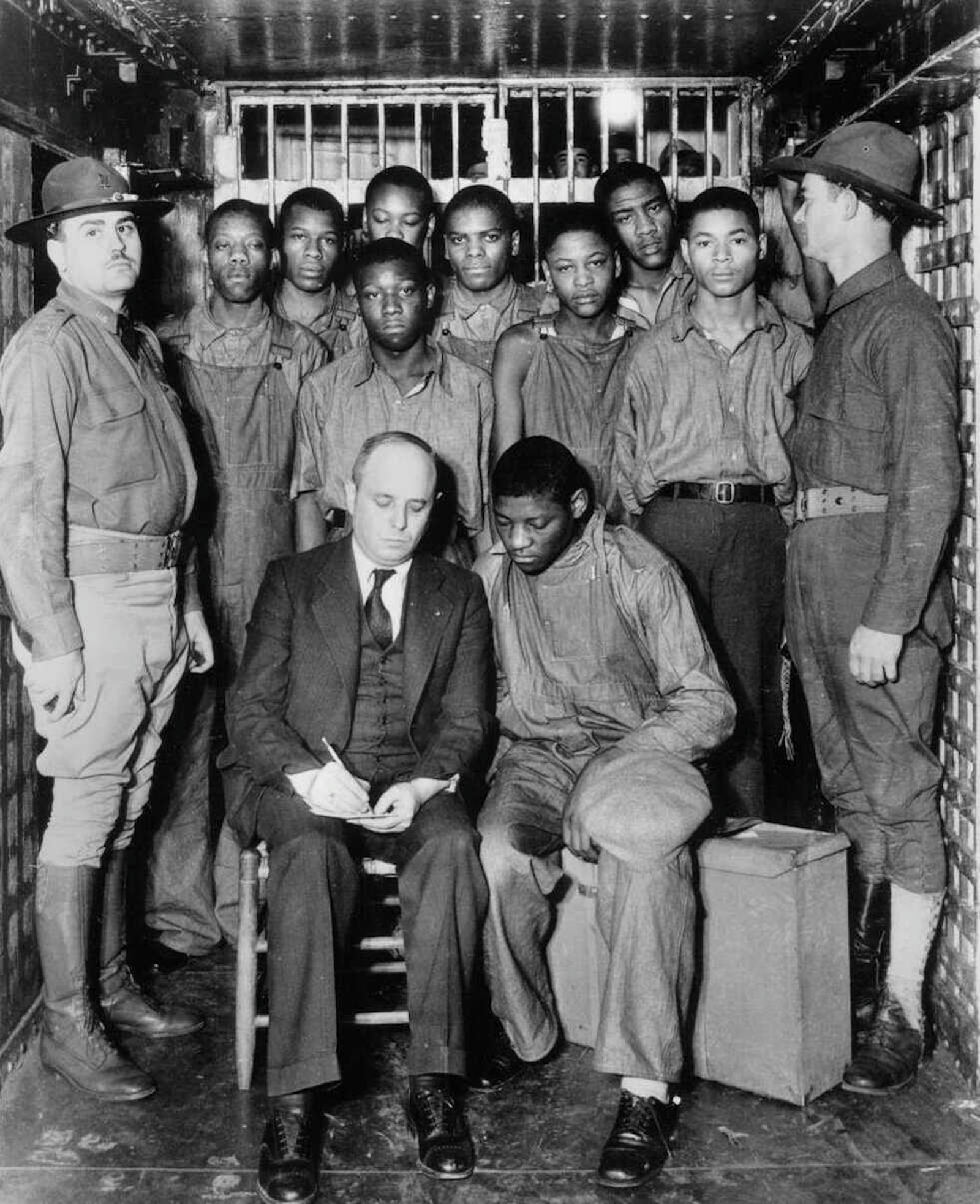
The broad outline is now familiar because the case became one of the most infamous legal episodes of the 20th century: nine Black youths were accused of raping two white women aboard a Southern Railway freight train near Scottsboro, Alabama, and, as the Smithsonian’s National Museum of African American History and Culture explains in its account of the Scottsboro Boys, the first convictions came with stunning speed. Eight were sentenced to death. The youngest, Roy Wright, was spared only because jurors could not agree whether a child should be executed or imprisoned for life.
That narrow escape was not mercy. It was the shape of Jim Crow justice revealing itself. A system that presented itself as law had absorbed the logic of lynching; the courthouse did not replace the mob so much as refine it. The Scottsboro Boys were not merely defendants. They were made into symbols of white fear, Black vulnerability, Communist organizing, liberal legal reform, Southern defiance, and the long struggle to force American courts to recognize Black defendants as rights-bearing human beings.
A Train in the Depression
The train mattered because it was both literal and emblematic. In 1931, the United States was deep in economic collapse. Young men rode boxcars because work had vanished, families were scattered, and the road offered the illusion of possibility when home offered only hunger. The Scottsboro Boys were part of that larger Depression migration, but Black poverty carried a different legal exposure. To be poor and white was dangerous. To be poor and Black in Alabama was to be one accusation away from annihilation.
The events began after a fight between Black and white riders on the train. When the train stopped near Paint Rock, an armed posse took the Black youths into custody. Two white women, Victoria Price and Ruby Bates, also on the train, accused them of rape. PBS’s “American Experience,” in its documentary materials on Scottsboro: An American Tragedy, describes the accusation as emerging after the train was stopped and the young men were seized by authorities. In the legal and racial climate of Alabama, the accusation required little evidence to become destiny.
The medical evidence did not support the story of gang rape. The testimony shifted. The timelines strained belief. Ruby Bates would later recant and say no rape occurred. But the facts did not govern the first trials. Racial mythology did. The image of Black male sexual danger, one of the oldest instruments of white supremacist power in the South, was enough to produce public frenzy and judicial momentum.
That mythology had already justified lynching across the region. The Scottsboro case arrived during a period when anti-lynching campaigns were pressing the nation to confront racial terror, but the machinery of Southern law often served the same ends with greater respectability. The defendants were tried in a mob atmosphere, with little meaningful preparation by counsel, before all-white juries in a state where Black citizens were systematically excluded from jury service.
The Speed of Condemnation
The first trials were less proceedings than rituals of confirmation. The defendants were indicted, tried and condemned with astonishing haste. As the Equal Justice Initiative notes in its history of Scottsboro and racial injustice, all-white juries delivered guilty verdicts even though evidence pointed toward innocence, including the later recantation by one accuser. What Alabama produced was not a search for truth. It was an official performance of racial order.
The state’s posture depended on an old Southern argument: that trials themselves proved civilization. White officials could say the boys were not lynched, as though the mere existence of a courtroom transformed racial vengeance into due process. This was one of the case’s enduring lessons. Procedure can be used as camouflage. A judge, a jury, a transcript and a sentence do not guarantee justice when the rules have already been bent around a racial conclusion.
The defendants’ youth should have mattered. Eugene Williams was 13. Roy Wright was 14. Ozie Powell and Willie Roberson were 16. Olen Montgomery was 17 and nearly blind. Several of the boys barely knew one another. Yet the state treated them as interchangeable Black bodies. Individual biography disappeared into the accusation. The name “Scottsboro Boys” later gave the case historical coherence, but it also risks flattening the lives at stake. They were not born as symbols. They were made into them by a system that refused to see them as children.
The Communist Defense and the Fight Over Meaning
The case became national and then international because activists made it so. The International Labor Defense, associated with the Communist Party, took up the case early and framed Scottsboro as proof that capitalism, racism and state violence were intertwined. The NAACP, more cautious at first and wary of Communist leadership, eventually became part of the broader struggle over defense strategy, public narrative and Black civil rights politics.
This rivalry has shaped Scottsboro historiography for decades. Dan T. Carter’s landmark book, Scottsboro: A Tragedy of the American South, helped establish the case as a central drama of Southern history, legal injustice and Depression-era politics. James Goodman’s later Stories of Scottsboro pushed the historiography further by emphasizing competing narratives—Black defendants, white accusers, Communist organizers, Southern officials, journalists, lawyers and ordinary citizens all struggling to define what Scottsboro meant.
That interpretive shift matters. Scottsboro was never just a case file. It was a battle over who had authority to narrate the South. Was it a story about innocent boys? A story about class struggle? A story about white womanhood and racial terror? A story about constitutional law? A story about the limits of liberal reform? Goodman’s method, praised by reviewers for refusing a simple morality play, helps explain why Scottsboro remains inexhaustible. The case is clarifying not because it is simple, but because so many American systems reveal themselves inside it.
The case also exposed the power and peril of outside advocacy. Samuel Leibowitz, the New York defense lawyer who later entered the case, became famous for his courtroom skill and his fierce confrontation with Alabama’s legal system. Yet his outsider status also gave Southern officials a way to cast the defense as alien interference. The state could defend injustice as local sovereignty, a pattern that would recur throughout the civil rights era.
The Supreme Court Enters
Scottsboro changed American constitutional law because the injustice was too visible to remain local. In Powell v. Alabama, decided in 1932, the United States Supreme Court held that the defendants had been denied due process because they had not been given a meaningful opportunity to secure counsel. The ruling did not declare the boys innocent. It did something narrower and still profound: it recognized that in a capital case, the appointment of counsel must be real, timely and effective enough to matter.
The decision stands as a landmark in the development of the right to counsel. The Court’s opinion, available through Justia’s archive of Powell v. Alabama, made clear that the formal presence of a lawyer is not enough when the circumstances make actual defense impossible. This distinction remains central to criminal procedure. A lawyer in name only can become another instrument of conviction.
Harvard Law School clinical professor Dehlia Umunna, discussing the case in Harvard’s “Cases in Brief” series, described Powell as a foundational case involving young Black men falsely accused, rushed through trial and repeatedly convicted by all-white juries. Her framing underscores what legal summaries can sometimes drain away: constitutional doctrine emerged here from the terror inflicted on actual children.
Three years later, the Supreme Court again intervened. In Norris v. Alabama, the Court confronted the systematic exclusion of Black people from jury service. The ruling recognized that a criminal conviction cannot stand when the jury system itself has been racially engineered. The ACLU, in its history of the Scottsboro Boys case, notes that Norris unanimously overturned a conviction because African Americans had been excluded from jury pools, violating constitutional guarantees of equal protection and fair trial.
These decisions did not free the Scottsboro Boys immediately. That is one of the cruelties of the story. The law changed, but the defendants remained trapped in Alabama’s determination to punish them. The Supreme Court could order new trials, but it could not, by opinion alone, dismantle the local culture that had made the prosecutions possible.
Ruby Bates, Victoria Price and the Politics of White Womanhood
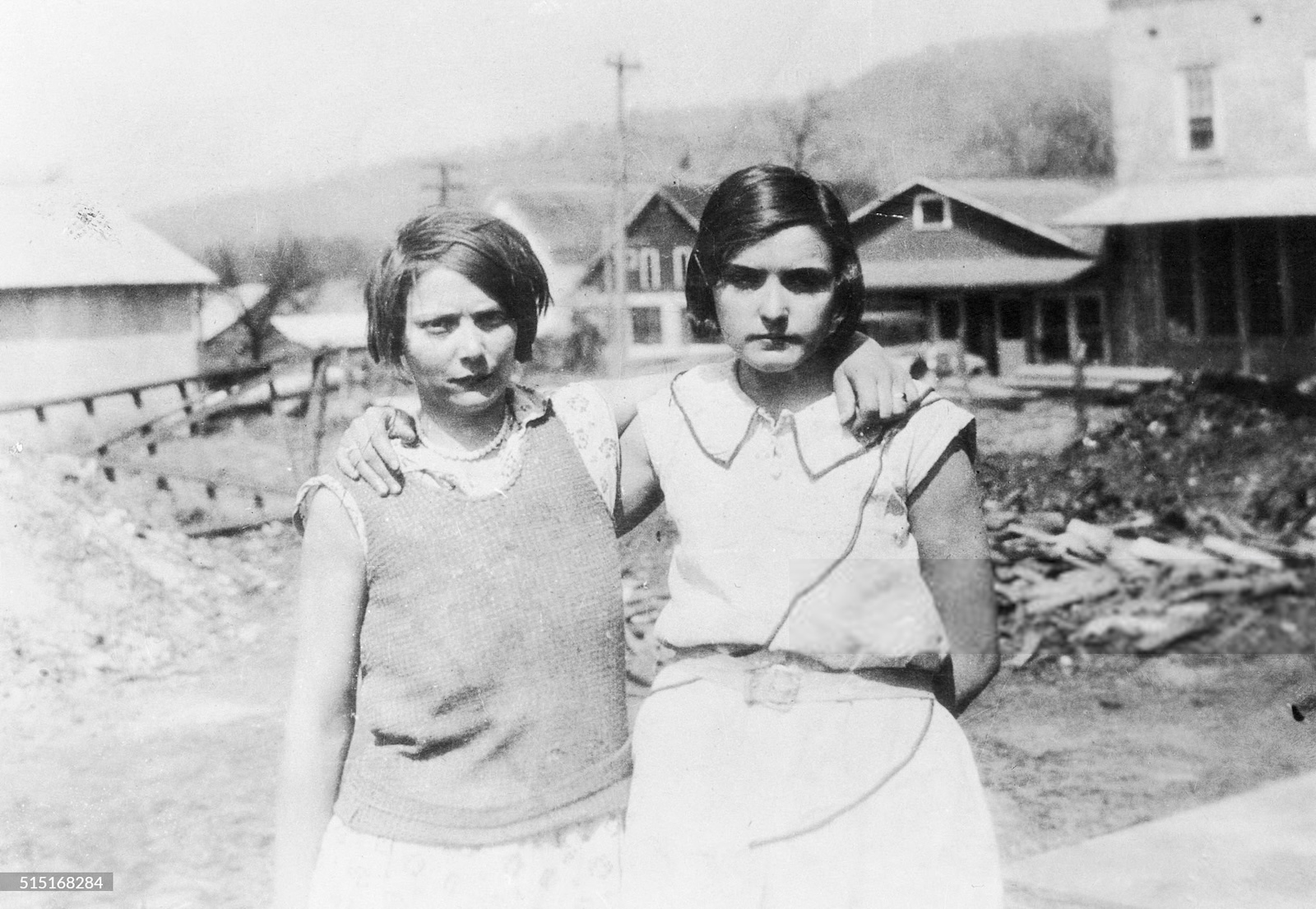
No honest account of Scottsboro can ignore the role of white womanhood in the case. Victoria Price never recanted. Ruby Bates did, later testifying that no rape had occurred. Their lives were shaped by poverty, gendered vulnerability and the harsh moral codes imposed on working-class women in the South. But the legal power of their accusation came from whiteness, not from gender alone.
White Southern society often treated white women as symbols to be protected, but that protection was selective and political. Poor white women could be shamed, policed and exploited; at the same time, their accusations against Black men could be weaponized to reaffirm white male authority. Scottsboro sat inside that contradiction. Price and Bates were not elite Southern women guarded by plantation mythology. They were working-class women whose own behavior on the train may have exposed them to arrest or disgrace. The rape accusation transformed them from vulnerable subjects into instruments of racial prosecution.
This does not require caricature. Historians have been careful to resist reducing the women to stock villains. The stronger point is structural. Jim Crow did not need perfect witnesses. It needed usable witnesses. Once the accusation aligned with the racial needs of Alabama’s legal order, inconsistencies became secondary.
The Boys After the Headlines
The tragedy of Scottsboro did not end with Supreme Court opinions or newspaper campaigns. The defendants lost years to prison, parole conditions, poor health, poverty, public scrutiny and the psychological wreckage of being condemned by a lie. Some were released earlier than others. Some fled. Some struggled to rebuild lives that had been permanently interrupted.
Haywood Patterson escaped from prison in 1948, later published a memoir, and died after a barroom altercation in Michigan. Clarence Norris, the last surviving Scottsboro defendant, lived for years as a fugitive after violating parole before receiving a pardon from Alabama Governor George Wallace in 1976. The Innocence Project’s account of the later Scottsboro pardons notes that Norris had been pardoned before his death, while Alabama did not create a path for posthumous pardons until decades later.
In 2013, Alabama finally issued posthumous pardons to Haywood Patterson, Andy Wright and Charlie Weems. The act was symbolically important and morally insufficient. A pardon can clear a name, but it cannot return childhood, restore years in prison, undo the terror of execution dates, or repair the damage done to families who watched the state build a case out of racial fiction.
The National Museum of African American History and Culture notes that the Scottsboro Boys collectively served more than 100 years in prison. That number is almost too clean for the damage it represents. It compresses hunger, fear, solitary endurance, lost wages, broken kinship, illness, stigma and the strange burden of becoming historically important through suffering.
Scottsboro’s Place in KOLUMN’s Larger Archive
For KOLUMN readers, Scottsboro belongs beside other cases in which Black innocence was forced to survive the machinery of official guilt. KOLUMN’s recent story on the Groveland Four argued that some cases are not miscarriages of justice in the narrow sense, but revelations of justice operating exactly as Jim Crow intended. Scottsboro is one of the clearest examples of that principle. The scandal was not simply that safeguards failed. The scandal was that the safeguards were embedded in a system designed to protect white authority first.
KOLUMN’s account of Johnnie Mae Chappell likewise shows how long racial violence can remain unresolved when institutions treat Black suffering as administratively inconvenient. Scottsboro offers the earlier legal architecture of the same problem: evidence discounted, Black life devalued, official delay mistaken for closure. The archive is not repetitive. It is cumulative. Each case reveals a different chamber in the same house.
The Scottsboro Boys also connect to KOLUMN’s broader interest in Black memory as infrastructure. A society that forgets Scottsboro does not merely lose a historical episode. It loses a diagnostic tool. The case helps readers understand why jury composition matters, why public defense matters, why media framing matters, why local courts cannot always be trusted to police local racial power, and why innocence alone has never guaranteed safety for Black defendants.
Historiography and the Problem of the “Landmark”
The phrase “landmark case” can domesticate Scottsboro. It invites readers to imagine a clean arc: injustice, appeal, Supreme Court correction, progress. That is not what happened. The case did produce landmark rulings, but the defendants continued to suffer. The Court’s interventions were vital, yet partial. The system conceded procedural principles while Alabama kept trying to convict.
Legal historian Michael J. Klarman, in scholarship on Scottsboro and constitutional change, has argued that the case must be understood not only as doctrine but as a collision among law, politics, public opinion and racial power. His Marquette Law Review article on Scottsboro places the case within a larger debate about whether Supreme Court decisions drive social change or respond to pressures already building outside the Court. Scottsboro suggests both. The Court mattered, but so did protest, journalism, radical organizing, Black institutional pressure and international embarrassment.
That is why the historiography is so rich. Carter’s work placed the case within the tragic landscape of the American South. Goodman’s work emphasized narrative plurality and the instability of public memory. Legal scholars have treated Scottsboro as a foundation for criminal procedure. Civil rights historians have seen it as a precursor to later movement lawyering. Left historians have emphasized the International Labor Defense and the Communist Party’s role in forcing the case into global consciousness. Memory institutions now frame Scottsboro as a story of wrongful conviction and racial terror.
Each lens is necessary, but none is sufficient alone. Scottsboro was a legal case, but not only a legal case. It was a media event, but not only a media event. It was a civil rights milestone, but not only a civil rights milestone. It was, above all, a demonstration of how quickly a racial state could convert Black youth into condemned men.
Expert Voices and the Continuing Legal Shadow
Modern experts often return to Scottsboro because its questions remain unsettled. What does the right to counsel mean if public defense systems are underfunded? What does equal protection mean if juries are still shaped by exclusion, peremptory strikes or racially skewed local politics? What does due process mean when media narratives decide guilt before evidence is tested?
The Equal Justice Initiative’s work on racial terror and wrongful convictions gives Scottsboro contemporary force. EJI’s framing of the case emphasizes that the defendants were falsely accused, nearly lynched, condemned by all-white juries and pursued by the state despite exculpatory evidence. That language matters because it refuses euphemism. Scottsboro was not merely “controversial.” It was an injustice built from recognizable parts: racial panic, legal abandonment, prosecutorial stubbornness and public appetite for punishment.
The Office of Justice Programs, reflecting on the Scottsboro Boys Museum, has described the nine young men as international symbols of racial injustice and linked their memory to ongoing work for equity in the justice system. The museum itself, housed in historic Joyce Chapel, describes its location as the former home of the first African American church in Jackson County. That setting is fitting. The memory of Scottsboro is preserved not in marble distance, but in a Black sacred space, where testimony and survival remain close.
The International Case
Scottsboro became global because it exposed the contradiction between American democratic rhetoric and American racial practice. International activists, newspapers and political organizations saw in the case a brutal answer to U.S. claims of liberty. The Communist press made Scottsboro a world cause. Black newspapers followed it closely. The case traveled because its meaning was portable: a modern nation claiming constitutional virtue had nearly executed boys after trials that made a mockery of justice.
That international pressure embarrassed Alabama and the United States, but it also complicated domestic civil rights politics. Some liberals who supported the defendants worried about Communist influence. Some Black leaders feared that radical control of the case could endanger the boys. Yet without radical agitation, Scottsboro might never have become too visible to bury.
This is one of the uncomfortable lessons of the case. Respectable reform often needs disruptive pressure to make injustice unavoidable. The defendants required courtroom skill, but they also required mass protest. They required appeals, but also headlines. They required legal doctrine, but also political shame.
Why Scottsboro Still Matters
The significance of the Scottsboro Boys lies not only in what was done to them, but in what their case forced the country to admit. It forced the Supreme Court to recognize that counsel must be meaningful in capital cases. It forced national attention onto the exclusion of Black jurors. It exposed the danger of all-white juries sitting in judgment of Black defendants in racially charged cases. It demonstrated how quickly sexual accusation, racial mythology and economic precarity could merge into state violence. It gave civil rights lawyers, activists and organizers a template for turning local injustice into national crisis.
Yet the deepest significance may be moral rather than doctrinal. Scottsboro reminds us that innocence is not self-executing. Facts do not speak in court unless someone is allowed to make them audible. Rights do not defend themselves unless institutions are forced to honor them. The law does not become justice simply because it has rules.
The Scottsboro Boys were eventually vindicated in history, but history’s vindication came late. Too late for childhood. Too late for peace. Too late for the ordinary lives they might have lived. Their names remain because they were nearly erased. Their case remains because it clarified something America has often tried to obscure: racial injustice is not only the absence of law. Sometimes it is law, wearing its proper clothes.
The boys on that train did not set out to change constitutional law. They were looking for work, movement, survival. The country gave them chains, trials, prison numbers and headlines. Nearly a century later, the task is not to turn them into monuments so polished that their suffering becomes abstract. The task is to remember them as boys first, defendants second, symbols only because America made them so.
Scottsboro endures because it refuses closure. It asks whether the legal system has changed enough, whether public memory is honest enough, whether innocence is protected equally enough, and whether the nation can bear to see the children it once tried to kill in the name of law.
More great stories
Afro Sheen, Wall Street, and the Architecture of Black Possibility
July 6, 2026
No Comments
The Fire Inside the Fourth
July 5, 2026
No Comments