




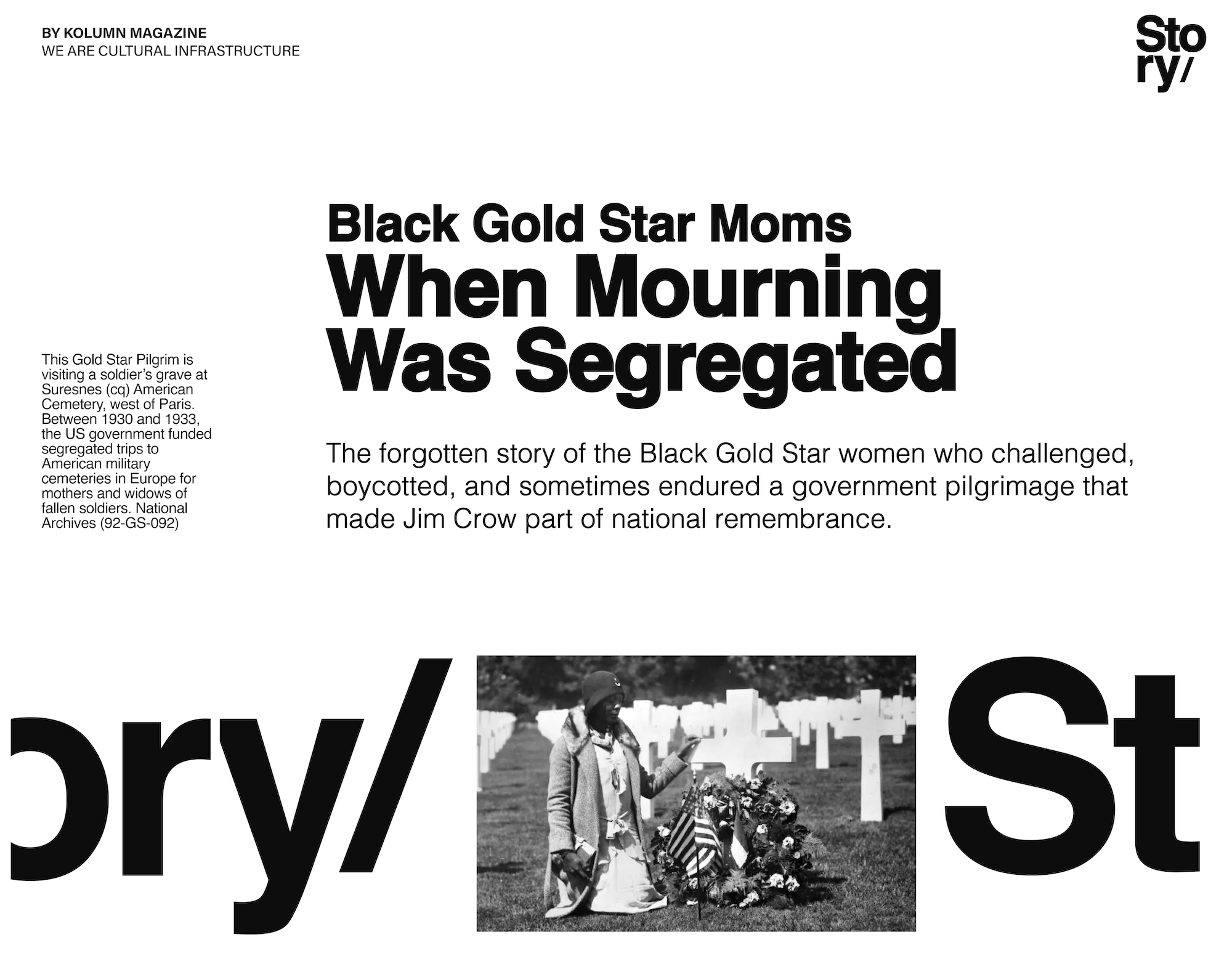
The government did not merely tolerate segregation in this episode. It administered it, scheduled it, defended it, and dressed it in the language of care.
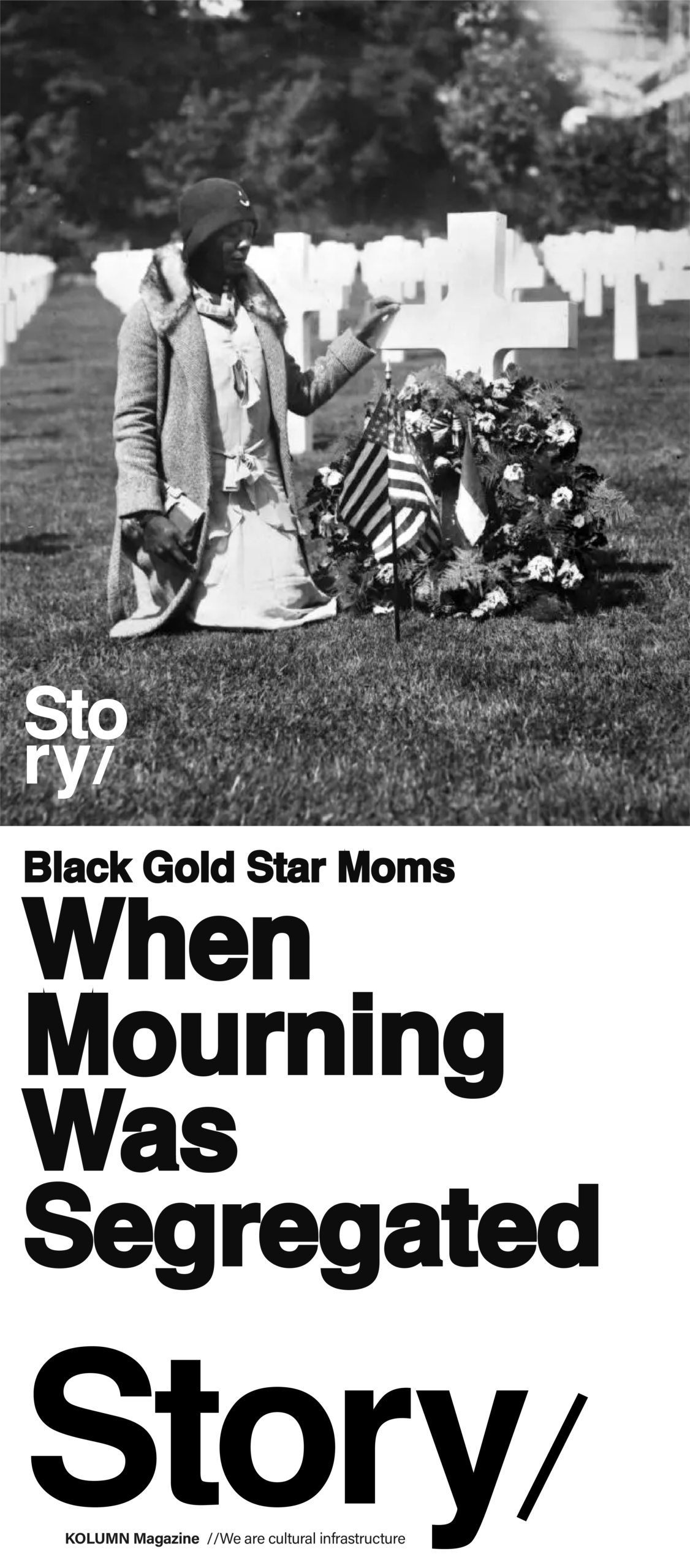
The government did not merely tolerate segregation in this episode. It administered it, scheduled it, defended it, and dressed it in the language of care.
By KOLUMN Magazine
The American state has always known how to stage mourning. It knows the flag-draped casket, the bugle’s last note, the careful choreography of military honor. It knows how to turn private loss into public language: sacrifice, gratitude, service, nation. But in 1930, when the U.S. government began sending Gold Star mothers and widows across the Atlantic to visit the graves of husbands and sons who had died in World War I, it also revealed something colder and more enduring. Even grief, if the grieving were Black, could be segregated.
The pilgrimages were conceived as a grand act of national tenderness. Congress had authorized the program on March 2, 1929, giving mothers and un-remarried widows of American service members buried or memorialized overseas the chance to travel at federal expense to American cemeteries in Europe. The American Battle Monuments Commission later summarized the undertaking as one in which the government recognized the sacrifices of women whose loved ones had been buried abroad, noting that 6,654 women participated between 1930 and 1933 in trips organized with Army precision and patriotic ceremony through the Gold Star Mothers and Widows Pilgrimages.
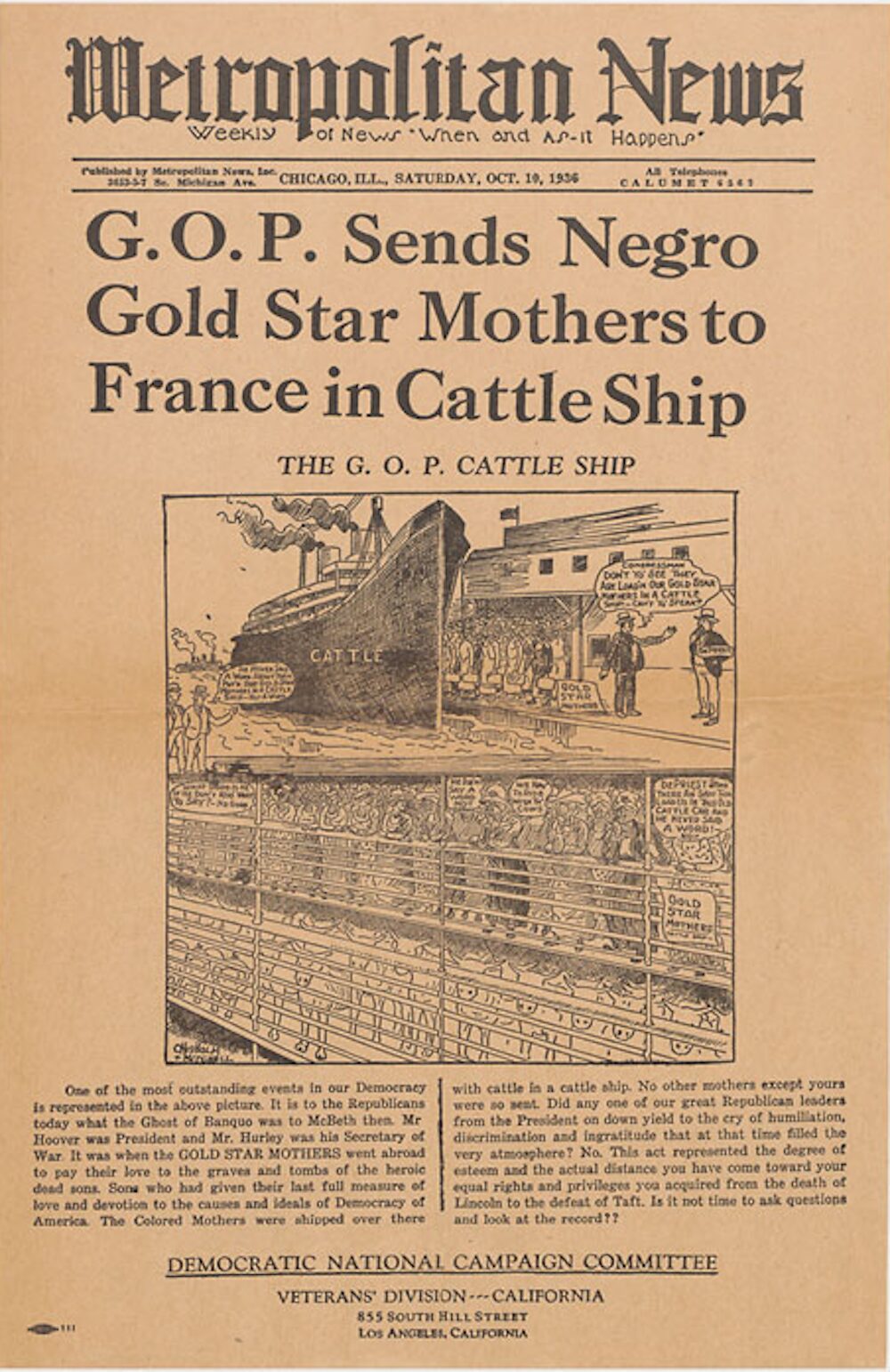
But recognition came divided. The War Department, through the Army Quartermaster Corps, racially segregated the pilgrimages. White mothers and widows traveled in one set of parties; Black mothers and widows traveled in another. White women sailed on luxury liners. Black women were routed onto commercial steamers. The official language was comfort, order, practicality. The meaning was Jim Crow.
The cruelty of the policy was sharpened by the occasion. These women were not asking for charity. They were claiming the right to mourn men who had died in uniform. Their sons and husbands had served in a segregated Army, endured the humiliations of American racism, and in many cases were asked to fight for democracy abroad while denied its substance at home. Now their mothers and widows were told that even the pilgrimage to their graves would be organized by race.
The National Archives’ account of the pilgrimages names the contradiction plainly: the journey brought together women across class, religion, nativity and region, but race remained the dividing line; African American women were segregated from white pilgrims, and accommodations differed in practice despite official assurances of equality in World War I Gold Star Mothers Pilgrimages, Part I.
This was not an administrative footnote. It was a national argument over who counted as a mother of the nation.
The Making of a Federal Pilgrimage
The phrase “Gold Star” emerged from wartime service flags, where a blue star represented a family member serving in the military and a gold star marked a death in service. After World War I, Gold Star mothers and widows became symbols of sacrifice, and organizations of bereaved women pressed Congress for the means to visit overseas graves. Many families had faced a wrenching decision after the war: repatriate the body or allow burial in an American cemetery abroad. For those whose sons and husbands remained in Europe, the grave could feel unreachable.
By the late 1920s, Gold Star organizations had made that distance a political issue. The government had buried their dead overseas; the government, they argued, owed the living a chance to stand at the grave. When Congress approved the pilgrimages in 1929, the program became something rare in American public life: a federally funded, carefully organized journey of mourning for women.
Jim Crow often announced itself not as hatred, but as management.
The Army Quartermaster Corps managed the operation. The government paid travel expenses, arranged transportation, supervised schedules, provided escorts, nurses and hostesses, and built the trip around both cemetery visits and patriotic rituals. The pilgrims visited graves, battlefields, memorials and Paris landmarks. At cemeteries, staff decorated graves with American and host-country flags, provided chairs beside headstones, and made space for women to sit with the dead. The American Battle Monuments Commission describes pilgrims laying wreaths and receiving photographs of themselves at the graves, gestures meant to add dignity and consolation to the journey in its overview of the program.
For white women, the experience was cast as a state-sponsored rite of national gratitude. For Black women, the rite came with the terms of caste.
In early 1930, the Hoover administration announced that Black and white women would be divided into separate groups. Officials insisted this would be done “in the interests of the pilgrims themselves,” with no discrimination intended, a formulation preserved by the Smithsonian’s National Museum of African American History and Culture in its account, Honoring Our Gold Star Mothers. The War Department argued that separate groups would assure “contentment and comfort,” language quoted in the National Archives’ Prologue essay on Gold Star Mothers Pilgrimages.
It was the old architecture of segregation disguised as benevolence. Officials did not say Black women were unworthy. They said separation was practical. They did not say white supremacy was the policy. They said the mothers might prefer companions “of their own race.”
The government’s claim of equal treatment broke down almost immediately. National Archives historian Constance Potter documented that white women traveled on luxury liners while African American women traveled on commercial steamers in Part I, and her follow-up on Katherine Holley’s journey notes that Black and white parties often had the same broad itineraries but remained segregated, with Black women assigned to separate parties and different arrangements in Part II.
Segregation was not incidental to the trip. It was built into the manifest.
The Petition Against a “Gratuitous Insult”
Black women and civil rights leaders did not quietly accept the policy. In May 1930, with support from the NAACP, 55 Black Gold Star mothers and widows from 21 states petitioned President Herbert Hoover to end the segregation. The American Battle Monuments Commission’s teaching materials note that the petition was sent to Hoover in May 1930 and that the women initially planned not to go if forced to travel separately in African American Gold Star Mothers.
The petition’s opening line, preserved in later reporting and scholarship, cut through the War Department’s euphemisms: “As a Gold Star Mother who happens to be colored I wish to protest against the gratuitous insult.” The sentence mattered because it reversed the government’s framing. The women were not asking to be admitted into white grief. They were asserting that their status as Gold Star women already entitled them to equal treatment.
Johns Hopkins University’s Freedom Papers exhibit describes the protest as an assertion of citizenship rights, noting that Black mothers and widows claimed the same military benefits afforded white mothers and widows, and that the NAACP-drafted letter signed by 55 women pledged refusal rather than submission to segregation in Black Gold Star Mothers.
The War Department refused.
The decision carried symbolic force because it came from the federal government itself. This was not a Southern railway car, not a local hotel, not a county clerk’s office. It was Washington deciding that the women who had surrendered sons and husbands to the republic would be honored according to racial hierarchy.
The Black press understood the stakes. Newspapers such as the Chicago Defender and the Pittsburgh Courier treated the episode as a front-page civil rights issue, not a social slight. The government was not merely insulting Black women; it was desecrating Black military sacrifice. The contradiction was unbearable: the same nation that could send Black men to war could not allow their mothers to share a ship with white women after death.
In the historiography of the pilgrimages, this protest has become central. Rebecca Jo Plant and Frances M. Clarke’s landmark Journal of American History article, “The Crowning Insult”: Federal Segregation and the Gold Star Mother and Widow Pilgrimages of the Early 1930s, argues that the episode reveals the shifting landscape of Black politics in the interwar period and the extraordinary position of women who had to weigh racial solidarity, personal grief and public protest. In an interview with the Organization of American Historians, Plant and Clarke said the story drew them because it had received front-page Black newspaper coverage yet appeared only fleetingly in historical accounts; they described the controversy as a moment when the Hoover administration revealed the depth of the state’s commitment to segregation in Federal Segregation and Gold Star Mothers.
That is the essential historiographical turn. Earlier accounts often treated the pilgrimages as a moving veterans’ history or women’s history episode. Plant and Clarke re-center the Black women and the political conflict their choices exposed.
Boycott, Grief and the Burden Placed on Black Women
Once the government refused to desegregate the trips, the question became painfully intimate: should Black mothers and widows boycott, or should they go?
Civil rights leaders and Black newspapers urged resistance. Some women agreed, rejecting the “Jim Crow invitation” as an insult to the dead. The Alaska Digital Newspaper Project’s historical discussion quotes one woman saying that taking the trip would insult the son who had died for his country, and another saying that accepting the invitation would dishonor her husband’s memory in Gold Star Mothers, WWI, and Jim Crow.
But boycott was not an abstract tactic for the women themselves. It meant surrendering perhaps the only chance they would ever have to stand at a grave in France. It meant choosing between the politics of protest and the ache of personal mourning. The country had already taken their sons and husbands. Now the race struggle asked them to sacrifice the visit, too.
The boycott demanded moral clarity from women whose grief had already been made into public property.
This is where Plant and Clarke’s scholarship is especially important. Their work refuses to flatten the women into symbols. Some boycotted. Some protested and later went. Some went despite pressure not to. Some, as the Johns Hopkins exhibit argues, affirmed their right to grieve and define freedom for themselves as Black mothers and wives in Black Gold Star Mothers.
The numbers vary depending on source and method, which itself reveals the difficulty of recovering Black women’s experience from federal records. The American Battle Monuments Commission states that 168 African American women participated in the pilgrimages in its program history. ABMC educational materials also note that 624 of 17,389 eligible women were African American in African American Gold Star Mothers. Plant and Clarke’s later scholarship, summarized in public discussions of their article, has identified roughly 279 Black women who ultimately made the journey, while noting that dozens upheld the boycott.
The discrepancy should not be ignored. It should be explained. Official commemoration, teaching materials, archival files and later scholarly reconstruction do not always count the same categories in the same way: mothers versus widows, invited women versus participating pilgrims, scheduled groups versus completed travel. The more important point is not a single tidy figure. It is that hundreds of Black women were eligible, dozens resisted, and a significant number crossed the Atlantic under rules that marked their mourning as racially separate.
Their decisions were not contradictions. They were evidence of the impossible position Jim Crow created.
Katherine Holley and Party Q
One of the clearest windows into the pilgrimages comes through Katherine B. Holley, a Black widow from West Virginia whose husband, Lewis A. Holley, was buried overseas. The National Archives follows her journey in detail, using Graves Registration Service files and Quartermaster records to reconstruct the human story behind the bureaucracy.
Holley was assigned to Party Q, an Oise-Aisne group composed of African American women. The party sailed from New York aboard the American Merchant, with Col. Benjamin O. Davis as officer in charge. Davis, then one of the highest-ranking Black officers in the Army and later the first African American brigadier general, escorted multiple Black Gold Star pilgrimage groups, according to the National Archives’ account of Katherine Holley’s trip.
There is a painful irony in Davis’s role. His presence gave the women a Black officer of dignity and distinction in a segregated system. Yet his assignment also helped the system function. He was there to escort Black women through a policy that should not have existed.
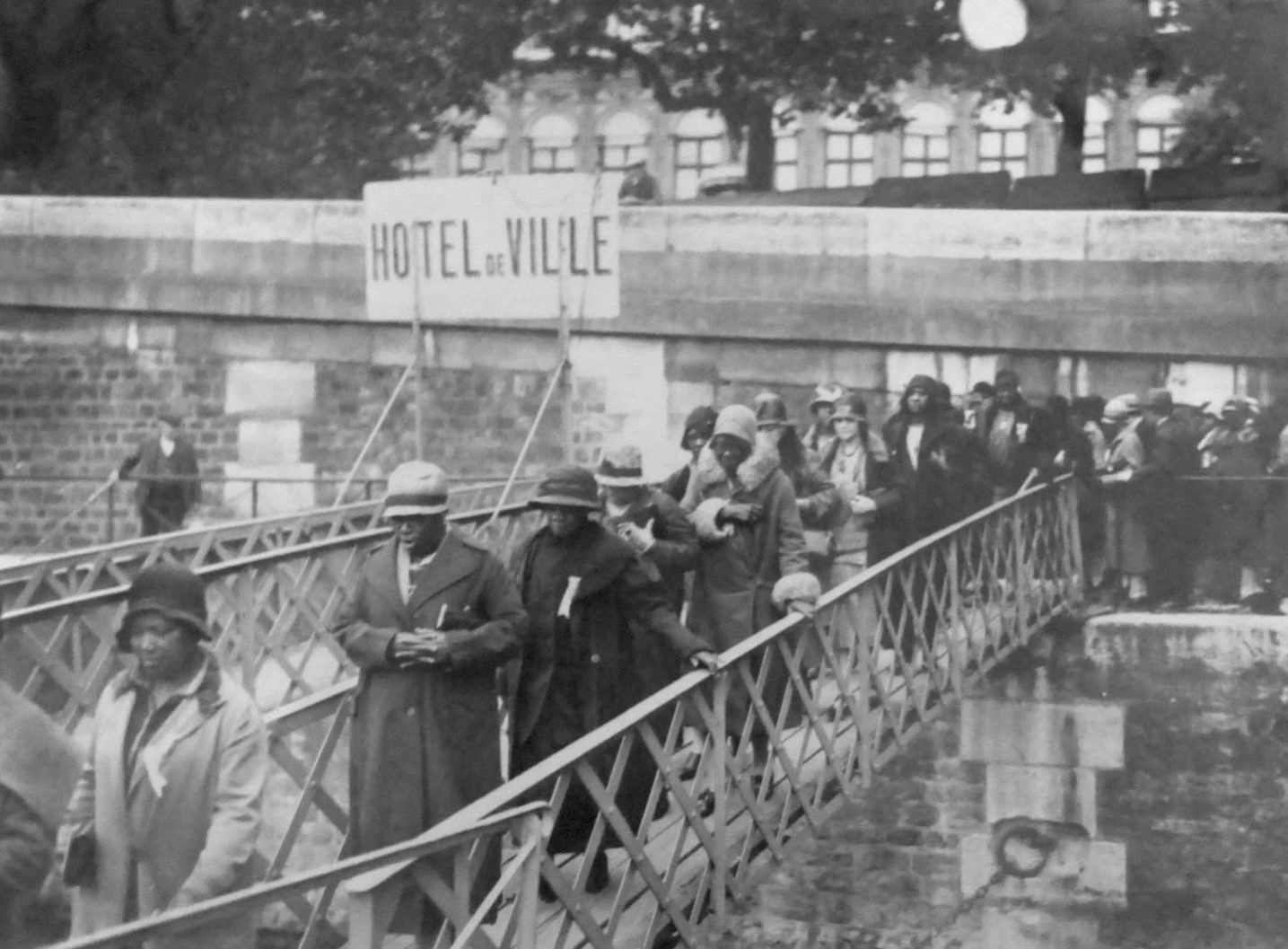
Party Q’s itinerary included Paris, the Arc de Triomphe, the Tomb of the Unknown Soldier, Chateau-Thierry, Belleau Wood and the Oise-Aisne American Cemetery. At the Arc de Triomphe, Louise Kimbro, mother of Martin Kimbro, served as the party’s “honor pilgrim” and laid a wreath, according to National Archives Prologue. The women were greeted with ceremony. They dined, toured, prayed and wept. They entered spaces in France where Black American uniformed sacrifice was legible in ways it often was not at home.
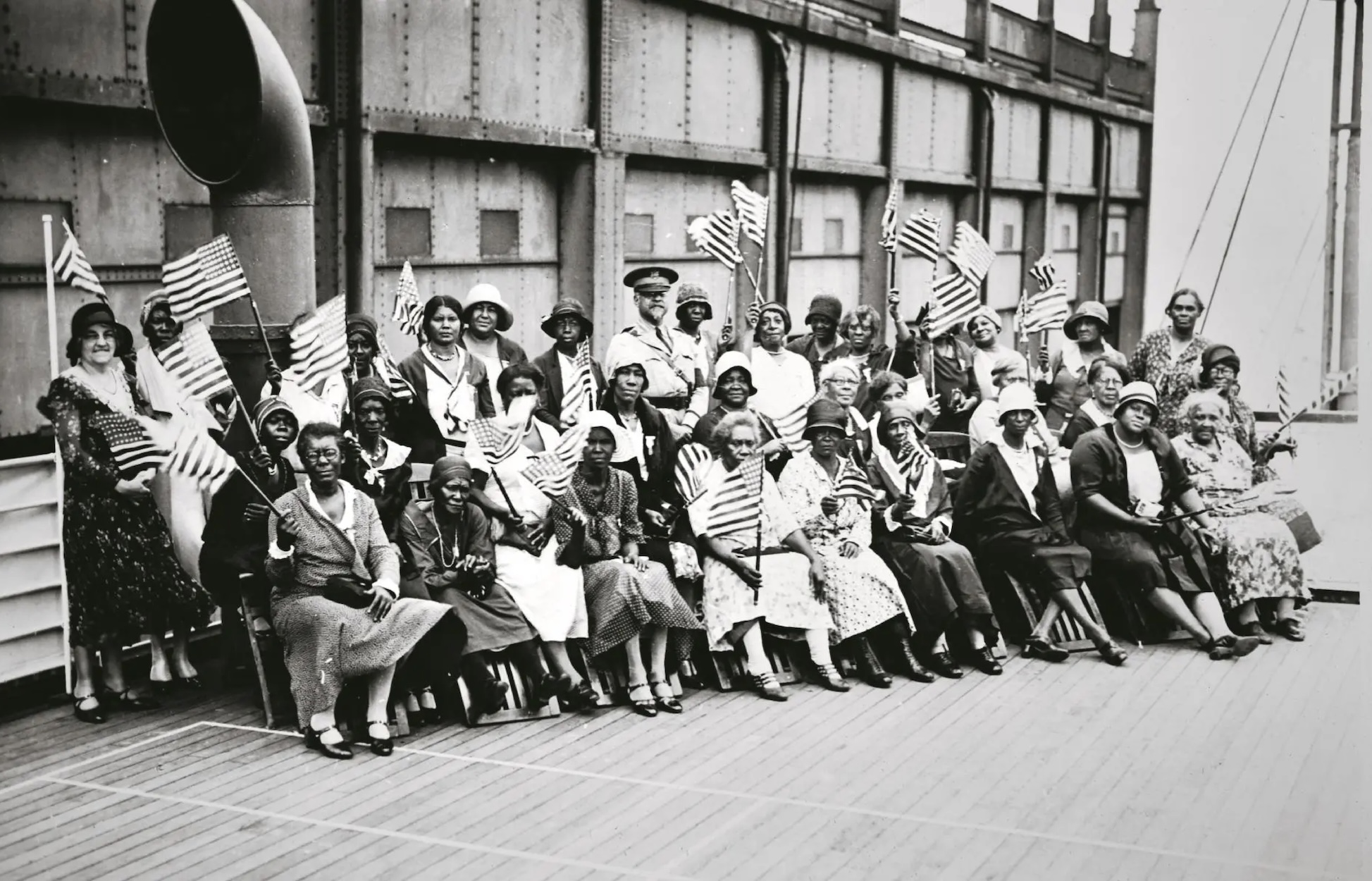
Photographs of Black Gold Star pilgrims complicate the story. Plant and Clarke note in their OAH interview that official images show Black women dining in elegant restaurants, riding first-class train cars, being served by white wait staff, visiting Paris tourist sites and being honored by French and American officers in Federal Segregation and Gold Star Mothers. These images do not excuse the segregation. They reveal the contradictions of federal power: the same government that degraded Black women also documented them as honored guests abroad.
For the women, the cemetery was the center. The administrative record can tell us ship names, room assignments and departure dates. It cannot fully measure what it meant to sit beside a headstone after twelve years of absence. It cannot capture what a mother said when no official was writing.
Democracy Abroad, Jim Crow at Sea
The segregation of the pilgrimages cannot be separated from the broader history of Black military service in World War I. Black soldiers served in a segregated Army under white command, often relegated to labor battalions but also fighting with distinction, most famously in units such as the 369th Infantry. They returned to a country convulsed by racial violence, including the Red Summer of 1919, when Black veterans were among those targeted for asserting rights at home after service abroad.
The pilgrimage controversy thus reopened a wound from the war itself. Black families had been asked to believe in the moral language of the war. Woodrow Wilson had spoken of making the world safe for democracy. Black men had worn the uniform. Black families had endured absence and death. Yet when the state came to honor the bereaved, it reproduced the same racial order the war had failed to disturb.
America revered the Gold Star mother in theory. In practice, it asked whether she was white.
This is why James Weldon Johnson’s reaction was so fierce. Plant and Clarke’s Journal of American History article opens with Johnson reading that Black Gold Star mothers would not sail with white mothers but would instead travel separately on a “second-class vessel,” prompting him to write a satirical poem in protest, as summarized in the article extract for “The Crowning Insult”. Johnson understood that the policy did not merely insult women. It re-inscribed the betrayal of Black soldiers.
The federal government’s defense also exposed the limits of American maternal reverence. Gold Star mothers were publicly exalted as sacred figures, embodiments of national sacrifice. But Black Gold Star mothers were only conditionally sacred. Their motherhood could be honored, but not if honoring it required white women to share space with them.
That contradiction belongs in the same moral archive as KOLUMN Magazine’s recent work on Black remembrance and civic erasure, including its treatment of the Black origins of Memorial Day in Charleston. The throughline is clear: Black Americans have not merely participated in national memory; they have often built it, defended it, and then been pushed out of its official frame.
Historiography: From Veterans’ Ritual to Black Women’s Political History
For decades, the Gold Star pilgrimages appeared mainly in histories of World War I commemoration, women’s patriotism, veterans’ policy and the American Battle Monuments Commission. These accounts rightly emphasized the scale and novelty of the program. No other nation had undertaken quite the same federally funded pilgrimage for bereaved women. The trips were logistically impressive and emotionally powerful.
But the older frame could make segregation appear secondary, almost an unfortunate administrative choice attached to an otherwise benevolent program. Newer scholarship has changed that. Plant and Clarke moved the controversy to the center, arguing that the segregated pilgrimages illuminate Black political struggle, federal power, gendered citizenship and the burdens placed on Black women as symbols of both family and race. In their OAH interview, they describe the women as “so-called ordinary black women” placed in an extraordinary situation, forced to weigh calls for racial solidarity against personal desires in Plant and Clarke: Federal Segregation and Gold Star Mothers.
That shift matters. It changes the question from “Why did the government segregate the pilgrimages?” to “What did Black women do when the government segregated their grief?”
Public history institutions have also begun to reframe the episode. The Smithsonian’s National Museum of African American History and Culture presents the segregated trips as part of the long history of Black sacrifice under unequal citizenship in Honoring Our Gold Star Mothers. Johns Hopkins’ Freedom Papers exhibit emphasizes Black women’s self-definition, including the symbolic power of Black pilgrims holding American flags in official photographs in Black Gold Star Mothers. The National Archives’ Prologue essays ground the story in the documentary record, revealing both the machinery of the pilgrimage and the intimate details of individual women’s journeys in Part I and Part II.
The best contemporary reading holds these frames together. The pilgrimages were acts of state care. They were also acts of state segregation. They gave thousands of women consolation. They forced Black women to accept humiliation as the price of mourning. They produced beautiful photographs. They also produced protest letters.
History rarely offers moral simplicity. But it often offers moral clarity.
What the Black Mothers Knew
The Black Gold Star mothers and widows understood something the government tried to obscure: separate mourning was not equal mourning.
They knew that a nation cannot claim to honor the dead while degrading the living who loved them. They knew that a son’s death in uniform did not suspend the color line. They knew that patriotism, for Black Americans, often required mourning both the person lost and the country that failed him.
Some refused. Some sailed. Some did both in sequence, protesting first and traveling later. None of those choices should be judged cheaply. The boycott was brave. The pilgrimage was also brave. The women who went did not necessarily consent to Jim Crow; many simply refused to let Jim Crow steal the grave, too.
That is the story’s hardest truth. Segregation did not only exclude. It forced Black people into impossible moral bargains and then judged them for surviving those bargains.
The federal government wanted the pilgrimage to produce closure. Instead, for Black America, it produced evidence. Evidence that sacrifice did not guarantee citizenship. Evidence that official gratitude could coexist with official racism. Evidence that Black women’s grief could become a site of political struggle because the nation had made it so.
The Afterlife of the Insult
The story resurfaced in national conversation in 2017 after controversy over the treatment of Myeshia Johnson, the pregnant Black widow of Sgt. La David Johnson, who was killed in Niger. The Washington Post revisited the 1930s pilgrimages in “Insulting African American Gold Star widows has a history”, connecting the modern dispute to the older record of Black Gold Star women being slighted by the government. The Washington Informer likewise pointed readers back to Plant and Clarke’s research in Black Gold Star Widows Historically Slighted by Government.
The recurrence is telling. Black Gold Star families have repeatedly been asked to prove the legitimacy of their grief in public. Their mourning becomes a test of national empathy, and too often the nation fails.
The 1930–1933 pilgrimages deserve to be remembered not as a minor embarrassment in veterans’ history but as a defining episode in the racial history of American commemoration. They show how segregation operated not only in schools, buses and lunch counters, but in rituals of honor. They show how bureaucracy can make cruelty appear orderly. They show how Black women, even in mourning, confronted the state with a claim it could not answer honestly: if our sons and husbands died for the nation, why is our grief not national grief?
Nearly a century later, the answer still indicts.
The Black Gold Star mothers and widows were invited to France to see where America had buried its war dead. But the journey also revealed what America had buried at home: the truth that Black sacrifice had always been central to the republic, and Black equality had always been treated as optional.
They crossed the Atlantic under segregation. They stood at graves under the flag. They carried home a story the country preferred not to tell.
It is our obligation now to tell it without separating the honor from the insult.
More great stories

Afro Sheen, Wall Street, and the Architecture of Black Possibility
July 6, 2026
No Comments
The Fire Inside the Fourth
July 5, 2026
No Comments