

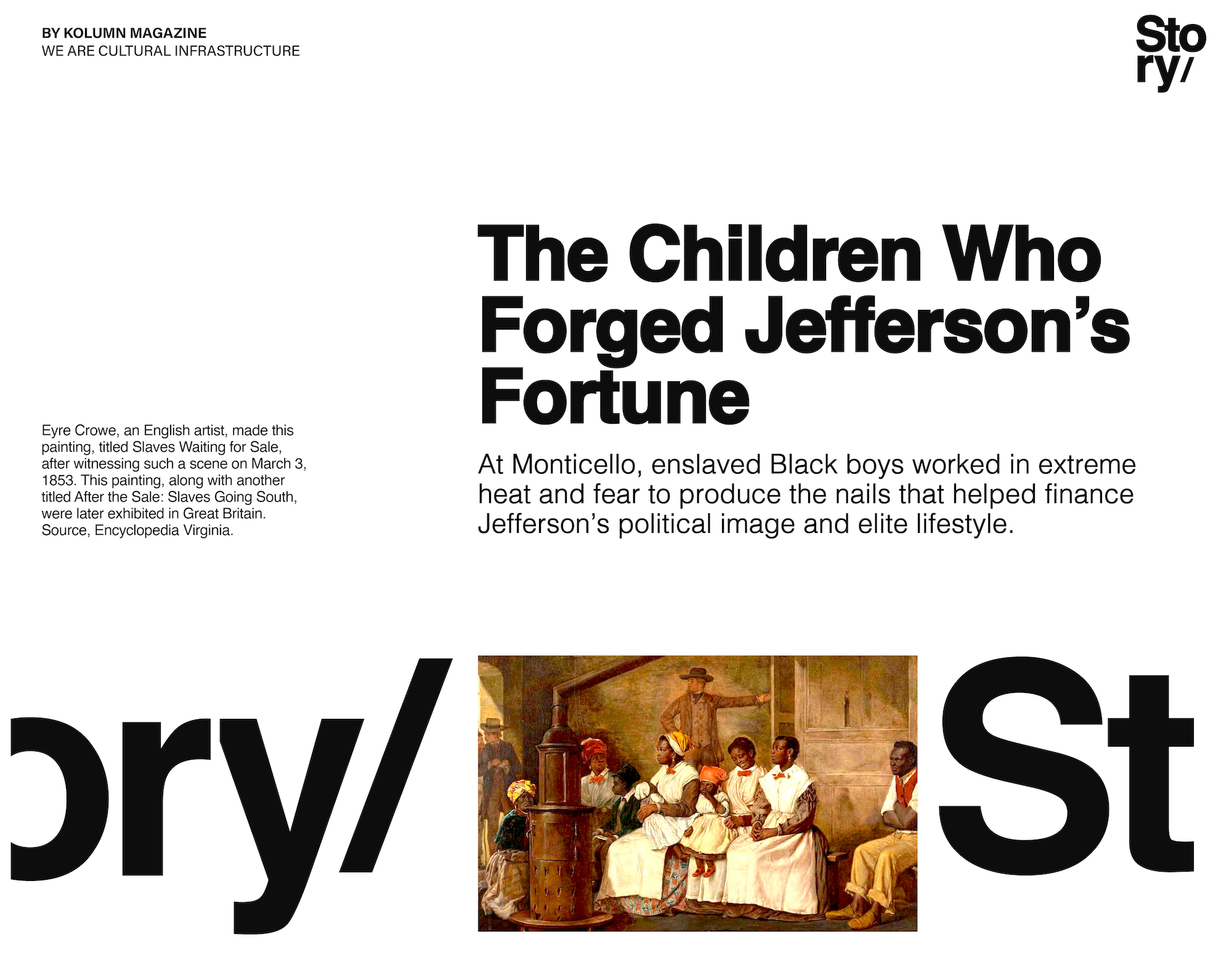
The nailery transformed enslaved Black children into units of economic output long before modern factories normalized child labor in America.
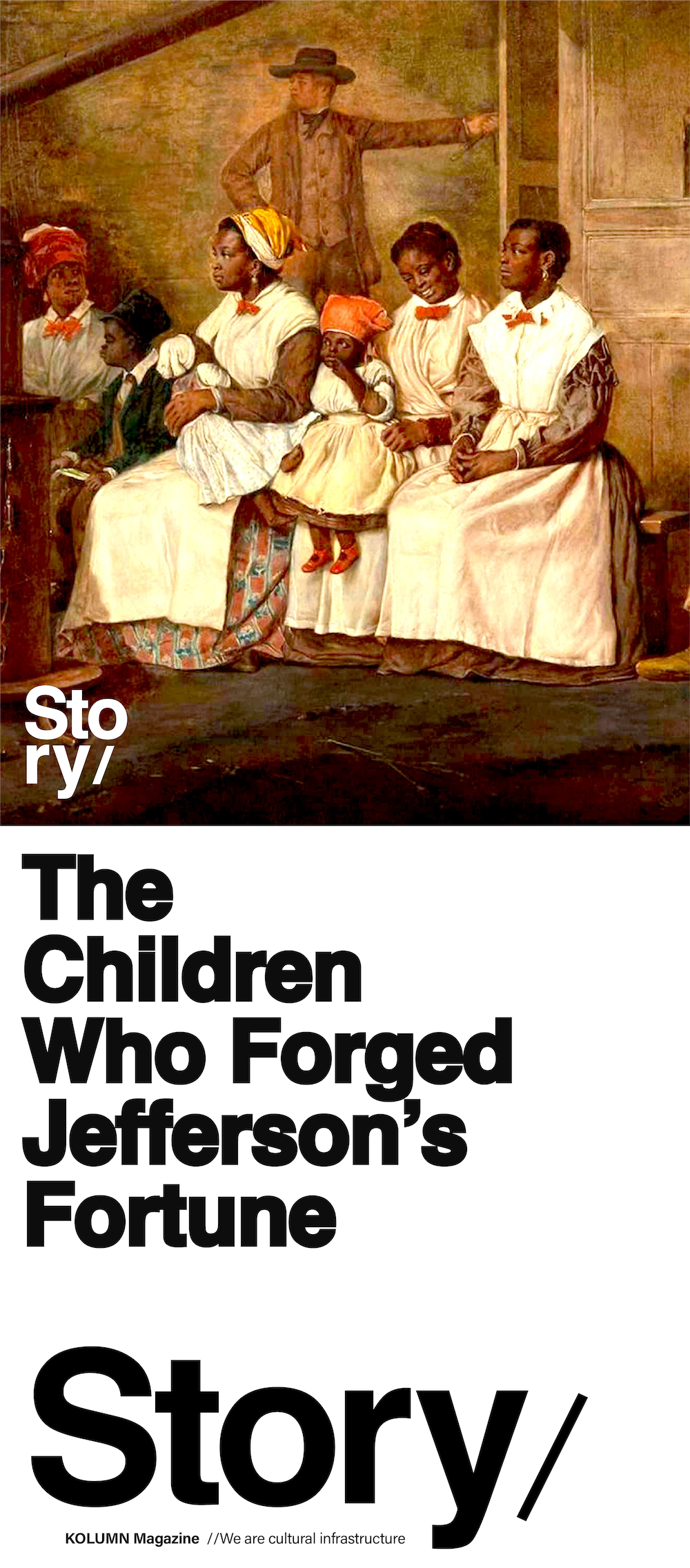
The nailery transformed enslaved Black children into units of economic output long before modern factories normalized child labor in America.
By KOLUMN Magazine
Thomas Jefferson liked to imagine himself as a philosopher of enlightenment, a steward of reason, a man whose mind stretched from architecture to agriculture to republican democracy. At Monticello, he cultivated this image carefully. Visitors encountered a plantation that appeared orderly, intellectual, almost experimental in its design. Jefferson collected books obsessively, corresponded with Europe’s leading thinkers, and wrote the words that would become the moral centerpiece of the American experiment: “all men are created equal.”
But behind the symmetry of Monticello’s columns and the mythology of the Founding Fathers stood a different kind of innovation — one built not on abstract liberty, but on the extraction of labor from enslaved Black children.
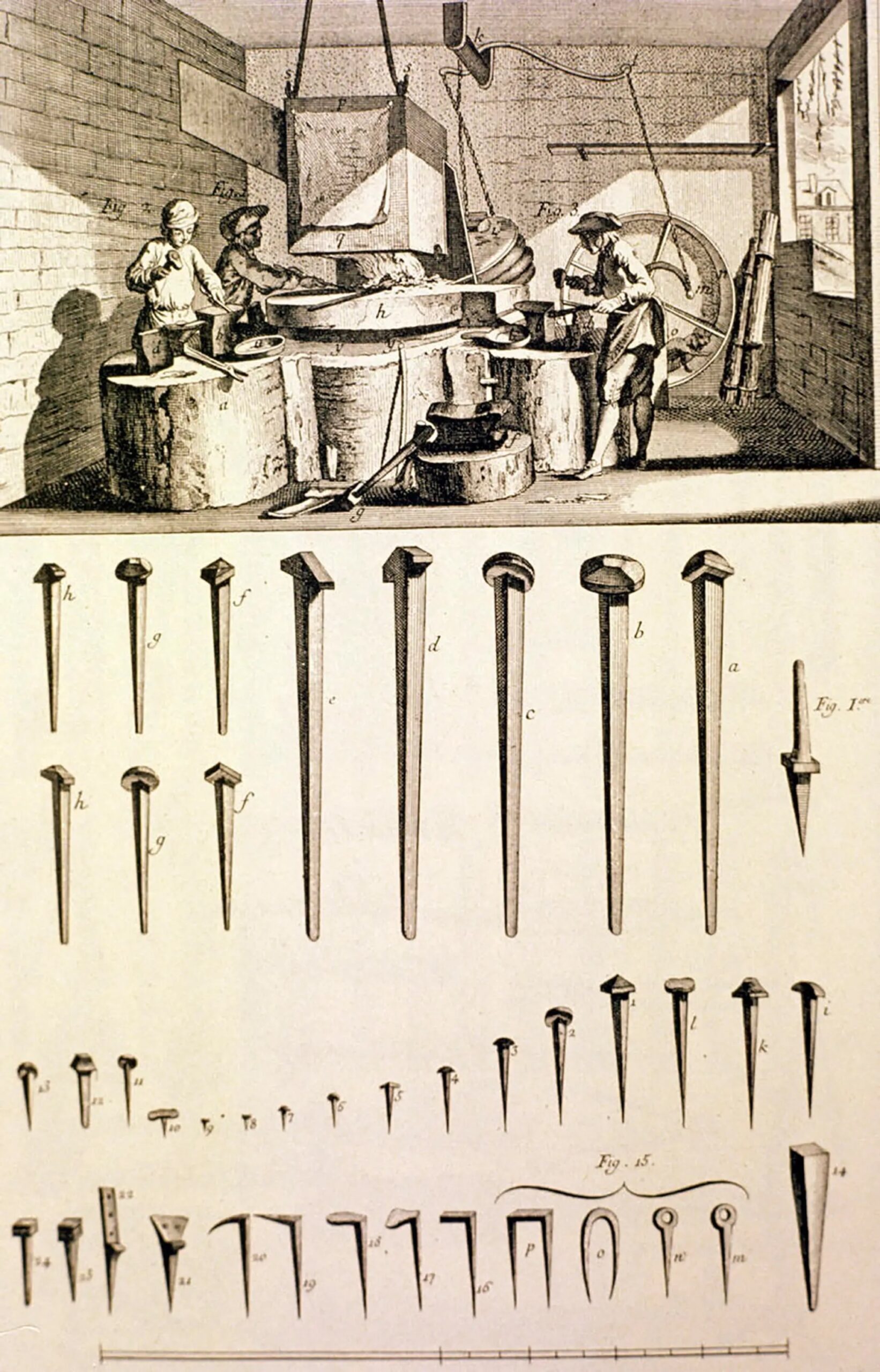
Inside Jefferson’s nailery, boys as young as 10 years old hammered glowing iron into nails for hours each day in a suffocating workshop perched below the mountaintop mansion. The operation generated critical cash for Jefferson, whose lifelong financial instability depended heavily on enslaved labor. Jefferson monitored the children’s productivity meticulously, rewarding higher output and punishing failure. The nailery was not peripheral to Monticello’s economy. It was central to it.
And overseeing much of that labor was Gabriel Lilly, a white overseer whose reputation for violence became infamous even within a slave society accustomed to brutality.
The nailery remains one of the clearest windows into the economic logic of American slavery before industrialization: the conversion of Black childhood into measurable capital. Historians have increasingly argued that Jefferson’s nailery functioned as an early factory model, one where surveillance, quotas, incentives, punishment, and youth labor converged into a prototype of industrial discipline decades before America’s manufacturing boom.
Jefferson understood precisely what he was building.
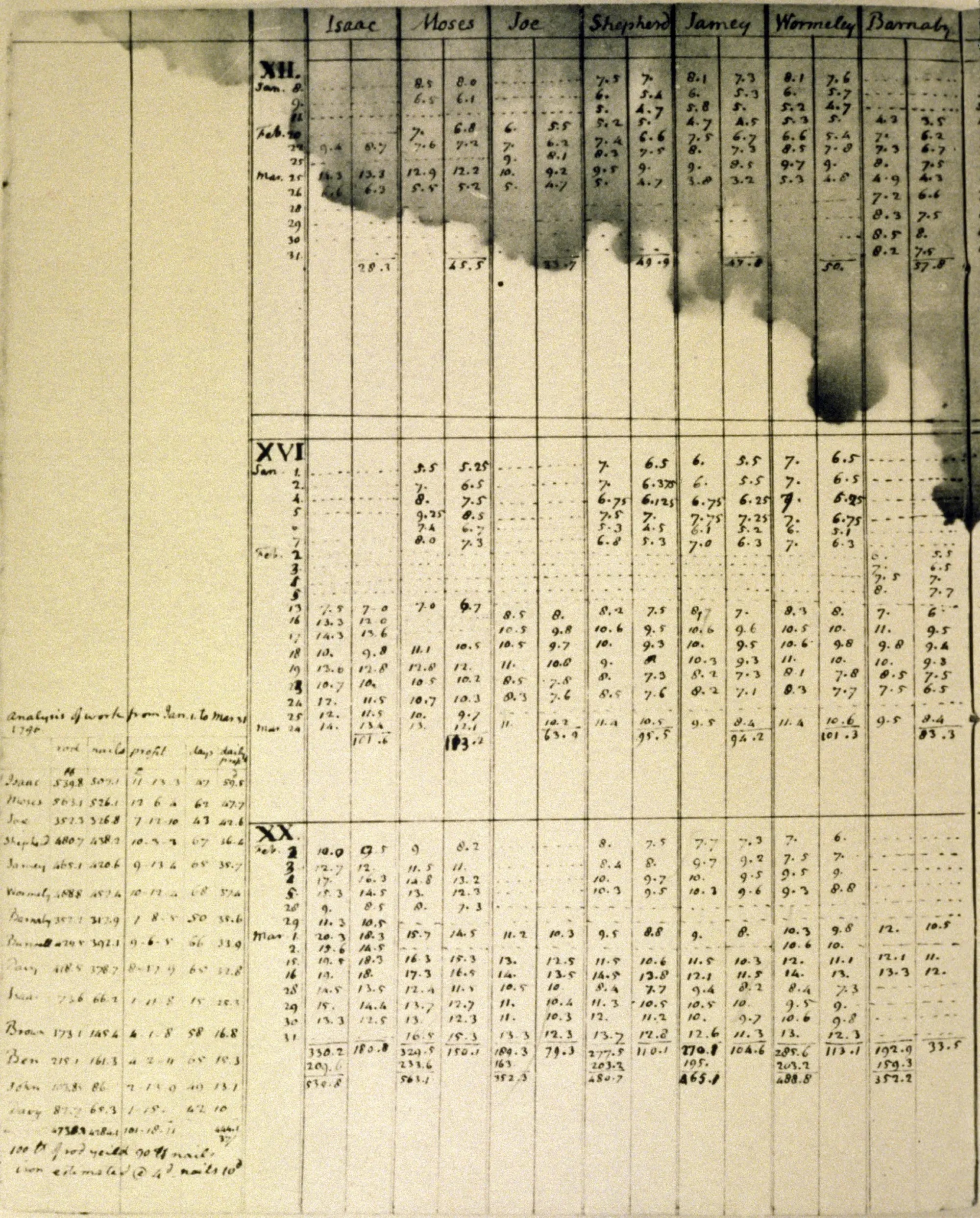
In his own records, he tracked nail production with the precision of an accountant. He measured output per child. He calculated profitability. He recognized that children could be trained early, controlled more easily, and made economically productive for decades.
This was not accidental hypocrisy. It was systematized economics.
As historian Lucia Stanton explained in her analysis of Monticello’s enslaved community, the nailery became “the training ground” where boys were conditioned into plantation labor and surveillance structures that would define their lives. Jefferson himself described the operation as exceptionally lucrative in letters and plantation memoranda. According to research published by the Thomas Jefferson Foundation’s Monticello archives, the nailery at times produced thousands of nails per day and generated desperately needed revenue for Jefferson’s estate.
The contradiction is staggering not because Jefferson failed to understand slavery’s cruelty, but because he understood it intimately and still optimized it.
The mythology surrounding Jefferson has often softened this reality. For generations, biographers portrayed him as morally conflicted, trapped within a slave system he supposedly disliked but could not escape. Yet newer scholarship has increasingly challenged that framing. Historians such as Annette Gordon-Reed, Henry Wiencek, and Christa Dierksheide have argued that Jefferson’s management of slavery was neither passive nor reluctant. It was deeply managerial, profit-conscious, and deliberate.
The nailery may be the clearest evidence of that truth.
The Workshop Beneath the Mansion
The nailery sat physically below Jefferson’s mountaintop residence, but morally it occupied the foundation beneath the entire plantation economy.
Located on Mulberry Row — the industrial corridor of Monticello — the nailery operated as a blacksmithing workshop where enslaved boys transformed imported iron into nails used across Virginia’s growing construction economy. According to the Monticello archive on Mulberry Row, the area functioned as the plantation’s manufacturing center, crowded with smokehouses, workshops, dwellings, and labor spaces occupied by enslaved workers.
Jefferson’s nailery emerged in the 1790s during one of the most financially precarious periods of his life. Though publicly celebrated as a political philosopher and diplomat, Jefferson privately struggled under mounting debt. Maintaining Monticello’s lavish architecture, extensive landholdings, imported goods, and elite lifestyle required constant cash flow.
Tobacco agriculture alone could not sustain him.
Nail production offered something different: liquid revenue.
As historian Henry Wiencek observed in Master of the Mountain, Jefferson realized that nail manufacturing could produce steady profits relatively insulated from agricultural volatility. Nails were in constant demand throughout the expanding republic. Jefferson saw opportunity.
The workers he selected were children.
Boys typically entered the nailery around age 10 to 12. Jefferson believed children could be molded into disciplined laborers early, before adulthood brought resistance or independent habits. In letters and farm records, Jefferson documented production totals obsessively, recording which boys performed well and which lagged behind quotas.
The children’s lives became numerical calculations.
According to Smithsonian Magazine’s examination of Jefferson and slavery, Jefferson used systems of incentives and punishments inside the nailery, including better clothing or food for productive boys and whippings for those who failed to meet expectations.
This was not merely agricultural slavery. It was managerial capitalism emerging inside bondage.
Jefferson rewarded competition among enslaved children. Boys who exceeded production targets could receive extra rations, garments, or privileges. Those who failed were subjected to violence or humiliation. The structure intentionally fostered internal competition while reinforcing white authority.
Modern labor historians recognize the pattern instantly.
The nailery functioned with rhythms later associated with industrial factories: quotas, surveillance, productivity measurements, labor specialization, and performance incentives. The difference was that the workforce consisted entirely of enslaved Black children who had no capacity to refuse participation.
Jefferson’s records reveal not discomfort with the arrangement, but fascination with its efficiency.
Historian Christa Dierksheide, former editor of the Papers of Thomas Jefferson, has argued that Jefferson’s plantation management displayed a highly modern understanding of labor extraction and data collection. The nailery illustrates that mentality vividly. Jefferson tracked outputs almost scientifically.
The children were workers, inventory, and investments simultaneously.
Gabriel Lilly and the Machinery of Terror
If Jefferson designed the system, Gabriel Lilly enforced it.
Few figures in the history of Monticello embody the raw violence of plantation discipline more clearly than Lilly, an overseer whose cruelty became notorious even among Jefferson’s contemporaries.
According to the Monticello biography of Gabriel Lilly, Jefferson hired Lilly in the 1790s to supervise enslaved laborers, including boys in the nailery. Lilly quickly developed a reputation for excessive brutality, drunkenness, and sexual predation.
Jefferson knew it.
Records indicate Jefferson repeatedly acknowledged Lilly’s violence while continuing to employ him because of his effectiveness in extracting labor. Lilly whipped enslaved workers aggressively, pursued enslaved women, and reportedly fostered terror among Monticello’s enslaved population.
Yet Jefferson retained him for years.
The historical significance of Lilly lies not merely in his cruelty, but in what his employment reveals about Jefferson himself. Lilly was useful. He maintained production. He disciplined children into compliance.
The violence was not incidental to the nailery’s profitability. It was part of the economic model.
“Jefferson condemned slavery in theory while employing a man whose brutality helped make child labor profitable in practice.”
This contradiction has become central to contemporary historiography surrounding Jefferson. Earlier generations of historians often depicted Jefferson as morally trapped within an inherited institution. But scholars increasingly argue that his actions demonstrate sustained participation in — and refinement of — slavery’s economic structures.
Annette Gordon-Reed’s work, particularly The Hemingses of Monticello, reframed Jefferson not as an abstract symbol, but as an active plantation manager whose daily decisions shaped enslaved lives. Her scholarship emphasizes that understanding Jefferson requires examining the operational reality of Monticello rather than the rhetoric of his public writings.
Gabriel Lilly forces that examination.
Jefferson eventually dismissed Lilly, but not immediately because of violence against enslaved people. According to Monticello records, Jefferson’s frustrations centered partly around Lilly’s instability and public behavior. The moral horror of whipping children did not disqualify him from employment.
Indeed, plantation economies across Virginia normalized precisely this kind of brutality.
The nailery depended on fear because it depended on output.
The boys worked near furnaces handling hot iron, repetitive hammering, and physically punishing quotas. Errors reduced profitability. Resistance threatened order. Violence became managerial policy.
Modern readers often imagine slavery primarily through agricultural labor — cotton fields, tobacco rows, sugar plantations. But the nailery reveals slavery’s industrial dimensions. Enslaved labor powered manufacturing, skilled trades, logistics, and finance. Jefferson’s workshop exposed how adaptable slavery was to capitalist expansion.
The boys were not learning trades for their own advancement. They were increasing Jefferson’s revenue stream.
The Economics of Enslaved Childhood
Jefferson’s genius — and his moral failure — lay partly in recognizing that enslaved children represented long-term economic assets.
In plantation records analyzed by historians, Jefferson frequently discussed enslaved people through actuarial logic. Children represented future productivity. Their labor could offset debt. Their bodies held financial value before adulthood.
The nailery accelerated that value extraction.
Unlike field labor, nail manufacturing transformed boys into immediately profitable workers at relatively young ages. Historian Alfred F. Young and scholars of early American labor systems have noted that artisanal production environments often demanded apprenticeships beginning in childhood. Jefferson exploited that structure through slavery.
The difference between white apprentices and enslaved Black boys was ownership.
White children theoretically trained toward independence. Enslaved children trained toward permanent exploitation.
Jefferson calculated precisely how profitable the nailery could become. According to the Thomas Jefferson Foundation’s nailery research, nail production generated thousands of dollars annually in some years — substantial income in the late eighteenth century.
Those profits mattered immensely because Jefferson was drowning in debt.
As detailed in The New York Times’ reporting on Jefferson’s finances and slavery, Jefferson’s plantation economy continually failed to support his spending habits and political stature. Enslaved labor became the mechanism that sustained the illusion of aristocratic stability.
The nailery therefore represented more than a workshop. It was financial triage.
Jefferson’s understanding of slavery was intensely economic. He knew enslaved people appreciated in value over time. He borrowed against them. He leveraged their labor to maintain creditworthiness.
Children became especially important because they represented decades of future returns.
This reality destabilizes older narratives portraying Jefferson as a reluctant slaveholder trapped by circumstance. Jefferson expanded labor systems that increased efficiency and profitability. The nailery did not emerge accidentally. It was engineered.
And the engineering depended on children.
Historians Reconsider Jefferson
For much of American history, Jefferson occupied an almost sacred space in public memory. Textbooks celebrated him as the principal author of the Declaration of Independence, founder of the University of Virginia, architect, philosopher, and champion of liberty.
The enslaved children of the nailery existed largely at the margins of that story.
That omission was not accidental.
“The nailery was not an exception to Jefferson’s ideals. It was one of the clearest expressions of how those ideals coexisted with exploitation.”
Historian Merrill Peterson’s influential twentieth-century work on the “Jefferson Image” documented how Americans repeatedly reshaped Jefferson into a usable national symbol. In many earlier biographies, slavery appeared as contradiction but not defining structure. Jefferson’s intellect overshadowed the violence that financed it.
Recent historiography has shifted sharply.
Scholars increasingly center slavery not as peripheral embarrassment but as foundational to Jefferson’s identity and wealth. Works by Annette Gordon-Reed, Henry Wiencek, Lucia Stanton, and others have forced a reconsideration of Monticello as both intellectual sanctuary and labor camp.
The nailery has become central to that reassessment because it produces documentary clarity difficult to evade.
Jefferson wrote extensively about it.
His farm books recorded production totals, labor assignments, rewards, and punishments. The archival paper trail eliminates ambiguity. Historians do not need to speculate about whether Jefferson knew children worked intensely in the nailery. He supervised the operation personally.
According to Lucia Stanton’s research on Monticello’s enslaved families, the nailery also functioned psychologically as a disciplinary institution where enslaved boys learned the plantation hierarchy early.
Childhood itself became colonized by labor expectations.
This shift in scholarship parallels broader transformations in American historical analysis. Historians increasingly examine slavery not simply as Southern agriculture, but as a national economic system intertwined with capitalism, banking, manufacturing, and political development.
Jefferson’s nailery fits squarely within that framework.
The workshop demonstrates how slavery adapted to industrial logic long before Northern factories expanded child labor during the nineteenth century. Surveillance, quotas, productivity metrics, competition among workers, and managerial punishment systems all existed inside Jefferson’s operation.
The American factory did not emerge separate from slavery. In many ways, slavery rehearsed it.
The Myth of Benevolent Slavery
Jefferson spent portions of his life cultivating the image of humane slaveholding.
That mythology persisted long after his death.
Some defenders pointed to Jefferson’s intellectual discomfort with slavery, his occasional criticisms of the institution, or his theoretical opposition to the transatlantic slave trade. Yet historians increasingly argue that such framing obscures the operational reality of Monticello.
Jefferson rarely emancipated enslaved people. He profited from them consistently. He pursued fugitives. He relied on child labor. He maintained productivity through coercion.
The nailery exposes the collapse of the “benevolent master” narrative.
Children were whipped for insufficient output. Their labor funded Jefferson’s lifestyle. Violence remained integral to maintaining order.
Gabriel Lilly was not an aberration from the plantation system. He was one of its logical instruments.
Henry Wiencek’s scholarship particularly challenged sanitized portrayals of Jefferson by arguing that Jefferson’s commitment to profitability repeatedly overrode moral hesitation. In interviews discussing Master of the Mountain, Wiencek emphasized Jefferson’s increasing reliance on enslaved children as financial pressures intensified.
The nailery represented efficiency.
Children consumed fewer resources than adults while generating valuable manufactured goods. Jefferson understood this equation clearly.
What makes the nailery especially haunting is the intimacy of Jefferson’s oversight. He was not a distant absentee owner ignorant of daily operations. He visited the workshop. He reviewed numbers. He evaluated children’s performance.
He knew their names.
The historical record preserves boys such as Cary, Davy, Moses, Wormley, and others whose labor sustained Monticello’s economy. Their identities survive partly because Jefferson documented their output so rigorously.
The archive remembers them as workers because the system required them to be workers first.
America’s Founding Contradiction
The nailery ultimately forces a larger national reckoning.
Jefferson’s contradiction was never uniquely personal. It was American.
The same republic proclaiming universal liberty simultaneously expanded slavery across the South. The same political class celebrating individual rights engineered systems of racial bondage that generated immense wealth.
Jefferson’s nailery condensed that contradiction into one workshop.
Children hammered iron while the author of the Declaration wrote about freedom above them on the mountain.
The imagery feels almost allegorical, yet it was materially real.
Modern debates over how to remember Jefferson often descend into false binaries: saint or villain, genius or hypocrite. But the nailery resists simplification. Jefferson was intellectually extraordinary and morally devastating. His vision of democracy expanded human possibility while his economic practices denied humanity to those he enslaved.
Both truths coexist.
The importance of studying the nailery lies partly in refusing national amnesia. The workshop demonstrates how deeply slavery shaped American development — not only agriculturally, but industrially and financially.
The labor of Black children helped sustain one of America’s most celebrated founders.
That fact cannot be separated from the nation’s origin story.
In recent years, institutions including Monticello itself have attempted fuller public reckonings with slavery’s role in Jefferson’s world. Exhibitions now foreground enslaved families, labor systems, and the violence underpinning plantation life. Descendant communities have also pushed historical institutions toward more honest interpretations.
Still, the cultural myth of Jefferson often remains remarkably resilient.
Public memory prefers inspiration over indictment.
But the nailery survives in the archive as stubborn evidence.
It reminds Americans that the architecture of liberty in the early republic rested partly upon coerced childhood labor. It reveals that sophisticated economic management and racial violence were not opposites within slavery. They were partners.
And it forces a final uncomfortable recognition: Jefferson’s enlightenment ideals did not fail to prevent exploitation. In many ways, they coexisted with it seamlessly.
The boys in the nailery understood that reality long before historians did.
More great stories
Afro Sheen, Wall Street, and the Architecture of Black Possibility
July 6, 2026
No Comments
The Fire Inside the Fourth
July 5, 2026
No Comments