




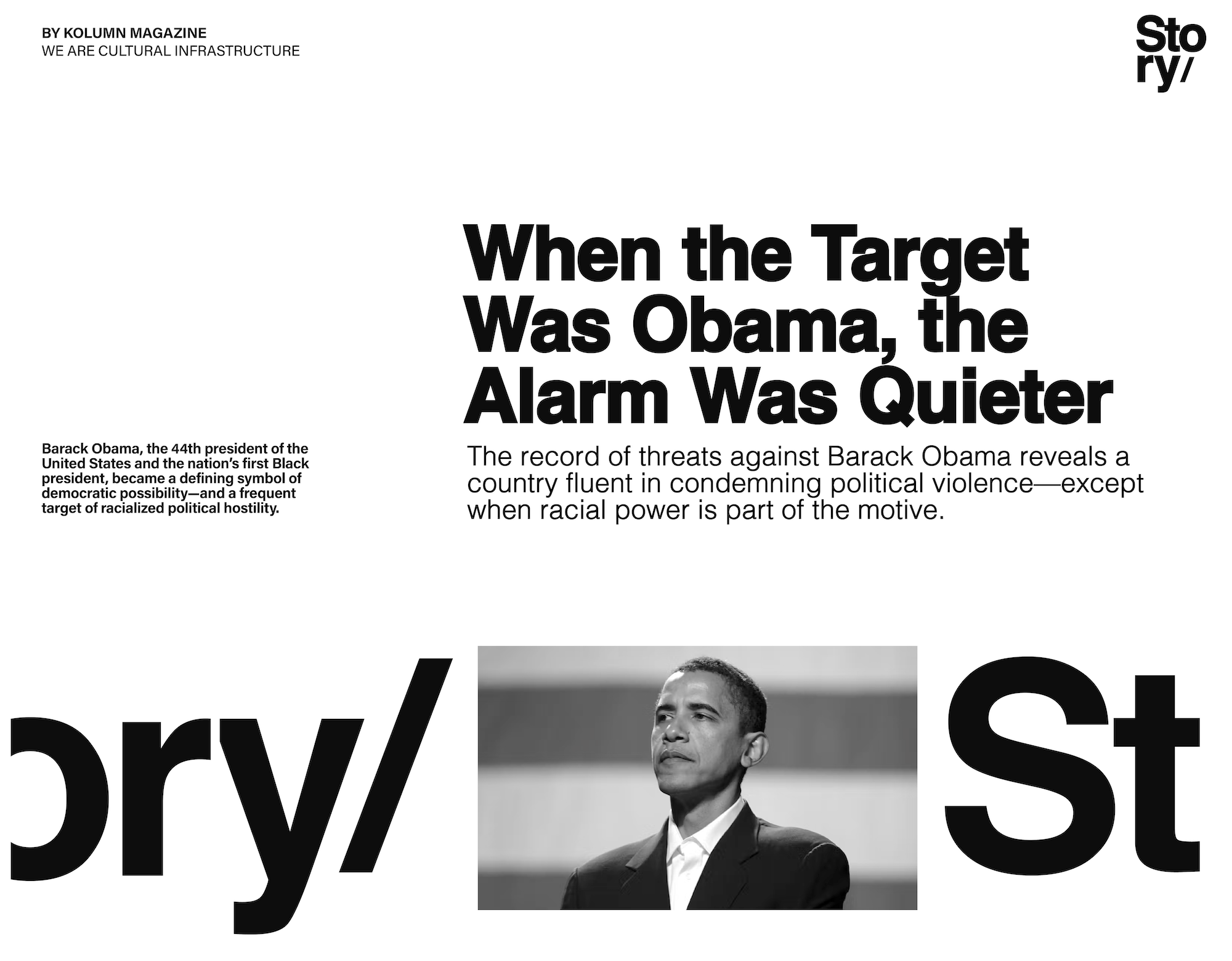
Obama’s presidency did not create the hatred. It exposed how ready parts of America were to treat Black authority as a provocation.
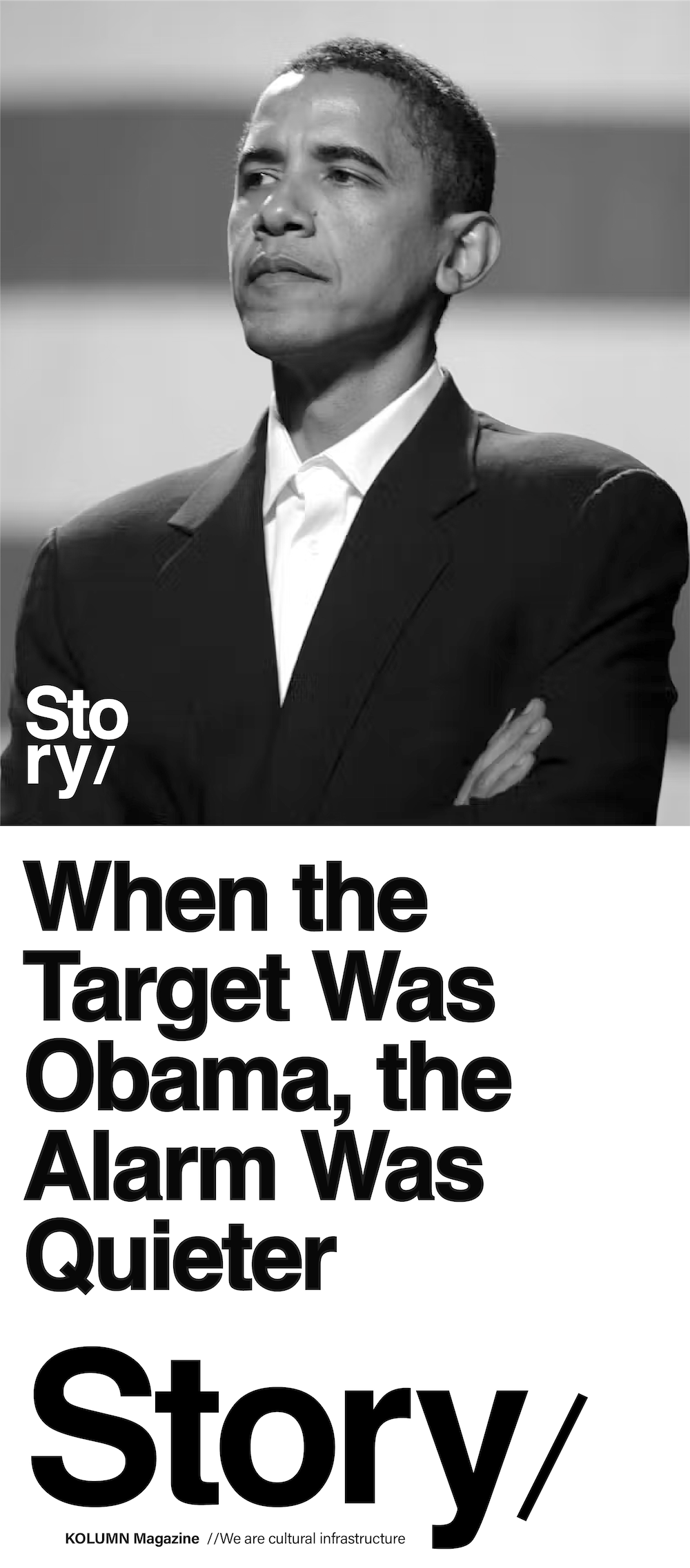
Obama’s presidency did not create the hatred. It exposed how ready parts of America were to treat Black authority as a provocation.
By KOLUMN Magazine
Barack Obama’s rise to the presidency did not simply invite disagreement. It activated something older, uglier, and more dangerous than ordinary partisan opposition: the recurring American fear of Black political authority made visible at the highest level of government. Long before Obama took the oath of office, the Secret Service had already placed him under protection unusually early in the 2008 cycle, in May 2007, while he was still a candidate and months before the Iowa caucuses, a decision reported at the time by CBS News as tied to security concerns surrounding his candidacy.
That detail should sit at the center of any honest discussion about political violence in modern America. Obama had not yet become president. He had not yet signed the Affordable Care Act. He had not yet become the face onto which the right would project fantasies of socialism, foreignness, racial grievance, and national displacement. Yet the threat environment around him was already serious enough for federal protection.
Reported threats and plots against Obama read less like a list of isolated cranks than a map of a political atmosphere: neo-Nazi conspirators, online threat-makers, armed men, ricin letters, a militia fantasy of overthrow, and a rifle attack on the White House itself. Not every case was ideologically identical. Not every defendant belonged to an organized extremist group. Some cases involved mental illness, intoxication, personal instability, or performative online menace. But taken together, they show that Obama’s public life was shadowed by violence in ways the country rarely allowed itself to fully confront.
That silence matters now because of the contrast. When Donald Trump survived an assassination attempt at a Butler, Pennsylvania, rally on July 13, 2024, the FBI immediately described the shooting as an assassination attempt and potential domestic terrorism; the attack killed rallygoer Corey Comperatore, injured Trump and others, and produced a national wave of condemnation. That condemnation was necessary. Political violence is an assault on democratic life, no matter the target. But the right’s posture after Trump’s shooting—its insistence that the nation recognize the gravity of the moment, identify rhetorical enablers, and treat an attack on a political figure as an attack on the republic—revealed a standard it had rarely applied with equal moral force when the target was Obama.
This is not an argument for minimizing threats against Trump. It is an argument against the selective memory that makes violence seem intolerable only when it confirms one side’s sense of injury.
The First Black President as a Security Event
Obama’s candidacy unfolded under the language of hope, but federal security officials understood the darker grammar beneath it. In May 2007, CBS News reported that Obama had been placed under Secret Service protection after consultations among congressional leaders and Homeland Security officials, an unusually early step for a presidential candidate. Days later, Obama acknowledged that some hostility toward him was racially rooted, telling CBS News that there were people “troubled with an African-American president.”
There was no need to romanticize what was happening. The country was not merely debating tax policy or troop withdrawals. It was debating, through Obama’s body, who could plausibly embody the state.
KOLUMN has returned to this terrain again and again: in its coverage of Colfax, where white political violence was described as central rather than incidental to the overthrow of Reconstruction; in its treatment of Ida B. Wells and the train car as a contested public space; in its stories about Selma, Orangeburg, and civil-rights organizing, where Black civic assertion repeatedly met official or vigilante force. The Obama threat record belongs in that lineage. It is not the same story as Colfax or Selma, but it rhymes with their governing principle: Black participation in democracy has often been treated not as citizenship, but as trespass. KOLUMN’s own essay on Colfax put the matter plainly, writing that white political violence was “not peripheral to American democracy” but often part of how power was guarded and rationalized.
Obama’s presence on the presidential stage threatened symbolic arrangements older than the modern Republican Party. To millions, he represented democratic expansion. To others, he became a vessel for racial panic disguised as constitutional concern.
The Campaign Trail and the Neo-Nazi Plot
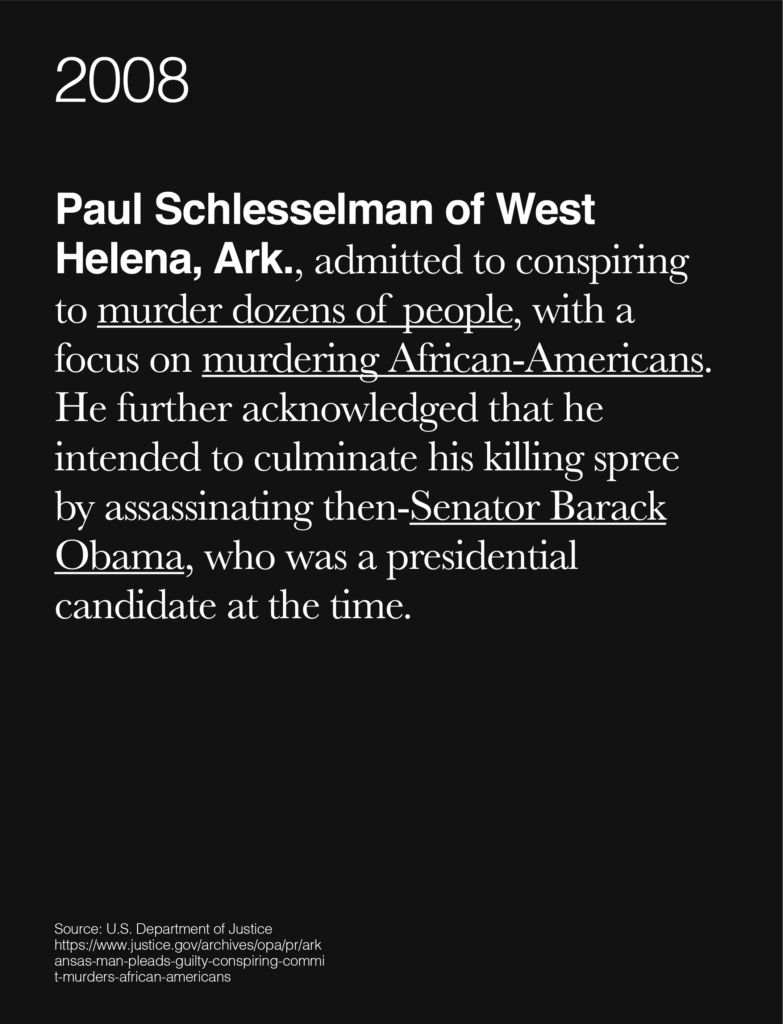
The most infamous 2008 plot came in the closing stretch of the presidential campaign, when Paul Schlesselman of Arkansas and Daniel Cowart of Tennessee were accused of planning a racist killing spree that would culminate in an attempt to assassinate Obama. The Justice Department said the men conspired to murder African Americans and target Obama because of race; Cowart was later sentenced to 14 years in prison.
Federal prosecutors described a plot steeped in white supremacist symbolism. The indictment alleged that the men planned to kill Black people before attempting to attack Obama, and contemporaneous reporting by The Guardian noted that authorities said they intended to kill 88 people and behead 14, numbers with specific meaning in white-power culture.
The plot was not simply anti-Obama. It was anti-Black democracy, written in the numeric code of white-power fantasy.
The case should have become one of the defining stories of the 2008 election: two young white men allegedly imagining mass murder of Black people as a prelude to killing the first Black major-party presidential nominee. Instead, it passed into the news cycle as a grotesque but containable episode. It did not generate a durable right-wing reckoning with white supremacist political violence. It did not produce the kind of sustained moral campaign that followed attacks on conservatives years later. It did not force a national conservative conversation about how racialized conspiracy, gun culture, and anti-Obama extremism were beginning to converge.
To be fair, federal law enforcement acted. Prosecutors charged. Courts sentenced. The criminal-justice system did not ignore the case. But political culture is not the same as prosecution. The question is not whether the plotters were punished. The question is whether the broader movement that claimed Obama was an existential danger ever treated anti-Obama violence as a warning about itself.
The record suggests it did not.
The Plot That Wasn’t, and the Plots That Were
Not every alleged threat held up in the same way. In August 2008, three men arrested in Denver during the Democratic National Convention were investigated after weapons and threatening talk raised alarm. The Guardian reported that authorities later said the men appeared to lack the capacity to carry out an attack on Obama, and the case ultimately moved forward on firearms and drug charges rather than a substantiated assassination conspiracy.
That distinction matters. Journalism should not inflate every arrest into a plot. Threat reporting requires precision, especially when fear can become a political instrument. Some cases in the Obama threat record were fantasies. Some were online threats. Some were unstable men with weapons and grievance. Some were organized conspiracies. Some were direct attacks.
But the pattern remains. In August 2008, Raymond Hunter Geisel was arrested in Miami after allegedly making threats against Obama; later reporting by the Bangor Daily News said prosecutors agreed to drop assassination-threat charges as part of a plea involving firearms and ammunition possession by someone previously committed to a mental institution. The Center for Public Integrity later reported that agents recovered a gun, a hatchet, armor-piercing ammunition, and tear gas canisters from Geisel’s hotel room, while also noting failures in the background-check system that had allowed him to acquire firearms.
In October 2008, Walter Bagdasarian posted online threats about Obama; his conviction was later overturned on First Amendment grounds, a reminder that the law distinguishes between protected ugly speech and prosecutable true threats. The legal nuance is important, but the climate is also important: Obama’s candidacy was accompanied by a steady stream of violent racial imagination, some criminal, some constitutionally protected, all politically revealing.
The Presidency and the Rifle at the White House
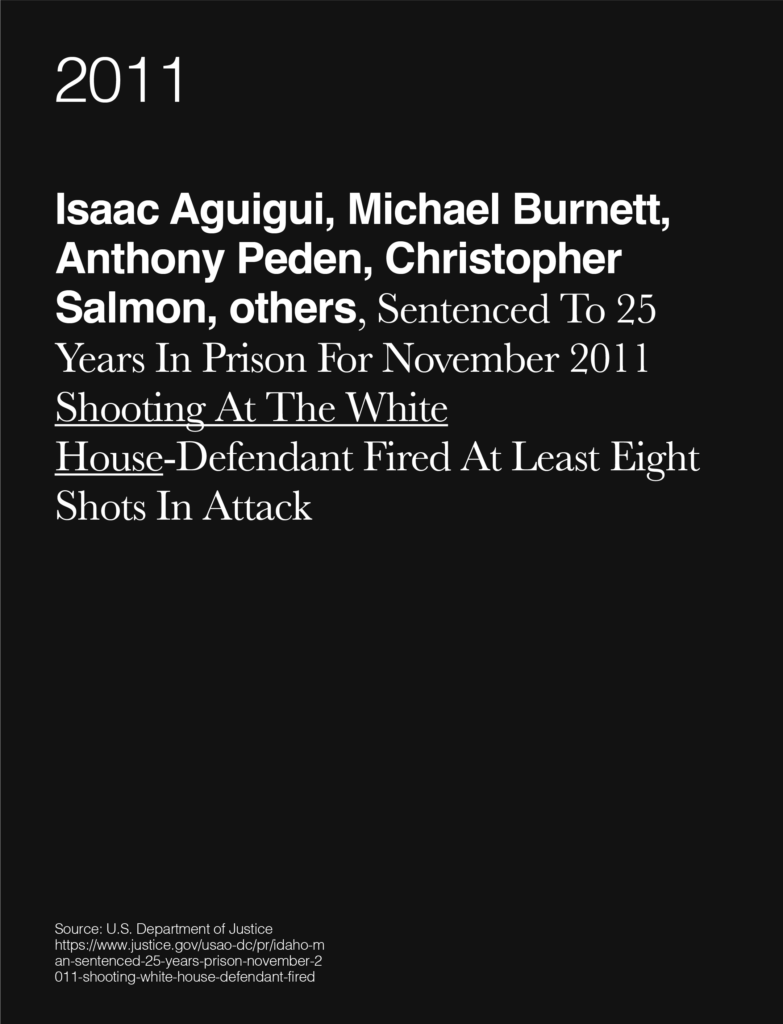
The threat environment did not end once Obama entered the White House. In November 2011, Oscar Ramiro Ortega-Hernandez fired at least eight rounds at the White House with a semi-automatic rifle. The Justice Department later said he was sentenced to 25 years in prison for terrorism and weapons offenses. Earlier, federal prosecutors had indicted him for attempting to assassinate the president, stemming from the shooting near the White House.
Read that again: a man fired rifle rounds at the White House while Obama was president.
A rifle attack on the Obama White House became a security story. A rifle attack on Trump became a national identity story.
In another political era, under another president, such an event might have become a permanent feature of partisan memory. It might have been cited in campaign speeches, invoked in hearings, and treated as proof that the president’s enemies had lost their moral bearings. Yet the Ortega-Hernandez shooting did not become a central conservative concern about the radicalization of Obama hatred. It did not produce a right-wing media campaign about anti-presidential rhetoric. It did not become shorthand for an attack on the republic in the way Trump’s Butler shooting immediately and understandably did.
The asymmetry is not that Trump’s shooting received too much outrage. It is that Obama’s threats received too little moral interpretation.
The Militia Fantasy
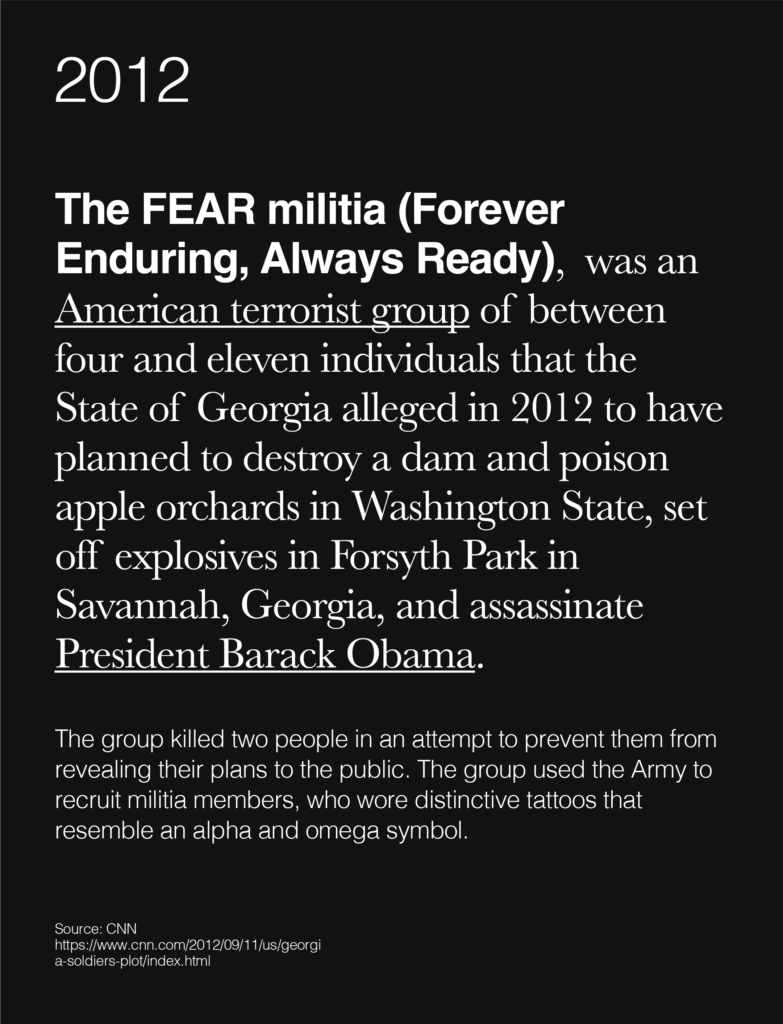
In 2012, prosecutors in Georgia described a deeply disturbing case involving soldiers connected to an anti-government militia known as FEAR, short for Forever Enduring, Always Ready. The Guardian, citing Associated Press reporting, described allegations that the group planned to stockpile weapons, poison a food supply, destroy infrastructure, and assassinate Obama. A subsequent Guardian report said three serving members of the military faced the death penalty in a murder case connected to the militia plot.
The FEAR case was not simply an Obama threat case. It was a case about anti-government extremism, military access, weapons, conspiracy, and murder. But Obama’s assassination appeared inside the group’s imagined war against the state. Here again, the first Black president became a symbolic target in a larger fantasy of violent restoration.
This was the early 2010s, when the Tea Party movement had already made Obama into a figure of constitutional apocalypse. Most Tea Party activists were not violent. Most conservatives did not endorse threats. But the wider discourse around Obama often portrayed him not merely as wrong, but as alien, illegitimate, tyrannical, and anti-American. The infamous “birther” conspiracy, pushed for years by Donald Trump before his presidency, did not accuse Obama of a policy error; it cast him as a fraudulent occupant of the office itself.
That matters because political violence rarely emerges from nowhere. It is often preceded by permission structures: jokes, dehumanization, delegitimization, conspiratorial certainty, the insistence that ordinary democratic defeat is actually national occupation.
Ricin Letters and the Theater of Poison
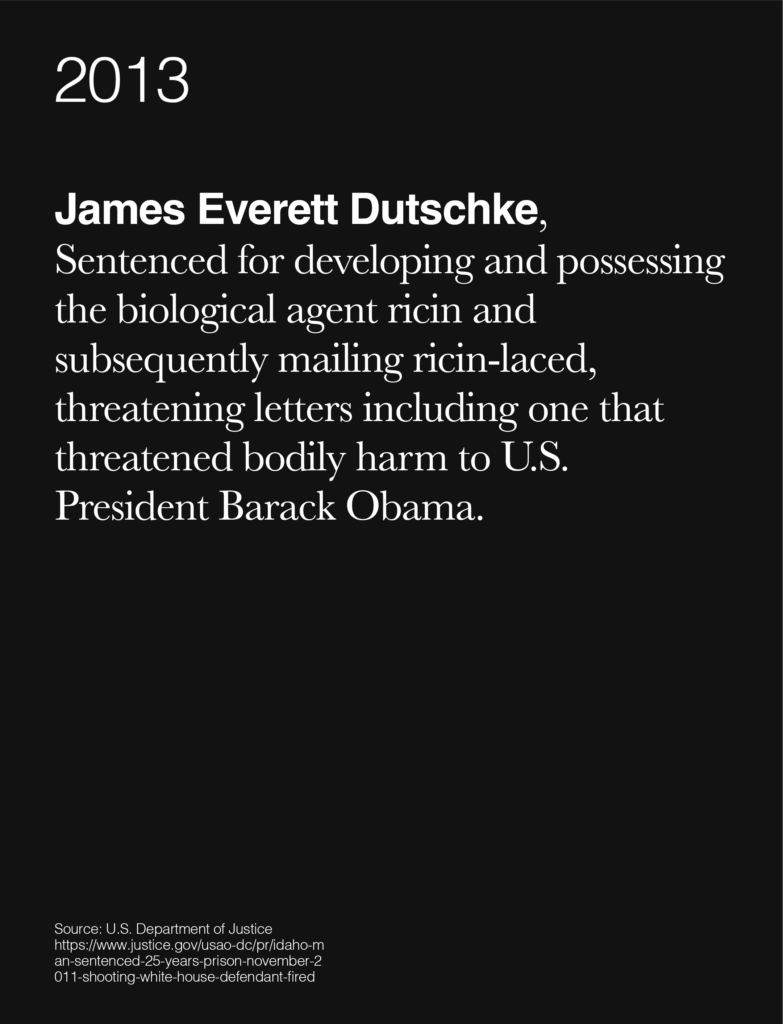
In 2013, the Obama presidency became the target of poison letters. James Everett Dutschke of Mississippi was sentenced to 300 months in prison after pleading guilty to developing and possessing ricin and mailing ricin-laced threatening letters, including one that threatened bodily harm to the president. Reuters reported that Dutschke mailed ricin-laced letters to Obama, Senator Roger Wicker, and a Mississippi judge, though the letters to Obama and Wicker were intercepted.
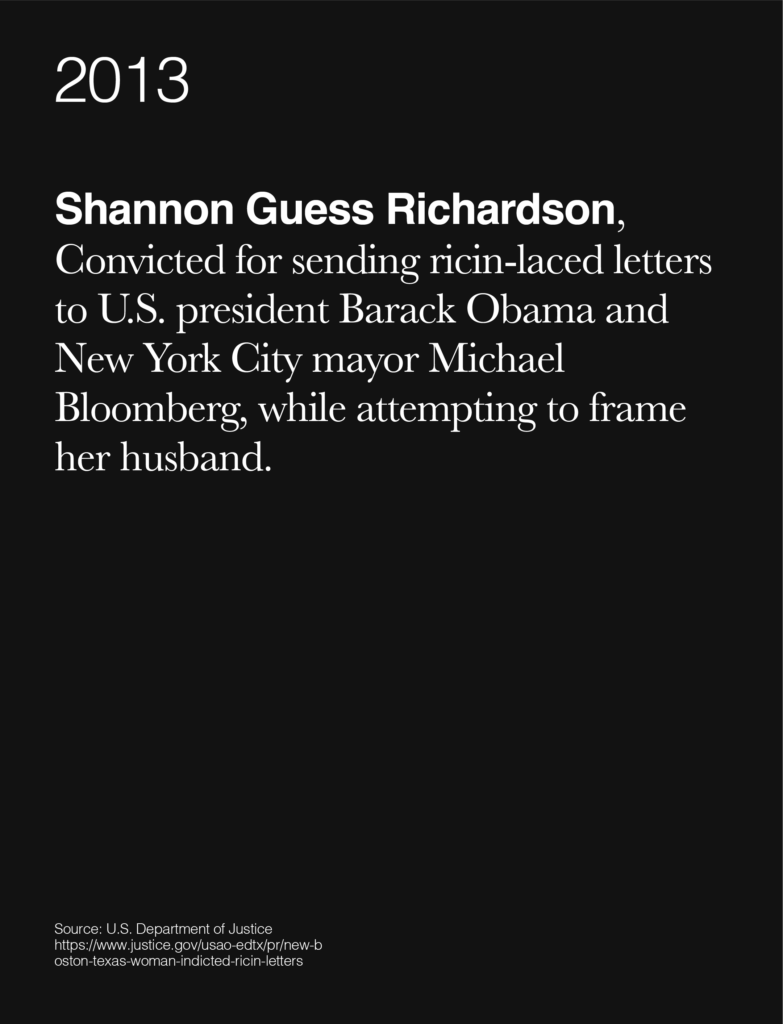
That same year, Shannon Guess Richardson, an actress from Texas, was also prosecuted in a ricin-letter case involving Obama and others; the broader point is that the Obama threat record included not only guns and online threats, but biological toxins sent through the mail.
Poison has a particular symbolic charge in American political violence. It is intimate and distant at once. It turns the postal system into a delivery mechanism for terror. It announces that the target’s office, staff, and routines are penetrable. In Obama’s case, ricin letters joined a wider catalog of plots that should have demanded sustained national attention.
Instead, the episodes became discrete crime stories.
Online Threats and the New Public Square
Obama’s presidency also coincided with the rise of social media as a mass political arena. Threats that might once have been muttered in bars or scribbled in private could now be broadcast instantly. Federal prosecutors brought multiple cases involving online threats against Obama.
In 2012, Joaquin Amador Serrapio Jr., a Miami student, pleaded guilty after posting threats tied to Obama’s visit to the University of Miami; Reuters reported that one Facebook post threatened to put a bullet through Obama’s head. He was later sentenced to home confinement, probation, and community service, according to NBC Miami.
Jarvis Britton of Birmingham, Alabama, pleaded guilty to threatening Obama on Twitter and was sentenced to one year in prison. The Justice Department said Britton had tweeted threats against the president and was ordered to serve three years of supervised release after prison.
These cases were not all alike in seriousness. Some were impulsive, some theatrical, some incoherent. But the digital threat environment around Obama demonstrated how quickly racist and anti-government aggression could travel through the platforms that were reshaping American politics.
The country did not yet have the vocabulary it would later develop for stochastic terrorism, online radicalization, and algorithmic amplification. But the signs were already visible.
The Right-Wing Extremism Report and the Backlash
In April 2009, the Department of Homeland Security circulated an intelligence assessment warning that right-wing extremists could use the election of the first Black president, the economic crisis, and fears of gun control as recruiting tools. The report became a political firestorm. Conservative critics, veterans’ groups, and Republican lawmakers denounced it, and the backlash helped chill the federal government’s willingness to publicly confront right-wing extremism.
This is one of the central facts in the story. At the very moment when Obama’s election was being used by extremists as a recruiting accelerant, a government effort to analyze that danger was reframed by parts of the right as an attack on conservatives.
The warning was treated as the scandal. The violence it anticipated was treated as background noise.
Years later, former DHS analyst Daryl Johnson wrote in The Washington Post that he had warned about right-wing violence in 2009 and that the report caused an uproar; he argued that the warning had been vindicated by subsequent events. TIME later reported that the Obama-era DHS report had been lambasted by conservatives and that federal efforts to address right-wing extremism were weakened even as white nationalist terrorism became a growing concern.
The irony is brutal. The same political ecosystem that would later demand total national seriousness after violence against Trump helped stigmatize federal scrutiny of right-wing extremism during Obama’s presidency.
That does not mean every threat against Obama came from the right. Ulugbek Kodirov, an Uzbek national, pleaded guilty in a case involving a desire to kill Obama and an attempt to obtain weapons from an undercover agent; the Justice Department said he was sentenced in 2012 on terrorism and weapons charges. The Obama threat record included jihadist aspiration as well as white supremacist violence, militia fantasy, social-media threats, and personal grievance. Accuracy requires that breadth.
But the political throughline remains: when threats aligned with narratives about white grievance, anti-government militancy, or Obama’s supposed illegitimacy, the right often resisted the broader diagnosis.
The Trump Standard
The attempt on Trump’s life in Butler deserved national condemnation. The FBI said the shooting was being investigated as an assassination attempt and potential domestic terrorism. A later Senate Homeland Security and Governmental Affairs Committee report described “stunning failures” by the Secret Service that allowed Trump to be shot.
Then came another case. In September 2024, Ryan Wesley Routh was accused of attempting to assassinate Trump near Trump International Golf Club in Florida. The Justice Department later announced that Routh was convicted and sentenced to life in prison for the attempted assassination of President Donald J. Trump and assaulting a federal officer.
These cases are grave. They should be treated as grave. But they also reveal the machinery of outrage: congressional hearings, wall-to-wall commentary, blame assigned to rhetoric, calls for accountability, and insistence that violence against a political leader is violence against democracy itself.
That machinery existed when Obama was threatened. It was simply not activated with the same intensity by the political right.
The reasons are not mysterious. Obama’s opponents often cast themselves as victims of his presidency even when he was the one receiving threats. They claimed persecution when federal agencies examined right-wing extremism. They treated Obama’s symbolic power as the real danger and the violent fantasies aimed at him as embarrassing exceptions. In that framing, the nation’s first Black president could be both the most powerful man in the world and somehow still the aggressor.
The Moral Accounting
A fair reading must make several distinctions. First, not all anti-Obama threats were right-wing. Second, not all right-wing criticism of Obama was violent or racist. Third, federal law enforcement did investigate, charge, and convict numerous threat-makers. Fourth, threats against Trump are real and should not be dismissed because Trump himself has trafficked in violent or dehumanizing rhetoric.
But fairness is not false equivalence. The racial and ideological dimensions of the Obama threat record are undeniable. The Schlesselman-Cowart plot explicitly targeted African Americans and Obama because of race, according to the Justice Department. The 2009 DHS report warned that Obama’s election could fuel right-wing radicalization, and the backlash to that report helped make the warning politically radioactive.
The right’s current language around political violence asks the country to see attacks on Trump as attacks on the democratic order. That principle is correct. But if it is correct now, it was correct then.
It was correct when Obama received Secret Service protection early.
It was correct when neo-Nazis plotted a racist massacre and imagined Obama as the final target.
It was correct when rifle rounds hit the White House.
It was correct when ricin letters were mailed.
It was correct when anti-government militants folded Obama’s assassination into fantasies of armed revolt.
The problem is not that America learned to condemn political violence. The problem is that it learned selectively.
What the Silence Protected
The muted right-wing response to threats against Obama protected several myths. It protected the myth that anti-Obama extremism was merely overheated patriotism. It protected the myth that white grievance was a legitimate political emotion while Black fear was oversensitivity. It protected the myth that violence is only political when the victim belongs to the right.
To threaten Obama was, for many extremists, to threaten the future that his election made imaginable.
That pattern has deep roots. KOLUMN’s work on Black public life has repeatedly returned to the politics of minimization: the way anti-Black violence is explained away as local, aberrational, unfortunate, or disconnected from power. In its recent coverage of the alleged New Orleans mass-shooting threat against Black festivalgoers, KOLUMN described the symbolic violence of targeting Black life in public. The same concept applies here. Threats against Obama were not only threats against a man. They were threats against the meaning of Black citizenship at the summit of the state.
America has always argued over which violence counts. The violence that maintains hierarchy is often described as disorder, crime, madness, or isolated extremism. The violence that disturbs hierarchy is described as civilizational emergency. That double standard is one reason Obama’s threat record feels so unresolved. The facts are public. The prosecutions are documented. The danger was real. What remains missing is the national moral memory.
After Obama
The threats did not end when Obama left office. Former presidents retain security risks, and Obama remains a symbolic target in conspiracy culture. The same ecosystem that treated his presidency as illegitimate has not disappeared; it has migrated through birtherism, replacement theory, anti-DEI panic, election denial, and anti-democratic grievance politics.
The country has since endured January 6, rising threats against public officials, attacks on election workers, and a broader normalization of menace. The Secret Service’s protective mission has become more strained, public trust has fluctuated, and political violence has become an ambient feature of civic life. The question is no longer whether violent rhetoric can attach itself to national politics. It already has.
The harder question is whether the country can develop a nonpartisan moral language for political violence that does not collapse the moment race enters the frame.
Obama’s story suggests how difficult that will be. His presidency was celebrated as proof of racial progress and treated by extremists as proof of racial catastrophe. He was expected to absorb indignity calmly, condemn violence universally, and avoid naming too sharply the forces arrayed against him. Even his danger had to be managed politely.
Trump, by contrast, has been allowed by his supporters to convert danger into accusation: against Democrats, media, prosecutors, judges, immigrants, and ideological enemies. That does not make the danger false. It makes the politics around it revealing.
The Record We Have to Hold
The attached dataset is not exhaustive, but it is instructive. It begins before Obama’s presidency, follows him through the White House years, and extends into the afterlife of his symbolic meaning. It includes high-profile plots and lesser-known prosecutions, organized extremists and lone actors, online threats and physical attacks.
Its cumulative force is the story.
Obama was not merely disliked. He was targeted. He was not merely criticized. He was imagined as killable by men who understood his race and office as connected facts. He was not simply protected by the Secret Service. He was protected against a country that had not fully accepted the legitimacy of Black power.
The right’s failure was not that it criticized Obama. Criticism is democracy. The failure was that too much of the right refused to confront the violent edge of its own anti-Obama mythology. It wanted the energy without the accountability, the grievance without the audit, the warning signs without the warning.
Now, when Trump is threatened, many of the same voices demand a national reckoning. They are right to demand seriousness. But seriousness cannot be retroactive only for one side. It cannot notice the bullet only when it travels toward a favored body. It cannot mourn political violence while ignoring the racialized violence that has long shaped American politics.
The measure of a democracy is not whether it condemns violence against the powerful people it likes. That is easy. The measure is whether it can tell the truth when the target is someone it has been taught to fear.
Barack Obama’s threat record asks that question still.
More great stories
Afro Sheen, Wall Street, and the Architecture of Black Possibility
July 6, 2026
No Comments
The Fire Inside the Fourth
July 5, 2026
No Comments