



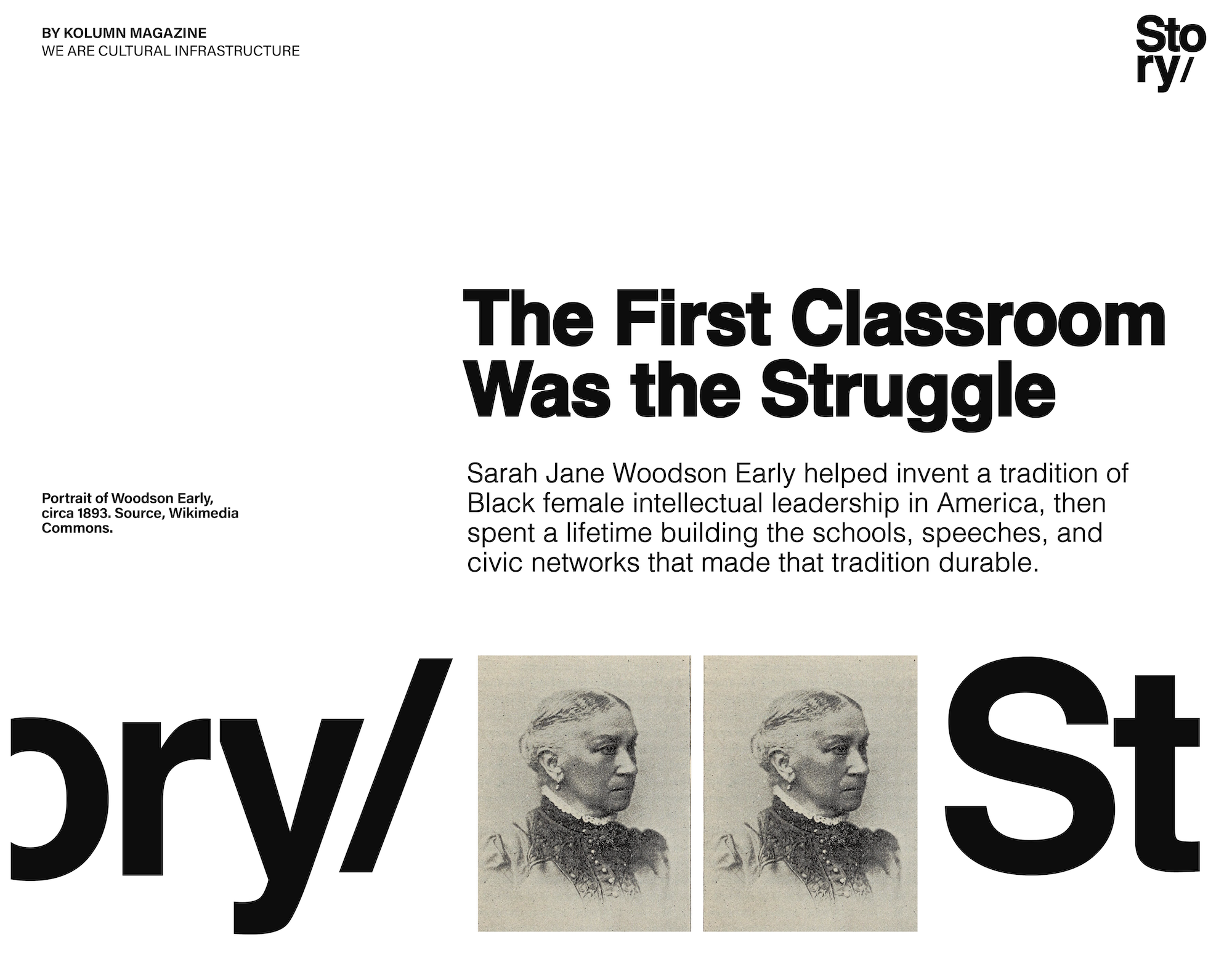
Sarah Jane Woodson Early was not important because she was first at the lectern. She was important because she understood the lectern itself as a tool of racial self-determination.
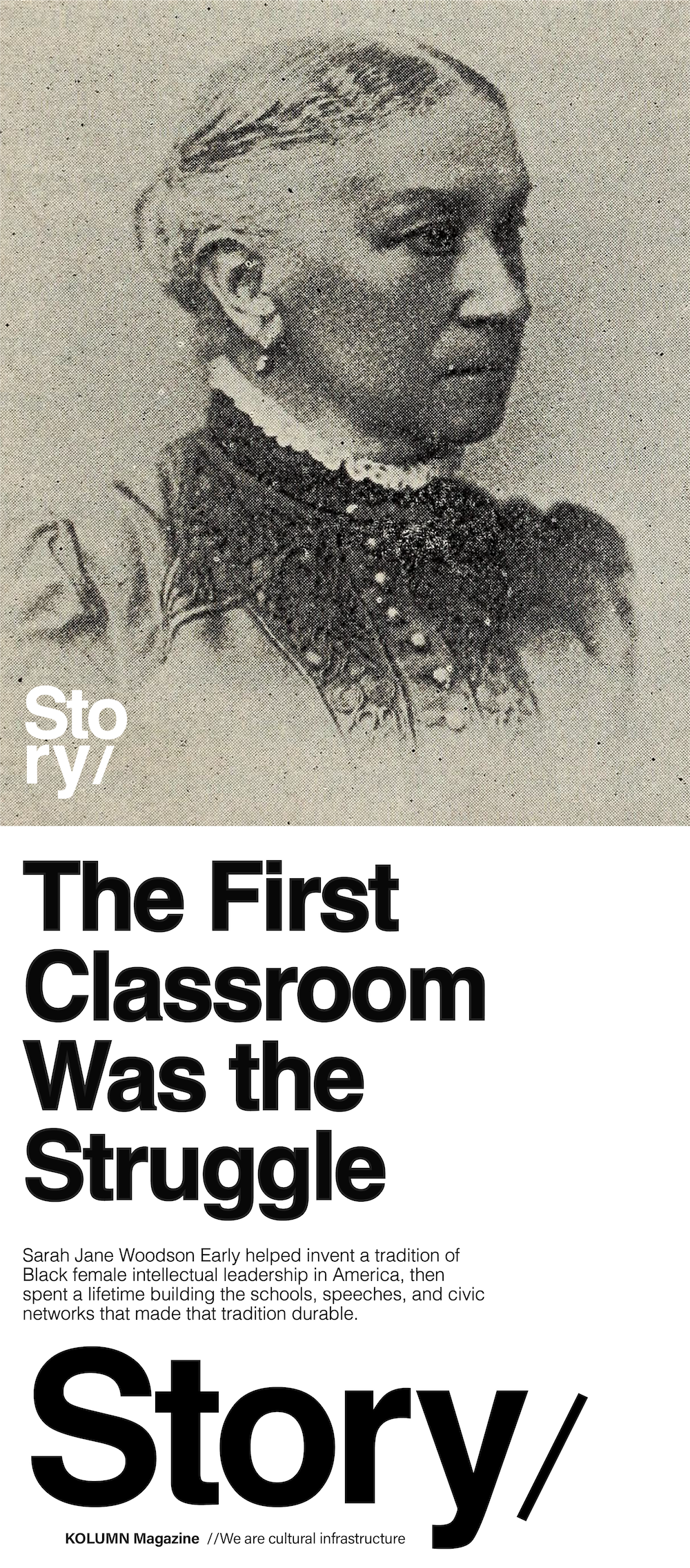
Sarah Jane Woodson Early was not important because she was first at the lectern. She was important because she understood the lectern itself as a tool of racial self-determination.
By KOLUMN Magazine
There are historical figures whose names survive because they were attached to spectacle. They stood at the center of a lawsuit, a march, a riot, a war, a famous photograph, a single sentence that textbooks could compress into a caption. Then there are the figures whose importance has to be understood not in one scene, but in a lifetime of labor. Sarah Jane Woodson Early belongs to that second category. Her story does not lend itself to a single iconic image. It asks for something more serious from a reader: attention to process, institution, and endurance.
That is precisely why she matters now. To speak of Sarah Jane Woodson Early is to speak about the making of Black intellectual life in the United States before the nation had any settled willingness to recognize Black intellect, Black womanhood, or Black institutional power as central to democracy. Born free in Chillicothe, Ohio, in 1825, educated at Oberlin, hired by Wilberforce in the 1850s, active in the African Methodist Episcopal Church, visible in temperance work, and later the author of a major 1894 biography of her husband, Jordan W. Early, she lived at the intersection of several histories that are too often told apart: the history of Black education, the history of Black women’s public speech, the history of the AME Church as an engine of self-governance, and the history of how Black communities treated literacy not as ornament but as infrastructure. Getting Word and Wilberforce University place her squarely inside that tradition, while Documenting the American South preserves the book through which she helped shape its memory.
To call her merely a “first” is accurate, but insufficient. Oberlin’s records place her among its Black graduates of the 1850s, and multiple institutional accounts credit her as the first Black woman to teach at a college or university and the first Black American to teach at what would become a historically Black college or university. Oberlin College, Oberlin Alumni Association of African Ancestry, and the African American Registry all preserve that outline. But the real significance of Sarah Jane Woodson Early is not that she crossed a threshold. It is that she understood, earlier than many of her contemporaries, that crossing a threshold meant very little unless Black people could hold the door open for one another afterward.
That theme has surfaced before in KOLUMN’s own pages. In Ella Baker: The Woman Who Built the Room, the central insight was that durable Black political life is often built not by those most loudly celebrated, but by those who create the conditions in which other people can think, gather, organize, and move. In The Teacher Who Made Baltimore Larger, KOLUMN argued something similar about educational work as civic expansion. Sarah Jane Woodson Early belongs in that lineage. She was not simply a pioneer because she arrived first. She was a pioneer because she treated Black education as a collective project and Black women’s public intellect as a social necessity.
A child of freedom, in a country structured by bondage
Sarah Jane Woodson was born on November 15, 1825, in Chillicothe, Ohio, to Thomas and Jemima Woodson. The family had already done the kind of difficult and deliberate freedom-making that defined so many Black lives in the early republic: movement, institution-building, landholding, church work, and the conversion of precarious liberty into something more stable. Accounts preserved by Getting Word, the African American Registry, and local historical writing describe the Woodsons as part of a Black family network in Ohio that linked religion, education, and communal self-help. Even the familiar anecdote that Sarah had memorized hymns and long passages of Scripture as a child, repeated across multiple biographical sources, matters less as charming legend than as evidence of the household culture that formed her: literacy, memory, sacred language, and expectation.
The world around her was not free in any uncomplicated sense. Ohio was a free state, but freedom in the antebellum North was always conditional, vulnerable, and policed. Black families could build churches and schools and communities, yet still live under legal discrimination, economic hostility, and the permanent threat of racial violence. That is one reason Sarah Jane Woodson Early’s life should not be romanticized as a simple Northern success story. Her upbringing exposed her to what might be called disciplined freedom: the understanding that liberty had to be organized, defended, and taught.
Sources on the Woodson family repeatedly point to Berlin Crossroads, the Black farming community in which churches, schools, and mutual support were central. Monroe County NOW and Getting Word both emphasize that the family’s world was not simply private and domestic; it was civic. In practical terms, that meant Sarah Woodson came of age in a culture where institution-building was ordinary Black work. Churches were not just places of worship. They were sites of strategy. Schools were not just places of instruction. They were declarations of personhood. Homes were not only homes. In Black freedom communities, they were relay stations in a larger moral geography.
This is one of the reasons she later moved so fluently between teaching, church work, lecturing, reform politics, and writing. Those categories were not separate in the world that formed her. They were parts of one project: the making of a Black public.
Oberlin and the discipline of intellectual seriousness
When Sarah Jane Woodson attended Oberlin College, she entered one of the most symbolically important institutions in 19th-century Black educational history. Oberlin was never perfect; no abolitionist institution was. But it did create an opening that mattered. The college admitted Black students and women at a moment when the nation still regarded both groups as naturally subordinate to white male authority, and its alumni network became one of the great pipelines of antislavery activism, education, ministry, and reform. Oberlin College lists Sarah Woodson Early among its Black graduates, while Oberlin’s alumni association still places her among the institution’s most consequential Black trailblazers.
She earned her L.B. degree in 1856, a point preserved in Oberlin-related materials and Black historical registries. That detail matters because it places her in the company of the earliest Black women in the country to complete serious collegiate study. It also places her before the better-known educational milestones that dominate popular memory. Mary Jane Patterson’s A.B. degree at Oberlin in 1862 receives deserved attention, and rightly so, but Sarah Jane Woodson Early’s presence in the 1850s reminds us that Black women were already occupying intellectually rigorous spaces before the Civil War fully rearranged the national moral imagination. Oberlin College, the African American History Museum, and scholarship indexed through the University of Delaware all point to that chronology.
Oberlin gave her more than credentials. It gave her a language of seriousness. Classical training, moral philosophy, oratory, and disciplined reading were not luxuries in this context. They were weapons against the ideological core of anti-Blackness, which insisted that Black people were either incapable of advanced thought or unworthy of it. Sarah Jane Woodson Early would spend the rest of her life dismantling that lie not through abstract rebuttal alone, but through embodied evidence. She taught. She administered. She lectured. She published. She kept showing, in public, that Black women could inhabit the role of intellectual authority without apology.
The significance of that posture can be easy to miss now. Today the idea of a Black woman professor, principal, lecturer, or author is not unusual, even if the path remains unequal. In the 1850s and 1860s, however, every one of those roles involved a direct challenge to prevailing social doctrine. Sarah Jane Woodson Early was not merely receiving an education in that period. She was entering a fight over the definition of the human.
Wilberforce and the politics of the Black faculty voice
If Oberlin helped form Sarah Jane Woodson Early intellectually, Wilberforce made visible what her education meant in public life. Wilberforce occupies a singular place in American history. Founded in 1856 and later operated by the African Methodist Episcopal Church, it is widely recognized by the institution itself as the nation’s oldest private historically Black university owned and operated by African Americans. Wilberforce University still describes that legacy in precisely those terms, and the university’s modern catalogs preserve the institutional memory of its antebellum origins and postwar reorganization.
Into that setting came Sarah Jane Woodson Early. Sources from Oberlin, Wilberforce, and long-circulating historical profiles consistently describe her 1858 appointment as a historic breakthrough: the first Black woman to teach at the college level in the United States, and the first Black American to teach at an HBCU. Some sources phrase the date and title slightly differently, distinguishing between her initial instructional role and her later more formal designation, but the consensus is unmistakable. She stood at the faculty line when that line was still being invented for Black women. Oberlin Alumni Association of African Ancestry, the African American Registry, and recent scholarship in Public Humanities all converge on that significance.
This matters for more than bragging rights. A Black woman faculty member in the late 1850s represented several overlapping challenges to the American order. She unsettled assumptions about race, assumptions about gender, assumptions about higher learning, and assumptions about who could speak with authority over the development of young minds. Her hiring did not mean those assumptions had collapsed. It meant they had been confronted.
Accounts of her later service at Wilberforce describe her as “Preceptress of English and Latin” and “Lady Principal and Matron,” positions that signaled both academic and supervisory authority. The titles are period-specific and can sound ornamental to modern ears, but they carried real institutional weight. They placed her not at the margins of school life, but near its moral and pedagogical center. She taught language and classical study. She helped shape student formation. She participated in building the culture of a Black college in an age when the very notion of a Black-controlled institution was itself a political statement.
This is where Sarah Jane Woodson Early’s significance widens beyond “women’s history” in the narrow commemorative sense. She is not only an inspiring figure for the archive of Black female achievement. She is part of the history of Black institutional sovereignty. Wilberforce was not simply a place where Black students could enroll. It was a place where Black educational vision could be articulated and administered. A Black woman on that faculty meant that Black institutional authority was already taking a fuller form than mainstream histories often allow.
“Address to the Youth” and the making of a Black public philosophy
One of the clearest windows into Sarah Jane Woodson Early’s mind is her 1863 speech, “Address to the Youth,” delivered before the Colored Teachers’ Association of Ohio and later preserved in AME print culture. It appears in scholarly references and later collections cited through the University of Delaware dissertation archive, Texas A&M’s , and recent Black rhetorical scholarship on JSTOR. Even in snippet form, the speech’s reputation is clear: it was a serious argument for intellectual development, racial obligation, and the disciplined use of learning.
The timing mattered. 1863 was not a neutral year in Black history. It was a year of war, emancipation, uncertainty, and possibility. To address Black youth in that moment was to address a generation standing in the violent doorway between slavery and an as-yet undefined freedom. Sarah Jane Woodson Early did not treat that audience sentimentally. She treated them as political and moral actors.
Scholarship describing the speech makes clear that she urged Black young people toward education not as mere self-improvement but as preparation for communal leadership. Science, teaching, and intellectual cultivation were part of a larger racial mission. She was not preaching assimilation into white approval. She was articulating a program of Black advancement through disciplined development. That is one reason some scholars have understood her as a Black nationalist thinker in a 19th-century key: not nationalist in the flattening modern sense, but committed to Black institutionality, Black mutual obligation, and Black control over the terms of uplift.
There is an important tonal distinction here. Sarah Jane Woodson Early was not arguing that education alone would solve anti-Blackness. Her era supplied too much evidence to believe that. What she argued, rather, was that Black communities needed trained minds, cultivated judgment, and moral seriousness in order to survive and govern themselves under hostile conditions. In that sense, her thought feels startlingly contemporary. She anticipated a problem that still haunts public life: the mistake of confusing representation with infrastructure. Getting one Black face into one prestigious room is not transformation. Building a durable culture of learning, speech, leadership, and accountability is.
That is why “Address to the Youth” should be read not simply as an inspirational address, but as an educational manifesto. It belongs to a long Black tradition in which oratory did not merely express feeling; it organized duty.
Reconstruction, the South, and the hard geography of teaching
After the Civil War, Sarah Jane Woodson Early did what many armchair celebrants of freedom did not have to do: she went where the work was hardest. Sources on her life report that she taught in schools for Black girls in North Carolina under Freedmen’s Bureau auspices and later continued educational work in the South after her 1868 marriage to Jordan Winston Early, an AME minister who had risen from slavery. Amsterdam News, Getting Word, and Documenting the American South collectively show a life in motion across educational and ecclesiastical networks rather than one settled comfortably into symbolic distinction.
This Southern phase matters because it prevents us from treating her career as a northern exception story. She did not remain safely within the orbit of her early triumphs. She entered the brutal improvisation of Reconstruction, where schools for freedpeople were targets as much as they were promises. Teaching Black children in the postwar South was not philanthropy in the soft sense. It was governance under siege. Every classroom had to be defended against underfunding, racial hostility, and the broader campaign to make Black freedom thin, symbolic, and reversible.
In many standard histories, Reconstruction appears through legislatures, paramilitary violence, and constitutional amendments. All of that matters. But Sarah Jane Woodson Early’s life reminds us that Reconstruction was also a pedagogical battle. It involved questions such as: Who will teach the freed? What curriculum will signal citizenship? What kind of woman can stand publicly as a Black educator in the South and insist upon being obeyed? Those are political questions, even when they look domestic or local.
Accounts of her later life also note that she served as principal in multiple cities. That administrative work deserves more attention than it usually receives. The Black principal in the 19th century was not merely a school manager. She was often fundraiser, disciplinarian, public representative, cultural translator, and guardian of the institution’s moral legitimacy. To lead a school in that era was to hold together a fragile civic organism with very little margin for error. Sarah Jane Woodson Early did that repeatedly.
The AME Church, women’s labor, and the grammar of leadership
Any serious account of Sarah Jane Woodson Early has to reckon with the African Methodist Episcopal Church. Not as background. Not as a faith label. As structure. AME was one of the central Black institutions of the 19th century, and Documenting the American South preserves period texts that testify to its scale and historical ambition. It was a church, yes, but also a communications network, an educational sponsor, a political training ground, and a culture-making force. Sarah Jane Woodson Early’s life inside that world helps explain both her subject matter and her authority.
This is especially visible in the way she wrote and spoke about women’s labor. The Getting Word archive preserves part of her 1893 language on the role of women in the church, including the striking line, “The women were ready.” That phrase does not read as ornamental praise. It reads as historical correction. She is naming women as foundational workers in the making of Black religious institutions: fundraisers, organizers, sustainers, recruiters, builders, and moral centers.
That insistence matters because Black women in the 19th century were often expected to provide labor without historical authorship. Sarah Jane Woodson Early pushed against that arrangement. She documented. She addressed audiences. She interpreted organizational life. She made arguments about what women had already done and what their collective work meant. She was not only participating in the Black public sphere. She was helping define who counted within it.
This is also why her authorship of Life and Labors of Rev. Jordan W. Early should not be treated as merely dutiful wifely biography. The book, published in 1894 and preserved by Documenting the American South, is certainly a tribute to her husband. But it is also an act of historical curation and Black archival stewardship. In the preface, she describes the recording of AME pioneers as a duty owed to “those worthy men” who built the church under crushing conditions. Yet the very act of recording is itself a claim to authority. Sarah Jane Woodson Early writes history in order to prevent erasure. She identifies memory as labor. She takes responsibility for narrative.
That move deserves to be read alongside the broader Black women’s tradition of the century: women who organized sewing circles, schools, missionary societies, aid associations, newspapers, and lecture circuits while also producing the language through which those efforts would be remembered. Sarah Jane Woodson Early is part of that tradition not only because she did the work, but because she understood the danger of leaving its record to others.
Temperance, respectability, and the politics of strategy
Modern readers can understandably hesitate around temperance activism. The 19th-century temperance movement was often entangled with paternalism, moral surveillance, and respectability politics in ways that deserve criticism. Yet to stop there would be to miss what Black women reformers such as Sarah Jane Woodson Early were doing inside and through those organizations.
Sources consistently note that she served from 1888 to 1892 as national superintendent of the Colored Division of the Women’s Christian Temperance Union and that she traveled widely, giving more than one hundred lectures across a five-state region. Amsterdam News, the African American History Museum, and institutional summaries reproduced in widely circulated historical profiles all preserve that record of movement and public address.
The scale of that lecturing matters. One hundred speeches is not a sideline. It is a public career. It means travel, audiences, persuasion, logistics, reputation, and stamina. It means she was not simply a local school figure who occasionally appeared in reform spaces. She was a working Black woman intellectual in motion.
What did temperance mean in her hands? Not simply abstinence. For many Black women, temperance became a platform from which to discuss domestic safety, civic virtue, communal discipline, and the moral conditions necessary for Black advancement in a hostile society. It also offered a structure, however imperfect, through which Black women could organize across geography. Some historical accounts note that the Colored Division of the WCTU was among the earliest national platforms through which Black women were organized at scale. That should not be romanticized; white reform spaces often remained profoundly unequal. But neither should it be dismissed. Sarah Jane Woodson Early used the space that existed to enlarge the space that did not yet exist.
This is where her pragmatism comes into view. She was not waiting for ideologically pure institutions to appear before acting. She worked in churches, colleges, reform associations, schoolrooms, and public lecture settings that were all compromised in some way. The question for her seems to have been whether they could be made useful to Black life. That is a harder, more adult politics than retrospective purity allows.
Chicago, 1893, and Black women speaking for themselves
Sarah Jane Woodson Early’s appearance at the 1893 World’s Congress of Representative Women in Chicago provides one of the most revealing scenes of her mature public life. Multiple sources identify her as one of a small group of Black women invited to speak there alongside figures such as Anna Julia Cooper, Fannie Barrier Williams, Hallie Quinn Brown, and Fanny Jackson Coppin. Her talk was titled “The Organized Efforts of the Colored Women of the South to Improve Their Condition,” and bibliographic records preserved by Routledge Historical Resources and George Mason University Libraries confirm the speech’s publication in the official congress volume. (Routledge Historical Resources)
This was not a minor detail in a decorative women’s event. The 1893 congress was part of a larger contest over who would represent womanhood, civilization, reform, and progress at the end of the century. For Black women to speak there was to interrupt a white feminist public that often universalized itself while marginalizing Black experience. Sarah Jane Woodson Early entered that arena not to ask politely for inclusion, but to document Black women’s organizing as an accomplished fact.
One of the most memorable lines associated with that address, preserved in later references, is that organization had taught Black women “the art of self government.” Even in paraphrase, the force of that claim is unmistakable. She was arguing that Black women’s clubs, associations, church work, and reform activity were not ancillary charitable gestures. They were training grounds in governance. They produced executive ability, mutual accountability, and civic capacity. In other words: Black women were not waiting to be civilized into public life. They were already practicing it.
That argument belongs to a wider Black feminist archive of the 1890s, but it is especially resonant in Sarah Jane Woodson Early’s case because it gathered together themes she had been living for decades. School leadership. Church labor. Public speech. Written history. Reform travel. Institutional maintenance. By Chicago, she was not theorizing abstractly. She was naming, from experience, the political meaning of Black women’s work.
Why her authorship matters as much as her teaching
Sarah Jane Woodson Early is sometimes remembered as an educator and only secondarily as a writer. That hierarchy should be challenged. Her authorship matters not because it decorates her résumé, but because writing was one of the ways she secured historical continuity.
Her 1894 Life and Labors of Rev. Jordan W. Early is often described as a biography of her husband, and it is. But it is also a text about Black religious movement, Black memory, and the struggle to preserve a usable institutional past. Documenting the American South makes clear from the book’s preface that she regarded the recording of early AME lives as a duty to posterity. That is an archival instinct, not merely a devotional one. She knew that great movements disappear from public memory when the people who built them leave too few documents behind. So she wrote one.
That act places her inside a broader Black women’s literary tradition in which genre boundaries were porous. Biography could also be movement history. Religious narrative could also be political argument. Family memory could also become collective record. For women who were routinely excluded from official archives, writing was one method of refusing disappearance.
This should also change the way we think about her title as “author.” She was not a novelist in the conventional canon-making sense. She was something equally important: a Black woman public writer whose prose served institution, memory, and community transmission. That kind of authorship is often undervalued because it is not easily slotted into narrow literary prestige categories. But for Black life in the 19th century, it was indispensable.
The lesson of Sarah Jane Woodson Early
What, finally, does Sarah Jane Woodson Early signify?
She signifies that Black women did not merely enter American intellectual life. They helped build its most necessary democratic forms while being denied full recognition by the nation around them. She signifies that education in Black history has never been only about individual mobility. It has been about preparing a people to survive distortion, exclusion, and theft. She signifies that institution-building is often quieter than protest but no less radical. She signifies that writing history is part of making history. And she signifies that a life can be foundational even when it is not widely famous.
There is a temptation, especially in commemorative culture, to make figures like Sarah Jane Woodson Early legible through uplift alone. The first Black woman on a faculty. The accomplished educator. The clubwoman. The lecturer. The author. All true. But the sharper reading is this: she belonged to a generation of Black women who refused the boundaries the country tried to assign them and then refused, too, the smaller boundaries that posterity sometimes assigns in return. She was not just an educator. She was a strategist of Black continuity.
In an era that regularly confuses visibility for victory, her life offers a corrective. Sarah Jane Woodson Early was not sustained by celebrity. She was sustained by the work itself. By schools. By speeches. By church networks. By students. By the long belief that if Black people were to inhabit freedom fully, they would need institutions equal to that freedom, and they would need women capable of leading them.
That is why she deserves more than a plaque-like summary. She deserves a serious place in the story of American ideas. Because when Sarah Jane Woodson Early stood before students, readers, church audiences, or reform gatherings, she was doing more than teaching content. She was enlarging the definition of who could think in public, who could lead in public, who could narrate a people’s past, and who could prepare a people’s future.
In that sense, Sarah Jane Woodson Early did not simply teach in a classroom. She helped invent one.
More great stories
Afro Sheen, Wall Street, and the Architecture of Black Possibility
July 6, 2026
No Comments
The Fire Inside the Fourth
July 5, 2026
No Comments