
By KOLUMN Magazine
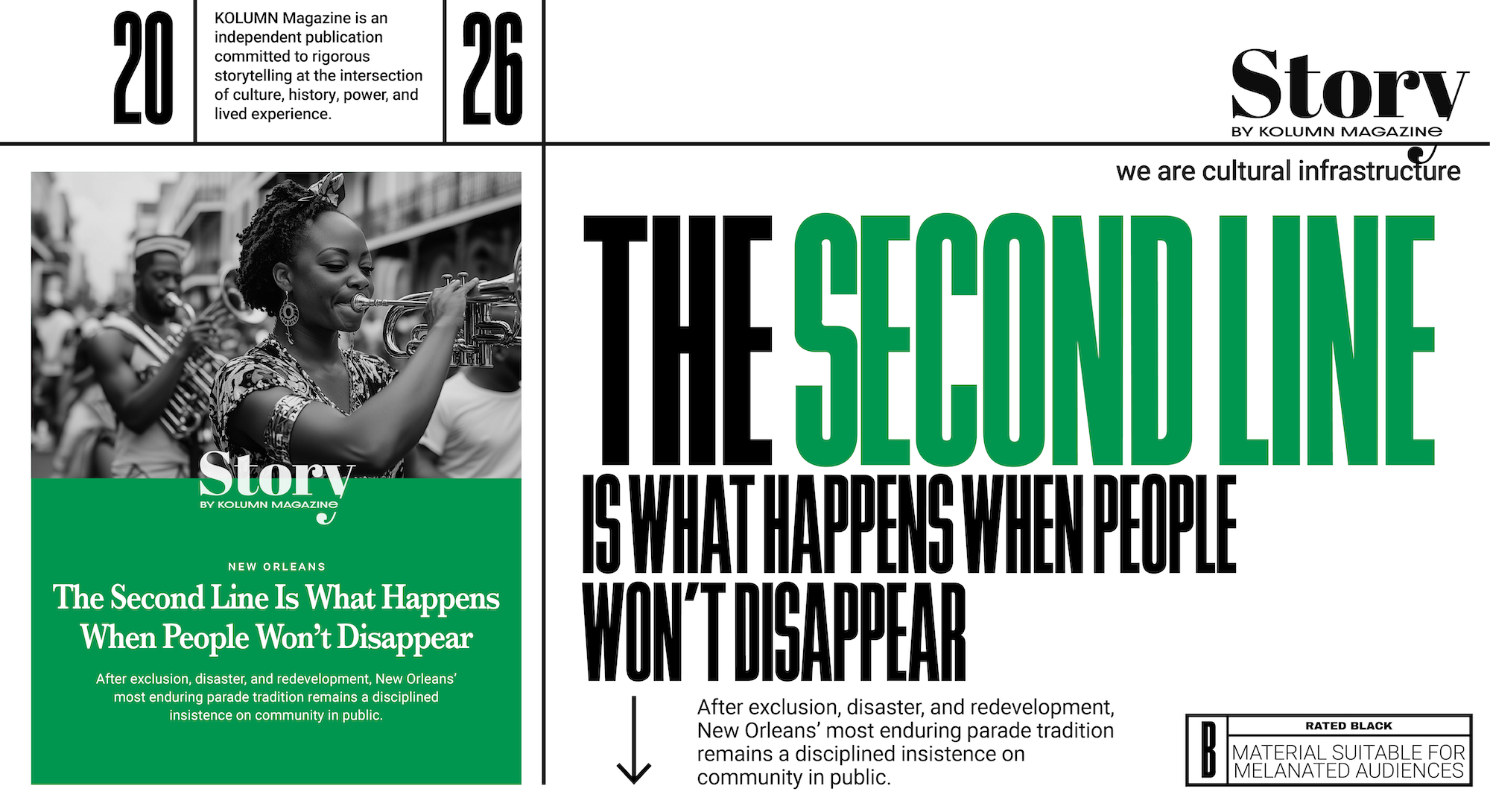
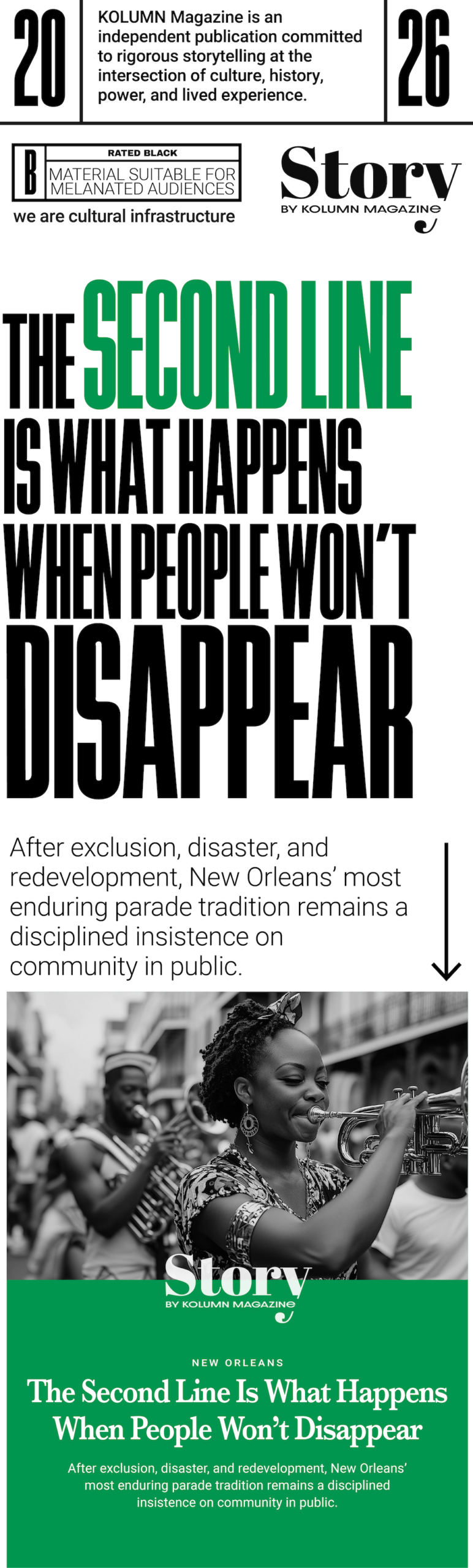
On a Sunday afternoon in New Orleans, the street can change character in an instant. A few blocks ahead, the air starts to thicken with brass: the swell of a tuba line, the bright cut of trumpets, the muscular insistence of a snare drum that seems to speak in complete sentences. Then comes the shimmer—sunlight ricocheting off a horn bell, sequins catching the day like a dare, a hand-decorated parasol turning in a slow, practiced circle. The first people you notice are often the ones who look official: a grand marshal in a sharp suit and hat, moving with the calm authority of someone conducting traffic without ever raising his voice; club members in coordinated colors and tailored fits; a rope line that isn’t so much a barrier as a moving boundary between order and ecstatic improvisation.
And then you notice everyone else. The crowd behind the band isn’t a crowd in the conventional sense—it is an argument made with bodies. Teenagers buck-jump beside elders who step with measured precision. Toddlers bounce on hips. Neighbors lean from porches. People you’ve never met hand you a cup, a napkin, a word of instruction—stay behind the band, watch the turns, keep up. Strangers become co-authors. That swelling, dancing, waving, sweating mass is the second line: the people who follow, the people who join, the people who make the parade more than a performance and less than a spectacle.
To understand the second line is to understand New Orleans not as a postcard, but as a city that has long used culture as infrastructure—an everyday technology for survival. The second line is often described as a “roving street party,” and it is that. But it is also a living archive of Black civic life, a public ceremony built from older African-derived aesthetics and newer American pressures, a mutual-aid tradition that learned to advertise itself through beauty, and a form of social choreography that insists a neighborhood belongs to the people who animate it. In the simplest terms, second lining is a parade practice organized most famously by Social Aid and Pleasure Clubs (SAPCs), with a brass band at the front and the public forming the moving celebration behind. In deeper terms, it is what happens when a community refuses to separate grief from joy, or music from policy, or tradition from the present tense.
This tradition has endured through slavery’s aftermath, Jim Crow exclusion, municipal crackdowns, hurricanes, gentrification, and the ongoing tug-of-war between cultural tourism and cultural ownership. It has evolved without surrendering its logic: that public space can be sanctified by movement; that sound can function as a social bond; that mutual aid is not only money in an envelope but also a ritual commitment to show up for one another; that a city’s most important institutions are sometimes informal, intergenerational, and loud enough to stop traffic.
What “Second Line” Means—and Why the Definition Matters
The term “second line” begins as a spatial description. The “first line” is the core: the permitted organization—often a Social Aid and Pleasure Club—along with the brass band and the club’s immediate formation. The “second line” is everyone else: the followers, dancers, neighbors, and passersby who join behind the band, turning a planned parade into a porous, collective event. That porosity is part of the point. Second lines are not designed as ticketed experiences or fenced performances; they are designed to be absorbed into, to be joined, to be extended by the public.
But the term also functions as a cultural claim. In New Orleans, the second line is not merely a “parade audience.” It is a participatory role with its own etiquette and aesthetics: the style of dance—often described as buck-jumping and improvisational strutting; the use of parasols and handkerchiefs; the call-and-response between band and bodies; the way an entire neighborhood becomes, for a few hours, a moving commons.
That matters because the second line is often flattened in outside descriptions into a colorful “local tradition,” the kind of thing travel writing treats as ambient charm. The better lens is civic. Historically, many of the organizations that anchor second lines emerged because Black New Orleanians built their own systems of care when formal systems denied them access. Benevolent societies and later social aid organizations offered forms of insurance, burial assistance, loans, and community support. The parade—joyful, visible, loud—was one way those organizations affirmed their presence and, crucially, their legitimacy.
In other words: the second line is a celebration, but it is also a public ledger of who cares for whom.
Before the Brass: Congo Square, Ring Shouts, and the Long Memory of Movement
No single origin story can contain the second line, but credible scholarship and local historical institutions repeatedly point back to African-derived dance and ritual traditions that survived enslavement and re-formed in New Orleans’ distinct colonial and American contexts. Congo Square—today part of Louis Armstrong Park—appears again and again in this genealogy. Scholars have described the square as a site where enslaved and free Black people gathered on Sundays for drumming, dance, and community, sustaining forms of ancestral worship and social cohesion under oppressive conditions. Those gatherings, rooted in West and Central African performance traditions, helped preserve a movement vocabulary—circle dances, improvisation, polyrhythm, call-and-response—that would later echo in New Orleans’ street culture.
If you watch a second line closely, you can see how much of it is about permission: permission to move however the music instructs, permission to be uncontained, permission to take up space. That insistence on embodied freedom is one reason historians and ethnomusicologists emphasize the continuity between earlier African-derived public dances and later street parades. The second line, as a form, can be understood as a braid: African ritual and social dance practices interwoven with European military band traditions and the parade culture of a port city shaped by French and Spanish colonial histories.
This is also why the second line is inseparable from New Orleans music history. Brass bands did not emerge in a vacuum; they became crucial patrons and employers for Black musicians, offering a path to livelihood and community organization. The street, in New Orleans, has always been a stage—but also a workplace, a classroom, and a sanctuary.
Mutual Aid in Motion: Benevolent Societies, Social Aid, and the Politics of Care
To write about second lines as pure celebration is to miss the hard logic underneath their beauty. In the 1800s and into the early 1900s, mutual aid organizations—benevolent associations, fraternal orders, and later social aid and pleasure clubs—became crucial in Black New Orleans, particularly as discriminatory practices in insurance and social services restricted access. These organizations collected dues, supported members through sickness and hardship, and often provided burial assistance—an expense that could otherwise devastate families.
The Atlantic’s reporting on the Young Men Olympian Jr. Benevolent Association—described as one of the city’s oldest second-line groups—underscored the depth of this mutual-aid function: financial help, funeral expenses, and a dues-paying structure that treats membership not as a social club alone but as a civic commitment.
This is one of the central truths of the second line: it is a cultural form born from social necessity. When the state fails to provide, communities invent institutions. When those institutions need visibility and cohesion, they gather in public. When public gathering is policed or threatened, the gathering evolves—becoming more organized, more symbolically rich, more musically compelling, more difficult to erase.
New Orleans’ own cultural and tourism institutions, while writing for visitors, still point to this history: neighborhood organizations offering aid—loans, insurance-like support, and funeral honors—and using the second line as a form of “advertising” that also affirmed dignity and belonging.
The word “advertising” can sound crass until you remember what was being sold: not a product, but a promise that you would not be abandoned. The parade says: we exist, we are organized, we take care of our own, and we are proud enough to dress like royalty while doing it.
The Jazz Funeral Connection—and the Crucial Distinction
Outside Louisiana, many people encounter the second line first through the idea of the jazz funeral: the procession that escorts the dead with music that moves from solemnity to release. The kinship is real. Second lines and jazz funerals share roots in benevolent societies and Black ritual life, and both involve brass bands and public procession.
But they are not identical. A second line parade does not require death as its premise. Many second lines are scheduled events sponsored by social aid and pleasure clubs “for their own sake,” as community celebrations that can also honor living anniversaries, neighborhood pride, and the ongoing continuity of the club itself. National Geographic noted that second-line parades occur even without funerals, often sponsored by social aid clubs and benevolent societies.
That distinction matters ethically and politically. The second line is not merely a “funeral turned party.” It is a standalone institution of social life. Its joy is not only catharsis after mourning; it is an assertion that a community’s right to gather is reason enough.
The Route as Narrative: Neighborhoods, Boundaries, and Who Gets to Be Seen
Second lines are not random wanderings. They are routed through neighborhoods with intention—passing homes, corners, bars, churches, and landmarks that hold memory. The parade’s geography functions like a narrative: it tells you what the club considers its territory, its history, its audience. It is common to hear New Orleanians talk about second lines as neighborhood events, not merely citywide attractions. That local specificity is part of why the tradition has remained resilient; it is anchored not in a single venue but in a network of streets and relationships.
In that sense, the second line can be read as a moving map of Black New Orleans. Tremé, Central City, the Seventh Ward, the Sixth Ward, and other historically Black neighborhoods appear repeatedly in reporting and cultural documentation as key sites of parading culture. The Atlantic’s account of the Young Men Olympian Jr. Benevolent Association placed it in Central City and described how floodwaters after Hurricane Katrina destroyed its clubhouse—an example of how physical loss intersects with cultural continuity.
KOLUMN Magazine, in a recent piece reflecting on Tremé’s built environment, described the neighborhood’s architecture—stoops, galleries, and porches—as a kind of co-performer in street ceremony, emphasizing how domestic life spills into public life in a place shaped by second lines and parading culture.
This is an important corrective to the tourist gaze. For locals, the second line is often as much about the porch as the street: the elders watching, the neighbors joining for a block or two, the informal checkpoints where people greet one another and reassert a shared sense of place.
Style Is Not Decoration: Suits, Parasols, Handkerchiefs, and the Aesthetics of Dignity
Second lines are visually unforgettable, and it can be tempting to describe that spectacle as mere “costume.” But the finery of second lining—custom suits, coordinated club colors, feathered fans, parasols, sashes, and polished shoes—has long functioned as an aesthetics of dignity and self-determination.
In a country that has historically denied Black communities the presumption of refinement and public authority, the act of dressing elaborately for a neighborhood parade becomes political. It is not just pageantry; it is a declaration that the street belongs to people worthy of ceremony. The grand marshal’s role, the club member’s uniformity, and the crowd’s improvisational flair collectively produce a moving court, a civic theater.
New Orleans & Company—again writing for a broad audience—still captures a core truth: the second line is a “joie de vivre” that welcomes people in, with parasols twirling and dancers “buck-jumping for joy.” That language can sound romantic until you put it against the historical record. The joy is not naive; it is earned.
The Music: Brass Band Lineage, Innovation, and the “Second Line Feel”
If the second line is a moving institution, the brass band is its engine. Brass bands in New Orleans have long served as musical employers, community anchors, and carriers of repertoire that spans hymns, early jazz, R&B, funk, and contemporary adaptations. The Washington Post has documented the ongoing legacy of brass band music, noting how brass bands helped Black musicians organize and earn a living, and describing training spaces like summer camps that cultivated younger players.
The Post’s older travel coverage also treated second line band culture as a living ecosystem—distinguishing traditional parade bands from “new sound” groups that pushed the style forward. Even as the piece reads like a guide for outsiders, it reflects something important: second line music has never been static. It has always been responsive to the city’s broader musical currents.
This is part of what makes second lines so musically instructive. They are not museum pieces; they are laboratories. Bands like the Dirty Dozen Brass Band, frequently credited with expanding brass band idioms into funk, bebop, and R&B-inflected forms, demonstrate how the “second line” can describe both a parade structure and a rhythmic sensibility that has influenced broader American music.
When musicians and cultural commentators talk about the “second line feel,” they are pointing to a rhythmic pocket—syncopated, propulsive, elastic—that invites dancers to interpret rather than merely march. The band doesn’t just play for the crowd; it plays with the crowd, responding to who is dancing, how the block is feeling, what kind of release is needed.
The Atlantic’s interviews with New Orleans artists about communal culture have emphasized precisely this social function. In a Q&A tied to the magazine’s “Floodlines” project, musician Chief Xian aTunde Adjuah described second lines as spaces where you see neighbors, talk, and dance—an ordinary ritual of connection.
Ordinary, here, does not mean small. It means integrated into life.
A Tradition That Refuses to Stay in One Box: Weddings, Festivals, and the Expansion of Second Lining
One of the clearest signs of second line resilience is how the tradition travels across life events. Weddings in New Orleans often incorporate second lines, turning the move from ceremony to reception into a street celebration that draws neighbors into the couple’s joy. New Orleans & Company explicitly describes wedding second lines as a tradition marking “the beginning of a new life together,” with umbrellas in hand and guests following the band.
Festivals have also increasingly incorporated second lines, which creates both opportunity and tension. On one hand, festival second lines can provide work for bands and broaden exposure. On the other, the more the second line is staged for visitors, the more it risks being understood as entertainment divorced from its mutual-aid roots.
The FrenchQuarter.com overview notes that festival second lines—at events like Satchmo SummerFest, the French Quarter Festival, and Jazz Fest—are common places for visitors to encounter the form.
This is not inherently bad. But it shifts the context. A neighborhood second line anchored by a social aid club is not the same as a festival “activation,” even if the horns and parasols look similar. The question becomes: who sets the route, who benefits economically, and who retains interpretive authority over what the tradition means?
Katrina and the Question of Cultural Survival: When the Street Becomes a Measure of Recovery
Hurricane Katrina did not just flood homes; it disrupted the networks that make cultural traditions possible: neighborhood continuity, meeting spaces, rehearsal rhythms, local economies, and the informal social contracts of everyday life. Yet, as with so much in New Orleans, culture became one of the ways people measured survival.
The Atlantic’s reporting on benevolent associations after Katrina described how the Young Men Olympian Jr. Benevolent Association’s clubhouse was destroyed, yet the organization persisted—an emblem of cultural continuity amid physical ruin.
The Guardian, in coverage reflecting on New Orleans years after the storm, repeatedly invoked second lines as both symbol and practice—parades that carried grief, defiance, and the insistence on public life even when the city’s infrastructure failed.
The second line, in the post-Katrina era, became a kind of moving proof-of-life: a sign that the neighborhood could still gather, still sound like itself, still claim the street as communal space rather than as contested real estate.
At the same time, Katrina accelerated outside attention—philanthropy, media, redevelopment, and tourism—bringing new pressures. When a tradition becomes a symbol, it becomes easier to commodify. When neighborhoods change demographically and economically, parading routes can become flashpoints: residents complaining about noise, city officials worrying about security, clubs navigating permits and policing.
The second line persists anyway, partly because it has always been an adaptive system. Mutual aid teaches flexibility: how to stretch limited resources, how to keep moving even when the formal world says you should stop.
Policing, Permits, and the Constant Negotiation of Public Space
Second lines are not simply cultural events; they are regulated events. Permits, fees, security requirements, and police presence all shape how a second line can operate. This is not merely bureaucratic friction—it is the modern expression of a longer history in which Black public gathering has been policed as suspicious, disruptive, or dangerous.
The tension becomes particularly visible when violence touches a second line. The Associated Press reported on arrests connected to a mass shooting that occurred during a second-line event hosted by the Nine Times Social Aid & Pleasure Club, underscoring how these parades remain large public gatherings that can be vulnerable in a heavily armed society.
Ebony has similarly covered shootings tied to second-line events, noting the cultural centrality of these parades even as they become sites where broader public safety failures can erupt.
Yet it would be a mistake—and a harmful one—to let safety discourse become a cover for cultural suppression. Historically, one of the risks is that “public order” becomes the language used to restrict Black traditions while leaving other forms of mass gathering comparatively unburdened. The second line’s future, therefore, is partly a policy question: whether the city treats these parades as problems to manage or as heritage to protect with real resources and respectful collaboration.
The Guardian’s recent investigative reporting on New Orleans’ public safety failures in tourist corridors is not about second lines specifically, but it is relevant to the city’s broader credibility when it claims certain security measures are impossible. If the city struggles to implement promised safety infrastructure in its most economically prioritized zones, it raises questions about how equitably—and competently—it supports community events outside those corridors.
Second lines have long survived because communities bore the costs themselves—financial, organizational, emotional. But survival should not be mistaken for fairness.
Culture Versus Commodity: Tourism, Branding, and the Risk of Extraction
New Orleans is marketed globally as a place where culture is abundant and accessible, and second lines often appear in that marketing as shorthand for authenticity. The dilemma is straightforward: when a city sells culture, who gets paid—and who gets flattened into a brand?
Tourism-oriented guides frequently emphasize that “everyone is welcome” at a second line, which is true in practice and generous in spirit. But openness can be exploited. When visitors treat second lines as content opportunities—backdrops for selfies, “must-see experiences,” viral clips—the tradition risks being consumed rather than joined. Participation becomes extraction when it is not paired with respect: following the etiquette, supporting the clubs and bands economically, and understanding that the parade is not staged for you even if you are invited into it.
There are grassroots efforts to protect culture bearers in more direct ways. Ebony has noted organizations like Feed the Second Line, which supports New Orleans culture bearers with essentials and assistance—evidence that even today, the mutual-aid logic that birthed social aid clubs continues in modern forms.
The central question is not whether outsiders can appreciate second lines. They can, and often do. The question is whether appreciation becomes reciprocity.
Gender, Performance, and the Expanding Story of Who Leads
Second line culture is often narrated through male-coded images: grand marshals, brass band front lines, club hierarchies. But the tradition has always been broader, with women organizing, leading, dancing, and shaping aesthetics—sometimes in ways under-credited by mainstream narratives.
The Root’s cultural writing on New Orleans repeatedly describes second lines not as a narrow “parade type” but as a social world—part street party, part neighborhood reunion, part moving barbecue—where families and communities gather. That framing matters because it situates the second line inside domestic and communal life, where women’s labor—planning, caregiving, community glue—has always been central.
There are also traditions adjacent to second lining that complicate gender expectations, such as the Baby Dolls culture referenced in The Root’s reporting on New Orleans street performance and celebration. These stories remind us that second lining is not only about preservation; it is also about creative redefinition.
The second line’s elasticity—its ability to hold multiple identities, aesthetics, and social roles—is part of why it remains contemporary rather than nostalgic.
The Second Line as Language: How a Local Form Becomes a National Metaphor
Another sign of the second line’s cultural power is how often it is borrowed as metaphor. Writers use “second line” to describe a kind of resilient celebration after catastrophe, or a communal procession that carries memory forward. The Root, in a piece reflecting on a Katrina-related film, described the work as serving like a “second line” performance—an echo of how the tradition symbolizes tribute and survival.
The metaphor travels because the underlying idea is legible: when the official world collapses, people gather anyway; they make ritual anyway; they move anyway. They refuse to let trauma be the final organizing principle.
But metaphors can dilute. The danger is that “second line” becomes a vibe—something you can invoke without engaging its history of Black organizing, exclusion, and ingenuity. The more responsible approach is to treat the metaphor as a prompt: if you admire the second line’s resilience, do you also support the people who keep it alive?
A Living Archive That Still Has to Pay Rent
To talk about second lines as “centuries-old” is accurate; the tradition’s roots reach deep into the city’s Black history and older African-derived practices. The Historic New Orleans Collection, for example, traces second-line origins back more than 200 years and emphasizes the way Black advocacy and celebration in public spaces carried forward through cultural institutions and community practices.
But the most important fact about the second line is not its age. It is its ongoing cost.
Brass bands require instruments, rehearsal time, and paid gigs. Social aid clubs require dues, organizing labor, and administrative stamina. Routes require permits and logistics. Members invest in elaborate outfits that can cost far more than outsiders assume. The tradition looks effortless only because a great deal of effort is being disguised as ease—one of New Orleans’ great aesthetic skills.
The Washington Post’s more recent storytelling about New Orleans frequently returns to second lines as an emblem of the city’s soundscape and daily life, noting how music seems to echo constantly—sometimes “fueling a second line behind the brass band.” The phrasing is casual, but the reality behind it is not. A city does not get a constant soundtrack by accident. It gets one by choosing, again and again, to prioritize culture as a public good—even when budgets, policies, and outside narratives push in the opposite direction.
What the Second Line Teaches America—If America Is Willing to Learn
In an era when “community” is often treated as a branding term—used by companies, campaigns, and institutions that rarely invest in real social bonds—the second line offers a harder definition. Community is what you can mobilize without an app. It is what shows up when someone dies, when someone marries, when someone comes home, when a neighborhood needs reminding that it still belongs to itself.
The second line is also a reminder that mutual aid is not new, not trendy, and not optional. It is a proven strategy Black communities have used for generations when the formal economy and state systems were hostile or indifferent. Benevolent associations and social aid clubs did not emerge from leisure; they emerged from need. And yet they built something that looks like joy. That alchemy—need into beauty, exclusion into self-made ceremony—is one of New Orleans’ most consequential contributions to American culture.
The second line does not ask to be romanticized. It asks to be understood accurately: as tradition, yes, but also as policy in motion; as music, yes, but also as labor; as celebration, yes, but also as the public face of a private promise to care for one another.
On the street, the band rounds a corner and the second line surges to keep up. A dancer dips low, snaps back, and laughs—at himself, at the world, at whatever tried to reduce him to something smaller. The parasols tilt. The horns flash. The neighborhood watches, then joins. For a few hours, the city’s deepest argument becomes visible: that culture is not decoration on top of life, but one of the ways life is protected.
And when the last notes fade and the street returns to traffic, what remains is not just the memory of a good time. What remains is the proof that a people can build an institution out of sound and movement—and keep it alive, block by block, generation by generation, even when the rest of the country only notices when it wants a story.