


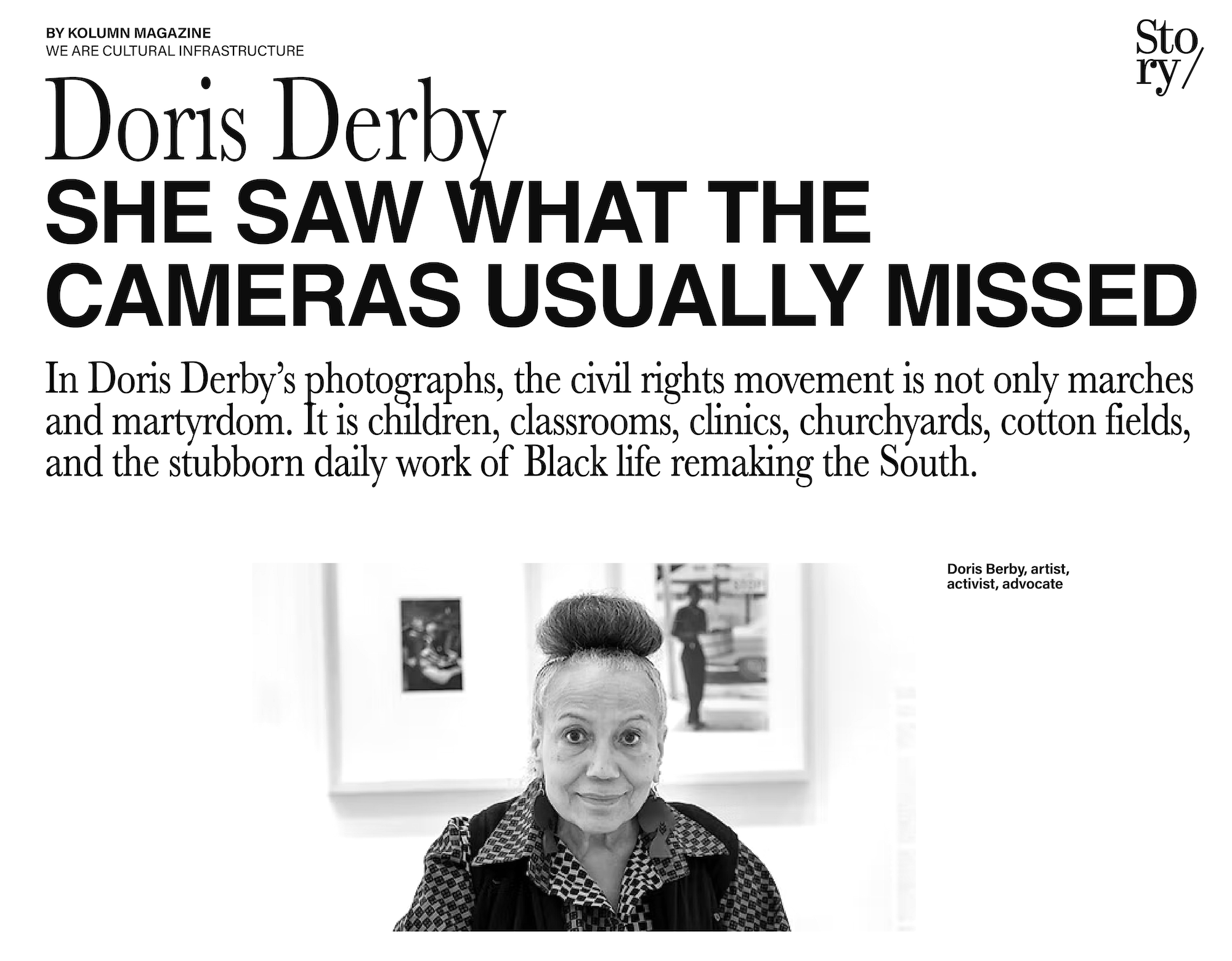
Doris Derby did not photograph the movement as spectacle. She photographed it as a lived Black world under siege and in creation at the same time.
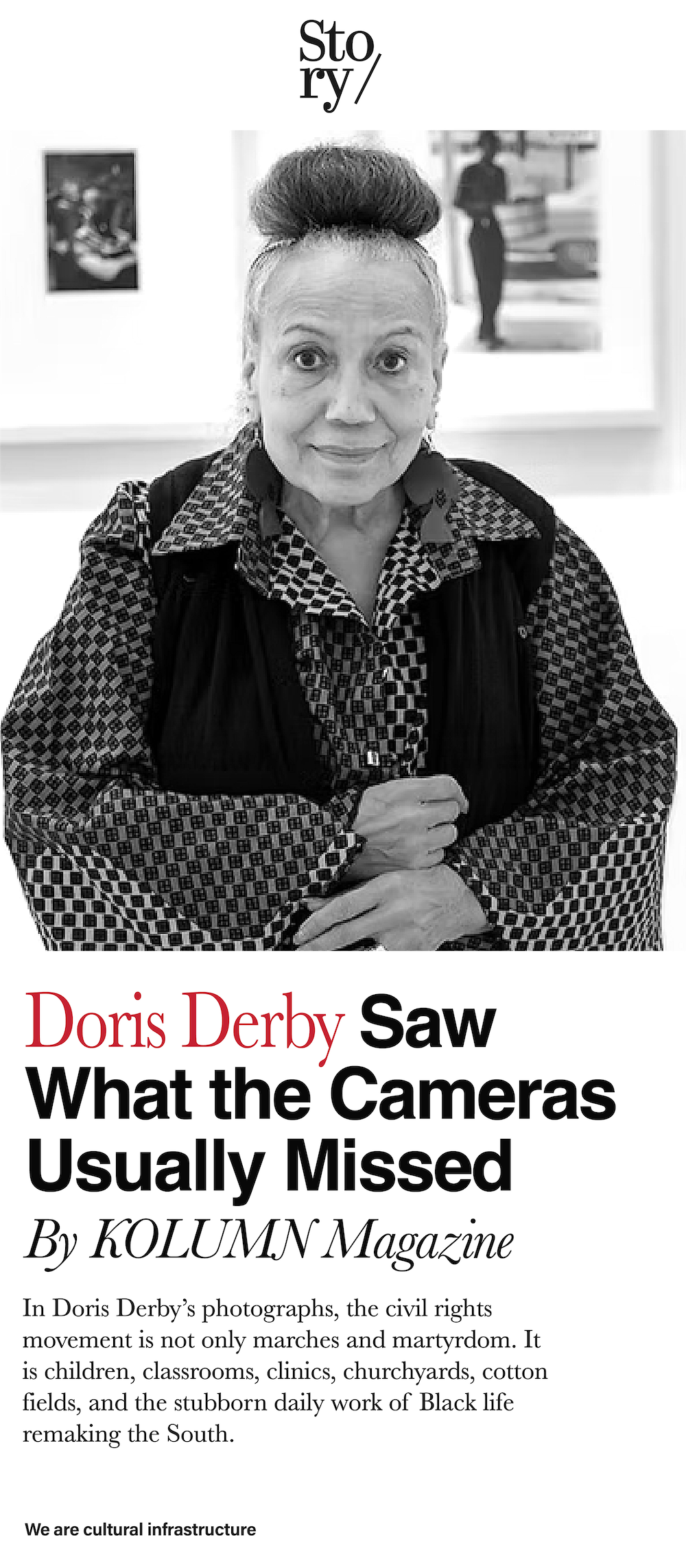
Doris Derby did not photograph the movement as spectacle. She photographed it as a lived Black world under siege and in creation at the same time.
By KOLUMN Magazine
The standard iconography of the civil rights movement is so familiar it can feel almost pre-edited in the national mind: police dogs, fire hoses, marchers crossing bridges, bodies bloodied for democracy, ministers at podiums, widows in grief, Black children facing down a nation’s contempt. Those images matter. They should matter. But they are not the whole story, and Doris Derby understood that with unusual clarity. Her work was never interested only in crisis at its most photogenic. She turned instead toward the dense, unglamorous, sacred material of movement life: literacy classes, health clinics, church women, sharecroppers, children in fields, families on porches, cooperative labor, backstage work, waiting, learning, surviving. In Derby’s photographs, the freedom struggle is not an interruption of life. It is life itself, under pressure, inventing a future.
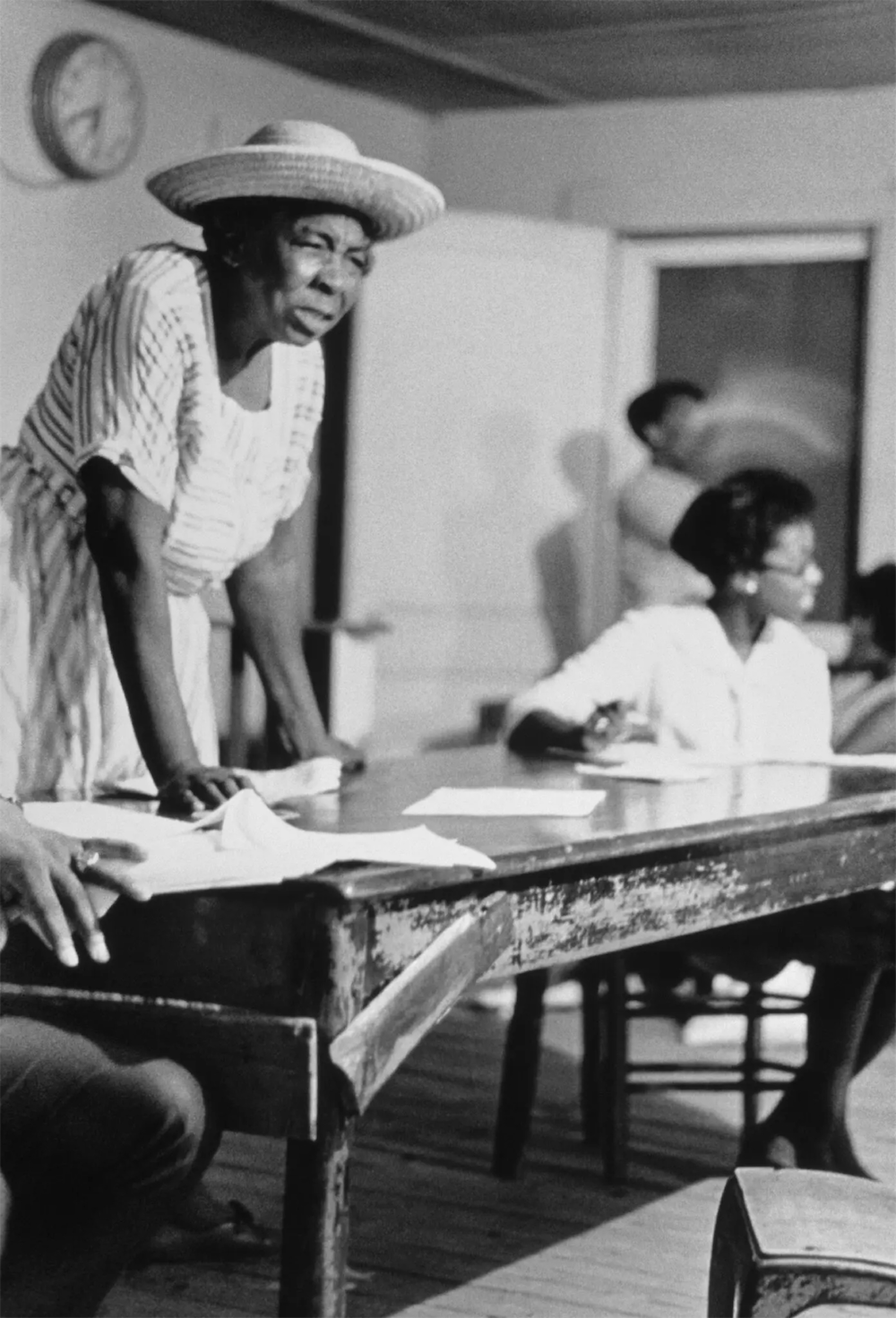
That is what makes Derby so significant now. She was not a visitor dropping into Mississippi to gather evidence. She was not a white photojournalist granted temporary access to Black suffering and then returned to editorial distance. She was a Black woman organizer, a Student Nonviolent Coordinating Committee field secretary, an educator, a cultural worker, and later an anthropologist, making pictures from within the struggle she was helping to build. The phrase “inside view” can be overused in cultural criticism, but with Derby it is exact. Her archive carries the texture of participation. She knew the stakes because they were hers too. The people in her frame were not abstractions, and that difference changes everything about the ethics of looking.
A Bronx education in Black looking
Derby was born in New York City on November 11, 1939, and grew up in the Bronx in a family whose political sensibility and cultural range helped shape the artist and activist she would become. In her oral history, she recalled a childhood formed not only by relatives who prized discipline and collective responsibility, but also by the discovery of the Schomburg’s holdings on African and African American life. She described realizing, as a young person, that Black people were too often absent or distorted in books and magazines, and that if the images she needed were missing, she might have to help create them herself. That idea, at once artistic and political, would become the logic of her life’s work.
Her family background mattered in another way too. Derby later said that her concept of civil rights was broad because she came from people for whom racial justice was not a slogan but a family inheritance. In a later interview around the publication of A Civil Rights Journey, she noted that her grandmother had been a founding member of an NAACP chapter in the 1920s, while her father fought discrimination in education and employment. Her oral history similarly points to a household alive with memory, duty, and global Black consciousness, including stories and materials tied to Haiti, Liberia, and the wider African diaspora. Before Derby ever entered Mississippi, she had already been trained to regard Black culture as history-bearing and Black images as politically consequential.
She studied at Hunter College, where that sensibility deepened into activism. According to the SNCC Digital Gateway, Derby entered southern struggle with organizing experience gained through the Northern Student Movement. She had been involved in discussions around segregation, sit-ins, and the Freedom Rides, and she moved in circles where political education, art, and student organizing were inseparable. Derby was also steeped in African diasporic art and dance, including study connected to Katherine Dunham’s world, an important detail because it helps explain why culture never appeared in her career as an accessory to politics. For Derby, culture was already part of political method.
Going South, and staying
In 1963, Derby was teaching elementary school in New York when the violence of southern white supremacy made its demand on her conscience. Accounts of her life agree on the turning point: she saw what peaceful protesters were facing and concluded that she had to go South and contribute what she could. The Washington Post obituary records that she left New York for the movement that year; Derby herself later described the sense that if others could put their lives on the line in Mississippi, the least she could do was bring her own talents to that fight. She first went through Atlanta, then to Albany, Georgia, and soon found herself doing the kind of organizing work that reveals how movements actually function—liaising with jailed activists, working with local people, filling whatever role the hour required.
“Her archive widens the frame: freedom was not only a march route. It was a classroom, a clinic, a church basement, a field road, a hand raised to vote.”
What she encountered in the South was not only open terror but a level of rural deprivation that demanded a politics larger than the drama of public protest. Derby’s oral history and later interviews show that she became deeply involved in adult literacy work tied to voter registration, developing materials that might help Black adults meet the absurd requirements imposed by racist disfranchisement while also addressing practical needs of everyday life. In Mississippi Folklife, Robert Luckett Jr. writes that Derby’s work reflected a bottom-up commitment to community survival and Black cultural continuity. This is crucial to understanding her photographs. They are not simply pictures of a movement. They are pictures made by someone whose definition of freedom included reading, credit, childcare, healthcare, culture, and self-representation.
The photographs that emerged from this period have an unmistakable moral intelligence. Derby did photograph movement figures and major events, but again and again she turned her lens toward the “everyday human effort,” as one obituary put it, required to endure Jim Crow and undo it. The Guardian’s appraisal captured this well: rather than centering only the most dramatic confrontations, Derby went into rural communities to witness women caring for families in wooden shacks, children laboring in fields, and ordinary people searching for a path out of poverty and political exclusion. These were not soft images. They were hard in their clarity. But they were never pornographic in their relation to suffering. Derby’s camera does not feast on misery. It insists on context, dignity, and personhood.
The movement beyond spectacle
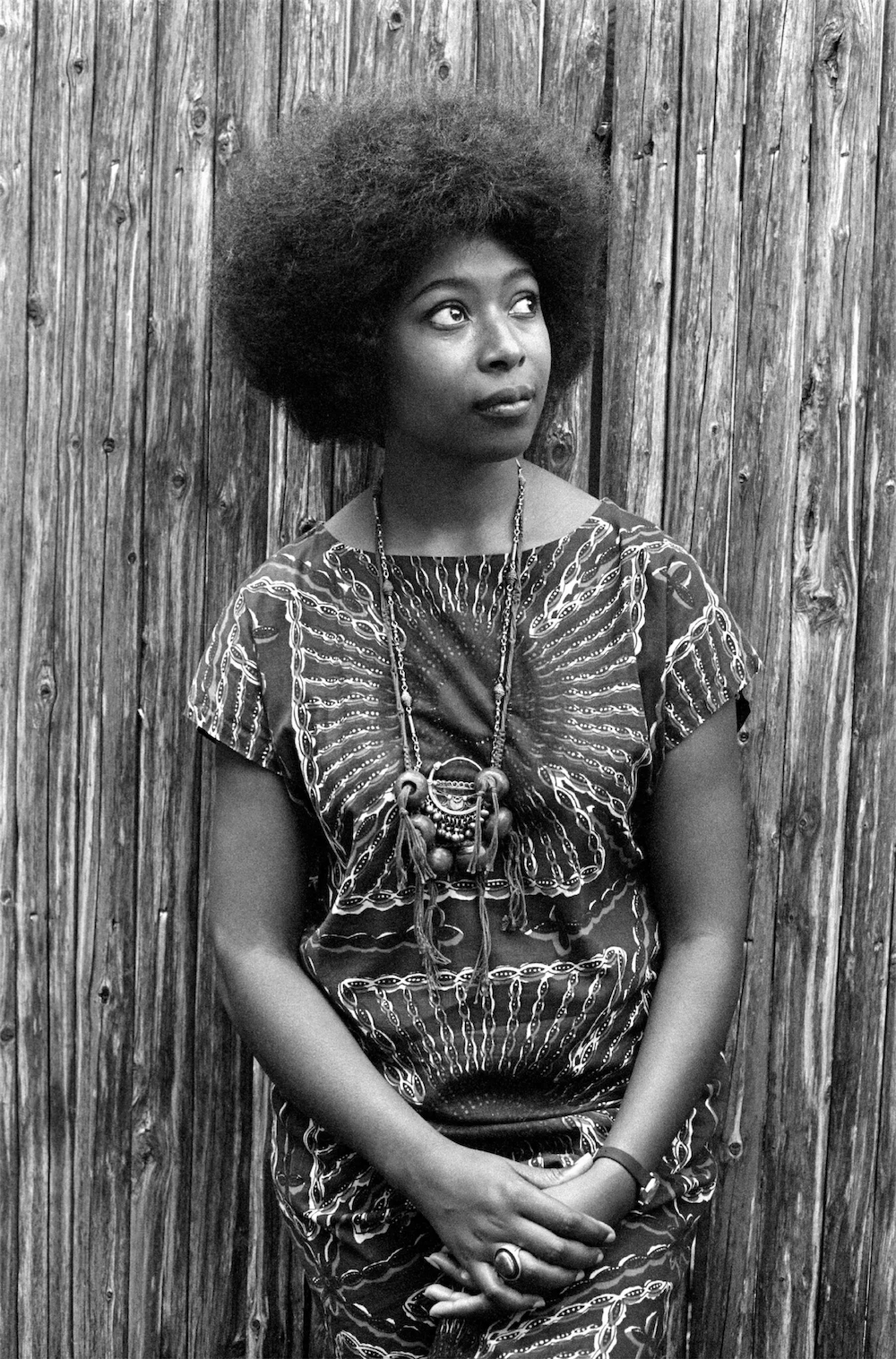
Derby’s significance as a photographer lies partly in what her work corrects. The dominant visual history of the civil rights era has long relied on a relatively narrow grammar: charismatic male leadership, public confrontation, white violence, Black victimization, and newspaper-ready climax. That archive is indispensable, but it is also incomplete. A 2022 Journal of American Studies essay on Derby argues that her womanist perspective challenges the movement’s dominant visual rhetoric by foregrounding the everyday activism of African American women and communities. The article’s point is not merely academic. It names a profound structural problem in how Americans remember Black freedom struggle: we too often remember the movement at the moment it becomes legible to white institutions, rather than in the patient worlds Black people built for themselves. Derby photographed those worlds.
This is why her images feel at once intimate and revisionary. They make visible the labor that allowed the better-known headlines to happen at all. Organizing did not begin and end at demonstrations. It was sustained by literacy campaigns, childcare infrastructures, health initiatives, voter education, community meetings, food, travel, mutual care, and cultural production. Reviewers of A Civil Rights Journey have noted exactly this quality in her work. The C4 Journal review emphasizes how Derby’s pictures illuminate literacy programs, healthcare initiatives, handcraft cooperatives, theatre productions, and the mundane but essential routines of meetings and movement administration. Hyperallergic similarly stressed that her lens was trained not mainly on famous images of confrontation, but on sharecroppers, churchgoers, students, and rural families becoming political actors. Together these readings make plain that Derby’s archive is not supplementary to movement history. It is foundational to a fuller one.
The political importance of this shift cannot be overstated. To photograph only the moment of attack is to risk letting white violence dictate the visual terms of Black history. Derby refused that arrangement. She understood that Black life had to be documented in its own right, not only when racism made it spectacular to outsiders. Even in conditions of deprivation, her images allow pleasure, beauty, thoughtfulness, style, companionship, and concentration to appear. They are composed with care, but never with the falsifying sheen of uplift propaganda. Her people are not symbols. They are people. That insistence is what makes the pictures endure.
Culture as infrastructure
One of the most revealing threads in Derby’s life is the way she treated art not as refuge from politics but as a mode of organizing. That sensibility culminated in her role as a co-founder of the Free Southern Theater, established in the winter of 1963–1964 with John O’Neal and Gilbert Moses. The SNCC Digital Gateway describes the Free Southern Theater as an effort to create a theatrical form that spoke directly to poor Black southerners and traveled to audiences often excluded from conventional cultural institutions. Derby, with her background in African diasporic art and movement work, helped shape the idea that a freedom movement also needed a cultural arm
“For Derby, culture was never extracurricular. It was part of how Black communities survived domination and rehearsed freedom.”
In a 2021 interview with American Theatre, Derby recalled the logic with admirable plainness: the movement needed another way to communicate with people, not only through meetings and churches but through art that could circulate ideas, confidence, and new self-images. Tougaloo College, where this vision took form, was already a crucial site of civil rights activity. The theater traveled through Mississippi and beyond, performing in Freedom Schools, churches, and makeshift spaces, sometimes in communities under direct terrorist threat. It was not decorative culture. It was strategic culture—an experiment in what happens when aesthetics join the struggle against racial domination without becoming merely instrumental. That is part of Derby’s larger legacy too. She kept proving that Black art and Black organizing were not separate enterprises.
This same philosophy runs through her later work in education and community programming. Derby’s oral history describes her involvement in Head Start-related efforts, where she brought African art into classrooms and churches, built teaching tools from available materials, and worked as a resourceful trainer in underfunded Black communities. The details matter because they reveal a mind committed to cultural self-making at every scale. She did not reserve theory for the lecture hall. She practiced it in how children learned, how communities saw themselves, and how Black histories were materially shared. For Derby, images, objects, performance, and pedagogy all belonged to the same struggle against erasure.
The ethics of an insider lens
There is a temptation, when discussing photographers of the civil rights era, to reach first for the language of witness. Derby was certainly a witness. But that word can be too passive for what she was doing. She was also a participant, and her participation complicated the very act of image-making. Because she was embedded in organizing, her photographs carry a different relation to time. They are less concerned with the single decisive instant than with accumulation: what communities looked like before, during, and after visible events; how organizing occupied ordinary space; how political transformation registered in posture, labor, and attention.
That insider position also mattered in terms of trust. Derby’s photographs often feel close without being invasive. This is partly a matter of temperament and craft, but it is also social. She was not merely extracting images from vulnerable people. She shared risk with them. The archive she built over roughly nine years in the South emerged through relationships forged in common work. That does not make the photographs innocent; no serious photography is innocent. But it does change their social contract. A Black woman activist photographing Black southerners in struggle from within their movement is doing something fundamentally different from mainstream media coverage, however sympathetic that coverage may have been. Derby’s images are not free from power. They are just more accountable to the people they depict.
The result is a body of work in which Black women appear not as background figures in a male-led story, but as organizers, mothers, workers, caretakers, thinkers, and agents of historical motion. The Journal of American Studies article is especially valuable here, arguing that Derby’s photographs broaden our understanding of the movement by centering everyday activism, particularly that of African American women. This is not simply a matter of inclusion. It is a matter of analytic truth. If one wants to know how the movement functioned at the level of actual community life, Black women are not marginal to that history. They are among its principal authors. Derby’s lens knew that.
The long afterlife of Mississippi
Derby eventually left Mississippi to pursue graduate study at the University of Illinois, later earning advanced degrees and building a substantial career in academia and student support. She became the founding director of African American Student Services and Programs at Georgia State University in 1990 and served there until her retirement in 2012, while also teaching cultural anthropology. Several biographies and memorial notices note that she taught at other institutions as well and continued to develop exhibitions, lectures, and public work around her archive. In other words, she did not “move on” from the movement so much as carry its questions into other institutional forms.
Her archive, too, entered a longer public life. Emory’s Rose Library holds her papers, which span decades of photographs and materials from roughly 1958 to 2015. Her work has been preserved and interpreted through the Library of Congress, the Smithsonian’s National Museum of African American History and Culture, and other institutions. In recent years, exhibitions and publications have further widened her visibility, including the 2021 monograph A Civil Rights Journey and international exhibition contexts noted by scholars and reviewers. These developments matter because Derby was long less widely recognized than many of the mostly male, often white photographers whose civil rights pictures populate textbooks and documentaries. The renewed attention is not a correction complete enough to call justice, but it is at least an overdue reordering of the record.
The institutions preserving Derby’s work have emphasized different aspects of her legacy—civil rights veteran, anthropologist, educator, photographer, cultural worker—but perhaps the essential point is that these identities were never separate compartments. Derby’s photographs are better because she was an organizer. Her teaching was deeper because she was an artist. Her anthropology was less extractive because she understood culture as lived practice rather than museum specimen. A person like that is difficult for institutions to classify neatly, which is one reason she can be underrecognized in life and then appear, in hindsight, startlingly ahead of our categories.
Why Doris Derby matters now
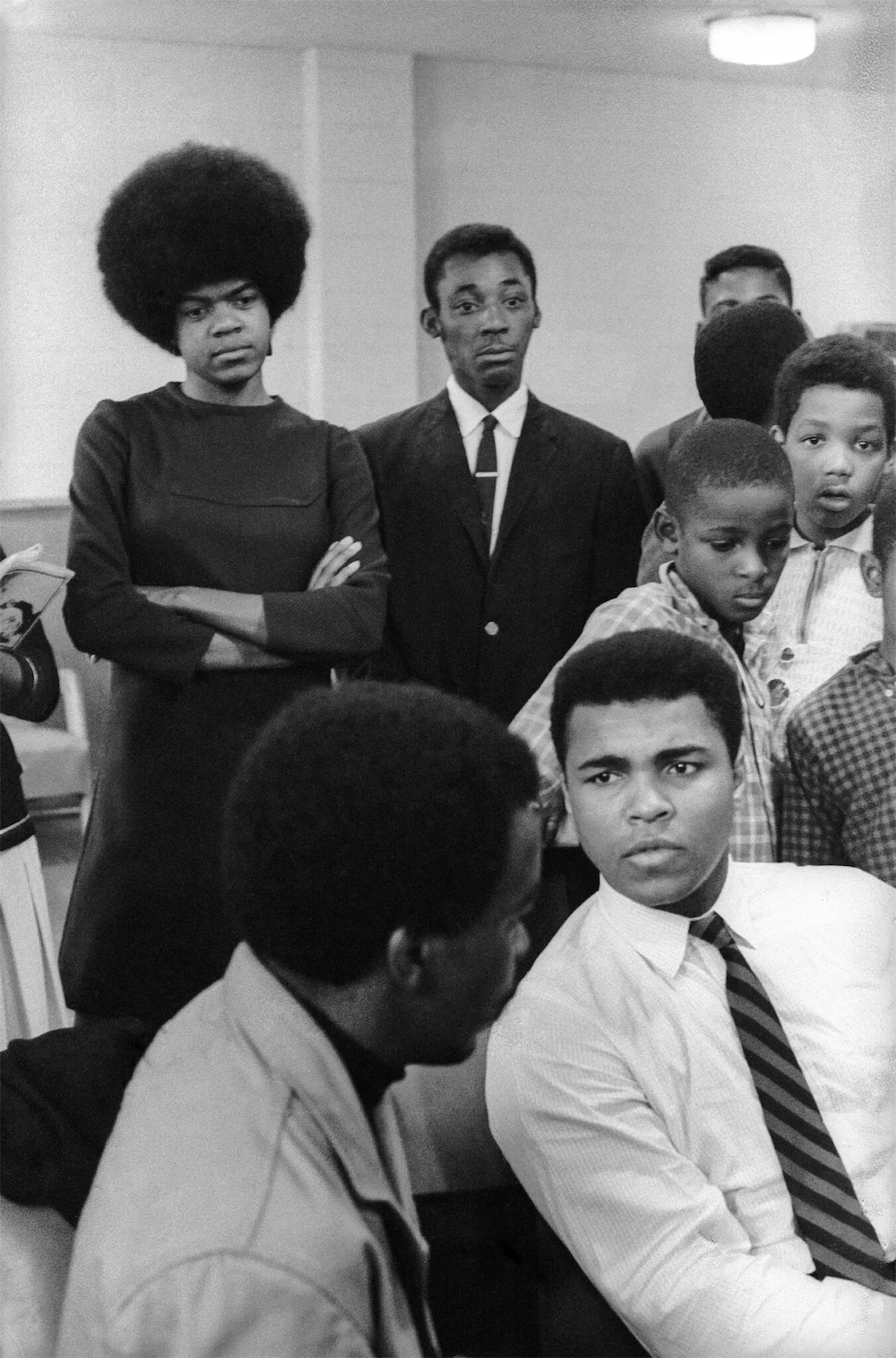
There is a contemporary urgency to Derby’s archive that goes beyond historical recovery. We live in a period that still struggles to understand Black political life except at the moment of rupture. News media remain structurally drawn to eruption—murder, march, crackdown, outrage, viral image—while the slower architectures of Black survival and organizing often remain under-described. Derby’s photographs offer a counter-archive to that habit. They remind us that movements are built in long stretches of time not usually considered visually dramatic: in study, preparation, childcare, art-making, patient travel, local leadership, and the disciplined cultivation of community trust. Her work can teach journalists something, not just historians and curators. It can teach us where to look when we say we are trying to understand political change.
They also arrive with force in an era of renewed battles over memory. Across the United States, the teaching of Black history remains contested terrain, while archives of racial struggle are alternately commodified, sanitized, or attacked. Derby’s images resist all three moves. They cannot easily be reduced to heroic cliché, because they keep returning us to need, labor, and complexity. They cannot easily be sanitized, because poverty and state neglect remain visible. And they cannot be dismissed as marginal, because they document the very substrate of democratic transformation. To look at Derby seriously is to confront how much of American freedom was made by people whose names were never meant to be nationally known.
For KOLUMN, that makes her an especially fitting subject. Recent KOLUMN appreciations of figures such as Claude Clark and Yvonne Pickering Carter have taken seriously the proposition that Black cultural lives are not sidebars to American history but central archives of it. Derby belongs squarely in that lineage, though she also complicates it. She was not only an artist making work about Black life; she was one of the people helping produce the social conditions in which that life could fight for itself, represent itself, and imagine itself otherwise. Her photography is therefore not just aesthetically important or historically useful. It is structurally revelatory. It shows us what a movement looks like when the camera is held by someone who knows that freedom is both an event and a practice.
A life larger than the caption
When Doris Derby died in 2022 at 82, the obituaries rightly called attention to the rarity of her position: one of the few Black women to chronicle the civil rights movement through photography, and one whose archive ran to thousands of images. But even that description, while accurate, can feel too small for the life. Derby was not simply a photographer who happened to be present at history. She helped make the world she photographed. She understood that images were part of political struggle because visibility itself was contested terrain. She understood that culture could organize feeling, and that feeling could organize action. She understood that Black people in the South were entitled not only to rescue from violence but to representation in fullness.
What remains, finally, is the scale of her refusal. She refused the reduction of Black history to injury alone. She refused the notion that art and organizing are separate callings. She refused the dominant archive’s preference for headline over habitat, martyrdom over maintenance, masculine charisma over collective labor. And in refusing all that, she gave us something more durable than a set of famous pictures. She gave us a way of seeing. In Derby’s world, history is not only what explodes into public view. It is also what people build quietly while the nation is looking somewhere else. That may be the most important lesson her photographs still have to offer
More great stories
Afro Sheen, Wall Street, and the Architecture of Black Possibility
July 6, 2026
No Comments
The Fire Inside the Fourth
July 5, 2026
No Comments