



Politics, in the Diggs household, was not theoretical.
Politics, in the Diggs household, was not theoretical.
By KOLUMN Magazine
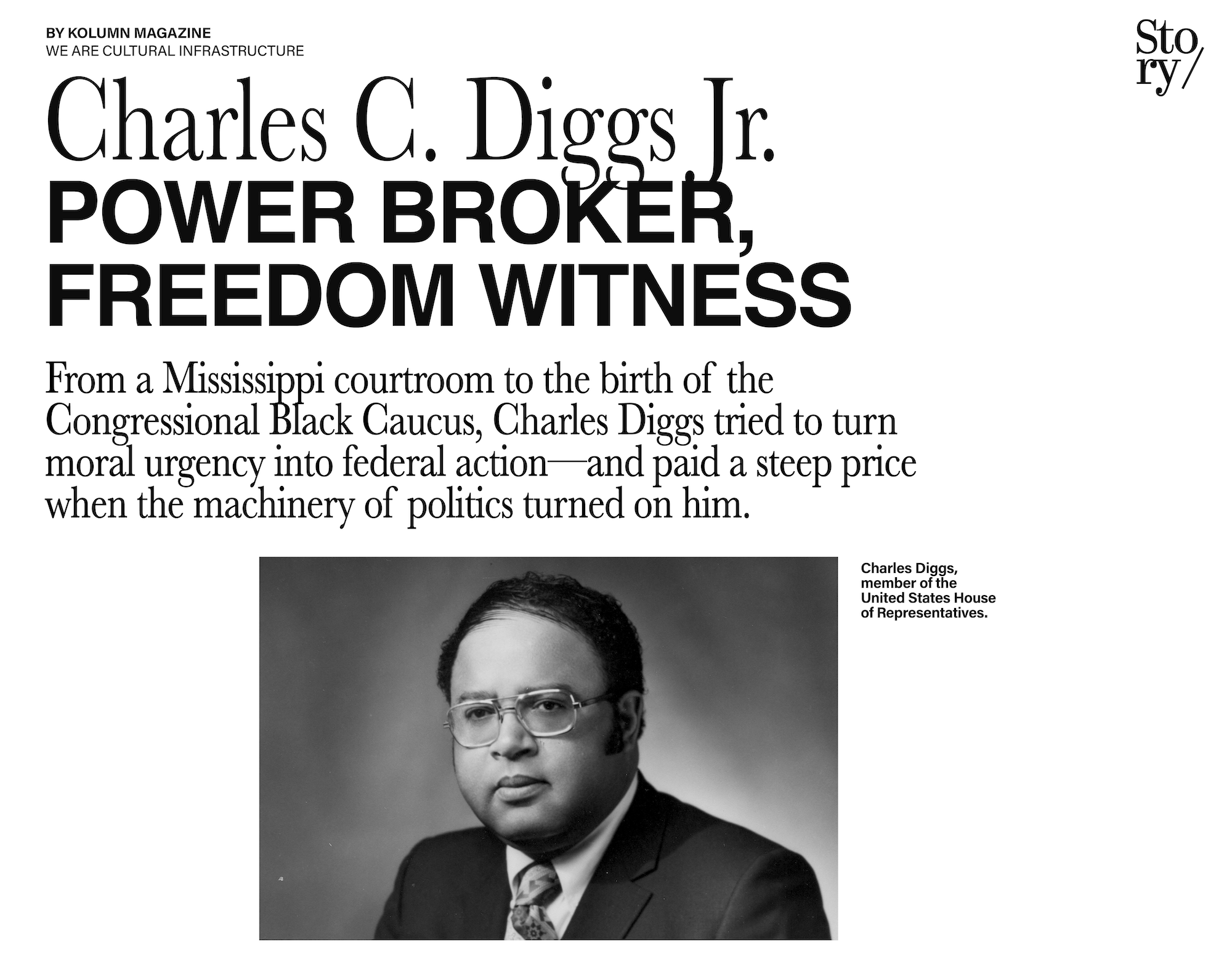
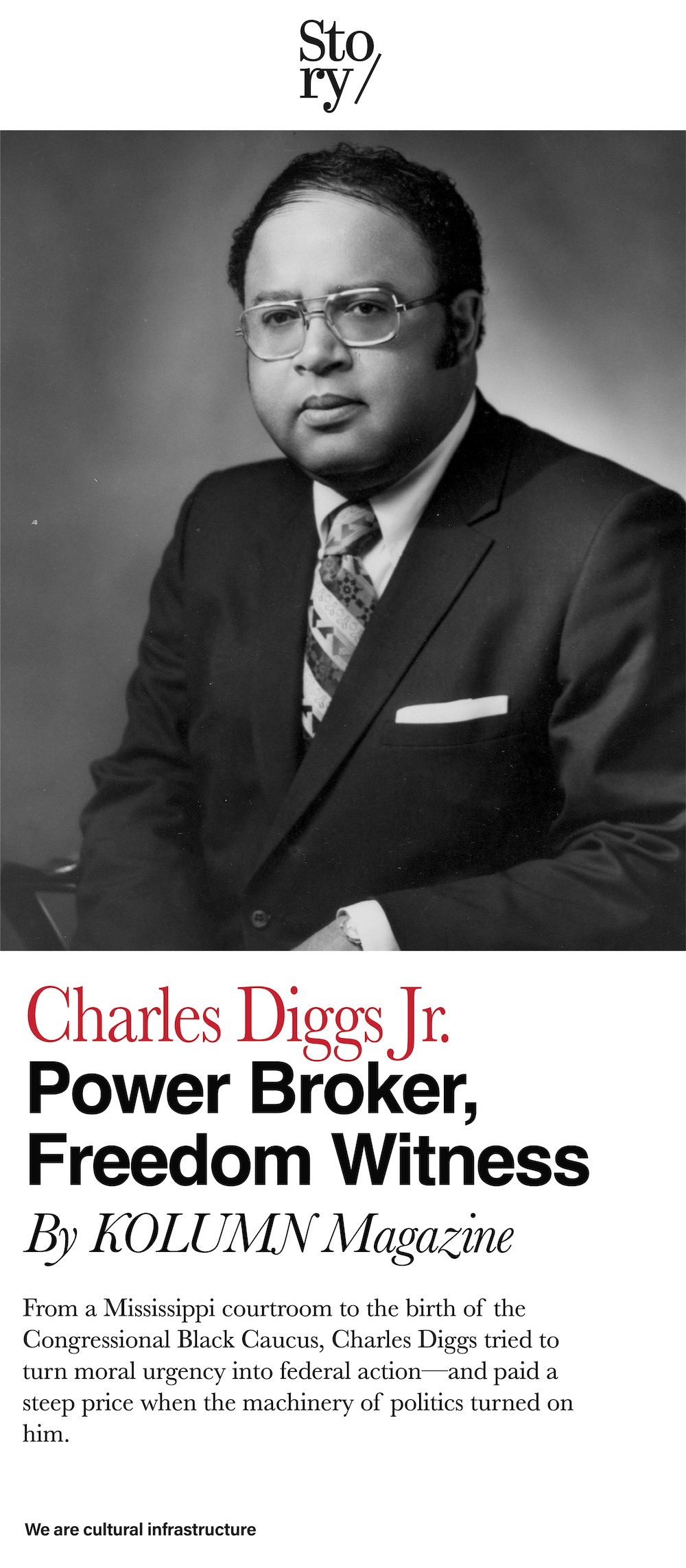
There are photographs of American politics that feel staged—hands clasped, flags draped, smiles pinned in place. And then there are the images that feel like evidence. Charles C. Diggs Jr. belonged to the second category long before a jury ever weighed his name. In 1955, newly elected and not yet hardened by Washington’s habits, Diggs traveled into the Deep South to attend the trial of the white men accused of murdering Emmett Till. In the mythology of the civil rights era, so much turns on speeches and marches that it’s easy to miss the quieter acts that carried equal moral freight: the decision to show up, to sit in the room, to let your presence say what the system wanted to deny—that federal power, and Black citizenship, extended even to a Mississippi courtroom. Diggs’s attendance drew national attention and placed him in a lineage of “witness-politicians,” figures who understood that the distance between Congress and a cotton-field county courthouse was not geographic but constitutional.
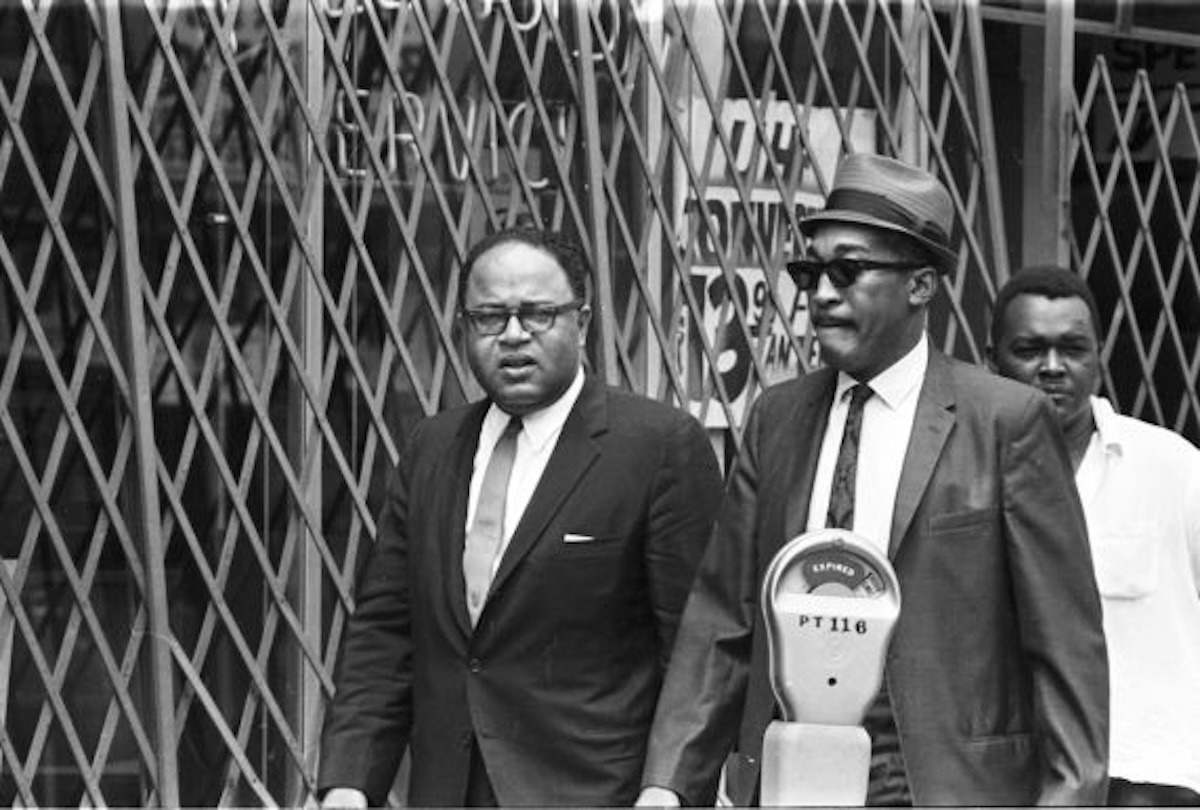
To write about Diggs is to write about American contradiction with unusual clarity. He was an early architect of the Congressional Black Caucus and its first chair, a champion of civil rights and a forceful advocate for American engagement with Africa, a key player in the decades-long effort to pressure apartheid South Africa, and a principal architect of Washington, D.C.’s home rule—work that shaped the country’s domestic and foreign policy agenda in ways that remain visible today.
And yet Diggs is also a reminder that history rarely grants unblemished saints. In 1978, he was convicted on counts tied to payroll fraud and kickbacks—money siphoned from staff salaries and misused funds that, prosecutors argued, helped support personal and congressional expenses. The House censured him overwhelmingly the next year; he eventually resigned and served prison time.
The tension between those two truths—builder and breaker, moral witness and convicted lawmaker—has long made Diggs difficult to place in the popular civil rights canon. It is easier to celebrate leaders whose public virtues were not interrupted by courtroom transcripts. But Diggs’s life, precisely because it resists tidy conclusion, offers a more useful lens on the era that produced him: the rise of Black political power in northern cities, the slow federalization of civil rights enforcement, the struggle to translate protest into legislative machinery, and the fragility of legitimacy for Black officials navigating institutions that alternately used them as symbols and treated them as suspects.
In recent years, scholars and journalists have begun returning to Diggs with fresh seriousness. A major new biography from political scientist Marion Orr frames him as one of the most consequential Black congressmen of the twentieth century—an argument built not on nostalgia but on archival research into the networks, strategies, and compromises of his long career. The timing is telling. As debates about voting rights, democratic representation in Washington, and the global dimensions of racial justice reemerge with force, Diggs’s fingerprints are visible on the institutions and arguments people keep reaching for.
A Detroit inheritance
Diggs was born in Detroit in 1922, a city that would come to define the particular mix of industrial ambition, Black migration, and political ferment that shaped his worldview. His story is bound up with the rise of Detroit as a capital of Black northern life and a battleground for power—where the promise of union wages existed alongside the realities of housing segregation, police violence, and political exclusion.
Politics, in the Diggs household, was not theoretical. His family’s public life carried both aspiration and warning. Michigan records emphasize that Diggs became the first African American man elected to the Michigan Senate in 1951, filling a vacancy and beginning a path from state politics to Congress. That trajectory—moving from local power bases into national office—mirrored what would become a broader pattern for Black politicians in the postwar North, where demographic shifts and ward politics created openings that the Jim Crow South foreclosed.
At 31, Diggs won election to the U.S. House, becoming the first African American elected to Congress from Michigan. He entered Washington at a moment when civil rights legislation was still largely aspirational rhetoric, and when Black members of Congress could be counted on one hand. His early power would not come from seniority alone—though he would eventually accumulate plenty—but from an ability to treat politics as both performance and infrastructure: show up publicly when it mattered and build quietly where it counted.
The Mississippi courtroom and the meaning of presence
The Emmett Till case is often narrated through the images we know: Till’s battered face in Jet, the testimony that shocked the nation, the swift acquittal that revealed how violently the South would defend white supremacy. Diggs’s role is not central in most retellings, but it is instructive. By attending the trial of Till’s killers, Diggs made a statement about federal responsibility at a time when the federal government preferred distance.
The House’s own historical writing about Diggs underscores that, within months of taking office, he was willing to travel far beyond his Detroit district to engage the moral crisis of Mississippi. A 2025 House history essay recounts Diggs speaking in Mound Bayou—an all-Black town founded in the nineteenth century—before a massive outdoor crowd, offering what the Chicago Defender described in revival-like terms, a kind of democratic sermon delivered in the very geography the nation tried to abandon.
That same willingness to treat civil rights as both local and national would define his career. Word In Black, reflecting on Diggs’s legacy, points to his role in dismantling segregation in airports and in pushing federal attention toward the everyday architecture of Jim Crow—spaces like terminals and transit hubs that shaped Black mobility and dignity. This is a useful corrective to the idea that civil rights victories were won only in court decisions or headline-grabbing bills. Diggs’s work often lived in the unglamorous realm of oversight, hearings, pressure campaigns, and coalition building.
The Atlantic’s long reported piece on Emmett Till’s murder adds another dimension to Diggs’s “witness” identity. The article recounts how Congressman Diggs escorted a key witness, Willie Reed, out of Mississippi after the trial, helping him reach safety in Chicago. Whether one reads this as personal courage or political intervention—and it was likely both—it reveals something essential about Diggs: he did not separate congressional identity from human obligation. He treated office as a tool for protection, not merely policy.
Building power inside a building not designed for you
Diggs’s congressional career began in 1955 and stretched for decades, long enough for him to witness the civil rights movement’s most iconic victories and its most bitter disappointments.
The House biography of Diggs describes him as an ardent supporter of civil rights and a leading advocate for increased American aid to Africa, while also emphasizing his role in the formation of the Congressional Black Caucus and in crafting an international legacy over 25 years. That combination—civil rights at home, liberation and diplomacy abroad—was not common among members of Congress in the mid-century era. It reflected a worldview increasingly shared by Black activists and intellectuals: that racial justice was global, that colonialism and segregation were cousins, and that the United States could not credibly sell democracy abroad while limiting it at home.
Diggs’s institutional positioning mattered. The Congressional Black Caucus, whose history highlights Diggs as an early chair and a key figure in its formation, emerged as a vehicle for collective power when individual Black members were too easily isolated or tokenized. (Congressional Black Caucus) Word In Black captures the idea of the CBC as a project whose ambitions exceeded district lines, quoting Diggs’s argument that Black lawmakers’ obligations were national and international in scope.
This philosophy—representation as something larger than geography—helps explain why Diggs invested so heavily in Africa policy and anti-apartheid advocacy, and why he took on the peculiar, often thankless, cause of Washington, D.C.’s democratic status.
Africa policy, apartheid, and the long game of pressure
In 1959, Diggs became the first African-American chairman of the House Subcommittee on Africa, according to CBC historical materials. The position gave him a platform from which to argue that U.S. foreign policy in Africa could not be separated from U.S. racial politics. The House’s educational content on apartheid notes that Diggs—alongside other members—challenged the apartheid government through congressional engagement and attention to postcolonial African politics.
The anti-apartheid movement in the United States is often remembered through the 1980s: campus divestment campaigns, mass protests, and the eventual passage of sanctions legislation over President Reagan’s veto. The CBC’s own history emphasizes that culminating moment—the Comprehensive Anti-Apartheid Act of 1986 and the veto override—while also underscoring the earlier legislative groundwork laid by Black members. Diggs’s significance lies partly in that earlier phase: the years when apartheid was not yet a mainstream U.S. political issue, when bringing South Africa’s system into congressional discussion required persistence and, often, a willingness to be dismissed.
The CBC Foundation’s AVOICE timeline on the anti-apartheid movement underscores Diggs as instrumental in the caucus’s early anti-apartheid work in the early 1970s, situating him within a broader coalition of members introducing and supporting early legislative interventions. The Root, writing about anti-apartheid activism and policy linkages, includes testimony from a former Hill staffer who worked first for Diggs and later helped craft sanctions legislation—an example of how Diggs’s office functioned as an incubator for a generation of Black foreign policy professionals.
This aspect of Diggs’s legacy is easy to underestimate because it doesn’t always map onto a single signature bill. Instead, it appears in networks, hearings, international relationships, and a political vocabulary that made space for concepts like sanctions, human rights conditionality, and solidarity with liberation movements. A modern House history project on “Human Rights Abroad: Ending Apartheid” places Diggs within a narrative of congressional attention to South Africa, showing him not as a late adopter but as a persistent voice in the long arc of U.S. anti-apartheid politics.
There is also a sharper edge to Diggs’s Africa politics—one that included public critique of U.S. policy. The Atlantic’s 1976 account of intelligence controversies mentions Diggs traveling to Addis Ababa and denouncing U.S. policy in Angola in unusually blunt terms, framing it as a historic blunder in U.S.-Africa relations. Even allowing for the rhetorical flourish of magazine writing, the reference captures Diggs’s willingness to criticize American policy on an international stage—an approach that did not always endear him to administrations eager for Cold War alignment.
The District of Columbia and the fight for self-government
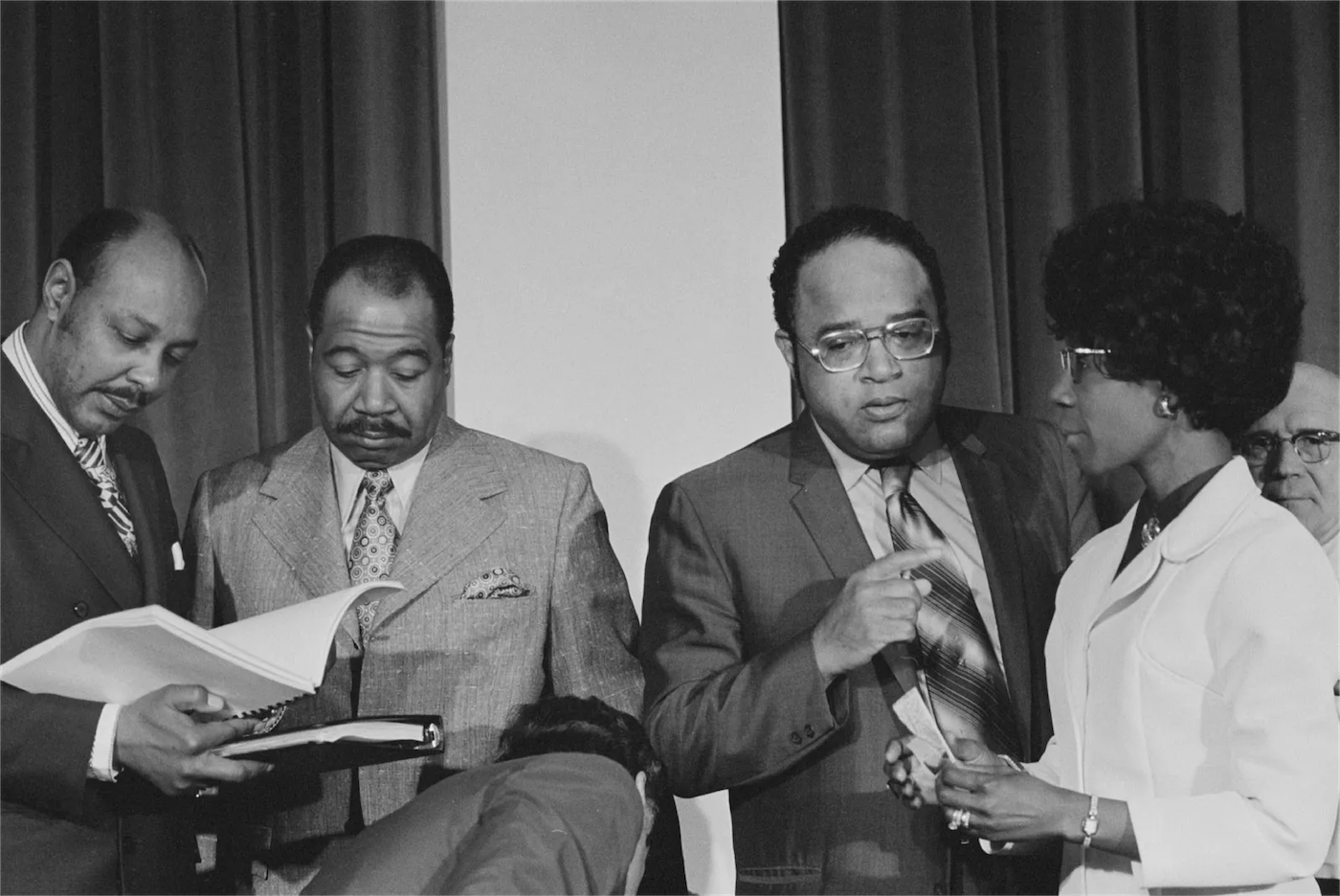
If Diggs’s Africa work connected racial justice to global politics, his work on Washington, D.C. connected it to the lived reality of American democracy. As chair of the House Committee on the District of Columbia, Diggs became a principal architect of home rule—legislation that provided the District with an elected mayor and council, a partial remedy to a longstanding democratic defect in the nation’s capital.
A 2024 WAMU history piece marks the 50-year anniversary of home rule and describes the difficulty of the fight in Congress, noting Diggs’s central role and the political obstacles to granting the District more control over its own governance. House historical materials note that Nixon signed the District of Columbia Self-Government and Governmental Reorganization Act into law in December 1973, and they place Diggs at the center of the committee work that shepherded it forward while also highlighting the complicated governance debates that followed.
The CQ Almanac’s entry on the legislation provides the institutional context—Congress clearing the bill and the structure of partial self-government. What matters, in Diggs’s story, is not just that home rule passed, but that it passed through a Congress that—then as now—often treated D.C. residents as a political afterthought. Diggs saw the District’s status as a civil rights issue: a majority-Black city governed, in crucial ways, by lawmakers who did not live there and did not answer to its voters. Home rule was not statehood, and it did not erase Congress’s ultimate authority. But it created a framework that still structures D.C.’s political life—and still anchors debates about autonomy and representation.
In this sense, Diggs is part of a lineage that feels newly relevant. Every modern flare-up over federal control of D.C.—whether about policing, budgets, courts, or local laws—echoes the same unresolved question Diggs spent years trying to address: What does American democracy mean if the people who live at its symbolic center are treated as less than full participants?
The Black caucus as institution—and as argument
The Congressional Black Caucus did not emerge simply as an affinity group. It emerged as a strategy, a counterweight to the political isolation that Black lawmakers faced in a Congress structured by seniority, committee gatekeeping, and informal networks that largely excluded them. Diggs’s role as founder and first chair is emphasized in multiple historical accounts.
The caucus’s own history situates its development within the broader arc of Black representation, emphasizing coalition-building and legislative influence. Word In Black’s modern commentary frames Diggs’s vision as expansive—Black lawmakers representing not only their districts but a national constituency shaped by shared vulnerability and shared hope.
This vision also made Diggs polarizing. A caucus that claimed moral urgency, and that was willing to challenge presidents publicly, disrupted the careful choreography of bipartisan deference that often governs Capitol Hill. Diggs lived in the tension between being asked to symbolize progress and insisting on using progress as leverage.
The fall: money, power, and the ethics machine
To discuss Diggs’s downfall responsibly is to resist both sensationalism and evasion. The facts, at this distance, are well documented. In 1978, Diggs was convicted in a case involving payroll fraud and kickbacks from congressional staff salaries—conduct that prosecutors argued diverted tens of thousands of dollars.
The Washington Post’s coverage from the period captures both the detail of the case and the political fight surrounding it. An editorial-style Post piece about a move to expel Diggs describes the core allegation: diversion of staff salary money to pay personal and congressional bills, and it frames expulsion as a question entangled with representation and race, not only ethics. Another Post report notes that an appeals court upheld his conviction.
The House’s disciplinary record lists Diggs among members censured, describing his conviction and the vote—an overwhelming 414–0. Congress.gov’s page for the censure resolution records that it called for public reading by the Speaker, the ritual humiliation that makes censure more than a reprimand on paper. And the House Ethics Committee’s detailed report from July 1979 offers the formal institutional voice of Congress assessing Diggs’s misconduct and the constitutional power to discipline a member.
The Post reported the censure vote itself and the unanimity that made it a kind of institutional exhale—Congress, eager to prove it could police itself, voting with rare unity when the subject was a member already convicted. A separate Post report described Diggs admitting misuse of funds, apologizing, agreeing to repay money, and accepting censure—an episode that complicates the simple storyline of denial, even as Diggs continued to insist, in broader terms, that his actions were misunderstood or unfairly framed.
There is no honest version of Diggs’s story that treats the scandal as footnote. It mattered not only because it ended his congressional career, but because it became a narrative weapon—used by critics of Black political power to suggest that newly empowered Black leadership was inherently suspect, and used by reformers to argue that Congress’s internal culture of perks, loose oversight, and personal debt was an open invitation to corruption.
The Atlantic’s later political reporting on congressional culture and Newt Gingrich’s rise mentions Diggs as an early example in Gingrich’s campaigns against colleagues, noting that Gingrich called for Diggs’s expulsion after his conviction. This detail matters because it reveals how Diggs’s case lived beyond Diggs: it became a prop in a new era of moralistic, media-savvy partisanship, where attacking colleagues became a route to attention and power.
What the scandal eclipsed—and what it revealed
Diggs resigned from Congress in 1980, closing a chapter that had lasted through multiple eras of American politics. His House biography details the aftermath: prison time, later educational pursuits, and an attempt at political return that failed. In other words, Diggs did not vanish. He lived with the consequences of public disgrace in a country that rarely allows disgraced politicians to narrate their own complexities.
After his release, House history notes that he opened a funeral home in suburban Maryland and completed a bachelor’s degree in political science at Howard University in 1983, then attempted an unsuccessful political comeback in 1990. He died in 1998 of complications from a stroke, according to both House history and contemporaneous reporting.
The Washington Post obituary frames him not only through scandal but through achievement, noting his long service, his role in D.C. home rule, and the basic fact of his death at 75. Even in death, the duality remained: the man who helped expand democracy for others died marked by the record of having violated the public trust.
If Diggs’s scandal eclipsed his legislative work in popular memory, it also revealed something about the era that elevated him. Congressional offices functioned, for decades, with a culture of informal practices and weak guardrails—clerk-hire budgets, patronage expectations, and personal financial pressures that created temptation. None of this excuses Diggs’s conduct. But it helps explain why his story is not only a story about individual failure, but about institutional design, political vulnerability, and the added scrutiny Black leaders often faced.
Legacy: a builder of pathways, a warning about shortcuts
How should a serious publication weigh Diggs’s significance? The most responsible answer is: by refusing to collapse him into either hero or villain.
On one side of the ledger is a remarkable record of institution-building. Diggs helped give the Congressional Black Caucus its early shape and premise: that Black lawmakers could act collectively, assert moral urgency, and insist that national policy address Black life not as an afterthought but as an organizing principle. He treated Africa policy as part of civil rights, pressing the U.S. to take seriously the political futures of postcolonial nations and to confront apartheid South Africa as a moral and strategic problem. (He helped drive the hard, procedural fight for D.C. home rule, which continues to structure the District’s governance and the nation’s ongoing debate about democratic inclusion. And he demonstrated a model of “witness” politics—attending Emmett Till’s trial, speaking in Mound Bayou, and intervening to protect people endangered by the South’s racial regime—that reminds us representation is not only legislative but human.
On the other side is the undeniable fact that Diggs misused public resources and violated ethical boundaries in ways that damaged his constituents, his staff, and the very causes he championed. The House’s censure and the ethics report are not ambiguous documents; they exist because Congress judged his misconduct serious enough to warrant one of its strongest non-expulsion punishments.
Holding both truths is not an exercise in balance for its own sake. It is the point. Diggs’s story teaches, among other things, that movements do not automatically purify the individuals who represent them; that structural injustice does not prevent personal wrongdoing; that institutional barriers can coexist with institutional opportunities; and that moral clarity in one domain does not guarantee ethical clarity in another.
The modern rediscovery of Diggs—through scholarship like Orr’s “House of Diggs,” through House historical projects linking him to Emmett Till’s legacy and to the anti-apartheid fight, through contemporary journalism revisiting how political power is built and broken—suggests that the country is ready to confront a more adult version of its political past.
In that version, Charles Diggs Jr. is not a symbol of uncomplicated progress. He is something harder and, for that reason, more illuminating: a man who expanded the meaning of congressional responsibility, who helped build Black institutional power in Washington, who connected American democracy to global liberation struggles, and who then demonstrated how quickly legitimacy can collapse when the public trust is treated as negotiable.
The final measure of his significance may be this: many of the issues Diggs fought over are still unsettled. D.C. still lacks full democratic representation. The relationship between American foreign policy and human rights remains contested. The question of whether Black political power will be treated as normal or as perpetually on trial has never fully disappeared. Diggs’s life does not resolve those questions, but it clarifies the stakes—and the costs—of trying to answer them from inside the system.
More great stories
Afro Sheen, Wall Street, and the Architecture of Black Possibility
July 6, 2026
No Comments
The Fire Inside the Fourth
July 5, 2026
No Comments