

Duncanson did not ask permission to enter American high art. He entered it at mural scale.
Duncanson did not ask permission to enter American high art. He entered it at mural scale.
By KOLUMN Magazine
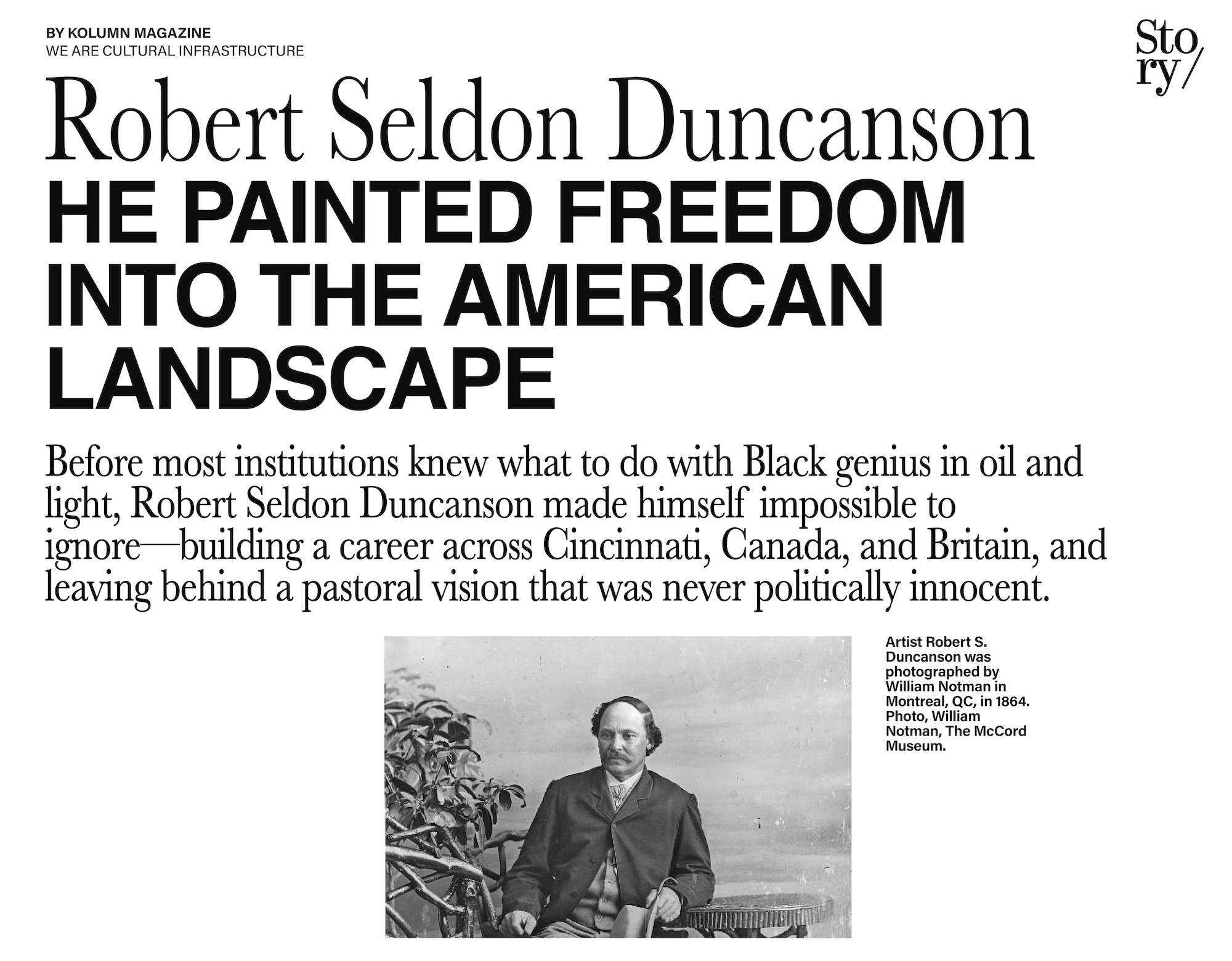
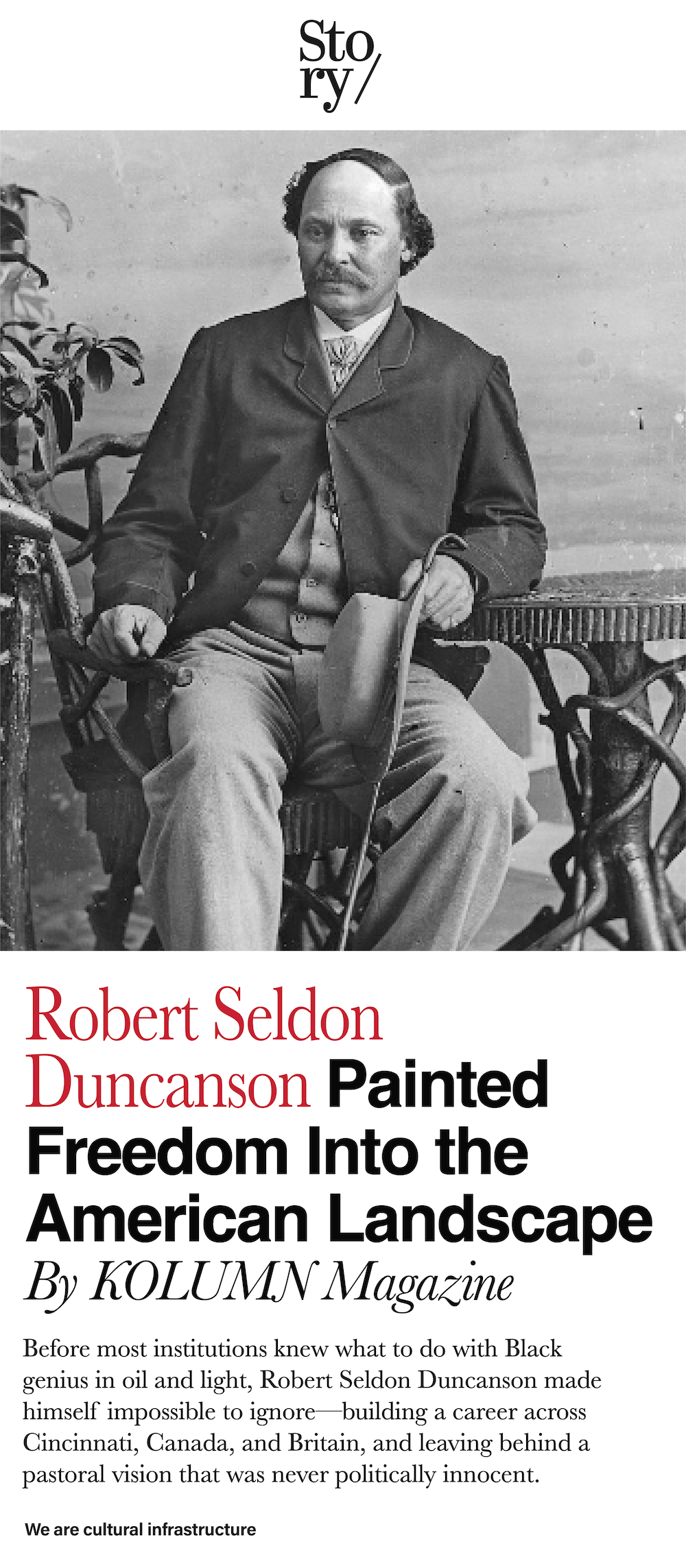
The first thing to say, for the sake of accuracy and because accuracy is a journalist’s first loyalty, is that Robert Seldon Duncanson was not an author. He was a painter—one of the most consequential Black painters of the nineteenth century, and by many accounts the first African American artist to achieve genuine international renown. He was born in Fayette, New York, in 1821, worked in Cincinnati, spent important years in Canada and Britain, and died in Detroit in 1872. His medium was oil, his field was landscape, and his subject, beneath all that pastoral calm, was the problem of freedom in a country that had not decided whether Black people could belong inside beauty, citizenship, or history at all.
That correction matters because Duncanson’s life has long suffered the small violences of misremembering. Even when he is recalled, he is sometimes reduced to a token first: first Black artist this, first internationally recognized that. Those facts are true, but they are not sufficient. They flatten a career that was technically ambitious, commercially shrewd, aesthetically searching, and politically legible in ways that older art history often refused to see. To call him only a pioneer is to miss the more difficult point: Duncanson was not merely early. He was excellent. He did not simply arrive ahead of his time; he forced his time to confront the possibility that a Black artist could master one of the most prestigious genres in American painting and do so on terms that scrambled the assumptions of white patronage.
That is why Duncanson belongs in the same KOLUMN lineage as recent considerations of David Driskell, Leonardo Drew, Claude Clark, and Yvonne Pickering Carter: artists whose work makes plain that Black art history is not a side corridor to American culture but one of its central load-bearing structures. Duncanson’s name may not yet circulate in popular discourse with the ease of Jacob Lawrence or Romare Bearden, but his career helped make later Black artistic ambition imaginable. He stands at a crucial hinge point—between craft labor and fine art, between abolitionist politics and market success, between national obscurity and transatlantic acclaim. To write about him now is to write about the long making of Black visibility in American art, and about the even longer struggle over who gets to picture the nation at all.
A self-taught artist in a hostile republic
Duncanson was born free in upstate New York, into a family connected to skilled trades. Museum and scholarly sources consistently note that he came from a background of carpenters and housepainters, and that this mattered. It placed him in an American tradition where manual skill and aesthetic skill were not yet cleanly separated, especially for Black workers, who were routinely permitted to labor but not readily admitted to the refined categories of culture. Duncanson’s earliest path into art seems to have run through this world of applied making: house painting, decorative work, copying prints, teaching himself by observation rather than by academy training. In another biography, that origin story might be romanticized as rugged individualism. In his case, it should be understood more precisely as exclusion. Self-teaching was not simply temperament. It was also necessity.
By the early 1840s he had settled in or near Cincinnati, then a booming river city with contradictory energies. It was often called the “Athens of the West,” a place with cultural ambition, commercial wealth, and a serious appetite for art. It was also a borderland city facing slaveholding Kentucky across the Ohio River, which meant that its liberal self-image was always pressed against the brutal realities of American racial order. For a free Black artist, Cincinnati offered possibility and peril in the same breath. That doubleness would shape Duncanson’s career. It gave him patrons, exhibition opportunities, and a regional school of landscape painting to enter. It also put him in a climate where Black advancement could provoke scrutiny, violence, or erasure.
He began, as many artists did, with portraiture and occasional genre or religious work. The National Gallery of Art and other sources also note a small but significant still-life practice from the late 1840s, a body of work that has drawn more scholarly attention in recent years. These still lifes matter not because they replace the landscapes for which he became famous, but because they reveal range. Duncanson could do surface, texture, arrangement, atmosphere. He understood the old academic lesson that still life trains the eye in structure and tonal intelligence, but he also used it to announce a painterly seriousness that could not be dismissed as amateur dabbling. Fewer than a dozen of these works are known, and their relative rarity only sharpens their value now.
Cincinnati, abolition, and the making of a career
No honest account of Duncanson can separate his ascent from the abolitionist networks that sustained him. The Smithsonian American Art Museum states plainly that Cincinnati abolitionists recognized his talent, purchased his work, and helped sponsor his travel to Europe. This was patronage, yes, but it was also ideology. Abolitionists saw in Duncanson not only an artist worth backing, but evidence against the racist lie that Black people were incapable of intellectual and aesthetic achievement. That dynamic created opportunity, but it was never simple. To be supported as a rebuttal to white supremacy is still to be made legible within white supremacy’s terms. Duncanson had to be extraordinary in order to receive what lesser white artists might be granted as ordinary cultivation.
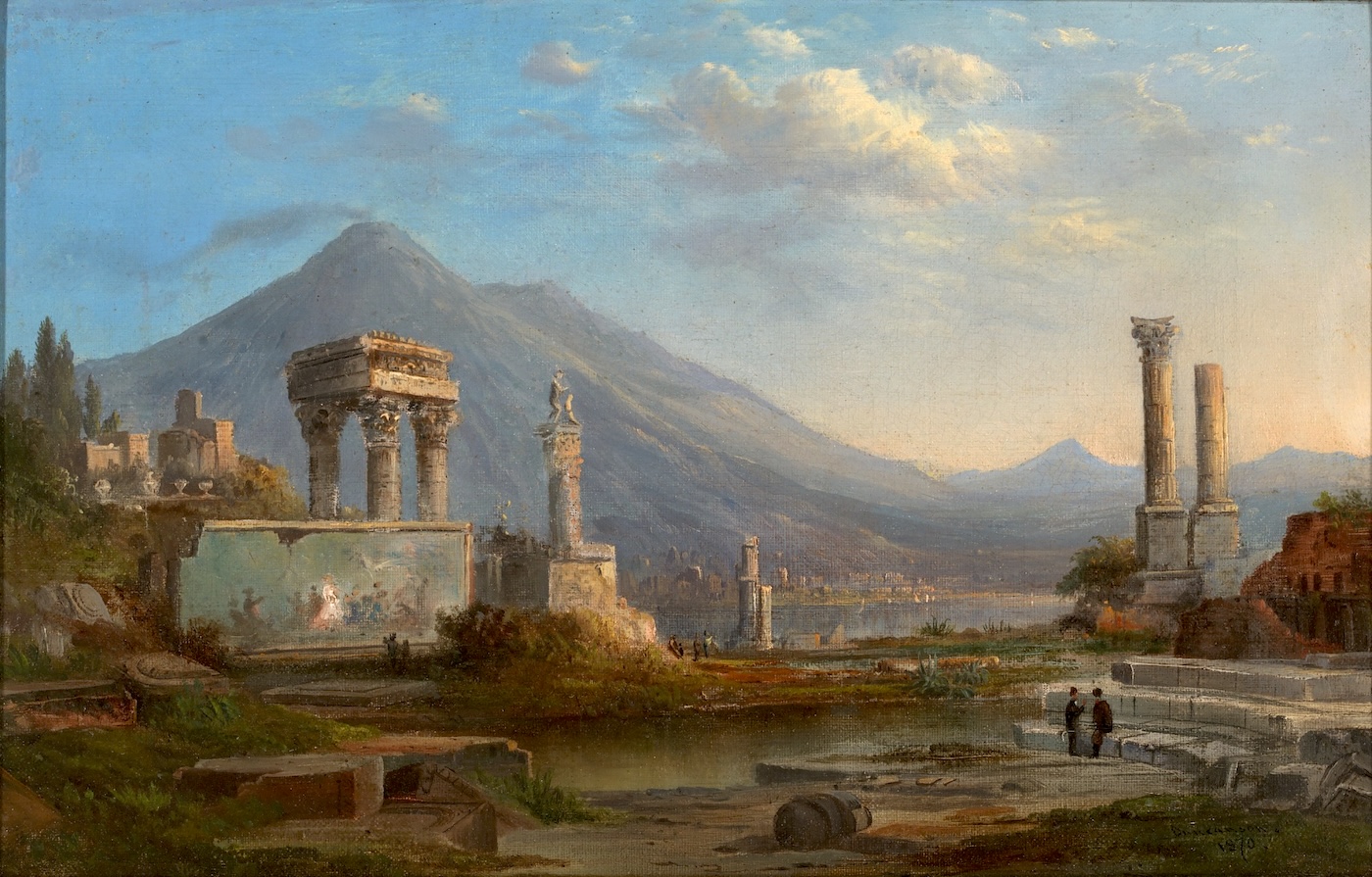
Among the key early commissions was Cliff Mine, Lake Superior, associated with the abolitionist Methodist minister Charles Avery, a work that helped place Duncanson inside a durable network of antislavery patronage and confirmed his potential as a landscapist. Soon after came one of the defining commissions of his life: the murals for Nicholas Longworth’s Cincinnati home, Belmont, now the Taft Museum of Art. Between 1850 and 1852, Duncanson painted eight monumental landscape murals and smaller still lifes directly onto the walls. The Taft Museum describes the project as a series of monumental landscapes painted on plaster; Ohio History has called them among the most ambitious and accomplished pre-Civil War domestic murals in the country. They were not just decorative. They were a declaration that a Black artist could command scale, space, and elite interiors in a society still organized to deny Black equality.
Longworth himself was a complicated but important figure—wealthy, influential, antislavery in principle, and capable of legitimizing an artist within elite circles. His commission gave Duncanson visibility, money, and a public marker of ambition. But just as importantly, it put him in dialogue with the period’s most prestigious landscape traditions. Landscape painting in mid-nineteenth-century America was not minor work. It was one of the nation’s signature forms, freighted with ideas about providence, expansion, cultivation, wilderness, and the moral uses of nature. To succeed there was to enter a field dense with national meaning. Duncanson understood this. He did not remain in portraiture because he knew landscape offered larger symbolic ground.
Cincinnati made that move possible. The city’s landscape school was shaped by the example of the Hudson River School while developing its own regional inflection. Sources from the Cincinnati Art Museum and the National Gallery of Canada note that Duncanson helped build the Ohio River Valley landscape tradition. This is one of the most important facts about him, and one of the least appreciated outside specialist circles. He was not merely influenced by a school; he became a formative participant in a regional one. American art history is often narrated eastward, with prestige flowing from New York and Boston. Duncanson complicates that map. He reminds us that Black modernity in American art was also made in river towns, frontier cities, and border zones where the politics of slavery and freedom were not abstractions but daily weather.
The politics inside the pastoral
To a casual eye, Duncanson’s landscapes can seem almost disarmingly serene. They are full of luminous valleys, lakes, cliffs, grazing animals, small figures, and carefully orchestrated skies. But serenity is not innocence. The Smithsonian notes that his pastoral scenes may quietly evoke the central divisive issue of mid-century America. The Met similarly emphasizes how his idealized views adapt Romantic conventions while omitting the industrialization, territorial conflict, and agricultural upheaval remaking the country. That omission is not retreat. It can also be read as intervention. Duncanson painted nature as a site of order, harmony, and moral intelligibility at the precise moment the United States was becoming more openly disordered by slavery’s crisis.
This is where a shallow reading of Duncanson usually fails. Because he was not, for the most part, painting scenes of overt racial violence, some interpreters once assumed that race was somehow absent from the work. But Blackness in nineteenth-century art does not need to appear as the visible body under attack to structure the image. Duncanson’s existence as a Black landscape painter already transformed the genre. The American landscape tradition was deeply entangled with ideas of national destiny, white settlement, and civilizational uplift. For a Black artist—born free, but living in a nation that still naturalized Black exclusion—to master that form was itself a conceptual disruption. He was painting a territory that denied him full belonging and, by painting it magnificently, insisting on a claim to it.
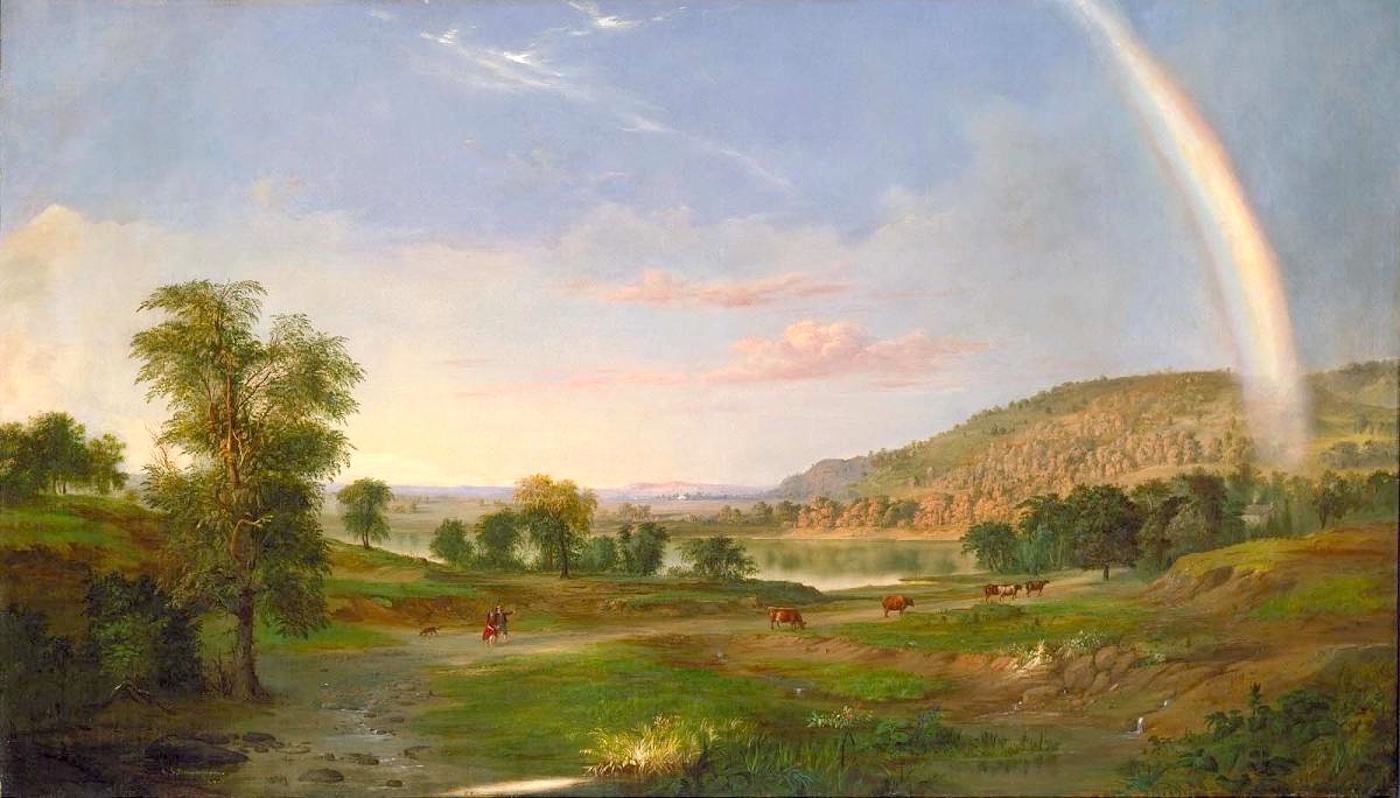
That is one reason Landscape with Rainbow remains such a generative work. The Smithsonian calls Duncanson America’s best-known African American painter in the years around the Civil War and notes that the 1859 canvas imagines a young couple walking through fertile pastureland toward a house at the end of a rainbow. The image projects harmony, homecoming, and providential calm. Yet 1859 was not calm. It was the eve of rupture. Seen in that context, the rainbow is not sentimentality. It is tension held in suspension: a promise painted against national dread. When the work was selected for the 2021 presidential inauguration, it was widely noted as the first painting by a Black artist chosen for that congressional inaugural tradition. The symbolism was obvious, but the painting’s older politics were already there. It had been speaking in this register for more than 160 years.
A rare direct engagement with slavery
If Duncanson usually worked obliquely, he was not incapable of direct reference. In 1853 he painted Uncle Tom and Little Eva, now at the Detroit Institute of Arts, drawing on Harriet Beecher Stowe’s wildly influential antislavery novel Uncle Tom’s Cabin. The choice is revealing. Rather than illustrating the book’s most violent brutalities, the painting takes up a gentler scene, placing the figures inside an idyllic setting. That decision has generated continuing interpretation. It may reflect the artist’s stronger command of landscape than figure painting, but it also reveals something about how abolitionist sentiment was often aestheticized for white audiences. Duncanson was working within a market that rewarded moral feeling so long as it remained compatible with beauty. The result is a painting that participates in antislavery discourse while also showing the constraints placed on what could be pictured, sold, and admired.
This tension—between the overt and the encoded—runs through much of Duncanson’s career. He understood public taste. He knew what elite patrons would hang, what critics would praise, what markets would circulate. That did not make him apolitical; it made him strategic. Artists working under racial restriction rarely get the luxury of pure declaration. They must decide when to speak plainly, when to smuggle, when to charm, when to overwhelm with skill, and when to let a work’s mere existence do the argumentative labor. Duncanson’s landscapes often operate in that last register. Their politics live not only in iconography but in authorship, in access, in the racial fact of who made them and who could not easily deny their quality.
Europe, Canada, and the transatlantic turn
Like ambitious American artists of his generation, Duncanson wanted Europe. The Grand Tour still functioned as a credentialing mechanism, a way to study old masters, expand technique, and return with enhanced cultural authority. Sources from Crystal Bridges and the Smithsonian indicate that he traveled through England, France, and Italy in the 1850s, sharpening his craft by direct exposure to European painting. Yet the most consequential transnational chapter of his life came later, under the pressure of the Civil War. During the war years, Duncanson relocated to Canada—particularly Montreal—before touring in Britain and Scotland. The Met notes the tense and hazardous conditions facing Black Cincinnatians during the war and his extended Canadian residency beginning in 1863.
Canada was not merely refuge. It was also expansion. The National Gallery of Canada has emphasized Duncanson’s importance to Canadian art, noting both his influence on painters such as Allan Edson and Otto R. Jacobi and his role in the development of a vernacular landscape tradition there. In other words, he did not simply pass through Canada while displaced by American crisis; he altered Canadian artistic culture. That is a remarkable fact. It makes Duncanson a transnational figure in Black art history, one whose significance cannot be contained within a narrow U.S. frame. He belongs to a larger Black Atlantic story in which artists moved through imperial, national, and border spaces, gathering patrons and publics while negotiating the racial structures of each.
Britain, too, offered him a different scale of response. Multiple sources repeat that the London Art Journal praised him as a “master of landscape painting,” a phrase that survives because it cuts through the fog of later neglect. Duncanson achieved something in Europe that America was not always prepared to grant: not tolerance, not novelty, but mastery. The word mattered then and matters now. It positioned him not as a curiosity from the provinces, nor as an exception explained away by race, but as a serious painter in a serious genre. For a Black American artist born in 1821, that acknowledgment was extraordinary, especially given the racial climate of the United States before and after the war.
Works associated with these later years—Canadian scenes, Scottish views, literary landscapes such as Land of the Lotus Eaters, and the late Scottish subjects—show an artist extending his atmospheric range and broadening his geographical imagination. The Smithsonian’s Loch Long description notes the panoramic emphasis of his Scottish scenes; the National Gallery of Canada’s more recent exhibition writing underscores his lasting Canadian impact. These are not incidental footnotes. They reveal Duncanson as an artist whose vision exceeded localism, even while remaining anchored in the specific racial politics of his American origins. He made landscapes that traveled because he himself had to travel—out of aspiration, out of danger, and out of the search for a public large enough to meet his ambition.
Fame, collapse, and disappearance
By the late 1860s, Duncanson had achieved what many artists dream of and few secure: critical notice, elite patronage, transatlantic reputation, and a body of work broad enough to sustain serious standing. Yet his life did not resolve into triumphant stability. He returned to the United States, worked again in Cincinnati and elsewhere, and continued painting, but his final years were troubled. Accounts of his health vary in detail, and some older narratives use language that reflects the period’s imprecision and stigma. What is clear is that he died in Detroit in 1872 at just fifty-one. The arc is painfully familiar. Black achievement that seems, in one decade, too substantial to erase becomes, in the next century, strangely easy for institutions to forget.
That forgetting is part of his story. Smithsonian Magazine’s 2011 feature described him as a beloved nineteenth-century artist who fell into obscurity before later rediscovery. That pattern tells us as much about American institutions as it does about Duncanson himself. He did not vanish because the work lost merit. He vanished because canons are curated by power, and the history of American art has long been written through exclusions so routine they masqueraded as neutrality. If a Black painter could be internationally praised in the nineteenth century and still require rediscovery in the twentieth, then the problem was never absence of achievement. It was the structure of remembrance.
This is where comparison to later Black art historians and curators becomes essential. The world David Driskell worked to build—a world in which Black artists could be studied as constitutive rather than supplementary to American art—was, in part, a world necessary because figures like Duncanson had been marginalized by the mainstream narratives that followed them. The recovery of Duncanson in the twentieth century, and the renewed exhibitions and scholarship of the twenty-first, belong to that broader corrective. He is not newly important. He is newly impossible to exclude.
Why Duncanson matters now
The temptation with artists like Duncanson is to treat them as ancestors whose importance is primarily genealogical: important because they came before, because they opened doors, because they can be slotted into a progress narrative ending in belated institutional inclusion. That is not enough. Duncanson matters now because the questions embedded in his work remain live. Who gets to picture the nation? Who is permitted access to beauty without being stripped of politics? What does it mean for a Black artist to work inside a genre historically used to naturalize white belonging? And how many forms of American forgetting must be dismantled before the canon reflects what the culture actually was?
He also matters because his art clarifies something often misunderstood about Black cultural production: direct protest is not the only political language available to Black makers. Duncanson’s landscapes were not posters. They were not agitprop. They did not need to be. Their politics resided in form, authorship, circulation, aspiration, and symbolic pressure. They proposed that Black artistic intelligence could command the sublime, the pastoral, the panoramic, the literary, and the transatlantic. They placed a Black painter where the republic had not intended him to stand: at the center of its visual imagination.
That is why his reappearance in public consciousness during the Biden inauguration felt larger than ceremonial decoration. Landscape with Rainbow was not just a lovely historical object chosen for its hopeful optics. It was a reentry. A nation that had once marginalized its maker briefly put his vision at the symbolic center of a transfer of power. The moment did not repair the historical record by itself. But it did illuminate how much of the record still waits to be read properly. Duncanson’s rainbow, painted in 1859, continues to function because it is not naïve. It is aspirational under duress. It is beauty carrying argument.
The long afterlife of a Black landscape painter
There is a final irony in Duncanson’s story. Landscape painting is often discussed as if it were impersonal, the genre farthest from autobiography. Yet his landscapes are inseparable from the conditions of his life. They bear the pressure of movement, racial negotiation, patronage, refuge, ambition, and the search for a place in which Black excellence could be received without qualification. Even when people are tiny or absent in the frame, the work is crowded with human consequence. A river is never just a river in border-state America. A clearing is never just a clearing when citizenship is unequally distributed. A rainbow is never just weather when painted by a Black artist on the brink of national fracture.
The museum record now reflects a broader consensus: Duncanson was self-taught, born free, artistically formidable, central to Cincinnati’s nineteenth-century culture, influential in Canada, admired in Britain, and foundational to the history of Black art in America. But KOLUMN’s task is not only to restate institutional consensus. It is to name the emotional and political scale of what that consensus means. Duncanson built a career in a century that had little room for men like him except as laborers, servants, or abstractions. He answered by painting worlds. He painted them with enough authority that wealthy patrons bought them, critics praised them, foreign audiences admired them, and later historians had to come back and ask how they had ever been overlooked in the first place.
His legacy now lives not only in collections at the Smithsonian, the Met, the National Gallery of Art, the Detroit Institute of Arts, the Taft Museum, and the National Gallery of Canada, but also in the interpretive frameworks that Black scholars, curators, and writers have fought to build. The Taft Museum’s Duncanson Program, established in 1986 to affirm an ongoing Black presence within the institution, is one concrete sign of that afterlife. It recognizes that memory must be practiced, not presumed. To honor Duncanson is not simply to preserve canvases. It is to preserve the claim those canvases make on American culture.
If Robert Seldon Duncanson teaches anything, it is that Black art history is full of artists who were recognized, then neglected, then rediscovered with a tone of institutional surprise that should itself be embarrassing. The proper response is not surprise. It is revision. It is to rewrite the national narrative so that Duncanson appears not as a belated addition but as what he was: a major nineteenth-century painter, a transatlantic Black artist, and a maker of landscapes whose quiet surfaces hold one of the loudest arguments in American art. He made beauty in a republic arranged against him. He made beauty that refused to concede the nation to those who believed only they could define it. And that is why, long after the patrons, the critics, and the border anxieties of his century have passed, Robert Seldon Duncanson still looks like a painter of the future.
More great stories
Afro Sheen, Wall Street, and the Architecture of Black Possibility
July 6, 2026
No Comments
The Fire Inside the Fourth
July 5, 2026
No Comments