




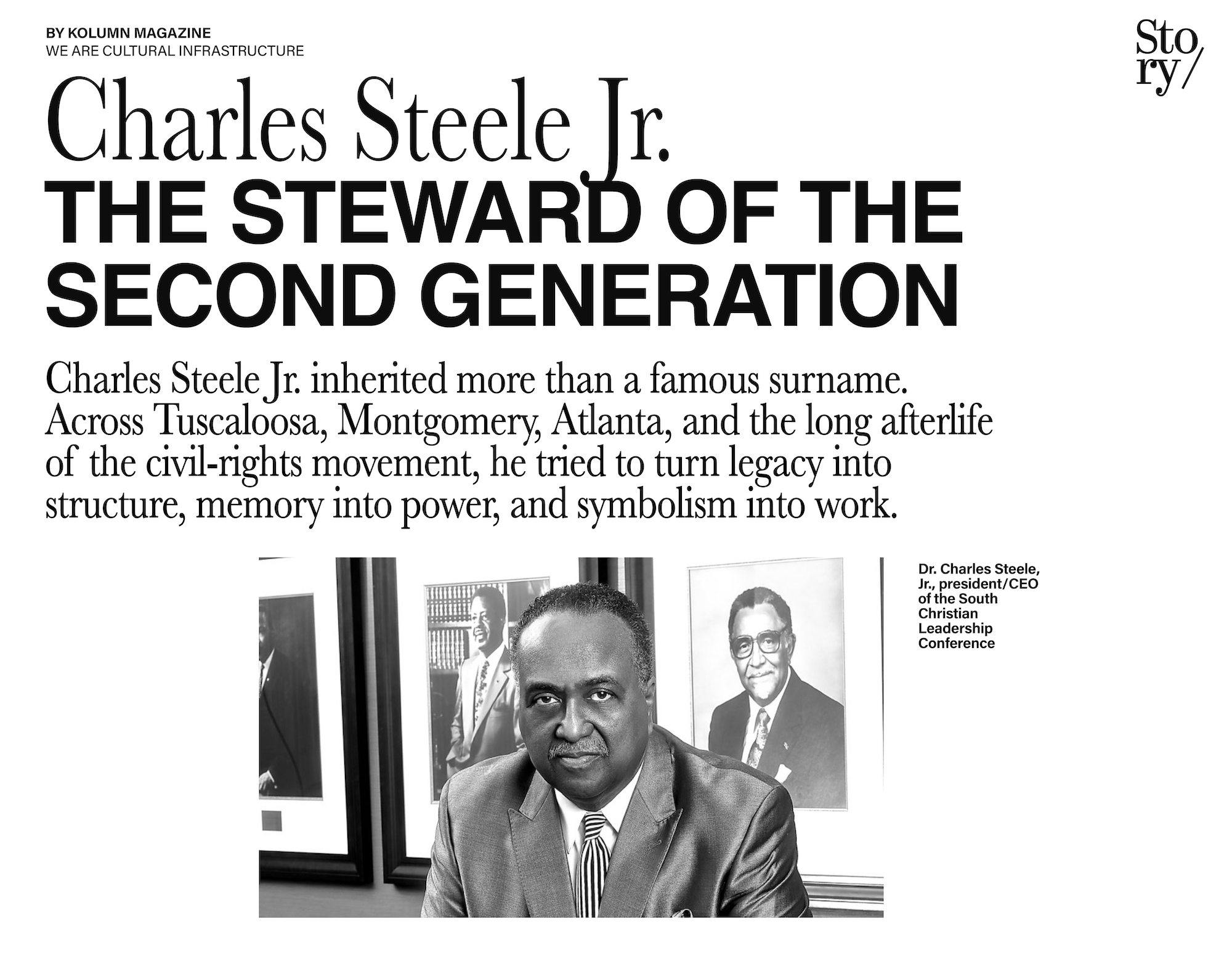
The second generation of civil-rights leadership did not inherit the romance of the movement. It inherited its maintenance.
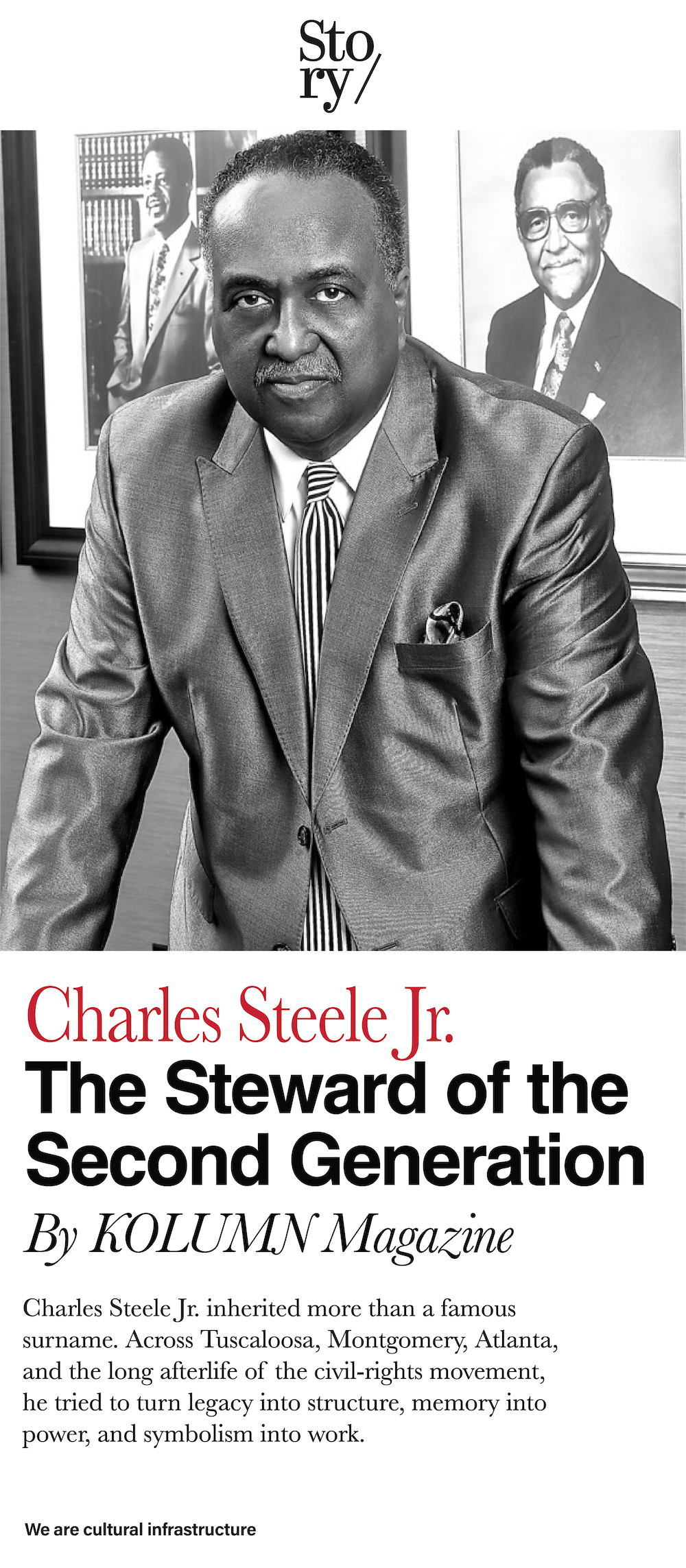
The second generation of civil-rights leadership did not inherit the romance of the movement. It inherited its maintenance.
By KOLUMN Magazine
There are some names in Black public life that arrive carrying architecture with them. Charles Steele Jr. is one of them. Before he ever entered elected office, before he led the Southern Christian Leadership Conference, before he became one of Alabama’s most visible Black political figures of the post–civil rights era, he was already linked to a family story that sat close to the movement’s sacred center. His father, C.K. Steele, was one of the key ministers of the Montgomery Bus Boycott and part of the infrastructure that helped transform a local transportation protest into a new grammar for American democracy. KOLUMN recently revisited that earlier generation in its piece on C.K. Steele, tracing how ministry, movement discipline, and Black institution-building became the hidden scaffolding of Southern freedom struggles. Charles Steele Jr.’s life belongs to the next chapter of that story: not the founding thunder of the modern movement, but the harder, less romantic work of maintaining it after triumph had become memory.
That distinction matters. The first generation of civil-rights leadership is often narrated through flashpoints: Montgomery, Birmingham, Selma, Washington. The second generation had to operate in a different political weather. Its leaders inherited not only the language of justice but the institutions, disappointments, and unfinished business that followed the legislative victories of the 1960s. They were asked to be heirs, managers, revivalists, fundraisers, public officials, preachers, and symbols all at once. Charles Steele Jr. would spend much of his public life inside that difficult assignment. Born in Tuscaloosa, Alabama, on August 3, 1946, Steele came of age in a state where Black citizenship was still under siege, but where the movement had already made clear that the old order was neither natural nor immortal. The question for men like Steele was not whether they would inherit struggle. It was what form that inheritance would take.
The record suggests that for Steele, politics and movement training were never cleanly separable. In recollections tied to Dorothy Cotton’s work in the Citizenship Education Program, Steele said he attended one of the workshops as a teenager in Tuscaloosa and later remembered the experience as decisive. Cotton’s workshops were not ornamental exercises in uplift; they were part of a larger SCLC strategy to translate moral protest into durable civic participation, teaching ordinary Black citizens about constitutional rights, ballots, organizing, and the mechanics of collective action. Steele later said the workshop “meant everything” to him. That detail is more than biographical color. It helps explain the texture of his career. He did not emerge only as a politician, or only as a commemorative civil-rights figure. He emerged from a tradition that treated education, participation, and organized local power as inseparable.
A son of Alabama, shaped by movement memory
Tuscaloosa is not Montgomery, at least not in the national imagination. It does not hold the same mythic placement in the shorthand of the civil-rights era. But Alabama’s geography of Black struggle has always been broader than the textbook map, and Tuscaloosa produced its own civic fighters, institution builders, and Black officeholders. Steele grew up in that soil. Official and institutional biographies consistently place him in Tuscaloosa’s Black civic tradition, describing a career grounded in local public service long before national titles arrived. He attended Druid High School and later studied at Mississippi Valley State University and Oakland University; institutional biographies also credit him with later degrees and honors, though some of those educational details appear mainly in biographical profiles rather than broad independent reporting, so the more central fact is the public one: Steele’s authority was built less through academic celebrity than through civic visibility.
What made Steele legible in Alabama politics was not simply that he was ambitious. It was that he represented a generation of Black Southerners stepping from movement-era exclusion into formal governing power. After Tuscaloosa changed to a mayor-council form of government, Steele was elected to the Tuscaloosa City Council in 1985. Multiple sources describe that election as historically significant: the Tuscaloosa Area Virtual Museum says Steele was among the first two African Americans to serve on the council, while other biographical accounts describe him as the first African American elected to the Tuscaloosa City Council. The exact phrasing varies by source, but the larger truth does not. Steele’s election marked a breach in a structure that had long excluded Black representation from the city’s governing core.
That kind of breakthrough can be flattened by hindsight. Today, it is easy to read a Black council seat as a normal feature of democratic life. In mid-1980s Alabama, it was a referendum on whether Black citizenship would remain symbolic or become administrative. Steele served two terms on the council, and the local and institutional biographies attached to his name emphasize that he treated office as an instrument for community-building rather than as a purely ceremonial milestone. Accounts credit him with helping organize the Unity Day Scholarship Fund, supporting the Tuscaloosa Police Athletic League, backing anti-drug initiatives, and helping secure projects tied to housing and youth development. Not every one of those achievements is documented in equal detail across major national publications, but the pattern is clear in the sources closest to Tuscaloosa: Steele’s politics were rooted in local material concerns, especially the relationship between Black civic inclusion and neighborhood infrastructure.
That is one reason Steele’s story matters. He belongs to the cohort that had to prove that the moral authority produced in protest could survive contact with budgets, law enforcement policy, recreation programs, land acquisition, and the banal machinery of municipal government. In Black political history, that shift is often underappreciated. Protest produces the breakthrough; governance determines whether the breakthrough becomes structure. Steele’s local career suggests he understood that distinction early.
Entering the statehouse after the movement
In 1994, Steele was elected to the Alabama State Senate. Here again, the historic dimension is plain, even if the wording differs from source to source. The Tuscaloosa Area Virtual Museum describes him as the first African American elected to the Alabama State Senate from that context, while other biographies call him one of the first African Americans elected to the body. Either way, his election placed him inside one of the South’s most symbolically loaded political spaces: an Alabama legislature still haunted by the long architecture of disfranchisement, white resistance, and racial hierarchy.
To understand what this meant, it helps to resist the temptation to tell a simple progress story. Black entry into Southern legislatures after the height of the movement did not mean the old order had vanished. It meant that Black elected officials were now being asked to operate inside institutions that had once been organized against their constituents. The work required improvisation. It required coalition, transaction, and persistence. It also required the ability to translate movement legitimacy into development language, because Black voters were not only seeking recognition. They were demanding roads, jobs, contracts, schools, industry, and investment.
Institutional biographies of Steele emphasize precisely that kind of work. The SCLC’s official profile says that as a state senator he played a key role in recruiting Mercedes-Benz to Tuscaloosa County and helped attract additional plants and economic opportunities to his district, including industrial and manufacturing projects in Greene and Perry Counties. Radio and local profiles repeat that emphasis, presenting Steele not as a movement purist detached from economics but as a Black Southern lawmaker who understood that dignity without material development could become its own kind of betrayal. Those accounts are partly celebratory and should be read as such, but they point toward a substantive truth about Steele’s political persona: he was part of a Black leadership tradition that refused to choose between civil rights and economic development.
This placed him squarely in a long debate inside Black politics. What counts as movement work after the major legal victories have been won? Is it protest? Is it voter registration? Is it symbolic witness? Is it capital formation, industrial recruitment, and access to economic life? Steele’s public career suggests his answer was all of the above, even if the balance shifted over time. That makes him an instructive figure for the present, when civil-rights discourse is often split into false binaries: street action versus electoral power, moral witness versus institutional bargaining, movement purity versus development pragmatism. Steele’s life does not fit those clean oppositions.
It also made him vulnerable to a familiar critique. Leaders who move from movement spaces into governing spaces are often accused, sooner or later, of accommodation. Sometimes that charge is deserved. Sometimes it is the cost of operating in real institutions. Steele’s career raises the question without always resolving it. What it does show, clearly, is that he spent years trying to make Black political entrance in Alabama produce something larger than representation alone.
Taking over an institution built by giants
If Steele’s state and local political career established him as a consequential Alabama figure, his 2004 rise to lead the Southern Christian Leadership Conference made him a national inheritor of movement memory. That was not a straightforward honor. By the early twenty-first century, SCLC was not merely a revered institution. It was also a troubled one. According to the Encyclopedia of Alabama, the organization had been weakened by leadership disputes, shrinking membership, financial instability, and internal feuds after the deaths or departures of its most iconic figures. In other words, Steele did not take over an empire in good order. He took over a legacy institution whose history was larger than its contemporary operational strength.
That context is essential. Too often, headlines about organizations like SCLC work as if prestige and capacity are the same thing. They are not. One can inherit a name the nation recognizes and a balance sheet that is in distress. One can preside over a shrine and still need payroll, programming, donor confidence, and strategic relevance. The Encyclopedia of Alabama’s account of Steele’s tenure is clear on the point: after he was chosen to head SCLC in 2004, the organization regained some financial footing and secured support from major corporations, including Coca-Cola, IBM, Home Depot, Wachovia, BellSouth, Georgia Power, and Cousins Properties. That matters not simply as a fundraising note, but as evidence of the kind of stewardship Steele practiced. He understood that legacy institutions die not only from ideological confusion but from administrative neglect.
The 2005 Los Angeles Times similarly described SCLC under Steele as an organization seeking stability by expanding and repositioning itself, with Steele publicly framing the moment as “A New Day, a New Way.” Even through the compressed summary available here, the picture is recognizable: Steele was trying to balance homage with institutional modernization. A civil-rights organization founded in the age of boycotts and church-centered protest had to find language for a new century without sounding like a museum exhibit.
In 2007, that attempt at renewal became concrete. The SCLC opened a new $3 million international headquarters in Atlanta on Auburn Avenue, and the organization’s golden anniversary convention emphasized financial empowerment, wealth creation, voter education, and conflict resolution alongside the movement’s original justice mission. The symbolism of that moment is difficult to miss. Here was an organization born out of Southern racial terror and nonviolent resistance, now attempting under Steele’s leadership to articulate a twenty-first-century agenda in which civil rights included economic literacy and institutional rebuilding. Former President Bill Clinton and future President Barack Obama addressed that convention, underscoring that SCLC still retained a gravitational pull in American public life.
There is a temptation to sentimentalize this stage of Steele’s life as a kind of ceremonial passing of the torch. That would miss the harder truth. He was not merely handed a sacred object to protect. He was handed a difficult institution to stabilize. The work required executive discipline as much as rhetorical fidelity.
Keeping the struggle legible in a new century
Steele’s defenders—and, often, Steele himself—framed his tenure at SCLC as a continuation rather than a reenactment. That distinction matters because the organization’s challenge in the 2000s and 2010s was not to relive 1963. It was to persuade the public that the civil-rights struggle still had a living agenda. Steele repeatedly positioned the organization in relation to contemporary voting rights, economic inequality, and public policy concerns, arguing that Black freedom required more than commemoration.
Coverage of a 2020 CBS discussion with Black faith leaders, for instance, showed Steele emphasizing access to capital as part of any meaningful racial justice agenda in the wake of George Floyd’s murder. His point was blunt: quality of life could not be severed from economic access. That comment is telling because it reflects the long arc of Steele’s politics. He did not speak only the language of moral injury. He also spoke the language of structural deprivation. That placed him within a Black leadership lineage that sees economic exclusion not as a secondary issue, but as one of civil rights’ central unfinished battles.
Likewise, Steele remained visible in voting-rights spaces tied to Selma’s historical memory. In 2015, during events marking the fiftieth anniversary of the Selma-to-Montgomery march, Georgia Public Broadcasting noted Steele’s participation and interview presence as SCLC president while leaders renewed calls for fewer voting restrictions. The significance here is not only commemorative. Selma anniversaries have often functioned as arguments about the present, not just the past. Steele’s presence in that arena showed the way he worked to connect historical ritual to contemporary democratic contestation.
His own life made that connection credible. The teenager who had once attended a Dorothy Cotton workshop had become the head of the organization that taught him how participation worked. In that sense, Steele’s biography forms a circle: from student of movement citizenship to custodian of movement institution. The circle is not neat, because history never is. But it is resonant.
It is also worth noting that Steele became a kind of public voice for movement continuity in moments of death and memorialization. As SCLC president, he issued statements on major civil-rights elders, including Amelia Boynton and C.T. Vivian, helping shape how the movement narrated its own ancestors. Those statements were not just tribute. They were acts of historical positioning. Leadership of an institution like SCLC requires speaking not only to policy but to lineage. Steele, whatever one thinks of his style, understood that stewardship of memory was part of the office.
The burden of being compared to a golden age
Every leader of SCLC after King has confronted the same structural problem: comparison. No successor can escape it. The organization was first led by Martin Luther King Jr.; it emerged from one of the defining mass movements in modern democratic history; and its mythology is so enormous that every later president risks being judged less on present conditions than on proximity to sanctified memory. Steele faced that burden acutely.
The public record shows him trying to answer it in two ways. The first was through institutional rehabilitation: fundraising, headquarters building, chapter development, and efforts to recover organizational relevance. The second was through a broader issue frame that linked classic civil-rights concerns—voting, citizenship, nonviolence—to economic development and empowerment. Supporters saw this as evolution. Critics, at times, worried about drift or about whether SCLC’s voice remained as sharp as the emergencies of the moment required. Such tensions are not unique to Steele. They shadow nearly every legacy institution attempting to survive its founders.
Still, it would be a mistake to tell Steele’s story only as one of institutional management. His significance also lies in what he represents historically: a bridge figure between eras. He is not one of the canonical names of the 1950s and 1960s, nor is he merely a post-racial-era politician. He belongs to the generation that had one foot in direct movement training and another in the formal Black political class that came after the Voting Rights Act. That is a distinct historical type. Figures like Steele help explain how the civil-rights movement did not simply end; it migrated—into city councils, statehouses, nonprofit boards, commemorative battles, donor networks, and national legacy organizations.
That migration is messy. It produces compromises and contradictions. It also produces institutions that can last longer than charismatic moments. Steele’s career sits squarely inside that mess, which is precisely why it deserves attention rather than simplification.
Alabama as proving ground
To write about Charles Steele Jr. without writing about Alabama would be to miss the point. Alabama is not just a setting in his story. It is a political proving ground and moral landscape that shaped the meaning of his achievements. The state occupies an outsized place in civil-rights history because it produced both the drama of white resistance and the brilliance of Black organizing. But Alabama also produced a second, quieter challenge: what happens after the spectacle fades and Black people still have to govern, negotiate, and survive in the same territory?
Steele’s transition from Tuscaloosa councilman to state senator to national civil-rights executive offers one answer. His career suggested that Black leadership in Alabama could be local, legislative, and symbolic at the same time. He was not merely a mascot of breakthrough. He occupied offices, built coalitions, and moved through institutions that had once been effectively closed to Black Alabamians.
That is one reason Rep. Terri Sewell’s 2025 tribute to Steele on the House floor carries more than ceremonial value. In honoring his retirement after 17 years as SCLC president and CEO, Sewell described him as “a true trailblazer,” noting his election to the Tuscaloosa City Council in 1985, his 1994 election to the Alabama State Senate, and his later leadership of SCLC, including the successful raising of more than $10 million and the groundbreaking of the organization’s new headquarters in Atlanta. House-floor tributes are not neutral historiography; they are commemorative speech. But they often crystallize how a public career has entered official memory. In Sewell’s framing, Steele appears as both Alabama pioneer and national steward. That duality is the core of his significance.
The long shadow of C.K. Steele
No serious profile of Charles Steele Jr. can avoid the paternal shadow. His father, C.K. Steele, remains one of the central ecclesiastical organizers of the Montgomery movement, a minister whose leadership helped convert outrage into disciplined mass action. The younger Steele’s public life inevitably invited comparison, not because he sought imitation in every respect, but because American memory is drawn to dynastic symbolism. A son of the movement becomes legible as a test of what the movement bequeathed.
That can be unfair. Children do not choose the public uses of their lineage. Yet it can also be revealing. In Charles Steele Jr.’s case, the lineage did not produce a mere curator of nostalgia. It produced a leader preoccupied with institutional endurance. If C.K. Steele belonged to the era when Black church leadership could electrify a boycott and remake the nation’s conscience, Charles Steele Jr. belonged to the era when that inherited moral capital had to be translated into governance, fundraising, development, and organizational relevance. Both roles matter. They are simply different historical tasks.
This is where KOLUMN’s interest in continuity becomes especially useful. The magazine’s recent attention to C.K. Steele helps frame Charles Steele Jr. not as an isolated profile subject but as part of a longer inquiry into how Black freedom infrastructure survives across generations. The elder Steele helped construct the moral vocabulary of movement-era mobilization. The younger Steele spent decades trying to prove that institutions born from that mobilization could still function in a transformed, unequal, and often cynical America.
Retirement, legacy, and the unfinished ledger
According to the SCLC’s official site, Steele retired as president and CEO in August 2024 and is now designated President Emeritus. That status is symbolically fitting. It marks him not only as a former executive but as a continuing elder attached to the institution he spent years trying to stabilize. His public retirement also creates a useful moment for evaluation, because distance allows clearer judgment than proximity sometimes does.
What, then, is Charles Steele Jr.’s legacy?
Part of it is electoral. He helped widen the meaning of Black officeholding in Alabama, moving from municipal power into the state senate at a time when Black representation there still carried clear historical charge. Part of it is institutional. He led SCLC across two stretches of national leadership and was widely credited by supportive sources with improving its finances, expanding its visibility, and anchoring it physically in a new headquarters. Part of it is pedagogical. His own testimony about Dorothy Cotton’s workshop suggests that he saw the movement not merely as inheritance, but as education—something transmitted, practiced, and renewed. And part of it is symbolic. Steele became a recognizable embodiment of the bridge between civil-rights memory and contemporary Black public life.
But a serious appraisal must also resist praise-language so broad that it loses content. Steele did not restore SCLC to the unrivaled centrality it held under King. No one realistically could. The world that made that version of SCLC possible is gone. Black politics is now dispersed across advocacy groups, legal defense organizations, electoral formations, media ecosystems, grassroots networks, and decentralized movements. The old apex model of civil-rights leadership has fractured. Steele’s accomplishment, if one is being precise, was not a return to mid-century supremacy. It was preservation with adaptation. He helped keep SCLC legible, solvent, and active in a political age that no longer automatically deferred to inherited movement institutions.
That may not sound glamorous. It is, however, historically consequential. Black institutions rarely disappear in dramatic collapses alone. More often they erode from neglect, underfunding, ego wars, strategic confusion, or the inability to connect their founding mission to present conditions. Steele’s public life suggests he understood those dangers intimately. If his career sometimes lacked the mythic glow attached to first-generation heroes, that says less about his importance than about the way the American public consumes Black history. It prefers crisis and charisma. It is less interested in maintenance.
And yet maintenance is where a great deal of Black political life actually happens.
Why Charles Steele Jr. still matters
Charles Steele Jr. matters because he embodies a truth American civil-rights storytelling often resists: the movement did not end when the cameras turned away from its most famous victories. It entered a longer, less photogenic phase in which Black leaders had to build, administer, legislate, fundraise, remember, and reinvent. Steele’s career touched each of those verbs. He was shaped by civil-rights pedagogy, entered local office in a city where Black representation itself was history-making, moved into the Alabama State Senate as part of a still-emergent Black governing class, and then assumed leadership of one of the movement’s most storied institutions during a period of genuine fragility.
He also matters because his life complicates simplistic distinctions between activist and politician. Too often, those terms are treated as opposites. In Black Southern history they have frequently overlapped. Steele’s path shows how movement culture could produce officeholders, and how officeholding could remain tethered—however imperfectly—to movement concerns. That is not a contradiction. It is one of the main ways Black democratic struggle has worked in practice.
And he matters because inheritance is one of the hardest political tests there is. To inherit a great name is to risk being diminished by it. To inherit a wounded institution is to risk being consumed by it. Steele lived with both conditions. The name Steele linked him to movement sanctity. The office at SCLC linked him to movement administration. He spent decades trying to prove that he could do more than borrow grandeur from either one.
The result is not a fairy tale, and it should not be written as one. It is something more instructive: the career of a man who stood in the difficult middle distance between movement legend and contemporary governance, trying to convert one into the other without losing the thread. In an era when American democracy is once again testing the durability of voting rights, institutional trust, and Black citizenship, that story feels less like a footnote than a warning—and, perhaps, a model. The heroes of the first movement wave changed the nation by forcing it to confront its conscience. Figures like Charles Steele Jr. remind us that conscience, by itself, does not keep an institution open, a coalition alive, or a democratic promise in force. Somebody still has to do the work.
More great stories
Afro Sheen, Wall Street, and the Architecture of Black Possibility
July 6, 2026
No Comments
The Fire Inside the Fourth
July 5, 2026
No Comments