




Black Art Matters is about education. It is about celebration, inspiration, and acknowledgment.
Black Art Matters is about education. It is about celebration, inspiration, and acknowledgment.
By KOLUMN Magazine
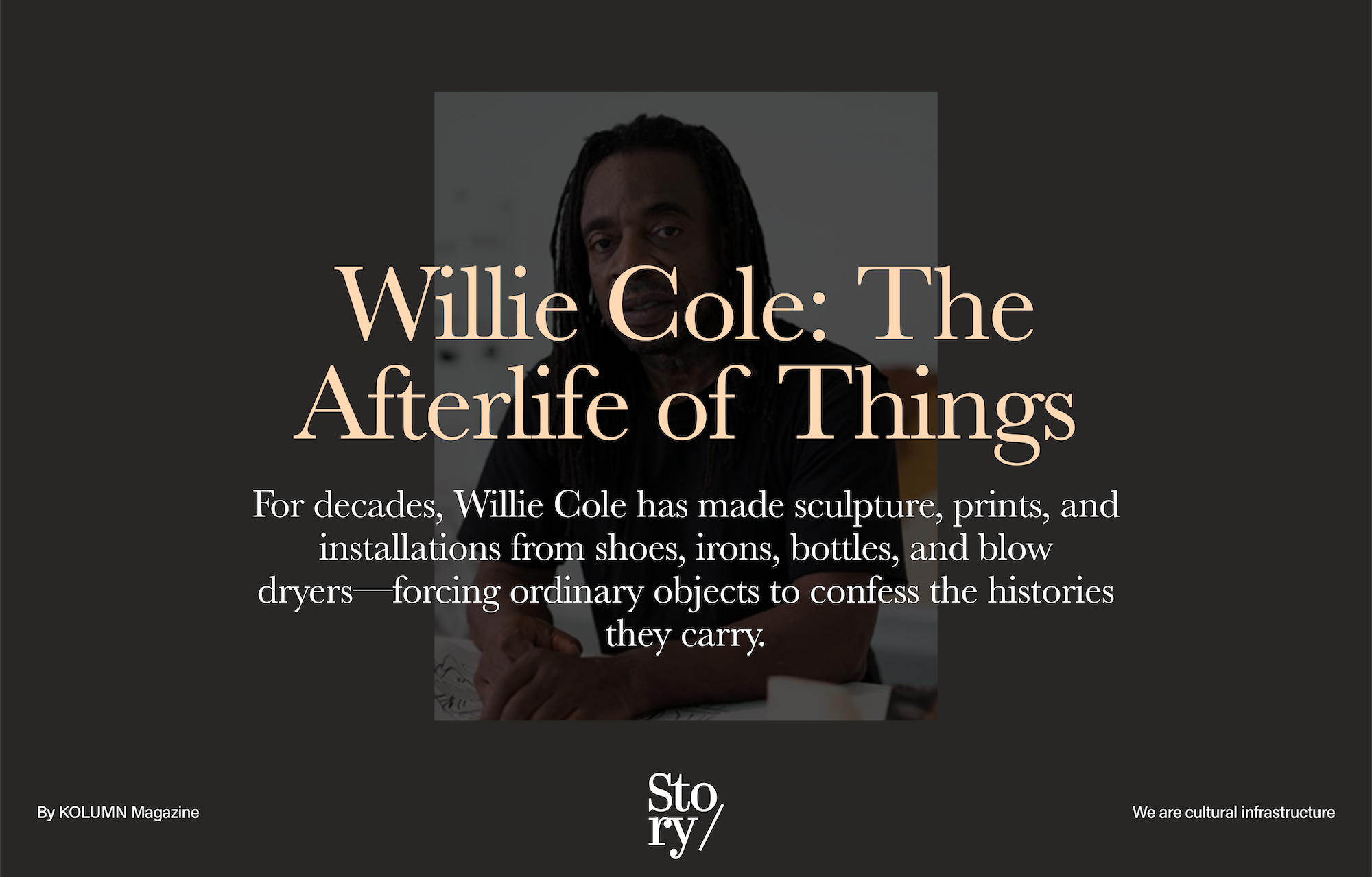
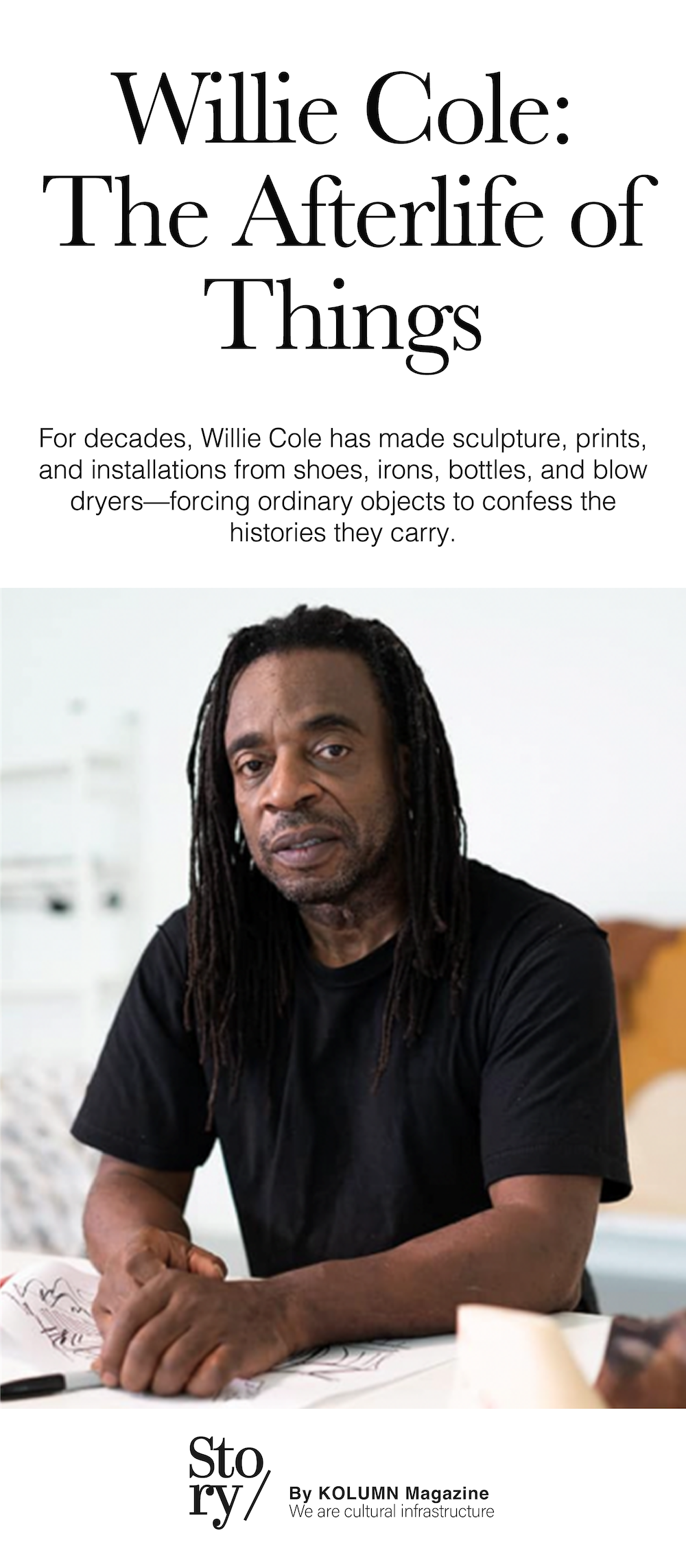
Willie Cole has built one of the most distinctive bodies of work in contemporary American art by refusing to treat ordinary objects as ordinary. He has spent decades pulling meaning out of the kinds of things most people barely register: steam irons, ironing boards, women’s shoes, hair dryers, bicycle parts, plastic water bottles, even musical instruments. In his studio, these castoffs do not stay fixed as tools of labor, fashion, utility, or waste. They become masks, shields, reliquaries, chandeliers, spirit forms, diagrams of captivity, and sometimes jokes with a sting in them. The result is a career that feels, all at once, formally rigorous, culturally literate, politically alert, and mischievously open-ended.
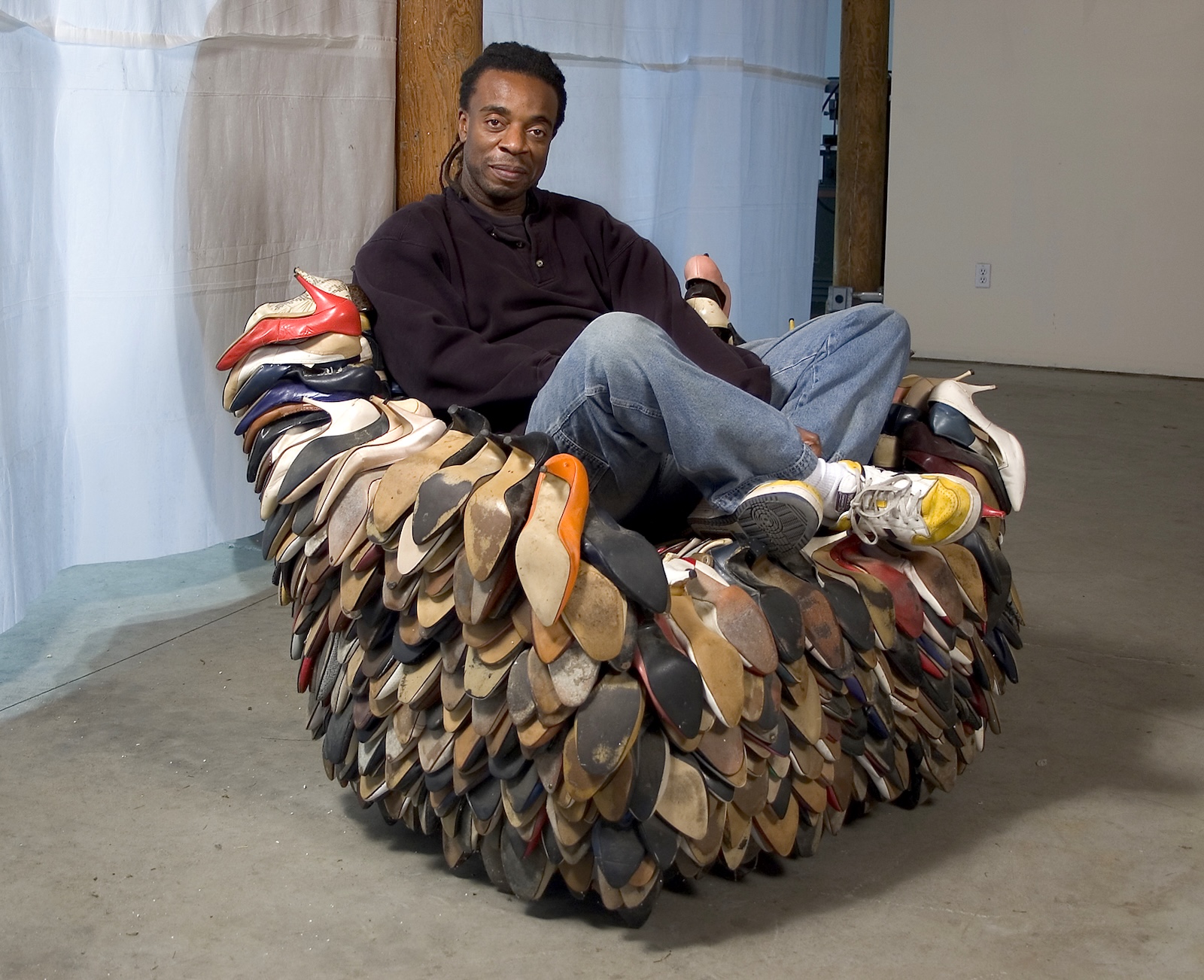
That combination is a big part of why Cole matters. Plenty of artists have worked with found objects. Plenty have drawn from African art, Black history, or consumer culture. Cole’s achievement is that he binds those strands together without flattening any of them. His work can be witty without becoming glib. It can be beautiful without abandoning critique. It can nod to Dada and Surrealism while remaining rooted in the urban Black experience, family memory, and the long afterlife of domestic labor. Museums and critics have often described his art through the language of transformation, but that word can sound too clean for what he actually does. What Cole really practices is pressure. He puts pressure on objects until they release buried associations. He puts pressure on viewers until looking becomes historical inquiry.
Born in Somerville, New Jersey, in 1955, Cole grew up largely in Newark after his parents separated. He studied at the School of Visual Arts in New York, graduating in 1976, and later pursued theater, music, writing, and illustration before visual art became his central lane. That breadth matters because his career has never looked like the story of a narrowly trained specialist. He thinks like a sculptor, but also like a graphic designer, a stage-maker, a storyteller, and a musician. In interviews, he has described discovering art as a child almost instinctively, recalling that his mother found him drawing cartoons from newspaper comic strips when he was three years old. That early sense of identity as “the little artist” stayed with him.
His path, though, was not smooth or neatly linear. Cole has spoken candidly about the racism he encountered as a young illustrator in the 1970s, when editors and publishers dismissed his work as “too ethnic.” He has recalled doing romance novel covers using photographs of white models, only to have the finished work rejected on racialized grounds. He has also said that in art school he studied the Renaissance without studying artists of color, and that he joined protests at the Newark Museum in the 1970s because the institution’s collection did not reflect the Black city around it. Those experiences matter because they help explain both the defiance and the sophistication of his mature work. Cole did not arrive at art with naïve faith in the neutrality of taste. He arrived knowing that visibility, legitimacy, and interpretation are all shaped by power.
That quote comes from a 2021 interview with the Chrysler Museum of Art, but it also reads like a key to the larger career. Cole’s work educates without lecturing, celebrates without sentimentality, and acknowledges histories that American culture often prefers to keep half-hidden. It is easy to look at his sculptures and first register only the virtuosity of assembly: the way shoes become faces, the way irons become marks, the way refuse becomes ornament. But the second look is where Cole lives. The second look is where you notice that the domestic object is also a racial object, that the repeated form echoes both ritual and mass production, that humor is sharing the stage with grief.
Newark, memory, and the making of an artistic language
Newark is not incidental in Cole’s story. It is foundational. Museum materials and interviews alike place him squarely in a Newark-based heritage, and that phrase is useful because it gets at more than address or biography. Newark shaped the social world his art thinks through: Black labor, working-class material culture, struggle, improvisation, and the layered realities of an American city that has too often been reduced to stereotype. The Frye Art Museum, in describing Cole’s survey Anxious Objects: Willie Cole’s Favorite Brands, notes that his work tracks a “distinctive, Newark-based heritage,” melding social, political, and cultural perspectives of urban African American experience.
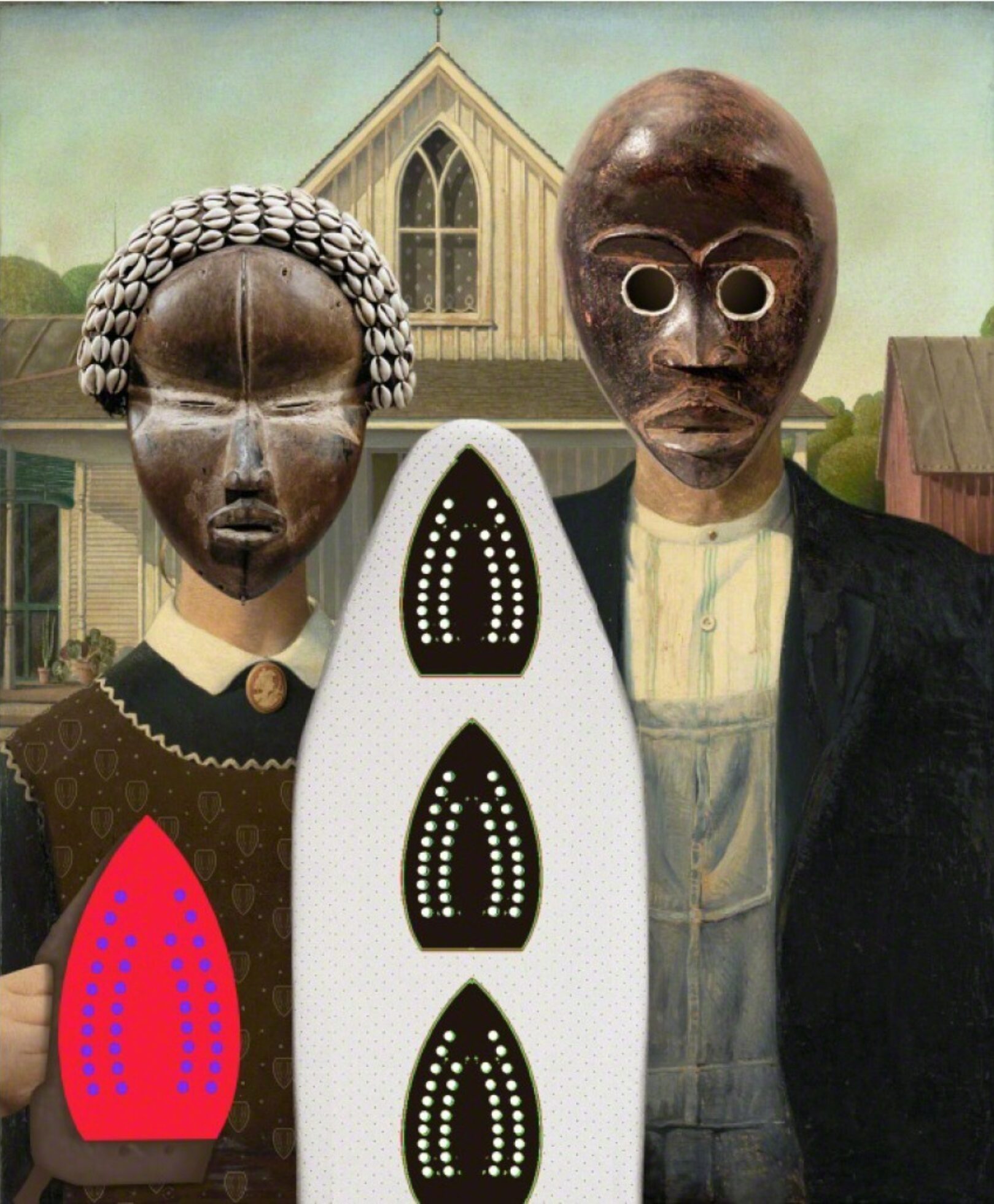
Cole’s family history enters the work not as anecdote but as structure. One of the most revealing moments in his public interviews concerns the origin of the iron motif. During his residency at the Studio Museum in Harlem in the late 1980s, he was commuting from Newark and spotted an iron in the street that had been run over by a car. Flattened, it looked to him like an African mask. That sight triggered a chain of recognition: his great-grandmother had worked as a domestic; he had inherited some of her broken irons; his loft had once been a sweatshop; scorch marks on the floor suddenly became charged forms. In a few sentences, the entire matrix of his practice appears—African visual reference, family labor history, found-object chance, industrial residue, and a flash of formal imagination.
That origin story has become almost canonical because it is so succinct, but it should not be mistaken for a quaint artist anecdote. What Cole saw in that flattened iron was not just resemblance. He saw a portal between systems that are usually discussed separately: domestic work and sculpture, Black ancestry and modernism, gendered labor and museum display, the castoff appliance and the sacred object. The iron was already overdetermined before it entered his art. It carried the history of household service, often performed by Black women; the disciplining of appearance through heat and pressure; the repetitive labor of maintenance; and, in Cole’s hands, the possibility of producing marks that evoke African scarification, branding, and the packed violence of the slave ship diagram.
The Studio Museum in Harlem was crucial to that maturation. The museum notes that objects became Cole’s primary artistic materials in the 1980s, coinciding with his 1988–89 residency there. Since then, it has framed him as a self-described “archaeological ethnographic Dadaist,” a label that sounds a little unruly until you look closely at the work. Archaeological, because he excavates memory from material remains. Ethnographic, because he studies how objects signify within cultures. Dadaist, because he delights in the readymade’s capacity to unsettle categories. Yet even that formulation is incomplete, because Cole’s project is more accountable to Black historical experience than classic Euro-American Dada ever was. He borrows from that lineage, but he does not belong to it on its terms alone.
His early professional life also helps explain his unusual range. After art school, he worked across theater, illustration, and design. He was involved with the Negro Ensemble Theater Company and the National Black Theater of Harlem; he later served in a children’s theater company at the University of Delaware and worked as a computer graphics artist and freelancer for arts organizations in New Jersey. That mixed creative life may be why Cole has always seemed comfortable slipping between mediums and publics. He is not one of those artists whose authority depends on hermetic purity. He is too porous for that, too interested in what ideas can do when they pass between sculpture, printmaking, commerce, fashion, music, and social critique.
The iron as tool, stamp, wound, and witness
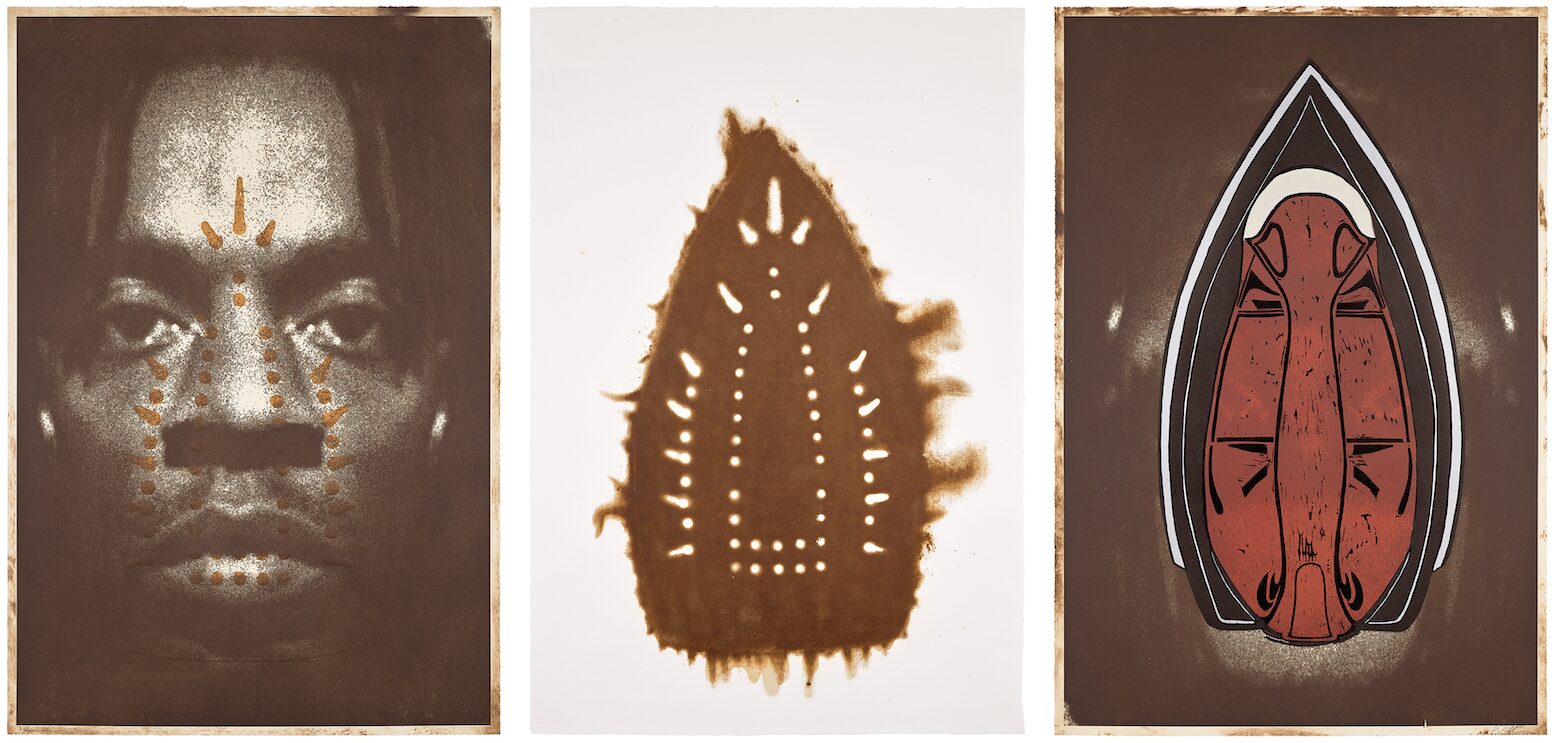
If one object anchors Cole’s legacy, it is the steam iron. MoMA, which mounted New Concepts in Printmaking 2: Willie Cole in 1998, described him then as having been preoccupied with the steam iron as a domestic, artistic, and symbolic object for over a decade. That triad—domestic, artistic, symbolic—is exact. The iron is a household device, a tool of repetitive care work. In Cole’s hands it is also a mark-making instrument, used with heat “as a kind of ink.” And beyond both of those functions, it becomes a symbolic engine, generating associations that range from African masks to slave ships to the burdens of gendered labor.
The scorch works remain among his most haunting pieces because they are so materially direct. An iron touches a surface. Heat leaves an image. A mundane act turns spectral. The National Gallery of Art lists works such as Domestic ID, V from 1992, a composition made from steam-iron scorches and graphite on paper mounted in a window frame. Even that title matters. “Domestic” points to the sphere of home and labor; “ID” suggests identity, documentation, maybe even state surveillance; the window frame introduces the language of looking in and looking out. Cole is never just printing a pleasing repeat pattern. He is using repetition to ask what kinds of history become visible when labor leaves a trace.
His 1997 print Stowage is perhaps the clearest example of that historical density. The Whitney describes it as an unusual variant on the woodcut, made by embedding an ironing board and the soleplates of twelve irons into plywood and inking the whole surface. The forms produced by the irons suggest tribal markings, while the perforated ironing board evokes nineteenth-century illustrations of Africans packed into slave ships. MoMA’s audio materials include Cole explaining the physical process in his own words: cutting holes into plywood, fitting circles, cutting out the iron shapes, and inserting the iron soles. The technique is primitive in the best sense—hands-on, materially legible, stripped of distance.
What makes Stowage so potent is that it stages historical compression without reducing it to one note. The work is formally elegant, almost cool in its structure, but the reference it carries is devastating. Cole has spoken about seeing an image of a slave ship in a childhood schoolbook, and critics have connected that memory to this work. The Guardian, writing about a British Museum exhibition in 2016, noted that Cole’s massive woodcut Stowage drew from the well-known abolitionist diagram of enslaved Africans packed into a ship’s hold. That convergence of childhood memory, graphic design, and collective trauma is classic Cole. He takes an image many Americans know in abstraction and rematerializes it through domestic hardware—through the tools of ironing, smoothing, pressing, ordering.
In Willie Cole’s work, the iron does not merely symbolize labor. It behaves like history itself: hot, repetitive, hard to escape, and always capable of leaving a mark.
That is why his iron pieces refuse easy categorization as either political art or formal experiment. They are both. The object carries Black women’s labor, the aesthetics of African form, the violence of branding, and the routine maintenance of respectability under racial capitalism. Yet it also carries sheer visual possibility. Cole’s greatness is that he never lets one register cancel the other. He understands that beauty can sharpen critique rather than soften it.
Shoes, masks, femininity, and the slipperiness of desire
If the iron is Cole’s sternest recurring motif, the shoe may be his most seductive. Over time, he has turned high heels into masks, totems, maternal figures, and avian hybrids. These sculptures often hit viewers first through visual pleasure. The curves, colors, buckles, soles, and symmetry are irresistible. But as with the irons, pleasure is only the entry point. The shoe is an object saturated with gender performance, consumption, class aspiration, bodily strain, and sexual signaling. Cole stacks and assembles these associations until the result feels ceremonial and uncanny.
The shoe works also make his relationship to African art especially visible. Critics and institutions have frequently noted how his assemblages echo the structures and frontal intensity of African masks. What is striking is that Cole’s use of those references is neither coy nor superficial. The Frye emphasizes that his engagement with African forms is informed by “studious appreciation” rather than humorous imitation. That distinction matters in a field where appropriation has often been treated too casually. Cole is not mining African art as exotic spice for Western formalism. He is making hybrids that acknowledge Black diasporic inheritance while also confronting the American objects through which that inheritance gets filtered, distorted, marketed, or denied.
His sculpture Anne Klein With a Baby in Transit, cited in museum materials and public collections, is a good example of how layered these shoe works can be. Built from discarded women’s shoes, it suggests both mother-and-child figuration and the authority of African sculptural form. The punning title folds fashion branding into maternal movement. That is vintage Cole: a joke that lands only after you notice how consumer identity, motherhood, travel, and Black visual memory are all rubbing against one another. Even when he is playful, he is not lightweight.
The shoes also pushed Cole into unexpected collaborations beyond the conventional art-world lane. The Chrysler Museum noted in 2021 that his shoe sculptures caught the attention of Rei Kawakubo, leading to a collaboration for Comme des Garçons Homme Plus and headpieces made from black pumps for a runway show. That crossover makes perfect sense. Cole’s work has always had an eye for silhouette, rhythm, adornment, and the body. What it shows, too, is that his vocabulary can move from museum pedestal to fashion context without losing its edge. He understands display culture deeply enough to operate inside it and against it at the same time.
There is, of course, a tension in these works that serious viewers should not ignore. Women’s shoes are overburdened objects in modern culture. They index glamour and pain, elegance and objectification. Some critics have argued that the emotional and political stakes of the shoe pieces can be less immediate than the iron works. That is a fair debate. But the strongest argument for the shoes is that Cole uses them to dramatize how desire itself gets manufactured. He turns fashion’s intimate instruments into communal icons. A heel ceases to be just an accessory; it becomes a face, a spirit, a shield, a creature, or a cultural mask staring back at the society that produced it.
Humor, ritual, and the Black readymade
One reason Cole has endured is that he understands something many politically engaged artists miss: wit is not the enemy of seriousness. His art can make you laugh, or at least grin at the audacity of the transformation, before it makes you uncomfortable. This tonal slipperiness is central to his power. BOMB’s oral history project, Artforum reviews, museum texts, and interviews all circle the same point from different angles: Cole finds “new meanings in seemingly exhausted utilitarian sources,” creating work that is at once cultural critique and spiritual inquiry.
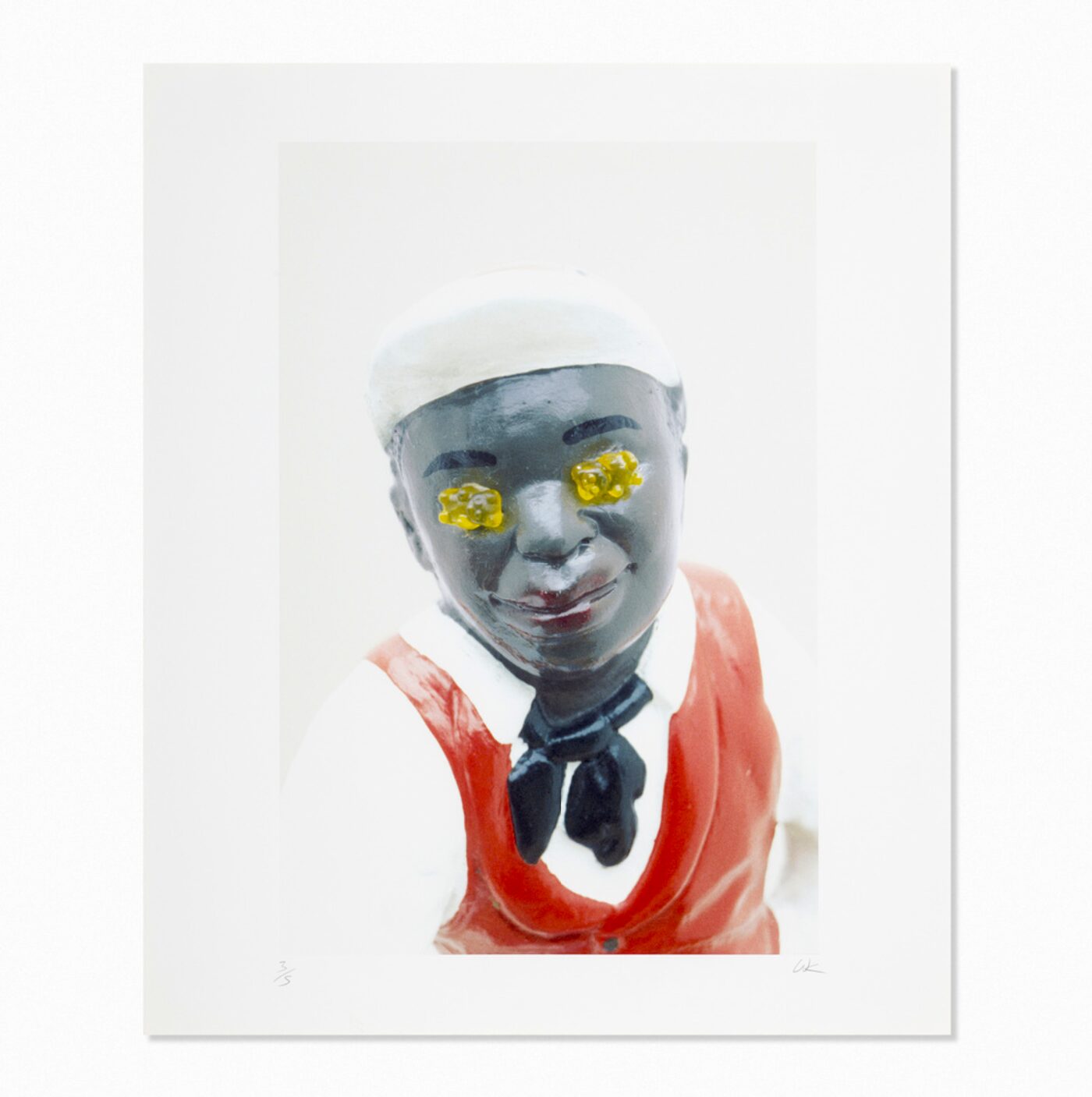
That is where the language of the readymade becomes both useful and limited. Yes, Cole extends a lineage that runs through Duchamp and Surrealism, as museums explicitly note. But what he does with the readymade is different because the objects he chooses are already socially marked by race, labor, and consumption in ways Duchamp’s urinal was not. An iron in America is not just an iron. A blow dryer, a lawn jockey, or a high heel is not just a formal unit waiting to be repurposed. These things arrive with baggage: with Black domestic work, suburban kitsch, beauty labor, sexism, capitalism, and disposable culture. Cole’s gift is that he lets the baggage stay onstage.
That is also why ritual feels like the right word for his process. The Frye says he “ritualizes” found Western objects, creating global artistic hybrids. The phrase gets at how his works operate beyond clever recombination. They often feel consecrated, as if repetition itself has changed the object’s status. Put enough shoes together, and they stop being shoes. Embed enough iron soles into a matrix, and the resulting image starts to feel like a cosmology. This is not magic in the sentimental sense. It is a disciplined way of insisting that industrial and consumer debris can still carry spirit.
Cole’s real medium may be neither sculpture nor printmaking, but transfiguration.
That is not hyperbole. Look across the career and the pattern holds. He takes what capitalism treats as finished and reopens it. He takes what domestic labor renders invisible and makes it monumental. He takes what American visual culture brands as ordinary and exposes it as historically loaded. The works do not ask for pity, and they do not settle for purity. They ask for sharper seeing.
Recognition, institutions, and the uneasy business of visibility
By now Cole’s résumé is plainly major. His work is in the collections of institutions including the Metropolitan Museum of Art, the Museum of Modern Art, the National Gallery of Art, the High Museum of Art, and the Newark Museum of Art. He has had solo presentations at MoMA, the Bronx Museum of the Arts, the Montclair Art Museum, the David C. Driskell Center, and other institutions. He received the Joan Mitchell Foundation Award in 1996, the Louis Comfort Tiffany Foundation Grant in 1995, and the David C. Driskell Prize in 2006. The Studio Museum, where he was once an artist-in-residence, now frames him as a key figure in its own history.
But Cole’s interviews suggest that recognition has never fully resolved the structural questions his career raises. In the Chrysler conversation, he spoke bluntly about how galleries after Basquiat began looking for Black artists, and how he was effectively “discovered” as a sculptor rather than as a painter. He also noted that dealers still seem to want from him what he called, with some bite, “that African thing.” That comment is easy to glide past, but it should not be. It names one of the enduring tensions in the reception of Black artists whose work engages African forms: the market is often happy to reward legible Blackness, but less interested in following the artist wherever else his imagination wants to go.
Cole’s frustration on that point is revealing because he has never been only an assemblage artist. He loves painting. He loves French painting, he says, from David to Monet. He has continued to make large paintings and to write children’s stories, play music, and design graphics. In other words, the public version of Willie Cole, though not false, is incomplete. Institutions have rightly celebrated the found-object genius, but the artist himself keeps reminding anyone who listens that creativity is broader than brand. He has even framed that expansiveness as a kind of rebirth, joking that despite being a senior citizen, he is still “being born again.”
There is an irony here. Cole’s art is in part about how brands shape perception, and yet he has had to navigate being branded as an artist. The title of the Montclair/Frye survey, Anxious Objects: Willie Cole’s Favorite Brands, captured that tension nicely. Brands in his work are never just corporate marks. They are the anxieties of value, identity, and circulation made material. The same could be said of the art world’s handling of Black artists: a hunger for recognizable signatures, a narrowing of acceptable complexity, and a persistent confusion between market legibility and artistic truth. Cole has succeeded inside that system without sounding fully seduced by it.
Sustainability, upcycling, and the new monumental scale
In recent years, Cole’s work with plastic water bottles has brought a fresh dimension to his practice, though it is really an extension of long-held concerns. He has described the bottle chandeliers as emerging almost by accident: squeezing a water bottle during a planning meeting, noticing the collapsed geometry, then dreaming of a chandelier. That description is pure Cole. The idea arrives through touch, pressure, and pattern recognition. What changes in these works is not the underlying method but the contemporary frame. Where the iron pieces foreground domestic labor and historical memory, the bottle works also pull environmental waste and public pedagogy into sharper view.
The 2023 New York Times profile, as summarized on Cole’s website, centered two large new sculptures in Newark and a group exhibition generated by an open call inviting artists to transform landfill-bound objects. That public-facing project extended Cole’s practice into something like community method: not just art made from castoffs, but a social invitation to reimagine disposal itself. Newark Museum materials from 2024 similarly highlighted The Water Bottle Giant, a piece made from 10,000 water bottles. Other recent projects have involved even larger counts, including a water-bottle sculpture project in Texas that used roughly 24,000 bottles.
It would be easy to read these works as a simple pivot to sustainability art, but that would undersell them. Cole is not just illustrating environmental crisis. He is asking what kinds of beauty and civic imagination become possible when waste is taken seriously as form. That is still very much in line with his older practice. A plastic bottle, like an iron or shoe, is a mass-produced object with a social life and a discard life. It has touched bodies, circulated through systems, and arrived burdened with labor, desire, and extraction. Cole’s artcycling philosophy—his term for repurposing discarded materials into art—does not erase those histories. It concentrates them.
These newer works also show Cole’s comfort with scale and public presence. He has never been a miniature-minded artist, but the bottle pieces and airport commissions make clear that he can move from intimate symbolic charge to civic monument without becoming generic. That matters because public art often strips artists of subtlety. Cole, by contrast, can go big and still remain himself. The bottle giant is not some random eco mascot. It is another entry in his long argument that the things America throws away are often the best evidence of what it values, exploits, and forgets.
Why Willie Cole lasts
The simplest case for Willie Cole’s significance is that he has made a vocabulary no one else owns. You can see a Cole from across the room and, more often than not, know you are in his territory. But distinctiveness alone is not enough to guarantee importance. Plenty of artists are recognizable. What makes Cole durable is that his formal signature is inseparable from a sustained intellectual and historical project. His work offers one of the strongest examples in American art of how assemblage can think—not just decorate, not just provoke, but think. It thinks through Black labor, African continuities, modernist form, consumer waste, racial visibility, and the politics of value.
He also matters because he resists the fantasy that contemporary Black art must choose between beauty and critique, accessibility and depth, vernacular intelligence and institutional seriousness. Cole’s work is legible enough to draw in people who do not arrive armed with theory, yet layered enough to reward scholars, curators, and artists who know the histories in play. That combination is rare. It helps explain why he can live productively in so many contexts: the museum collection, the academic interview, the fashion collaboration, the community workshop, the airport commission, the Met’s Afrofuturist period room. His art scales across audiences because its intelligence is embedded in the object, not outsourced to wall text.
And then there is the matter of time. Cole belongs to a generation of Black artists who came of age before the current institutional enthusiasm for Black contemporary art, and who therefore carry a different memory of exclusion. He remembers protesting museum absence. He remembers being told his work was too ethnic. He remembers a New York gallery world that had little room for artists of color before Basquiat’s death altered the market. That memory gives his success a sharper contour. It is not simply that he won recognition. It is that he kept building a language sturdy enough to survive the conditions that tried to narrow him.
Willie Cole’s art keeps insisting on a hard truth: nothing in American life is merely functional. Every object is carrying somebody’s labor, somebody’s fantasy, somebody’s wound.
That may be the deepest reason his work continues to matter. In a culture built on disposability—of goods, of workers, of neighborhoods, of memory—Cole has spent decades practicing the opposite ethic. He retrieves. He recombines. He refuses disappearance. The old iron is not dead. The worn shoe is not done speaking. The bottle headed to landfill still has one more life in it. And if that sounds like a philosophy of objects, it is also a philosophy of people.
The art world will keep finding new tags for Willie Cole: assemblage artist, conceptual sculptor, printmaker, recycler, postmodern bricoleur, Afro-diasporic formalist. Some of those labels are useful. None of them quite gets it. Cole’s enduring accomplishment is not that he has turned trash into treasure, though that cliché will follow him forever. It is that he has turned the debris of ordinary life into a method for reading America—its beauty, its appetite, its racial memory, its labor structures, its waste streams, and its talent for hiding history in plain sight. Few artists have made so much from so much that others overlook. Fewer still have done it with this much wit, elegance, and moral pressure.
More great stories

Eldzier Cortor Knew Beauty Was Political
April 9, 2026
No Comments
Bobby E. Wright Saw the System Clearly
April 9, 2026
No Comments