




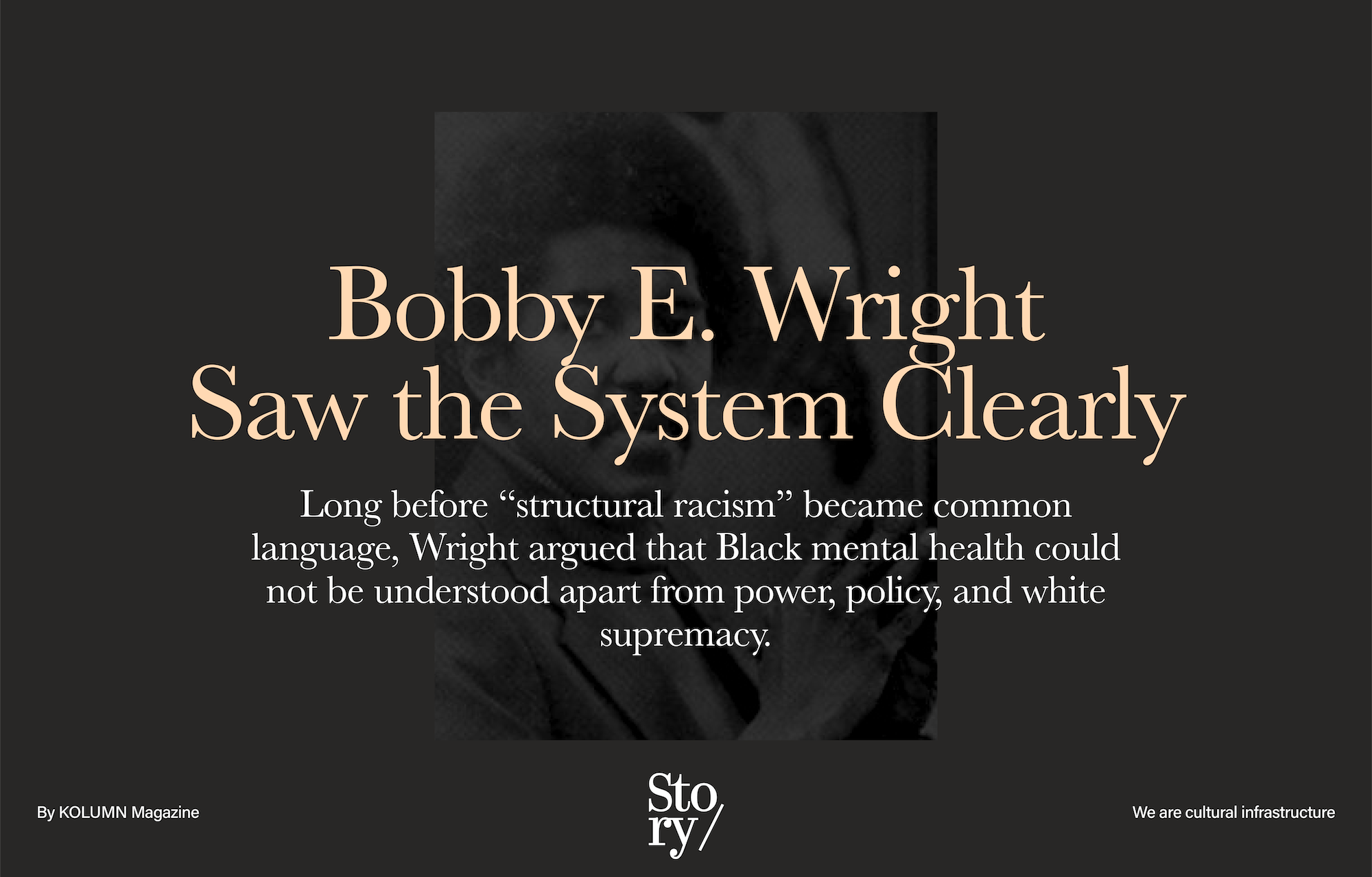
Bobby E. Wright did not treat psychology as a neutral science floating above history. He treated it as a battleground.
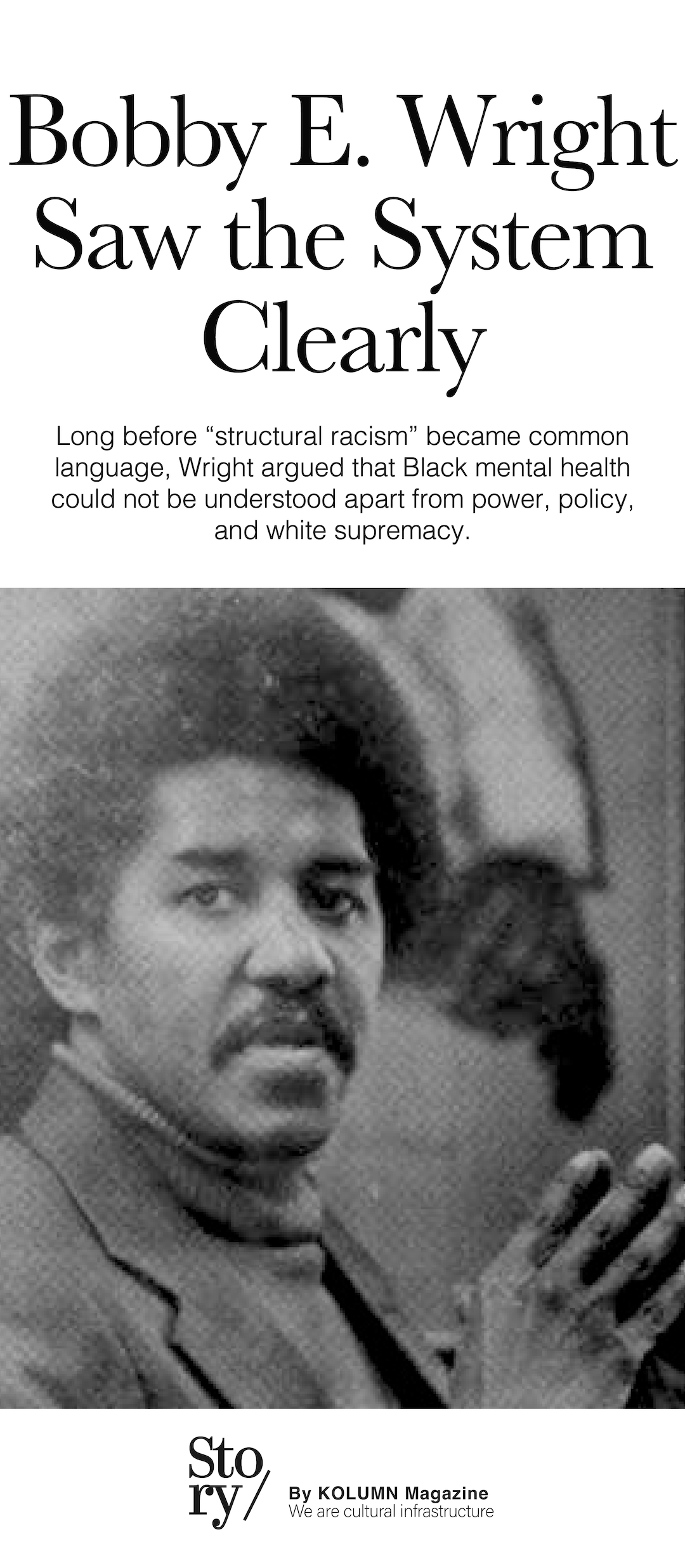
Bobby E. Wright did not treat psychology as a neutral science floating above history. He treated it as a battleground.
By KOLUMN Magazine
Bobby E. Wright does not occupy the kind of household-name status granted to Martin Luther King Jr., Malcolm X, Angela Davis, James Baldwin, or Frantz Fanon. But in the intellectual and activist traditions where Black liberation, psychology, and political struggle meet, Wright’s name still carries unusual force. He was a clinical psychologist, educator, organizer, public thinker, and institution-builder who refused to separate mental health from power. For Wright, racism was not simply prejudice, nor was Black suffering best understood as a private pathology. It was political. It was structured. It was cultivated. And in his view, it was often studied in the wrong direction.
That core reversal is what makes Wright so important. He did not ask, in the conventional language of mid-20th-century American psychology, what was “wrong” with Black people living under racial domination. He asked what kind of social order could produce domination so enduring, so rationalized, and so destructive—and what kind of psychology would be required to name it honestly. His best-known writings, especially The Psychopathic Racial Personality and Mentacide, pushed readers to consider white supremacy not as a regrettable social flaw but as a deeply organized psychological and political system. Those arguments remain controversial, sometimes intentionally unsettling, but their influence on African-centered and Black psychology is real and durable.
Wright’s life also matters because he did not live only on the page. He worked in Chicago’s public schools, challenged racist hiring structures, helped organize Black teachers, led a major community mental health institution on the West Side, participated in Black professional and political organizations, and left such a strong institutional imprint that a Chicago behavioral health center still bears his name decades after his death. His career was short—he died in 1982 at age 48—but the scope of his work was unusually broad. He moved between theory and practice with the conviction that one was useless without the other.
To write about Bobby E. Wright now is to write about more than a person. It is to write about a tradition of Black thought that refused domestication. It is to revisit a moment when Black psychologists, educators, and organizers were building their own institutions, their own frameworks, and their own critiques of mainstream knowledge. And it is to ask why a thinker who anticipated so many contemporary arguments about structural violence, racial trauma, culturally grounded care, and the politics of diagnosis still remains less known than he should be.
A scholar shaped by Alabama, Chicago, and the Black freedom era
The biographical outline of Wright’s life tells part of the story, though not all of it. He was born in Alabama in 1934, served in the U.S. Army, and moved to Chicago in 1959. He later earned degrees from Chicago State University and a Ph.D. in clinical psychology from the University of Chicago in 1972. Those facts matter not simply as résumé items, but because they place him squarely within the generational arc of Black migration, postwar urban transformation, and the rise of a new Black professional and political class that was deeply shaped by segregation and civil rights struggle.
Chicago was crucial. It gave Wright a political laboratory. In the mid-1960s he worked for the Chicago Public School system as a truant officer, and that role seems to have sharpened rather than softened his view of institutional racism. According to later accounts from Black political and intellectual circles in Chicago, Wright confronted the discriminatory hiring structure that trapped many Black teachers in the category known as FTBS, or Full Time Basil Substitute. Rather than accepting that arrangement as bureaucratic routine, he helped organize the Black Teachers Caucus to challenge it. The point here is not just that Wright opposed racism in the abstract. He fought it in the machinery of everyday governance: hiring rules, school systems, credentialing, access to authority.
That teacher struggle is one of the most revealing parts of Wright’s life because it clarifies his political temperament. He was not an incrementalist. He did not appear especially interested in the etiquette of reform for its own sake. The accounts that survive describe him as forceful, uncompromising, and deeply committed to Black self-determination. Even sympathetic retrospectives present him as a figure who took unpopular positions and insisted that professional knowledge had to be accountable to Black communities, not merely to universities, foundations, or white-led institutions.
That posture also helps explain why Wright sits at an interesting intersection in Black intellectual history. He was not only a clinician or academic. He belonged to a wider network that included Black psychologists, Black educators, Pan-African political actors, community activists, and institution-builders. His affiliations included the Association of Black Psychologists, the National Alliance of Black School Educators, Communiversity, the National Black United Front, and the Temple of the African Community of Chicago. He also served on the Science and Technology commission of the Sixth Pan African Conference in Tanzania in 1974. That is not the résumé of a narrow specialist. That is the footprint of someone who understood psychological work as part of a liberation project.
Black psychology as refusal
To understand Wright’s significance, it helps to understand the intellectual field he helped shape. Black psychology emerged in part as a response to the failures and harms of mainstream American psychology, which had long pathologized Black life, universalized white norms, and treated the experience of African-descended people as deviation rather than as a legitimate basis for theory. By the late 1960s and early 1970s, Black psychologists were building an alternative framework—one concerned with culture, history, liberation, and the full humanity of Black people. Wright became one of that movement’s most forceful voices.
Fielding Graduate University’s history of Black psychology identifies Wright as one of the founding fathers of Black psychology in the United States. The Association of Black Psychologists likewise places him among major figures in the field and emphasizes his commitment to Black self-determination, community development, and culturally sensitive mental health care. Those descriptions are important because they establish the terms on which Wright should be read. He was not a fringe commentator hovering outside the discipline; he was part of a deliberate effort to reconstruct the discipline itself.
Still, “Black psychology” can sound almost too polite if one does not attend to what Wright meant by it. In his case, the project was not merely representational. It was not just about adding Black faces to white institutions or adjusting mainstream categories so they felt less insulting. Wright argued that Black people needed to study themselves in their own terms, rather than only through the conceptual schemes of those who dominated them. This sounds obvious now, perhaps even banal, because contemporary academic language has absorbed some version of that critique. But in Wright’s time—and even now, if we are honest—the insistence that oppressed people should define reality for themselves was and remains a radical challenge to the authority structures of knowledge.
Wright’s work also belonged to the stream of Black thought that rejected the idea that psychology could be meaningfully divorced from political economy and state power. He argued that Black mental health had to be understood in relation to white supremacy, not merely in relation to individual adjustment. That distinction matters. Conventional psychology often asks how a person can adapt to a damaged environment. Wright’s framework asked what it means when the environment itself is organized around domination—and what it would mean for a discipline to stop treating that fact as incidental.
This is one reason his work still resonates with contemporary discussions about racial trauma and structural violence. Today, plenty of public discourse recognizes that mental distress can be shaped by institutions, housing, policing, schooling, poverty, and discrimination. Wright was making an even sharper version of that argument decades ago. He was not only saying that oppression harms mental health. He was saying that any psychology that fails to theorize domination accurately will end up misdiagnosing the oppressed.
The provocation of The Psychopathic Racial Personality
No discussion of Wright can avoid his most famous and most debated work: The Psychopathic Racial Personality. First published in 1974 and later republished in expanded essay collections, the text offered a startling and confrontational claim. Wright argued that European domination of African peoples could be understood through the lens of psychopathy—not as a loose insult, but as an analytic framework for recurring patterns of racial violence, exploitation, deceit, and moral indifference.
Wright’s most unsettling argument was also his most enduring one: maybe the violence was not a malfunction of the system. Maybe it was evidence of the system’s design.
There is a reason the essay continues to circulate. It names something many readers recognize but mainstream discourse often sanitizes: the sheer regularity with which domination can present itself as order, benevolence, civilization, religion, science, or progress. Wright’s provocation was that this pattern should not be treated as contradictory or accidental. In his view, the system was revealing its character, not betraying it. Later summaries of his work describe his argument as a claim that Europeans exhibited a cluster of psychopathic traits in their relationships with African peoples: disregard for ethical limits, exploitative social relations, manipulative promises, a demand for psychological compliance, and an inability or unwillingness to sustain genuinely reciprocal human connection across racial power lines.
That is strong medicine, and it raises hard questions. Does Wright’s language overreach? Does it turn a political system into a biologized personality type? Does it risk collapsing history into essentialism? Those questions are fair, and any responsible treatment of Wright has to acknowledge them. His writing is not mild, and some of its framing remains deeply controversial. But it is also worth noticing what gave the essay its staying power. Wright was trying to solve a genuine analytic problem: how to explain the persistence of racial domination in a society that constantly narrates itself as moral, democratic, and rational. The intensity of his language was part of an effort to break through euphemism.
What Wright saw, and what many later scholars continue to wrestle with, is that white supremacy often depends on a staggering emotional and moral dissociation. Enslavement coexisted with Christian piety. Segregation coexisted with constitutional rhetoric. Urban disinvestment coexisted with civic self-congratulation. So did school exclusion, psychiatric bias, police violence, and the routine bureaucratic management of Black suffering. Wright’s essay can be read as a demand that language catch up to reality. If a system repeatedly degrades human life while insisting on its own innocence, what vocabulary is adequate to that contradiction? Wright chose one of the harshest vocabularies available.
The essay’s afterlife is also instructive. It remains widely cited in Black intellectual spaces, library catalogs, later discussions of whiteness and pathology, and conferences devoted to African/Black psychology. Whether one accepts all of Wright’s claims or not, his argument entered the bloodstream of a broader tradition that refused to naturalize racial domination. That alone makes the essay historically significant.
“Mentacide” and the war for Black consciousness
If The Psychopathic Racial Personality is Wright’s most notorious formulation, “mentacide” may be his most portable one. The term is typically described, in later discussions of his work, as the systematic and deliberate destruction of a people’s mind with the aim of group eradication. Wright used it to describe a form of psychological warfare that does not stop at bad schooling, media distortion, or cultural insult, though all of those can be part of it. The broader point was that domination operates by training the oppressed to misrecognize themselves, distrust one another, internalize inferiority, and reproduce systems that work against their collective survival.
This idea remains striking because it forces a shift from incident to process. Wright was not describing a one-time injury. He was describing an ongoing structure of consciousness management. In that framework, schools, media, professional disciplines, churches, cultural norms, and state institutions can all become sites where Black people are induced to accept narratives that degrade Black life or conceal the workings of power. The violence, in other words, is not only physical. It is epistemic. It trains perception.
This is where Wright begins to sound eerily contemporary. Long before people argued in mainstream venues about algorithmic bias, historical erasure in curricula, respectability politics, or the psychological damage of constant exposure to anti-Black imagery, Wright was describing a coordinated assault on Black self-conception. He saw ideological confusion as part of the architecture of domination, not as a side effect. And he believed that liberation required not just policy change, but mental decolonization.
To be clear, Wright was not the only thinker working in that register. One can hear echoes of Fanon, of anti-colonial theory, of Black nationalist critique, and of broader Pan-African analyses of culture and power. But Wright’s distinct contribution was to bring those insights into conversation with clinical psychology, community mental health, and Black institution-building in the United States. He gave the political critique a psychological grammar that many subsequent thinkers found useful, especially in African-centered psychology and educational theory.
One reason “mentacide” survives is that it gives people a name for a diffuse but familiar experience: the sense that domination works by getting into the head, rearranging value, and distorting reality from the inside. Even readers who never adopt Wright’s full conceptual scheme often recognize the force of that naming. A concept survives when it helps people see something they had felt but not yet articulated. “Mentacide” did that.
The clinic, the neighborhood, and the politics of care
It would be easy to reduce Wright to an incendiary theorist. That would be a mistake. One of the most important facts about his life is that he was not just a writer of concepts; he was a builder of institutions. After earning his doctorate, he became executive director of the Garfield Park Comprehensive Community Mental Health Center on Chicago’s West Side. Under his leadership, according to the center’s own institutional history, the agency expanded from one sheltered workshop program to eleven clinical programs. After his death in 1982, the organization was renamed in his honor and continues to serve West Side communities today.
His legacy was not only a body of ideas. It was also a neighborhood institution built to make care more accountable to Black life.
That institutional legacy changes how his ideas should be read. Wright was not simply denouncing racist systems from a distance; he was also trying to build alternative structures of care. The contemporary Bobby E. Wright Comprehensive Behavioral Health Center describes its mission in terms that would not be out of place in Wright’s own framework: culturally sensitive care, community-grounded service, accessibility regardless of ability to pay, and holistic mental health support in neighborhoods that have long been underserved. The organization’s current footprint in Chicago suggests that Wright’s legacy is not merely symbolic. It remains infrastructural.
That matters especially because community mental health is often discussed as a technocratic issue rather than a political one. Wright did not appear to make that separation. For him, a Black mental health institution on the West Side of Chicago was not just a service provider. It was part of a broader struggle over who gets care, who defines wellness, who controls professional knowledge, and whether Black communities can build durable institutions outside the logic of neglect.
The institution itself has evolved with time, as any surviving organization must. Today it offers behavioral health, addiction treatment, developmental disability services, crisis intervention, outpatient care, housing-linked programs, and youth services. Contemporary partnerships in West Side behavioral health also include the center in collaborative care models intended to close gaps between hospitals and community-based treatment. Those present-day structures are not identical to Wright’s moment, but they do reveal a continuity: the need for neighborhood-rooted mental health infrastructure in Black Chicago has not disappeared.
This practical side of Wright is sometimes overshadowed by the polemical fame of his writings. Yet it may be the most persuasive evidence that he should be taken seriously. Plenty of thinkers critique domination. Fewer help build community institutions capable of responding to it. Wright tried to do both.
Wright’s social-political model and the question of Black suffering
Another important dimension of Wright’s work concerns suicide, depression, and what later scholars describe as his social-political model. Later discussions of that model, especially in the work of psychologist Daudi Ajani ya Azibo, frame Wright’s argument as a refusal to individualize Black self-destruction under white domination. The model holds that Black people living under white supremacy who take their own lives cannot be fully understood apart from the larger political order that structures their despair.
This is a powerful and difficult intervention. Mainstream suicide discourse tends to focus on individual psychopathology, family history, neurochemistry, or immediate life stressors. Wright did not deny psychological pain. But he insisted that social domination must be treated as etiological, not incidental. In practical terms, that means mental health professionals cannot pretend that anti-Black institutions are merely “context” while the real pathology resides inside the Black subject. The political order, in Wright’s reading, is part of the wound.
That line of thought remains relevant in an age of renewed attention to racialized stress, police violence, educational exclusion, and the cumulative health consequences of structural racism. Contemporary scholarship may use different terminology and more methodologically cautious phrasing, but the central intuition is recognizable: Black suffering is patterned by systems. Wright pushed that argument with unusual directness, and later scholars have continued to revisit it because it challenges victim-blaming models that remain embedded in clinical and public discourse.
At the same time, Wright’s model also exposes the limitations of liberal recognition. It is now common to say that racism affects mental health. But Wright was demanding more than recognition. He was demanding reorientation. If the system helps produce the suffering, then treatment, prevention, theory, and policy all have to change. One cannot simply acknowledge racism in the intake form and proceed with business as usual. Wright’s framework presses clinicians and institutions toward a more uncomfortable question: what would it mean to practice mental health care without naturalizing white supremacy?
Why the mainstream never fully absorbed him
There is an obvious question here: if Wright was this important, why is he not more broadly known? Part of the answer is structural. National mainstream outlets devoted relatively little sustained attention to him compared with the later reverence afforded to more canonized public intellectuals. The archival footprint that survives is stronger in Black psychology, local Chicago institutional history, movement writing, conference records, and Black intellectual networks than in the prestige press. His prominence was real, but it circulated in a different public sphere.
Another reason is that Wright’s language resists easy domestication. He is not a thinker whose work can be comfortably excerpted into corporate DEI programming or flattened into generic uplift. He did not offer a reassuring diagnosis. He did not imply that incremental recognition by existing institutions would be enough. He questioned the moral psychology of domination itself. He challenged the foundation of a field that preferred to see itself as neutral. And he tied community mental health to Black self-determination in a way that remains politically demanding.
It also does not help that some of Wright’s ideas are easier to cite than to sit with. “Mentacide” is memorable. “Psychopathic racial personality” is unforgettable. But to take either concept seriously would require institutions to interrogate the forms of schooling, policing, media production, professional authority, and public policy that continue to structure anti-Black life. That is a much bigger ask than celebrating Wright as a historical curiosity.
And then there is the matter of timing. Wright died in 1982, just before Chicago elected Harold Washington as its first Black mayor in 1983. Later accounts credit Wright’s political work as part of the groundwork that made that moment possible. But he was not there to become a public elder in the way some of his contemporaries did. He did not have decades to consolidate a mainstream reputation, build a larger popular readership, or soften his own image for broader consumption. His early death froze him in a more insurgent register.
The challenge of reading Wright now
A serious reading of Bobby E. Wright requires two things at once: admiration and scrutiny. Admiration, because he recognized with unusual clarity that Black mental health cannot be severed from political domination, and because he helped build institutions meant to answer that reality. Scrutiny, because some of his formulations are intentionally extreme and because modern readers may question elements of his theoretical framing, especially where it appears to edge toward sweeping claims about group character. Both responses are part of reading him honestly.
But perhaps the bigger challenge is not whether every line of Wright’s theory survives unchanged. The bigger challenge is whether we are willing to confront the problems he insisted on naming. Is anti-Black domination still organized through institutions that harm mental health? Yes. Do professional disciplines still struggle to theorize Black suffering without sliding into victim-blaming or cultural deficit models? Also yes. Do communities still need culturally grounded systems of care that are accountable to the people they serve? Clearly they do. On those questions, Wright feels less like a relic than like a rough-edged precursor to arguments that remain unresolved.
His continuing relevance is visible in the institutions and intellectual communities that keep invoking him. The Association of Black Psychologists still places him within its educational lineage. Conferences have been dedicated to reflecting on his contributions. Later scholars continue to revisit his social-political model. Chicago’s West Side still houses a behavioral health center named for him, serving residents in a city where mental health inequity remains a live issue, not a historical footnote.
Wright also speaks to a broader tension in Black public life: the tension between therapeutic language that individualizes pain and political language that situates pain in systems. He refused to choose between psyche and structure. In that sense, he belongs to a lineage of Black thinkers who insisted that liberation requires both inner and outer transformation, both care and struggle, both healing and analysis. His work remains potent precisely because it does not let those categories drift apart.
A legacy still arguing with the present
The easiest way to memorialize Bobby E. Wright would be to turn him into a respectable ancestor and leave it there. But Wright is not especially useful in bronze. He is more useful as an argument. He argues with the complacency of mainstream psychology. He argues with the fantasy that racism is mostly interpersonal misunderstanding. He argues with the notion that Black communities can survive on symbolic recognition without institutions. He argues, too, with any therapeutic framework that treats people as broken while leaving domination conceptually intact.
He left behind a challenge, not a comfort: to study Black suffering without losing sight of the system that profits from it.
That argumentative quality is exactly why he still matters. We are living in a period when the language of trauma, structural harm, and racial inequity is far more mainstream than it was in Wright’s day. But mainstreaming language is not the same thing as transforming conditions. Black communities still confront disinvestment, punitive schooling, uneven access to care, ideological assaults on history and identity, and the endless public recycling of Black pain as spectacle. Wright would likely recognize the terrain immediately. He might simply say that the diagnostics have improved a little while the structure remains stubbornly familiar. That is an inference, but it is one grounded in the enduring fit between his framework and the conditions he sought to name.
In the end, Bobby E. Wright’s significance lies in the fact that he expanded the field of vision. He forced readers, students, clinicians, and activists to see Black mental health as inseparable from history, power, and collective survival. He moved between school systems, community institutions, Pan-African politics, professional associations, and theoretical writing without treating any of those arenas as isolated. And he left behind both an intellectual vocabulary and a practical legacy that continue to matter.
If Wright is still underread outside specialist and movement circles, that may say less about the limits of his work than about the limits of the culture that receives it. American public life has a habit of embracing Black thinkers once their edges have been dulled. Wright’s edges remain sharp. That is part of why he endures. He is still difficult, still provocative, still resistant to easy incorporation. And in a moment when so many institutions want the language of justice without the burden of transformation, Bobby E. Wright still sounds like what he was: a man unwilling to confuse diagnosis with surrender.
More great stories
Afro Sheen, Wall Street, and the Architecture of Black Possibility
July 6, 2026
No Comments
The Fire Inside the Fourth
July 5, 2026
No Comments