




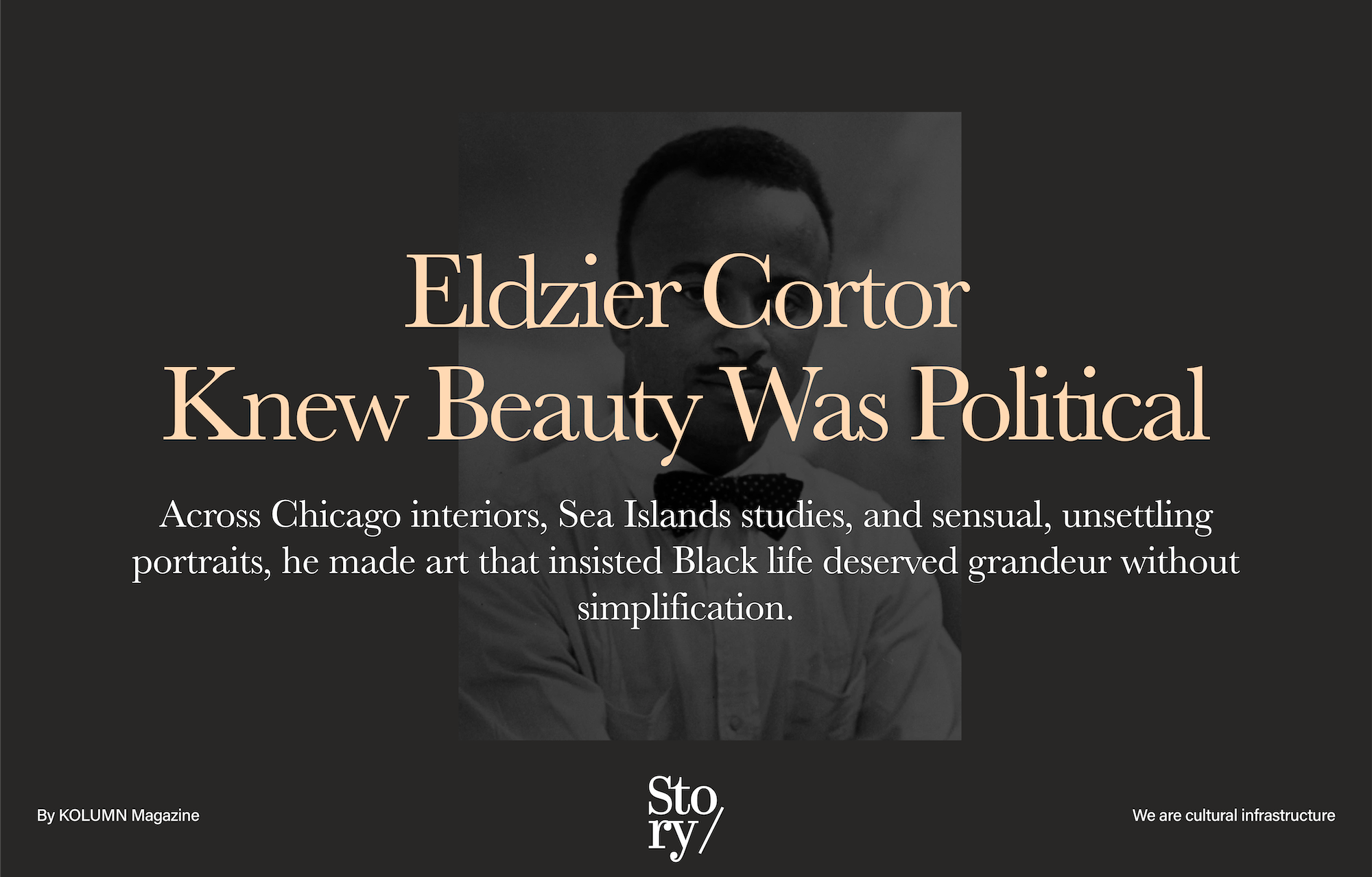
Cortor did not merely place Black women in art history’s frame. He tried to rebuild the frame around them.
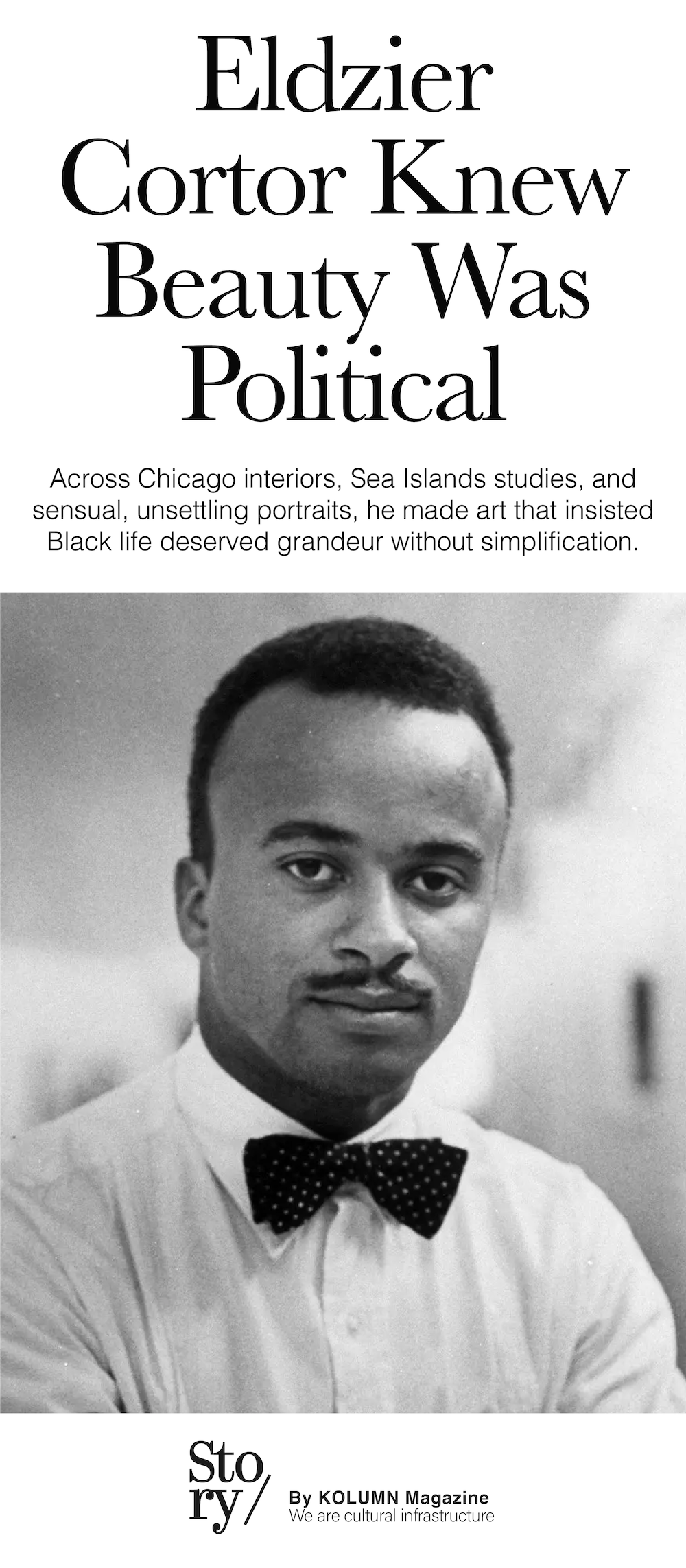
Cortor did not merely place Black women in art history’s frame. He tried to rebuild the frame around them.
By KOLUMN Magazine
For more than seven decades, the painter and printmaker Eldzier Cortor made work that insisted on two ideas at once: that Black life could be rendered with dignity even under conditions of deprivation, and that Black beauty—especially Black womanhood—deserved to be centered, studied, and monumentalized. Born in Richmond, Virginia, in 1916 and raised on Chicago’s South Side after his family joined the Great Migration, Cortor built a career that moved from Depression-era social realism to formally adventurous figuration, printmaking, and diasporic study. Along the way, he became one of the most distinctive American artists of the 20th century, even if he never achieved the mainstream name recognition of some of his peers.
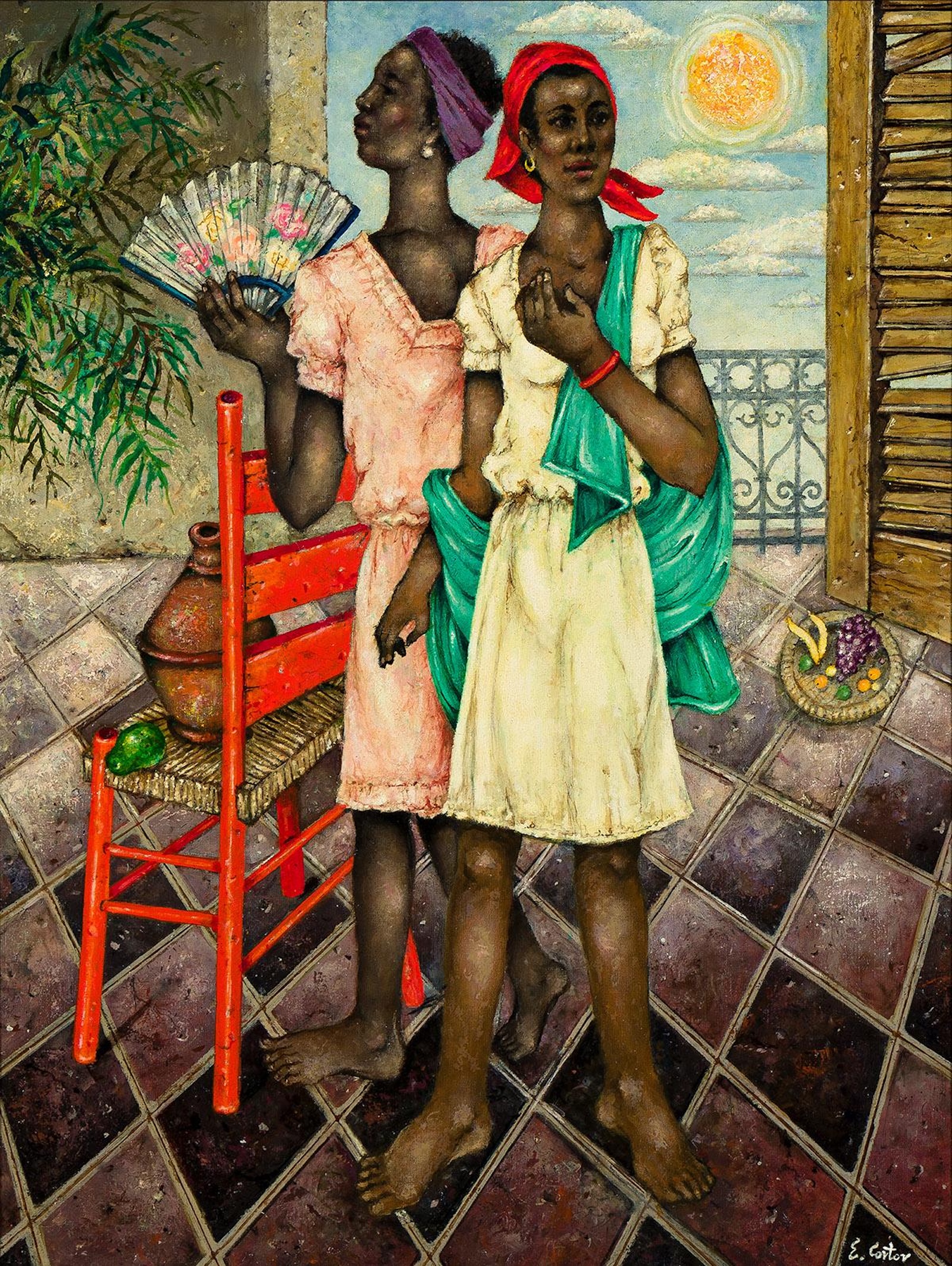
Cortor’s significance is not just that he painted Black people when too many American institutions ignored them. It is that he painted Black people with ambition. He was not interested in flattening his subjects into sociology, propaganda, or uplift cliché. His figures stretch, recline, twist, and fill rooms with psychological charge. His interiors can feel claustrophobic and dreamlike at once. His women can appear statuesque, sensuous, self-contained, and symbolically overburdened all in the same frame. That tension—between reverence and risk, realism and surrealism, document and invention—is what keeps his work alive.
To write about Cortor now is to write about an artist who sat at several crossroads at once: Chicago modernism and Black social realism, African diasporic consciousness and American art-school training, intimate domestic observation and mythic stylization. He was shaped by the Works Progress Administration, by the South Side Community Art Center, by the Sea Islands of Georgia and South Carolina, by travel in Haiti, Cuba, and Jamaica, and by a long, serious engagement with African sculpture. All of that enters the work. None of it cancels the rest.
That line, from Washington Post critic Sebastian Smee’s reading of The Room No. VI, gets at something essential in Cortor’s career. Visibility, for Cortor, was never a simple matter of representation. It was a matter of form. Who gets elongated into elegance? Who gets rendered with mystery? Whose room becomes a stage for modern art rather than a file in the archive of poverty? Cortor’s answer was radical precisely because it did not ask permission.
A Chicago education, inside and outside the museum
Eldzier Cortor’s life began in the South, but his artistic formation was decisively Chicagoan. His family moved north when he was still an infant, part of the broader migration of Black families leaving the South for industrial cities. He grew up in Bronzeville-adjacent Chicago, attended Englewood High School, and studied at the School of the Art Institute of Chicago, graduating in the 1930s. The city gave him both an art education and a social education: museum collections, Black newspapers, segregated neighborhoods, and a rich network of Black intellectual and cultural life.
At the Art Institute, Cortor absorbed the disciplines of draftsmanship and painting, but his education was not confined to academic technique. He studied European painting, yes, but he was also deeply affected by African sculpture he encountered in Chicago collections, especially at the Field Museum. That encounter mattered. The rhythmic, cylindrical, sculptural treatment of the body that would become a hallmark of his work did not emerge from nowhere; it was part formal vocabulary, part philosophical reorientation. He saw in African art not a supplement to Western art history, but a foundational source of beauty, proportion, and expressive force.
That matters because American art history too often frames Black artists of Cortor’s generation as marginal respondents to European modernism. Cortor was doing something more self-possessed than that. He learned from European painting, but he did not subordinate himself to it. His work folded African sculpture, Black social life, and modernist distortion into a language that felt answerable to Black experience rather than to white institutional approval. That distinction is crucial.
Chicago also offered a political context. In the late 1930s and early 1940s, the city’s Black cultural world was buzzing with artistic, civic, and intellectual experimentation. Cortor worked under the WPA Federal Art Project and helped establish the South Side Community Art Center in 1941, an institution that remains one of the most important Black art spaces in the country. The center was not some side note. It was part of the infrastructure that made Black artistic self-determination possible in an era when mainstream museums and galleries still offered limited access.
Cortor’s early career was built inside a Black cultural ecosystem that understood art not as decoration, but as community record, argument, and survival.
That grounding helps explain why even his most stylized work never fully detaches from lived conditions. However lyrical the bodies become, however strange the spatial distortion, Cortor’s art remains tied to the material and psychic architecture of Black life.
Painting Black life without stripping it of complexity
Cortor’s WPA years are often described as a period when he depicted everyday life on Chicago’s South Side. That is true, but it undersells what he was after. He was not simply painting “scenes” in a documentary sense. He was figuring out how to portray Black domestic life without reducing it either to pity or sentimentality. His interiors, tenements, and neighborhood observations are rooted in social fact, but they are arranged with intense formal intelligence.
The best-known example is The Room No. VI from 1948, now in the Art Institute of Chicago. The picture shows four figures asleep in a cramped interior, their bodies arranged across a bed in a way that simultaneously conveys intimacy, exhaustion, overcrowding, and compositional grace. The Art Institute notes that the work exposes the impoverished living conditions many Black families endured in midcentury Chicago. But the picture’s power comes from the fact that it does not stop at exposure. Cortor compresses the space, tilts perspective, and arranges pattern and body so that necessity becomes visual complexity rather than spectacle.
Washington Post critic Sebastian Smee put it well when he argued that Cortor painted Black poverty “with beauty and great invention.” That phrasing is useful because it captures the ethical difficulty of the painting. Beauty, in another artist’s hands, might have prettified deprivation. In Cortor’s hands, beauty becomes a refusal to let poverty exhaust the meaning of the people inside the room. The sleeping bodies are not props in a social problem painting. They remain human presences, each with weight, contour, rhythm, and mystery.
This is one reason Cortor’s realism feels different from the blunt didacticism that sometimes marks New Deal-era art. He was interested in fact, but he was just as interested in psychic atmosphere. The room is packed, but it is also unstable, nearly dreamlike. Perspective does not behave. Bodies seem to slide vertically as much as recline horizontally. The painting feels at once specific and suspended, as if ordinary Black life were being granted the same formal daring that museums usually reserve for canonical white modernists.
That move—bringing modernist invention to Black domestic life—may be one of Cortor’s greatest contributions. He made it harder to maintain the lazy division between “serious art” on one side and “social subject matter” on the other. In Cortor, those categories collapse into each other.
The Black female figure at the center
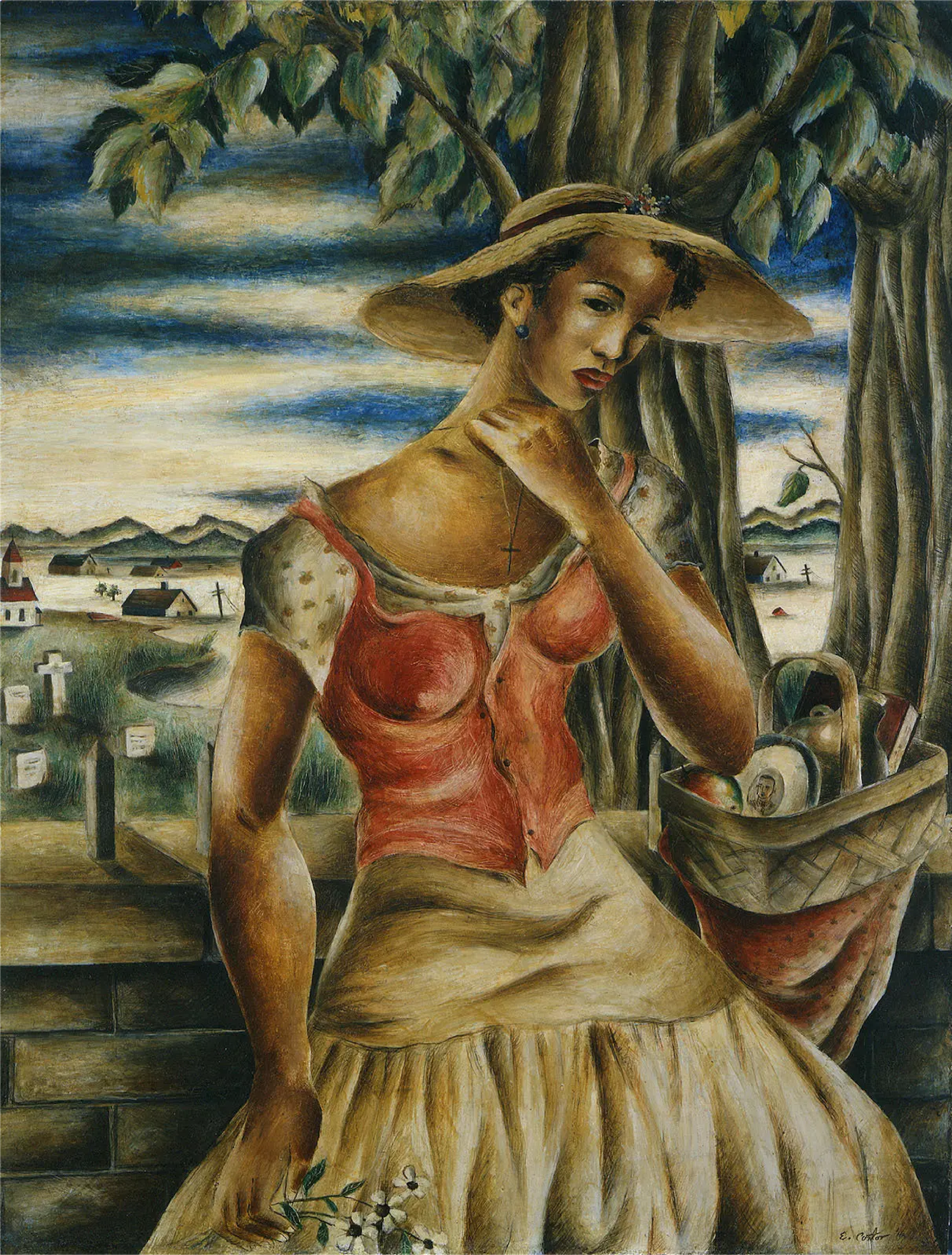
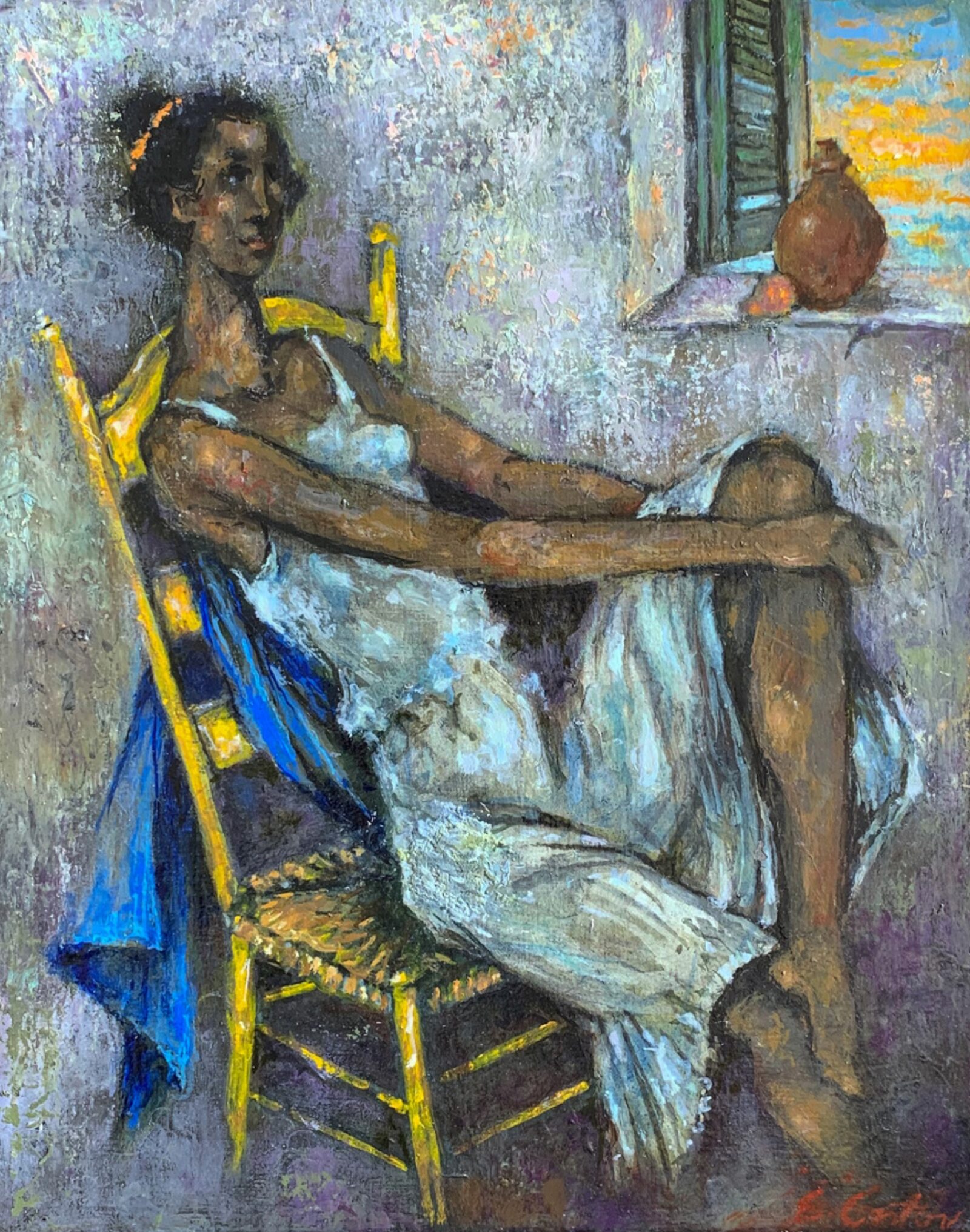
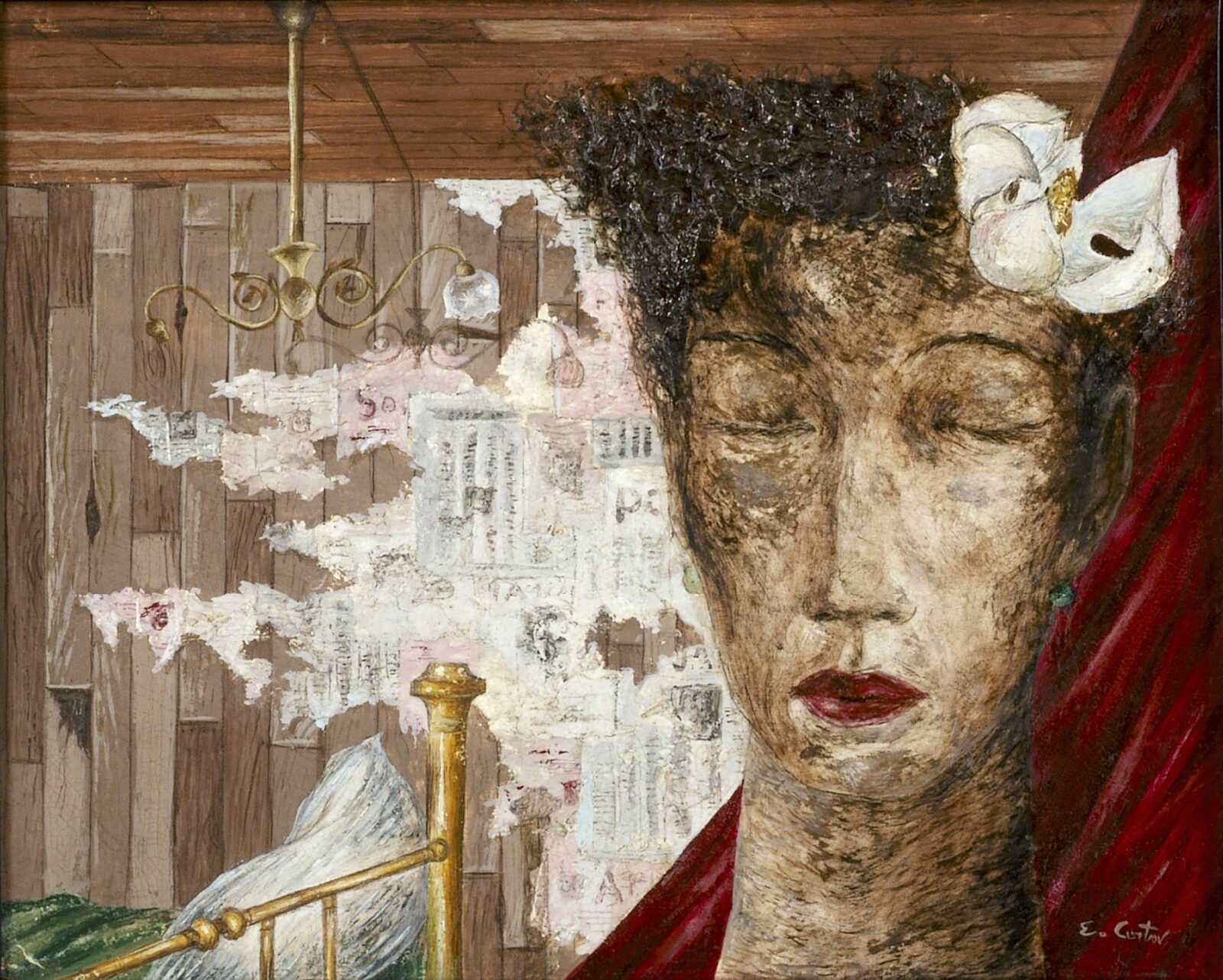
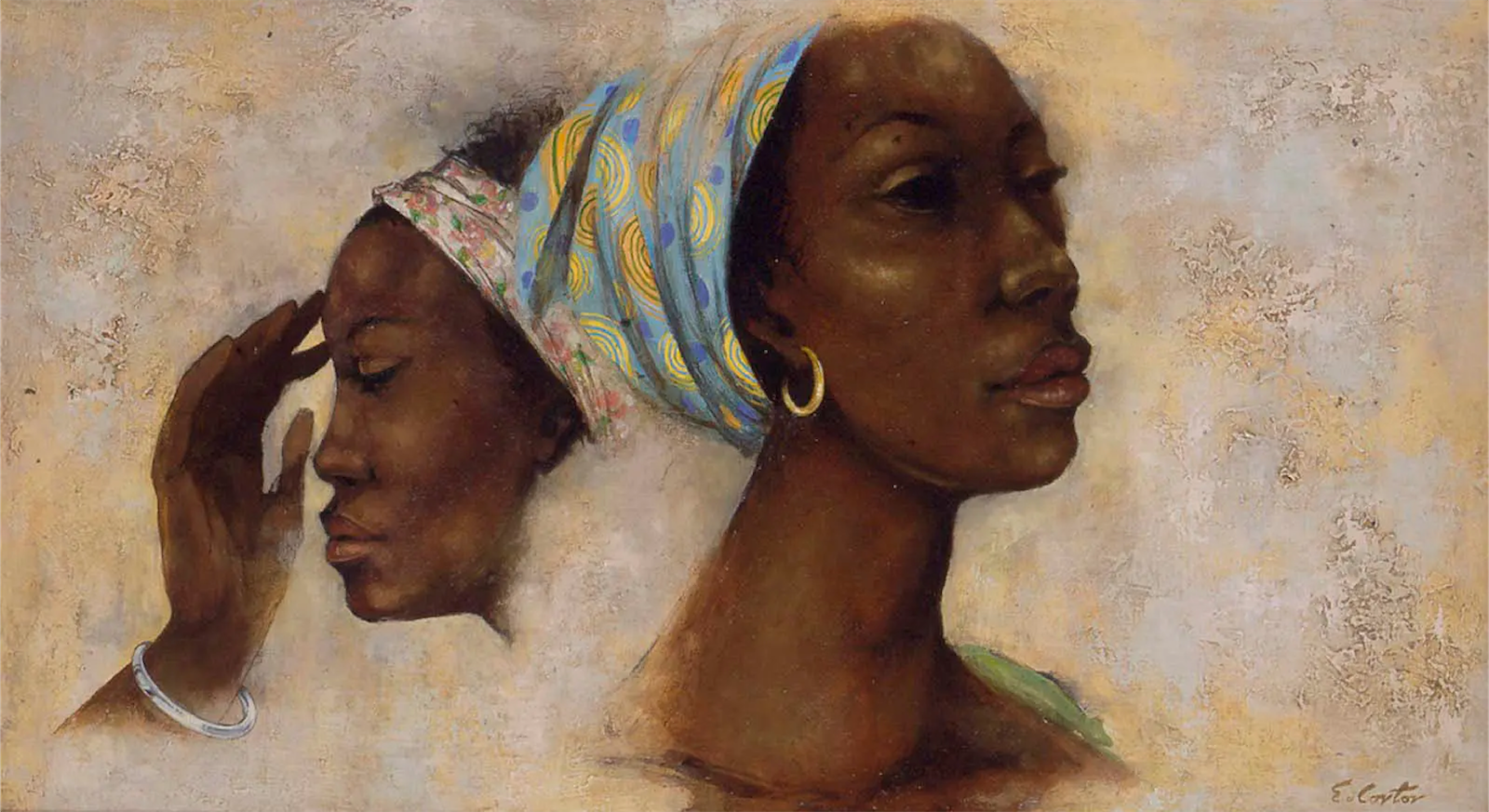
If The Room No. VI shows Cortor’s moral and formal seriousness, his many depictions of Black women show the scale of his ambition. He returned again and again to the Black female figure, often nude or semi-nude, often elongated, often composed with sculptural poise. Smithsonian American Art Museum notes that he focused primarily on the female figure and quoted him as saying, “the Black woman represents the Black race.” That statement helps explain both the strength and the complications of his project.
On one level, Cortor’s insistence on Black women as central subjects was groundbreaking. In mainstream American art of the 1930s, 1940s, and 1950s, the Black female nude was not a standard subject of dignity or beauty. Black women were omitted, caricatured, desexualized, hypersexualized, or relegated to laboring roles. Cortor intervened in that visual regime. He painted Black women as icons, as vessels of continuity, as embodiments of cultural endurance, as sensual beings, and as formal anchors for modern painting. He made them impossible to ignore.
On another level, that very centrality invites critique. When any artist repeatedly turns one kind of body into symbol, the body risks becoming overdetermined. Cortor admired Black women deeply, but admiration does not automatically prevent objectification. Later scholars and critics have noted that some of his works can feel idealizing or even exoticizing, especially when the women depicted are made to carry civilizational meaning or erotic charge beyond their individuality. That criticism is not incidental to his legacy. It is part of it.
Still, to stop there would be too easy. Cortor’s women are not interchangeable decorative forms. Many of them project interior life and command. Their elongated limbs and masklike faces are not simply erotic devices; they are part of an effort to invent a Black modern figuration rooted in African sculptural reference and diasporic memory. In painting after painting, Cortor asks what it would mean to picture Black womanhood outside the white gaze, even if he never fully escapes the complications of gendered looking himself.
Cortor did not merely place Black women in art history’s frame. He tried to rebuild the frame around them.
That is why his work continues to provoke real discussion. It is not pious. It does not sit quietly in consensus. It asks viewers to reckon with beauty, power, vulnerability, desire, and representation all at once.
The Sea Islands and the search for diasporic continuity
A major turning point in Cortor’s career came through two Rosenwald fellowships in the 1940s, which enabled him to travel to the Sea Islands off Georgia and South Carolina. There he encountered Gullah communities whose cultural practices, language, and social life reflected strong continuities with African traditions. For Cortor, this was not just a travel opportunity. It was a profound diasporic education. Smithsonian and the Archives of American Art both identify the Sea Islands years as formative in his development.
The Sea Islands gave Cortor more than subject matter. They sharpened his sense that African American life was not merely a byproduct of American history, but part of a broader Black Atlantic continuum. That shift matters in understanding his work. He did not see Blackness as a sealed national identity. He saw it as a field of survivals, transformations, and aesthetic inheritances. The Sea Islands became, for him, a living archive.
The paintings and drawings linked to this period often present Black figures with an intensified sculptural gravity. Brooklyn Museum’s description of Southern Landscape (Southern Flood) notes the calm stoicism of the figures and the way Cortor modeled their facial features on the fixed, powerful forms of African masks. That fusion of landscape, social observation, and diasporic form is classic Cortor: a regional American scene rendered through transatlantic consciousness.
The Sea Islands also helped consolidate his understanding of Black women as carriers of cultural continuity. That idea runs throughout his later work, sometimes fruitfully, sometimes problematically. But within the context of his Sea Islands experience, it becomes legible as part of a larger argument: that Black women held memory, community, beauty, and endurance together under conditions designed to fracture all four.
There is a temptation, in writing about artists of Cortor’s era, to turn every engagement with African diasporic culture into a romance of origins. Cortor’s work resists that simplification. He was not chasing purity. He was studying persistence. The Sea Islands mattered not because they were untouched fantasy space, but because they showed him how culture survives adaptation, pressure, and displacement.
Haiti, Cuba, Jamaica—and a Black world larger than the United States
In 1949, Cortor received a Guggenheim fellowship that allowed him to travel to Cuba, Jamaica, and Haiti. He later taught at the Centre d’Art in Port-au-Prince. These travels widened an already expanding field of reference and deepened his engagement with the African diaspora beyond the United States. The Archives of American Art and the National Gallery of Art both situate this phase as central to his development.
Haiti, in particular, loomed large. The National Gallery notes that Haiti influenced generations of African American artists and identifies Cortor among those who traveled there and worked there. For Black American artists, Haiti was never just another destination. It was the site of the first Black republic, a place where Black sovereignty and Black artistic production carried enormous symbolic charge. Cortor’s immersion there gave him access to new visual and political vocabularies.
His later L’Abbatoire works, including the woodcut L’Abbatoire No. 1 (Slaughterhouse No. 1), show how travel and politics could converge in his printmaking. The National Gallery describes the work as a surrealist image that considers relationships among humans, animals, and histories of Black bodies. That is a loaded formulation, and rightly so. In Cortor’s hands, the slaughterhouse is not just an industrial site. It becomes a metaphorical environment in which consumption, violence, race, and modernity meet.
This is one of the places where Cortor’s career exceeds the narrower label of “painter of Black beauty.” He absolutely was that, but he was also a printmaker capable of building dense symbolic worlds. His art could be lyrical, but it could also be brutal, politically alert, and strange. The Haitian years did not pull him away from Black life; they expanded the map of what Black life meant to him.
Cortor’s diaspora was not decorative. It was analytic.
He traveled to see, to compare, to learn how Black histories echoed across geography. That comparative vision is one reason his work still feels larger than a local or biographical story.
Why he never fit neatly into the art-market script
Cortor’s career lasted more than 70 years, but he long occupied an odd place in American art history: respected, collected, institutionally present, yet never fully absorbed into the standard modernist canon. Part of that was structural. Black artists of his generation routinely faced exclusion from the museum and gallery systems that manufactured prestige and permanence. Washington Post commentary on Black art collecting and museum recognition makes clear that this invisibility was historical, not accidental.
Part of it was also aesthetic timing. Cortor remained committed to figuration and Black subject matter during periods when elite art discourse often privileged abstraction, especially postwar abstraction, as the language of seriousness and innovation. He was interested in abstraction, but, as the Art Institute has noted, he did not regard it as the right tool for what he wanted to say about Black life. He chose representation not because he lacked formal ambition, but because he had a different one.
That choice likely cost him visibility in certain critical circles. Midcentury American art history was built in ways that often separated formal experimentation from Black social content, treating the former as universal and the latter as particular. Cortor made that division look foolish. His work is formally sophisticated precisely because it is socially specific. But American institutions were slow to reward that kind of sophistication when it came from Black artists.
And yet he endured. His work entered major collections. He continued making prints and paintings deep into old age. The Art Institute mounted an important homecoming presentation in 2015, the year of his death. More recently, the Whitney added Day Clean to its collection and highlighted the story behind the acquisition in 2024, a sign that institutions are still catching up to the scale of his achievement.
There is something fitting about Cortor’s delayed ascent. His work was always resisting simplification. It does not lend itself to easy brand-making. It asks too many questions.
The late recognition and the long afterlife
When Eldzier Cortor died in 2015 at age 99, the public framing of his career often emphasized his longevity and his images of Black women. Both were true, but neither alone captures his historical weight. He was a bridge figure: between Chicago and New York, between social realism and surrealism, between African American art history and Black diasporic modernism, between easel painting and printmaking. Smithsonian, the Archives of American Art, and multiple museums now treat him as exactly that kind of foundational artist.
His posthumous reputation has benefited from a broader institutional correction in American art. Museums, scholars, and critics have increasingly recognized that Black artists were never peripheral to modernism; they were building parallel and intersecting modernisms all along. Cortor’s work is now easier to see in that frame. Not as an exception. As a key participant.
But reevaluation should not become sanctification. The most honest reading of Cortor keeps both admiration and scrutiny in play. He was a deeply original artist who expanded the visual field for Black life. He was also an artist whose idealization of Black women can be read as both celebratory and controlling. He made beauty out of poverty without surrendering to voyeurism, but he also worked close to the line where symbol can overtake personhood. That tension is not a flaw in the historical record. It is part of why the work still matters.
In practical terms, Cortor’s legacy now lives in several places at once: in museum collections, in archives, in criticism, in oral history, and in the visual vocabulary of later Black artists who took Black figuration seriously as a modern project. His example helped clear space for artists who refused the binary between beauty and politics, between formal rigor and cultural specificity.
What Eldzier Cortor means now
So what, exactly, is Eldzier Cortor’s significance?
He matters because he insisted that Black life was worthy of complex form. He matters because he painted ordinary interiors and made them sites of high modern invention. He matters because he centered Black women at a time when the American art world did not know how to see them except through distortion or omission. He matters because he looked to African sculpture and Black diasporic culture not as ethnographic garnish, but as living intellectual resources. He matters because he treated the Black Atlantic as a field of aesthetic relation before that language became fashionable in the academy.
He also matters because his work demonstrates how much American art history has been shaped by gatekeeping. An artist can be this good, this formally accomplished, this historically important, and still require rediscovery. That fact says as much about the institutions that sidelined him as it does about him.
And then there is the art itself. Stand in front of The Room No. VI and you see more than a scene of overcrowding. You see composition refusing condescension. You see Black bodies arranged not as burden but as structure. You see the ethics of looking worked out through angle, compression, and pattern. Look across his female figures and you see an artist trying—sometimes successfully, sometimes imperfectly—to produce a visual language equal to Black beauty’s gravity. Look at the prints and you see a maker interested in movement, violence, ritual, and the reach of metaphor.
Eldzier Cortor did not ask American art to make room for Black life. He painted as though that room already belonged to it.
That may be the deepest reason his work still lands. It does not plead. It declares. Even at its most intimate, it carries the force of a claim: that Black people, Black spaces, Black women, and Black memory belong not at the margins of art history, but near its center.
In that sense, Cortor was not simply chronicling a world. He was revising the terms by which a world could be seen.
More great stories
Afro Sheen, Wall Street, and the Architecture of Black Possibility
July 6, 2026
No Comments
The Fire Inside the Fourth
July 5, 2026
No Comments