




To be a Negro in a day like this / Demands forgiveness.
To be a Negro in a day like this / Demands forgiveness.
By KOLUMN Magazine
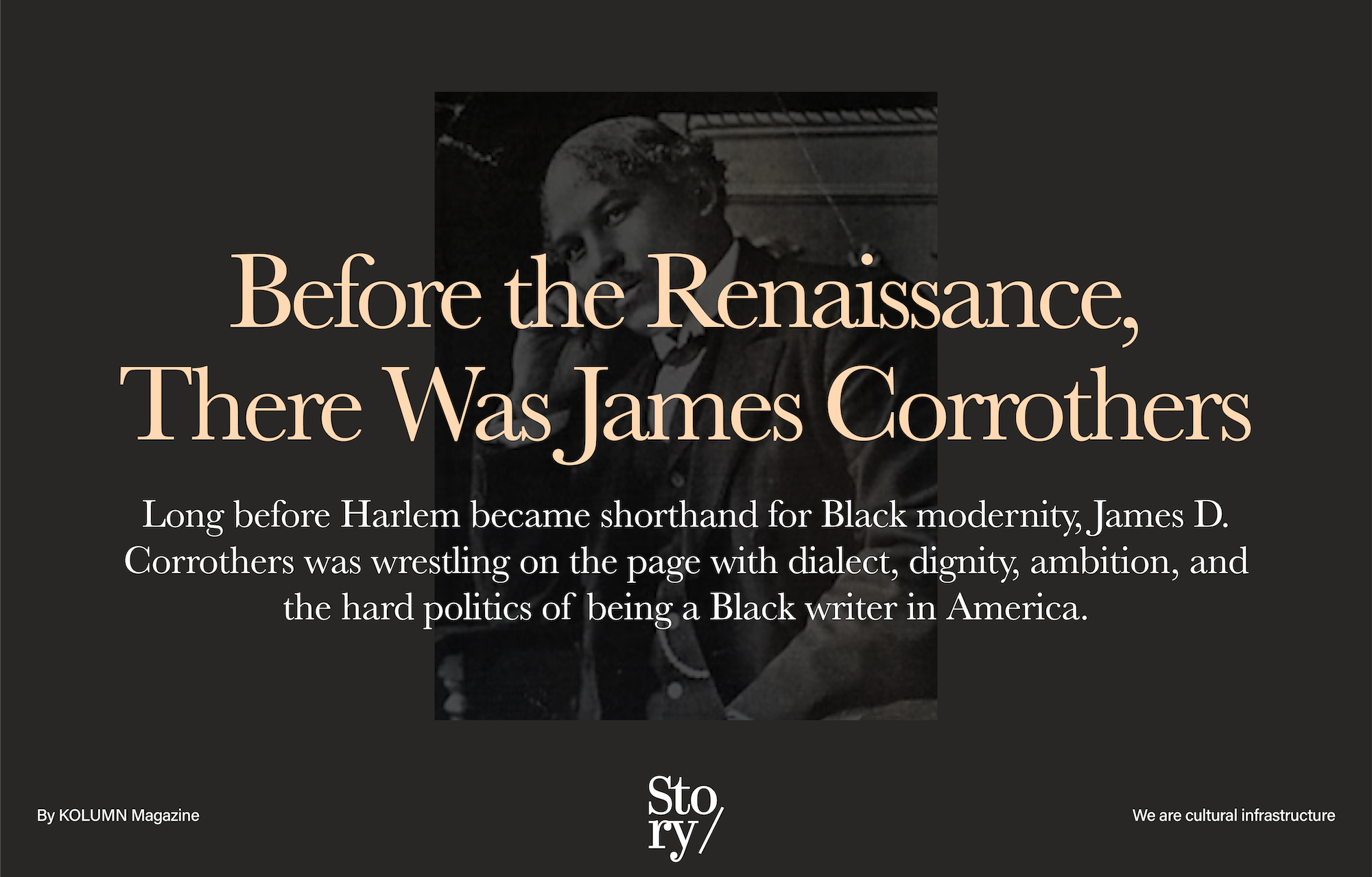
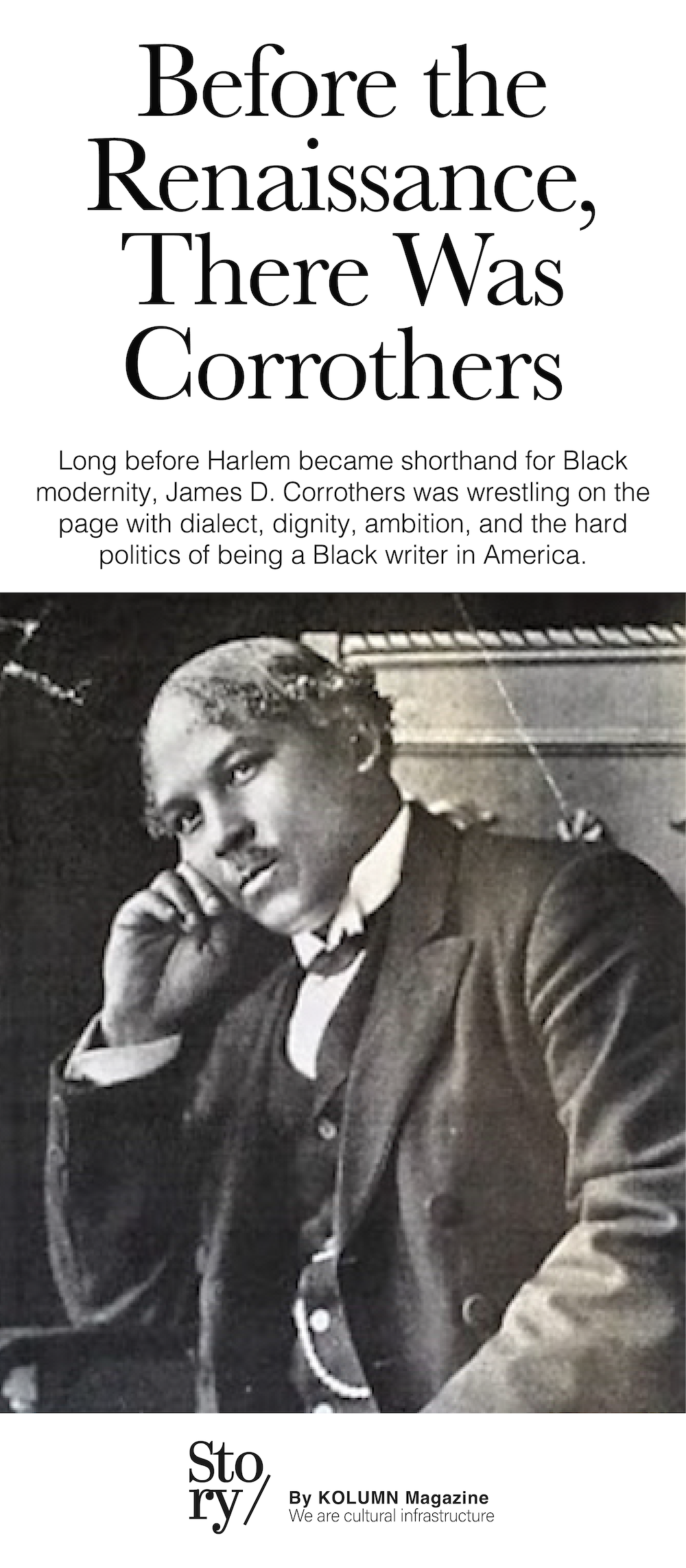
James David Corrothers does not occupy the same easy shelf-space in American memory as Paul Laurence Dunbar, Charles Chesnutt, James Weldon Johnson, or W. E. B. Du Bois. That is part of what makes him so revealing. He is one of those figures who, once you start reading him seriously, makes the conventional map of Black literary history feel incomplete. Born in 1869 in Cass County, Michigan, and dead by 1917 in West Chester, Pennsylvania, Corrothers lived in the hinge period between Reconstruction’s collapse and the cultural reconfiguration that would later be called the Harlem Renaissance. He wrote poetry, journalism, folklore, fiction, criticism, and autobiography. He preached. He argued. He revised himself in public. And throughout his life he kept returning to one question that still feels uncomfortably current: what does a Black writer owe the race, the craft, and the market when all three are pulling in different directions?
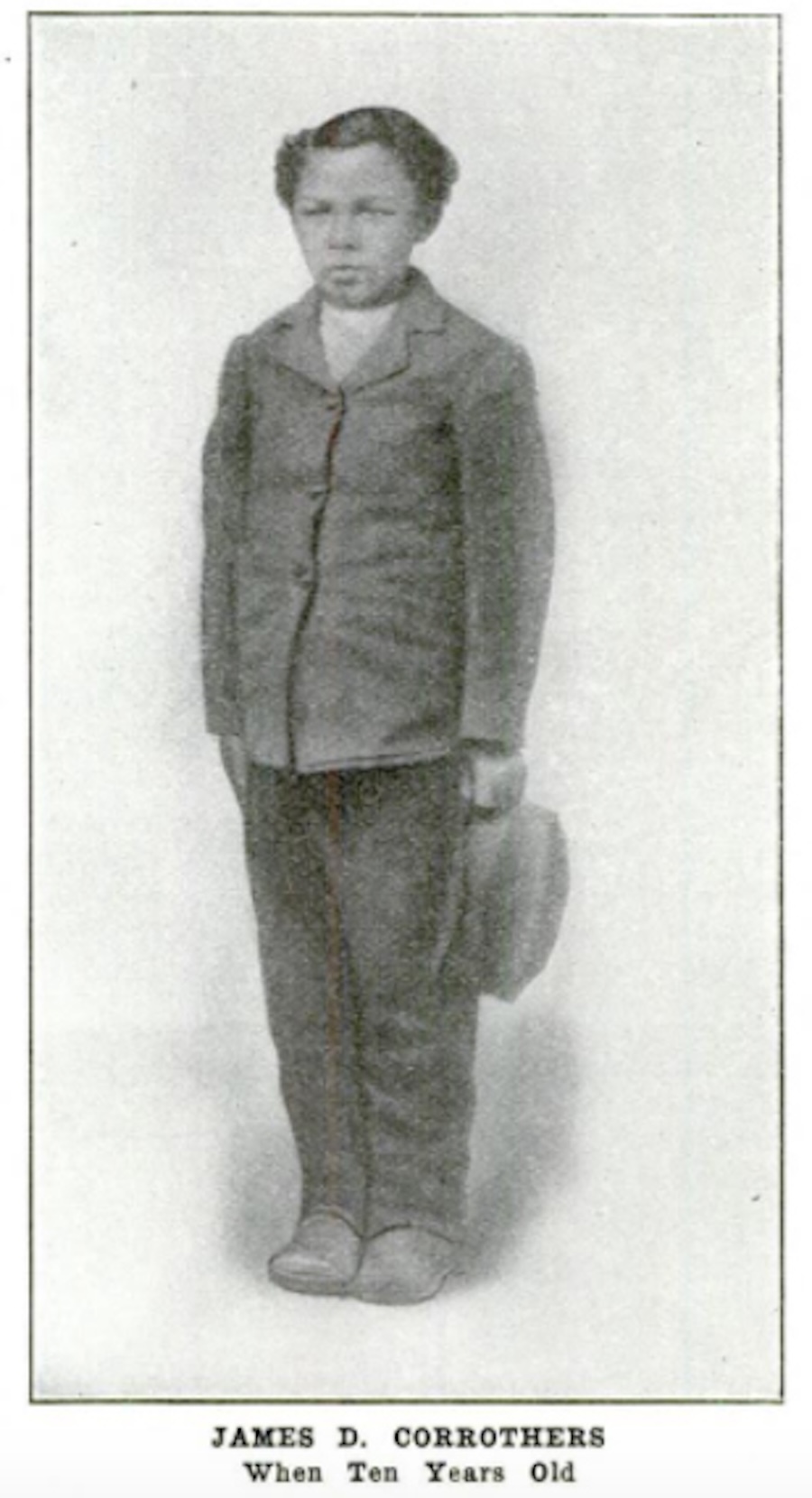
Corrothers matters not simply because he was talented, though he plainly was. He matters because his career captures the pressure placed on Black authors at the turn of the 20th century to perform authenticity, to soothe white curiosity, to uplift Black readers, and to win entry into a literary establishment that often wanted Black writing only on narrow terms. His work traces the evolution of a writer who first found attention through dialect verse and then grew dissatisfied with what that attention required. He became, in effect, one of the earliest major Black American writers to stage an extended public argument with his own reputation. That argument runs through his best-known works, from The Snapping of the Bow and The Black Cat Club to the poem “At the Closed Gate of Justice” and the autobiography In Spite of the Handicap.
What makes Corrothers especially compelling is that he was never easy to summarize. He admired Paul Laurence Dunbar yet moved away from the literary lane Dunbar helped popularize. He wrote in dialect yet later questioned its sufficiency. He understood uplift politics yet distrusted easy formulas. He served churches, but he was not merely clerical. He wanted literary achievement in the broadest American sense, but he also refused to forget the racial humiliations that shaped Black life in both North and South. In that sense, Corrothers belongs to a lineage of Black intellectuals who were already working out, decades before midcentury criticism gave the matter academic names, the terms of representation, audience, authenticity, and racial burden.
That opening from “At the Closed Gate of Justice” is the line most often attached to Corrothers now, and for good reason. It is compressed, bitter, morally demanding, and formally controlled. It sounds like a poet who understands that American racism does not merely wound; it imposes an almost theological burden on its victims, requiring from them not just endurance but magnanimity. The line is also a useful key to Corrothers’s larger project. He was a writer drawn to doubleness: beauty and anger, aspiration and exclusion, cultural pride and strategic self-correction. If some writers are important because they represent an era cleanly, Corrothers is important because he exposes its contradictions.
A boyhood in Black Michigan
Corrothers’s life began in a part of the Midwest that complicates the usual North-South shorthand of American racial history. He was born in Cass County, Michigan, an area linked to a free Black settlement and to antislavery networks before the Civil War. BlackPast notes that he grew up in and around communities shaped by abolitionist activity, while his own autobiography describes the Chain Lake Settlement and the broader social world of southwestern Michigan in concrete detail. That geography mattered. Corrothers did not emerge from the plantation South, nor from an elite eastern Black enclave, but from a Midwestern Black environment that sat close to white communities and close to the unstable promises of northern freedom.
His early life was marked by instability. His mother died shortly after his birth, and he spent important years with relatives, especially his grandfather. In In Spite of the Handicap, he recounts a childhood shaped by poverty, manual labor, and repeated confrontations with race prejudice. One of the most arresting passages in the Google Books record of his autobiography recalls being “the only coloured boy in the village” and having to fight white boys in order to attend school in peace. Even allowing for the self-fashioning that autobiography inevitably involves, the anecdote captures something central about Corrothers’s sensibility: he came of age not in abstraction but in daily contest, where education, dignity, and safety had to be defended at close range.
That Midwestern upbringing also gave him an unusually sharp comparative view of American race relations. Later in his autobiography, Corrothers wrote that in the North a Black person might encounter the color line unpredictably, whereas in the South racial boundaries were declared immediately and unmistakably. It is a striking observation because it resists northern self-congratulation. Corrothers understood that northern racism often hid behind formality, distance, or selective access rather than explicit codification. That perception would become one of his enduring intellectual strengths: he could see race prejudice as structure, not merely insult.
He worked young, doing hard labor around South Haven and later Muskegon, including in the lumber economy that shaped parts of western Michigan. A state historic study drawing on his autobiography notes his movement through those towns and the social conditions he described there. Corrothers’s education, then, was never confined to classrooms. It came from boats, barber shops, odd jobs, segregated expectations, church life, and the close study of people who thought themselves his social superiors. That kind of apprenticeship tends to produce either bitterness or acute observation. In Corrothers it produced both, and then turned both into prose and verse.
Chicago, journalism, and literary entry
Like so many ambitious Black writers of the period, Corrothers was pulled toward Chicago. The city offered industry, newspapers, Black institutions, and the possibility of reinvention. It also offered the familiar American arrangement in which opportunity arrived entangled with condescension. Several reference sources, including Oxford Reference and the Oxford companion material surfaced in search, recount the pivotal episode in which Corrothers met journalist-reformer Henry Demarest Lloyd while working in a white barber shop. Lloyd helped place some of Corrothers’s poems in the Chicago Tribune and secured him work connected to the paper. The episode opened a door, but it also revealed how easily Black talent could be mediated, patronized, and distorted. One account notes that Corrothers was dismayed when a story he worked on about Chicago’s Black elite appeared rewritten through stereotype and that he was not properly paid for the labor.
That tension—entry into the mainstream on terms someone else controls—would stay with him. Corrothers attended Northwestern University and also studied at Bennett College, though he did not settle into a conventional academic path. He moved in and out of journalism, literary work, and ministry, making a career the way many Black intellectuals of his era had to make one: improvisationally. BlackPast and the Academy of American Poets both sketch this period, noting his education, his newspaper work, and his emergence as a published poet whose writing appeared in major venues.
What is important here is not only that Corrothers published, but where. By 1917, The Journal of Negro History could describe him as a writer whose work had appeared in Century Magazine, Harper’s, The Dial, The Crisis, The Southern Workman, The Boston Transcript, and the Chicago Tribune. That list is not ornamental. It shows that Corrothers occupied both Black and mainstream literary-public spheres. He was neither a purely local writer nor an exclusively race-press figure. He was navigating multiple publics at once, and that helps explain both his ambition and his anxieties about style.
The dialect question
Any serious account of Corrothers has to face the dialect issue head-on. He gained early notice in part through writing that drew on Black vernacular speech, especially in work associated with Dunbar’s influence and in books such as The Black Cat Club: Negro Humor and Folklore. But unlike some writers who remained comfortable in that register, Corrothers came to regard dialect as both resource and trap. Scholars of African American literature have emphasized this tension for decades. Kevin Gaines’s influential essay describes Corrothers’s literary project as bound up with racial uplift and the politics of representation, while the Cambridge History of African American Literature places him among writers whose dialect poetry engaged Black vernacular but was also constrained by the terms under which that vernacular could circulate in print culture.
That is not just a matter of taste. Dialect writing in late 19th- and early 20th-century America was inseparable from minstrelsy, sentimentalism, white expectations of Black expressiveness, and market demand for supposedly “authentic” racial types. Corrothers knew that. And he knew, too, that dialect could carry wit, musicality, social knowledge, and community texture that standard literary English might flatten. This is what makes his career so instructive: he did not resolve the question cleanly because the question itself was not clean. He wrote in dialect. He benefited from it. He later criticized its limits. He was, in other words, arguing against a cage he had partly inhabited.
In In Spite of the Handicap, Corrothers explicitly indicates his shift toward “standard English,” and search summaries tied to the autobiography note his view that standard English poetry better suited the 20th century. Read generously, that shift can look like aesthetic development. Read critically, it can also look like a strategy of refusal: a rejection of the expectation that Black writers were most valuable when sounding most available to white amusement or nostalgia. Both readings have merit. Corrothers was not abandoning Black speech so much as resisting its reduction to literary costume.
Corrothers’s career is not the story of a writer “outgrowing” Black vernacular. It is the story of a writer refusing to let Black language be turned into a cage.
That refusal is one reason he feels modern. He understood, before the full flowering of New Negro criticism, that Black artists were constantly being sorted into usable categories. Too folkloric, and you risk caricature. Too polished, and you risk being charged with imitation or class betrayal. Too militant, and you risk exclusion from the very publications that confer prestige. Too universal, and you are accused of evading the race. Corrothers spent a career moving among those accusations.
Paul Laurence Dunbar, friendship, and literary inheritance
Corrothers’s relationship to Paul Laurence Dunbar is central to understanding his development. The two men were contemporaries and friends, and Corrothers later wrote a celebrated memorial poem, “Paul Laurence Dunbar,” which appeared in Century Magazine and was later included in James Weldon Johnson’s The Book of American Negro Poetry. Search results and anthology records confirm both the poem’s publication and its later canonizing function. In his autobiography, Corrothers even claimed credit for helping bring Dunbar’s work to the attention of William Dean Howells, the influential critic whose praise was crucial to Dunbar’s national reputation.
Whether one treats that claim as fully decisive or as a bit of autobiographical self-positioning, it reveals how Corrothers understood himself: not merely as a fellow traveler, but as a participant in the making of Black literary history. He was not standing outside the scene looking in. He believed he had shaped the scene. That matters because Corrothers has often been remembered as marginal, when in fact he was entangled with the key literary networks of his day.
His poem on Dunbar is reverent, but it is also diagnostic. In praising Dunbar, Corrothers was measuring the scale of Black poetic achievement in the United States and asking what came next. Searchable excerpts from Google Books preserve lines about Dunbar as the singer who “constrained the masters, listening, to admire,” a formulation that says a great deal about Corrothers’s understanding of literary success. To make “the masters” listen was itself an achievement; to be heard across the color line was no small thing. But the phrase also carries the burden of that achievement. Why, after all, should admiration have to be constrained? Why must Black genius arrive before white arbiters like a petition?
The Corrothers-Dunbar relationship also helps explain Corrothers’s ambivalence about dialect. Dunbar’s brilliance in dialect poetry was undeniable, but his reception showed the danger of being loved for the part of one’s art that most reassured the racial imagination of the mainstream. Corrothers admired Dunbar deeply while also recognizing the costs of that literary economy. That recognition would inform his own later movement toward more overtly political and meditative verse.
The minister and the man of letters
It can be tempting to separate Corrothers’s ministry from his writing, as if one were day job and the other vocation. That would be a mistake. Black ministry at the turn of the century was often one of the few institutional sites where literacy, leadership, public rhetoric, and moral argument could converge. Corrothers served in African Methodist Episcopal, Baptist, and Presbyterian contexts over the course of his life, and The Crisis noted in 1915 that he had become pastor of the Second Presbyterian Church in West Chester, Pennsylvania.
That movement among denominations suggests both flexibility and instability. Corrothers did not enjoy the kind of settled professional infrastructure available to many white literary men of the era. Ministry offered standing, but it also brought responsibility and constraint. His writing, especially the later work, often carries the cadence of ethical witness rather than mere ornament. Even when he is not explicitly theological, he writes like a man who understands sin in institutional terms and injustice as a problem that cannot be solved by etiquette.
This is especially visible in the moral architecture of “At the Closed Gate of Justice.” The poem is not simply angry. It is chastened, judicial, almost liturgical. Its indictment of American racial order is sharpened by a spiritual discipline that refuses melodrama while never surrendering urgency. That tonal control may owe something to the pulpit. Corrothers knew how to make moral seriousness audible.
“At the Closed Gate of Justice” and the politics of the lyric
If one text secures Corrothers’s place in American letters, it is “At the Closed Gate of Justice,” first published in 1913. The poem appears in later anthologies of African American verse and remains the piece most consistently cited in accounts of his legacy. That persistence is deserved. The poem condenses a national argument into lyric form. It imagines justice as visible, dazzling, proximate—“all gold and amethyst”—and still inaccessible to the speaker because he is “merely a Negro.” The brilliance of the poem lies in how it stages exclusion not as crude distance but as proximity denied. The gate shines. The promise exists. The nation keeps advertising it. Access is what is refused.
Scholarly and historical sources alike treat the poem as a response to intensifying racial hostility in the United States during the post-Reconstruction period. BlackPast specifically highlights it as a work that profiled growing racial intolerance, while recent Cambridge scholarship uses it to illustrate formal and political developments in African American poetry before the Harlem Renaissance. The point is not merely that the poem protested racism. Many texts did that. The point is that Corrothers found a form equal to the contradiction of American liberalism: a republic obsessed with justice and shut against Black people in its actual distribution of dignity.
The poem also demonstrates Corrothers at his most distilled. Gone is the risk of dialect being misheard as theatricality. What remains is a disciplined lyric intelligence, sharpened by injury and historical awareness. It is perhaps the clearest rebuttal to any attempt to confine him to a minor niche. Corrothers was capable of humor, folklore, character sketch, and memoir. But he could also produce a poem that stands comfortably beside the foundational protest verse of the era.
The poem’s real target is not only injustice. It is the hypocrisy of a nation that keeps the gate polished while deciding who will never pass through it.
The Black Cat Club and the problem of folklore
Corrothers’s The Black Cat Club: Negro Humor and Folklore is harder to place neatly in modern literary discourse, and that difficulty is part of its value. The book, originally published in 1902, collects humor and folklore material in a form that sits somewhere between ethnographic performance, comic sketch, and literary experiment. Google Books records confirm the book’s original publication by Funk & Wagnalls and its framing as Black humor and folklore. More recent scholarship on the Black Midwest identifies The Black Cat Club as part of Corrothers’s experimentation with hybrid literary style.
For modern readers, the discomfort is obvious. Anything involving Black vernacular humor in that era risks contamination by minstrelsy and by the white publishing industry’s appetite for Black types. But the book also preserves something important: the social texture of talk, club life, anecdote, and communal narration. Corrothers was not simply packaging Black life for white consumption. He was also trying to register Black expressive culture as culture—as wit, memory, social intelligence, and style. The problem is that the line between preservation and performance was, in his era, perilously thin.
This is where Corrothers is most useful to contemporary criticism. He forces us to abandon the easy binary in which a work is either compromised by racist convention or triumphantly free of it. Often Black writers were working inside hostile conventions while trying to bend them toward self-definition. Corrothers did that repeatedly. He was neither pure folk chronicler nor simple accommodationist. He was a working writer attempting to wrest value from forms that arrived already loaded with danger.
The autobiography as witness
Published in 1916, In Spite of the Handicap is one of Corrothers’s most revealing works and arguably the key to reading the rest. The book is introduced by Ray Stannard Baker, a prominent white journalist, which in itself tells us something about the cross-racial literary circuits through which Corrothers had to move. HathiTrust and Google Books records confirm the book’s publication details, and contemporary notice in The Journal of Negro History described it as an important study of northern race prejudice.
The title is telling. “Handicap” carries the era’s language of burden and obstruction, but also a refusal of final defeat. The autobiography does not read like a triumphal ascent. Instead, it records how race prejudice narrows possibility in mundane and cumulative ways. Corrothers writes about labor, schooling, mobility, literary frustration, church politics, and humiliations both casual and structural. That is one reason the book still matters: it offers a northern Black life narrative that does not rely on the old national script in which the North automatically equals liberation.
In some ways the autobiography anticipates later Black nonfiction by insisting that the texture of racism lies in repetition, in interruption, in doors half-opened and then closed. Corrothers’s observations about northern versus southern race relations remain especially incisive because they refuse sentimental geography. He understood what many Americans still prefer not to see: that northern racial liberalism often masked exclusion under the language of civility and law.
There is also a quiet self-consciousness in the book. Corrothers is telling the story of a writer making himself, but he is also telling the story of how America misreads Black aspiration. That duality gives the autobiography unusual interpretive richness. It is not merely personal document. It is literary argument by way of lived experience.
Why he never became a household name
There is no single reason Corrothers is less widely known now than some of his peers. Part of it is chronology: he died in 1917, just before the Harlem Renaissance created a more legible national frame for Black literary modernity. Part of it is genre: he did not leave behind one universally assigned masterwork on the order of The Souls of Black Folk or Cane. Part of it is the instability of his oeuvre itself, which resists easy packaging. And part of it is the discomfort his career produces for literary history, since he occupies the awkward zone between dialect-era popularity and later New Negro self-assertion. Those points are partly inferential, but they align with the record of his publication history, anthology presence, and subsequent scholarly recovery.
Still, “forgotten” would be too simple. James Weldon Johnson included seven of his poems in The Book of American Negro Poetry in 1922, which means Corrothers was not discarded by the next generation of Black literary institution-builders. He was carried forward, but not at the center. That is often how literary memory works: not erasure exactly, but partial preservation. Enough to keep the name alive for specialists, not enough to sustain broad public recognition.
E. B. Du Bois’s response to Corrothers’s death is worth recalling here. The Crisis referred to his death as that of “the poet,” and later summary sources preserve Du Bois’s judgment that it was “a serious loss to the race and to literature.” That is not courtesy language. It is an estimate from one of the era’s most exacting literary-political minds. Du Bois understood that Corrothers represented a serious Black literary intelligence, one that had not yet yielded all it might have.
Corrothers and the long prehistory of the Harlem Renaissance
One of the strongest arguments for Corrothers’s significance is that he belongs in the prehistory of the Harlem Renaissance not as a mere precursor, but as one of the thinkers who made its concerns imaginable. Questions later associated with Alain Locke’s New Negro era—representation, audience, racial dignity, formal innovation, the uses and risks of folk culture—were already live in Corrothers’s work. He did not solve them. But he lived inside them with unusual clarity.
His career also broadens the geography of Black literary modernity. Too often the story runs from the postbellum South to Washington, New York, and Harlem, with the Midwest serving merely as backdrop. Corrothers helps restore the Black Midwest as an intellectual region. Recent scholarship on race and region in the Dunbar decades places him among Black Midwestern writers experimenting with literary hybridity and regional identity. That matters because it shows Black literary formation happening across a wider map than standard cultural memory allows.
Corrothers also belongs in the history of Black literary self-critique. He was not satisfied merely to produce respectable work; he worried at the terms under which Black work became legible. That recursive, self-interrogating quality is part of what makes him attractive to modern readers. He reads like someone already aware that every Black success in American letters risks being turned into a lesson, a symbol, or a limitation.
What James Corrothers still says to us
There is a reason Corrothers can feel unexpectedly contemporary. He understood performance politics long before that phrase existed. He understood respectability’s uses and its insufficiency. He understood the pressure to be legible to hostile audiences. He understood the temptation to believe that technical excellence alone could dissolve racial contempt, and he understood the evidence against that belief. He also understood something artists still confront: once the market finds a version of you it can sell, changing course becomes an act of risk.
That makes his body of work more than an archival curiosity. It makes it diagnostic. Corrothers helps explain how Black American writers before the Renaissance navigated a culture that wanted their expressiveness while restricting their authority. He helps explain how literary form becomes political even when the poem is not sloganistic. And he reminds us that canon formation often overlooks the writers who most clearly expose a period’s internal contradictions.
He is also, simply, worth reading for pleasure and force. The memorial poem to Dunbar has sweep. “At the Closed Gate of Justice” retains sting. The autobiography offers vivid observation and unsparing social insight. Even the more difficult works, like The Black Cat Club, are valuable because they show an artist trying to negotiate compromised terrain without surrendering intellect. That is not minor work. It is human work, and historical work, and sometimes first-rate literary work.
Near the end of his life, Corrothers had achieved real recognition but not security of fame. He had written across genres, preached across denominations, and entered major magazines without ever fully escaping the racial structure of American letters. That unfinishedness may be part of why he remains so compelling. He stands not as a monument already polished by consensus, but as a challenge to literary memory. Read him closely and the usual story of Black American literature before the 1920s begins to widen. It has to.
And perhaps that is the strongest case for James Corrothers now. He reminds us that Black literary history was never a neat procession from protest to renaissance to canon. It was messier, riskier, and more argumentative than that. Corrothers lived in the mess. He made art from the argument. And even now, more than a century later, you can still hear in his best work the sound of a writer refusing the place America had prepared for him.
More great stories

Eldzier Cortor Knew Beauty Was Political
April 9, 2026
No Comments
Bobby E. Wright Saw the System Clearly
April 9, 2026
No Comments