




There has to be a method of opening the doors.” — Floyd McKissick, reflecting on direct action and confrontation.
There has to be a method of opening the doors.” — Floyd McKissick, reflecting on direct action and confrontation.
By KOLUMN Magazine
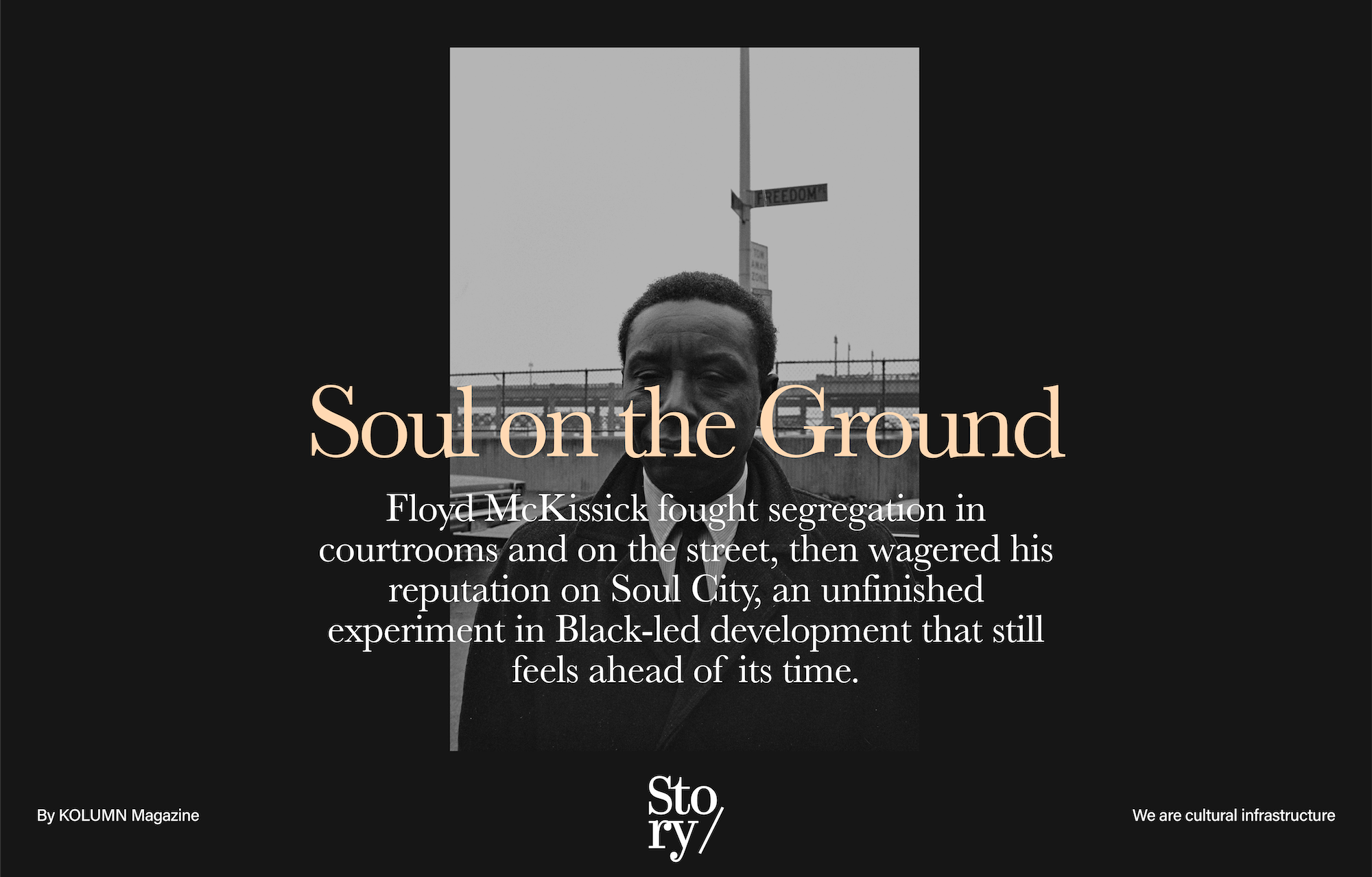
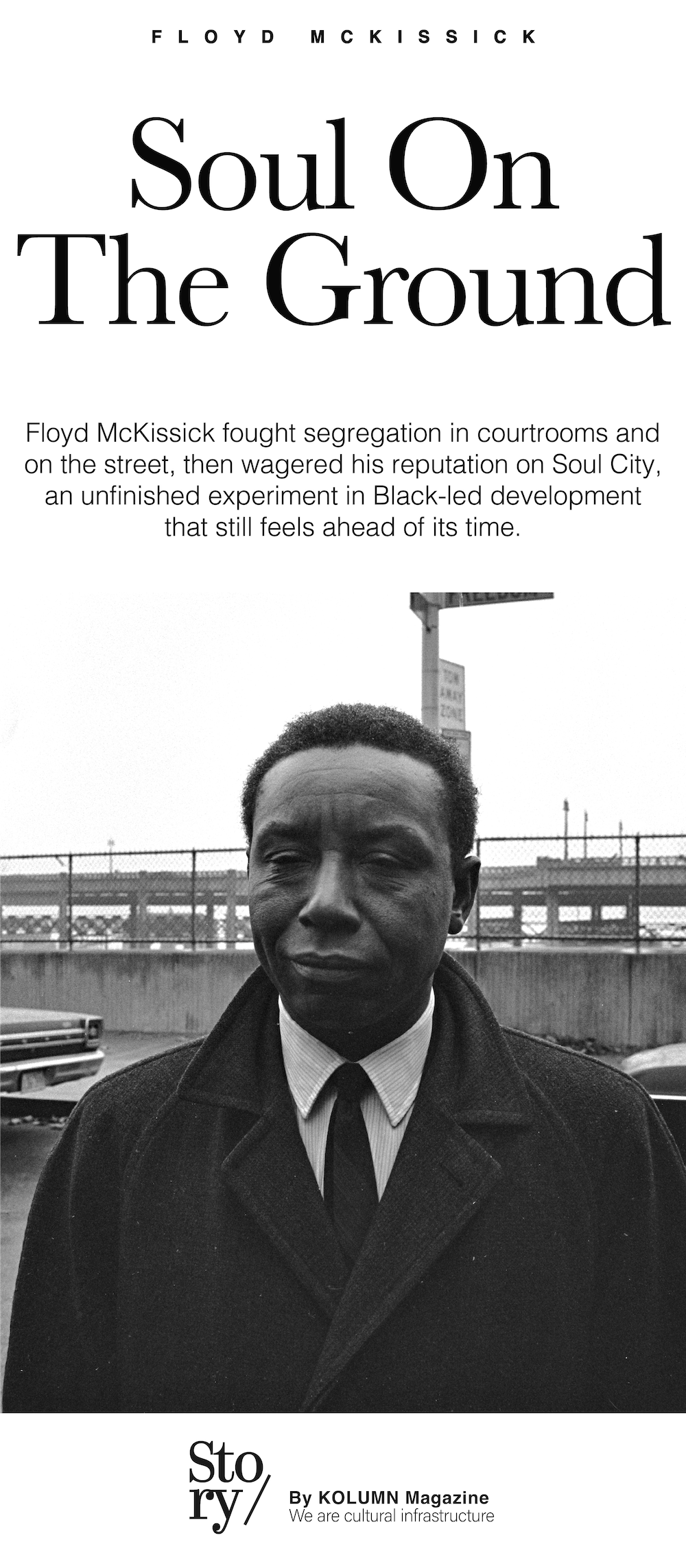
Floyd McKissick was a courtroom strategist, street-level activist and desegregation lawyer who later embraced Black Power. He was a national civil rights leader who wound up best known, in some circles, for a city that never fully materialized. He was both a movement insider and, at key moments, a dissenter from its prevailing script. That complexity is precisely what makes him so significant. McKissick’s life is not just the story of a man. It is a map of the civil rights movement’s evolution from legal integration to direct action, from protest to power, from moral appeal to the harder economics of land, labor and capital.
Born in Asheville, North Carolina, on March 9, 1922, Floyd Bixler McKissick came of age in a segregated South that taught Black children, early and often, where the lines were. In an oral history recorded late in his life, he described a family shaped by church life, discipline and the social structure of Black community life under segregation. He also linked his activism to a formative early encounter with police violence in Asheville, and to a lifetime conviction that unjust laws were meant to be challenged in public. That point matters. McKissick did not drift into activism. He understood confrontation, from a young age, as part of citizenship.
He spent time at Morehouse College before serving in World War II, then returned to continue his education in the postwar years. Like many Black veterans, McKissick came home unwilling to accept the old racial order as natural or permanent. In his 1989 oral history, he recalled that Black veterans had seen too much of the world to return quietly to Southern apartheid. That generational shift is one of the keys to understanding McKissick. He belonged to a cohort shaped by war, migration, education and sharpened political expectations. They were less willing to wait for white moderation to ripen into justice.
A lawyer made by Jim Crow
McKissick’s early public significance rests partly on a simple but historic fact: he was among the first African American students admitted to the University of North Carolina at Chapel Hill after a court order forced the law school to integrate in 1951. UNC notes that McKissick enrolled that year alongside Harvey Beech, James Lassiter, J. Kenneth Lee and James Robert Walker, becoming part of the first group of Black students at Carolina. The King Institute’s biography adds the essential context: McKissick had first been denied admission to the all-white law school, enrolled at North Carolina Central College’s law school, and then—supported by the NAACP and Thurgood Marshall—won a court ruling that opened UNC’s doors. By the time the decision arrived, he had already earned his law degree from North Carolina Central, but he attended UNC that summer anyway, understanding that the legal victory mattered beyond his own résumé.
That episode tends to be summarized as a first, a milestone, a barrier broken. But McKissick himself described it in less celebratory terms. In his oral history, he remembered the campus as an unfriendly place and the process as slow, tactical and dependent on litigation. He also made a broader point that remains striking: North Carolina liked to present itself as more progressive than the rest of the South, but much of its racial change came only when it was forced. That insight became central to his political worldview. He never confused polite rhetoric with structural transformation.
After establishing his law practice in Durham in the mid-1950s, McKissick became one of the city’s most consequential civil rights attorneys. Durham County Library’s civil rights materials credit him with representing the first Black undergraduates admitted to UNC in 1955, defending the protesters arrested in the 1957 Royal Ice Cream sit-in, and helping represent the families who pushed Durham’s school system toward desegregation. The lead plaintiffs in one of those school desegregation battles included his own wife, Evelyn, and his daughter Joycelyn. In other words, McKissick’s politics were not abstract. His family lived inside the cases. His household was part law office, part movement infrastructure, part proving ground.
The Royal Ice Cream sit-in, in particular, helps place McKissick within a chronology that often begins too late. The Greensboro sit-ins of 1960 dominate public memory, but Durham’s 1957 protest at the Royal Ice Cream Parlor was an important precursor. Durham County sources note that McKissick defended those protesters after they challenged the segregated seating arrangement. He would go on to advise and participate in Durham’s broader sit-in movement, helping make the city one of the South’s more active centers of youth-led direct action. This is part of McKissick’s enduring importance: he helped bridge phases of the movement that are too often separated in public storytelling—litigation, sit-ins, school desegregation, labor fights and later Black Power politics.
Durham, movement city
Durham in the 1950s and 1960s was not simply a backdrop for McKissick; it was a laboratory. The city’s Black professional class, civic traditions and movement institutions gave organizers room to maneuver, but the city also remained deeply segregated. McKissick worked within that contradiction. He handled civil rights cases. He advised student activists. He remained connected to both the NAACP and CORE. According to the King Institute, he served as youth chairman for the North Carolina branch of the NAACP after the war and later became an important CORE figure as well. Durham County Library’s exhibit describes him as a leader whose politics gradually moved toward a more Black-centered analysis while he still operated across organizations with different tactical instincts. That flexibility—some would call it ideological breadth, others strategic restlessness—became one of his trademarks.
He also had a labor politics that deserves more attention than it usually gets. The King Institute notes that McKissick won a well-publicized challenge involving the Tobacco Workers International union, helping Black workers move into the skilled scale without losing seniority. That mattered in Durham, where tobacco and labor were inseparable from Black economic life. McKissick understood that integration without economic mobility would leave the old hierarchy mostly intact. That understanding did not arrive late in his life with Soul City. It was already visible in his legal work.
In retrospect, it is easy to frame McKissick’s later turn toward Black economic development as a dramatic departure from classical civil rights liberalism. But the record suggests something more continuous. From school cases to union cases to sit-in defense, he was already asking a version of the same question: after a barrier falls, who actually gains power? Who gets the job, the contract, the mortgage, the school seat, the promotion, the safety? McKissick was never especially interested in the decorative language of progress. He wanted institutional leverage.
For McKissick, the right to enter a space was never enough. The deeper question was who owned it, ran it, financed it and passed it on.
Marching into a new era at CORE
McKissick’s national profile rose sharply through CORE. He became chairman of CORE’s national board in 1963, and in 1966 he succeeded James Farmer as national director. Those years were among the most ideologically volatile in the freedom struggle. Formal civil rights victories had been achieved through the Civil Rights Act and Voting Rights Act, but frustration was mounting over white backlash, persistent poverty, urban inequality and the limits of moral suasion. McKissick stepped into CORE at exactly that inflection point.
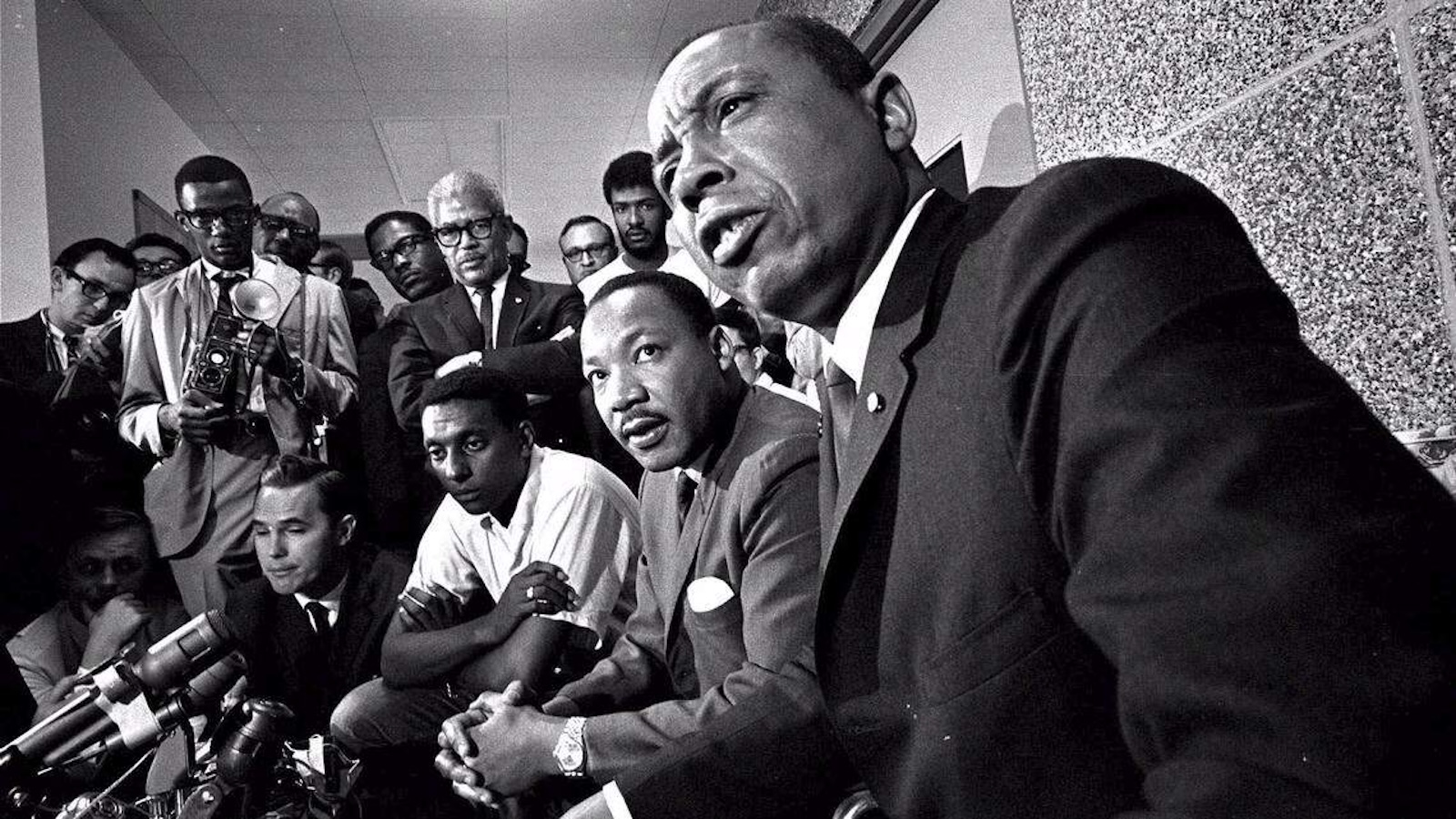
That same year, after James Meredith was shot during his March Against Fear in Mississippi, McKissick joined Martin Luther King Jr. and Stokely Carmichael in continuing the march. The King Institute notes that the three organizations—CORE, SCLC and SNCC—co-led the remainder of the campaign. It was during that march that Carmichael’s public use of “Black Power” accelerated one of the defining debates of the era. McKissick embraced the term, but with an emphasis that is often flattened in shorthand retellings. According to Stanford’s King Institute, he defined Black Power as building political and economic power in Black communities. That is a crucial distinction. For McKissick, Black Power was not just rhetorical militancy. It was a theory of institution-building.
The press, naturally, was drawn to the conflict narrative: King versus Carmichael, nonviolence versus militancy, integration versus separatism. McKissick was often placed inside that frame. Yet the record also shows he and King deliberately downplayed their differences and stressed mutual respect. The King Institute notes that the media focused on their disagreements, while the two leaders emphasized “brotherhood.” McKissick did depart from King on self-defense, arguing that “self-defense and nonviolence are not incompatible,” but he did not reject nonviolence as a tactic in demonstrations. He occupied a more complicated position than the era’s blunt labels usually allow.
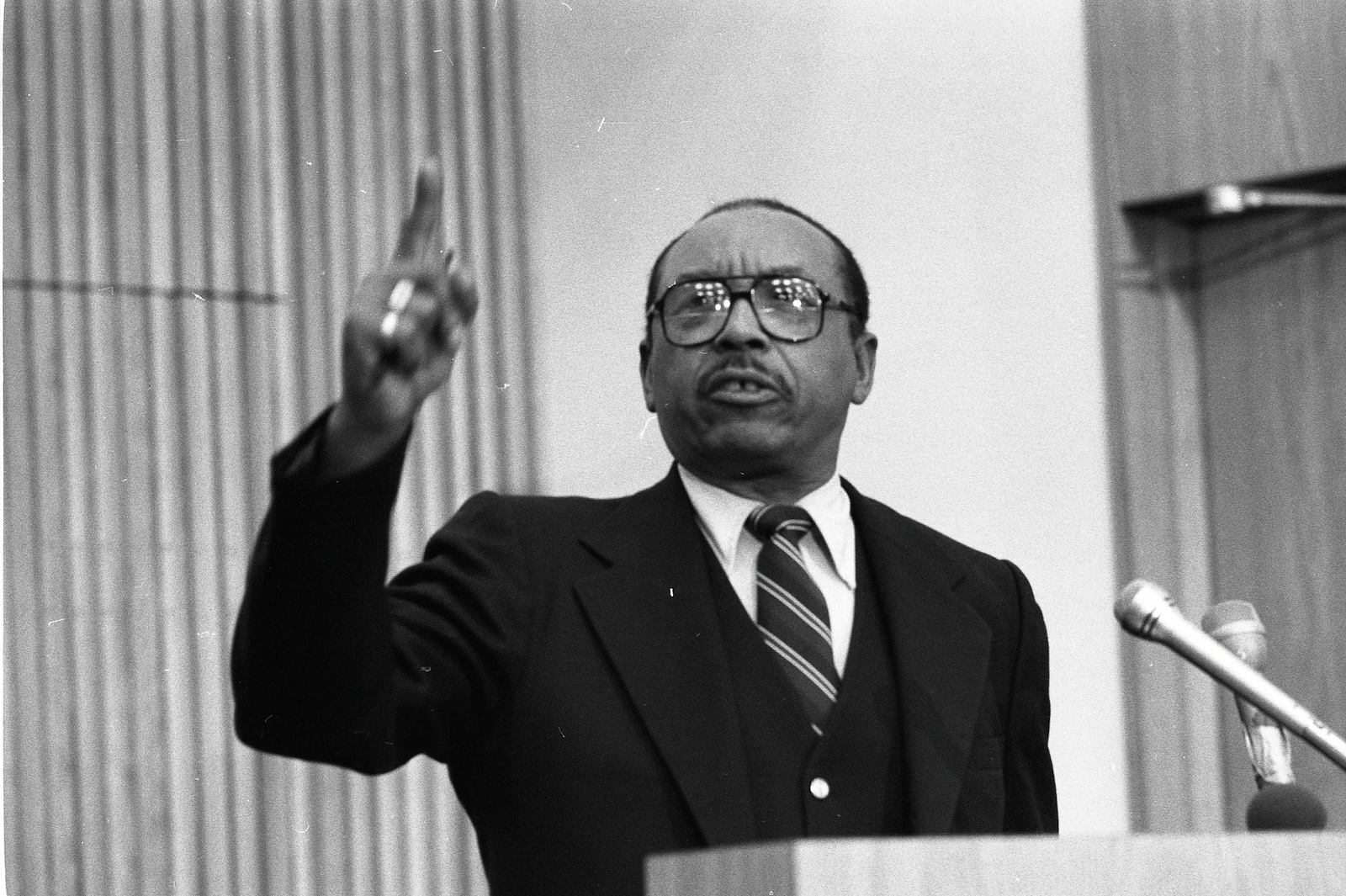
His role at the 1963 March on Washington offers a revealing snapshot of that in-between position. James Farmer, jailed in Louisiana, could not appear. McKissick read Farmer’s prepared remarks at the Lincoln Memorial. The JFK Library’s speech excerpts identify him as the CORE representative who delivered Farmer’s message, and GBH’s Open Vault explains that Farmer stayed in jail to dramatize the cause while McKissick took his place at the march. It is a small but telling image: McKissick standing at one of the movement’s most iconic ceremonies, not as its most famous voice, but as a trusted executor of movement will—disciplined, visible, indispensable.
The problem with symbolic victory
By the late 1960s, McKissick’s dissatisfaction with integrationist politics had sharpened. This was not because he had abandoned civil rights, but because he had come to believe that legal rights alone would not solve Black inequality. Thomas Healy’s work on Soul City, excerpted in The Atlantic and discussed in an AAIHS interview, distills McKissick’s critique with unusual clarity: what good was the right to sit at a lunch counter if you lacked the money to buy a hamburger? McKissick’s point was not anti-integration. It was anti-illusion. Formal access without economic capacity could become a new kind of false finish line.
This is where McKissick begins to sound remarkably contemporary. He was asking questions that later debates about wealth gaps, disinvestment and structural inequality would place front and center. He understood that desegregation could coexist with Black dispossession. He saw that a civil rights victory measured only by law could leave housing, credit, wages, business ownership and public investment largely untouched. In that sense, McKissick was not leaving the movement behind. He was trying to force it into its next chapter.
That chapter would have a name: Soul City.
Soul City, or freedom in concrete and pipe
Soul City was McKissick’s boldest act and, depending on your perspective, his most visionary or most quixotic one. Planned in Warren County, North Carolina, it was conceived as a new town that would offer poor and working-class people—especially African Americans—housing, jobs and the possibility of self-determination beyond the crowded inequality of Northern cities and the stagnation of the rural South. The project broke ground in 1973. North Carolina’s Department of Natural and Cultural Resources says Warren County was chosen in part because it was one of the poorest areas in the state, and describes Soul City as an attempt to provide affordable housing and an alternative to urban slums.
Soul City is often misremembered as an all-Black separatist project. That is not quite right. Healy’s Atlantic excerpt states plainly that Soul City was intended to be integrated, though explicitly designed to help Black people, particularly the poor and unemployed. The Guardian’s feature on the project similarly describes McKissick’s aim as a racially integrated community planned and managed by African Americans. NMAAHC’s essay on Black geographies places Soul City within a longer Black tradition of imagining and claiming space, describing McKissick’s portfolio as a vision for transforming a slave plantation into a community where poor and unemployed African Americans could experience prosperity.
That distinction matters because it goes to the center of McKissick’s political philosophy. He was not proposing exclusion as liberation. He was proposing Black-led development as a corrective to a landscape in which Black people were expected to integrate into systems designed, financed and governed by others. Soul City was supposed to reverse that relationship. It would demonstrate that Black leadership could plan a city, attract industry, build infrastructure and create new patterns of social life. In his 1973 oral history, McKissick called it “about the only thing that is really positive going” and described it, in effect, as the movement translated into land use, jobs and region-building.
Soul City was McKissick’s wager that civil rights could not remain only a politics of access. It had to become a politics of design.
The federal government, through HUD and the New Communities framework, backed the project with a major loan guarantee. The Atlantic excerpt notes that the Nixon administration awarded Soul City a $14 million loan guarantee in 1972 as part of a broader new communities program, and that Soul City was the only rural project and the only one led by a Black developer. Stanford’s King Institute likewise notes that federal funding arrived in July 1972. The state of North Carolina and private donors also contributed support. On the ground, the development produced real infrastructure: a water system, a health clinic and the industrial facility known as SoulTech I. However incomplete the town remained, it was not imaginary. Concrete was poured. Plans were engineered. Institutions were attempted.
Why Soul City became a target
But if Soul City was materially real, it was also politically vulnerable from the start. Its name alone invited projection. Healy writes that critics quickly branded it a Black nationalist experiment or a domestic Liberia, even though its core aim was economic equality rather than racial separation. McKissick’s own profile did not calm those fears. He was a former CORE leader associated with Black Power rhetoric, and in 1972 he further inflamed opinion by switching to the Republican Party and serving as a minority campaign chairman for Richard Nixon’s reelection. The King Institute records that shift, and contemporaries clearly understood it as provocative. For many former allies, it looked like betrayal, opportunism, or both.
That move remains one of the most contested elements of McKissick’s legacy. It is not hard to see why. Nixon was not simply another party option. He was, for many Black activists, the face of backlash politics, coded appeals to white resentment and a law-and-order agenda hostile to movement demands. Supporting him alienated many Black observers and made Soul City easier to attack. Yet McKissick’s politics were never rooted in party loyalty. He argued, according to later accounts, that Black Americans should not place all their hopes in one political party. Whatever one makes of that argument, it aligned with his lifelong skepticism toward dependency—legal, economic or partisan.
Soul City also faced the old American combination of racism, bad timing and political sabotage. North Carolina’s DNCR says a 1975 News & Observer exposé accusing McKissick of corruption was later found to be false, but the accusations triggered audits and damaged business confidence. The AAIHS interview with Thomas Healy argues that some influential white journalists misunderstood Soul City because they could not reconcile a predominantly Black development with integrationist ideals and were also put off by McKissick’s Nixon alliance. Healy further argues that the federal government’s commitment was inconsistent: approval took years, the released money was less than promised, and funds could be used only for infrastructure, not for the houses, stores and factories needed to create visible momentum. Once official support wavered, industry pulled back.
This is where the Soul City story becomes bigger than McKissick himself. The project exposed how difficult it was for Black-led development to secure the benefit of institutional patience. White-led failures are often granted time, reframing and second chances. Black-led ambition is more likely to be treated as suspect at the point of conception and scandalous at the point of delay. Soul City encountered scrutiny, mockery and political hostility out of proportion to its actual progress and failure rate within a risky federal new-town experiment. That is not to say it had no internal problems. It did. But the public handling of those problems tells its own story about who gets to be seen as visionary and who gets cast as delusional.
The collapse, and what survived it
By the end of the 1970s, Soul City had lost the momentum it needed. Stanford’s King Institute says it was declared economically unviable in 1979 and that the land was later taken over by the federal government. The North Carolina DNCR similarly states that HUD withdrew support in 1979. Yet even the language of “failure” is worth inspecting. Soul City failed as a full-scale new city. It did not fail as an idea that revealed the depth of the nation’s resistance to Black-controlled development. Nor did it fail as a historical lens. Today, its archival life is substantial: UNC’s finding aid highlights the richness of McKissick’s papers and the project’s lasting significance to Black economic and political history, while NMAAHC frames Soul City as part of the Black spatial imagination itself.
And in a deeper sense, Soul City anticipated debates that dominate the present. Discussions about Black wealth, cooperative economics, displacement, regional equity, rural development, environmental justice and the design of space all echo problems McKissick was trying to solve decades ago. He understood that where people live, how they move, who finances the built environment and who controls local institutions are all civil rights questions. Today that seems obvious. In the late 1960s and 1970s, it still struck many observers as strange or extreme. McKissick was ahead of the public vocabulary.
The contradictions are the point
Late in life, McKissick returned to law and public service. Stanford’s King Institute says he was appointed a judge in North Carolina’s Ninth Judicial District in 1990. He died of lung cancer in 1991 and was buried in Soul City. That burial feels almost too fitting, as if the last chapter insisted on closing inside the landscape that had come to define his most ambitious gamble.
To write about Floyd McKissick honestly is to resist the temptation to sand down his contradictions. He was admired and mistrusted. He could sound prophetic and abrasive, strategic and reckless, expansive and impatient. He was not always easy to place in a tidy moral tableau. But perhaps that is another way of saying he belonged to history rather than myth. McKissick inhabited the fractures of the Black freedom struggle as it moved from courtroom victories to urban uprisings, from interracial coalitions to Black-centered power, from protest politics to development politics. He did not merely witness those shifts. He embodied them.
For that reason, his legacy deserves wider recognition than it often receives. He helped desegregate institutions in North Carolina. He defended early sit-in protesters. He led CORE during one of the movement’s most contested transitions. He stood beside King and Carmichael in Mississippi at a moment when the language of freedom itself was changing. And then, when many leaders might have settled for symbolic stature, he tried to build an actual place that could hold Black aspiration in roads, pipes, clinics, businesses and homes. Even unfinished, that is a staggering ambition.
Floyd McKissick’s life asks a question that remains unresolved: what does freedom look like once the law changes but the economy does not?
Why he matters now
McKissick matters now because the country still lives inside the distance between civil rights law and civil rights reality. Schools may be formally open, while wealth remains segregated. Housing discrimination may be illegal, while neighborhoods remain unequal. Voting rights may be celebrated, while political representation and material security remain uneven. McKissick saw that gap clearly. He saw that inclusion without power could become a managed form of disappointment. He saw that a movement organized only around access might win entry and still lose control.
He also matters because he reminds us that Black political thought in the 20th century was never one thing. It was not only nonviolence, only integration, only nationalism, only electoral politics, or only capitalism. In McKissick, those debates collided. His career moved through all of them, sometimes gracefully, sometimes awkwardly. The result is not a perfect model. It is something more useful: a record of serious experimentation under pressure. His life suggests that freedom struggles are not diminished when they argue with themselves. Sometimes they mature that way.
And then there is Soul City, still hovering over his reputation like a question mark and a challenge. It is easy to reduce the project to failure because Americans are often more comfortable with Black suffering than with Black planning. We know how to narrate brutality, martyrdom and courageous protest. We are less practiced at narrating Black governance, Black design, Black administration and Black ambition at metropolitan scale. Soul City asks for a different kind of historical literacy. It asks us to take Black imagination seriously even when the balance sheet never matches the blueprint.
Floyd McKissick’s career can therefore be read not as a detour from the movement’s main road, but as an argument about where that road had to go next. He did not believe a lunch counter, a school desk or a ballot box was the final destination. Necessary, yes. Historic, absolutely. Sufficient, no. He wanted a world in which Black people had the power to shape institutions, neighborhoods and regional futures. He wanted freedom to become physical, not just legal. That is why his story still lands with force. It does not belong to the past as neatly as some would prefer. It keeps reaching into the present, asking whether this country has yet made room for the kind of democracy he was trying, however imperfectly, to build.
More great stories
Afro Sheen, Wall Street, and the Architecture of Black Possibility
July 6, 2026
No Comments
The Fire Inside the Fourth
July 5, 2026
No Comments