



Peck did not simply join movements. He moved through them as if American democracy were a promise that had to be physically tested.
Peck did not simply join movements. He moved through them as if American democracy were a promise that had to be physically tested.
By KOLUMN Magazine
James Peck’s face became evidence before it became memory.
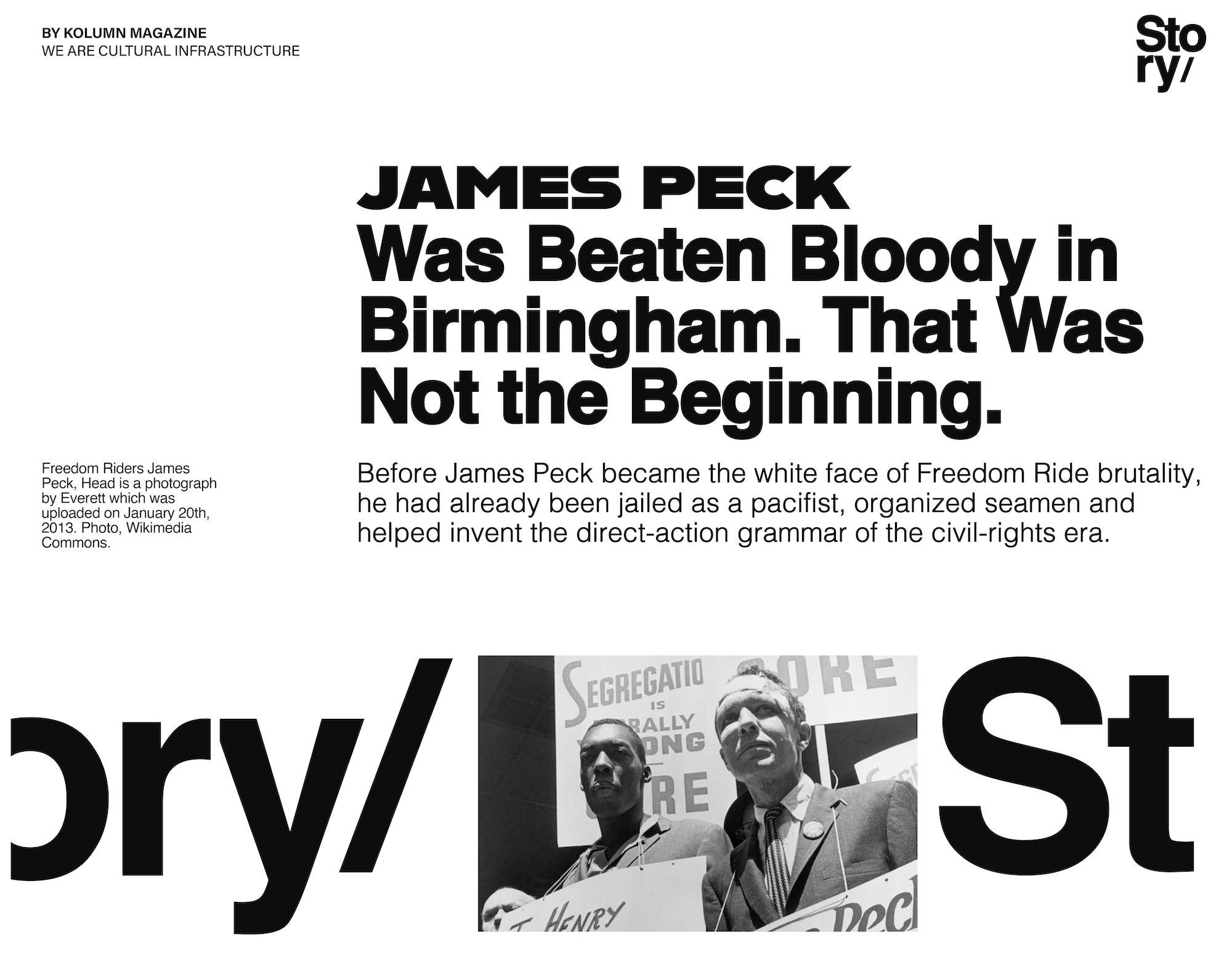
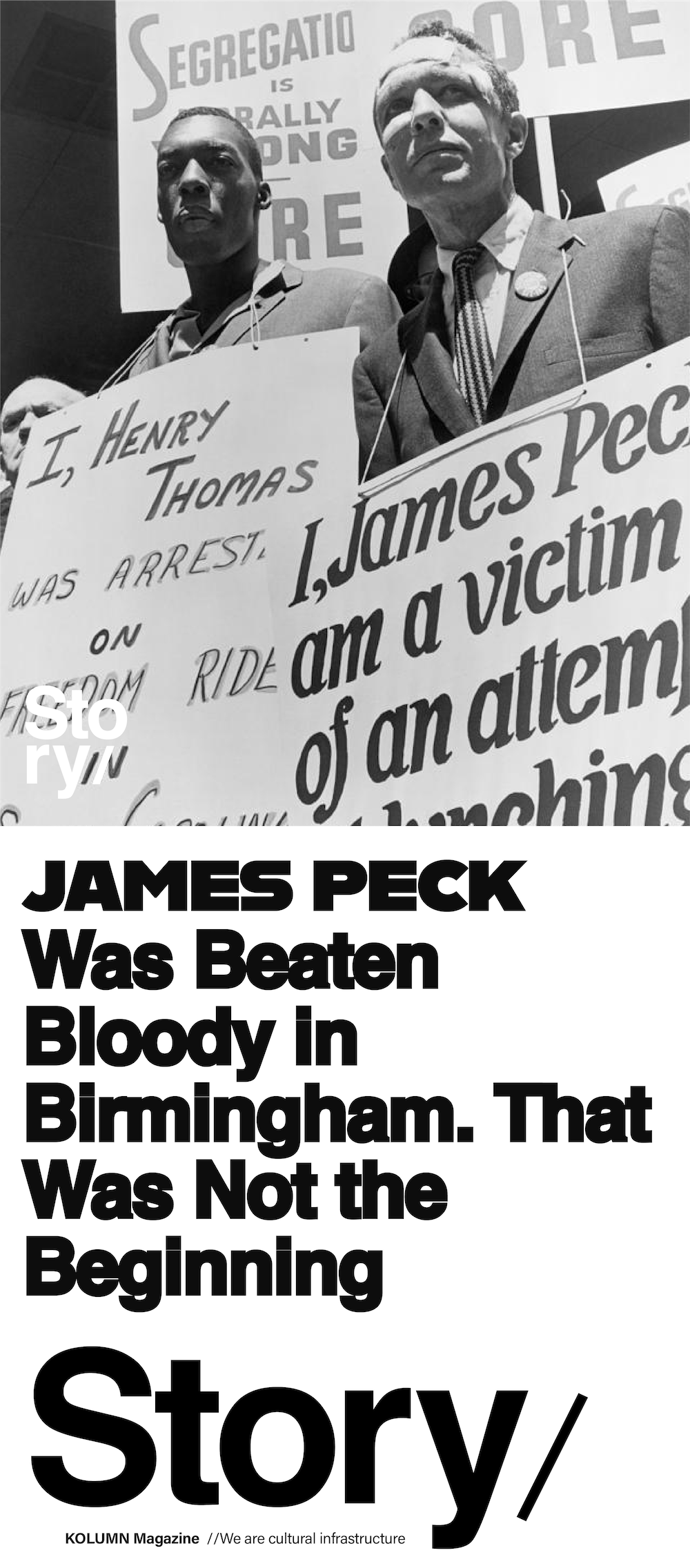
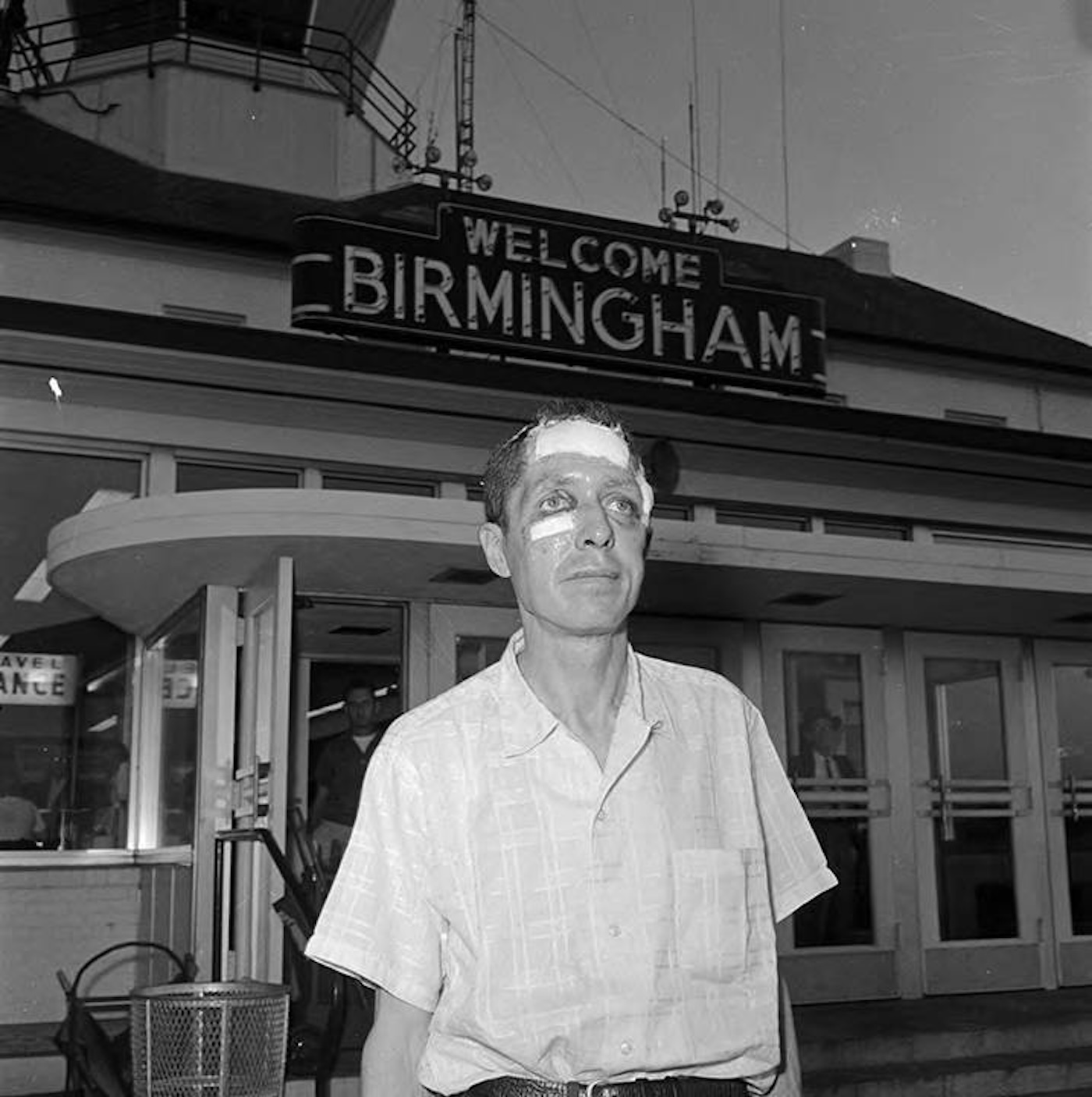
In the famous 1961 photograph, he sits upright on a hospital gurney in Birmingham, Alabama, his head wrapped in bandages, his expression strangely composed for a man whose body had just absorbed the full argument of white supremacy. He had arrived in Birmingham as one of the original Freedom Riders, part of the Congress of Racial Equality’s interracial campaign to test federal rulings against segregation in interstate travel. He left the bus terminal bloodied, requiring more than 50 stitches, after Klansmen and local segregationists attacked Riders while police failed to intervene. The image has since entered the visual grammar of the civil-rights movement: a white pacifist, beaten nearly to death for riding beside Black Americans.
But to understand James “Jim” Peck only through Birmingham is to mistake the climax for the story.
Peck was not an accidental martyr. He was a radical pacifist, labor organizer, journalist, conscientious objector, CORE strategist and serial practitioner of nonviolent confrontation. Born in New York City in 1914, the son of a wealthy clothier, Peck briefly attended Harvard before choosing a life outside the polite corridors of class privilege. The Martin Luther King, Jr. Research and Education Institute describes him as “a radical pacifist, trade union proponent, and civil rights activist,” a phrase that captures the braided nature of his commitments: antiwar politics, labor democracy and racial justice were not separate causes in his life. They were one moral project.
His significance rests not only in what happened to him, but in what he helped make possible. Peck participated in the 1947 Journey of Reconciliation—the direct precursor to the 1961 Freedom Rides—and then returned fourteen years later for the better-known campaign that shook the Kennedy administration and forced federal enforcement of desegregation in interstate transportation. The Civil Rights Digital Library notes that Peck helped organize and represent the National Maritime Union, protested World War II with the War Resisters League, joined CORE after the war, rode with Bayard Rustin in 1947, then helped lead CORE activities for seventeen years. In a movement often remembered through charismatic Black leadership and spectacular Southern confrontations, Peck’s life helps illuminate the quieter infrastructure: newsletters, trainings, jail terms, organizing memos, fundraising, stockholder protests, jailhouse strikes, legal actions and the long discipline of staying in the struggle after the cameras left.
That is why Peck belongs in the same KOLUMN lineage as earlier civil-rights profiles of figures like James Orange, John Berry Meachum and Ida B. Wells—people who understood that American freedom was not granted by sentiment, but forced into the record by organized confrontation. Peck’s story also complicates the magazine’s recurring investigation into Black freedom movements by showing how interracial activism could be both necessary and tense, heroic and imperfect, courageous and historically overshadowed by the Black communities whose freedom was at stake.
A Privileged Son Who Walked Away
James Peck was born on December 19, 1914, in Manhattan. His background could have delivered him into the upper-middle-class glide path of early twentieth-century white America. Instead, his life became a rebuke to inherited comfort. The King Institute’s biographical account notes that Peck was the son of a wealthy clothier and briefly attended Harvard before becoming a full-time activist, a biographical turn that placed him among a generation of radicals for whom the Great Depression, labor unrest, fascism abroad and racial caste at home shattered any illusion that neutrality was moral seriousness.
“His pacifism was not a retreat from conflict. It was a decision to enter conflict without surrendering moral agency to violence.”
Peck’s early radicalization came through labor. He worked among seamen and became involved in union organizing before the civil-rights movement made him nationally visible. The New York Times obituary, archived through Gale, summarized his life as more than four decades of activism: pro-union work among seamen in the 1930s, imprisonment as a conscientious objector in the 1940s, civil-rights demonstrations in the South in the 1960s and later volunteer work for Amnesty International. That arc matters. Peck did not discover justice in Montgomery, Birmingham or Jackson. By the time the Freedom Rides made him famous, he had already developed a theory of power: institutions yield only when confronted by organized people willing to bear consequences.
His pacifism was not passive. It was militant nonviolence, a phrase that sounds contradictory only to those who confuse nonviolence with quietism. Peck’s refusal to fight in World War II placed him in the unpopular minority of American dissenters who opposed militarism even during the “good war.” According to the King Institute, he was interned for 28 months as a conscientious objector. Other accounts note that he spent time at Danbury Correctional Institution, where imprisoned conscientious objectors challenged segregation inside the prison itself.
That episode is essential. Peck’s antiwar stance was not merely a private theological objection to killing. It became a politics of institutional resistance. Inside prison, he and other conscientious objectors confronted racial segregation in the mess hall, revealing that even the machinery built to punish dissent reproduced the racial caste system outside its walls. Peck’s prison years sharpened the method he would carry into CORE: nonviolent discipline, interracial solidarity, willingness to accept jail and an insistence that democracy had to be tested in the places where it lied about itself.
CORE, Pacifism and the Machinery of Direct Action
After World War II, Peck joined the Congress of Racial Equality, an organization founded in 1942 by activists influenced by Gandhian nonviolence, Christian pacifism, labor organizing and interracial direct action. CORE was small in its early years, but its ideas were large. It believed segregation could be confronted not only through court cases, but through disciplined bodies entering forbidden spaces: lunch counters, bus terminals, restaurants, theaters and waiting rooms.
Peck became one of CORE’s key communicators. The King Institute notes that he edited CORE’s newsletter, the CORE-lator, for seventeen years. That kind of work rarely receives the cinematic treatment given to marches and jailings, but movements live or die by communication. Newsletters connected local chapters, spread tactics, documented abuses and gave activists a shared sense that their isolated confrontations belonged to a national struggle.
Peck also wrote. His books included We Who Would Not Kill, Freedom Ride and Underdogs vs. Upperdogs. His 1962 book Freedom Ride, published by Simon & Schuster, became one of the earliest first-person accounts of the 1961 campaign; rare-book listings identify it as a 1962 Simon & Schuster publication. The fact that Peck wrote so quickly after the violence underscores his dual role: he was both participant and chronicler, both witness and interpreter.
The historiography of Peck’s life is inseparable from the broader historiography of nonviolent direct action. Scholars such as Raymond Arsenault, whose book Freedom Riders: 1961 and the Struggle for Racial Justice formed the basis for Stanley Nelson’s PBS American Experience documentary, have emphasized that the Freedom Rides were not spontaneous eruptions of youthful courage, but the product of long organizational genealogy. Derek Catsam’s work on the Journey of Reconciliation likewise places the 1961 rides in a longer struggle over interstate transportation, federal authority and grassroots enforcement of constitutional rights.
Peck’s life is one of the connective tissues in that genealogy.
The First Freedom Ride Before the Freedom Rides
In April 1947, James Peck joined Bayard Rustin and other activists in the Journey of Reconciliation, often called the first Freedom Ride. The campaign tested the Supreme Court’s 1946 Morgan v. Virginia decision, which held that segregation in interstate bus travel placed an unconstitutional burden on interstate commerce. The Zinn Education Project recounts that the Journey of Reconciliation left Washington, D.C., on April 9, 1947, traveling through the upper South to challenge segregated seating practices.
“The 1961 Freedom Rides did not begin in 1961. They began in the stubborn memory of activists who knew federal rights meant little unless someone boarded the bus.”
The 1947 ride did not have the mass-media impact of 1961, but it established the template: interracial teams, direct violation of segregation customs, advance planning, legal risk, jail time and deliberate moral theater. Peck and Rustin were arrested in Durham, North Carolina. In Chapel Hill, Peck was attacked. The lesson was clear: even where federal law had changed, local racial power remained ready to enforce segregation with fists, police, judges and jail cells.
The Journey of Reconciliation also placed Peck in relationship with Bayard Rustin, one of the most brilliant strategists in the Black freedom struggle and another figure whose pacifism, sexuality and radical politics complicated his public recognition. Rustin’s later role in organizing the 1963 March on Washington is well known; his 1947 work with CORE and the Fellowship of Reconciliation deserves equal attention. Peck’s collaboration with Rustin demonstrates how pacifist networks, labor circles and Black freedom organizations cross-pollinated before the civil-rights movement became a nightly television event.
For KOLUMN readers, this earlier ride resonates with a recurring theme in Black history: the first act of defiance is often not the one remembered. Ida B. Wells was removed from a train near Memphis in 1884, decades before Rosa Parks refused to surrender her bus seat in Montgomery. John Berry Meachum built educational resistance in Missouri long before Brown v. Board. Peck’s 1947 ride belongs to that archive of precursor struggles—events that did not immediately transform the nation, but made later victories imaginable.
The Stockholder as Agitator
Peck’s activism was not limited to jail-ins and buses. He was also an early practitioner of corporate pressure tactics. In the late 1940s and 1950s, he attended stockholder meetings of companies like Greyhound, using the formal rituals of capitalism against the racial practices those corporations enabled. He understood that segregation was not simply Southern custom. It was corporate policy, franchise practice, insurance calculation, managerial cowardice and shareholder silence.
This part of Peck’s work deserves more attention because it foreshadows modern shareholder activism, consumer boycotts and corporate accountability campaigns. Long before diversity statements and ESG reports, Peck and CORE activists recognized that private companies were public actors in the architecture of segregation. Bus companies, lunch-counter chains and roadside restaurants profited from Black travelers while humiliating them. They could not be allowed to hide behind “local custom.”
Peck’s genius was tactical persistence. He saw that every institution had a point of pressure: the jail had a mess hall, the bus company had a stockholder meeting, the restaurant had a lunch counter, the federal government had regulatory authority, the press had cameras and the public had a conscience that could be forced awake. This was direct action as systems analysis.
Birmingham, 1961
On May 4, 1961, thirteen Freedom Riders left Washington, D.C., headed toward New Orleans on Greyhound and Trailways buses. Their plan was to test two Supreme Court rulings—Morgan v. Virginia and Boynton v. Virginia—that prohibited segregation in interstate travel and related terminal facilities. The rides were interracial, deliberately visible and designed to force the federal government to enforce its own law.
By Mother’s Day, May 14, the campaign had entered Alabama.
One bus was attacked and firebombed outside Anniston. Riders escaped the burning vehicle only to face further mob violence. Peck was aboard the Trailways bus that also passed through Anniston before reaching Birmingham. In his Washington University interview preserved by the Civil Rights Movement Veterans site, Peck described the terror and confusion of the trip, recalling the atmosphere as Riders moved toward Birmingham knowing danger was waiting.
“Peck’s blood mattered because it exposed the lie. Black blood had been exposing it for centuries.”
When the Trailways bus arrived in Birmingham, Peck and Charles Person, a young Black student from Atlanta, were among the first to exit. The mob attacked. Peck was beaten savagely. Person was beaten too. The violence was not random chaos; later investigations and testimony suggested coordination among Klansmen and law enforcement. Gary Thomas Rowe, an FBI informant inside the Klan, later testified that the mob had been given time to attack before police intervened.
The moral obscenity was compounded by medical racism. Peck was initially taken to a segregated hospital that refused to treat him. He eventually received care elsewhere. The photograph of him bandaged on a gurney became one of the most searing images of the campaign.
But the image can mislead if viewed too simply. Peck’s whiteness mattered. National media and federal officials often responded differently when white activists were brutalized alongside Black activists. The sight of a white man bloodied by segregation made visible to some white Americans what Black Americans had been saying for generations. That does not diminish Peck’s courage; it clarifies the racial optics of American empathy.
Historians have wrestled with this tension. The civil-rights movement depended on interracial solidarity, but media attention often privileged white suffering as proof of Black testimony. Peck himself knew that the movement was not about his body alone. His wounds were evidence, but the crime was the system that had long brutalized Black travelers, Black workers, Black students and Black communities without comparable national alarm.
A White Ally in a Black Freedom Struggle
Writing about James Peck requires precision. He should neither be inflated into the center of a Black-led movement nor reduced to a footnote because he was white. His importance lies in the disciplined, dangerous and sustained role he played as an ally who accepted consequences.
Peck’s activism challenges the shallow contemporary language of allyship. He did not treat solidarity as identity performance. He accepted jail, beatings, estrangement, poverty, surveillance and organizational conflict. He did the unglamorous work. He wrote newsletters. He raised funds. He attended meetings. He got on buses. He came back after being beaten. He kept organizing after the headline moment passed.
At the same time, the later history of CORE reveals the limits and tensions of interracial organizations in the Black Power era. By the mid-1960s, CORE was changing. Black activists increasingly demanded Black leadership and questioned the role of white activists inside organizations built to confront Black oppression. Peck, who had edited the CORE-lator for years, was eventually removed from that position as CORE moved toward a different political formation. That transition was not simply personal rejection; it reflected a broader ideological shift inside the movement.
The historiography of the civil-rights era has increasingly emphasized these tensions. Earlier narratives often celebrated interracial liberalism as the movement’s moral high point. Later scholars have paid more attention to Black self-determination, grassroots women organizers, local movements, economic justice campaigns and the frustrations that led many activists to reject white paternalism. Peck’s life fits within that more complex account. He was a committed comrade in Black freedom work, but he was also part of organizations forced to confront how race, power and leadership operated even among allies.
That complexity strengthens, rather than weakens, his significance.
The Lawsuit Against the FBI
Peck’s fight did not end at the bus terminal. In 1976, he sued the FBI for damages related to the Birmingham attack, arguing that federal authorities had knowledge of the danger and failed to protect the Riders. The case grew out of revelations involving Gary Thomas Rowe, the FBI informant embedded in the Ku Klux Klan. In 1983, Peck was awarded $25,000.
The sum was modest. The symbolism was not.
The lawsuit placed Peck’s body into the legal record as evidence not only of mob violence, but of state failure. The Freedom Riders had been attacked by Klansmen, but their vulnerability was enabled by government actors who tolerated, minimized or strategically mishandled white supremacist violence. This is a crucial distinction. Civil-rights violence was often described as the work of mobs, extremists or local “troublemakers,” but the movement repeatedly exposed the complicity of sheriffs, police chiefs, governors, federal agencies and courts.
Peck’s lawsuit belongs to a larger history of activists forcing the state to answer for what it permitted. In that sense, his case anticipates later accountability frameworks used to examine surveillance, informants, police inaction and state violence. It also reminds readers that the civil-rights movement was not only a battle against bad customs. It was a battle over governance.
The Writer as Witness
Peck’s written work matters because it preserved the interior logic of direct action. In Freedom Ride, he offered not only a narrative of events, but a participant’s understanding of why the rides mattered. The book appeared in 1962, when the struggle was still unfolding and before the Freedom Rides had hardened into civic mythology.
That immediacy is important. Peck was writing before the nation had decided how it wanted to remember the movement. He wrote before the violence could be softened into inspirational footage, before public commemorations could sand down the radical edges, before “nonviolence” could be misremembered as politeness.
His journalism and memoir work also places him in a tradition of movement writers: Ida B. Wells documenting lynching, Bayard Rustin writing about nonviolence and democracy, James Baldwin diagnosing the spiritual crisis of white America, and countless local organizers producing newsletters, pamphlets and field reports. Movements require witnesses who can translate action into record.
Peck did that work repeatedly.
Expert Voices and the Historians’ Peck
Among historians, Peck is most often discussed in relation to three overlapping fields: pacifist radicalism, CORE’s direct-action tradition and the Freedom Rides. Raymond Arsenault’s work foregrounds the 1961 campaign as a turning point in federal civil-rights enforcement, showing how disciplined activists forced the Kennedy administration into action. The PBS documentary based on Arsenault’s book helped bring Riders’ testimony to a broad audience, situating Peck among a cast of activists whose courage transformed interstate travel.
The Civil Rights Digital Library’s concise biography places Peck in an even longer frame, linking his maritime union work, War Resisters League activism, 1947 Journey of Reconciliation participation and long CORE service. The King Institute similarly emphasizes Peck’s pacifism, unionism and editorial labor, including his role in introducing a CORE reprint of Martin Luther King Jr.’s “Our Struggle: The Story of Montgomery.” These institutional accounts are not merely biographical; they reveal the movement ecosystem in which Peck operated.
The historiographical challenge is that Peck can disappear between categories. Labor historians may treat him as a union radical. Peace historians may claim him as a conscientious objector. Civil-rights historians may remember him as a Freedom Rider. Media histories may preserve him through one photograph. But his life’s significance comes from refusing those separations. He understood militarism, racism and economic exploitation as linked systems of domination.
That intersectional view—though he would not have used today’s academic vocabulary—made him unusually consistent. He opposed war, prisons, segregation, labor exploitation and state violence not as separate moral hobbies, but as expressions of hierarchy.
After the Spotlight
After the 1960s, Peck continued working for justice causes. The New York Times obituary notes that he later stuffed envelopes for Amnesty International in the 1980s—a detail that might sound small until one understands it as the purest expression of movement discipline. The same man whose blood had appeared in newspapers was still doing administrative work for human rights decades later.
That is the measure of a serious activist.
The public often prefers martyrs at the moment of sacrifice, not organizers in the long aftermath. Peck’s later years were marked by health struggles, including the effects of a stroke. He died on July 12, 1993, in Minneapolis at age 78. His passing received notice, but not the kind of national reckoning that often follows the deaths of more famous civil-rights figures.
Perhaps that is fitting, though not just. Peck’s life was never built around celebrity. It was built around witness.
What James Peck Still Teaches
James Peck’s life speaks sharply to the present because it refuses sentimental versions of democracy. He understood that rights on paper are fragile unless people organize to enforce them. He understood that courts matter, but court victories can be ignored. He understood that corporations shape public life. He understood that state inaction can be a form of violence. He understood that allyship without risk is often theater.
He also understood that nonviolence is not weakness. In Peck’s life, nonviolence was confrontation stripped of domination. It required preparation, discipline and courage. It did not ask the oppressed to be patient. It forced oppressors to reveal themselves.
For KOLUMN Magazine’s broader archive of Black freedom stories, Peck’s life offers a necessary angle on solidarity. The Black freedom struggle has always included white allies, but the standard for meaningful solidarity has never been sympathy alone. It has been sacrifice, accountability and a willingness to follow the moral leadership of those most endangered by injustice. Peck met that standard more often than most.
His story also reminds us that the civil-rights movement was not one movement, but many: labor radicals, church women, student organizers, pacifists, lawyers, journalists, domestic workers, union men, sharecroppers, ministers, teenagers, veterans, teachers and people who simply got tired of humiliation. Peck moved among those worlds, carrying tactics from one arena to another.
The photograph from Birmingham will remain the image by which many encounter him. That is understandable. It is difficult to look away from his bandaged head and composed face. But the deeper lesson is not that James Peck was beaten. It is that he had trained himself, across decades, to keep showing up where America’s violence was most likely to reveal the truth.
He rode in 1947. He rode again in 1961. He wrote. He sued. He organized. He endured.
And in doing so, he left behind a life that asks a brutal and clarifying question: What kind of country requires people to bleed before it obeys its own laws?
More great stories
Afro Sheen, Wall Street, and the Architecture of Black Possibility
July 6, 2026
No Comments
The Fire Inside the Fourth
July 5, 2026
No Comments