



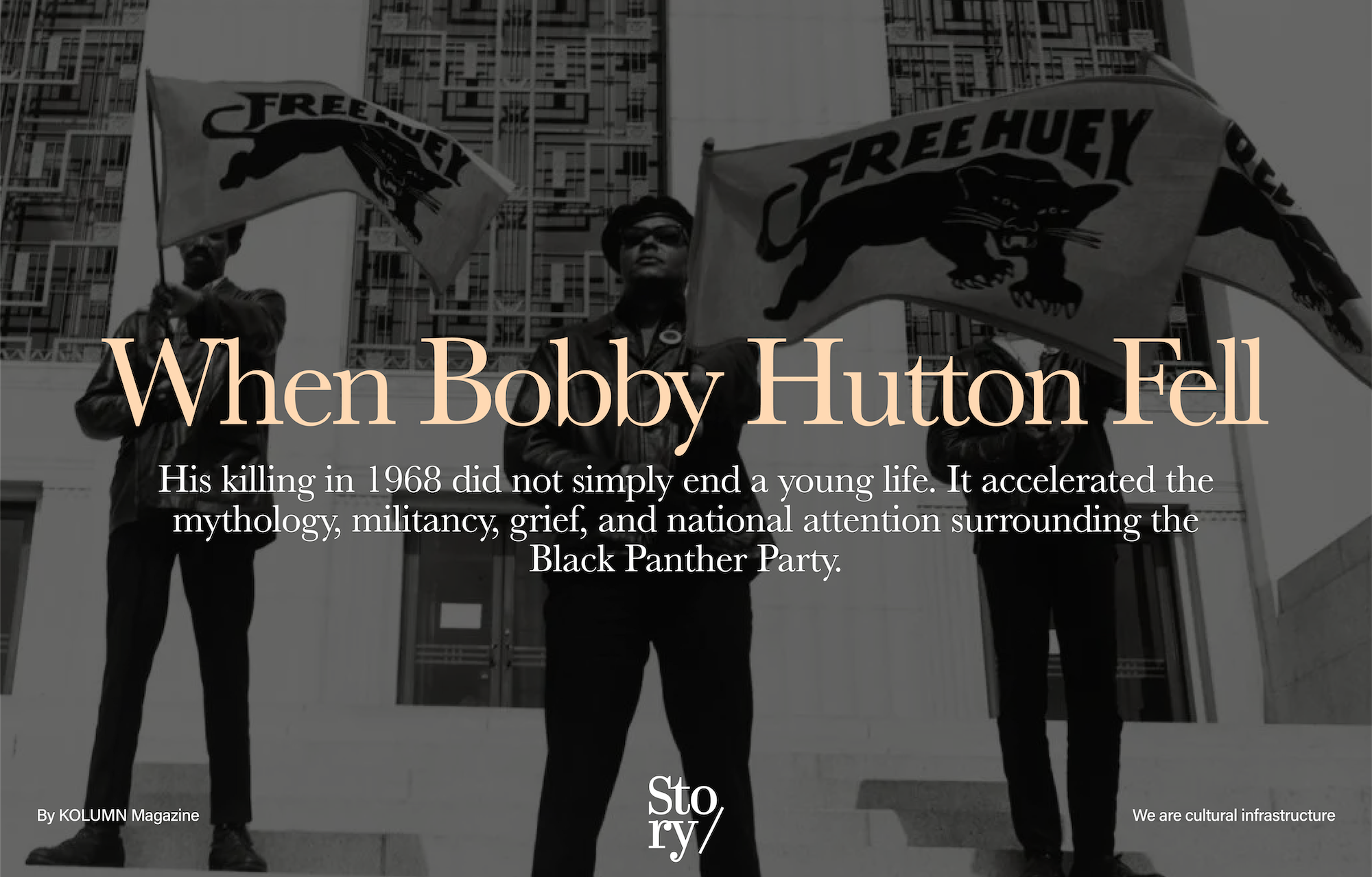
Bobby Hutton was only 16 when he joined. The Panthers made him visible. His death made the movement unforgettable.
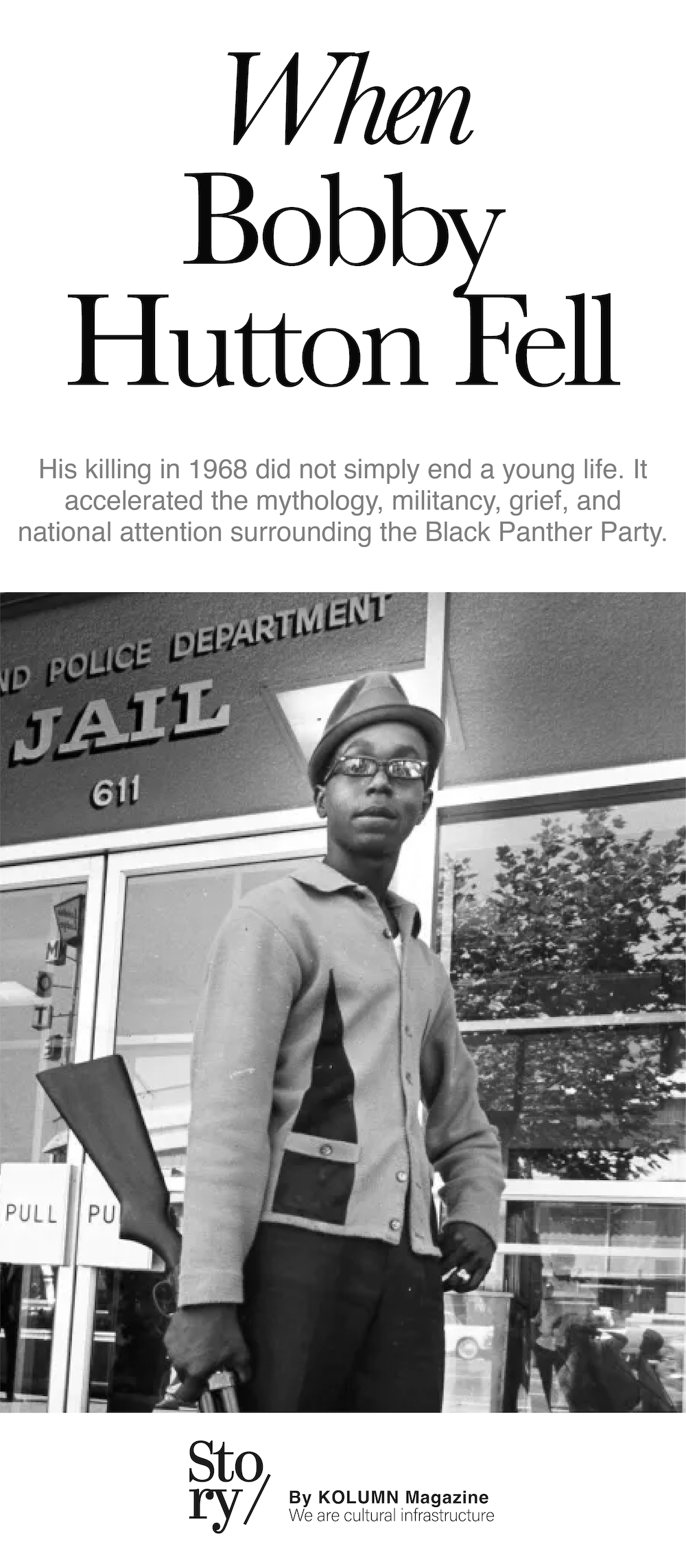
Bobby Hutton was only 16 when he joined. The Panthers made him visible. His death made the movement unforgettable.
By KOLUMN Magazine
Bobby Hutton did not live long enough to become the most famous face of the Black Panther Party. He did not have time to write a major memoir, develop a national speaking platform, or grow old enough to reinterpret his own legend. He died at 17, just weeks before his eighteenth birthday, and that fact matters—not as a sentimental mark, but as the central force of his story. Bobby Hutton was a child by legal standards, a teenager by temperament, and yet already a political actor by conviction. He was also the first recruit to join the Black Panther Party for Self-Defense, its first treasurer, and the first Panther widely remembered as killed by police. In that sense, his biography is inseparable from the party’s biography. The rise of one and the death of the other became fused in the public imagination.
The shorthand version of Hutton’s life is familiar: Arkansas-born, Oakland-raised, politically awakened, drawn into the orbit of Huey P. Newton and Bobby Seale, present at the Sacramento protest against the Mulford Act, then dead in a police confrontation in West Oakland in April 1968. But shorthand often flattens him into a symbol so quickly that the actual person disappears. And that is the tension at the center of his legacy. Bobby Hutton was, on one hand, a teenager shaped by migration, poverty, police violence, and the kinetic radicalism of the late 1960s. On the other, he became almost immediately a public emblem—“Lil’ Bobby,” the fallen Panther, the boy-martyr of Oakland, the face of a state confrontation that helped catapult the Panthers into even greater national prominence.
To write honestly about Hutton now requires resisting both romantic simplification and reactionary caricature. He was neither merely an innocent child swept into history nor simply a militant foot soldier in an inevitably violent movement. He was part of an organization that believed armed self-defense was a necessary answer to anti-Black state violence. He joined that organization willingly, at 16, because its analysis of Black life in Oakland made sense to him. At the same time, he was a teenager in a movement whose youthfulness was both its power and its vulnerability, a movement facing police hostility, public alarm, and soon a sweeping federal campaign of repression.
A child of Arkansas and Oakland
Robert James Hutton was born on April 21, 1950, in Jefferson County, Arkansas. His family later moved west to Oakland as part of the broader Black migration away from the racial terror and economic constraint of the South. The move was not an abstraction in Hutton’s story. According to biographical accounts, his family left Arkansas after intimidation by white nightriders, part of the climate of menace that pushed many Black families toward California in search of safety and possibility. In Oakland, however, the Hutton family did not arrive in a promised land free of racial hierarchy. They entered a city marked by segregation, exclusion, overpolicing, and constrained opportunity, especially for Black residents in the flatlands.
That movement—from Southern terror to Western containment—helps explain the political terrain Bobby Hutton inherited. Oakland in the 1960s was a place of contradiction: an industrial city shaped by wartime labor migration, a Black urban center with rising political consciousness, and a city where police brutality was a routine grievance rather than an occasional scandal. The Black Panther Party would emerge from precisely that contradiction. Newton and Seale did not invent Black anger in Oakland; they gave it doctrine, discipline, and spectacle. Hutton came of age within those conditions, which is one reason he was receptive to the party’s message so early.
Former Panthers and later chroniclers have remembered Hutton as serious beyond his years, politically alert, and hungry for purpose. A 1998 SFGATE report on Oakland’s memorial observance quoted former Panther Will Jennings describing him as “a man-child,” a phrase that catches the contradiction exactly. Jennings recalled that Hutton had enough political awareness as a mid-teen to recognize the conditions around him and want to act. He also noted that when Hutton first joined, he had limited literacy, but before his death he was reading W.E.B. Du Bois. That detail matters because it places Hutton not only in the mythology of militancy, but in a culture of study. The Panthers were never just leather jackets and firearms. They were also political education, reading, newspaper circulation, ideological apprenticeship, and the cultivation of disciplined selfhood. Hutton was being formed inside that world.
The first recruit
The official mythology of movements often centers founders, but organizations are also defined by their first believers. Bobby Hutton was the first recruit to join the newly formed Black Panther Party for Self-Defense. PBS’s A Huey P. Newton Story places that moment in December 1966, when Hutton was 16 years old. He became not only the first rank-and-file Panther but also the party’s first treasurer, an early sign that he was trusted inside an organization still in the process of inventing itself.
That distinction—first recruit—carries more than ceremonial weight. It means Hutton signed on before the Panthers were a national phenomenon, before the iconography had hardened, before liberal fascination and state repression reached full intensity. He joined at the point when the Panthers were still primarily a local Oakland formation organized around police patrols, self-defense, and the Ten-Point Program. That matters because it suggests Hutton’s commitment was not drawn chiefly by celebrity or theatrics. He joined before the brand had scale. He joined the idea before the legend.
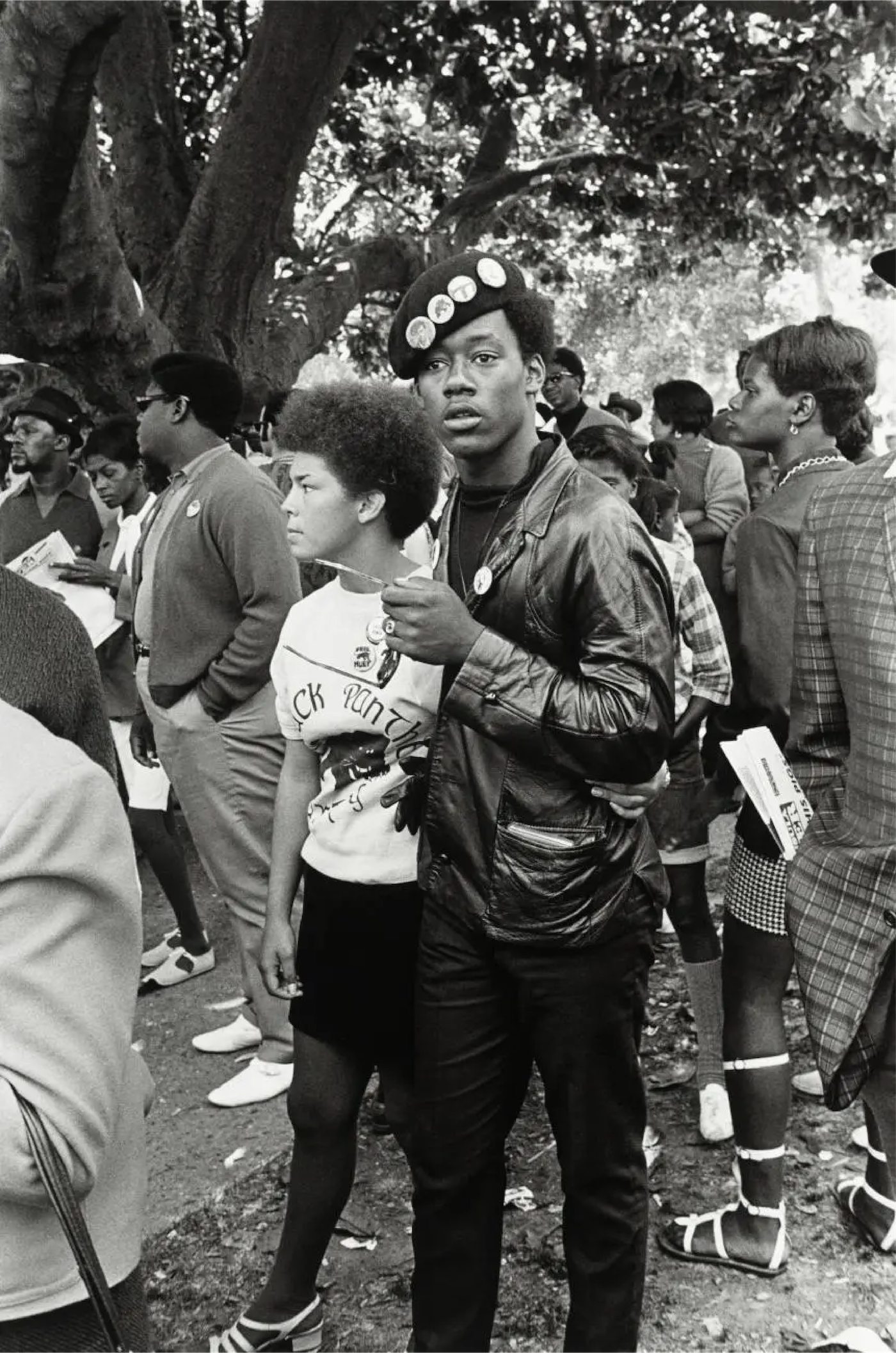
The Panthers’ early appeal to young Black people like Hutton was not difficult to understand. Their program named material grievances plainly: freedom, full employment, decent housing, education that told the truth, exemption from military service, an end to police brutality, and justice in the courts. Their public bearing—berets, leather jackets, law books, firearms, precision—projected discipline rather than plea. In a period when many Black communities felt that nonviolent appeals were not stopping beatings, killings, or neglect, the Panthers staged a different political language: self-defense, observation, mutual aid, and public confrontation. For a teenager in Oakland looking at the limits of American democracy from the sidewalk up, that language could feel less extreme than honest.
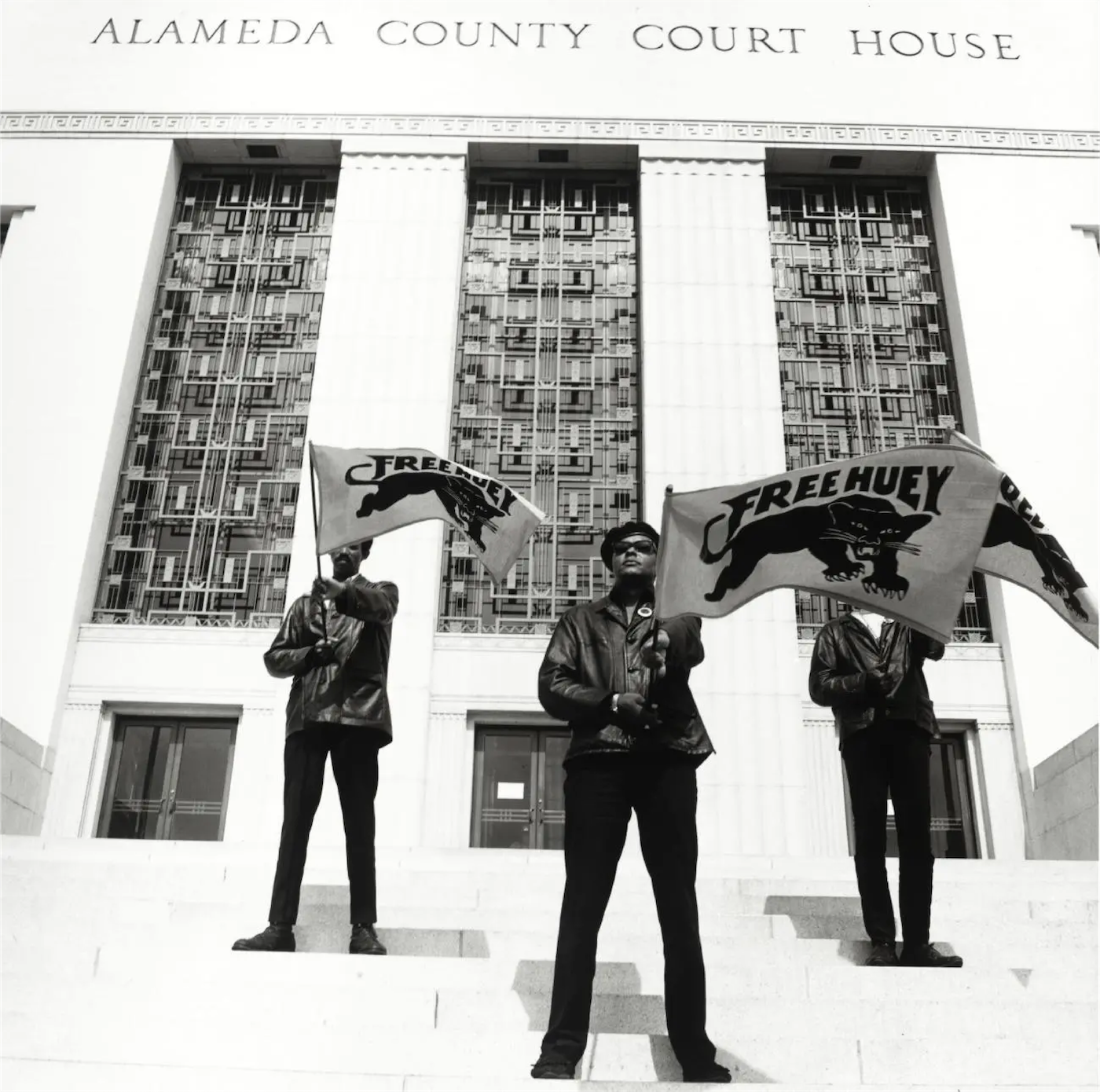
Hutton appears in these histories not as a peripheral mascot but as an actual working member of the organization. He was present during formative actions, including the 1967 armed protest in Sacramento against the Mulford Act, legislation aimed at restricting the public carrying of loaded firearms and widely understood as a direct response to Panther patrols. PBS states that Hutton led 26 Panthers in the march on the state capitol and that they were arrested; the Encyclopedia of Arkansas likewise notes his role in the Sacramento action and subsequent arrests. The action made national headlines and forced the country to confront a disquieting image: young Black people invoking the language of constitutional rights while openly carrying guns in the statehouse. Hutton was still a teenager, yet already participating in one of the defining media events of early Panther history.
Youth inside a revolutionary organization
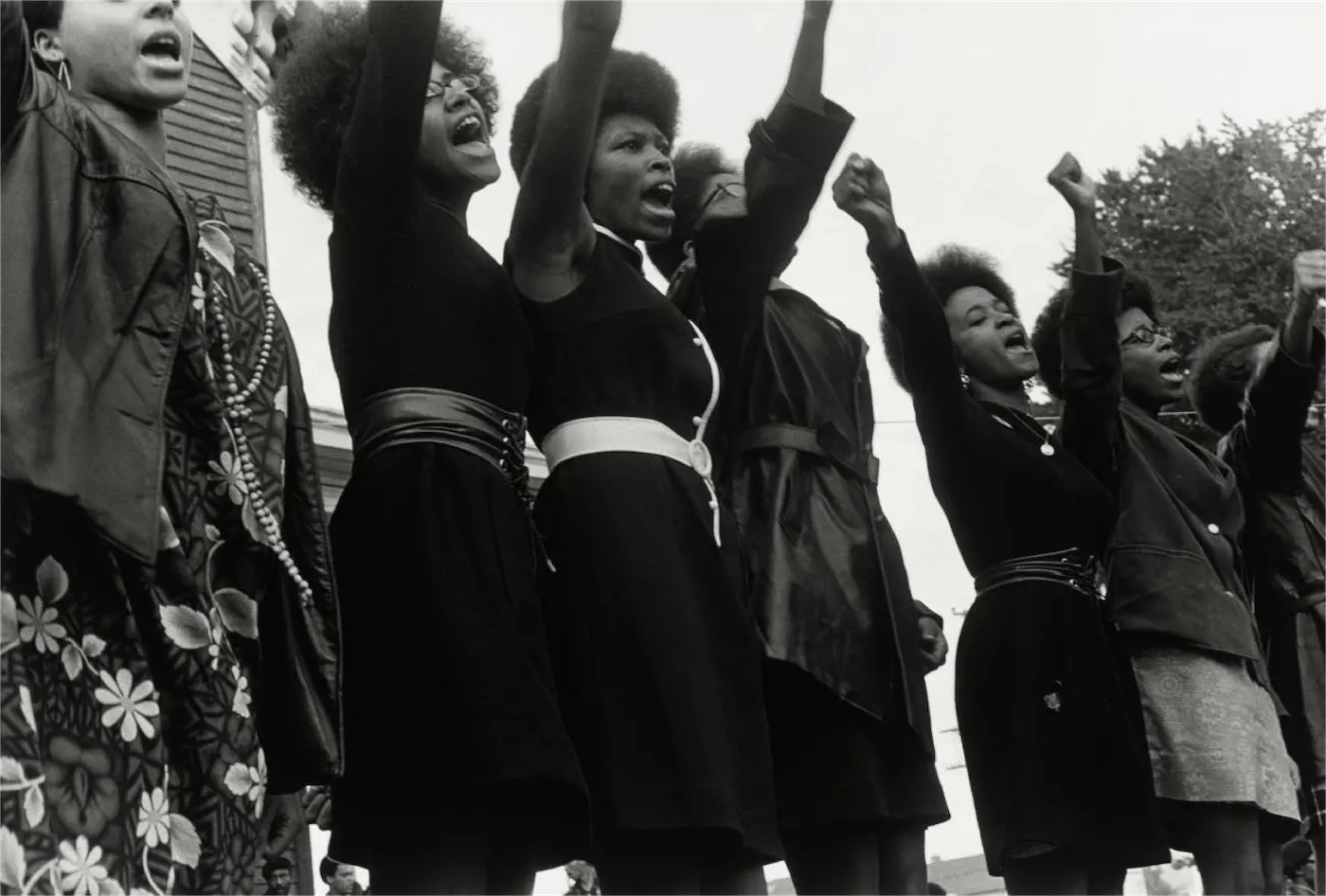
One of the most striking features of Bobby Hutton’s story is how young he was relative to the political burden he carried. The Panthers were, in many respects, a youth movement, though not always remembered that way. Their energy, fearlessness, and improvisational brilliance came in part from the fact that many members were very young. That youth produced boldness. It also produced exposure. Kathleen Cleaver later reflected on the party’s place in a broad insurgent generation that refused to tolerate systematic violence and abuse against Black people. Her framing is useful because it locates the Panthers not as aberrant extremists floating outside the decade, but as one formation inside a generational revolt against racism, war, and state power.
The problem, of course, is that American institutions often read Black youth politicization as inherent danger. A teenage white dissenter might be called idealistic, confused, or rebellious. A teenage Black revolutionary with a beret and a political line was far more likely to be treated as a public threat. Hutton’s life and death unfolded within that racial double standard. His age did not shield him from state force; arguably it intensified the symbolic threat he represented. A Black teenager who did not appear deferential, who embraced discipline, who carried himself like a political subject rather than an object of policy—such a figure disrupted the governing script.
This is one reason Hutton’s memory has endured so intensely inside Black radical history. He embodied a terrifyingly compressed American truth: Black children are often denied childhood when they become politically legible. The state saw not a boy in formation, but an insurgent in miniature. The movement saw not merely a recruit, but proof that the next generation was ready to reject accommodation. Both readings enlarged him, in different ways, beyond the private scale of his actual life.
April 1968: grief, rage, and the Oakland shootout
Bobby Hutton died on April 6, 1968, in Oakland, two days after the assassination of Martin Luther King Jr. The timing is impossible to separate from the emotional and political atmosphere of the event. King’s murder had already pushed the country into grief, rebellion, rage, and heightened police alert. According to accounts cited by PBS and other sources, Hutton was with Eldridge Cleaver and other Panthers in an encounter that escalated into a confrontation with Oakland police. A ninety-minute shootout followed. Two officers were wounded. Cleaver was wounded. Hutton was killed.
The core facts are agreed upon. The interpretation is not. That dispute is central to the politics of Bobby Hutton’s legacy. Panther-aligned accounts, including PBS’s Hutton biography and statements attributed to Eldridge Cleaver, maintain that Hutton had surrendered, stripped down to his underwear to prove he was unarmed, and was then shot more than a dozen times by police. The Encyclopedia of Arkansas repeats that report while also noting the police account: officers said Hutton was wearing a long coat, his hands could not be seen, and he ignored commands. Those conflicting narratives are not incidental details. They are the heart of the case. Was Hutton killed while surrendering, or shot in a still-uncertain tactical moment? The answer shapes whether his death is remembered principally as police murder, tragic combat, or both.
Journalistically, the responsible position is to state plainly that the circumstances remain contested in the record. But it is equally important to note which version became historically consequential. Inside the Black Panther Party and among many sympathizers, Hutton’s death was understood as an execution—a teenage Panther killed after surrender, an emblem of anti-Black police violence so stark that it seemed to confirm everything the party had been saying about the state. That interpretation circulated fast, helped mobilize grief into politics, and deepened the sense that the Panthers were confronting not a flawed democracy open to persuasion, but a system willing to destroy them.
Eldridge Cleaver’s later recollections amplified that view, and Kathleen Cleaver’s memorial rhetoric made clear how quickly Hutton’s killing had been folded into a larger catalog of racial martyrdom. In her April 12, 1968 speech, she placed Bobby Hutton in a line with Malcolm X and Martin Luther King Jr., declaring that “a racist bullet” had murdered all three. The speech was not a neutral reconstruction of events; it was movement oratory, angry and accusatory by design. But it captures the emotional reality of the moment: Hutton’s death was experienced not as an isolated local tragedy, but as part of a structure of racist violence, policing, courts, and incarceration.
The funeral and the public birth of a martyr
If Hutton’s death transformed him into a symbol, his funeral made that symbolism public. PBS states that more than 2,000 people attended his funeral at the Ephesian Church of God in Berkeley. The American Archive of Public Broadcasting describes the service and the rally that followed at Merritt Park, noting that Kathleen Cleaver, Bobby Seale, Ron Dellums, and Marlon Brando were among the speakers or attendees connected to the day’s commemorations. More than a burial, the funeral was a political ceremony—mourning fused with mass communication.
The presence of celebrity and movement leadership mattered. Brando’s attendance linked the Panthers’ cause to a broader anti-establishment public. Dellums’ participation linked grief to institutional politics. Kathleen Cleaver’s speech linked the death to a revolutionary analysis of state violence. The result was that Hutton’s funeral operated as both memorial and message. It told Oakland and the nation that this death would not be privately absorbed. It would be staged, named, and used as indictment.
There is a cruel paradox here. Bobby Hutton became more publicly known in death than he could possibly have become in life by age 17. That is often how American racial politics works: Black youth are ignored until they are killed, then enlarged into evidence. Yet the Panthers also understood the political necessity of that enlargement. To let Hutton’s death remain merely local would have been, from their perspective, to surrender the narrative to the police and the courts. By making him a martyr, they insisted that the nation confront a question it preferred to avoid: what does it mean when a teenager is politicized by police violence and then dies in a disputed police shooting?
Why his death changed the Panthers
Bobby Hutton’s killing was not the first conflict involving the Black Panther Party, but it was among the earliest to carry national symbolic force. History.com notes that the 1968 shootout involving Eldridge Cleaver and Bobby Hutton left Hutton dead and two officers wounded, situating the event within the party’s reputation for violent clashes with police. But that framing, while factually concise, misses why the event reverberated so profoundly. Hutton’s death did not simply reinforce an image of militancy. It crystallized the Panthers’ own argument that police violence against Black radicals was systemic, escalating, and likely lethal.
Public media retrospectives have gone further, explicitly describing Hutton’s death as a turning point that catapulted the Panthers to broader fame. That claim makes sense. The juxtaposition was narratively explosive: a 17-year-old first recruit, reportedly surrendering, killed by police in the immediate aftermath of King’s assassination. It was the kind of event that could travel quickly across the country because it condensed the era’s key tensions into one story—youth, race, militancy, policing, martyrdom, media, repression.
Within the party, the killing also hardened internal feeling. PBS describes the murder of Hutton as a major event in Panther history that incensed the organization and made it stronger. That assessment may sound counterintuitive, given that the party would later suffer internal splits, state repression, imprisonment, and deadly raids. But in the immediate sense, martyrdom often consolidates movements. It creates moral clarity for insiders. It heightens urgency. It recruits memory as a political tool. Hutton’s death gave the Panthers an irrefutable emotional center: not just doctrine, but blood.
The danger, of course, is that martyrdom can also intensify a movement’s attraction to confrontation. Hutton’s death deepened the party’s conviction that force was already being used against them and that the state’s appetite for repression was real. Later accounts of the Panthers’ trajectory cannot be separated from that belief. Nor can later accusations—some fair, some opportunistic—that the Panthers embraced revolutionary theater at a human cost. Bobby Hutton’s death sits at that junction. It validated fear of the police and may also have deepened the logic of escalation.
Bobby Hutton and the American fear of Black self-defense
There is no way to understand Hutton without understanding the political shock generated by Black self-defense. The Panthers’ early patrols, legalistic observation of police, and open carrying of weapons were not merely tactical choices. They were challenges to the racial monopoly on legitimate force. American political culture has often tolerated, even celebrated, armed citizenship in the abstract, but it has reacted with alarm when Black people publicly claimed that same right in defense of their communities. Hutton’s presence at the Sacramento protest and his later death in Oakland belong to that history.
The response to the Panthers’ visibility helps make sense of the intensity that followed. The Black Panther uniform itself became a political technology—berets, leather jackets, posture, choreography. The Smithsonian’s National Museum of African American History and Culture notes how the Panthers used dress and public symbolism to communicate Black pride, self-determination, and discipline. Hutton was part of that visual revolution. He was not just in the movement; he looked like the movement. And because he did, his body after death carried symbolic charge. A slain Panther in full political image was not merely a victim. He was a message about what the country did to young Black defiance.
Bobby Hutton’s life reminds us that the Panthers were not terrifying because they were incoherent. They were terrifying to the state because they were coherent.
Repression, COINTELPRO, and the wider war on the Panthers
Though Bobby Hutton died in 1968, before the full public exposure of the FBI’s COINTELPRO campaign, his killing has to be placed within the broader architecture of state repression that would define the Panthers’ next years. FBI records show that COINTELPRO expanded in the 1960s to target a range of domestic groups, including the Black Panther Party. PBS and other historical sources note that J. Edgar Hoover regarded the Panthers as a major internal threat and that federal counterintelligence efforts sought to expose, disrupt, misdirect, discredit, or neutralize Black liberation groups.
This wider context matters because it complicates any effort to isolate Hutton’s death as a single tragic episode detached from institutional patterns. Kathleen Cleaver’s memorial speech, for all its polemical intensity, was grounded in a reality that later documentation would bear out: the Panthers were under concerted pressure from police and federal intelligence agencies. American Public Media’s contextual notes on her speech state that the gunfight that led to Hutton’s death unfolded amid escalating confrontations between Panthers and law enforcement and that by 1968 Hoover had ordered or expanded operations aimed at neutralizing Black liberation groups.
That does not prove every Panther claim about every confrontation. It does, however, establish that state hostility toward the party was not paranoid fantasy. The Panthers were indeed being surveilled, infiltrated, and destabilized. Seen from that angle, Hutton’s death becomes part of an emergent war over Black radical visibility in the late 1960s—a war fought through raids, prosecutions, propaganda, and public spectacle. He was not simply caught in history’s crossfire. He was part of a generation being told, by increasingly formal means, that radical Black politics would be monitored and contained.
The afterlife of “Lil’ Bobby”
Not every martyr remains legible across generations. Some names fade into footnotes while a few persist in neighborhoods, songs, rituals, and local geography. Bobby Hutton has remained unusually present, especially in Oakland. DeFremery Park in West Oakland became popularly known as Lil’ Bobby Hutton Memorial Park, and later official city recognition followed. A 1998 SFGATE report notes Oakland’s proclamation of a holiday in his memory and describes the park as having been informally renamed soon after his death. The Encyclopedia of Arkansas similarly notes annual memorial observances and the eventual renaming of the park. Visit Oakland’s history guide likewise identifies DeFremery Park as Lil’ Bobby Hutton Memorial Park and notes the continued annual observance of Lil’ Bobby Hutton Day.
This kind of memorialization is important because it demonstrates that Hutton’s legacy has never belonged only to published history. It belongs to civic ritual and neighborhood memory. Parks are where community memory settles into landscape. To rename or re-understand a park after Bobby Hutton is to insist that his life remains part of Oakland’s physical vocabulary. It is a refusal of historical erasure. It also reflects how the Panthers, for all the fear they generated in mainstream narratives, remain deeply rooted in local memory as protectors, organizers, and symbols of Black self-respect.
Hutton has also persisted in political culture and art. The Encyclopedia of Arkansas notes references to him in music, commemorative campaigns, and visual culture, including the dedication of Country Joe and the Fish’s 1968 album Together. Popular references alone do not prove political depth, but they do show that Hutton’s story has remained available for reuse by artists trying to name state violence, Black memory, or unfinished struggle. His image and name continue to function as shorthand for a certain kind of stolen Black youth—conscious, disciplined, and killed before adulthood could fully begin.
The problem with martyrdom
Still, there is a danger in making Bobby Hutton too perfect. Martyrdom can preserve memory, but it can also harden people into symbols so smooth that their actual humanity disappears. Hutton was likely more complicated than the public icon allowed. He was young enough to still be changing. He was learning, reading, and becoming. He had not yet had the chance to revise his politics, sharpen them, abandon them, deepen them, or contradict them. History denied him all the ordinary untidiness of adulthood. That denial is part of the tragedy.
This is why his age remains so morally destabilizing. Bobby Hutton did not die after decades in public office or after years as an elder of the movement. He died before he could outgrow his first political identity. And that means every later use of his image is, in some sense, a claim made on behalf of someone who never got to speak from maturity. The Panthers claimed him as martyr. Critics of the Panthers sometimes treat him as cautionary evidence of revolutionary irresponsibility. The city of Oakland remembers him as a politically conscious local son. Each of those frameworks captures something real. None can fully recover the private boy beneath the legend.
Why Bobby Hutton still matters
Bobby Hutton matters now for reasons that go beyond historical completionism. He matters because his life forces a set of questions that remain unresolved in American public life. What happens when Black youth interpret police violence not as isolated abuse but as structural fact? What forms of political identity emerge from that realization? How does the state respond when the young refuse the language of gratitude and instead speak in the language of rights, self-defense, and power? Hutton’s life does not answer those questions neatly. It makes them unavoidable.
He also matters because his story exposes how quickly the country polarizes around Black dissent. To some observers, the Panthers’ militancy invalidated their critique. To others, the existence of police violence made militancy understandable, if not always strategically wise. Bobby Hutton stands at the center of that argument because his death is precisely where those two readings collide. If he was killed while surrendering, his story becomes one of almost unbearable clarity: a teenager proving the Panthers right with his body. If the encounter was more chaotic than Panther accounts maintain, his death is still inseparable from the system of antagonism, policing, and racial fear that made such lethal confrontations more likely. Either way, he does not disappear from the moral frame.
And then there is the matter of scale. Hutton was not a national officeholder, a bestselling author, or a celebrity organizer. He was a local teenager whose death became nationally meaningful because the underlying conditions were national. That is perhaps the most American part of the story. The country is often revealed most clearly not by its giants but by the young people it renders vulnerable at the moment they become politically visible. Bobby Hutton became visible. The country answered with bullets. The argument over exactly how and why has lasted for decades, but the fact of that answer remains.
Beyond the photograph
There is a temptation, when writing about Bobby Hutton, to freeze him in the iconic black-and-white visual grammar of the Panthers: the beret, the leather jacket, the public stance. Those images are powerful, and they deserve their place in American visual history. But the deeper significance of Bobby Hutton lies in the contradiction those images contain. He looked composed, but he was still a teenager. He looked like a finished revolutionary, but he was still becoming. He looked like a threat to the state, but also like evidence of the state’s failure to protect Black childhood.
That is why his story endures. He represents the moment when Black youth consciousness, movement discipline, and state violence converged in a form the nation could not easily ignore. The Panthers would go on to expand nationally, build survival programs, endure repression, and fracture under internal and external pressure. Hutton would remain forever 17, which is both the source of his power in memory and the wound at the center of it. He became an ancestor before he could become an adult.
Bobby Hutton did not live long enough to narrate his own legacy. America has been arguing over it ever since.
In the end, Bobby Hutton’s significance is not only that he was first—the first recruit, the first treasurer, the first Panther widely memorialized after a police killing. It is that his brief life made visible the entire emotional architecture of the Black Panther era: the urgency of self-defense, the appeal of disciplined Black radicalism, the vulnerability of young organizers, the power of visual symbolism, the depth of police hostility, the machinery of state surveillance, and the political uses of grief.
He was not the whole Panther story. But without him, the Panther story is incomplete. Bobby Hutton gave the organization something movements rarely seek but often receive: a dead young body around which history could gather. The Panthers turned that loss into language, ceremony, and strategy. Oakland turned it into memorial geography. Later generations turned it into scholarship, song, and warning. But beneath all those afterlives remains the original fact: a 17-year-old boy joined a movement because he believed his community deserved defense and dignity. Less than two years later, he was dead. (PBS)
That is why Bobby Hutton still unsettles. He does not allow the comforts of distance. He insists that we look at youth and power together. He insists that we examine what kinds of politics become thinkable when ordinary Black life is structured by fear and brutality. He insists, too, that we remember movements not only through their founders and their slogans, but through their youngest believers—the ones who arrive early, carry more than they should, and sometimes die before the country is ready to understand what it has done.
More great stories
Afro Sheen, Wall Street, and the Architecture of Black Possibility
July 6, 2026
No Comments
The Fire Inside the Fourth
July 5, 2026
No Comments