




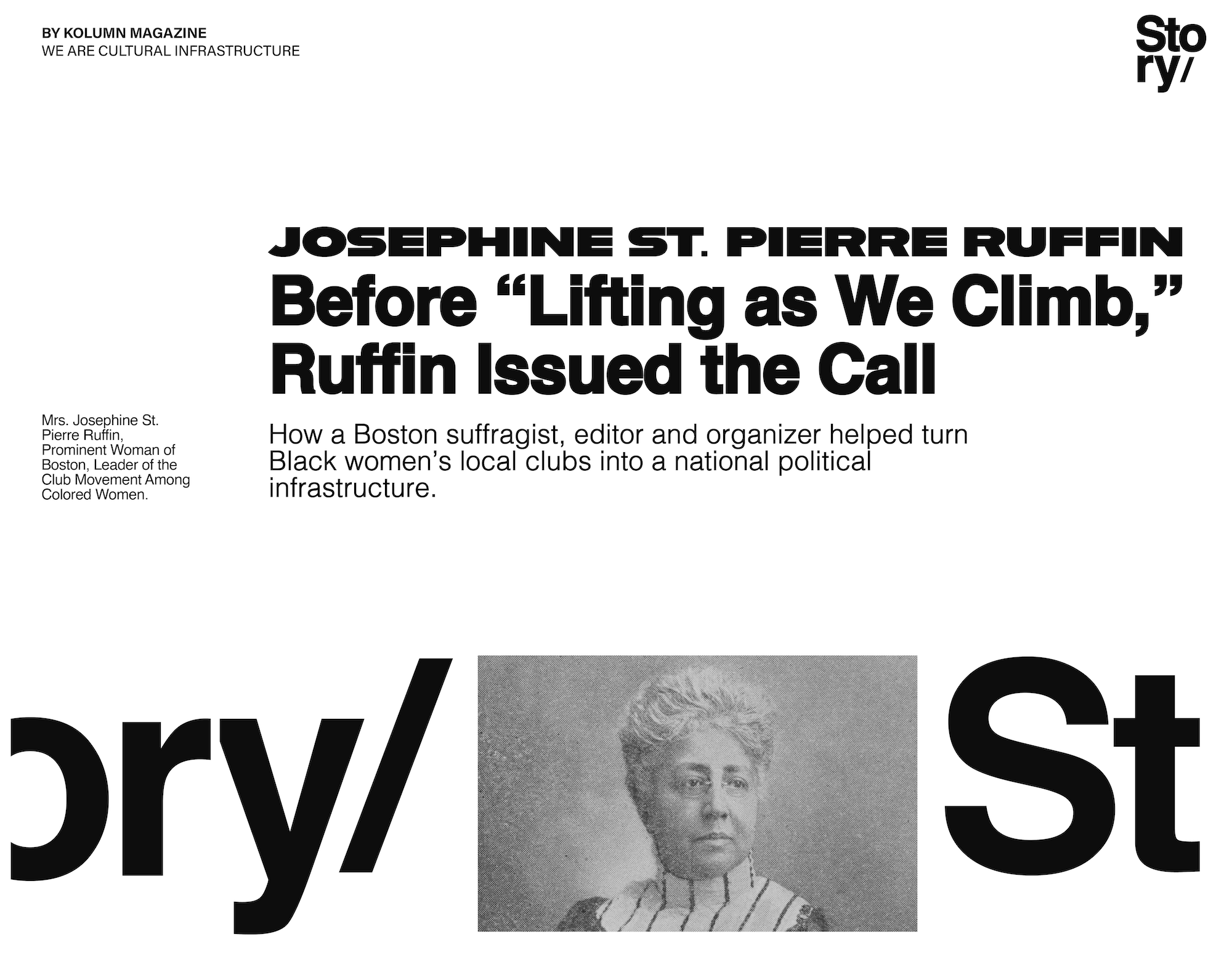
Ruffin understood that Black women needed more than recognition. They needed machinery: clubs, newspapers, conventions, archives, leadership pipelines.
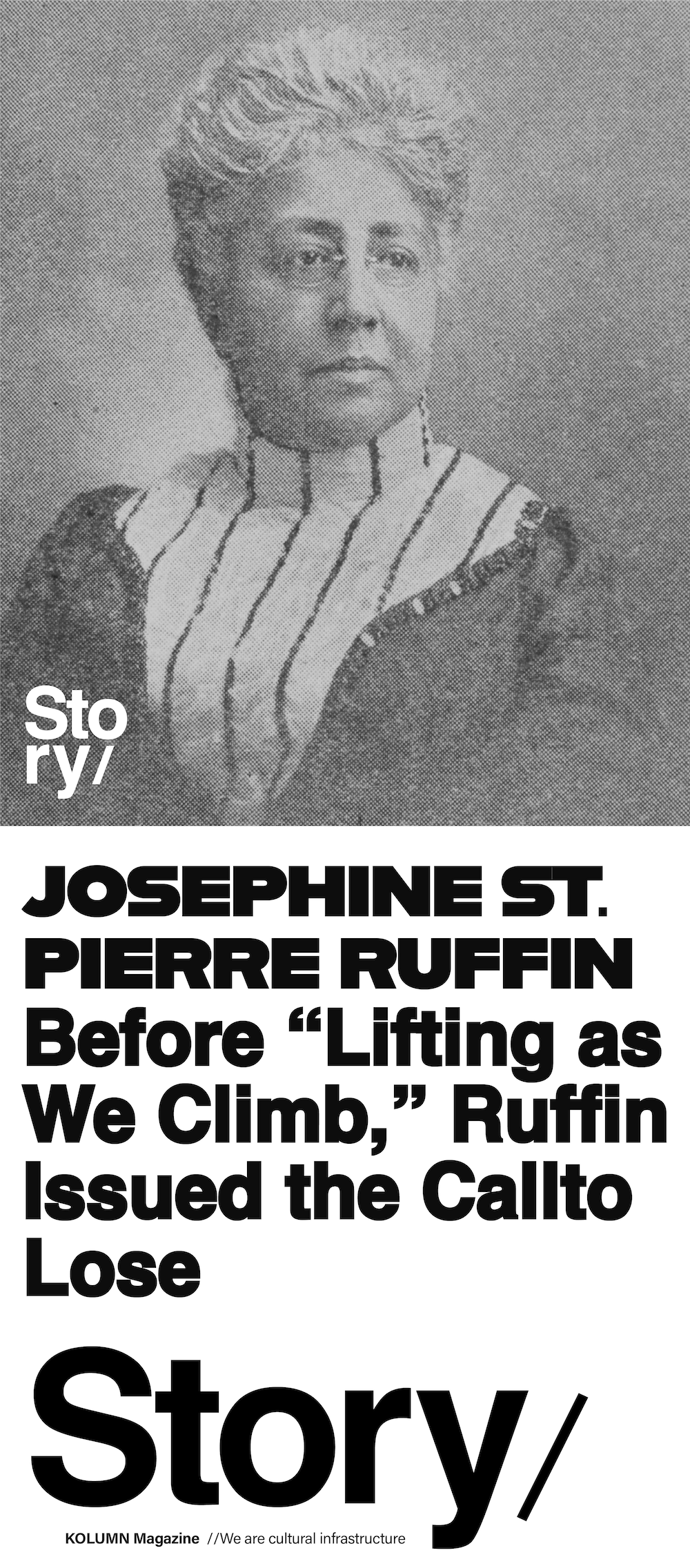
Ruffin understood that Black women needed more than recognition. They needed machinery: clubs, newspapers, conventions, archives, leadership pipelines.
By KOLUMN Magazine
Josephine St. Pierre Ruffin did not simply enter history as a suffragist, journalist, clubwoman or civil-rights organizer. She entered it as an architect of public legitimacy. In the late nineteenth century, when Black women were routinely caricatured, ignored or excluded from both white women’s reform circles and male-dominated racial politics, Ruffin built a structure sturdy enough to hold a nation’s worth of Black women’s ambitions. She founded the Woman’s Era Club in Boston, published The Woman’s Era, and convened the 1895 First National Conference of Colored Women, a gathering widely understood as a foundational moment in the national Black women’s club movement. The National Park Service describes Ruffin as a civil-rights advocate, suffragist, publisher and organizer whose work connected Boston’s Black community to national campaigns for racial justice.
Her life belongs in the same KOLUMN lineage as Frances Harper’s insistence that freedom was never one fight, Alice Dunbar-Nelson’s fusion of education, suffrage and Black print culture, and Nellie B. Nicholson’s quiet architecture of Black women’s civic power. Ruffin’s story is not a decorative footnote to suffrage history. It is one of the load-bearing beams.
Born in Boston on August 31, 1842, Ruffin came of age in Beacon Hill, in one of the North’s most important Black communities. Her father, John St. Pierre, was a successful clothier with roots in Martinique, African and Indigenous ancestry; her mother, Elizabeth Matilda Menhenick, was English-born, according to the National Park Service’s biography. That mixed Atlantic inheritance placed Ruffin inside a world of Black Boston respectability, abolitionist politics and racial contradiction. Boston was often imagined as an antislavery capital, but its schools, associations and public life could still reproduce the exclusions they claimed to oppose. Ruffin’s parents sent her to schools in Salem and New York after confronting Boston’s segregated educational customs, a detail preserved in accounts from BlackPast and the New-York Historical Society’s Women & the American Story project.
At sixteen, Josephine St. Pierre married George Lewis Ruffin, who would become one of Massachusetts’s most consequential Black legal figures. George Ruffin was the first African American graduate of Harvard Law School, the first African American elected to the Boston City Council and the first Black municipal judge in Massachusetts, as Mount Auburn Cemetery’s profile of George Lewis Ruffin notes. Their marriage was not merely domestic partnership; it was political formation. The Ruffin household sat at the intersection of law, abolition, journalism and civic reform.
During the Civil War, Josephine and George Ruffin helped recruit Black soldiers for the Union Army, including Massachusetts’s famed Black regiments, a record noted by the National Women’s Hall of Fame and the National Park Service. That work matters because it reveals Ruffin’s early understanding of citizenship as sacrifice and claim. Black men were asked to fight for a Union that had not yet guaranteed Black freedom as full belonging. Black women, meanwhile, supplied organizing labor that official military narratives rarely dignified. Ruffin’s war work placed her among the women who made emancipation operational.
After the war, Ruffin turned toward relief work, suffrage and racial uplift. She joined reform circles that included white suffragists such as Julia Ward Howe and Lucy Stone, and she became associated with the American Woman Suffrage Association, according to BlackPast. But Ruffin’s political education also taught her a hard truth: interracial reform often had limits set by white comfort. She could be useful, respectable and accomplished, but not always fully welcome. That tension would define much of her later public life.
The central fact of Ruffin’s career is that she did not wait for white institutions to become just. She built Black women’s institutions capable of acting without permission.
The Newspaper as a Political Instrument
In 1893, Ruffin founded the Woman’s Era Club in Boston with help from her daughter Florida Ruffin Ridley and educator Maria Louise Baldwin. The club, based in Ruffin’s home at 103 Charles Street, was one of Boston’s first Black women’s clubs and focused on intellectual development, political discussion and community service, according to the National Park Service site profile of the Woman’s Era Club meeting place. Within a year, the club had grown to more than 100 members, the National Park Service notes, suggesting how urgently Black women needed a civic room of their own.
Then came the newspaper. The Woman’s Era, first issued as a club publication and then circulated nationally, is recognized by Digital Commonwealth as the first national periodical published by and for Black women in the United States. Emory’s digital archive of The Woman’s Era preserves twenty-two extant issues from 1894 to 1897, making visible a publication that was both a newspaper and an organizing platform.
Ruffin’s journalism was not ornamental. It was strategic. The Woman’s Era published club news, political commentary, suffrage arguments, anti-lynching material and reports on Black women’s achievements. It linked Boston to Washington, New York, Chicago, the South and the broader Black diaspora of reform. In a period when mainstream newspapers often treated Black women as social problems rather than political thinkers, Ruffin edited a paper that treated them as citizens, intellectuals and leaders.
This is where historiography becomes essential. For decades, mainstream suffrage histories reduced the movement to a white-centered story of conventions, amendments and famous leaders. Black women appeared, if at all, as marginal auxiliaries. Black feminist historians changed that frame. Paula Giddings’s When and Where I Enter, available in widely circulated academic editions and excerpts, situates Ruffin among a generation of Black women who responded to Ida B. Wells’s anti-lynching campaign by building clubs in Boston, New York and Brooklyn; Giddings writes that after Wells’s 1892 campaign, women including Josephine St. Pierre Ruffin helped announce and organize new Black women’s clubs as the movement spread across the country, a pattern reflected in the text of Giddings’s work. The interpretive point is powerful: Ruffin’s club work was not polite social activity. It was a gendered answer to racial terror.
That matters because the club movement has sometimes been flattened under the phrase “uplift,” as though Black women were simply preaching manners. Ruffin’s uplift was more confrontational than that. It used respectability as shield, platform and sometimes weapon, but its core demand was civic authority. Black women were answering lynching, disenfranchisement, slander, segregation and exclusion. They were also answering the lie that they did not have the organizational capacity to lead.
The Call to Boston
In 1895, Ruffin issued the call for the First National Conference of Colored Women, held in Boston. The meeting brought together approximately 100 Black women at the Charles Street African Methodist Episcopal Church, according to the Schlager Group’s contextual note on Ruffin’s address and the BlackPast text of her speech. The immediate catalyst was the circulation of a racist letter by James W. Jacks, president of the Missouri Press Association, who had defamed Black women in correspondence sent abroad. Ruffin understood the insult not as a private matter but as an international political emergency. Black women had to answer in public.
Her opening address framed the conference as both defense and declaration. She argued that Black women had been maligned and that silence would be read as consent. She also insisted that the gathering was not merely reactive. It was constructive. The women had come to organize, to confer, to measure their work and to assert their place in the national reform landscape.
The 1895 conference helped lead to the National Federation of Afro-American Women and, soon after, to the 1896 formation of the National Association of Colored Women, which brought together several Black women’s organizations. The National Association of Colored Women’s Clubs describes itself as the first national organization for African American women, while the National Park Service’s overview of the Black women’s club movement places Ruffin’s Woman’s Era Club and newspaper among the institutions that helped generate a national movement. Mary Church Terrell became the NACW’s first president, and the organization’s motto, “Lifting as We Climb,” became one of the most durable phrases in Black women’s political history, as the Crusade for the Vote project explains.
But Ruffin’s role should not be reduced to “founder” as ceremonial title. She was a convener in the deepest sense. She identified a crisis, built a communications network, summoned leaders, and helped translate local club energy into national structure. That is political infrastructure.
Boston Was Not Innocent
Ruffin’s Boston is sometimes misremembered as a simple refuge: abolitionist, intellectual, morally superior to the slaveholding South. Ruffin’s life complicates that fiction. She was born into a city with a proud Black abolitionist tradition, but she also confronted segregated schooling, racial exclusion and the paternalism of white reformers. The West End Museum’s profile of Josephine and George Ruffin notes that she experienced discrimination early when a Boston private school rejected her because of race.
This dual Boston—radical and exclusionary, antislavery and anti-Black—shaped Ruffin’s political method. She learned how to work with white allies without surrendering Black autonomy. She understood that proximity to power was not the same as admission. Her career moved through interracial suffrage organizations, Black women’s clubs, newspaper networks and civil-rights organizations because she knew no single institution could carry the whole burden.
That insight feels strikingly modern. Ruffin practiced coalition politics without romanticizing coalition. She knew when to enter, when to challenge, when to build separately and when to make exclusion visible.
The clearest example came in 1900, at the General Federation of Women’s Clubs convention in Milwaukee. Ruffin attended as a delegate connected to three organizations: the Woman’s Era Club, the New England Woman’s Club and the New England Woman’s Press Association. The federation had initially accepted the Woman’s Era Club’s application, but when officials realized it was a Black women’s club, they refused to seat Ruffin as its representative, according to the National Park Service and the Massachusetts Women’s History Center. They reportedly offered to seat her as a representative of the white clubs with which she was affiliated. Ruffin refused.
That refusal is the heart of the “Ruffin Incident.” She would not accept personal inclusion purchased at the price of collective erasure. She would not enter as an exception while the Black women she represented were excluded as a class.
The episode exposed the racial fault line inside white women’s club culture. It also anticipated conflicts that would recur throughout the twentieth century, from suffrage parades to feminist organizations to professional associations that celebrated women’s progress while policing which women counted. Ruffin made the contradiction impossible to miss.
Suffrage Beyond the Ballot
Ruffin was a suffragist, but her suffrage politics cannot be understood as a single-issue campaign. She supported women’s voting rights because the ballot was one instrument of citizenship. But she also knew that Black women needed schools, newspapers, legal protection, economic opportunity and defense against racial violence. The National Park Service’s essay on African American women and the Nineteenth Amendment places Ruffin among Black women who joined interracial suffrage efforts cautiously, aware of the racism they often encountered even inside movements for women’s rights.
The difference between white suffrage and Black women’s suffrage was not simply racial inclusion. It was political scope. Many white suffragists argued for the vote as a symbol of educated womanhood, moral reform or gender equality. Black women had to argue for all of that while also confronting disfranchisement, lynching, labor exploitation, segregation and sexualized racist propaganda. Ruffin’s work demonstrates that Black women’s suffrage activism was never only about the vote. It was about survival and governance.
That is why Ruffin’s newspaper and club work belong in suffrage history as much as marches and amendment campaigns do. She helped create the civic training ground where Black women debated public questions, raised funds, supported education, circulated information and made leadership visible. Political power is not born on Election Day. Ruffin knew it is rehearsed in meeting rooms, printed in columns, argued in committees and defended in public.
The Daughter, the Circle, the Continuity
Ruffin’s activism also moved through family and intergenerational networks. Her daughter Florida Ruffin Ridley helped edit The Woman’s Era and became an educator and activist in her own right. The New-York Historical Society identifies Florida Ruffin Ridley as part of the circle that helped build the Woman’s Era Club, along with Maria Louise Baldwin, one of Boston’s most important Black educators.
This matters because Black women’s movements often grew through dense relational networks—mothers and daughters, teachers and students, club sisters, church members, editors and correspondents. Such networks are sometimes difficult for conventional political history to narrate because they do not always resemble formal party politics. But they were institutions. They moved money, information, strategy and trust.
Ruffin’s work also foreshadowed later Black women’s organizing in Boston. In 1918, she helped found the League of Women for Community Service, an organization connected to Black women’s civic life in the city, according to scholarship on African American women’s civil-rights leadership in Boston available through UMass ScholarWorks. She also became a founding member of the Boston branch of the NAACP in 1910, a fact noted by the Massachusetts State House suffrage exhibit materials and by the Washington Informer.
The NAACP connection is important because it places Ruffin in a longer civil-rights continuum. She was not confined to the post-Civil War era or the 1890s club movement. She lived long enough to see the rise of modern civil-rights litigation, anti-lynching campaigns and national interracial organizations, and she helped anchor that transition.
Respectability, Strategy and the Historian’s Problem
Any honest account of Ruffin has to address the politics of respectability. Like many elite and middle-class Black reformers of her era, Ruffin believed in public dignity, moral argument, education and institutional self-presentation. She wanted Black women to answer racist slander not only by denouncing it but by demonstrating achievement, refinement and civic seriousness.
Modern readers may find this strategy complicated. Respectability politics could sometimes burden poor and working-class Black people with expectations shaped by class privilege. It could imply that rights had to be earned through performance rather than guaranteed by humanity. But in Ruffin’s world, respectability was also a tactical language forced by a hostile public sphere. Black women were fighting obscene caricatures, exclusion from white women’s organizations, sexualized racist myths and claims that they were unfit for citizenship. They used the tools available, while also building new ones.
Historians have increasingly moved away from dismissing clubwomen as merely conservative or genteel. The better reading sees their work as institution-building under siege. The National Park Service’s Black women’s club movement essay emphasizes that clubs addressed politics, education, social welfare, anti-lynching work and community conditions. The New-York Historical Society’s Black women’s clubs teaching resource similarly frames Ruffin’s organizing as a collective response to the need for Black women to meet, deliberate and create opportunity.
The historian’s challenge is to hold tension without flattening it. Ruffin was elite, but not insulated. She was respectable, but not submissive. She worked with white women, but refused tokenization. She valued moral suasion, but also built independent Black power. Her politics were shaped by the constraints of her class and era, but her institutional imagination exceeded those constraints.
The Archive She Left Behind
One of Ruffin’s most enduring legacies is archival. The Woman’s Era gives scholars, journalists and readers access to Black women’s voices at a moment when mainstream archives often excluded or distorted them. The Emory digital edition and the Digital Commonwealth collection allow contemporary readers to see the publication not as myth but as material record.
That record matters. Black women have too often been remembered through institutions they were excluded from, rather than institutions they built. Ruffin reverses the direction of evidence. She left a paper trail produced by Black women for Black women. It documented ambition, disagreement, strategy and intellectual life. It proved that Black women were not waiting for permission to think politically.
In that sense, Ruffin was not only making news. She was making the future archive of Black feminism.
The Significance Now
Josephine St. Pierre Ruffin died in Boston on March 13, 1924, and is buried at Mount Auburn Cemetery, whose profile describes her as the first African American woman to own, edit and publish a newspaper for Black women. Her legacy has since been recognized through the Boston Women’s Heritage Trail, the National Women’s Hall of Fame and public history projects in Massachusetts, including the Massachusetts Women’s History Center.
But Ruffin’s significance is not commemorative alone. She speaks directly to the present because the questions she confronted remain unresolved. Who controls the public image of Black women? What happens when movements for equality reproduce racial hierarchy? How do excluded people build durable institutions? When is coalition useful, and when does it become camouflage for tokenism? What does political power require before and after the vote?
Ruffin’s answer was disciplined and expansive. Build the club. Publish the paper. Convene the conference. Challenge the gatekeepers. Refuse the badge if it requires betrayal. Leave a record.
Her genius was not only that she fought. It was that she understood freedom as infrastructure. That is why her life still matters. Josephine St. Pierre Ruffin helped create the civic architecture through which Black women could argue, organize, publish, defend themselves and lead. She made Black women’s collective power legible in a country determined not to read it.
More great stories
Afro Sheen, Wall Street, and the Architecture of Black Possibility
July 6, 2026
No Comments
The Fire Inside the Fourth
July 5, 2026
No Comments