




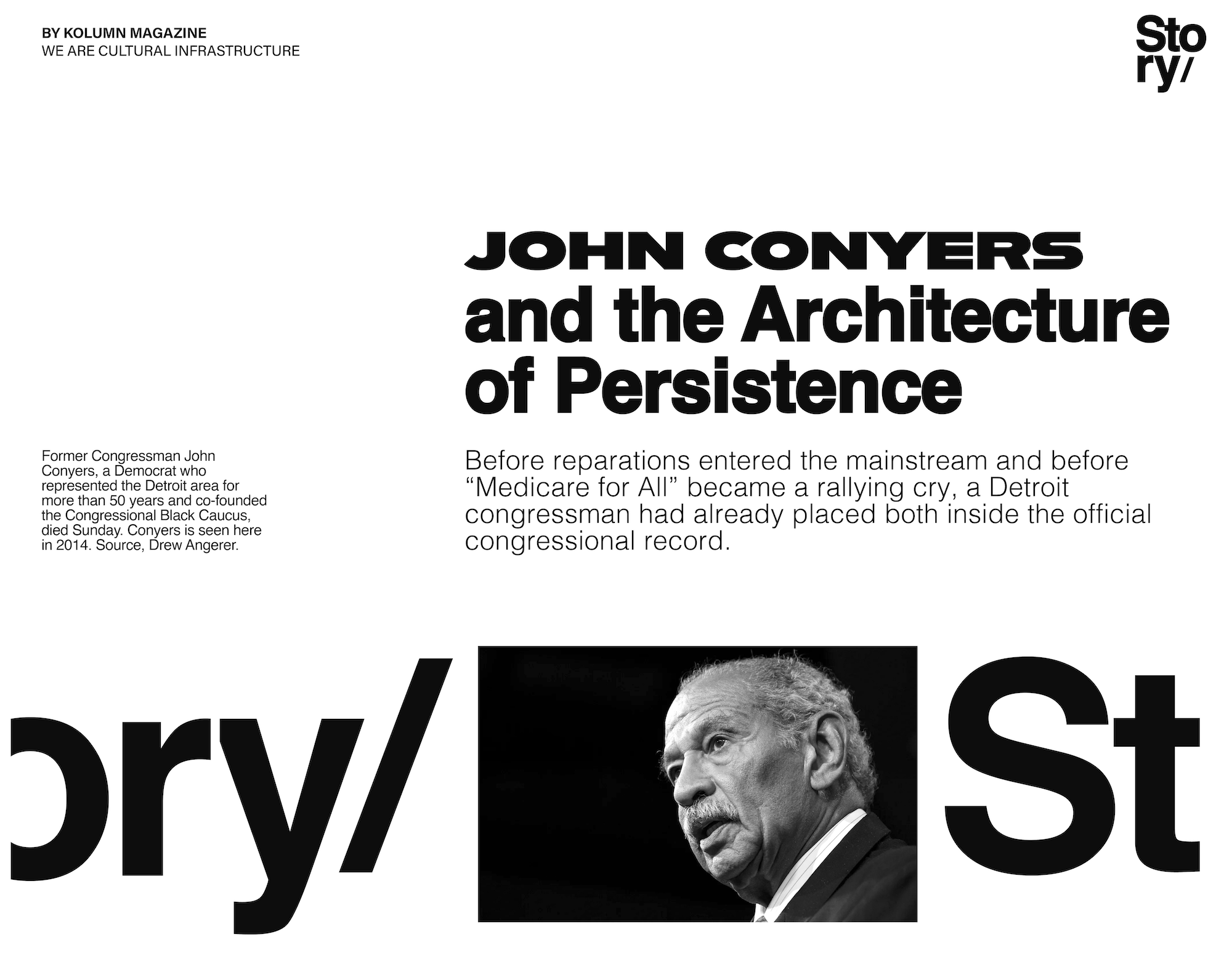
Conyers treated Congress like an archive under construction — one that had to be corrected in real time.
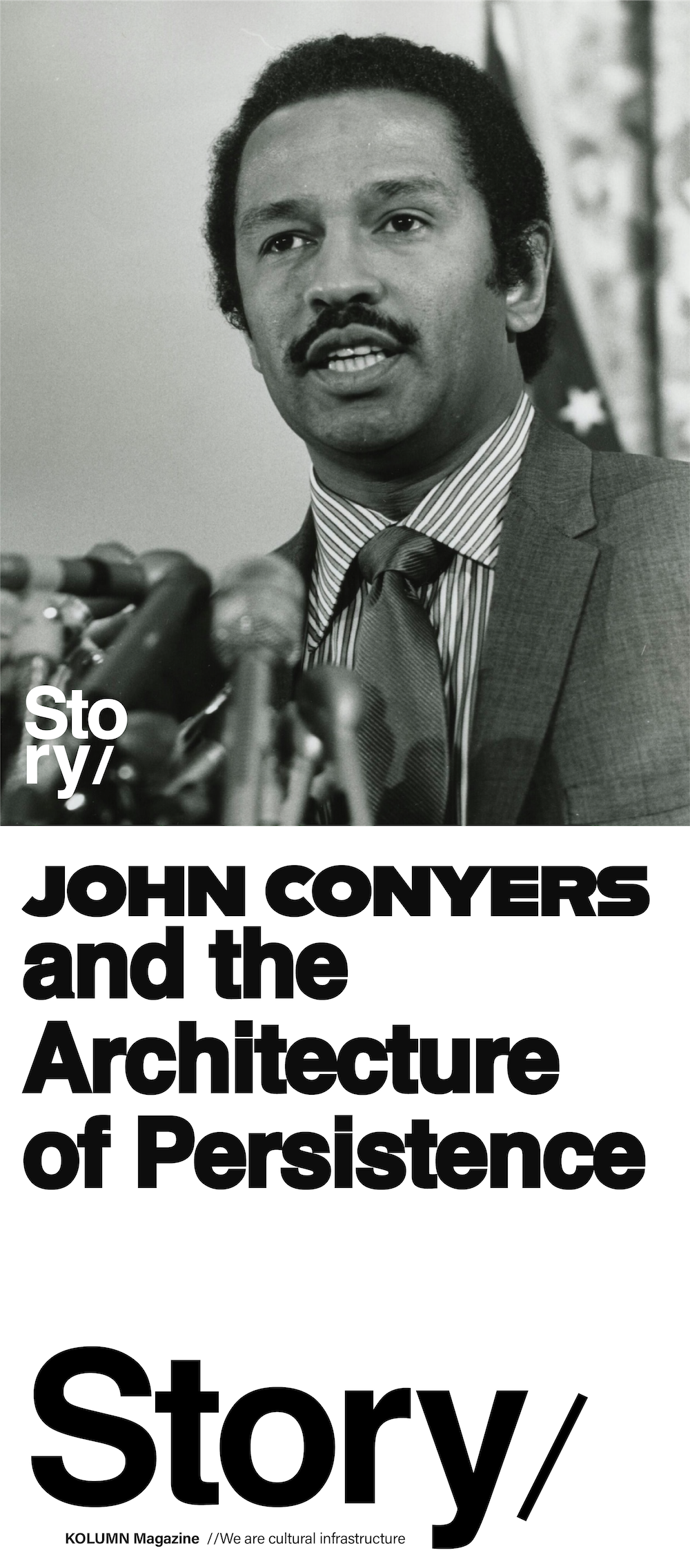
Conyers treated Congress like an archive under construction — one that had to be corrected in real time.
By KOLUMN Magazine
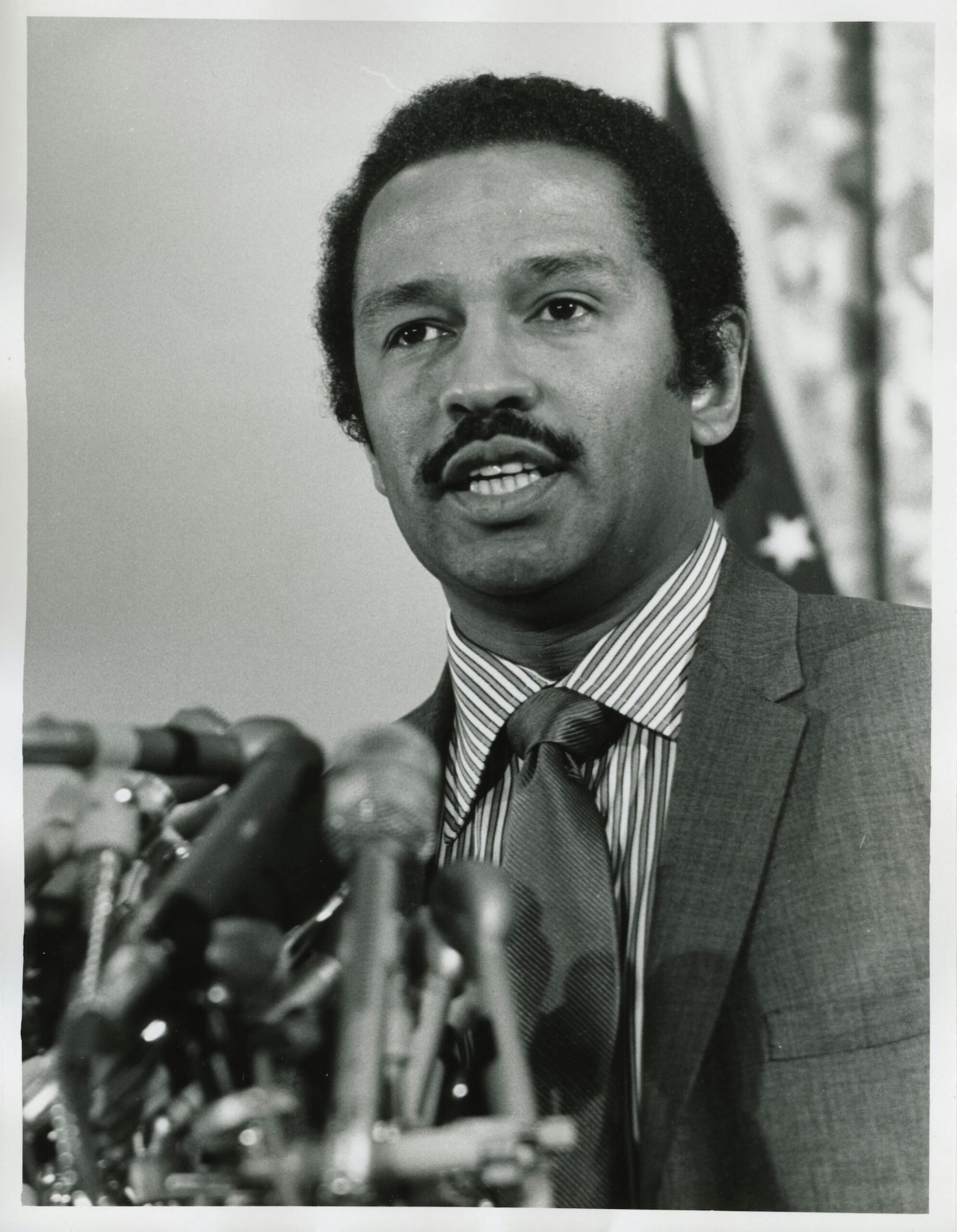
John Conyers Jr. entered Congress in January 1965, the same year the Voting Rights Act transformed American democracy and the same era that elevated Black political leadership into new national visibility. By the time Conyers left office in 2017, he had become the longest-serving African American member of Congress in U.S. history, serving more than fifty years in the House of Representatives, according to the U.S. House of Representatives History, Art & Archives. What made Conyers extraordinary, however, was not longevity alone. It was the peculiar endurance of his political imagination. Long before reparations hearings became mainstream political events, before “Medicare for All” entered Democratic primary debates, and before Martin Luther King Jr.’s birthday became a federally recognized holiday, Conyers had already transformed those ideas into congressional legislation.
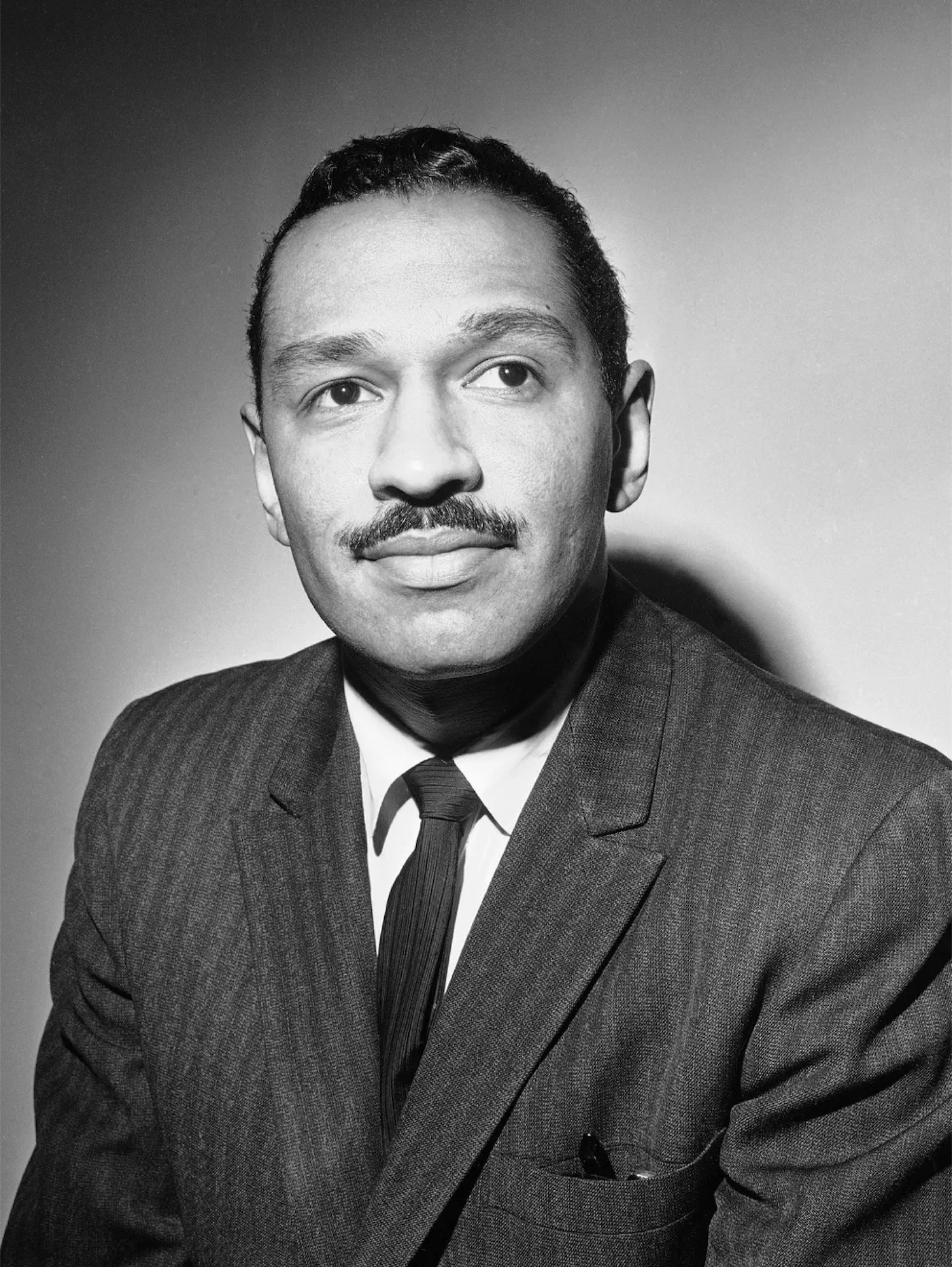
He belonged to a generation of Black lawmakers who understood Congress not merely as a site of governance, but as a battlefield over historical memory. Conyers’ career was built around forcing the federal government to acknowledge what it preferred to minimize. Whether the subject was voting rights, labor protections, antiwar politics, reparations, or racial inequality, Conyers repeatedly used the legislative process to make sure Black political demands remained permanently visible inside the national record.
Born in Detroit on May 16, 1929, Conyers emerged from the industrial and political culture of a city shaped by labor organizing, Black migration, racial segregation, and manufacturing power. According to the Biographical Directory of the United States Congress, he attended Detroit public schools before serving in the Michigan National Guard, the U.S. Army, and the Army Reserve during the Korean War era. He later earned both his undergraduate and law degrees from Wayne State University before entering private legal practice and labor representation.
Detroit shaped Conyers’ political vocabulary. He was raised in a city where Black workers built American industrial prosperity while being denied equal access to housing, public investment, and political representation. That contradiction became central to his politics. Before arriving in Washington, Conyers worked as counsel to labor unions and served on the staff of Congressman John Dingell, according to the House History Office. Those experiences grounded him in the mechanics of organized labor, constituent politics, and federal bureaucracy long before he became a national figure.
His campaign for Congress in 1964 also connected him directly to one of the defining figures of the Civil Rights Movement. Rosa Parks volunteered for Conyers’ first congressional campaign, and after his victory he hired her to work in his Detroit office. The Library of Congress notes that Parks served as a receptionist and administrative assistant in Conyers’ office beginning in 1965, handling constituent issues and community outreach until her retirement in 1988.
That detail matters because it complicates the sanitized mythology surrounding Parks herself. In mainstream retellings, Rosa Parks often appears frozen in a single moment on a Montgomery bus. But Parks’ life in Detroit involved labor activism, anti-apartheid advocacy, community organizing, and political engagement. Conyers understood that movement work did not end with symbolic victories. It continued through offices, institutions, constituent services, and local organizing networks.
In many ways, Conyers’ political life mirrored the larger editorial concerns that have surfaced repeatedly in KOLUMN Magazine’s examinations of figures such as Anna Arnold Hedgeman, Amzie Moore, and Beatrice Morrow Cannady: the relationship between public memory and institutional power. Conyers was not simply a protest politician. He was a builder of infrastructure. He understood that legislation itself could function as historical preservation.
Making Martin Luther King Jr. Federal
Just days after Martin Luther King Jr.’s assassination in April 1968, Conyers introduced legislation to establish King’s birthday as a federal holiday. According to the Martin Luther King Jr. Research and Education Institute at Stanford University, Conyers first introduced the bill four days after King’s death.
At the time, the proposal was treated by many lawmakers as politically unrealistic. Yet Conyers continued introducing the legislation year after year, transforming what initially appeared symbolic into a prolonged national campaign over whether the United States would formally recognize the Civil Rights Movement within its civic calendar.
The eventual success of the campaign owed much to broad organizing efforts led by Coretta Scott King, civil-rights organizations, labor unions, entertainers, and the Congressional Black Caucus. The Smithsonian National Museum of African American History and Culture notes that supporters gathered approximately six million petition signatures advocating for the federal holiday, while musician Stevie Wonder’s “Happy Birthday” campaign further expanded public support.
When Congress finally approved the holiday in 1983, the House passed the legislation by a vote of 338–90, according to the National Museum of African American History and Culture. President Ronald Reagan signed the bill later that year, and the first federal observance occurred in 1986, as documented by the King Institute.
The King holiday campaign revealed something essential about Conyers’ political method. He was willing to introduce legislation before the country was ready to support it. In fact, much of his career consisted of planting legislative markers for futures he believed would eventually arrive.
Founding the Congressional Black Caucus
In 1971, Conyers became one of the founding members of the Congressional Black Caucus, joining lawmakers such as Shirley Chisholm, Louis Stokes, Ron Dellums, Charles Diggs, Parren Mitchell, and Walter Fauntroy in establishing a formal bloc for Black political advocacy inside Congress. The Congressional Black Caucus Foundation and the House History Office both identify Conyers as part of the caucus’ founding generation.
The creation of the CBC represented a profound institutional shift. Prior to the civil-rights era, Black lawmakers often operated in relative isolation inside Congress. The caucus transformed Black congressional representation into a coordinated political force capable of collective bargaining, policy advocacy, and media visibility.
Conyers became one of the caucus’ intellectual anchors. Unlike some politicians who relied primarily on public charisma, Conyers built influence through committee work, legislative endurance, and procedural mastery. Over time, he developed a reputation as one of Congress’ most aggressive defenders of oversight authority and constitutional accountability.
That reputation deepened through his decades-long work on the House Judiciary Committee. The National Archives notes that Conyers was the only African American member serving on the House Judiciary Committee during the 1965 Voting Rights Act debates.
That historical detail is staggering in retrospect. During one of the most important voting-rights fights in American history, only one Black lawmaker sat on the committee responsible for helping shape the legislation.
Conyers later participated in the Judiciary Committee proceedings surrounding the Watergate scandal and the impeachment process against President Richard Nixon. According to the Encyclopaedia Britannica, Conyers eventually became the first African American to chair the House Judiciary Committee when Democrats regained control of the House in 2007.
H.R. 40 and the Politics of Historical Debt
If Martin Luther King Jr. Day demonstrated Conyers’ commitment to institutional memory, H.R. 40 represented his belief that Congress had an obligation to confront historical injustice directly.
In 1989, Conyers introduced H.R. 40, formally titled the Commission to Study and Develop Reparation Proposals for African Americans Act. According to Human Rights Watch, Conyers introduced the legislation shortly after Congress approved reparations payments for Japanese Americans incarcerated during World War II.
The legislation did not immediately demand direct financial compensation. Instead, it proposed creating a federal commission to study slavery, segregation, and systemic discrimination while examining potential reparative policies. Even so, the proposal was widely marginalized for decades.
Conyers continued reintroducing the bill every congressional session for nearly thirty years.
The number itself carried symbolic meaning. “40” referenced the abandoned Reconstruction-era promise of “forty acres and a mule,” a phrase synonymous with the federal government’s failure to provide formerly enslaved African Americans with economic restitution after the Civil War.
For years, reparations remained politically radioactive in mainstream American politics. Yet Conyers maintained the bill as a permanent legislative reminder that the nation had never fully confronted the economic consequences of slavery and racial dispossession.
After Conyers’ departure from Congress, the reparations conversation shifted dramatically. In 2019, writer Ta-Nehisi Coates testified before Congress in support of H.R. 40, and in 2021 the bill advanced out of committee for the first time in history. Human Rights Watch described the committee action as historic, emphasizing Conyers’ decades-long role in sustaining the legislation.
The significance of H.R. 40 ultimately extended beyond legislative outcomes. Conyers transformed reparations from a marginalized activist demand into a recurring congressional debate. He institutionalized the argument itself.
Medicare for All Before It Was Popular
Conyers also played a pivotal role in the development of modern single-payer healthcare politics. In 2003, he introduced H.R. 676, the Expanded and Improved Medicare for All Act. According to Healthcare-NOW, the legislation became one of the foundational congressional proposals advocating for a national single-payer healthcare system.
Today, “Medicare for All” is often associated with later progressive politicians, but Conyers spent years advancing universal healthcare proposals before they achieved mainstream visibility inside Democratic politics.
His support for universal healthcare reflected his broader ideological framework. Conyers viewed healthcare, labor rights, voting access, and racial justice as interconnected issues rather than isolated policy categories. That perspective emerged from Detroit’s political culture, where labor exploitation and racial inequality frequently operated together.
Throughout his career, Conyers consistently aligned himself with antiwar organizing, civil-rights enforcement, labor protections, and expanded social welfare policies. According to the Congressional Black Caucus, he also worked extensively on issues involving criminal justice reform, voting rights, and government oversight.
The Fall and the Complication
No serious examination of John Conyers can avoid the collapse that marked the final chapter of his career.
In 2017, amid the growing #MeToo movement, Conyers faced allegations of sexual harassment from former staff members. Reports also emerged that taxpayer funds had been used to settle a complaint involving a former employee. According to reporting from The New York Times and The Guardian, Conyers resigned from Congress later that year.
The allegations forced many longtime supporters to confront painful contradictions between Conyers’ public legacy and the experiences described by women who worked in his office.
A responsible historical assessment requires holding those realities together. Conyers’ legislative accomplishments do not erase the seriousness of the allegations. Nor do the allegations erase the fact that Conyers played a foundational role in shaping modern Black congressional politics.
That complexity is part of the broader story of American political institutions themselves. Conyers emerged from a congressional culture built on seniority, insulation, and informal power networks. That system enabled him to accumulate enormous influence over civil-rights policy and congressional oversight. It also contributed to the workplace dynamics that ultimately damaged his reputation and ended his career.
The Legacy of Persistence
When John Conyers died in Detroit on October 27, 2019, at age 90, major news organizations emphasized both the magnitude of his career and the controversies surrounding its conclusion. The Washington Post described him as a pioneering Black congressman and co-founder of the Congressional Black Caucus, while The Guardian emphasized both his historic tenure and his resignation amid harassment allegations.
Yet Conyers’ deepest influence may lie in the durability of the ideas he kept alive long enough for later generations to inherit them.
Martin Luther King Jr. Day is now woven into the American civic calendar. Reparations hearings have entered mainstream political discourse. Medicare for All remains a central debate within progressive politics. The Congressional Black Caucus has become one of the most influential ideological caucuses in Congress.
Conyers spent decades introducing legislation that often seemed politically impossible at the time. His career demonstrated that congressional influence is not always measured by immediate victories. Sometimes it is measured by whether an idea survives long enough to become inevitable.
In that sense, John Conyers functioned less like a conventional politician and more like a legislative archivist of Black political demands. He preserved arguments inside the machinery of government until the country was finally forced to confront them again.
More great stories
Afro Sheen, Wall Street, and the Architecture of Black Possibility
July 6, 2026
No Comments
The Fire Inside the Fourth
July 5, 2026
No Comments