




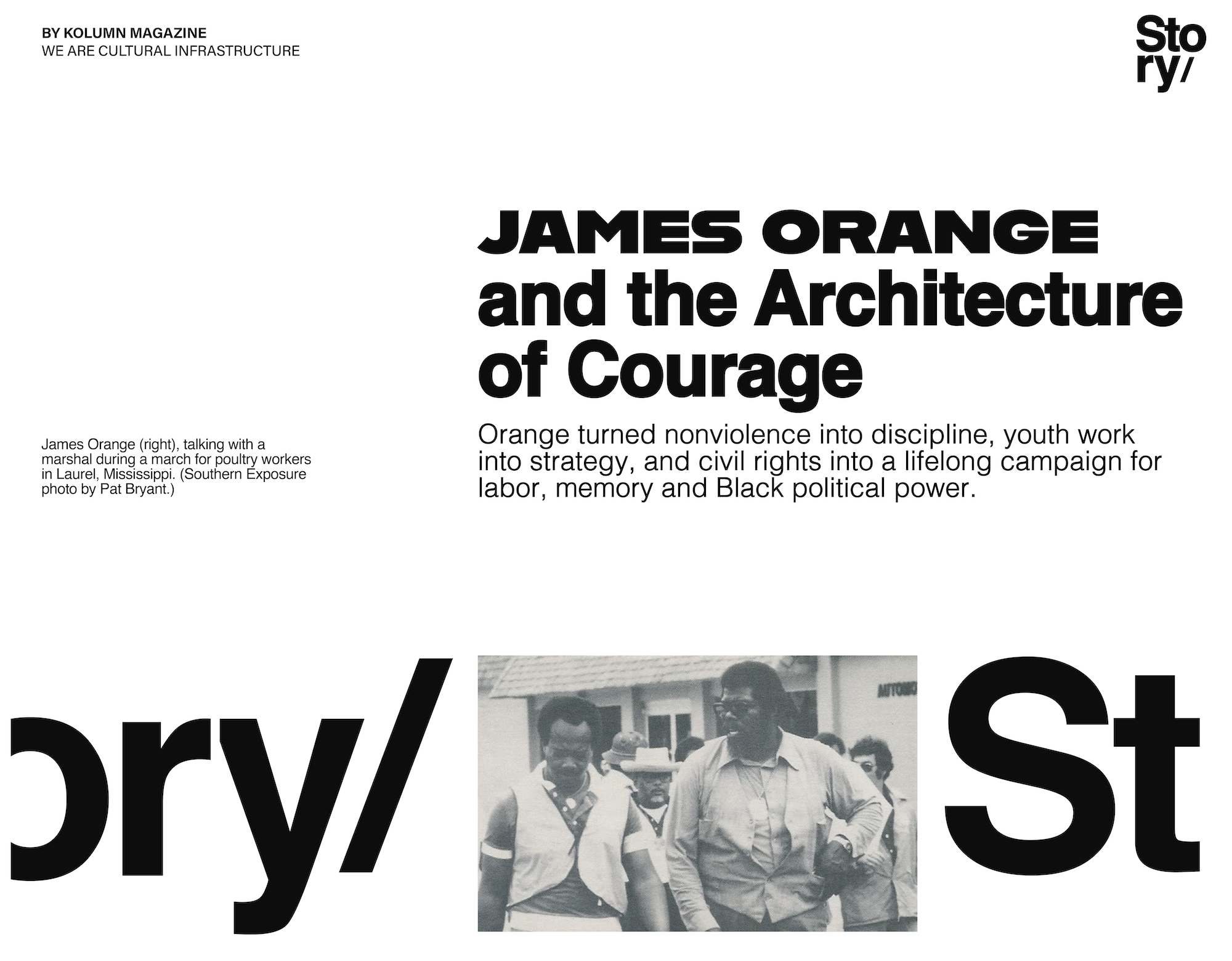
Orange’s life is a reminder that the civil-rights movement was never only a procession of famous speeches and iconic photographs. It was a system of organizers.
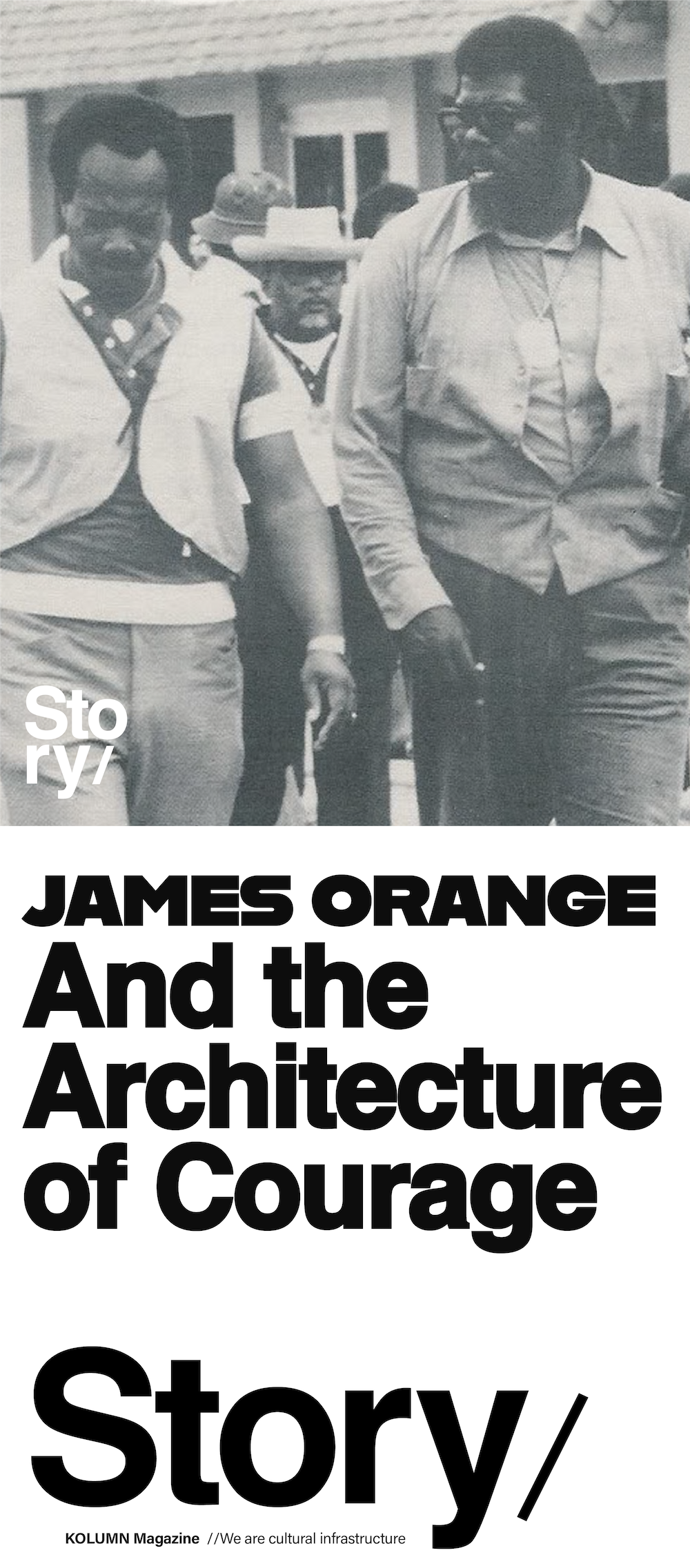
Orange’s life is a reminder that the civil-rights movement was never only a procession of famous speeches and iconic photographs. It was a system of organizers.
By KOLUMN Magazine
James Orange belongs to that class of movement people who are everywhere in the story and still too rarely centered in the telling. He is there in Birmingham, in the furnace of 1963, when mass meetings, jail cells and children’s courage forced the country to look directly at segregation’s machinery. He is there in Marion, Alabama, in 1965, jailed on charges tied to his work mobilizing young people, while a protest over his imprisonment leads into the police violence that fatally wounds Jimmie Lee Jackson and helps propel the Selma-to-Montgomery marches. He is there in Memphis in 1968, near the Lorraine Motel, part of the movement world that had come to stand with striking sanitation workers before Martin Luther King Jr. was assassinated. He is there after the great legislative victories, too, when the movement’s work migrates from lunch counters and courthouses into union halls, city streets, commemorative politics and the unfinished argument over economic justice.
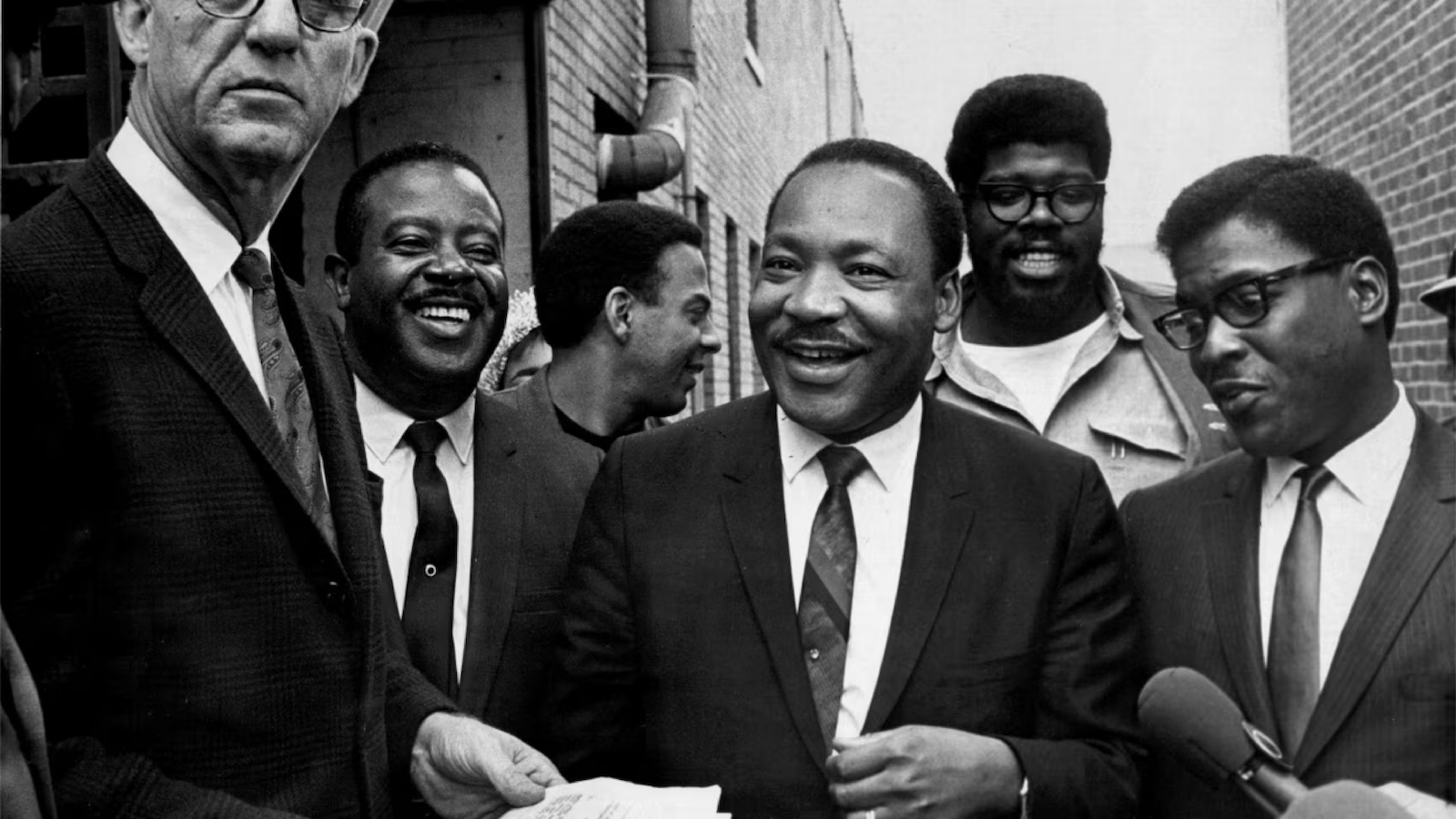
Orange’s life is a reminder that the civil-rights movement was never only a procession of famous speeches and iconic photographs. It was a system of organizers. It was a discipline. It was a network of people who could turn a mass meeting into a march, a jail sentence into a moral crisis, a frightened teenager into a public actor. The Encyclopedia of Alabama describes James Edward Orange as a civil-rights activist who worked with the Southern Christian Leadership Conference and the Alabama Christian Movement for Human Rights, participating in the Birmingham Campaign, the Poor People’s Campaign and the Memphis Sanitation Workers’ Strike, among other major campaigns of the era.
That résumé alone would justify historical attention. But Orange’s importance is not merely that he was present at famous events. His significance lies in the kind of work he did: the human-scale labor of movement-building. He recruited. He sang. He marched. He absorbed violence without returning it. He helped young people understand that their bodies, voices and choices could become instruments of democratic pressure. And, long after the movement was supposed to have “ended,” he carried its logic into labor organizing, anti-apartheid work and the annual rituals of King remembrance in Atlanta.
Birmingham Made Him
James Edward Orange was born in Birmingham, Alabama, in 1942, a fact that matters because Birmingham was not simply a hometown; it was a political education. The city was one of the citadels of Southern segregation, a place where racial control was enforced through law, employment, policing, custom and terror. Orange’s father worked at the American Cast Iron Pipe Company and, according to biographical accounts summarized by the Encyclopedia of Alabama, was fired in 1957 for union activity — an early family lesson in the connection between racial justice and labor power.
That connection would define Orange’s later life. Many civil-rights narratives are told as if the movement moved neatly from segregation to voting rights, then dissolved into commemoration. Orange’s career refuses that simplification. He understood, from family history and organizing experience, that political dignity and economic dignity were inseparable. A worker fired for union activity, a Black voter blocked at the courthouse, a sanitation worker forced to carry leaking tubs of refuse, a textile worker fighting for representation — these were not separate moral problems. They were variations on the same American question: who gets to stand upright?
Orange’s formal entrance into the movement came in Birmingham in 1963. Accounts of his life often return to the moment he heard Ralph Abernathy speak at a mass meeting at Sixteenth Street Baptist Church. The Washington Post, in its obituary, described Orange as one of the first full-time field organizers for SCLC, hired by King to mobilize young people in the early 1960s. The Civil Rights Movement Veterans archive remembers him as “Shack Daddy,” a physically imposing but understated organizer who became a major presence in Atlanta’s King holiday marches.
The nickname matters because it captures something essential about Orange’s style. He was not merely large in body, though he was often described as more than six feet tall and roughly 300 pounds. He had a large organizing presence. He could hold a crowd, steady young people, move through danger and make others feel that they had a role to play. In movement culture, that was not charisma for its own sake. It was infrastructure.
The Organizer as Recruiter
Orange’s work with young people placed him inside one of the most controversial and effective dimensions of the civil-rights struggle. The Birmingham Campaign had demonstrated that children and teenagers could shift the political atmosphere when adults were economically constrained or too vulnerable to risk arrest. That tactic carried enormous moral force and enormous danger. It also drew the fury of segregationist authorities, who understood that youth participation undermined the entire architecture of fear.
Orange became known for drawing young people into nonviolent protest. The Washington Post reported that King hired him to mobilize youth, and the National Park Service notes that in Marion, Alabama, Orange was jailed for “contributing to the delinquency of minors” amid a voting-rights campaign. That charge reveals the absurdity and menace of the segregationist order. To encourage Black children to sing freedom songs, march and imagine themselves as citizens was treated as delinquency. The state understood freedom work as corruption because freedom work taught young people not to accept the state’s lies.
There is a tendency, in retrospect, to sentimentalize the children of the movement. We see the old footage and admire their courage. But organizers like Orange had to do more than admire it. They had to prepare it. They had to explain nonviolence not as passivity but as control under pressure. They had to make jail less mysterious, fear less isolating and discipline more powerful than rage. In Chicago, later accounts noted, Orange worked to persuade street gangs to practice nonviolent civil disobedience; the American Postal Workers Union, drawing on AFL-CIO tributes, described him as a “gentle giant” who played key roles in Selma, Memphis and Chicago.
That phrase — gentle giant — is common in descriptions of Orange, but it can flatten him if treated only as personality. His gentleness was tactical. His size could have made him threatening in the eyes of police and segregationists; his commitment to nonviolence made him something more difficult to defeat. He embodied restraint without surrender. He taught that courage was not a mood but a practice.
Marion Before Selma
The most historically consequential episode in Orange’s life may be the one in which he is absent from the street because he is locked inside the jail.
In February 1965, the voting-rights struggle in Alabama was already escalating. Selma had become a national focal point, but the campaign was never confined to Selma alone. Nearby Marion, in Perry County, was also part of the landscape of disfranchisement and resistance. Orange was arrested there during organizing work connected to voting rights and youth mobilization. The National Park Service records that, after hundreds of Black children had been arrested for peacefully marching around the courthouse on February 3, Orange was jailed for “contributing to the delinquency of minors.”
On the night of February 18, about 500 people left Zion United Methodist Church in Marion and attempted to walk to the Perry County Jail, where Orange was being held. According to the National Park Service, the demonstration was organized after activists heard threats were being made against Orange; marchers planned to sing hymns and return to the church. The King Institute at Stanford recounts that Jimmie Lee Jackson took refuge at Mack’s Café after troopers broke up the night march protesting Orange’s arrest; there, an Alabama state trooper shot Jackson in the stomach as Jackson tried to protect his mother from being beaten.
Jackson died eight days later. His death became one of the catalytic events leading to the Selma-to-Montgomery marches. The National Park Service states that Jackson’s killing helped inspire the marches and the broader push that culminated in the Voting Rights Act of 1965. The Washington Post framed Orange’s 1965 jailing as an event that “set in motion” developments leading to the bloody Selma-to-Montgomery march.
History often remembers Selma through the Edmund Pettus Bridge. That is understandable. Bloody Sunday gave the nation an image of state violence so clear that denial became difficult. But to understand Selma fully, one must move backward from the bridge to Marion, from the televised spectacle to the local jail, from the famous march to the less famous arrest. Orange’s incarceration was not incidental. It exposed the volatility of a county where Black demands for citizenship were treated as threats, and it revealed how quickly a local act of solidarity could become a national turning point.
KOLUMN has repeatedly returned to the idea that Selma was built before it became symbol. In its profile of Bernard Lafayette, “Selma’s First Architect,” KOLUMN emphasized that Selma’s public drama rested on unglamorous groundwork — voter registration, door-knocking, training, local courage and repeated confrontation with violence. Orange belongs in that same architecture. He was not simply swept into Selma’s history. He helped create the conditions that made the nation confront it.
Nonviolence Was Not Softness
One of the great misunderstandings of the civil-rights movement is the belief that nonviolence was a temperament. In this lazy version, nonviolent activists were naturally gentle people who preferred peace. Orange’s life teaches the opposite. Nonviolence was not softness. It was training, discipline, theology, strategy and risk. It demanded that people walk toward clubs, dogs, guns and jails without allowing the violence of the state to dictate the moral terms of the encounter.
Orange’s physical presence made this even more striking. The Washington Post called him “an amiable giant of a man” and described him as one of SCLC’s first full-time field organizers. But a large Black man practicing nonviolence in the Jim Crow South was not being passive. He was refusing the script written for him. Segregationist power depended on caricature: the Black protester as criminal, agitator, threat. Orange’s discipline helped defeat that script in public.
His singing mattered, too. In movement spaces, song was not decoration. It was emotional technology. It steadied the fearful, unified the crowd and transformed danger into shared purpose. Orange’s baritone became part of his organizing identity. Movement veterans remembered him as a march leader and organizer, but also as a presence who could animate people through sound and spirit.
This is why Orange’s life cannot be reduced to the dramatic episodes around him. His gift was not only being at the flashpoints. It was helping people arrive there prepared. The popular memory of movements often rewards the confrontation itself: the march, the arrest, the televised beating. But a confrontation is only the visible tip of a much larger structure. Someone has to recruit the marchers, plan the route, calm the parents, speak to the students, call the ministers, coordinate with lawyers, train people not to retaliate and persuade the fearful that fear does not have to have the final word. Orange did that work.
Memphis and the Economic Meaning of Freedom
By 1968, the movement was speaking more insistently about poverty, labor and economic power. King’s final campaigns made explicit what had always been present: civil rights without economic justice would leave the structure of inequality intact. Orange was part of that terrain. The Encyclopedia of Alabama places him at the Memphis Sanitation Workers’ Strike, where King had gone to support Black workers demanding dignity, safety and recognition.
Memphis is often remembered through the assassination, and necessarily so. But before April 4, 1968, it was a labor struggle. Sanitation workers were not asking for symbolic inclusion. They were demanding the material conditions of personhood: safe work, fair pay, union recognition, respect. Their “I AM A MAN” signs distilled the relationship between labor and citizenship into four words.
Orange’s later career suggests that he understood Memphis not as an endpoint but as a mandate. After his SCLC years, he became a labor organizer. The AFL-CIO remembered him as one of America’s great advocates for social justice after his death in 2008. The Washington Post noted that he later became an AFL-CIO organizer and fought apartheid in South Africa.
The labor chapter of Orange’s life is not a secondary act. It is central to his meaning. It shows that the movement’s demand for freedom did not stop at access to public accommodations or the ballot. It continued into the workplace. It moved through union campaigns, textile mills and industrial organizing. It insisted that democracy had to mean something during the workday, not only on Election Day.
This continuity matters now because the civil-rights movement is too often commemorated in ways that strip it of economics. America likes the movement best when it can be translated into manners: be kind, include others, judge by character. Orange’s life points toward a more demanding interpretation. He came out of a household marked by labor retaliation. He helped fight segregation. He stood with voting-rights organizers. He supported workers. He entered the labor movement. His life says that civil rights was always also a labor struggle.
The Long Afterlife of Movement Work
Orange did not disappear after the 1960s. That fact alone challenges the way America narrates Black freedom movements. Too often, the story is compressed into a heroic decade, then sealed off. But organizers kept organizing. They moved into unions, city politics, schools, churches, community organizations and commemorative institutions. They fought apartheid. They trained younger activists. They argued over memory. They defended the meaning of King from political domestication.
Orange helped organize Atlanta’s annual King holiday observances. The Civil Rights Movement Veterans archive remembers him as the person who constructed and directed citywide marches to King’s tomb in Atlanta from the 1980s until his death. That work might sound ceremonial, but commemoration is never neutral. Who gets remembered, how they get remembered, who controls the platform, what politics are permitted in the room — these are live struggles.
In 2004, those struggles became public when President George W. Bush planned to mark King’s birthday in Atlanta while also attending a Republican fundraiser. Contemporary accounts noted that Black leaders objected to the disruption of local commemorations; Orange was among those involved in defending the integrity of the observance. The details, reported in outlets including The New York Times and summarized in later biographical accounts, show Orange still working the boundary between memory and politics.
That boundary remains contested. King is invoked by people who oppose the very policies King supported. Voting rights are praised in anniversary speeches while being narrowed in legislatures and courts. Labor dignity is celebrated in murals while workers fight for wages, safety and bargaining power. Orange’s post-1960s work is a warning against turning the movement into marble. He knew that memory could either sharpen the struggle or soften it into harmless nostalgia.
KOLUMN’s recent civil-rights coverage has repeatedly explored this problem. In “When the Bridge Became a Battlefield,” KOLUMN described Bloody Sunday as a national test of whether the federal government would protect constitutional rights when a state refused to do so. In “The Strategist in the Shadows,” KOLUMN traced how James Bevel’s strategic logic helped force the contradiction of state violence into public view. Orange’s story belongs in that same continuum: the organizer whose jailing helped expose the contradiction, and whose later work insisted that the contradiction had not vanished.
What James Orange Teaches
James Orange died on February 16, 2008, in Atlanta. He was 65. The Washington Post reported that he died at Emory Crawford Long Hospital after gallbladder surgery, with the cause initially unknown, according to his daughter Jamida Orange. The Los Angeles Times likewise described him as a civil-rights leader whose 1965 jailing helped set in motion events leading to the Selma-to-Montgomery march.
But the measure of his life is not only in the obituary language of proximity — aide to King, lieutenant of SCLC, witness to Selma. Those titles are accurate, but they risk making him appear as a supporting figure in someone else’s story. Orange’s life deserves a more exact reading. He was a builder of people. He was an organizer of courage. He understood that movements require not only brilliant leaders but reliable hands, strong voices, disciplined bodies and people willing to do the same necessary tasks again and again.
His arrest in Marion reminds us that history can turn on events that, at first, appear local and contained. A jailed organizer. A night march. A darkened street. A young man trying to protect his mother. A gunshot. A funeral. A bridge. A law. The chain is not clean, and it should not be made clean. Jimmie Lee Jackson’s death was not a metaphor. It was the killing of a young Black man. Orange’s jailing was not a mere prelude. It was part of a deliberate attack on voting-rights organizing. The Selma marches were not inevitable. They were built from grief, strategy, outrage and discipline.
Orange’s labor work reminds us that the civil-rights movement did not retire after the Voting Rights Act. It confronted the next layer of the same old problem: the gap between legal citizenship and lived power. The workplace became another courthouse. The union hall became another mass meeting. The picket line became another march route. Orange moved across those spaces because he recognized the same struggle in each of them.
And his work around King commemoration reminds us that memory itself is a field of action. To remember King honestly is to remember the movement’s demands for voting rights, labor rights, peace and economic justice. Orange did not preserve King by embalming him. He preserved King by organizing in his name.
The Giant in the Background Was Holding Up the Room
There is an old habit in American history: reduce movements to a few names, a few dates, a few monuments, then wonder why the lessons feel thin. James Orange thickens the story. He forces us to see the connective tissue — Birmingham to Marion, Marion to Selma, Selma to Memphis, Memphis to labor, labor to memory, memory back to the unfinished fight over democracy.
He also forces us to honor a particular kind of leadership. Not the leadership of permanent spotlight, but the leadership of availability. Orange was there when young people needed someone to tell them they were leaders. He was there when jailed organizers needed protection. He was there when workers needed solidarity. He was there when commemorations needed political spine. He was there when the movement required someone large enough to command attention and disciplined enough not to misuse it.
That may be his most enduring significance. James Orange demonstrated that history is not made only by those who deliver the speech. It is made by those who get people to the church before the speech begins, who walk them into the street afterward, who stand outside the jail, who keep singing when fear rises, who turn memory into obligation.
The civil-rights movement did not happen because America suddenly became ready for justice. It happened because people like James Orange made injustice harder to hide and harder to administer. They organized the pressure. They absorbed the punishment. They trained the next person. They returned the next day.
That is why Orange should be remembered not as a footnote to Selma, but as one of the movement’s essential organizers — a man whose life shows how freedom struggles actually work. Not as miracle. As labor. As discipline. As song. As risk. As the long, stubborn practice of calling ordinary people into extraordinary responsibility.
More great stories
Afro Sheen, Wall Street, and the Architecture of Black Possibility
July 6, 2026
No Comments
The Fire Inside the Fourth
July 5, 2026
No Comments