




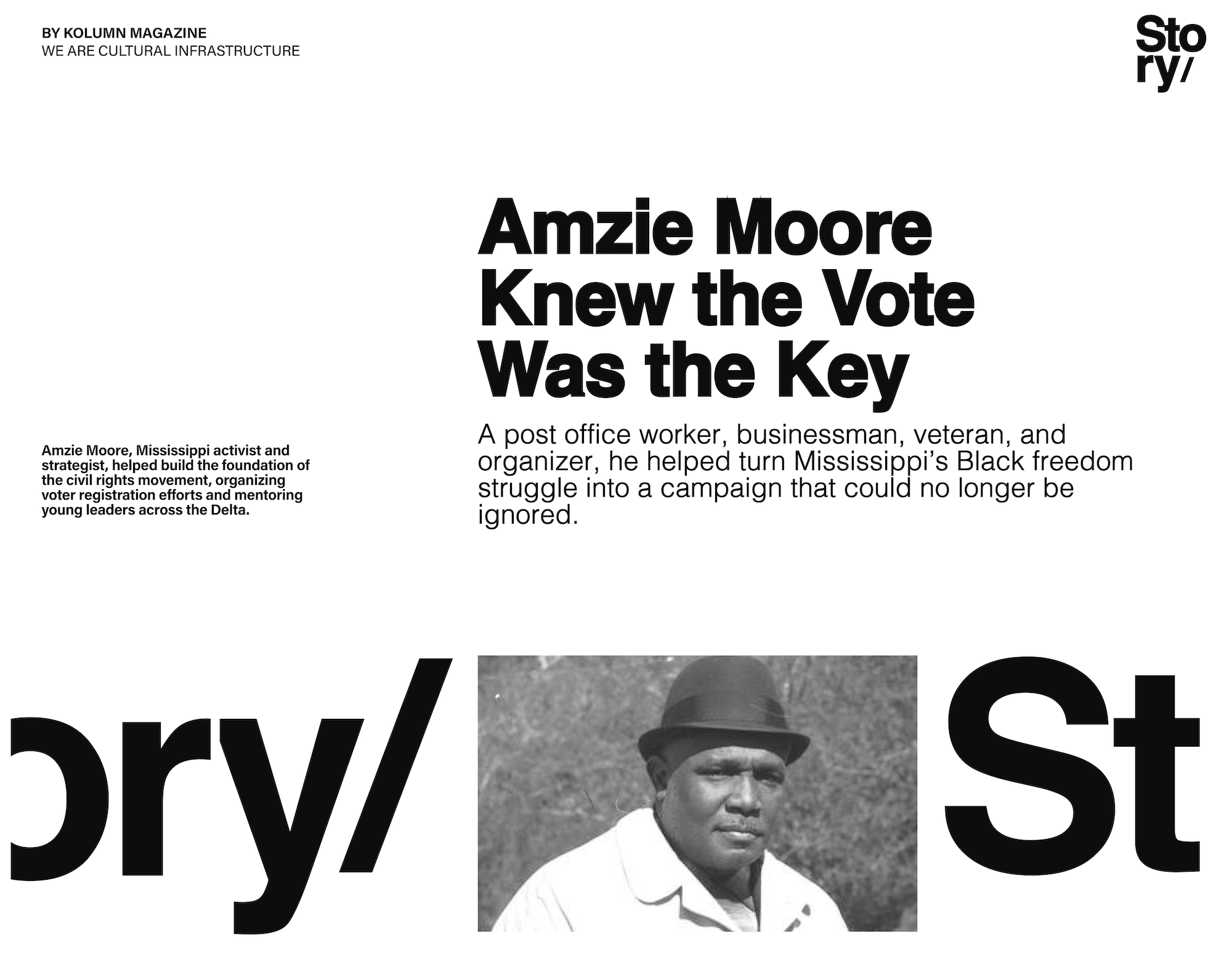
Moore was arguing that political exclusion was the state’s central architecture of white supremacy.
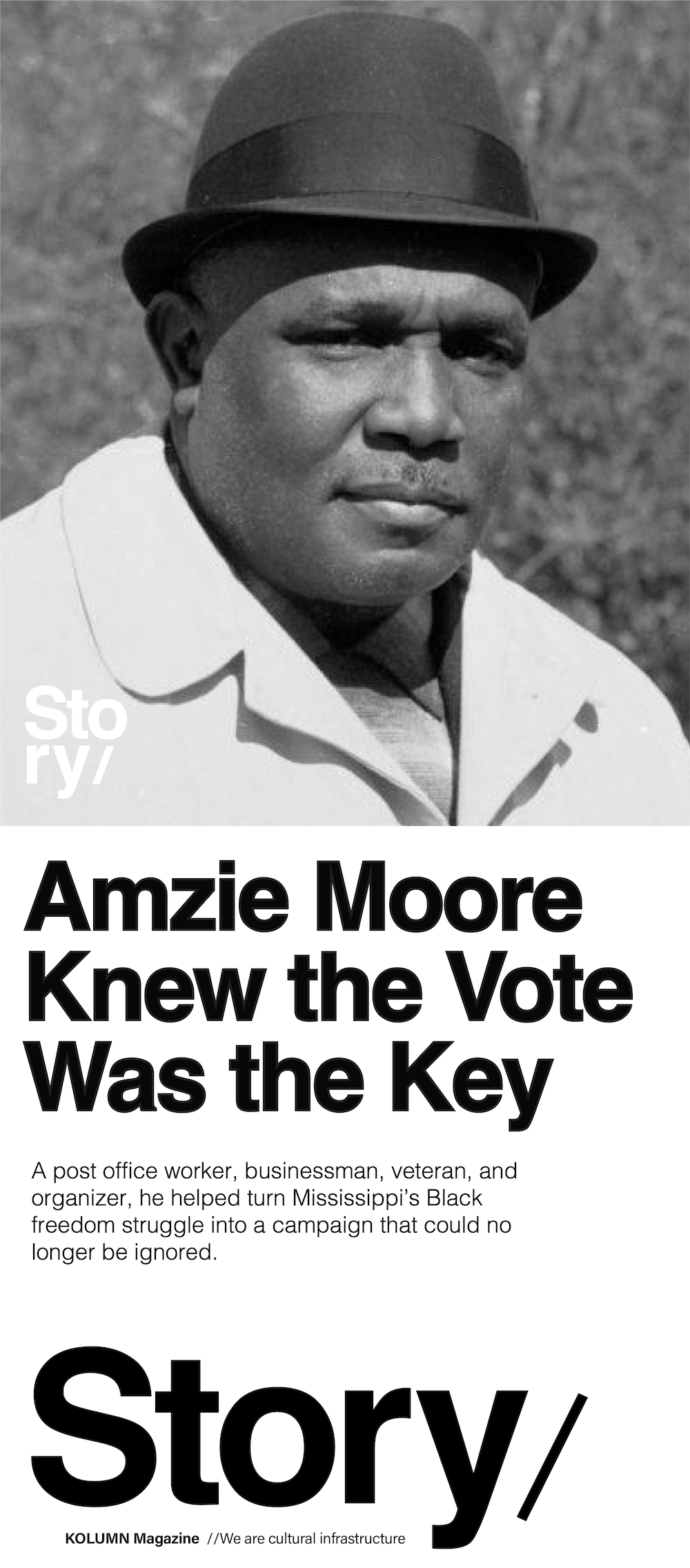
Moore was arguing that political exclusion was the state’s central architecture of white supremacy.
By KOLUMN Magazine
There are civil rights figures whose names arrive with instant recognition, and then there are the people without whom the story makes far less sense. Amzie Moore belongs firmly in the second category. He was not the movement’s most famous voice. He did not become a national television personality. He was not mythologized in the same way as Martin Luther King Jr., Medgar Evers, or Fannie Lou Hamer. And yet when you begin tracing how Mississippi’s freedom struggle actually worked—how it moved from local frustration to organized challenge, from private terror to public confrontation, from courthouse exclusion to mass political action—Amzie Moore keeps showing up at every hinge point that matters. He was there before the headlines, before Freedom Summer, before the Mississippi Freedom Democratic Party, before student organizers fully understood Mississippi. In many ways, he helped make all of that possible.
Moore’s significance lies partly in what he did and partly in what he understood earlier than many others. He understood that in Mississippi, the vote was not a side issue or a technical issue. It was the mechanism that locked everything else in place: the schools, the sheriffs, the courts, the road patrol, the registrars, the economic retaliation, the daily humiliation. Long before voter registration became the defining project of the Student Nonviolent Coordinating Committee in Mississippi, Moore was arguing that political exclusion was the state’s central architecture of white supremacy. Robert “Bob” Moses later said Moore recognized that voting rights and the political action that followed were the key to “unlocking” Mississippi. That is not a small historical footnote. That is strategic authorship.
To call him only an activist, though accurate, feels incomplete. He was also a veteran, a postal worker, a businessman, a church man, a recruiter, a movement host, a local institutionalist, and a translator between generations. He belonged to the older Black organizing tradition in Mississippi—NAACP branches, civic clubs, church networks, economic self-help circles—but he also understood the urgency, nerve, and moral clarity of the student movement. That bridge mattered. SNCC did not simply descend on Mississippi and invent local struggle out of thin air. It entered a landscape shaped by people like Amzie Moore, who had been laying groundwork for years and who knew both the danger and the possibility of organizing in the Delta.
A life formed in hardship
Amzie Moore was born on September 23, 1911, in Grenada County, Mississippi, on Wilkin Plantation, into a world structured by sharecropping, debt, and racial hierarchy. His family’s circumstances were fragile from the start. His parents separated when he was young, and when his mother died, he was only fourteen. He continued his schooling through the tenth grade at Stone Street High School in Greenwood, which was as far as Black students in that setting could go. The limitations were not incidental. They were part of the design of Jim Crow: enough education to labor, not enough to lead. Yet even in those early years, Moore was building the habits that would define him later—civic involvement, political curiosity, and an appetite for community institutions. After moving to Bolivar County in 1935, he took a job with the post office and became active in organizations including the Black and Tan Republican network; he also helped start what may have been the first Black Boy Scout troop in the Mississippi Delta.
That detail about the Boy Scout troop is worth lingering over because it tells you something essential about Moore’s politics. He was not waiting for the 1960s to become a leader. His activism did not suddenly appear once the nation’s attention turned to Mississippi. He was already interested in institution-building, youth formation, and practical citizenship. He believed Black life in the Delta needed more than protest alone. It needed infrastructure—social, educational, moral, and economic. That instinct would later shape the way he thought about civil rights organizing. He did not see freedom as an abstract moral condition. He saw it as something that required structures, routines, training, and organized people.
A 1940 conference on Black economic and educational advancement helped sharpen his political consciousness, but World War II transformed it. Drafted in 1942, Moore entered the U.S. military and encountered a broader world that forced him to reconsider what he had been taught about Black subordination. According to the SNCC Digital Gateway, he later reflected that his service “opened his eyes.” He had grown up believing Black subjugation was somehow ordained; military service and exposure to other environments convinced him otherwise. In oral history and later recollection, he framed the experience as an awakening. He learned that “people are just people,” a simple line with enormous weight for a man raised inside Mississippi apartheid.
Mississippi Encyclopedia adds another layer to that awakening. Moore was enraged by the hypocrisy of serving in a war supposedly fought for freedom while Black soldiers continued to face segregation and indignity. He was even expected to help boost morale among Black troops and soften their anger at the injustices they were living through. Instead, the contradiction radicalized him. He later asked, in effect, why Black soldiers were fighting for the “four freedoms” abroad while being denied freedom themselves. That paradox—patriotism without citizenship, service without equality—was central to the postwar generation of Black Southern veterans. In Moore’s case, it sharpened his determination and sent him home with a clearer political purpose.
Coming home to terror—and organizing anyway
When Moore returned to Mississippi after the war, he came back not to gratitude but to a South trying to discipline Black veterans before they could convert military service into political confidence. Mississippi Encyclopedia notes that he saw rising white violence as a campaign of intimidation directed in part at returning Black servicemen. This was not paranoia. It was the political climate. White power in Mississippi understood that war had changed people. Men who had traveled, worn uniforms, handled weapons, and seen other social arrangements were less likely to accept the old order without question. Moore was among those who came back unwilling to resume submission.
He joined the NAACP while serving abroad and, once home, became deeply involved in local and regional organizing. With Dr. T. R. M. Howard and others, he helped found the Regional Council of Negro Leadership, or RCNL, one of Mississippi’s most important early civil rights organizations. The RCNL blended civil rights advocacy with economic strategy. It pushed boycotts against businesses that took Black dollars while denying Black dignity. It held meetings, drew major speakers, pressed for voting rights, challenged police brutality, and offered a space for Black Mississippians to imagine themselves as citizens with leverage. The Mississippi Department of Archives and History notes that RCNL held voter registration classes, including some in Moore’s home. That alone tells you a lot: Moore’s house was not only a residence. It was already becoming political ground.
He also made a name for himself as a businessman. In 1954, he opened a combined gas station and café in Cleveland. Here again, the specifics matter. Moore refused to erect “white” and “colored” restroom signs, even though that decision carried economic risk. According to the SNCC Digital Gateway, local whites retaliated by cutting off his access to credit. He kept his home lit by floodlights and well-armed. Those details do not turn him into a folk hero of machismo; they place him in the actual political economy of the Delta. To insist on ordinary dignity in business dealings was itself a confrontation. To survive it required vigilance, strategy, and nerve.
The mood of those years can be flattened in retrospect, as though everyone simply lined up on the right side of history. That is not how it felt on the ground. Moore lived in a world where white retaliation could be financial, social, bureaucratic, or deadly. He knew this intimately. In a later oral history recorded for Eyes on the Prize, he recalled the threatening atmosphere around the Emmett Till case and described moving through daily life with a real sense that certain white men could kill him. He even laughed at the idea that he had been especially brave, suggesting instead that faith and necessity kept him going. That humility is instructive. He did not narrate himself as fearless. He organized while afraid, which is a more useful description of civil rights courage anyway.
Moore’s version of bravery was not glamour. It was persistence under conditions that gave him every reason to stop.
The organizer who saw the students coming
One of the most consequential things Amzie Moore ever did was recognize the potential of the student movement before many established leaders fully did. In 1960, Ella Baker sent Bob Moses on a tour through parts of the Deep South to make contacts and recruit people for an early SNCC gathering. When Moses reached Cleveland, Mississippi, he met Moore. That meeting became foundational. Moses later said Moore was the only NAACP leader he met on that trip who welcomed SNCC and seriously considered how to use the energy of the sit-ins. Moore was already thinking strategically: if these students were willing to risk everything, Mississippi needed them—but not as symbolic visitors. It needed them as organizers for voting rights.
This point is critical because it revises the standard movement storyline. The more familiar version suggests that young activists brought a new style of militancy to a cautious older generation. There is truth in that. But in Mississippi, the story is also that experienced local figures like Amzie Moore recognized what the students could become, then invited and guided them into the terrain. The SNCC Digital Gateway explicitly states that Moore “put voter registration on SNCC’s table.” Stanford’s King Institute likewise notes that Moses returned to Mississippi at Moore’s request to work on voter registration. SNCC’s own thematic materials describe veterans like Moore as crucial to the foundation on which the organization developed its work.
Moore was not merely endorsing youth. He was discipling it. He taught SNCC field secretaries what they could not learn in workshops or on college campuses: how to move through rural communities, how to read local power, how to survive, whom to trust, which church to start with, which elder could open a door, which small misstep could get someone killed. SNCC later described this as teaching organizers how to “move and stay alive” in the dangerous rural South. That phrase is not rhetorical excess. It is literal. Mississippi organizing depended on local people who could translate geography, kinship, and danger into usable knowledge. Moore was one of the finest at it.
He also helped recruit and place people who would become central to the movement’s expansion. In 1962, he took Moses and Dorie Ladner to recruit Willie Peacock. He helped connect Charles McLaurin, Charlie Cobb, Landy McNair, Sam Block, and others to communities where they could begin organizing. SNCC’s account of Sam Block’s arrival in Greenwood makes clear that Moore was a key family friend and activist link in bringing Block into the work. This kind of matchmaking is rarely glamorous in movement history, but it is indispensable. Moore was not only a leader in his own right. He was a builder of other leaders.
Why he insisted on the vote
Moore’s strategic fixation on voting rights was not legalistic. It was radically practical. He understood that if Black people in majority-Black counties could register and vote, they could alter the composition of local power. SNCC later summarized his argument this way: in the Black Belt, if Black citizens were allowed to vote, they could elect officials at every level who represented their concerns. That analysis may sound obvious now. In the early 1960s, in Mississippi, it was revolutionary because it named the system correctly. Segregated lunch counters mattered. School desegregation mattered. Public accommodations mattered. But Moore saw that unless Black Mississippians could challenge the state politically, every other victory remained precarious.
Bob Moses confirmed as much in retrospective interview. Moore, Moses said, was not uninterested in school integration or public facilities; he simply believed those issues did not go “straight to the heart” of what was wrong in Mississippi. The heart was power: who governed, who counted, who could punish, who could decide. Moore grasped that the courthouse registrar and the ballot box were tied to nearly every other injustice in Delta life. That insight helped direct SNCC away from a model centered mainly on courtroom wins or episodic protest and toward the slow, dangerous work of organizing ordinary people.
That organizing was punishing. It involved literacy tests, courthouse harassment, job loss, eviction, beatings, surveillance, and constant white intimidation. But it also involved church meetings, porches, back roads, songs, carpools, and painstaking conversations with people who had every reason to doubt that change was possible. Moore admired SNCC’s younger field workers for their willingness to live inside that uncertainty. He said they were “for business, live or die, sink or swim.” He meant that they came to stay, not to pose. Yet the reciprocal truth is just as important: many of those young organizers were effective because local leaders like Moore had already created the moral and logistical conditions under which they could work.
Emmett Till, Mississippi terror, and the making of a witness
Amzie Moore’s historical significance is also tied to his role as witness and communicator in the Mississippi of the 1950s. During the Emmett Till case, he became one of the Black Mississippians trying to gather information, call meetings, and force attention onto a terror system that preferred silence. In oral history, he recalled getting word that Till was missing, traveling in search of facts, and then helping spread the alarm by contacting people and convening meetings once the body was found. He also described the atmosphere around the trial: white crowds filling the courthouse, Black observers pushed to the margins, threat saturating the air.
These memories matter not only because they add texture to the Till story, but because they show where Moore stood in the political ecology of the Delta. He was one of the people others called when violence happened. He was a relay point, a convener, an interpreter, a local authority. White people recognized that too, which is why he became a target of hostility and rumor. In the oral history, he recounts a white man furious over false claims that Till’s mother had been invited to Cleveland for an event, and he describes the postmaster defending his standing in the community. Even there, in the anecdote’s small mechanics, you see Moore’s position: employed by the federal government, rooted in Black leadership, and visible enough that his actions carried symbolic and practical weight.
His testimony about fear is also historically useful because it resists the flattening of movement memory into inevitability. He remembered the Till trial not as a clean morality play but as an experience of threat, crowd pressure, and uncertainty. He remembered organizing after the murder not with some perfect script but by gathering friends, calling meetings, and trying to figure out where to go next. That improvisational quality was part of movement life. The people who changed Mississippi often did so without guarantees, with partial information, and under danger that was at once ambient and immediate.
The house on Chrisman Avenue
By the early 1960s, Moore’s brick home in Cleveland had become one of the movement’s indispensable spaces. Mississippi preservation and heritage records describe it as the first brick home owned by an African American in Cleveland and note that Moore was the first Black person in the area to receive a government-sponsored home loan. The house later hosted voter registration classes, strategy sessions, and a stream of visitors that reads like a civil rights roster: Fannie Lou Hamer, Bob Moses, Medgar Evers, Martin Luther King Jr., Thurgood Marshall, Stokely Carmichael, and others. Preservation sources and state records alike describe it as a meeting place, safe house, and what later writers called a “revolving dormitory.”
That language can sound romantic until you remember what it meant. A house like Moore’s functioned as housing, office space, tactical center, refuge, kitchen, listening post, and political classroom. In a state where white power could deny motel rooms, burn churches, terrorize renters, and raid offices, domestic space became movement infrastructure. Moore’s home was part of the physical architecture of civil rights work in Mississippi. It gave organizers somewhere to regroup, learn, sleep, argue, and plan. In movement history, public sites get plaques, but private homes carried enormous operational weight.
The house also symbolizes something larger about Moore’s politics. He did not separate family, property, and struggle into neat categories. He leveraged what he had—income from the post office, local standing, his business, his church relationships, his home—for collective use. That is one reason he remains so important. He modeled a form of local leadership that was neither purely charismatic nor purely institutional. It was embedded. The movement, in his hands, was not somewhere else. It was literally at home.
In Mississippi, a house could be more than shelter. In the hands of Amzie Moore, it became movement infrastructure.
Freedom Summer, MFDP, and the national turning point
By 1964, the organizing Moore had helped seed had matured into the Mississippi Freedom Summer project and the Mississippi Freedom Democratic Party. The Library of Congress identifies Amzie Moore as one of the organizers of the MFDP alongside Robert Moses, Aaron Henry, and David Dennis. That matters because it places him not on the margins of national political history but inside one of its defining insurgent projects: the creation of an alternative party to challenge Mississippi’s all-white Democratic establishment at the national convention in Atlantic City.
Freedom Summer is often remembered through the arrival of Northern students and the murders of James Chaney, Andrew Goodman, and Michael Schwerner. Those events deserve the attention they receive. But the national drama can sometimes obscure the local authors. Freedom Summer did not spring from nowhere. It was built on years of groundwork by Mississippians like Moore, who had already been organizing voter registration, building networks, and pressing the idea that Black political participation in the Delta could change the structure of power. In that sense, Freedom Summer was not a beginning. It was an escalation of work that Moore and others had been carrying for a long time.
The same is true of the MFDP challenge. The party’s demand to be seated at the Democratic National Convention exposed the fraudulence of a national party willing to preach democracy while accepting Mississippi’s exclusionary delegation. Moore’s role in that formation underscores his range. He was not only a local church-and-courthouse organizer. He was also part of a broader effort to move Black Mississippians from disfranchised subjects to political actors on a national stage. The MFDP did not win the seats it deserved in 1964, but it permanently shifted the terrain. Thereafter, as the Library of Congress notes, activists found other ways to build political power. That is part of Moore’s legacy too: not only protest, but institutional challenge.
What he stood for beyond voting
To reduce Moore to voting rights alone would still be too narrow. His own oral history record and public memory show a man interested in broader forms of Black advancement: housing, education, economic self-sufficiency, employment, and child development. The Civil Rights Digital Library summary of his oral history notes his work on low-cost housing, Head Start, and economic uplift. The Mississippi Department of Archives and History likewise credits him with helping start the first Head Start program in Bolivar County and with working across issues including education, social justice, and economic development.
This wider vision is one reason he fits so neatly into the deeper tradition of Black Southern freedom struggle. For Moore, the vote was the key, but it was not the final room. Political participation was supposed to open onto a fuller life: better schools, safer work, decent housing, local dignity, community control. He was part of a generation that refused to separate civil rights from material life. That sensibility feels especially contemporary now, when debates over democracy often become too procedural and too thin. Moore understood democracy as something lived in the body and in the household. A ballot mattered because it could alter the terms on which a family lived.
Why his legacy still matters
Amzie Moore died on February 1, 1982. He was sixty-nine years old. By then, much of what he had fought for had entered official American memory, even if unevenly and incompletely. But his stature has continued to grow, in part because later historians, archivists, and movement veterans have made clearer what people on the ground already knew: that Moore was one of the indispensable local strategists of the Mississippi movement. BlackPast, Mississippi Encyclopedia, SNCC’s archival project, state preservation records, and oral history archives all point in the same direction. He was foundational.
His legacy also pushes against a celebrity-driven reading of the civil rights era. He reminds us that movements are not made only by the people whose names fit easily into textbooks. They are made by those who host, recruit, teach, connect, risk property, absorb retaliation, and maintain political clarity when others are distracted. Moore’s greatness was not only that he was brave. It was that he was right, early, about what Mississippi required. He saw that the movement needed local roots, not just national attention; organized voters, not just symbolic victories; intergenerational cooperation, not just generational rebellion; and houses that functioned as hubs, not just speeches that produced applause.
There is something else, too. Moore’s life offers a corrective to the temptation to think of democracy as self-executing. He knew better. He lived in a place where the formal promise of citizenship meant almost nothing without organized pressure. He also knew that fear could become ordinary, and that ordinary people could still move through it. In his recollections of young SNCC organizers, you hear admiration not for polish but for determination. In his own story, you see a man who turned personal awakening into community strategy. In the history of the civil rights movement, that may be his deepest significance: he helped convert outrage into structure.
That is why Amzie Moore deserves to be read not as a supporting character in someone else’s triumphal narrative, but as one of the movement’s core democratic thinkers. He understood that power in Mississippi rested on managed exclusion. He understood that local people, if organized and protected, could break that arrangement. He understood that students needed elders and elders needed the audacity of youth. He understood that a house could become a headquarters, that a business could become a statement, that a county registrar could embody a state, and that the ballot could be both symbol and weapon. By the time America finally focused on Mississippi, Amzie Moore had already done the harder work: he had prepared the ground.
More great stories
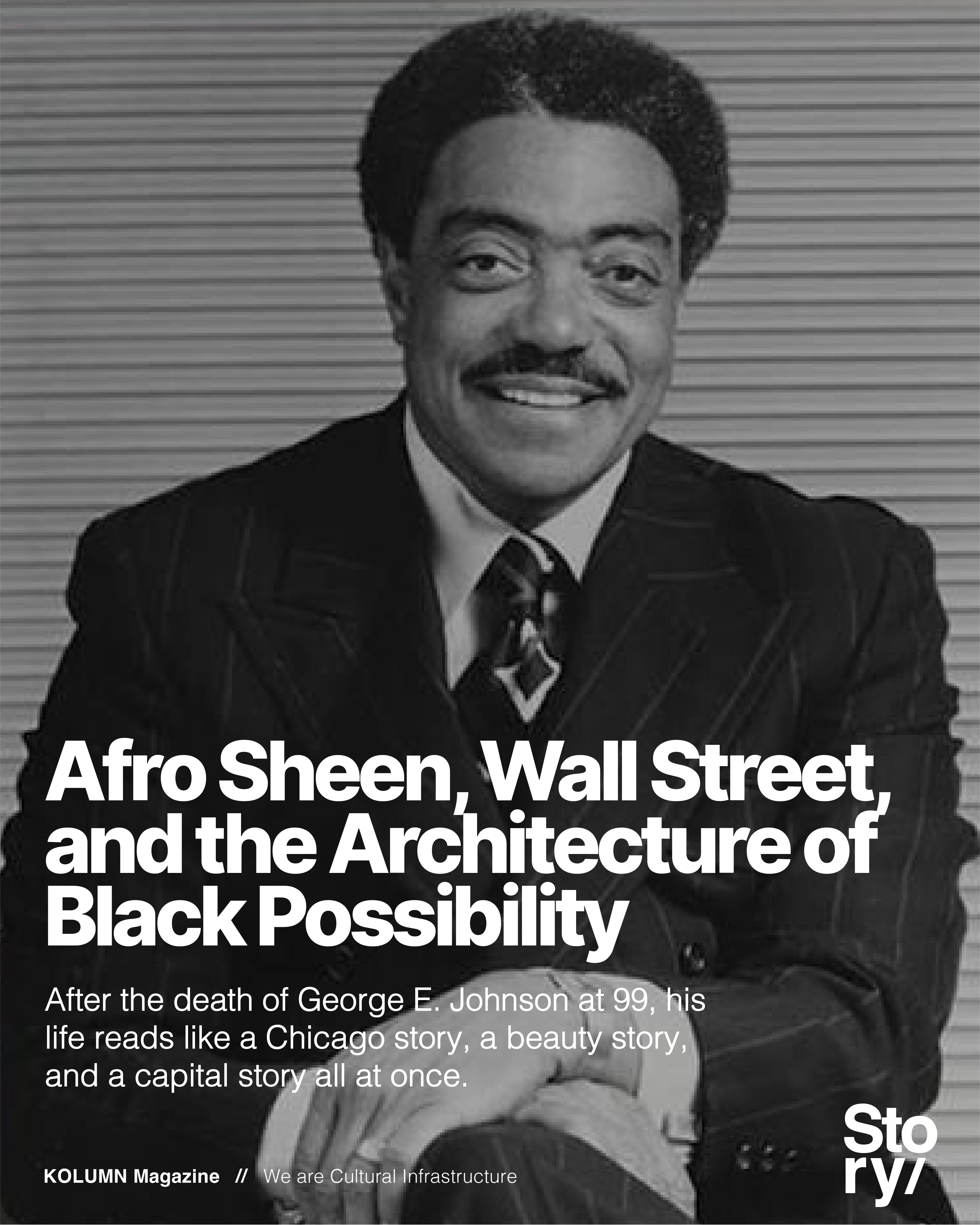
Afro Sheen, Wall Street, and the Architecture of Black Possibility
July 6, 2026
No Comments
The Fire Inside the Fourth
July 5, 2026
No Comments