




Pinder refuses the trap of being reduced to race while also refusing the fantasy that race can be aesthetically transcended by declaration.
Pinder refuses the trap of being reduced to race while also refusing the fantasy that race can be aesthetically transcended by declaration.
By KOLUMN Magazine
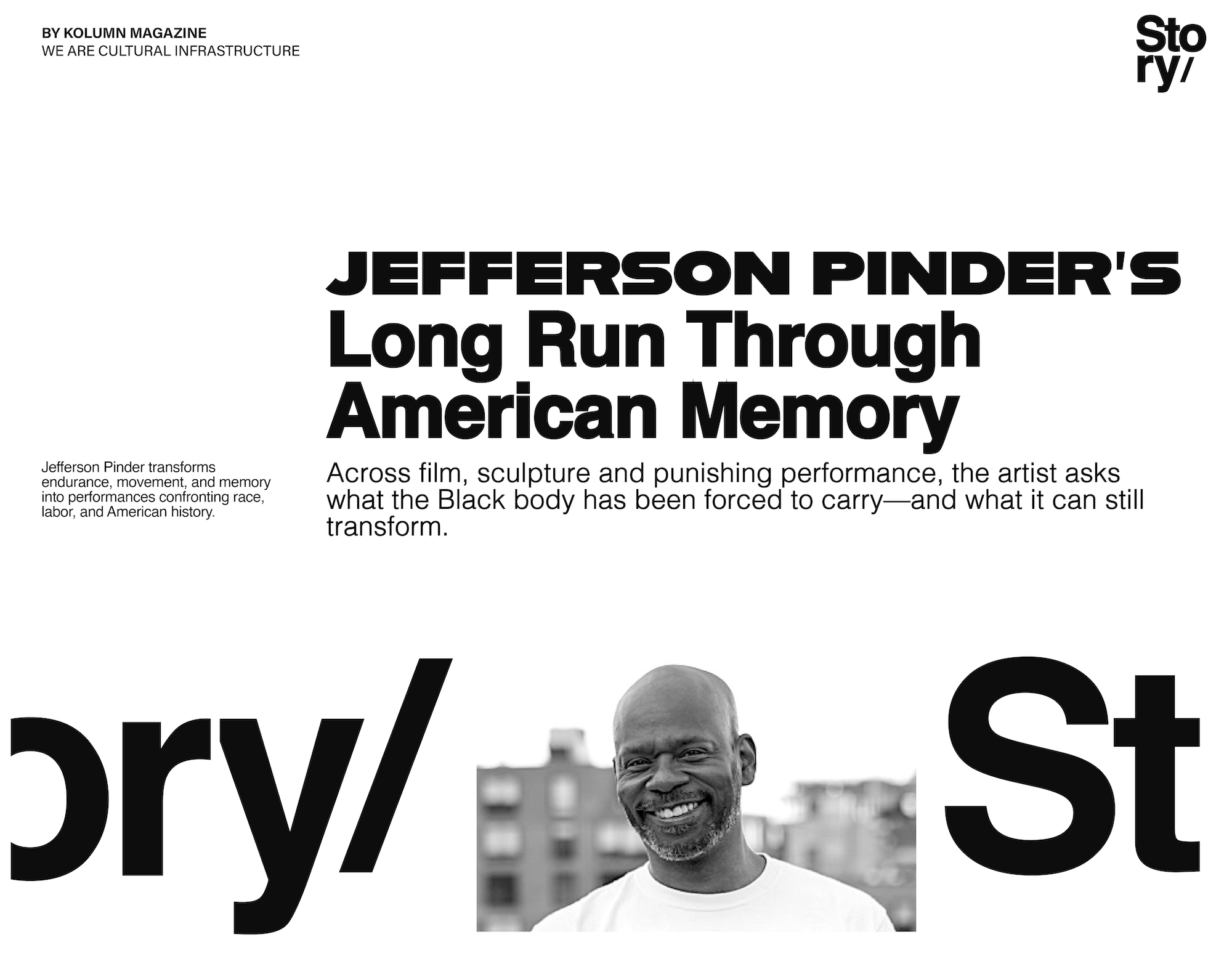
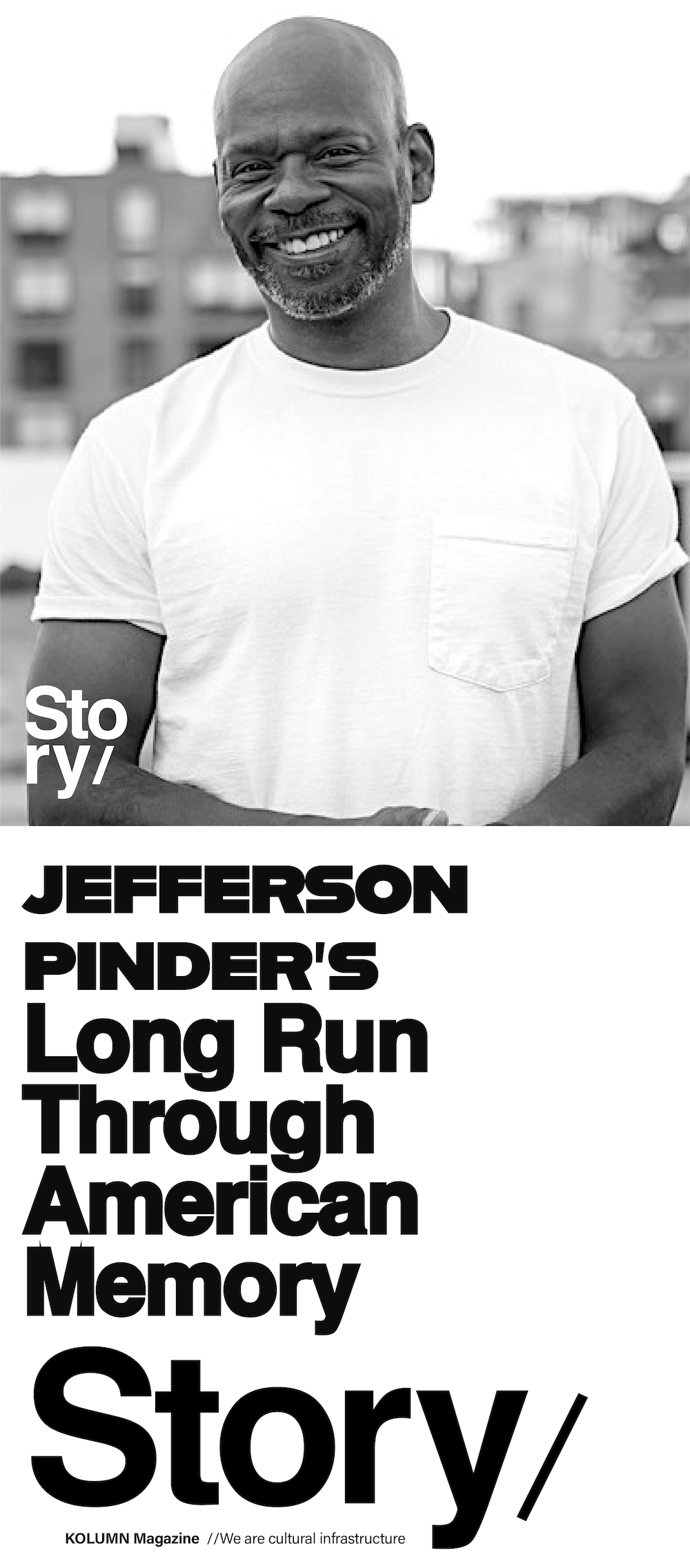
There is a particular kind of silence that gathers around a body in motion. It is not the silence of peace. It is the silence of watching, of waiting, of measuring whether flesh can outlast pressure. Jefferson Pinder has spent much of his career working inside that silence. His art asks what happens when history is not merely remembered but physically performed—when the Black body becomes an archive, a metronome, a warning system, a vessel for all the unfinished business America prefers to frame as past tense.
Pinder, born in Washington, D.C., in 1970, is often described as a performance artist, video artist, sculptor and educator, but none of those categories fully contains him. His own artist statement calls him “a time agent,” an apt phrase for a maker whose interventions, videos and objects move between reenactment, Afrofuturism, endurance, sound and ritual. On his official biography, Pinder’s work is described as transporting audiences into speculative spaces where “history’s symbolism is negotiated,” with the body serving as a vessel for excavating racial trauma through performance, historic reenactment and stylized music-video language.
That range matters. Pinder does not treat Black history as a museum label fixed behind glass. He treats it as an active force—something that moves through posture, fatigue, breath, choreography, architecture, popular music and the audience’s own complicity. In that sense, his work belongs to a lineage KOLUMN has returned to in its writing on Black artists who make the body central to cultural memory, from Nick Cave’s radical use of wearable sculpture and protection to Ernie Barnes’s insistence that Black movement could carry beauty, rhythm and social argument. Pinder’s contribution is sharper, harsher, and often more physically exposed: he makes endurance itself the medium.
Washington Roots, Theater Bones
Pinder’s artistic language begins in performance, but not initially in the gallery. He studied theater at the University of Maryland, later earning an MFA in mixed media there, and also studied at the Asolo Theatre Conservatory in Sarasota, Florida, according to Museum of the African Diaspora’s artist profile. That theatrical foundation never disappears from his work. Instead, it mutates. The timing of bodies, the arrangement of witnesses, the spatial tension between performer and audience, the question of who controls the scene—all of these remain central.
Jefferson Pinder does not treat Black history as a museum label fixed behind glass. He treats it as an active force—something that moves through posture, fatigue, breath, choreography and sound.
In a 2018 interview with Laura Roulet for Sculpture magazine, Pinder explained that he loved theater but became frustrated by “production mechanisms” that left actors with limited control. He wanted to direct, author, compose. That desire led him toward a practice where he could treat performance not as scripted entertainment but as a site of authorship and risk. He started a theater company, Middle Passage Guerrilla Theater Company, while in Seattle, and by the late 1990s began building the studio practice that would define his mature career.
That transition is crucial to understanding him. Pinder’s work does not abandon theater; it radicalizes it. The stage becomes the street, the museum, the gallery, the urban corridor. The actor becomes the laboring body. The script becomes a system of constraints. The audience becomes witness, and sometimes something closer to accomplice.
His first video, Nothing Clear in 1999, focused on gentrification in Seattle’s Central District, a historically Black neighborhood undergoing displacement. In the Sculpture magazine conversation, Pinder described the work as a collection of black-and-white portraits of people on the street—“ghosts,” he called them, Black folks no longer there. Already, the central concerns were visible: place, disappearance, racial memory, the camera as witness, and the way Black presence can become spectral under urban redevelopment.
The Studio Museum Moment
Pinder gained wider national attention through Frequency, the Studio Museum in Harlem’s influential 2005–2006 exhibition of emerging Black artists. The show followed the museum’s landmark Freestyle exhibition and helped define a generation of artists working after, around and sometimes against the much-debated idea of “post-Black” art. Patricia Sweetow Gallery’s profile notes that Pinder’s Car Wash Meditations appeared in Frequency, describing it as a video of a car moving through a car wash to Nas’s “Made You Look,” with explosive soap color functioning almost like action painting against the image of Pinder seated inside the vehicle.
That work is deceptively simple. A car wash is an everyday machine, a choreographed tunnel of pressure, foam, brushes and controlled assault. Inside it sits a Black man, framed by the apparatus, accompanied by hip-hop’s percussive authority. The scene is mundane and loaded at once. The car wash becomes ritual cleansing, surveillance chamber, abstraction machine, and metaphor for the public processing of Black masculinity. The body is still, but the system moves around it.
The Frequency context also places Pinder inside an important art-historical argument. In the early 2000s, “post-Black” was often invoked to describe artists who resisted narrow expectations that Black art must look or sound a certain way. But Pinder has been skeptical of the term. In the interview “Fade to Black,” available through Academia.edu’s posted text, he argued that “post-Black” felt like a phase and noted that race could not simply be wished away while it remained the first marker imposed on Black people in daily life.
That skepticism is not reactionary; it is precise. Pinder’s work refuses the trap of being reduced to race while also refusing the fantasy that race can be aesthetically transcended by declaration. He understands Blackness not as a theme to be checked off but as a condition of perception: how the body is seen, how sound is heard, how effort is interpreted, how risk is distributed.
The Black Body Under System Pressure
The most persistent image in Pinder’s career is not a single object but a situation: Black bodies placed under pressure, moving through a structure that tests them. This is why endurance is not merely a method in his work. It is an argument.
Isaiah Matthew Wooden’s essay and interview, “Jefferson Pinder and the Art of Black Endurance”, situates Pinder’s performances around the capacity of the Black body to endure systems that appear designed to produce failure. That formulation gets close to the heart of Pinder’s significance. His works do not simply show struggle; they stage conditions in which struggle becomes visible as structure.
In Ben-Hur, performed at the Corcoran Gallery of Art in Washington, D.C., in 2012, Pinder drew from the famous galley-slave sequence in the film Ben-Hur, translating cinematic spectacle into live durational performance. In Sculpture magazine, he described the performers as proxies and representatives for private thoughts, insisting that he was not merely directing but making an artwork through their embodied labor. The performers worked together in synchronized exertion, but variables—fatigue, audience proximity, real time—made the outcome unstable.
That instability matters. Pinder does not create polished simulations of suffering. He creates situations in which control frays. The viewer cannot simply consume the image; the viewer must sit with duration, discomfort, exertion and uncertainty. Will the performers last? What does it mean to watch them try? Where does admiration end and voyeurism begin?
Those questions place Pinder in conversation with the history of performance art, from the endurance practices of artists such as Tehching Hsieh and Marina Abramović to Black performance traditions shaped by labor, ritual, music, protest and survival. But Pinder’s work also challenges the art world’s tendency to treat endurance as a universal category. In his practice, endurance is racialized. It is historical. It is not a neutral test of will; it is bound to slavery, migration, policing, athletics, entertainment, military discipline, and the long American habit of demanding that Black people prove humanity through extraordinary stamina.
Music, Misrecognition and the Politics of Sound
Pinder’s art is unusually attuned to music—not simply as soundtrack but as cultural code. He uses popular music to scramble expectation, expose stereotypes and complicate ownership. In works such as Juke and Revival, he has staged Black performers lip-synching to songs associated with white rock, country or other seemingly coded genres. In his Sculpture magazine interview, he explained that this raises questions about who “owns” music and how cultural stereotypes form.
That question is not decorative. American music has always been a contested archive of Black invention, white appropriation, commercial circulation and racial fantasy. Pinder’s musical choices unsettle viewers because they expose how quickly audiences assign sound to race. When a Black body performs Queen, country music or other culturally coded material, the viewer’s assumptions become part of the piece.
This is where Pinder’s theatrical intelligence is most apparent. He understands that performance is not only what the artist does. Performance also includes what the audience expects to see, what it thinks it recognizes, and what it refuses to hear. His work operates in that gap.
The title Afro-Cosmonaut/Alien (White Noise) makes the point another way. The University of Texas at Austin’s Landmarks program describes the piece as part of Pinder’s series of video and performance works exploring “the realities and emotional truths of Black lives through the physicality and expressiveness of the body” in its video-art entry on the work. The piece belongs to Pinder’s Afrofuturist register, where Blackness is imagined through outer space, estrangement, technology and speculative displacement.
Afrofuturism in Pinder’s hands is not escapism. It is a diagnostic tool. To be Black in America has often meant being treated as alien inside one’s own nation, hypervisible and unseen, overpoliced and underprotected, mythologized and erased. The cosmonaut figure allows Pinder to stage that estrangement without surrendering to victimhood. The Black body becomes traveler, signal, glitch, astronaut, witness.
The Object World: Neon, Rust, Glitter, Salvage
Although Pinder is often discussed through performance and video, his sculptural language is equally important. His official statement identifies neon, rust and glitter as key materials, while institutional profiles describe his use of found objects, light, sound and salvaged materials. These are not neutral formal choices. They allow him to move between spectacle and decay, beauty and residue, glamour and wreckage.
What happens to the dream after the stage is dismantled? Pinder’s art asks what kind of craft can be built from the leftovers of symbolic progress.
One of the most evocative examples is Mothership (Capsule), assembled from lumber used to build Barack Obama’s first inauguration platform and other salvaged materials. In Sculpture magazine, the work is described as a centerpiece of the contemporary art collection at the Smithsonian National Museum of African American History and Culture, positioned near George Clinton’s P-Funk “Mothership” concert prop. That adjacency is almost too perfect: Obama’s symbolic ascent, Clinton’s Afrofuturist funk cosmology, and Pinder’s salvaged capsule all orbiting the question of Black possibility in American space.
The Obama platform lumber carries historical charge. It is literally material from a national ritual of hope, spectacle and power. But in Pinder’s hands, it becomes something stranger than memorabilia. It becomes wreckage and vessel at once. The inauguration platform was built for a moment of presidential visibility; Pinder’s sculpture asks what remains after the moment passes. What happens to the dream after the stage is dismantled? What kind of craft can be built from the leftovers of symbolic progress?
That question feels especially urgent in the years after Obama, when the language of “post-racial” America collapsed under the weight of backlash, police violence, voter suppression, anti-DEI campaigns and the mainstreaming of racial resentment. Pinder’s art did not need to predict that collapse; it had already refused the premise.
Education as Lineage
Pinder is not only an artist but also an educator. He taught at the University of Maryland from 2003 to 2011 and later became a professor at the School of the Art Institute of Chicago, according to his official biography. Museum of the African Diaspora’s profile identifies him as a professor of sculpture and dean of faculty at SAIC in its program description.
That institutional role should not be treated as secondary. For Black artists, teaching has often functioned as both livelihood and cultural transmission. Pinder’s own statement places him in a lineage connected to David C. Driskell and James Porter, two foundational figures in the study, preservation and advancement of African American art history. The David C. Driskell Center has emphasized Pinder’s connection to Driskell and his University of Maryland formation, situating him within a broader Black intellectual and artistic genealogy.
This is historiography in practice. Pinder’s work emerges not from an isolated studio mythology but from a chain of teachers, institutions, exhibitions and debates about what Black art is allowed to be. Driskell helped build the scholarly and curatorial infrastructure that made African American art legible inside institutions that had long marginalized it. Porter, often regarded as a father of African American art history, insisted that Black artists had to be studied as central participants in American art, not peripheral exceptions. Pinder inherits that seriousness but translates it into bodies, sound, duration and speculative movement.
The result is an art practice that is both conceptual and pedagogical. His work teaches audiences how to look at systems. It teaches students that form and politics need not be enemies. It teaches institutions that the Black body cannot be safely aestheticized without confronting the histories placed upon it.
The Archive of Joy
One of the dangers in writing about Pinder is reducing his work to pain. Endurance is central, but endurance is not the same as suffering. His practice also contains humor, musical pleasure, absurdity, style and joy. That complexity became explicit in his Smithsonian research.
In 2021, the Smithsonian announced Pinder as one of its Artist Research Fellows for a project titled Black Nostalgia, Black Joy. The Smithsonian’s release states that Pinder would examine archival films and materials documenting everyday Black life at the National Museum of African American History and Culture, with the research supporting a video artwork celebrating Black joy, according to the Smithsonian announcement.
This is an important turn, but not a contradiction. Black joy in Pinder’s work is not sentimental relief from history. It is part of history. The everyday footage of Black families, neighborhoods, gestures, dances and gatherings is not less political than the image of the body under pressure. It may be more radical precisely because it refuses the archive of Black life as only injury.
That refusal aligns with a larger movement in contemporary Black art and scholarship: the insistence that Black humanity cannot be documented only through trauma. Pinder’s project suggests that joy itself requires research, preservation and formal attention. It asks what the archive has saved, what it has missed, and what an artist can make visible by looking again.
Rome, Waste and the Global Black Body
Pinder’s newest chapter extends his concerns beyond the United States. In 2026, he received the Philip Guston Rome Prize from the American Academy in Rome. His project, Spazzino, runs from February to June 2026, and the American Academy in Rome describes it as a choreographed and interventionist trash-cleaning performance in the streets of Rome, connecting Italian Neorealism, Arte Povera and the Black Aesthetic movements of the 1960s and 1970s while responding to the role of the spazzino, or streetsweeper, as Black immigrants work amid Italy’s waste crisis.
The project sounds quintessentially Pinder: labor, public space, choreography, race, debris, history, and the politics of who cleans up after whom. But it also expands the geography of his inquiry. The Black body under system pressure is not only an American subject. It is diasporic. It appears in migration routes, sanitation labor, urban invisibility, European racial hierarchies, and the economies that depend on immigrant work while denying immigrant dignity.
By invoking Arte Povera, Pinder also enters a conversation about materials and poverty, about art made from humble substances, waste, remnants and anti-monumental gestures. But he complicates that history by bringing race and labor to the foreground. Trash is not merely material. It is social evidence. Streetsweeping is not merely maintenance. It is a racialized performance of urban order.
Why Jefferson Pinder Matters Now
Pinder matters because he makes abstraction answer to the body. In an era when institutions often speak in polished language about diversity, equity, representation and repair, his art returns the conversation to physical consequence. Who is exhausted? Who is watched? Who is asked to perform resilience? Who is allowed to rest? Who becomes visible only through labor? Who gets remembered as symbol and who gets used as material?
Pinder’s signature is distinct: he makes history exert itself. He makes it sweat.
These questions make his work especially resonant in the current political climate, where backlash against racial justice has often targeted the very frameworks needed to understand American history honestly. Pinder’s art refuses the soft censorship of comfort. It insists that memory is not a neutral field. It is contested terrain, and the body is where that contest often lands first.
His significance also lies in his refusal of singularity. He is not only an endurance artist, not only a video artist, not only an Afrofuturist, not only a sculptor, not only an educator. He is a maker of situations. Those situations expose the unstable relationship between spectacle and witness, history and reenactment, pain and pleasure, visibility and erasure.
For KOLUMN, Pinder belongs in the company of artists who expand the public meaning of Black art. Like Nick Cave, he understands the body as both target and instrument. Like Ernie Barnes, he understands movement as a form of knowledge. Like David C. Driskell, he understands that Black art requires lineage, scholarship and institutional memory. But Pinder’s own signature is distinct: he makes history exert itself. He makes it sweat.
The Long Work of Witness
There is a temptation, with performance art, to treat the event as ephemeral: something happened, people saw it, the moment passed. Pinder’s work argues otherwise. The performance continues in the body of the viewer. It continues in documentation, in memory, in criticism, in classrooms, in archives, in the discomfort that lingers after the applause has ended.
That lingering is the point. Pinder’s art does not offer clean resolution because the histories he engages have not resolved. The Black body is still conscripted into national drama. Black labor is still exploited and erased. Black joy is still treated as exceptional rather than ordinary. Black endurance is still praised in ways that can disguise the systems that make such endurance necessary.
But Pinder does not leave the body trapped there. His art also insists on transformation. A car wash becomes a painting machine. An inauguration platform becomes a spacecraft. A streetsweeper becomes a choreographic figure. A performer’s fatigue becomes public knowledge. An archive of everyday Black life becomes a source of joy.
That is the force of Jefferson Pinder’s practice. He takes the materials America leaves behind—wood, rust, music, stereotype, labor, spectacle, historical debris—and makes them move. He does not ask whether the past is over. He asks what the past is doing now, in the room, in the street, in the breath, in the body. And once he asks, the audience has to answer.
More great stories
Afro Sheen, Wall Street, and the Architecture of Black Possibility
July 6, 2026
No Comments
The Fire Inside the Fourth
July 5, 2026
No Comments