


Discipline is the servant of inspiration.
Discipline is the servant of inspiration.
By KOLUMN Magazine
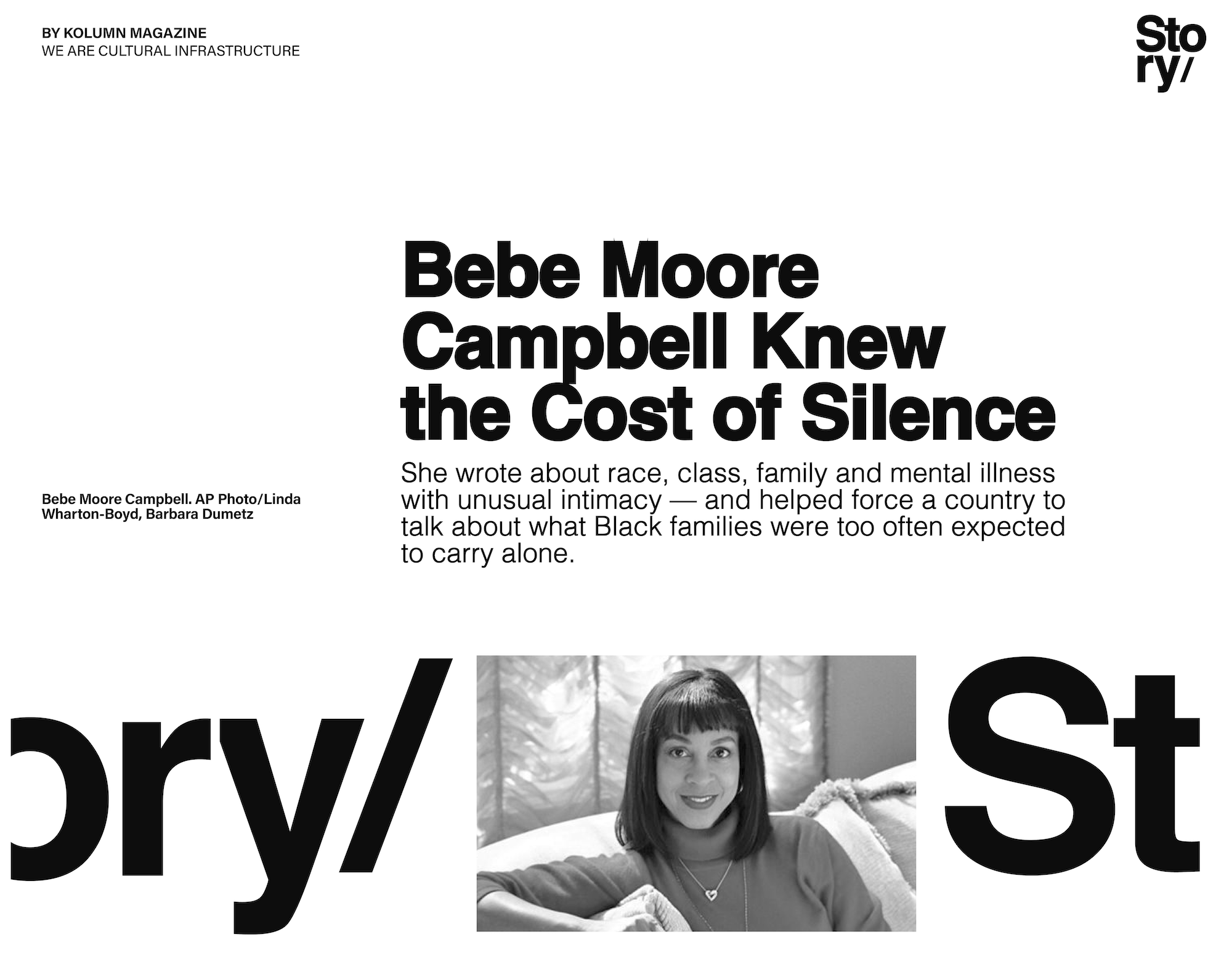
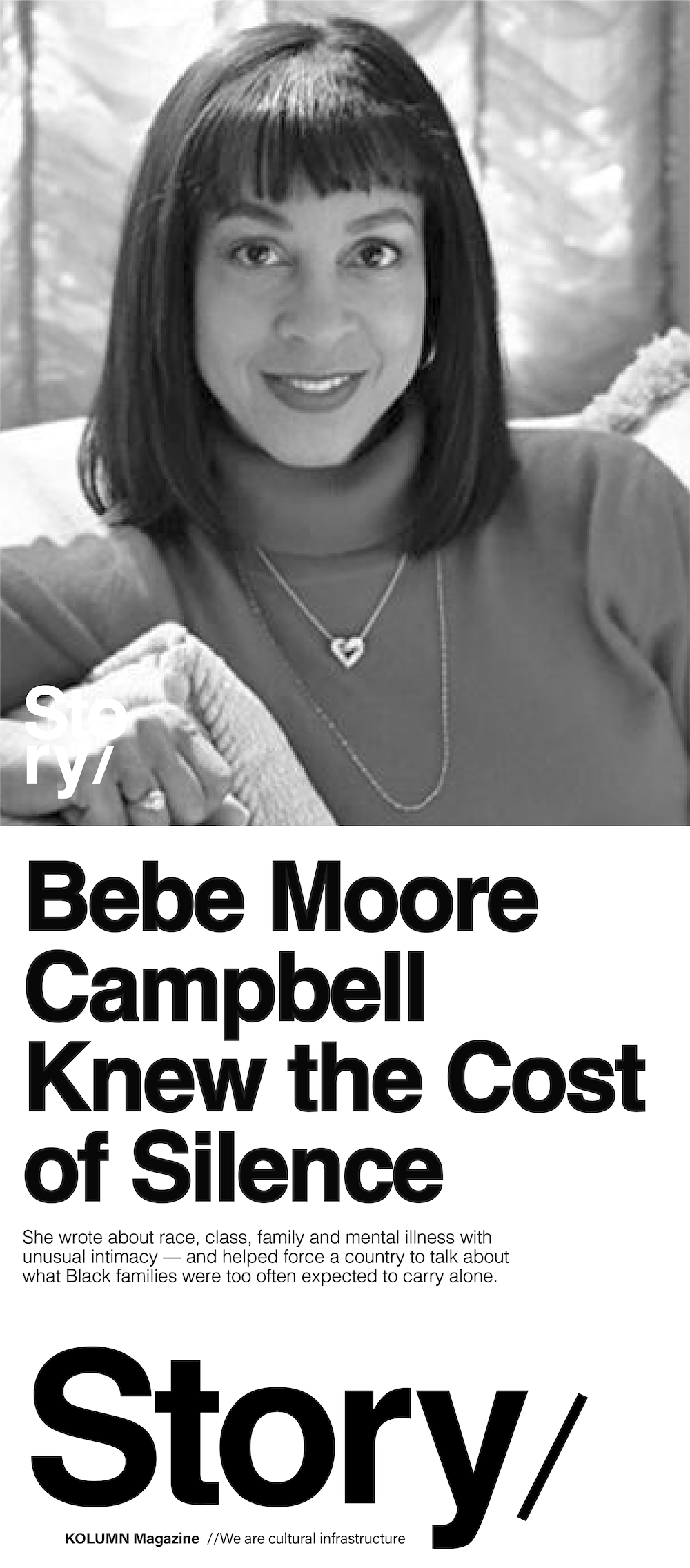
Bebe Moore Campbell belongs to that small class of writers who managed to be both widely read and seriously underestimated. During her lifetime, she was a best-selling novelist, an essayist, a journalist, a teacher and a public commentator whose byline and voice traveled through major American institutions: The New York Times, The Washington Post, Los Angeles Times, Essence, Ebony, Black Enterprise and NPR’s Morning Edition. She published fiction that sold, nonfiction that argued, children’s books that explained the unexplainable and advocacy that pushed a country to see mental health in Black communities as a public issue rather than a private embarrassment. Yet even now, nearly two decades after her death in 2006, Campbell is not always discussed with the same reflexive reverence accorded to some of her peers. That gap says as much about American literary culture as it does about her.
Campbell’s great subject was not just race, though race ran through nearly everything she wrote. It was not just gender, though Black women — their labor, their longings, their contradictions, their emotional math — were among her most important protagonists. And it was not just mental illness, though she became one of the most visible Black advocates in that arena. Her true subject was the full, messy scale of human life as it is lived under pressure: in families, in marriages, in offices, in neighborhoods, in institutions, in memory, in the body and in the mind. She wrote about people trying to hold themselves together while history, prejudice, ambition and love pulled at them from every direction.
That is one reason her work still lands with force. Campbell was never especially interested in flattening people into allegories. Even when she tackled enormous public issues — the legacy of Emmett Till, the racial tensions exposed by the Rodney King era, the failures of mental-health care — she stayed alert to motive, ego, confusion, tenderness and self-deception. She understood something many political arguments miss: people often carry history inside them long before they can name it. Her fiction was sharp because it knew that structural injustice always shows up somewhere concrete — in a mother’s fear, in a daughter’s shame, in a co-worker’s caution, in a friendship damaged by unequal power, in a family’s inability to get care when it is desperately needed.
A childhood shaped by distance, discipline and divided worlds
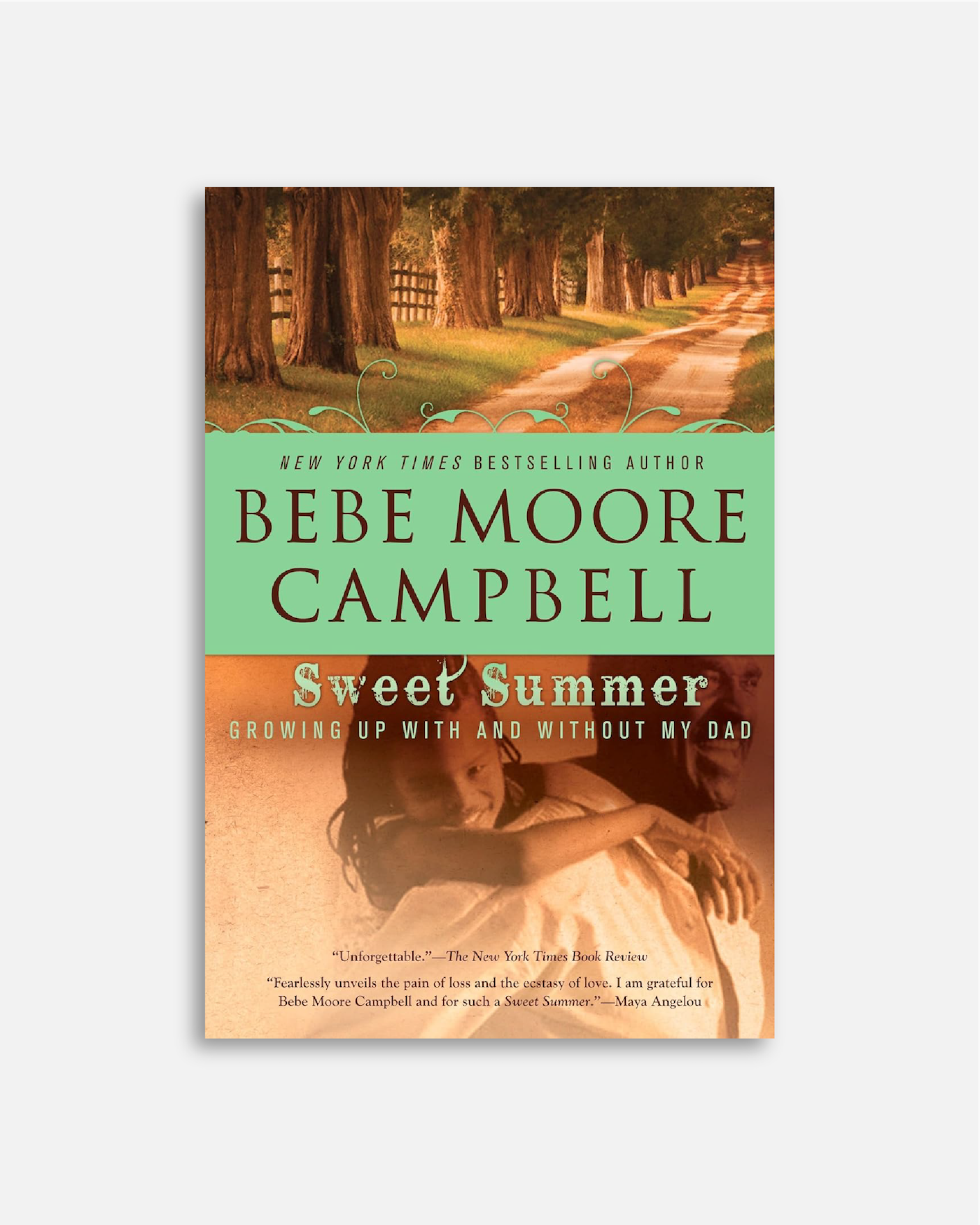
Elizabeth Bebe Moore Campbell was born in Philadelphia on February 18, 1950. She was the only child of Doris and George Moore. Her parents’ marriage ended early, and her father was left paraplegic after a car accident. Campbell grew up largely with her mother in Philadelphia but spent summers with her father in North Carolina, a pattern that exposed her, early and repeatedly, to different regional codes of Black life, different family atmospheres and different ways of understanding race, aspiration and belonging. Those “sweet summers” with her father would later become central to her memoir, Sweet Summer: Growing Up With and Without My Dad, and to the larger emotional architecture of her writing.
That kind of bifurcated upbringing mattered. Campbell did not come to complexity late. She lived it young. Philadelphia and North Carolina were not simply two places on a map; they represented different arrangements of authority, intimacy and racial experience. Her mother was highly educated, with advanced training in sociology and social work, and Campbell grew up in a home shaped by seriousness, educational expectation and adult ambition. At the same time, the separation from her father, and the seasonal rhythm of reunion, gave her an unusually early education in emotional doubleness — how one can be rooted and split at once, loved and deprived at once, formed by absences as much as by presence.
That doubleness helps explain why Campbell became such a compelling chronicler of people caught between worlds. Her protagonists are often negotiating more than one loyalty at a time: loyalty to self and family, to Blackness and professional advancement, to memory and reinvention, to realism and hope. Those tensions were not abstract to her. They were biographical material long before they became literary material. When readers respond to the lived-in emotional pressure of her novels, they are responding, in part, to a writer who knew from childhood that identity is often assembled across distance, contradiction and adaptation.
She attended the Philadelphia High School for Girls and later earned a bachelor’s degree in elementary education from the University of Pittsburgh in 1972. She then taught school in Atlanta for several years before turning more fully toward journalism and literary work. That sequence also matters. Campbell did not emerge from a purely literary cocoon. She taught children. She worked. She moved through institutions. She learned how people speak when they are not performing for art. She came to writing through teaching and reporting, both of which sharpened her instinct for audience, clarity and social texture.
That line, often associated with Campbell, feels less like a slogan than a key to her career. She produced across genres. She sustained a public voice. She wrote fiction with breadth but also with craft discipline. And she did it while inhabiting a media landscape that did not always grant Black women full critical seriousness unless they could be neatly categorized. Campbell was not neat. She was too curious, too versatile and too ambitious for that.
Before the novels, there was the journalist
By the time Campbell became famous as a novelist, she had already built a substantial career as a journalist and commentator. She wrote for major outlets, including Essence, where she was a contributing editor, and placed work in The New York Times, The Washington Post and other national publications. She also became a regular voice on NPR’s Morning Edition. This matters because journalism trained her not only in observation but in public argument. It required her to develop a prose style that could move between intimacy and analysis, between anecdote and critique — a style that would later become one of the hallmarks of her fiction.
Campbell herself framed these outlets as different instruments for different kinds of truth-telling. In a chat transcript preserved by the African American Literature Book Club, she said that NPR commentaries allowed her to “put my own spin on news events,” while writing for Essence gave her a way to explore issues tied to “my own community of African American women.” She also admitted plainly that novels were where she most enjoyed working, because fiction gave her the room to invent, stretch and let the story breathe. That self-description is useful because it captures the basic architecture of her career: reportage and commentary sharpened her interventions, while fiction let her widen the frame.
There is also something instructive about the timing. Campbell began publishing and building her public voice in the late 20th century, during a period when Black women writers were increasingly visible in commercial publishing but were still often boxed by the marketplace. Books by Black women were welcomed, but often as niche goods or sociological events rather than as literature that could claim the full range of American experience. Campbell resisted that narrowing. She never denied being a Black woman writer. But she objected to the implication that such a label confined her readership. “My books are for everyone,” she said.
That statement was not naïve universalism. It was a refusal of literary segregation. Campbell understood, perhaps more clearly than some critics did, that Black specificity does not diminish universality; it is one of the ways universality becomes honest. Her books were full of Black social life, Black ambition, Black grief and Black speech, but they were also full of questions any serious literature has to ask: What do we owe each other? What are the costs of denial? How do families survive betrayal? What does success deform? Who gets forgiven? Who gets seen?
Your Blues Ain’t Like Mine and the refusal to sentimentalize history
Campbell’s debut novel, Your Blues Ain’t Like Mine, arrived in 1992 and announced a writer who was not interested in taking the easy route into respectability. Inspired by the 1955 murder of Emmett Till, the novel follows the aftermath of the killing of a Black Chicago boy in Mississippi and traces how that violence radiates through families and communities. Britannica notes the Till connection directly, and secondary coverage at the time emphasized that Campbell wanted to give racism human shape rather than treat it as a vague abstraction.
What made the novel notable was not only its subject but its method. Campbell did not reduce racism to cartoon villainy. She located it in family systems, habits, silences, fear and inheritance. That is a riskier artistic move than simple denunciation because it asks readers to examine how ordinary people are made by structures they may not fully understand, and how harm is sustained through intimacy as much as through law. The result was a novel that could operate as historical fiction, moral inquiry and social anatomy all at once. The book became a New York Times Notable Book of the Year and won an NAACP Image Award for literature.
Campbell later said, in remarks quoted by SFGate from a New York Times Book Review interview, “I wanted to give racism a face.” That sentence gets at the engine behind much of her work. She was suspicious of sterile language. She wanted readers to feel systems in the nerves. Race, for Campbell, was never just a topic. It was an experience distributed across bedrooms, schools, workplaces and family tables. By dramatizing how violence and prejudice deform both private and public life, she rejected the comforting fantasy that racism is only the property of obvious monsters.
There was also a larger intervention underway. In Campbell’s hands, Black suffering was not mined for spectacle. It was narratively situated inside lives with texture, desire and competing claims. That distinction is critical. American culture has often been willing to memorialize Black pain while remaining incurious about Black interiority. Campbell insisted on both witness and interiority. Her people do not exist merely to symbolize a historical wound. They are fully peopled — funny, vain, loving, resentful, confused, practical, aspirational. That fullness is part of what made her fiction enduring and part of what made it so difficult to pigeonhole.
Writing the Black middle class without apology
One of Campbell’s major contributions was her insistence that the Black middle class, and especially upwardly mobile Black women, deserved serious literary attention. That may sound obvious now, but for a long time American literary culture treated Black life as most authentic when it was rural, impoverished, tragic or safely historical. Campbell refused that hierarchy. Her novels cared about professional life, social mobility, aspiration, etiquette, romance, workplace politics and the psychic strain of trying to succeed in institutions that remain racially coded.
“My books are for everyone.” — Bebe Moore Campbell
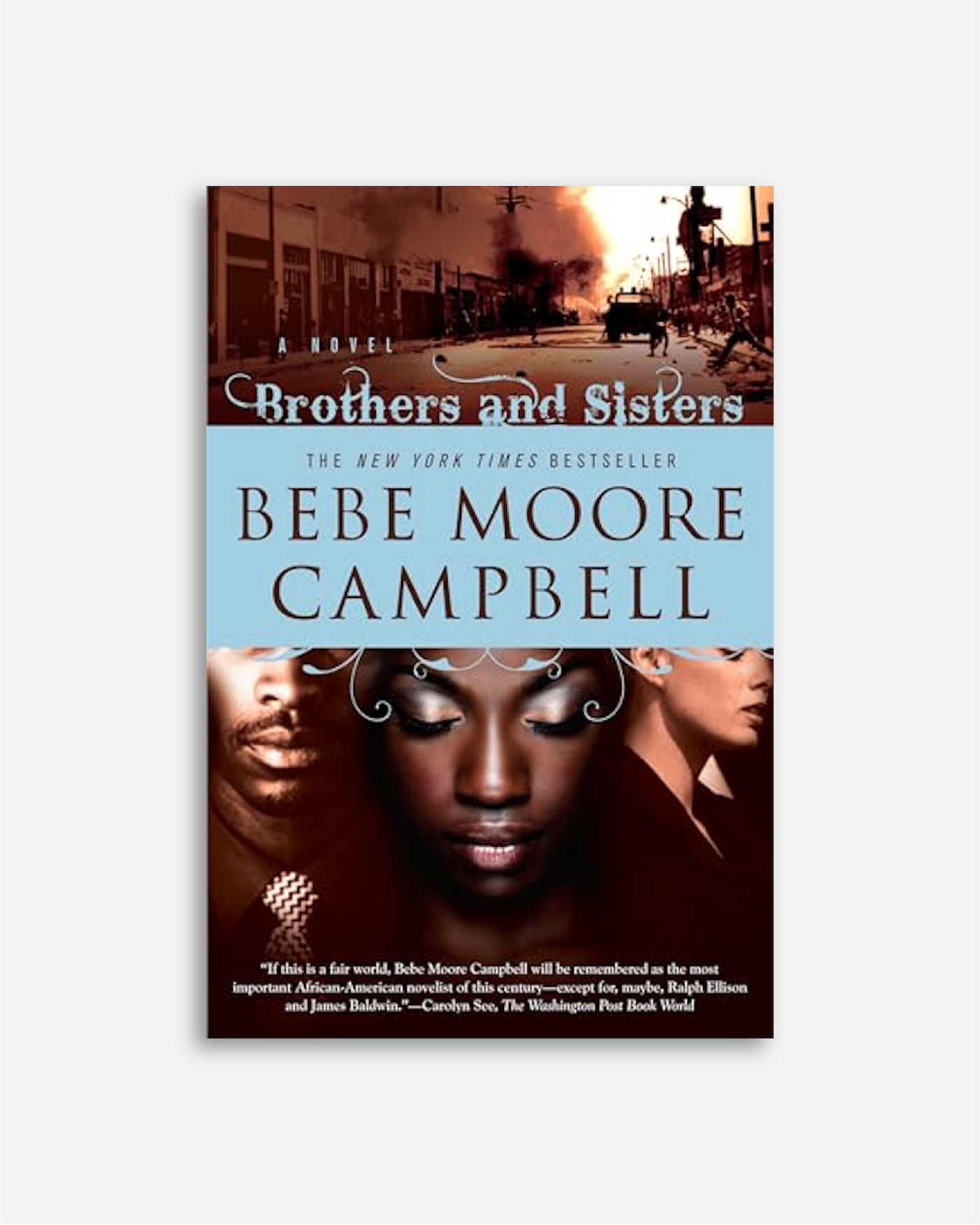
Brothers and Sisters, published in 1994, is perhaps the clearest example. Set in post-riot Los Angeles, the novel centers on Esther Jackson, a Black bank manager navigating race, gender and desire in a city still smoldering from the aftershocks of the Rodney King era. Penguin Random House describes it as unfolding “against the smoldering embers of post-riot Los Angeles,” while Campbell’s archive and biographical sources note that the book was directly shaped by the racial tensions of that period. It became a bestseller, and its praise included a striking assessment reproduced by the publisher from The Washington Post Book World, which declared that if the world were fair, Campbell would be remembered among the most important African American novelists of the century.
That praise was extravagant, but not irrational. Campbell had a rare ability to write social fiction that remained intimate. In Brothers and Sisters, corporate life is not separate from racial life; it is one of the places where racial meaning gets negotiated, denied and weaponized. Campbell examines mistrust, friendship and desire across racial lines without pretending that goodwill erases structural inequity. She was interested in what happens when people want to see themselves as decent but remain implicated in systems that train them into suspicion and hierarchy.
Her 1998 novel Singing in the Comeback Choir pushed another underexplored subject to the center: second chances, community repair and the emotional distance that class mobility can create inside Black life. In the AALBC exchange, Campbell described the book’s lesson with almost pedagogical directness: anyone willing to work hard deserves another chance. That may sound homespun, but the novel’s deeper concern is with return — what it means to come back to a place, a community or a part of the self that professional success encouraged one to outgrow. Campbell was not anti-ambition. She was anti-amnesia.
That declaration becomes more potent when read against the content of her fiction. Campbell was not sanding away Blackness to chase universality. She was arguing that Black life, in all its variety, already contains universality. The problem was not the literature. The problem was the gatekeeping imagination that assumed otherwise.
A novelist of Los Angeles, contradiction and aftermath
Los Angeles was one of Campbell’s great stages, and she wrote the city with an insider’s irritation and affection. In the AALBC transcript, she admitted hating L.A. for her first two years there and loving it afterward, calling it beautiful, spacious, energetic and open to new ideas, while also criticizing its superficiality. That ambivalence is exactly what made her such a useful writer of the place. She did not romanticize Los Angeles, but she understood its layered realities: Black neighborhoods, entertainment ambition, racial segmentation, reinvention, health culture, loneliness and possibility.
For Campbell, Los Angeles was not merely backdrop. It was one of the laboratories where late-20th-century American contradiction could be watched in real time. The city’s multiracial complexity, class stratification and spectacular inequalities made it ideal terrain for her fiction. In Brothers and Sisters, post-riot L.A. becomes the setting for examining the tension between formal multiculturalism and lived distrust. In 72 Hour Hold, the city and its systems become part of the drama of navigating mental illness, family panic and the bureaucracy of care. Campbell saw clearly that where a story happens shapes what kinds of suffering become visible and what kinds remain hidden.
There is a broader reason this matters. Campbell helped write Los Angeles as a Black intellectual and emotional geography, not just as an entertainment capital or riot shorthand. She treated Black Angelenos as workers, mothers, professionals, patients, organizers and neighbors. That perspective is one reason her work remains valuable to anyone trying to understand how race and class lived together in urban America after the civil-rights era, and especially after the myth of colorblind progress began to fracture under public strain.
Mental illness, family crisis and a new language for public care
If Campbell had done nothing beyond her novels on race and class, her place in American letters would still be secure. But her significance widened dramatically through her mental-health advocacy. This was not a late-career branding move. It grew out of lived experience. In a 2005 Time interview about 72 Hour Hold, Campbell said she had a mentally ill family member with bipolar disorder and had been coping with that reality for about nine years. She explained that this experience opened the door to her education about mania, psychiatric holds and the broader architecture of mental illness. She also described herself there as a co-founder of the National Alliance for the Mentally Ill-Inglewood chapter in California and as a support-group facilitator trained through NAMI.
That history matters because Campbell’s advocacy was grounded in practical knowledge, not generic awareness rhetoric. She had confronted the humiliations and confusion that families often encounter when trying to secure treatment. Mental illness in Black communities, as she understood and articulated, sat at the intersection of stigma, misdiagnosis, underinsurance, distrust of institutions and the long-standing weight of racial discrimination. She grasped that silence was not simply cultural backwardness. It was also a response to a society that had already over-stigmatized Black people and therefore made additional vulnerability feel dangerous.
Mental Health America preserves one of Campbell’s most incisive formulations of the issue. She argued that while stigma affects everyone, “people of color really don’t want to say it” because they already feel stigmatized by skin color, accent or other markers and do not want “any more reasons” to be judged. That is an extraordinarily concise diagnosis of how layered stigma works. It remains relevant because it explains why simple awareness campaigns often fail: they underestimate the cumulative burden of social devaluation.
Campbell turned that analysis into art. Her children’s book Sometimes My Mommy Gets Angry, published in 2003, sought to explain mental illness to young readers through the story of a girl coping with her mother’s instability. The University of Pittsburgh notes that the book won NAMI’s Outstanding Literature Award. Her play Even with the Madness and later novel 72 Hour Hold continued the work, using story to render psychiatric crisis, family fear and institutional breakdown legible to a broad audience. CBS News described 72 Hour Hold as the story of a mother dealing with her teenage daughter’s bipolar illness, and Mental Health America summarizes the novel as a portrait of a mother navigating a broken mental-health system and the stigma attached to illness in the Black community.
How advocacy changed her legacy — and the country’s vocabulary
Campbell’s advocacy outlived her in institutional form. In 2008, Congress recognized July as Bebe Moore Campbell National Minority Mental Health Awareness Month. NAMI continues to observe the month in her name, and Mental Health America likewise frames her as a foundational figure in bringing attention to the mental-health needs of Black and other underrepresented communities. Congressional remarks associated with the resolution explicitly cited her work, including 72 Hour Hold and Sometimes My Mommy Gets Angry, and linked the observance to the need for better treatment access, public awareness and culturally competent care in minority communities.
“We need a national campaign to destigmatize mental illness.” — Bebe Moore Campbell, as quoted by NAMI
That kind of posthumous recognition can sometimes flatten a person into a symbol. In Campbell’s case, the symbol points back to genuine labor. She was not merely invoked after the fact; she helped create the conversation that the designation formalized. NAMI’s current materials describe her legacy as one of challenging the status quo, creating spaces for unheard communities and linking healing to community transformation. Even allowing for the ceremonial language that institutions often use, the underlying point is solid: Campbell helped shift mental health from a whisper topic to a public issue that Black families could address without surrendering dignity.
What is especially striking is how contemporary her framework remains. Today many institutions talk about culturally competent care, systemic inequity, lived experience and the need to reduce stigma in communities of color. Campbell was arguing those points before much of that language was fashionable. Congressional discussion surrounding the 2008 designation referenced disparities in diagnosis, access and follow-up care for African Americans, as well as the need for providers equipped to serve multiethnic communities more effectively. Campbell had already understood the problem in lived terms: a family in crisis is not helped by abstract sympathy if the system around them is structurally unprepared to serve them well.
That line feels current because the work is unfinished. Mental-health conversations in public culture have grown louder, but access, affordability, trust and quality of care remain uneven. Campbell’s enduring relevance comes from the fact that she named both the emotional and structural dimensions of the problem. She understood that stigma hurts, but she also understood that even willing families can run into broken institutions. To read her now is to see not only a pioneer, but a diagnostician of conditions that still persist.
The breadth of the work, and why it still feels contemporary
A narrower writer might have become captive to the issue that brought late-career attention. Campbell never did. Even as mental-health advocacy became more central to her public identity, her larger body of work remained remarkably broad. Britannica notes fiction on race relations, social mobility and family strain; Pitt’s archival material points to her interest in childhood obesity, memory and friendship across racial lines; publishers’ descriptions and interviews show her moving comfortably from social realism to children’s literature to commentary.
That versatility is part of why she remains a vital rather than merely admirable figure. She did not live in one register. She could write books with commercial reach and still insist on serious subject matter. She could address Black women readers directly and still reject the idea that Black women’s literature belonged in a cultural side room. She could be pedagogical without becoming preachy, topical without becoming trapped in the news cycle. She wrote with an ear for everyday speech and an eye for system-level pressures. Those are difficult combinations to sustain. Campbell sustained them because she understood that readability and seriousness are not opposites.
Her children’s books make this especially clear. Sometimes My Mommy Gets Angry and Stompin’ at the Savoy might seem to belong to a different shelf than Your Blues Ain’t Like Mine or 72 Hour Hold, but they are linked by a shared ethic: explain the world truthfully without surrendering wonder or care. Britannica describes Stompin’ at the Savoy as an account of the origins of jazz, while Publishers Weekly highlights its imaginative trip into the integrated Harlem dance hall of the Savoy Ballroom. Campbell did not treat children as unworthy of complexity. She treated them as readers who deserve clarity, rhythm and emotional intelligence.
Why Bebe Moore Campbell still matters
Campbell died on November 27, 2006, in Los Angeles, at age 56, from complications of brain cancer. The loss was significant not only because of what she had already done, but because her career still seemed open-ended. The University of Pittsburgh archive, which houses her papers, offers a reminder of just how much working life she compressed into those years: drafts, revisions, contracts, reviews, publicity materials and tour schedules documenting a professional writer deeply engaged with the business and craft of authorship. She was not a mythic genius floating above labor. She was a worker of literature — organized, disciplined, public-facing and serious about the machinery that gets books into the world.
Her continuing importance sits at the intersection of at least three legacies. First, she expanded the representational map of Black fiction, especially by treating Black middle-class life and Black women’s ambition as worthy of sustained, complex narrative treatment. Second, she built a career that bridged journalism and literature, showing how a public intellectual can move between commentary and storytelling without thinning either one. Third, she helped create a durable public language around mental health in Black communities, one grounded not in abstraction but in experience, stigma, care and institutional failure.
But perhaps the most important thing to say about Bebe Moore Campbell is this: she made it harder to erase people. She wrote against erasure in multiple directions at once. She refused the erasure of Black interior life. She refused the erasure of Black women as central American subjects. She refused the erasure of mental illness from respectable conversation. She refused the erasure of class tension, racial contradiction and familial pain under easy optimism. And she refused the erasure of readers who wanted books that were intelligent, socially alert and emotionally accessible at the same time.
In literary culture, there are writers who become monuments and writers who become tools. Campbell has been both, though the second role may be more useful. She is a tool for thinking about how literature works in public life. She is a tool for understanding the psychic architecture of race after the slogans fade. She is a tool for seeing how family stories and policy failures converge. She is a tool for younger writers trying to figure out whether one can be readable without being shallow, political without being bloodless, compassionate without becoming sentimental. Her answer, across her body of work, was yes.
Campbell once said that fiction allowed her to be “as creative as I can be.” That freedom mattered, but so did her sense of obligation. Even her most entertaining work carries the imprint of someone who believed stories should do something in the world — teach, unsettle, reveal, humanize, argue, console, provoke. Not propaganda. Not homework. Just serious storytelling with a conscience. In an era that still struggles to hold all those values together, Bebe Moore Campbell looks less like a relic than like a model.
And that may be the clearest measure of her significance. She did not just write books people bought. She wrote books — and made arguments — that helped alter what people felt permitted to say about race, family, ambition and mental illness. She changed the conversation without ever stopping being a novelist. Few writers manage that. Fewer still make it look as natural as she did.
More great stories

Afro Sheen, Wall Street, and the Architecture of Black Possibility
July 6, 2026
No Comments
The Fire Inside the Fourth
July 5, 2026
No Comments