
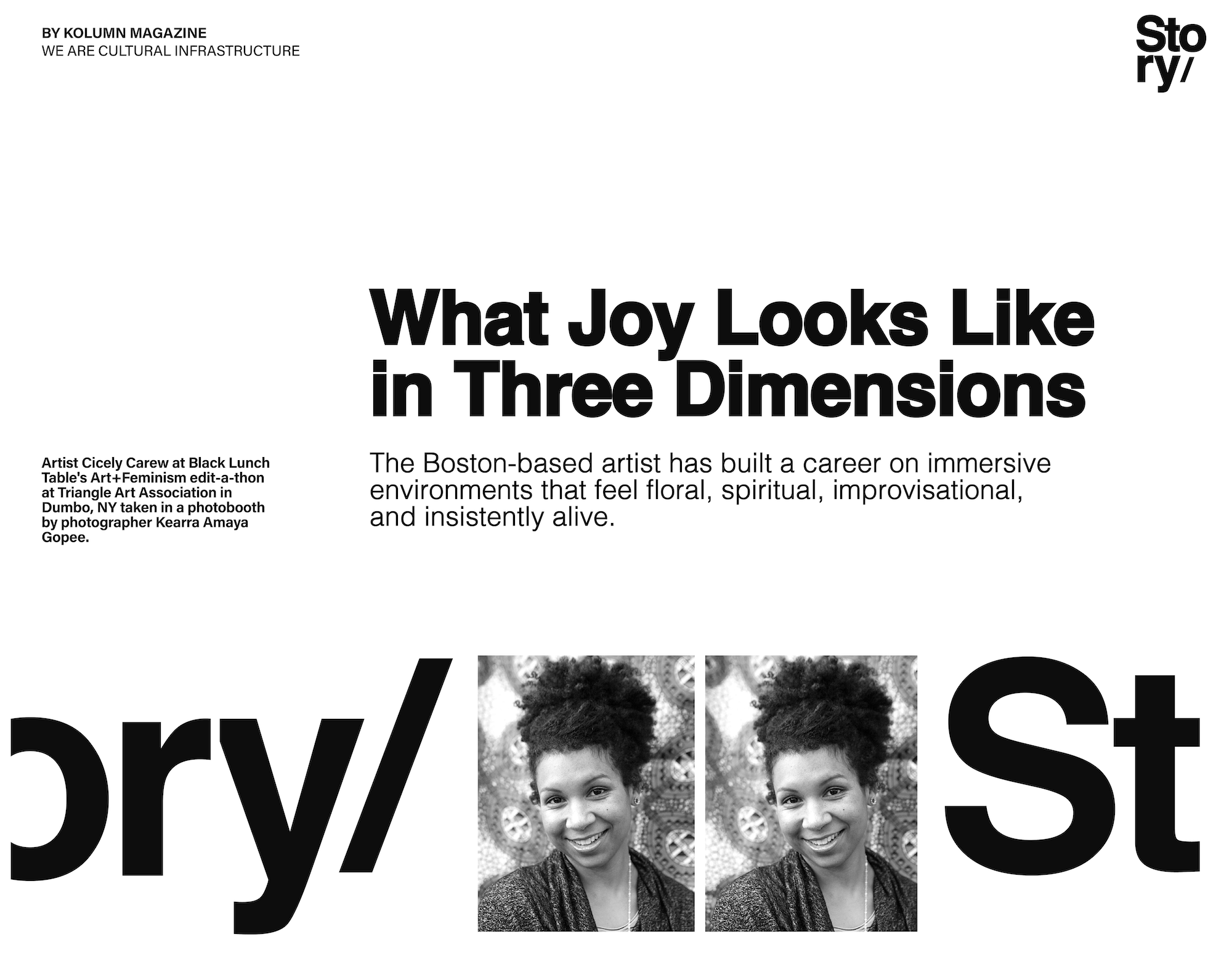
I want the freedom to make work my way—for it to be a conduit of healing and unapologetic joy.
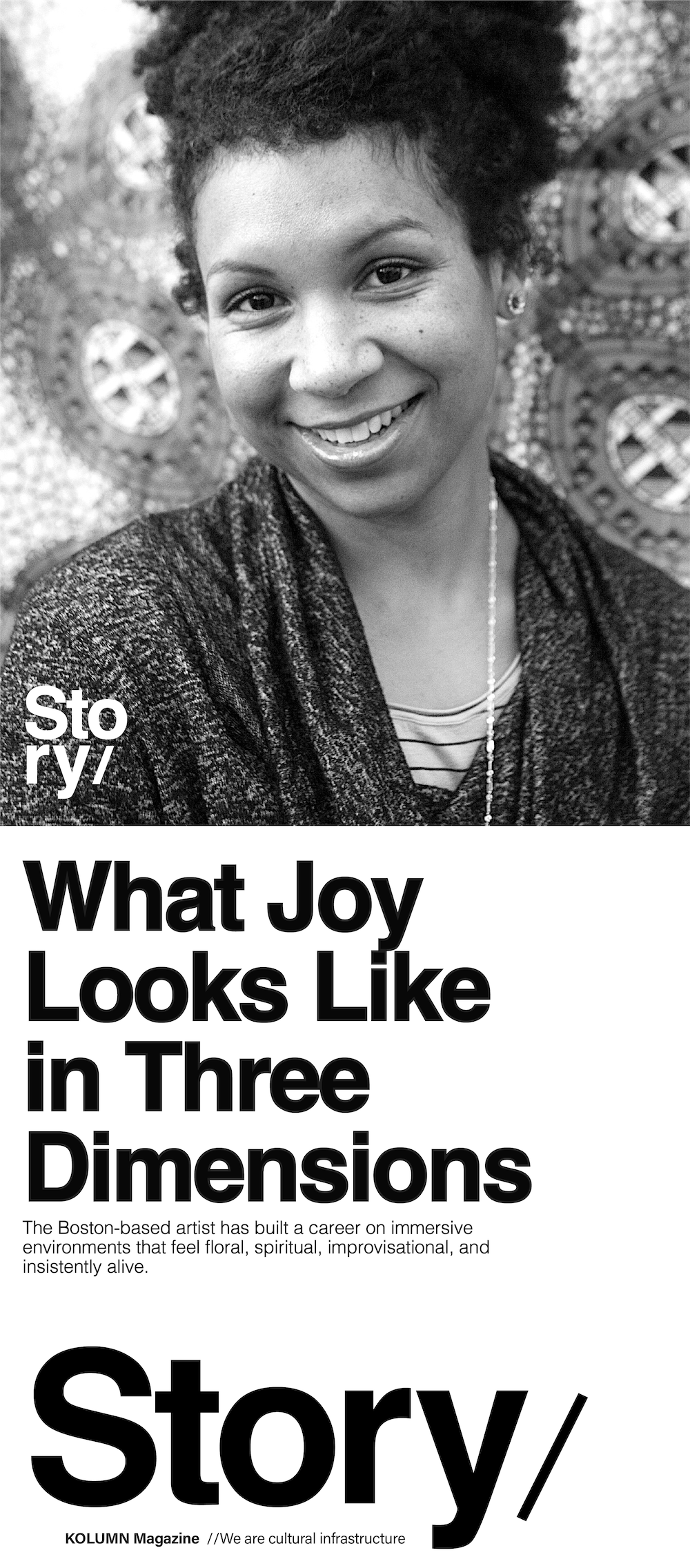
I want the freedom to make work my way—for it to be a conduit of healing and unapologetic joy.
By KOLUMN Magazine
To write about Cicely Carew is to write about an artist who has made a habit of refusing the flatness of categories. She is called a painter, and she is. She is called a sculptor, and she is that too. She is also an installation artist, a public artist, an educator, a mind-body facilitator, and, increasingly, one of the most recognizable makers of immersive abstraction in Boston’s contemporary art ecosystem. On her own terms, Carew’s practice spans installation, sculpture, painting, collage, printmaking, sound, and video; across institutional profiles, interviews, and exhibition texts, a few phrases recur with notable consistency: improvisation, spiritual embodiment, joy, liberation, transformation. Those are not branding words in her case. They are the architecture of the work itself.
That matters because contemporary abstraction, particularly when it moves into museums and public spaces, is still too often discussed in chilly formalist language: process, surface, gesture, materiality, spatial relation. All of those things apply to Carew, but none of them explains why people respond to the work with something closer to exhale than analysis. Her installations frequently feel less like objects to decode than places to enter. The materials may be industrial or improvised—mesh, tulle, screens, spray paint, light, found and layered matter—but the cumulative effect is tender, ecstatic, and strangely protective. Fuller Craft Museum described her 2025 solo exhibition BeLOVEd as a “sanctuary for reflection,” while Fitchburg Art Museum framed Quantum Sanctuary as a reclamation space activating the senses and awareness of interconnectedness. Even when the language comes from institutions, it rings true because it matches the lived experience viewers and critics have described.
Carew was born in Los Angeles in 1982 and is now based in the Boston area, where she lives and works in Cambridge. She earned her BFA from Massachusetts College of Art and Design and later completed an MFA at Lesley Art + Design. Along the way, she built not only a studio practice but a civic one: teaching mixed media and printmaking, serving as an artist-in-residence at Shady Hill School, lecturing at area institutions, and working across educational, nonprofit, museum, and commercial contexts. That breadth is easy to flatten into résumé language, but in Carew’s case it is central to the story. She is not an artist who emerged by sealing herself off from the world. Her career has developed through a porous relationship to community, pedagogy, and public encounter.
“I want the freedom to make work my way—for it to be a conduit of healing and unapologetic joy.”
That line, from a 2021 conversation with Boston Art Review, helps explain why Carew’s work lands with unusual force at this moment. The phrase “unapologetic joy” can sound soft in the abstract, even vague, until you place it in the context of Black artistic practice, public fatigue, institutional precarity, and a broader culture organized around spectacle, speed, and psychic depletion. In that framework, joy is not decoration. It is discipline. It is refusal. It is method. Carew’s work repeatedly suggests that delight and seriousness are not opposites, and that liberation requires an aesthetics large enough to hold both tenderness and strain. Her own language bears this out: she has described wanting to liberate herself from the idea of separateness and to make work through purpose, healing, and acceptance of “what is bitter and what is sweet.”
When Paint Leaves the Wall
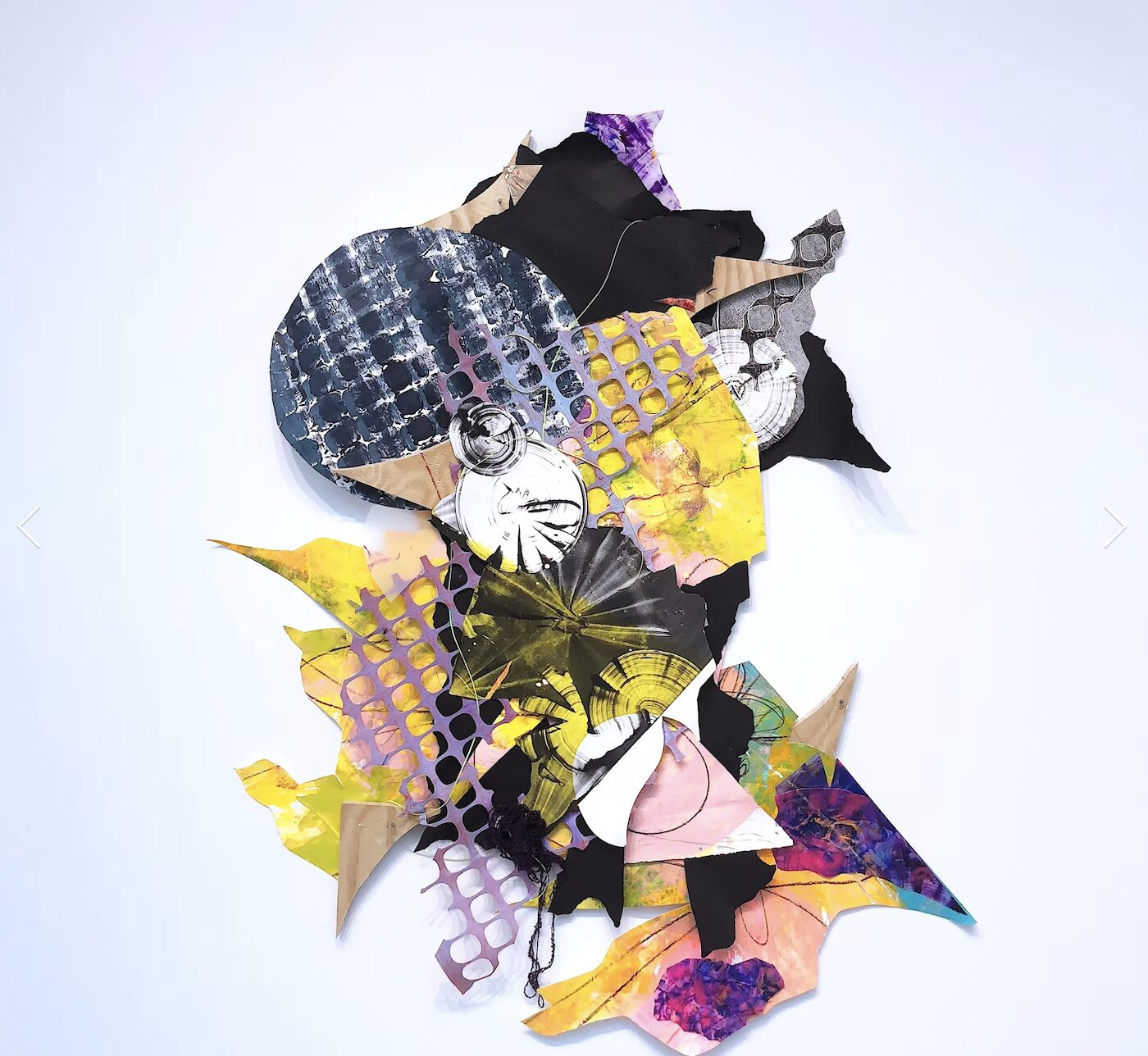
One of the most useful ways to understand Carew is through motion. Even when her works are fixed, they rarely feel static. Critics and institutions alike have described her pieces as “flying paintings,” dangling, suspended, drifting, reaching, blooming. The phrase sounds playful, but it gets at something real in how her practice destabilizes disciplinary borders. Her sculptural forms often behave like painting that has escaped the wall. Her collages and layered works often feel sculptural in their density and lift. Her installations choreograph the viewer physically, asking people to walk around, under, beside, and through fields of color and material. The work is not simply seen; it is navigated. The result is a kind of expanded abstraction that is bodily before it is theoretical.
Her rise in public visibility has been steady rather than explosive, which may actually be the better route for an artist building a durable practice. Before the wider institutional recognition came, Carew had already been exhibiting in solo and group shows across the Northeast and producing projects that moved between gallery, campus, and civic space. She later received a string of honors that signaled mounting recognition: the St. Botolph Club Foundation Emerging Artist Award, the Blanche E. Colman Award, the Brother Thomas Fellowship, and, most visibly, the James and Audrey Foster Prize from the Institute of Contemporary Art/Boston. Those honors did not create the work, but they helped clarify what local observers had already been seeing: that Carew’s practice had grown formally ambitious, publicly resonant, and impossible to dismiss as merely decorative.
The Foster Prize mattered for reasons beyond prestige. The ICA describes the biennial award as recognizing some of the most compelling art being made in Boston, and Carew was selected in 2023 alongside Venetia Dale and Yu-Wen Wu for an exhibition engaging change, time, and transformation. In coverage of the announcement and the show itself, Carew’s work was framed as part of a thriving local art scene, one less dependent on imported validation than on institutions finally paying closer attention to the complexity already in their orbit. The Boston Globe’s Cate McQuaid, reviewing the Foster Prize exhibition, wrote about Carew’s hanging and wall-based works as “inviting knots of ebullient chaos,” and connected them to a larger argument about Black culture claiming space within American art history through abstraction and sound. That framing is important. Carew’s significance is not only personal or regional; it also sits inside a longer art-historical contest over who gets to author abstraction’s emotional and intellectual vocabulary.
Carew’s work argues, again and again, that abstraction does not have to be distant to be profound; it can be lush, accessible, sensual, and still deeply rigorous.
Public Art as Reorientation
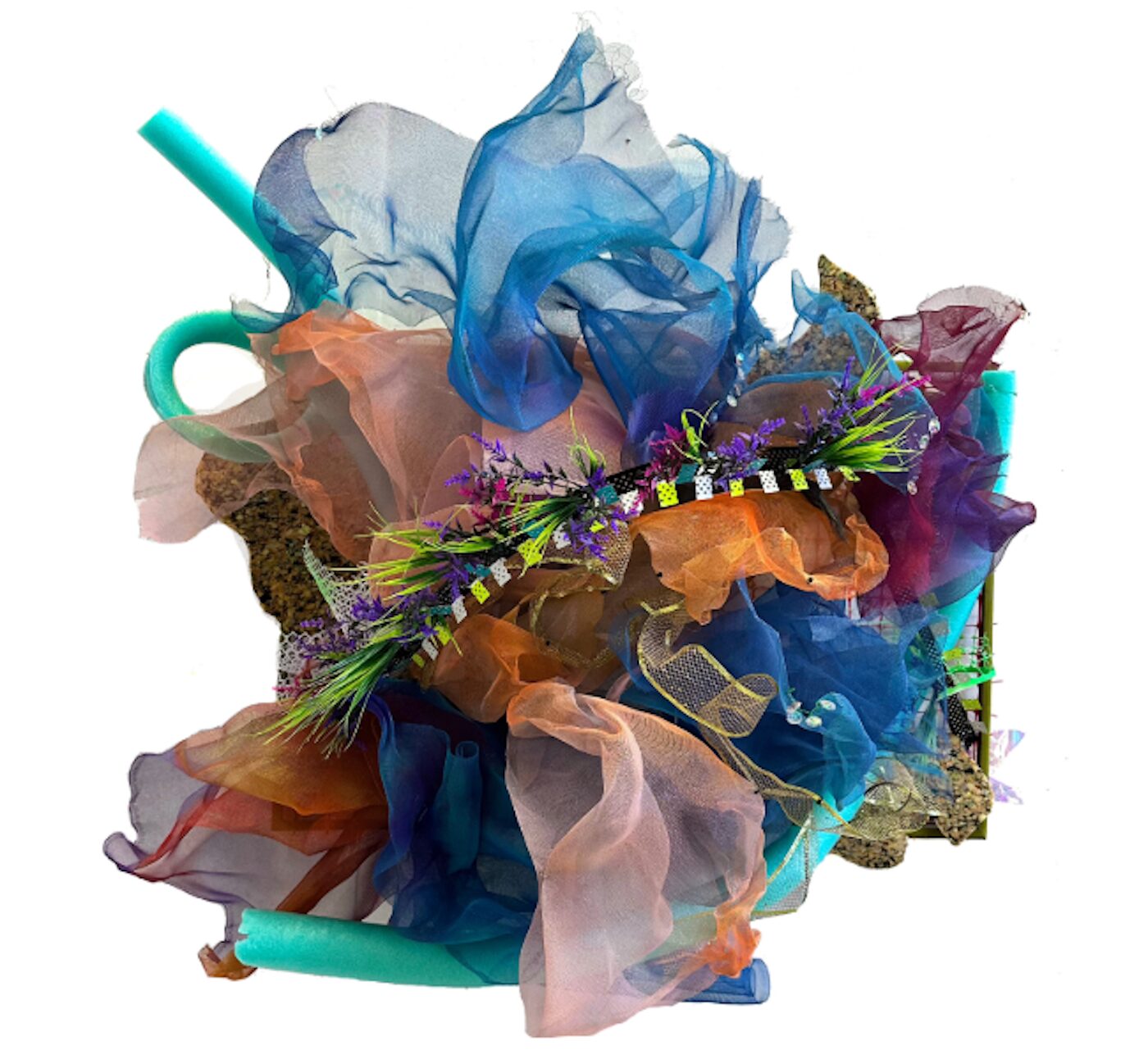
That may be one reason her public art has been so effective. In 2021, her installation Ambrosia opened at the Prudential Center through a collaboration involving Boston Properties and the public art nonprofit Now + There. The work consisted of suspended sculptural forms made from materials including spray-painted mesh, tulle, and screens, hanging over several parts of the site. In interviews around the project, Carew said she hoped people would “look up,” both literally and psychologically. This was pandemic-era public art, but not in the predictable register of trauma processing or civic sloganeering. Instead, it offered a recalibration of attention. The point was not to deny difficulty; it was to interrupt the bodily habits that difficulty had produced—heads down, movement narrowed, imagination compressed.
That gesture—redirecting the body so the mind can follow—is one of Carew’s recurrent strengths. She has an instinct for making viewers feel the proposition of the work before they formulate it intellectually. At the Prudential Center, the idea was upward possibility. At Northeastern University, where her long-term installation Rooted brought five flower-like sculptures to Krentzman Quad in 2024, the proposition was environmental enchantment in an urban setting. The sculptures, nearly fifteen feet high, were designed to live outdoors for years, and Carew worked with industrial gardening materials, tightened structural forms against weather, and imagined surrounding vines and blooms gradually integrating with the piece. The president’s directive, she told WBUR, was to make a sterile environment feel more lush and inviting. On paper, that sounds like campus beautification. In practice, Carew made something more ambitious: a small argument that institutional space can be less armored, less deadened, more alive.
The WBUR interview about Rooted also revealed another dimension of Carew’s importance: her ability to speak plainly about art without reducing it. She discussed the practical challenge of building for weather and vandalism, but she also spoke about the installation occurring amid political tension on campus, including arrests linked to a pro-Palestinian encampment. She described the “cognitive dissonance” of installing life-affirming work in that atmosphere and said she thinks about what her work can do “in the context of liberation.” The flowers, she said, are “prayers for something better,” and for the courage to remain enchanted with life instead of checking out or separating from one another. That is not naïveté. It is a serious philosophy of relation. Carew understands beauty as a social practice, not an escape hatch.
Material Transformation and Immersive Space
This is where some of the best criticism around her work gets especially useful. Too often, art writing falls into one of two traps with artists working in lush material vocabularies: either it sentimentalizes the beauty or it overcorrects by insisting on theoretical hardness. Carew invites neither. The more precise reading is that she mobilizes beauty as a sensorium through which viewers can encounter complexity. Her forms may evoke flowers, clouds, reefs, or celestial matter; they are also built from industrial and synthetic materials that carry the visual memory of fencing, screens, construction, and barrier. That friction matters. The work’s softness is made, in part, from the very materials of containment and utility. The transformation is therefore formal and political at once: she turns the mundane and the infrastructural into something atmospheric, almost devotional. That is one reason her installations can feel simultaneously vulnerable and resilient.
Her 2022 exhibition Quantum Sanctuary at Fitchburg Art Museum pushed this sensibility into a fully immersive register. The museum described the installation as activating the senses through light, sound, digital display, and physical sculpture, while also promoting awareness of interconnectedness and honoring ancestral origins. The title is revealing. “Sanctuary” tells you how the work wants to function; “quantum” suggests scale, vibration, interdependence, and realities not visible at ordinary glance. On Carew’s site and in institutional descriptions, the exhibition appears not simply as an arrangement of artworks but as an environment designed for altered attention. That ambition—to create spaces that feel restorative without becoming passive—is central to her development. By the time she reached BeLOVEd at Fuller Craft Museum in 2025, she had become increasingly adept at constructing total environments in which sculpture, soundscape, print, light, and atmosphere reinforce one another.
In Carew’s hands, wonder is not a mood. It is a strategy for survival.
That helps explain why BeLOVEd drew such warm language from those covering it. Fuller Craft called it a transformative realm and a liminal zone; GBH described it as a visionary, site-specific installation uniting sculpture, video, and sound into a meditative experience; The Boston Globe reported that Carew saw the exhibition as “a sacred container” and quoted her saying, “I want you to feel that this is a gift for you.” There is a risk, when writing about work like this, of making it sound merely soothing. But Carew’s own framing keeps steering the conversation back toward generosity as an active condition. The work wants to hold viewers, yes, but also to re-sensitize them. It is immersive not as spectacle for spectacle’s sake, but as a means of deepening presence.
Teaching, Community, and a New Audience for Abstraction
Her profile also complicates the stale idea that public-facing, emotionally legible art is somehow less rigorous than conceptually colder work. Carew’s installations are meticulously built, materially layered, and historically aware. Critics have linked her abstractions to studio detritus, gestural painting, sound, and the legacy of Abstract Expressionism, even as her own practice departs from that tradition’s masculinist myths by emphasizing embodiment, care, collectivity, and permeability. She has also drawn on sacred geometry, meditation, and healing language in projects such as Wishing Well, an interactive installation addressing mental health, ancestral trauma, and support for BIPOC women through a contemplative sculptural environment. Whether one uses the language of formal innovation or social practice, the point is the same: Carew has built a body of work in which aesthetics and ethics are tightly braided.
The educational dimension of her career reinforces that reading. Carew has taught screen printing, mixed media, and printmaking; served as an artist-in-residence; lectured at universities and museums; and maintained a visible role in the Boston-area arts community. This matters not just because teaching is honorable labor, but because it situates her inside a lineage of artists who understand making as reciprocal exchange. The same generosity that viewers identify in the installations appears in the structure of the career itself. She does not merely produce objects for consumption; she participates in building audiences, students, and local art worlds. That kind of civic artistry is often undervalued because it does not always translate into national-market hype. But it is exactly the sort of labor that makes regional ecosystems durable and, eventually, nationally relevant.
There is also the matter of collections and commissions, which tell a story about institutional trust. Carew’s work is held in collections including Fidelity, Simmons University, Northeastern University, the Cambridge Arts Council, and the Federal Reserve Bank of Boston. She has been commissioned by organizations and sites including Google in Cambridge, Peloton in New York City, the Prudential Center in Boston, and Northeastern. Read narrowly, those are career markers. Read more broadly, they suggest that her visual language travels. It can inhabit the museum, the campus, the corporate environment, and the civic corridor without losing its identity. That adaptability is not trivial. Many artists can scale up; fewer can scale across contexts while maintaining conceptual integrity. Carew has done that with unusual fluency.
Still, her significance cannot be measured only through institutional endorsement. The deeper question is what her work makes newly available to viewers. One answer is a reconfigured relationship to abstraction itself. In the dominant popular imagination, abstract art is often treated as remote, elitist, or emotionally withholding. Carew’s practice quietly dismantles that caricature. Her abstractions are sensuous and open-ended, but they are not opaque for opacity’s sake. They invite intuition without demanding prior expertise. They accommodate stillness, but they do not insist on silence. They feel deeply considered while remaining hospitable. That combination is rarer than it should be. It is also one reason her work has earned coverage from outlets and institutions across the Boston arts sphere, from WBUR and The Boston Globe to the ICA, Fuller Craft, Fitchburg Art Museum, MassArt, and Northeastern. Taken together, that pattern suggests not a passing local fad but an artist whose vocabulary has become central to how one city now imagines contemporary art in public.
Why Cicely Carew Matters Now
Her work also arrives in a broader moment when many institutions are trying, sometimes awkwardly, to rethink how art can support reflection, plurality, and embodied experience rather than just prestige display. Carew seems especially well suited to that shift because she does not tack on ideas of healing, spirituality, or liberation after the fact. Those concerns are embedded in the work’s form, pacing, and atmosphere. Even the materials tell the story: hard things made soft; barriers turned porous; synthetic matter reoriented toward bloom. In another artist’s hands, that could read as visual optimism detached from structural reality. In Carew’s, it reads more like practice—an ongoing rehearsal for how to remain open without becoming fragile. That balance may be the deepest through line in her career so far.
There is a temptation, when an artist’s work is this openly generous, to overstate the therapeutic and understate the formal risk. But Carew’s career shows she has been willing to keep testing scale, medium, and context. From wall works and prints to large suspended installations, from campus commissions to immersive museum environments, she has expanded the grammar of her practice without abandoning its core commitments. That is harder than it sounds. Many artists either harden into signature or disperse into experimentation without coherence. Carew has managed a more difficult feat: evolution with continuity. The language of joy, transformation, and liberation has remained, but the work’s reach and confidence have widened.
And that, finally, may be why Cicely Carew matters. Not because she has solved the problem of contemporary art’s accessibility, and not because every flower-like form or floating abstraction can bear the full weight of social hope. She matters because she has built a serious, materially inventive practice around the proposition that wonder belongs in public life. She has insisted that beauty can be rigorous, that abstraction can be communal, that softness can carry force, and that viewers deserve spaces in which perception itself can loosen and deepen. In a time that rewards cynicism as intelligence, Carew’s work makes a more difficult argument: that enchantment is not the opposite of awareness but one of its conditions. That is an artistic achievement. It is also a civic one.
More great stories
Afro Sheen, Wall Street, and the Architecture of Black Possibility
July 6, 2026
No Comments
The Fire Inside the Fourth
July 5, 2026
No Comments