



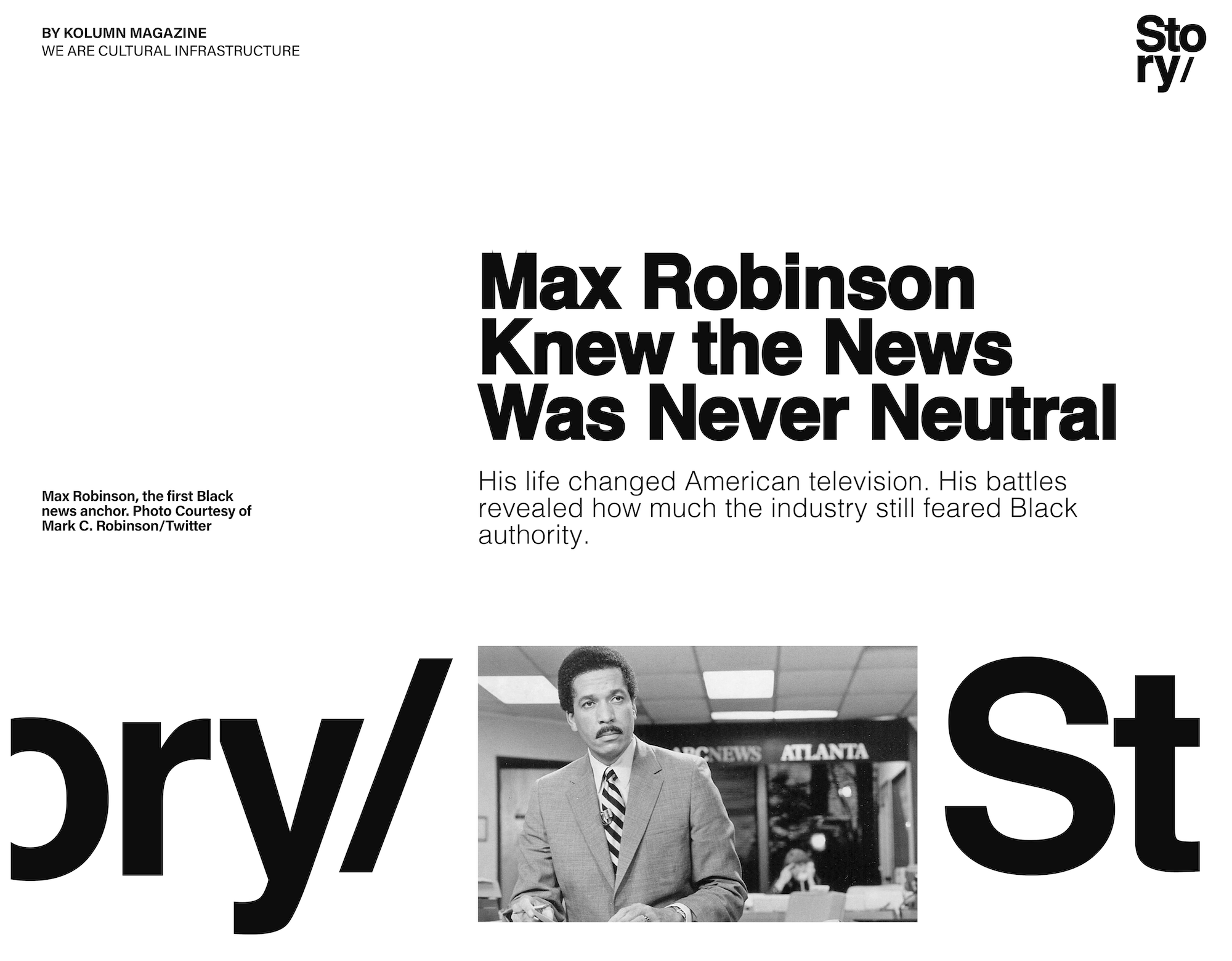
Robinson’s breakthrough was not just that a Black man appeared on national television. It was that he arrived carrying a critique of the institution that had finally opened the door.
Robinson’s breakthrough was not just that a Black man appeared on national television. It was that he arrived carrying a critique of the institution that had finally opened the door.
By KOLUMN Magazine
Max Robinson did not simply enter American television news. He altered the picture.
Before “representation” became a corporate promise, before network diversity reports and branded inclusion campaigns, before cable panels made visibility look routine, Robinson forced American broadcast journalism to confront a question it had long avoided: who gets to speak for the nation? Born Maxie Cleveland Robinson Jr. in Richmond, Virginia, on May 1, 1939, and dead by December 20, 1988, at only 49, Robinson’s life moved with the velocity of a breakthrough and the pressure of a warning. Britannica identifies him as the first African American man to anchor a nightly network newscast, while the National Association of Black Journalists remembers him as both a founding member and a former ABC News anchor. But the label “first” is too small for the life.
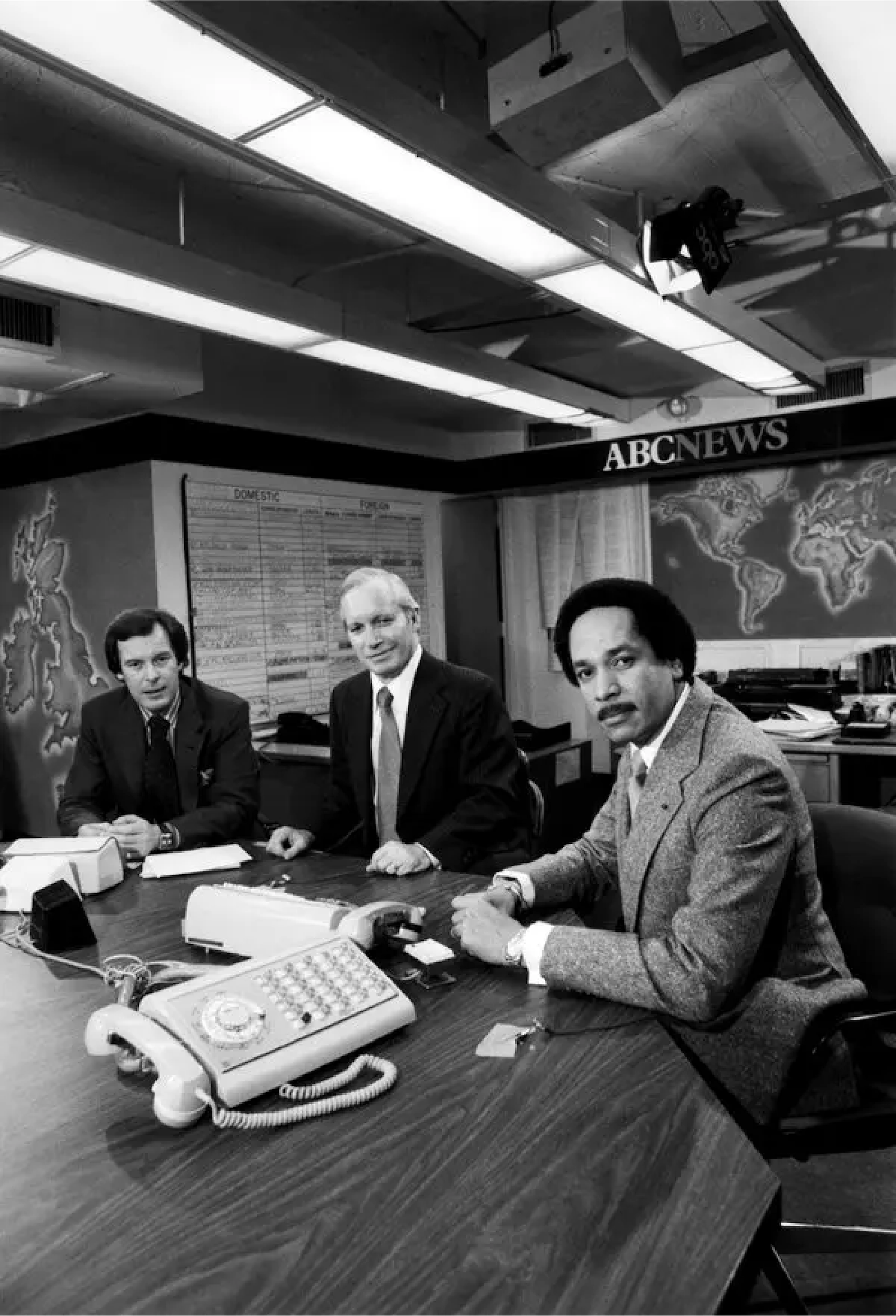
Robinson was not only a pioneer of presence. He was a critic of the room he entered. He understood that newsrooms were not merely places where facts were assembled. They were institutions of power, deciding which communities were understood, which were pathologized, which were treated as citizens, and which were treated as problems. Long before mainstream media developed a fluent vocabulary around structural bias, Robinson was calling out the architecture.
Richmond, Jim Crow, and the Sound of Authority
Robinson was born in Richmond, Virginia, into a country that made authority look white by design. His early life unfolded in the shadow of Jim Crow, where the boundaries of race were not abstract social customs but daily systems of discipline. Whitman-Walker notes that Robinson grew up during segregation, an experience that shaped his later commitment to equity in journalism. That word—equity—can sound soft now, institutional, grant-ready. In Robinson’s era, the demand was sharper. Black people wanted access to the microphone, the camera, the assignment desk, the editorial meeting, and the final say over how their lives were framed.
The Robinson household produced more than one public fighter. Max’s brother Randall Robinson would later become a major human-rights advocate and founder of TransAfrica, a reminder that the family’s political imagination extended beyond domestic civil rights into global Black struggle. Encyclopedia.com places Max Robinson within a biography marked by ambition, public voice, and institutional combat. His path through education included Oberlin College, Indiana University, and Virginia Union University, according to Britannica, though his career would be shaped less by a tidy academic résumé than by the rougher apprenticeship of local broadcasting.
Robinson entered media when American television still treated Blackness as an object rather than a source of interpretation. Black people appeared on screen as protestors, victims, entertainers, athletes, defendants, witnesses, and symbols of urban crisis. They were far less likely to appear as the calm voice of record. Robinson wanted that authority. He wanted the public trust attached to the anchor desk, not as ornament but as power.
The most famous early story from his career still reads like allegory. At WTOV-TV in Portsmouth, Virginia, Robinson was reportedly hired to read the news but required to remain unseen behind a station-logo slide. He eventually ordered the slide removed and was fired the next day, a story recounted in multiple biographical summaries, including BlackPast. The episode endures because it contains the old bargain in miniature: Black labor could be useful, Black voice could be exploited, but Black presence had to be hidden.
The logo was not just a graphic. It was a mask. Robinson’s refusal to stay behind it was his first great act of journalism.
Washington, D.C., and the Local Breakthrough
Before Robinson became a national figure, he became a Washington one. That matters because Washington was not merely another television market. It was the symbolic capital of American power and a majority-Black city whose realities were often distorted by national narratives. Robinson’s rise in local news took place at the intersection of federal authority, Black municipal life, civil-rights aftermath, and urban transformation.
“The station-logo story endured because it revealed the old bargain: Black labor could be heard so long as Black authority remained unseen.”
At WRC-TV, Robinson reported during a turbulent period in the late 1960s, including the years surrounding the assassination of Dr. Martin Luther King Jr. His early documentary work included The Other Washington, an Emmy-winning exploration of Black life in Anacostia, cited in William Raspberry’s searching remembrance in The Washington Post. The title alone carried a politics. There was the Washington of monuments, motorcades, congressional hearings, and official ceremonies. Then there was the other Washington: Black, working-class, overpoliced, under-covered, culturally alive, and rarely granted interpretive dignity.
Robinson understood that city. He also understood television’s ability to either reveal it or reduce it. In 1969, he joined WTOP-TV, now WUSA, and became the first African American anchor on a local television news program in Washington, D.C., according to Britannica. With Gordon Peterson, Robinson helped form one of the city’s most successful anchor teams. WUSA9 has revisited that local legacy, describing Robinson as an award-winning anchor whose life carried both brilliance and torment.
His popularity in Washington challenged one of television’s most persistent lies: that white audiences had to be slowly trained to accept Black authority. Robinson’s work suggested something else. Audiences responded to competence, intelligence, charisma, and credibility. The problem was not the public’s incapacity to trust Black journalists. The problem was the industry’s refusal to give them the chair.
ABC and the National Color Line
In 1978, ABC News president Roone Arledge reimagined the network’s evening news as a three-anchor broadcast. Frank Reynolds would anchor from Washington, Peter Jennings from London, and Max Robinson from Chicago. With that appointment, Robinson became the first Black man to anchor a nightly network newscast, a milestone documented by Britannica and remembered by the National Association of Black Journalists. It was a landmark not only in broadcast history but in the visual grammar of American citizenship.
The network anchor in the 1970s occupied a role that no longer exists in quite the same way. Before cable fragmentation, before the internet, before social media and algorithmic feeds, the evening newscast was one of the country’s central rituals. The anchor was a nightly interpreter of national reality. Presidents, wars, recessions, storms, assassinations, diplomatic crises, and social movements passed through that frame. To place Robinson inside it was to change the frame.
But the breakthrough was also carefully structured. Robinson was not made the sole anchor. He was part of a three-man format, a design that both elevated him and distributed authority around him. That arrangement does not diminish the historical significance of his appointment. It does, however, clarify the condition of his arrival. The industry made room for him, but not without architecture. He was central, yet managed. Historic, yet contained.
Robinson’s ABC years placed him in the national imagination. They also exposed the tension between symbolic inclusion and editorial power. As The Root later framed it, Robinson was not only a “first”; he was a figure who challenged the truth-telling obligations of television itself. He wanted newsrooms to confront how they covered Black America, not merely hire Black journalists to read scripts shaped by the same old assumptions.
That was the deeper fight. Robinson had not endured segregation, invisibility, and local newsroom barriers simply to become a polished emblem of institutional progress. He wanted the institution to change.
The Anchor as Critic
Robinson’s public legacy is sometimes softened into a ceremonial story: first Black network anchor, historic figure, tragic death. That version is true but incomplete. The more important Robinson was not ceremonial. He was adversarial when he believed the truth required it. He criticized racism in media, challenged coverage that distorted Black life, and argued that newsrooms could not claim objectivity while reproducing racial hierarchy.
This made him difficult in the way that institutional truth-tellers are often labeled difficult. His critiques anticipated debates that dominate journalism now: source diversity, crime coverage, newsroom leadership, racial framing, community trust, and the difference between neutrality and accuracy. Robinson understood that “neutrality” could become a disguise for inherited bias. If a newsroom treated police accounts as default truth and Black residents as emotional reaction, it was not neutral. If it covered Black neighborhoods only through crisis, it was not neutral. If it treated white discomfort as the boundary of acceptable reporting, it was not neutral.
His institutional work mattered as much as his on-air role. Robinson was among the founders of the National Association of Black Journalists, established in 1975 by 44 journalists seeking to strengthen Black presence and power in media. The NABJ founders list includes Max Robinson of WTOP-TV. That founding was not professional networking in the shallow sense. It was infrastructure-building. Black journalists needed collective leverage because individual excellence was not enough.
The creation of NABJ recognized a hard truth: the newsroom could celebrate a Black star while leaving Black reporters isolated, underpaid, underpromoted, and unheard. Robinson’s involvement signaled that he understood representation as a beginning, not a destination.
KOLUMN Magazine’s own archive has repeatedly returned to figures who understood that access without power is fragile. In its recent profile “Fred Gray and the Law of Black Survival,” KOLUMN Magazine framed Gray’s legal work as a sustained effort to make American institutions confront harms they had long protected. Robinson’s field was different, but the moral architecture was similar. Gray challenged the law’s claim to fairness. Robinson challenged the newsroom’s claim to neutrality.
The Problem of the First
To be first is to be celebrated and burdened at once. Robinson’s career demonstrates the cruelty built into that status. The “first” must be excellent enough to justify the institution’s risk, composed enough not to frighten those who opened the door, representative enough to satisfy the community, and restrained enough not to embarrass the employer. The first is often asked to prove that the system works while privately enduring evidence that it does not.
Robinson did not always endure quietly. That is part of why his story remains alive. He spoke about racism. He challenged the profession. He carried himself with pride that could read, to some managers and colleagues, as defiance. But Black self-respect has often been misread as arrogance by institutions accustomed to Black gratitude.
William Raspberry’s remembrance in The Washington Post did not reduce Robinson to triumph. Raspberry wrote of talent and torment, of demons that drove Robinson upward and contributed to his fall. That balance remains necessary. Robinson’s life should not be turned into a frictionless monument. He was brilliant, wounded, demanding, charismatic, troubled, and historically indispensable.
The industry’s treatment of him should also be understood within a broader pattern. Black pioneers are often remembered for the door they opened but not for the weather inside the room. Robinson entered national television at a time when there were few Black executives with real editorial power. He worked inside a medium still built around white institutional comfort. His presence could be praised while his critique was treated as a problem. That contradiction exacts a cost.
Robinson’s struggles with alcohol, professional instability, and personal turmoil have been reported in accounts of his later years. Los Angeles Times described his life as marked by alcohol abuse, racial struggles, career disaster, and three failed marriages. These details are painful, but serious journalism should resist using them as spectacle. They belong in the story because they are part of the life. They do not erase the achievement, and the achievement does not erase the pain.
Chicago, Conflict, and Decline
After ABC, Robinson’s career moved into a more difficult phase. Los Angeles Times reported at the time of his death that he had not worked regularly in television for three years. He joined WMAQ-TV in Chicago in 1984, where he became the station’s first Black anchor, but that chapter proved troubled and brief, according to biographical accounts summarized by Encyclopedia.com. The arc from national breakthrough to professional isolation was steep.
It would be easy to narrate this period as personal collapse alone. That would be too simple. Robinson made choices, and some of them damaged his career and relationships. But the more complete story must consider the unequal emotional demands placed on Black figures who carry both personal ambition and communal symbolism. Robinson was not allowed to be merely an anchor. He was a sign. He was evidence. He was hope. He was critique. He was proof for some and threat for others.
That kind of visibility can become a cage.
In the years after Robinson’s network breakthrough, the television industry changed but did not transform enough. Black journalists entered the frame in greater numbers, yet ownership, executive power, assignment authority, and editorial culture remained uneven. Robinson’s own decline became, for some observers, a cautionary tale. But caution against what? Against ambition? Against anger? Against speaking too plainly? Against believing the institution would love the critic as much as it loved the symbol?
A more useful reading is that Robinson’s life revealed the inadequacy of individual breakthrough as a theory of justice. One person can break a barrier. One person cannot, alone, rebuild the institution behind it.
AIDS, Silence, and a Final Public Act
Robinson died on December 20, 1988, at Howard University Hospital in Washington, D.C. Los Angeles Times reported that he died of complications from AIDS. The detail matters not because it should define him, but because of what his family did next. According to Los Angeles Times, Robinson had his family reveal that he had AIDS so that others in the Black community would be alerted to the dangers of the disease and the need for treatment and education.
That disclosure was an act of public service in a period when AIDS was surrounded by fear, misinformation, homophobia, stigma, and governmental neglect. In the 1980s, the disease was too often framed through moral panic rather than public health. For Black communities, the silence could be especially deadly, shaped by inadequate medical access, distrust of institutions, and the added burden of shame. Robinson’s family’s disclosure turned private tragedy into warning.
It was also consistent with the deepest theme of his career. The hidden had to be shown. The face behind the logo had to appear. The illness behind the whisper had to be named. The truth behind the institution’s preferred image had to be spoken.
Whitman-Walker has remembered Robinson as a pioneer of Black journalism whose death from AIDS-related complications remains part of his public legacy. That remembrance is important because it resists the erasure that stigma often produces. Robinson was not a scandal. He was a man, a journalist, a father, a brother, a colleague, a founder, a barrier-breaker, and finally a public-health witness.
Why Robinson Still Matters
Max Robinson’s importance has grown because the questions he raised remain unsettled. American newsrooms have more Black journalists than they did in 1978. There are Black anchors, editors, media founders, correspondents, producers, documentary filmmakers, newsletter writers, and digital investigators. Yet the central issue Robinson confronted persists: visibility is not the same as power.
Who assigns the story? Who chooses the frame? Who decides whether a Black neighborhood is covered through violence or through policy failure, history, resistance, and ordinary life? Who gets believed first? Who is granted complexity? Who is allowed to be angry without being dismissed as biased? These are Robinson questions.
They are also KOLUMN questions. In “Charles W. Chesnutt Knew the Story America Told Itself,” KOLUMN Magazine argued that Chesnutt saw the country with greater accuracy than many of his more canonized peers. Robinson belongs to that same tradition of Black clarity. He saw the newsroom’s myth of innocence and refused to honor it.
His story also speaks to the digital present. The old broadcast gatekeepers no longer have the same monopoly, but new forms of mediation have emerged. Algorithms, platforms, search engines, artificial intelligence systems, and social feeds now shape what millions see and believe. The problem Robinson confronted—who narrates Black life—has not disappeared. It has migrated.
In that sense, Robinson’s career is not only broadcast history. It is a warning for every era of media technology. A new platform does not guarantee a more just narrative. A new distribution system does not automatically correct old distortions. The question remains whether Black communities have interpretive power or merely content visibility.
The Legacy Beyond the Desk
The most obvious legacy of Max Robinson is the line of Black broadcasters who came after him. But his deeper legacy is more demanding. He helped make it possible for Black journalists to imagine themselves as national authorities. He also modeled the refusal to separate professional advancement from institutional critique.
The National Association of Black Journalists remains one of the clearest expressions of that legacy. Its existence says what Robinson’s career also said: Black journalists should not have to survive alone inside institutions that benefit from their talent while resisting their analysis. They need community, standards, advocacy, and power.
Robinson’s life also requires a more mature language for Black excellence. He was excellent, but excellence did not save him from pain. He was historic, but history did not protect him from illness or professional exile. He was visible, but visibility did not guarantee peace. To honor him properly is to resist the flattening that often happens to Black pioneers after death. We should not turn him into a perfect statue. We should preserve him as a full human being whose contradictions sharpen rather than weaken the meaning of his work.
That fuller remembrance is especially necessary because Robinson’s career was, in many ways, about the right to complexity. He wanted Black life covered with depth. He deserves the same.
The Man Who Made America Look
There is a clean version of the Max Robinson story. It says that a boy from Richmond grew up, entered broadcasting, became the first Black anchor of a nightly network newscast, helped found NABJ, struggled, and died young. That version is accurate. It is not enough.
The fuller version says that Robinson spent his life fighting disappearance. First, the literal disappearance behind a station logo. Then, the civic disappearance of Black Washington in mainstream coverage. Then, the symbolic disappearance produced by network tokenism. Then, the moral disappearance caused by AIDS stigma. At every stage, the question was whether America would look directly at what it preferred to obscure.
Robinson made it look.
He made viewers look at a Black man carrying national authority. He made newsrooms look at their own racial habits. He made younger journalists look at a possible future. He made the public look at AIDS in a Black life at a time when silence could kill. His career did not solve the problems he named. But it made denial harder.
That is a legacy of real consequence. Not the soft legacy of inspiration alone, but the harder legacy of interruption. Robinson interrupted the broadcast image. He interrupted newsroom comfort. He interrupted the story America told about who could be trusted to speak.
Max Robinson did not stay behind the logo. He stepped into the frame, and the frame was never the same.
More great stories
Afro Sheen, Wall Street, and the Architecture of Black Possibility
July 6, 2026
No Comments
The Fire Inside the Fourth
July 5, 2026
No Comments