





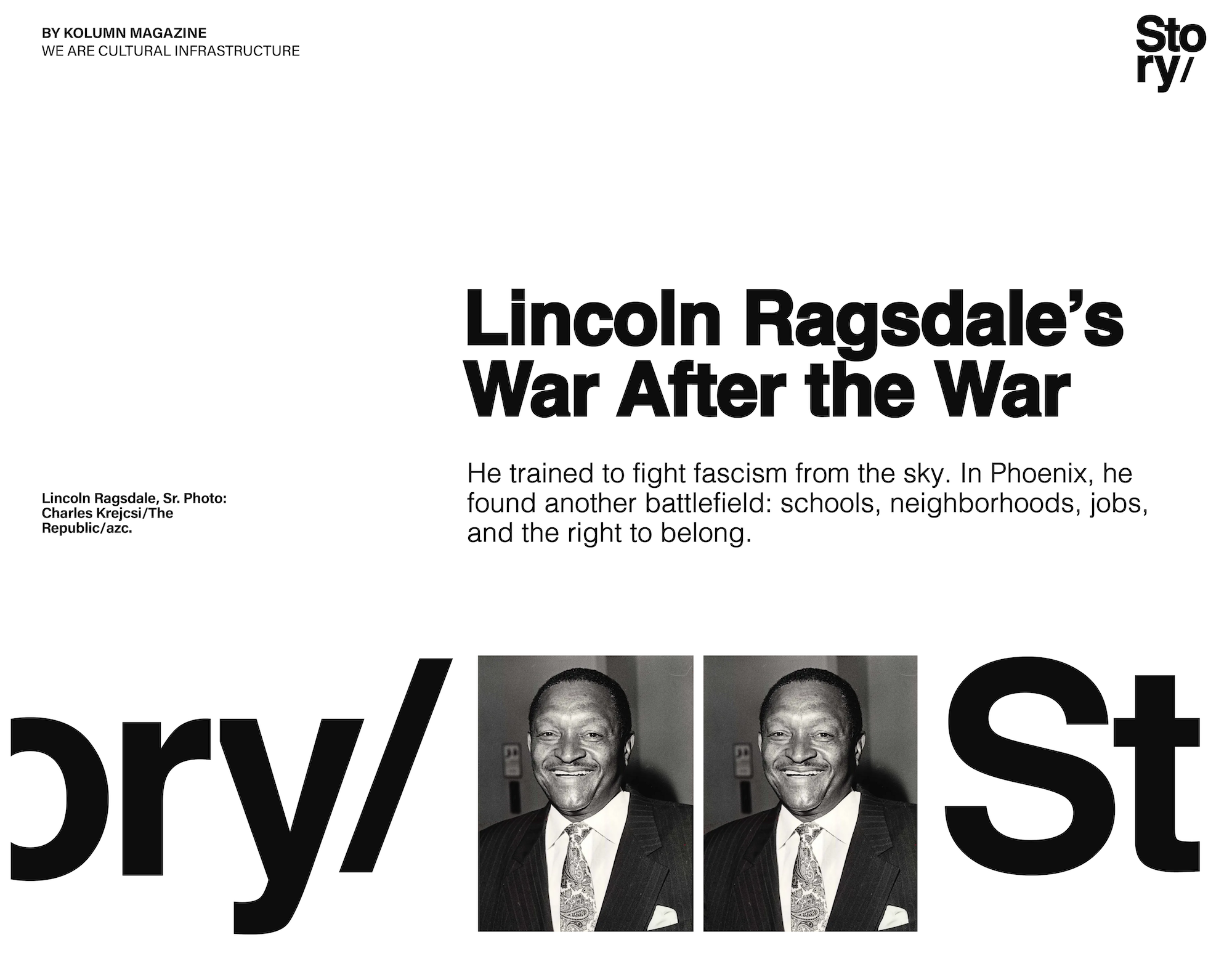
Ragsdale understood power as something built block by block: a business, a lawsuit, a house beyond the red line, a rally, a vote.
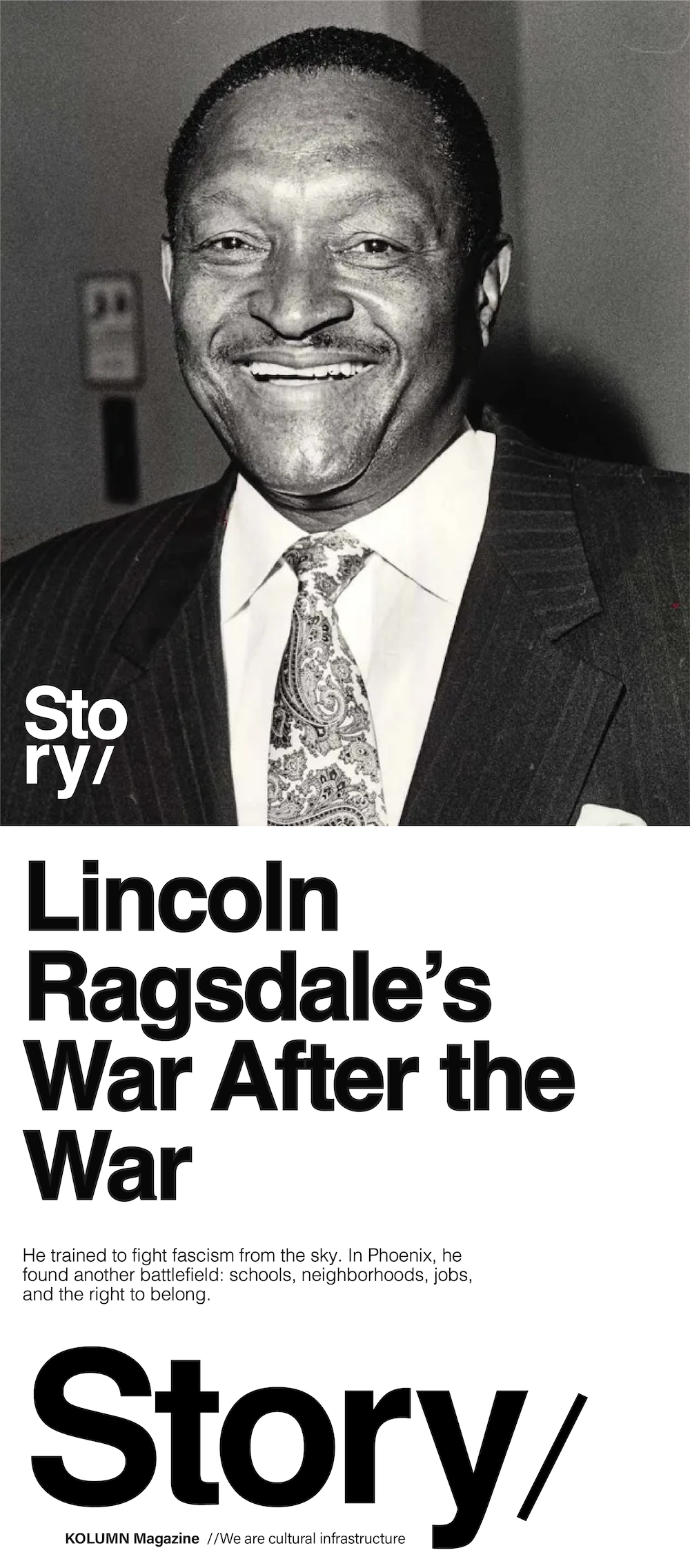
Ragsdale understood power as something built block by block: a business, a lawsuit, a house beyond the red line, a rally, a vote.
By KOLUMN Magazine
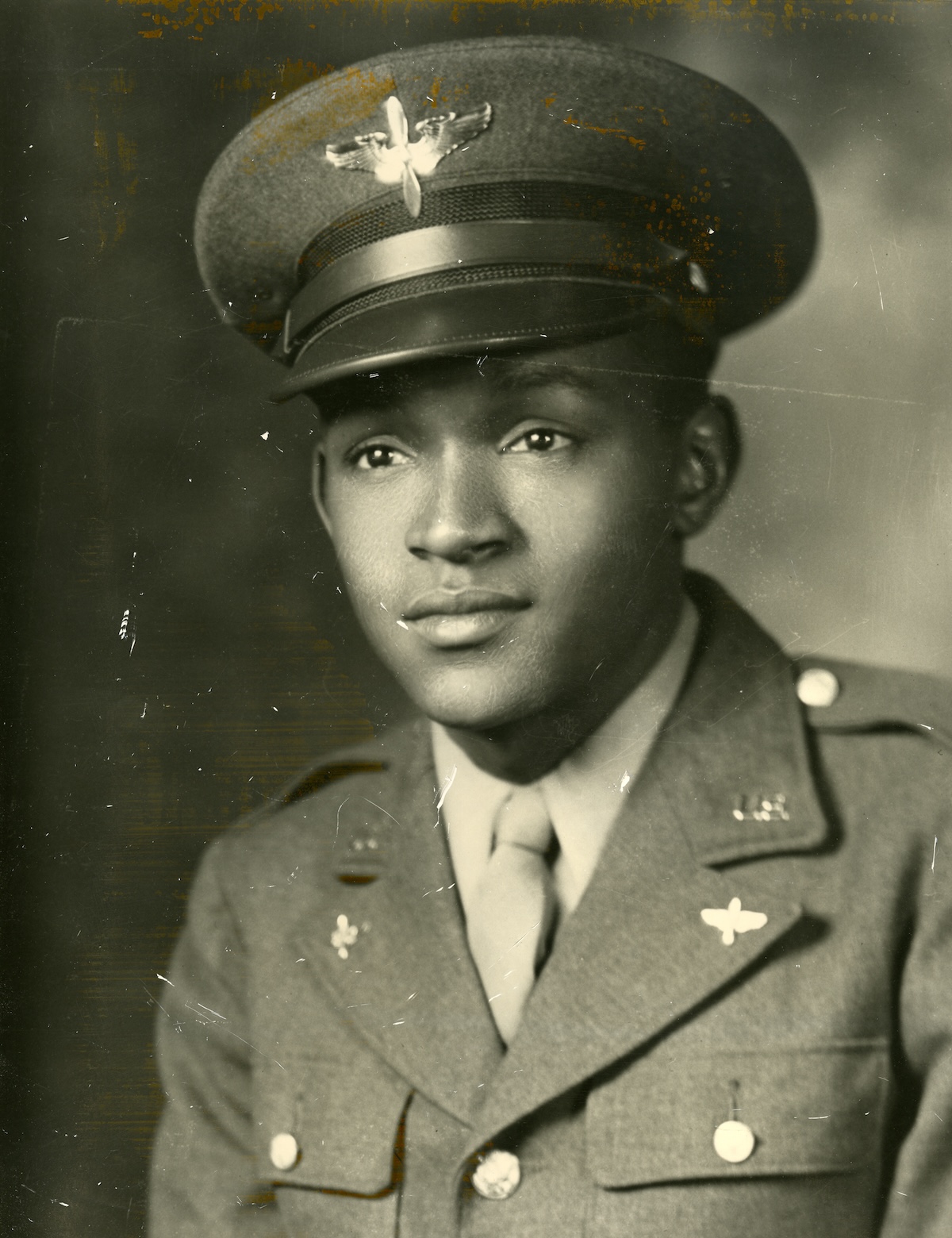
Lincoln Johnson Ragsdale Sr. arrived in Arizona with a pilot’s wings, a veteran’s discipline, and a rude education in the geography of American racism. Born in 1926 and trained as one of the Tuskegee Airmen, Ragsdale entered Phoenix after World War II expecting the desert West to offer at least some relief from the racial codes of the South. What he found instead was a city so rigidly segregated that he would later call it “the Mississippi of the West,” a phrase preserved in civil-rights profiles of his life and in accounts of his time at Luke Air Field, where white officers resisted sharing space with Black military men. Phoenix did not make him smaller. It gave him a target.
The familiar civil-rights map often runs through Montgomery, Birmingham, Jackson, Selma, Greensboro, and Memphis. Ragsdale’s life insists that Phoenix belongs on that map, too. In Arizona, segregation was not always announced with the theatrical cruelty of Deep South signage; it worked through banks, schools, cemeteries, employment networks, real-estate lines, hotel desks, lunch counters, and city hall. Ragsdale’s genius was that he recognized every one of those systems as a site of struggle. The Arizona Veterans Hall of Fame summarizes his postwar life as 46 years of civil-rights work: desegregating the Encanto District, organizing rallies for Black workers, pressing major employers to hire skilled Black workers, founding businesses, and opening doors for veterans, Hispanic residents, and Native Americans.
From Oklahoma Memory to Military Flight
Ragsdale was born July 27, 1926, into a family already shaped by Black institution-building and racial terror. His parents, Hartwell Ragsdale, a mortician, and Onlia Violet Ragsdale, a schoolteacher, raised him with a reverence for education and self-possession; CAF RISE ABOVE’s Tuskegee Airmen profile notes that he attended segregated Douglass High School in Ardmore, Oklahoma, and developed an early fascination with flight by earning money to pay a local pilot to take him into the air. His family’s mortuary tradition mattered, too. Undertaking was not merely a profession in Black communities; it was a business of dignity, ritual, logistics, credit, and trust in a society that denied Black people control over nearly every public institution.
The shadow of Tulsa also lived in the family history. Recent reporting on the Ragsdale Family Papers at Arizona State University notes that the collection documents Lincoln and Eleanor Ragsdale’s lives and families, including Lincoln Ragsdale Sr.’s World War II service, business ventures, and civil-rights activism. That archive matters because it places the Ragsdale story where it belongs: not as a local anecdote, but as a Black Western archive of migration, entrepreneurship, and resistance. Like KOLUMN’s earlier aviation-history feature on Willa Brown, which framed Black flight as both infrastructure and insurgency, Ragsdale’s story sits at the intersection of mobility and power: who gets to move, who gets certified, who gets housed, who gets served, who gets remembered.
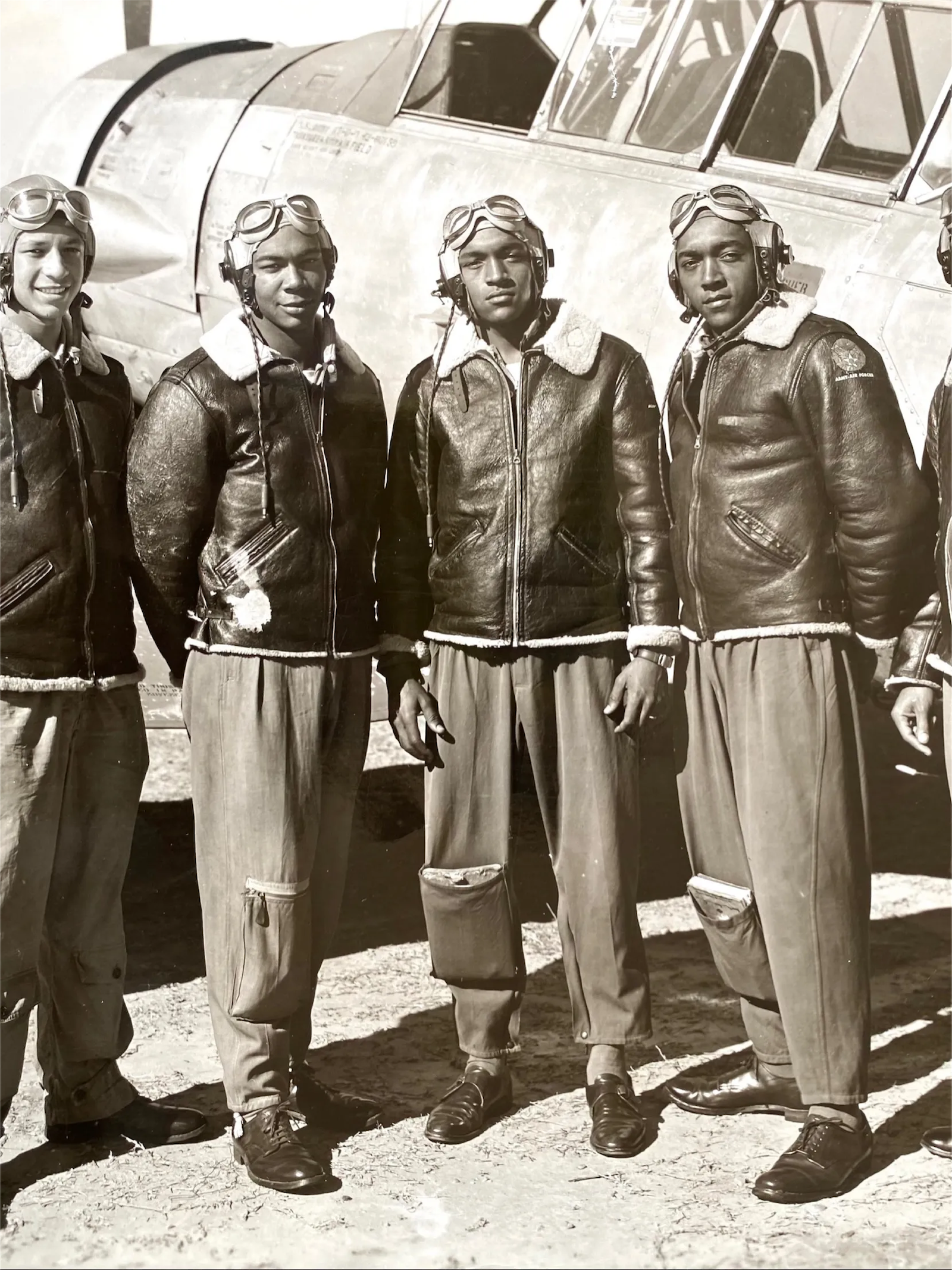
When Ragsdale graduated from high school in 1944, the Tuskegee Airmen represented more than a military assignment. They were a direct answer to racist claims that Black men lacked the discipline, intelligence, or temperament to fly. CAF RISE ABOVE records that Ragsdale trained at Tuskegee Army Air Corps Field in Alabama in 1945 and became part of the U.S. Army’s early integration effort. He later said the Tuskegee experience gave him “a whole new self-image,” recalling how Black children would touch the uniforms of returning airmen and ask whether they could really fly airplane. The uniform became evidence. The cockpit became rebuttal.
Ragsdale did not fly combat missions; he was commissioned after World War II. But the war he encountered at Luke Air Field in Arizona was unmistakably domestic. CAF RISE ABOVE’s profile recounts that eleven Tuskegee officers stationed at Luke were housed with white Southern roommates, and Ragsdale’s roommate refused to stay with him after realizing he was Black. That episode is not incidental. It reveals the contradiction at the heart of American democracy in uniform: Black men could train to defend the nation while being told they were unfit to share a room, a neighborhood, a school, or a job with white citizens.
Phoenix, the Red Line, and the Business of Refusal
Ragsdale stayed. That decision is one of the great turning points of his life. After his military discharge, he settled in Phoenix and entered the family profession. The Arizona Veterans Hall of Fame notes that in 1948 he co-founded Ragsdale Mortuary with his brother Hartwell, even as the city’s banks and business networks operated within a segregated economy. The mortuary became more than an enterprise. It was a base of operations, a Black-owned institution in a city that tried to contain Black ambition south of invisible but heavily policed lines.
ASU’s 2026 story on the Ragsdale Family Papers describes the family’s business empire as including Ragsdale Mortuary, Universal Memorial Center, Valley Life Insurance Company, the Century Sky Room restaurant and jazz club, and other ventures. Jessica Salow, assistant archivist of Black Collections at ASU Library, called the Ragsdales “powerhouses in the business industry,” noting their work in insurance, mortuary services, and nightlife. That range is central to understanding Ragsdale. He was not an activist who happened to own businesses. He was a businessman who turned enterprise into civil-rights machinery.
The undertaker’s work gave him standing in the most intimate moments of Black life. The insurance work gave him access to capital and risk. The real-estate work confronted segregation at the level of land. The nightclub created cultural space. The public activism gave those private institutions a civic purpose. Ragsdale’s businesses did what Black businesses have often done under apartheid-like conditions: they created services where white institutions refused service, then became platforms for political organizing.
Phoenix’s racial geography made housing one of the city’s defining battlegrounds. ASU notes that in 1953 Lincoln and Eleanor Ragsdale became the first Black family to cross Phoenix’s red line north of Van Buren and Jefferson, moving into the Encanto area despite the discriminatory withholding of financial services from minority. The phrase “cross the red line” can sound symbolic now, but in practice it meant living under surveillance, threat, and hostility. It meant deciding that the family home itself would become evidence against a city’s racial order.
Eleanor Ragsdale must be understood not as a supporting character but as a co-strategist. The Copper Courier’s 2026 profile emphasizes that Lincoln himself credited Eleanor’s courage, quoting him as saying she had “more guts” than he. She was a teacher, a real-estate actor, and a civil-rights force. Together, the Ragsdales treated segregation as a system that could be attacked through law, property, publicity, and pressure.
The School Case Before Brown
One of Ragsdale’s most consequential fights came before the U.S. Supreme Court handed down Brown v. Board of Education. Phoenix’s school segregation had a specific architecture. Education Forward Arizona notes that Phoenix Union Colored High School, later George Washington Carver High School, was the only school ever built in Arizona exclusively for Black high-school students, and that before its construction Black students had been segregated in the cellar of Phoenix Union High School. The story is grotesque in its clarity: Black children were not simply separated; they were literally pushed below.
In the early 1950s, civil-rights groups pressed Arizona lawmakers to allow school desegregation, but Phoenix districts did not voluntarily integrate. Education Forward Arizona records that in 1952 Lincoln Ragsdale, the Greater Phoenix Council for Civic Unity, and local NAACP members raised the $5,000 needed to challenge segregation in the Phoenix Union High School District. The case, decided by Maricopa County Superior Court Judge Fred C. Struckmeyer, held that Arizona’s school segregation laws were unconstitutional; Education Forward Arizona identifies the case as Phillips v. Phoenix Union High Schools and Junior College District and notes that Carver High School closed in 1954 after integration.
This is where the national map must widen. Ragsdale and his allies were not waiting for Washington to deliver liberation. They were building the local legal and financial infrastructure necessary to force the issue. The lawsuit required plaintiffs, lawyers, money, organizing, and public pressure. It required people willing to be named, families willing to expose themselves, and organizers willing to absorb defeat before victory. A year before Brown, Phoenix had already been made to answer.
The lesson is not that Arizona was ahead of the nation. It is more complicated than that. The victory came because Black organizers forced a state court to confront a contradiction the city preferred to normalize. Arizona’s formal segregation was vulnerable to legal challenge, but white resistance remained potent in housing, employment, public accommodations, and political representation. Ragsdale’s work after the school case shows that legal victory was not the same as social transformation. It opened a door; it did not move the furniture.
Cemeteries, Counters, Corporations
Ragsdale’s activism moved through the city with a strategist’s sense of leverage. Schools mattered because children carried the future. Housing mattered because wealth and belonging were tied to land. Employment mattered because wages determined whether legal equality could become lived equality. Public accommodations mattered because humiliation was part of the machinery of segregation.
The Arizona Veterans Hall of Fame notes that in the 1950s Ragsdale organized rallies and marches to demand inclusion of Black workers in banks and stores, and that in the 1960s he led the Maricopa County NAACP in fighting workplace discrimination against skilled Black workers. CAF RISE ABOVE adds that he helped desegregate major corporations including Motorola, General Electric, and Sperry Rand as early as 1962. Those names matter. Ragsdale was not only challenging mom-and-pop prejudice; he was pressuring the industrial and corporate engines of Arizona’s postwar growth.
The public-accommodations struggle placed the Ragsdales within the broader grammar of the civil-rights era. ASU’s archival story includes photographs of marchers at a 1962 public-accommodations rally from the Ragsdale Family Papers. Phoenix, like Greensboro, Nashville, Birmingham, and other cities, had to be forced to decide whether lunch counters, hotels, theaters, and stores would remain stages for racial degradation. Ragsdale understood that public space was political space. To be refused service was not merely inconvenience; it was citizenship denied in everyday form.
The cemetery struggles are especially revealing. Segregated burial grounds exposed the depth of racial caste: even death did not free Black families from white control. While open-source summaries vary in detail, civil-rights profiles consistently place Ragsdale’s mortuary work and desegregation activism in relation to burial dignity and public pressure. The undertaker’s vocation gave him a direct view of what racism did at the end of life: who could be buried where, whose grief was respected, whose military service counted. In that context, the mortuary was not just a business. It was a civil-rights front.
Lincoln and Eleanor, Strategy and Fire
The most accurate way to tell the Ragsdale story is as a partnership. ASU’s Family Papers collection documents Lincoln Johnson Ragsdale Sr. and Eleanor Odell Dickey Ragsdale together, preserving photographs, correspondence, interviews, and materials that trace their family, businesses, and civic work. The archive’s very structure corrects a common error in civil-rights memory: isolating charismatic men from the women who built strategy, networks, records, households, and campaigns alongside them.
Eleanor Ragsdale’s significance is especially important because Phoenix’s civil-rights movement required tactics that moved through intimate and domestic arenas. Housing integration depended on real-estate knowledge and social navigation. School desegregation depended on parent networks, teachers, and local trust. Public-accommodations protests depended on organizers who could mobilize people beyond formal titles. Eleanor’s labor belongs in the center of that history.
“The Ragsdales did not simply protest Phoenix’s boundaries. They moved into them, bought around them, sued through them, marched across them, and made the city explain itself.”
The Ragsdales’ home became a symbol of defiance and a working site of movement politics. When Martin Luther King Jr. visited Arizona in 1964, the Ragsdales were part of the local civil-rights network that received him. ASU notes that Lincoln Ragsdale Sr. was on the Sky Harbor Airport tarmac to welcome King before his ASU speech. ASU also reports that King delivered “Religious Witness for Human Dignity” to an audience of 8,000 at Goodwin Stadium on June 3, 1964, less than a month before the Civil Rights Act was signed.
That speech’s afterlife is extraordinary. ASU reports that a previously unknown recording of King’s 1964 ASU speech was found among reel-to-reel tapes donated by the deceased Phoenix businessman and civil-rights leader Lincoln Ragsdale and later discovered by Mary Scanlon at a Valley Goodwill store. The detail feels almost too cinematic: a civil-rights artifact moving from Ragsdale’s custody into accidental rediscovery, history waiting inside a box of tape. It also testifies to Ragsdale’s instinct as a keeper of records. He was not only making history. He was preserving it.
The Political City
Ragsdale understood that civil rights could not remain outside politics. Protest could expose injustice, litigation could break laws, business could build leverage, but city government controlled budgets, boards, police priorities, development, and representation. CAF RISE ABOVE notes that in 1963 Ragsdale became a cornerstone of a political campaign that helped wrest Phoenix city government away from an elite group of white civic leaders. Even when individual campaigns failed, the organizing changed the electorate.
This is a crucial part of the story because Phoenix’s modern image—growth, air-conditioning, subdivisions, airports, corporate relocation—often obscures the political struggles embedded in that expansion. The postwar Sun Belt sold itself as new, open, and future-oriented. But for Black residents, “new” did not mean just. Ragsdale’s activism exposed the gap between Phoenix’s booster language and its racial practices. He challenged the city to become what it advertised itself to be.
Ragsdale’s politics were also multiracial out of necessity and principle. Phoenix’s Black population was relatively small compared with other urban centers, and civil-rights work in Arizona required alliances among Black, Mexican American, Native American, labor, religious, and liberal white communities. The Arizona Veterans Hall of Fame’s biography notes that Ragsdale opened employment doors for veterans, Hispanics, and Native Americans. That coalition sensibility distinguishes the civil-rights West from simplified national narratives. The fight was not identical to Alabama or Mississippi; it had its own demography, geography, and power structure.
Ragsdale’s activism stretched across decades. CAF RISE ABOVE describes his work between 1963 and 1992 as a sustained campaign for diversity in Phoenix’s public and private sectors and for entrepreneurial opportunities for people of color in Arizona. The duration matters. He was not a momentary protest figure. He was an institution in motion, the kind of leader who stays after the cameras leave, after the law changes, after the first victory becomes a plaque.
Arizona and the King Holiday Fight
One of the final major arcs of Ragsdale’s public life was the fight for a Martin Luther King Jr. holiday in Arizona. CAF RISE ABOVE notes that Ragsdale played a major role in the state’s King holiday movement, which ended after two decades when Arizona became the first state to create a King holiday by popular vote in November 1992. ASU’s account of the Ragsdale Family Papers also identifies the King holiday campaign as part of the family’s later civil-rights work.
The King holiday battle in Arizona was not merely symbolic. It was a referendum on whether the state would publicly honor a Black freedom movement that many Arizonans had resisted in practice. For Ragsdale, who had welcomed King to Phoenix in 1964 and preserved the tape of King’s ASU speech, the fight carried historical intimacy. He was not arguing for an abstract icon. He was insisting that Arizona honor a movement in which he and Eleanor had participated on the ground.
The irony is sharp. A state that benefited from Black labor, Black military service, Black organizing, and Black cultural life had to be pressured for years to recognize King with a holiday. Ragsdale’s involvement exposes the distance between commemoration and justice. America often wants the holiday after resisting the movement. Ragsdale fought in the space between those two facts.
The Archive Opens
Ragsdale died June 9, 1995. Eleanor Ragsdale died in 1998. But their archive is newly alive. ASU announced in 2026 that the Ragsdale Family Papers had become part of its special collections, comprising photographs, correspondence, interviews, and other materials documenting Lincoln and Eleanor Ragsdale and their families. For scholars, students, and community members, that collection offers what public memory often withholds: texture.
The archive includes images of the Ragsdale Mortuary, Tuskegee materials, Lincoln Ragsdale with other airmen, Eleanor and Lincoln outside the Century Skyroom Supper Club and Valley Life Building, public-accommodations marchers in 1962, and King arriving at Sky Harbor Airport in 1964. These are not decorative remnants. They are evidence of a Black Phoenix infrastructure that was built, defended, and photographed by people who understood that erasure is one of racism’s quieter weapons.
Jessica Salow told ASU that the Ragsdales are integral to understanding Black history in metropolitan Phoenix and that preserving the depth of their work will help people recognize Black contributions to Arizona. That statement should be read as more than institutional praise. It is an argument about historical method. To understand Phoenix, you must understand Black Phoenix. To understand Black Phoenix, you must understand the Ragsdales.
Why Lincoln Ragsdale Still Matters
Ragsdale’s significance is not that he was first at everything, though his life includes many firsts and near-firsts. His significance is that he understood systems. He saw that segregation was not one law, one insult, one school, one bank, one employer, or one neighborhood. It was an ecosystem. So he built a counter-ecosystem: business, litigation, organizing, political campaigns, housing challenges, employment pressure, archival preservation, and public memory.
He also complicates the way we talk about Black entrepreneurship. Too often, entrepreneurship is stripped of politics and repackaged as individual uplift. Ragsdale’s business life refuses that reduction. His enterprises were not simply evidence of personal success; they were instruments in a segregated economy. He used ownership to create jobs, credibility, meeting space, capital, and leverage. He understood that wealth without justice could become accommodation, but wealth in service of justice could become infrastructure.
His life also expands the story of the Tuskegee Airmen. The airmen are often remembered through the drama of combat aviation, red tails, and military excellence. Ragsdale represents another part of that legacy: what Tuskegee veterans did after the war. The discipline, confidence, and symbolic power of Black military aviation did not end at the runway. In Ragsdale’s case, it moved into Phoenix’s neighborhoods, schools, boardrooms, and city politics. The veteran became a civic combatant.
His story belongs beside KOLUMN’s broader archive of Black institution-builders, aviators, legal strategists, and civil-rights organizers because it shows how freedom work often happens outside the most famous theaters. Like the magazine’s treatment of Willa Brown and Black aviation infrastructure, Ragsdale’s biography makes clear that movement history is not only marches and speeches; it is credentialing, capital, property, archives, lawsuits, and stubborn local pressure.
The City He Made Answer
There is a temptation to end with honorifics: terminal names, scholarships, archives, hall-of-fame induction. Those matter. The executive terminal at Phoenix Sky Harbor bears his name, and the Arizona Veterans Hall of Fame inducted him in its 2024 class, recognizing his military service and civic leadership. But the deeper monument is less visible. It is the altered city.
Phoenix is not free of inequality because Lincoln Ragsdale lived. No serious history would claim that. But Phoenix is different because he refused to accept its racial arrangements as natural. Black children entered schools they had been denied. Black families crossed lines drawn to contain them. Black workers challenged exclusion in banks, stores, and corporations. King’s voice in Arizona was preserved. A family archive now gives future generations the raw materials to study how local power was contested.
Ragsdale’s life is a reminder that the West was never racially innocent. It was not an escape hatch from American caste. It was another front. And in Phoenix, one of the people who made that front visible was a young Black pilot from Oklahoma who learned in uniform that a nation could praise his service while denying his humanity. He answered by building power where he stood.
Lincoln Ragsdale did not wait for Phoenix to become ready. He made it answer.
More great stories
Afro Sheen, Wall Street, and the Architecture of Black Possibility
July 6, 2026
No Comments
The Fire Inside the Fourth
July 5, 2026
No Comments