




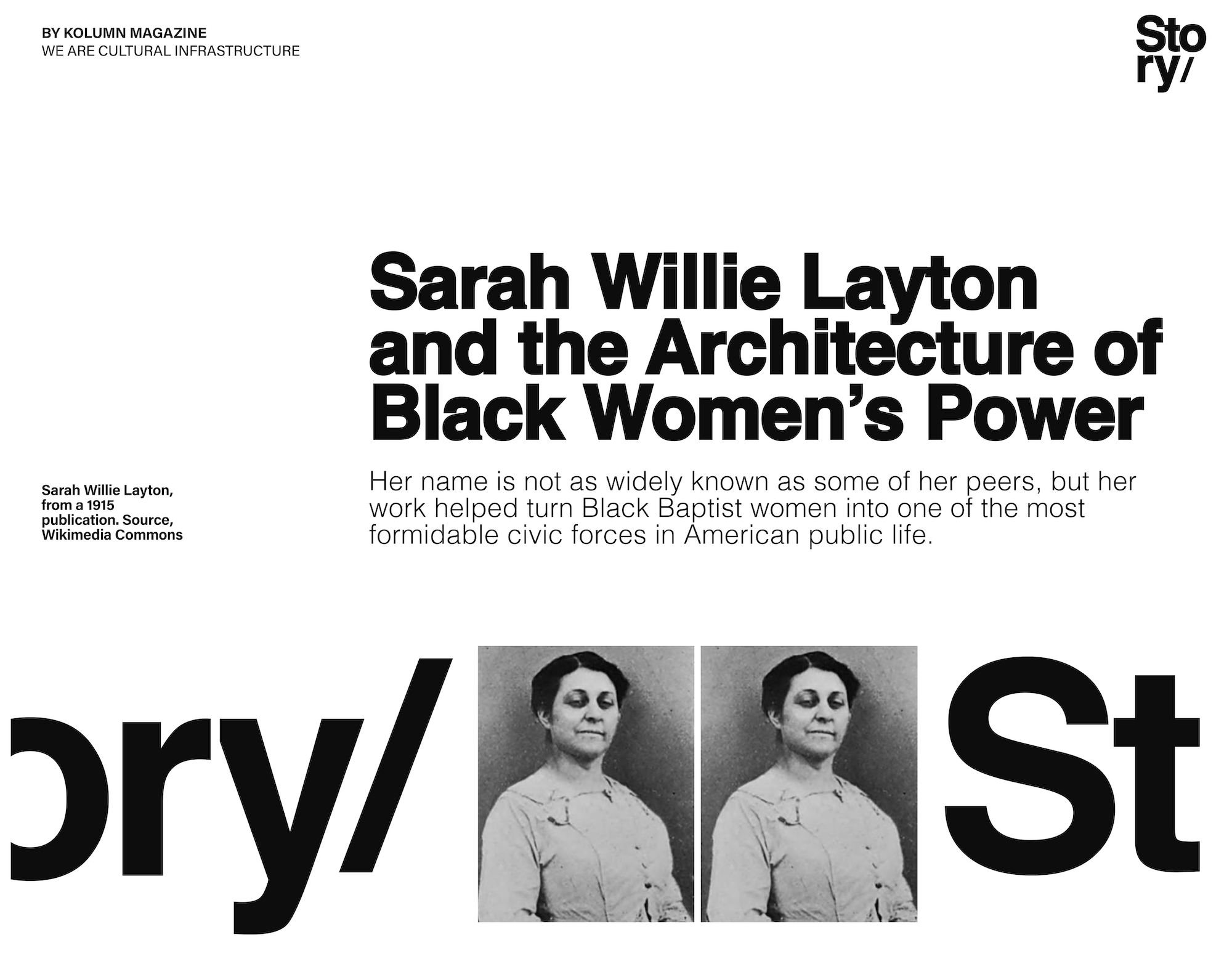
Before Black women could fully exercise the franchise, Layton was helping them practice power.
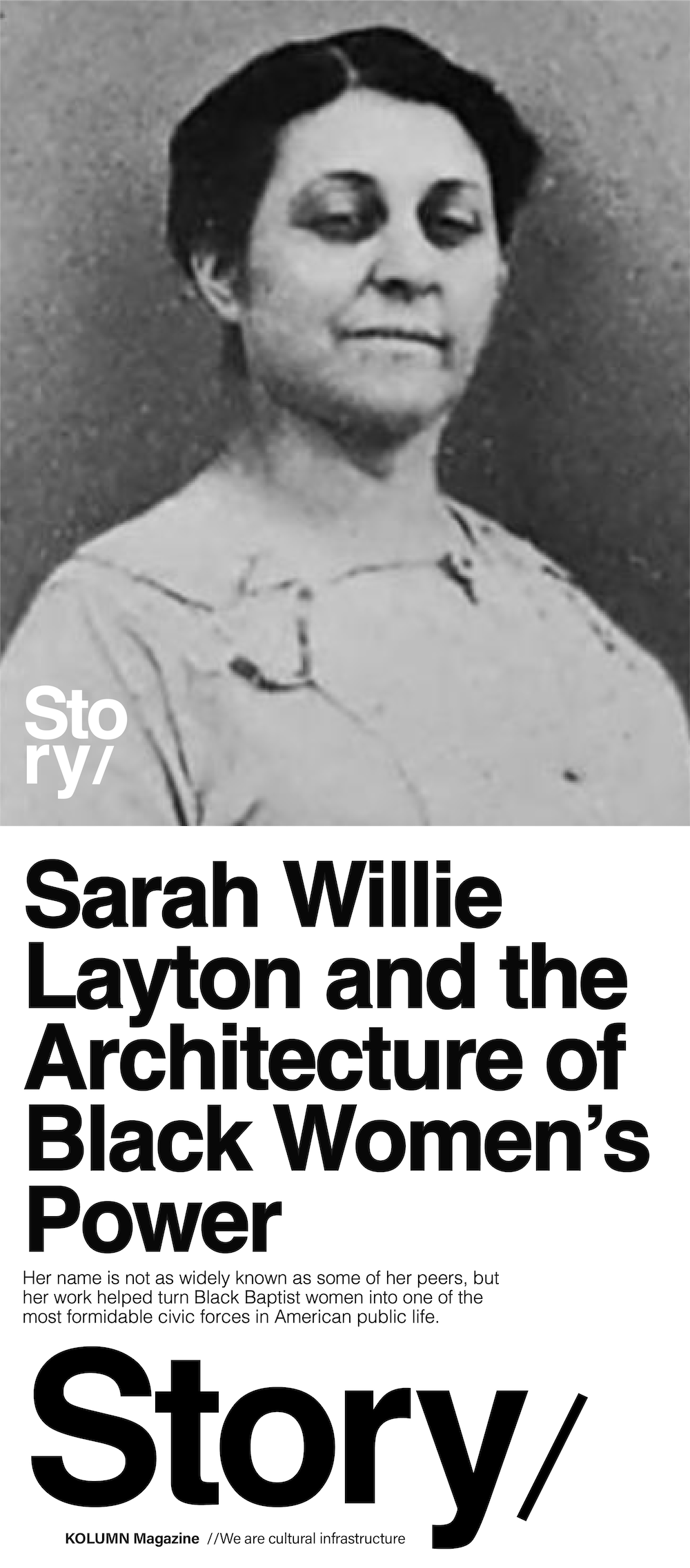
Before Black women could fully exercise the franchise, Layton was helping them practice power.
By KOLUMN Magazine
Sarah Willie Layton is exactly the kind of American figure who exposes the weaknesses of the usual historical spotlight. She was not obscure because she lacked consequence. She was obscured because she did much of her most consequential work in the places American history too often treats as secondary: Black women’s clubs, denominational infrastructure, missionary circles, reform committees, political auxiliaries, and the press networks that connected them. Born in Mississippi in 1864, educated at LeMoyne College, active first in California and then in Philadelphia, Layton became a suffragist, organizer, clubwoman, editor, denominational leader, and political worker whose career stretched across the era from Reconstruction’s aftermath to the dawn of the modern civil-rights age.
To write about Layton now is to confront a familiar archival fact: the women who built institutions were often recorded in fragments. Major national newspapers did not lavish the same attention on Black women organizers that they gave to presidents, financiers, or even many male ministers. As a result, Layton’s life has to be reconstructed through biographical sketches, denominational histories, scholarly work on Black women’s leadership, and the institutional traces left by organizations she helped shape. That relative scarcity is not a reason to minimize her importance. It is, in many ways, the story. The archive is telling us something about who got remembered in full and who was expected to remain part of the machinery of progress rather than part of its public mythology.
Layton’s significance lies in more than her support for woman suffrage, though that alone would justify serious attention. She matters because she belonged to a generation of Black women who understood that rights are rarely secured by rhetoric alone. They must be institutionalized. They must be taught, financed, circulated, and defended. Under Layton’s leadership, Black Baptist women were not simply encouraged to be respectable church workers; they were being trained into a broad public life that touched education, child welfare, anti-lynching advocacy, voter education, housing, race relations, and missionary work. In that sense, Layton was not just advocating for citizenship. She was engineering the habits and structures by which citizenship could be lived.
That is one reason her life resists tidy category labels. Call her a suffragist and you are right, but incomplete. Call her a civil-rights activist and you are also right, though the phrase can flatten the specifically gendered nature of her work. Call her a church leader and you risk understating her political sophistication. The cleanest way to understand Sarah Willie Layton may be this: she was a builder of Black women’s public capacity in an America designed to deny that capacity altogether.
A daughter of Reconstruction and its unfinished promises
Sarah Willie Layton was born Sarah Willie Phillips in Grenada, Mississippi, in 1864, at the hinge between slavery and formal emancipation. According to the African American National Biography data reflected in later summaries, it is likely that both of her parents were born into slavery, and it is possible that Sarah herself was born enslaved and freed in the Civil War’s closing period. Her father, William H. Phillips, was a Baptist minister, and the family’s religious life appears to have shaped not only her moral vocabulary but also her sense that leadership could be exercised through the church as a public institution, not merely a spiritual one.
That origin matters. Layton did not emerge from a world where Black citizenship was settled. She came of age in one where its terms were violently contested. Reconstruction had opened breathtaking possibilities and then watched many of them be narrowed by terror, disenfranchisement, segregation, and economic subordination. For Black women born in that moment, the route into public life usually required extraordinary improvisation. Schools, churches, clubs, and newspapers became substitute civic training grounds. Layton’s life would move through all of them.
She graduated from LeMoyne College in Memphis in 1881, a notable accomplishment in itself. LeMoyne was one of the institutions created to educate African Americans in the postwar South, and for a Black woman from Mississippi to pass through that environment in the nineteenth century was no small achievement. Education did not simply credential Layton. It placed her inside a tradition in which literacy, public speaking, administrative discipline, and moral reform were all understood as tools of racial advancement.
The Stowe Center’s recent work on the Phillips family places Layton within a line of advocacy rather than as an isolated exception. That framing is useful. Too often, Black women reformers are presented as singular marvels, as though they sprang into history unconnected to family, church, and community inheritance. In reality, many of them came from households where political consciousness was already being shaped, even if the available resources were thin and the dangers were real. Layton’s later institutional ambition makes more sense when seen against that backdrop.
California, clubs, and the making of a public woman
In 1882 she married I. H. Layton, and the couple moved to Los Angeles. This westward turn is one of the most revealing chapters of her life because it situates her in Black organizational culture beyond the South and before the Great Migration had fully transformed the urban North. In California she became active in the Western Baptist Association of California and the California Federation of Colored Women’s Clubs. She also served as the California editor of The Woman’s Era, the first national newspaper published by and for Black women.
That last detail deserves more than a passing nod. Editorial work was political work. For a Black woman in the nineteenth century, to edit or correspond for a publication like The Woman’s Era meant helping define what issues mattered, which women counted as leaders, and how local activism could be turned into a broader public conversation. Newspapers were connective tissue. They turned isolated efforts into intelligible movements. If Layton was already learning how to organize in California, she was also learning how to narrate organization, and that is a different but equally essential skill.
The club movement also sharpened her political worldview. Black women’s clubs are sometimes reduced in popular memory to benevolence and uplift language, but scholars have long shown that they functioned as training grounds for governance. Budgets had to be balanced. Meetings had to be run. campaigns had to be planned. Public statements had to be drafted. Vulnerable women and girls needed protection. Schools and homes needed support. Clubwomen were doing politics even when the nation insisted they were only doing charity. Layton’s later career inside Baptist women’s organizing looks, in many respects, like an expansion of lessons first learned in club life.
Then came rupture. After her husband’s death, Layton moved to Philadelphia in 1894. Widowed women in American history are often narrated as figures forced into retrenchment. Layton’s story moved in the opposite direction. Philadelphia became the place where her public life widened dramatically. The city was a major hub of Black institutional life, and there she entered the orbit of the National Baptist Convention and the women’s organizational apparatus that would define her legacy.
The Woman’s Convention and the institutional genius of Black Baptist women
Layton is most closely associated with the Baptist women’s movement connected to the National Baptist Convention. Sources differ in how they summarize the early organizational chronology, but they align on the essential point: Layton was central to the formation and leadership of the Baptist women’s convention structure around 1900, and she served as its first president. Under her leadership, the Woman’s Convention became one of the most significant organizational vehicles for Black women in the United States.
It is difficult to overstate how much this mattered. The Black church is often discussed as a platform for male leadership, especially in conventional accounts of twentieth-century civil-rights history. But the Woman’s Convention reveals another truth: Black women were building a parallel and sometimes pressure-generating infrastructure within and around church life. They raised funds, supported missions, built educational initiatives, shaped program priorities, and created an enormous network through which information and leadership practices circulated nationally. Scholarly work on Black Baptist women has described the convention as crucial to expanding the church’s public reach and turning it into a powerful institution of racial self-help. Layton was there at the front end of that architecture.
Her alliance with Nannie Helen Burroughs is especially important. Burroughs would become one of the most celebrated Black women religious intellectuals and educators of the early twentieth century, but Layton was part of the circle that made that world possible. SAGE’s overview of Protestant women’s leadership identifies Sarah Willie Layton and Burroughs as founders of the women’s auxiliary structure in 1900, while scholarship on Burroughs repeatedly places Layton as a senior leader and colleague whose rhetoric and institutional role helped define the convention’s political language.
And what language it was. One scholarly source preserves a line attributed to Layton during World War I: “The great battles of the world” were fought “upon the field of intellect.” Even in excerpt, it captures her style. This was not a politics of passivity. It was a politics that treated disciplined thought, speech, and organization as weapons in a struggle for civilization itself. That framing was deeply resonant for Black women who had been denied both formal political power and public authority. Layton was effectively arguing that intellectual order and coordinated civic action were forms of combat suited to a disenfranchised people.
“Citizenship, in Layton’s world, was not only a status to be won. It was a discipline to be learned.”
This helps explain why the Woman’s Convention became more than an internal church body. It was a massive school of public life. Women who participated in it learned how to speak from platforms, handle correspondence, manage committees, interpret current events, and see local work as part of national struggle. In later decades, historians would identify these kinds of spaces as seedbeds for broader movements. Layton, without using that later academic language, was helping construct exactly such a seedbed.
Suffrage, but never only suffrage
One of the risks in writing about Black women who supported the vote is that suffrage can swallow the rest of their agenda. In Layton’s case, the sources suggest a broader reform horizon. Around the 1910s, under her leadership, the Baptist women’s movement took up women’s suffrage more explicitly, including through the creation of suffrage and legislative departments. But her activism also touched anti-lynching legislation, voter education, child welfare, housing, and the fight against segregation.
That breadth is not incidental. It reflects a distinctly Black women’s understanding of politics in the Jim Crow era. The vote mattered not as an abstract token of equality but as one mechanism among many for protecting family life, bodily safety, housing stability, educational access, and public dignity. For Black women, suffrage was tied to survival questions that white suffrage narratives have sometimes underplayed. Layton’s reform portfolio makes that plain. She was advocating for the ballot, yes, but also for the conditions that would make the ballot meaningful in a violently unequal society.
Her involvement with the National League for the Protection of Colored Women is especially revealing. That organization was concerned with the vulnerabilities faced by Black women and girls, particularly in urbanizing America, where migration and labor precarity could expose them to exploitation. One source credits Layton with forming the organization in 1906; others note her work with it and its later connection to the National Urban League orbit. Either way, the association fits squarely within her larger pattern: institution building aimed at concrete protection.
She also appears in relation to the Church Women’s Committee on Race Relations, the Republican Party, the Progressive Party, and the National Woman’s Party. That list is striking not because it suggests ideological inconsistency, but because it shows tactical range. Layton operated in denominational, interracial reform, and formal political arenas at once. She understood that Black women’s interests could not be left to a single institution. They needed leverage wherever leverage could be found.
Politics after the ballot
When the Nineteenth Amendment was ratified in 1920, Black women in the South were still blocked from full political participation by white terror, discriminatory law, and administrative obstruction. That is why activists like Layton remain so important. They understood, before many civics textbooks ever would, that constitutional recognition does not automatically produce usable democracy. Black women had to continue organizing, educating, and pressuring institutions long after the amendment’s formal victory.
Layton’s political affiliations also underscore that she did not treat woman suffrage as an end point. She remained politically active throughout her life, supporting Republican women’s organizing and other reform initiatives. Her activism unfolded in a period when Black voters and reformers were reassessing party loyalties, testing coalitions, and trying to force both moral and practical concessions from a political system not designed with them in mind. The Black women who worked in those spaces were often doing painstaking connective labor rather than headline-grabbing insurgency. Layton was one of them.
This is part of why her public memory is thinner than it should be. American history is better at commemorating rupture than maintenance. It likes spectacular moments: the march, the speech, the arrest, the court ruling. It is less comfortable honoring the woman who chaired, corresponded, fundraised, traveled, networked, and kept an entire machine running for decades. But maintenance is where movements either become durable or collapse into sentiment. Layton specialized in durability.
Why Sarah Willie Layton is not better known
There is an irony in Layton’s legacy. She helped create structures through which countless others could gain visibility, confidence, and leadership experience, yet she herself never entered the top tier of public remembrance. Part of that is gender. Part of it is race. Part of it is the chronic undervaluing of religious women’s organizing when it is not attached to a more famous male figure. And part of it is that Black women’s institution building often leaves dispersed records instead of one definitive archive.
Still, fragments accumulate. We know she was born in Mississippi and educated in Memphis. We know California expanded her club and editorial life. We know widowhood did not end her activism. We know Philadelphia became the headquarters of a far larger public mission. We know she stood at the center of Black Baptist women’s organizing and helped steer it toward suffrage, reform, and political participation. We know she remained active into the late 1940s and died in Philadelphia in January 1950, after being bedridden for two years according to one biographical account. We know that decades later, a hospital in Malawi would bear the S. Willie Layton name, a reminder that her influence radiated through missionary and denominational networks far beyond the United States.
Those facts are enough to establish consequence, but they also invite a broader methodological correction. The question is not just why Layton is not famous. The question is what kind of historical habits make women like her legible only in specialist literature. Once asked that way, Layton becomes more than a biography subject. She becomes a critique of how the nation tells its own story.
Her real legacy
Sarah Willie Layton’s real legacy is not captured by a single office held or a single speech delivered. It is found in the civic ecosystem she helped strengthen. She belonged to a generation of Black women who refused the idea that political modernity would be handed to them from above. They built it from underneath: in church basements, convention halls, editorial pages, club meetings, educational ventures, and reform committees. They made institutions where there were exclusions. They made publics where there was silence. They made capacity where there was contempt.
Seen that way, Layton stands as a bridge figure. She linked post-Emancipation Black educational aspiration to early twentieth-century Black women’s club activism, and that activism to broader struggles over voting, race relations, segregation, welfare, and political representation. She reminds us that the Black freedom struggle did not begin in the mid-twentieth century and did not belong only to the men whose names are most familiar. Long before television could capture protest, women like Layton were already creating the organizational grammar of freedom work.
There is also something bracingly contemporary about her example. In an era when public life often feels trapped between performative outrage and institutional decay, Layton’s career argues for another model: build the structure, train the people, circulate the information, connect the local to the national, and do not confuse low visibility with low impact. It is not glamorous. It is not always narratively satisfying. But it is how communities survive exclusion long enough to convert survival into power. That was her lesson then, and it remains one now.
When historians continue the work of recovering Sarah Willie Layton, they are not merely adding another admirable name to a crowded ledger. They are restoring proportion. They are acknowledging that Black women’s political history did not happen at the margins of democracy but at its very core. Layton did not simply ask America to make room for Black women. She helped Black women build rooms of their own, then halls, then conventions, then networks large enough to shape the nation whether the nation was ready to admit it or not.
And maybe that is the cleanest way to say what Sarah Willie Layton means. She represents the long labor beneath the headline. The hidden administrative brilliance behind movement language. The disciplined Black woman public life that made later democratic gains imaginable. She may not be among the most famous names in American activism, but once you see her clearly, the history around her also comes into clearer focus. It begins to look less like a story driven by a few celebrated leaders and more like what it actually was: a densely woven, often female, relentlessly organized struggle over who counted as fully human and fully American.
More great stories
Afro Sheen, Wall Street, and the Architecture of Black Possibility
July 6, 2026
No Comments
The Fire Inside the Fourth
July 5, 2026
No Comments