


Abney’s great subject is not simply politics. It is the pressure of being forced to read politics everywhere, all the time, even inside pleasure.
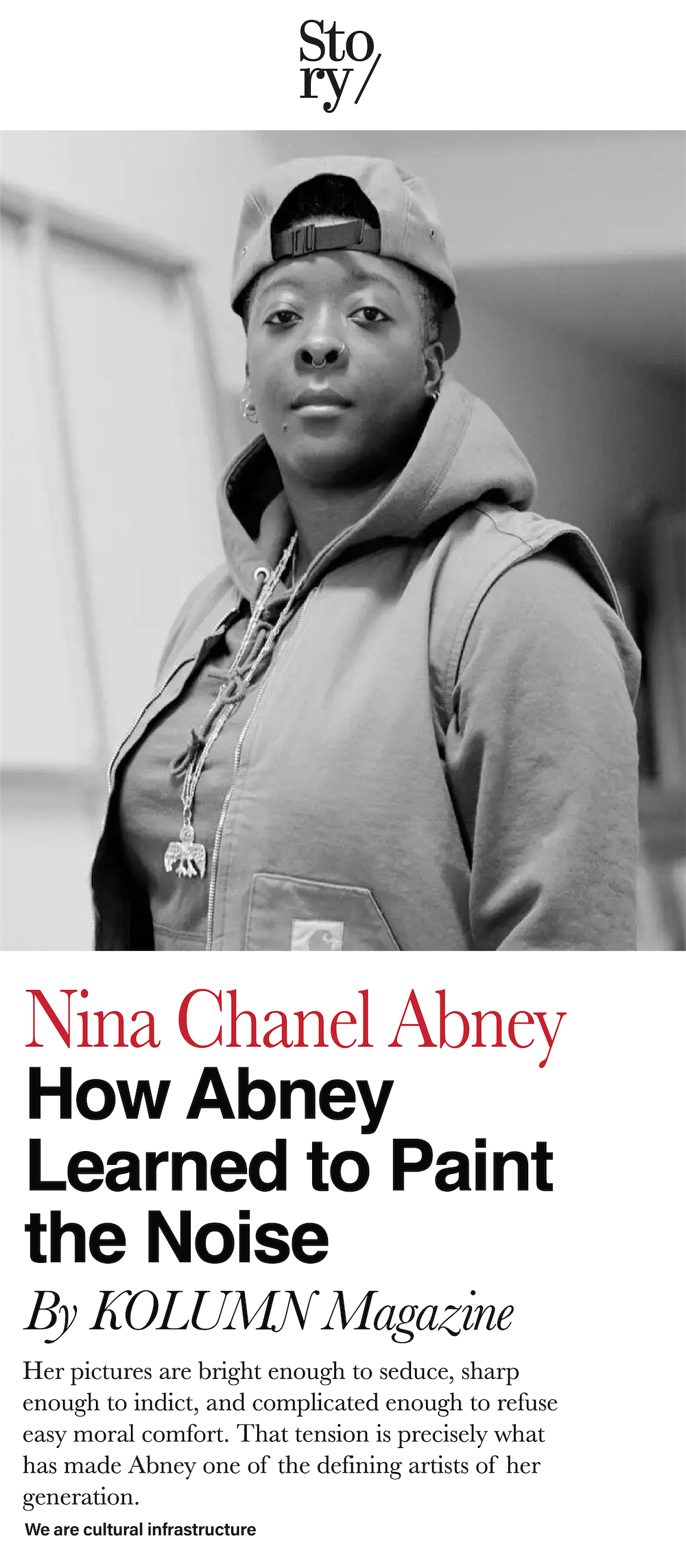
Abney’s great subject is not simply politics. It is the pressure of being forced to read politics everywhere, all the time, even inside pleasure.
By KOLUMN Magazine
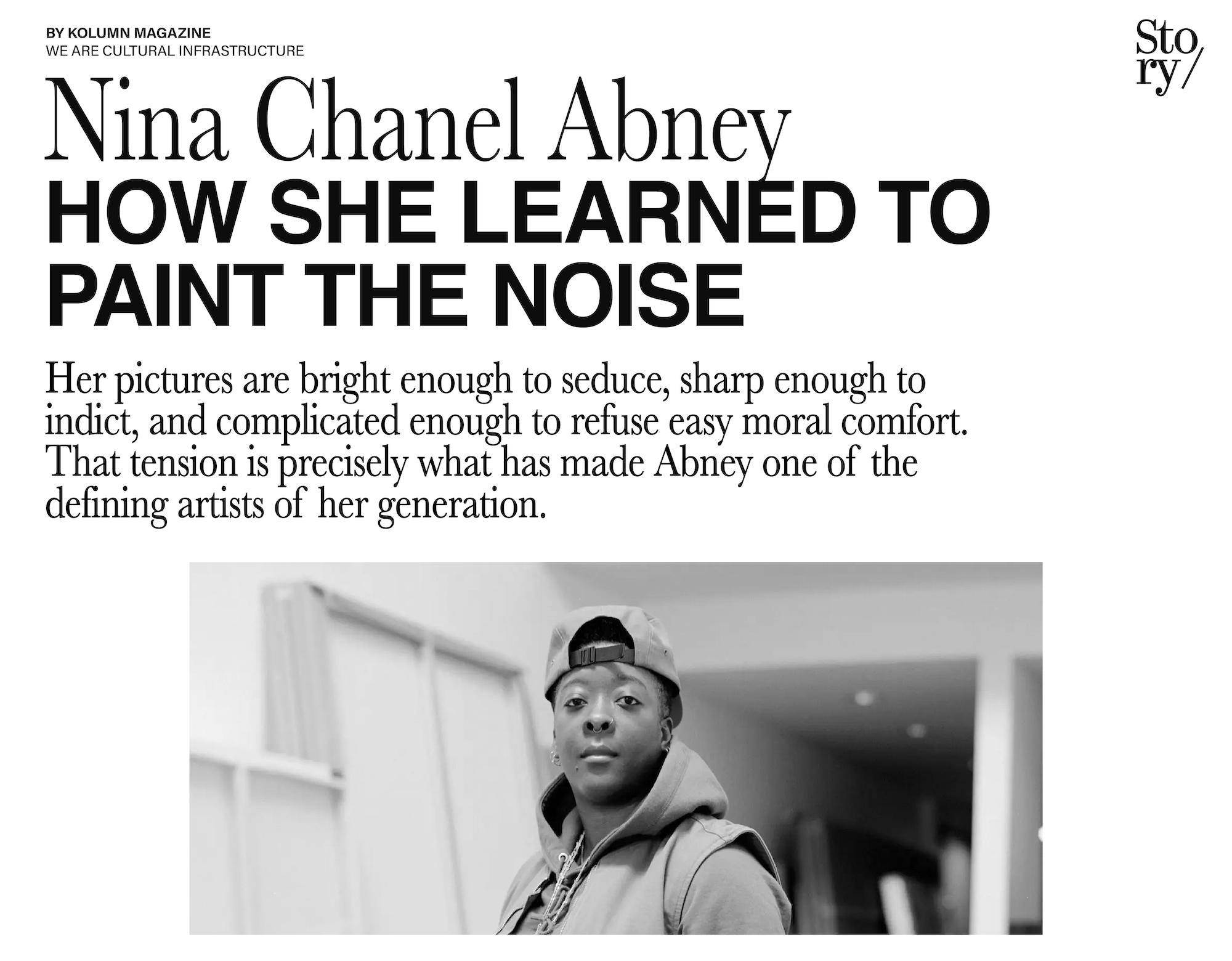
There are artists whose work announces itself slowly, asking for patience before it yields its codes. Then there are artists like Nina Chanel Abney, whose paintings hit with immediate voltage: hot color, flattened figures, fragments of text, bodies broken into signs, comedy shadowed by menace, seduction carrying a charge. The first encounter can feel like impact before interpretation. But that is precisely part of Abney’s achievement. She has spent nearly two decades building a visual language that accepts the conditions of contemporary looking—speed, distraction, overload, contradiction—without surrendering either formal rigor or political intelligence. Born in Harvey, Illinois, in 1982, trained at Augustana College and Parsons School of Design, and long based in New York, Abney has become one of the most recognizable painters of her generation by making work that looks deceptively easy to enter and refuses to stay simple once you do.

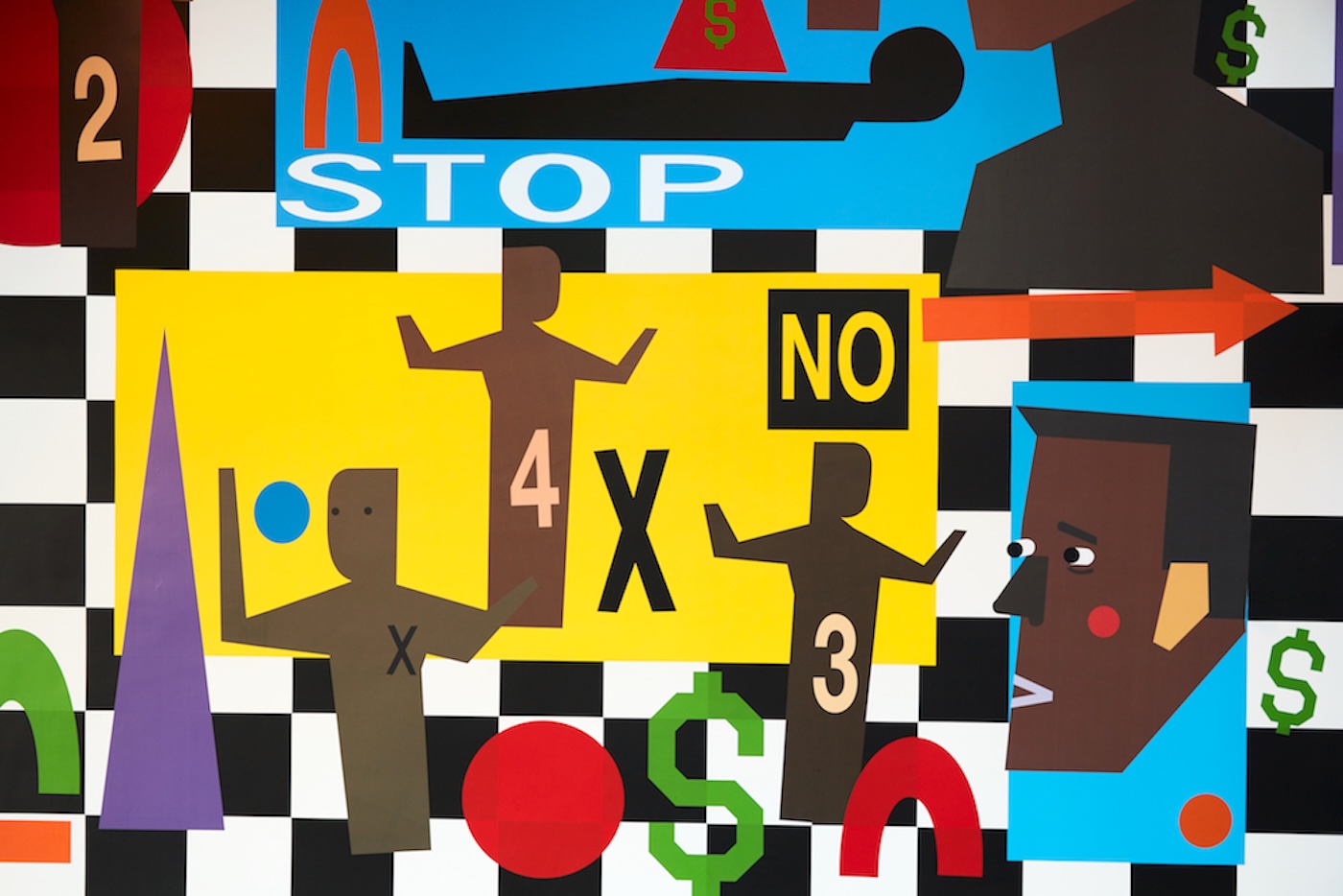
The shorthand description of Abney’s art is familiar by now: colorful, graphic, socially engaged, somewhere between figuration and abstraction. None of that is wrong, but none of it quite explains why her pictures matter. What distinguishes Abney is not merely that she addresses race, policing, celebrity, sexuality, consumer culture, or queer life. Many artists do. It is that she has devised a form elastic enough to hold all of those subjects at once, often within a single surface, while also registering the cognitive stress of living through American public life. Her canvases and collages are not illustrations of politics. They are structures of compression. They translate the churn of headlines, images, history, desire, and fear into compositions that feel as though they have been edited by the nervous system. The Nasher Museum, organizing her landmark exhibition Royal Flush, described her paintings as taking on pressing issues from racial dynamics and criminal justice to celebrity culture, using a “jumble of figures, words and shapes” that pushes toward information overload. That is more than curatorial phrasing; it is a useful description of Abney’s method.
To understand why Abney’s work lands with such force, it helps to begin with the problem she has solved. How do you make paintings about the present without producing dead-on-arrival topicality? How do you speak to mass audiences without flattening complexity? How do you create politically serious art that does not confuse solemnity for depth? Abney’s answer has been to court ambiguity as a discipline rather than a dodge. Her paintings are “colorfully seductive” and “deceptively simple,” as one museum video put it, because they operate through misdirection. The eye is invited in by clarity of silhouette, bold palette, cartoon logic, and the pleasure of rhythm. Then the work begins to snag. Figures read as both playful and wounded. Symbols toggle between joke and threat. A composition that first seems cheerful reveals itself as a scene of surveillance, coercion, mourning, or coded eroticism. Abney does not hide the subject; she lets it arrive in layers, the way difficult knowledge often does in life.
A breakout made under pressure
A great deal of Abney’s public story has understandably returned to Class of 2007, the diptych that emerged from her MFA thesis at Parsons and became a breakout point in her career. The work entered the Rubell collection and was included in 30 Americans, the groundbreaking exhibition of Black artists that first opened in Miami in 2008 and went on to tour widely. The painting’s dimensions alone announced ambition, but what mattered more was its audacity: a personal and institutional reckoning staged through role reversal, caricature, and a refusal of decorum. The Rubell Museum identifies Class of 2007 as a 2007 diptych by Abney and confirms her inclusion in 30 Americans, a show that placed her in dialogue with a formidable cohort that included figures such as Leonardo Drew, Mickalene Thomas, Rashid Johnson, and Kerry James Marshall.
What Class of 2007 also revealed was Abney’s understanding that visibility in the art world is rarely neutral. Culture Type’s retrospective discussion of the work recalls how meaningful it was for the young artist to enter 30 Americans so soon after school. Even then, Abney seemed to grasp that painting could be both an arena of self-invention and a confrontation with the scripts imposed on Black artists—what they are expected to represent, how quickly they are sorted into narratives, what kinds of anger or confession are made legible to institutions. From the start, her work registered that entry into elite art spaces does not erase asymmetry; it merely changes the setting in which it appears. That may be one reason her art has never felt fully assimilated to the white cube, even when it hangs comfortably inside it.
That early pressure matters because Abney’s career did not unfold through a quiet maturation away from politics into pure form. Instead, form itself became the way she metabolized politics. Her compositions grew more assured, her scale more commanding, her iconography more supple, but the central wager remained consistent: that the speed of contemporary Black life, especially under conditions of scrutiny and misrecognition, required a painting language that could move fast without becoming shallow. The Washington Post noted in 2016 that Abney would continue examining the relationship between police and minority communities “until she sees progress,” quoting the artist: “My work talks about the now.” That sentence has lingered because it clarifies both the urgency and the trap. To work on “the now” is to risk obsolescence. Abney has repeatedly escaped that risk by refusing literalism. She paints the atmospherics of the present, not just its events.
Seduction as strategy
Abney’s formal language has often been described through art-historical comparison: Matisse, collage, Cubism, graphic design, street art, pop. Those references are useful but incomplete. What they can miss is how strategic her clarity is. The simplified limbs, mask-like faces, compressed space, and emphatic patterning are not merely stylistic signatures. They are instruments for moving difficult content across thresholds of attention. In an age when viewers are trained by social platforms, advertising, and news graphics to decide within seconds whether an image deserves more time, Abney has made that first second count. The work is legible from across the room. Then, once captured, the viewer must reckon with scenes that refuse easy consumption. The ICA Miami described her symbols as drawing viewers into complex narratives while communicating urgent realities with immediacy to the largest possible audience. That idea of “the largest possible audience” is central to Abney’s practice. She is not painting for a cloister. She is painting for a public whose literacy has already been shaped by posters, logos, memes, comics, music videos, protest graphics, and television.
This is why so many critics reach for the language of contradiction when writing about her. The Guardian, surveying concurrent exhibitions in 2018, emphasized the tension between her playful surfaces and the seriousness of her subjects. Santigold, speaking admiringly of Abney’s work, put it with plain precision: the art is “playful even though the topics are not.” That juxtaposition is not an accident or a branding exercise. It is the point. American culture routinely packages violence inside spectacle, market logic, and entertainment. Abney does not transcend that condition; she mirrors and reorganizes it. Her paintings know that sweetness can be sinister, that flatness can conceal psychic depth, that bright color can function like camouflage. They ask whether viewers are willing to stay with discomfort once delight has opened the door.
There is also, in Abney’s work, a persistent understanding that representation is always unstable. A body becomes a silhouette, then a symbol, then a racialized sign, then an abstraction, then a memory of a body. A word fragment appears not as explanation but as another unstable unit, half slogan and half interruption. This instability is one reason her pictures feel contemporary in a deeper sense than mere subject matter. They understand that public identity today is assembled through fragments: profiles, performances, projected fantasies, surveillance footage, hashtags, hearsay. Abney turns that fragmentation into composition without pretending it can be neatly healed. Her art offers coherence, but it is the coherence of pressure, not resolution.
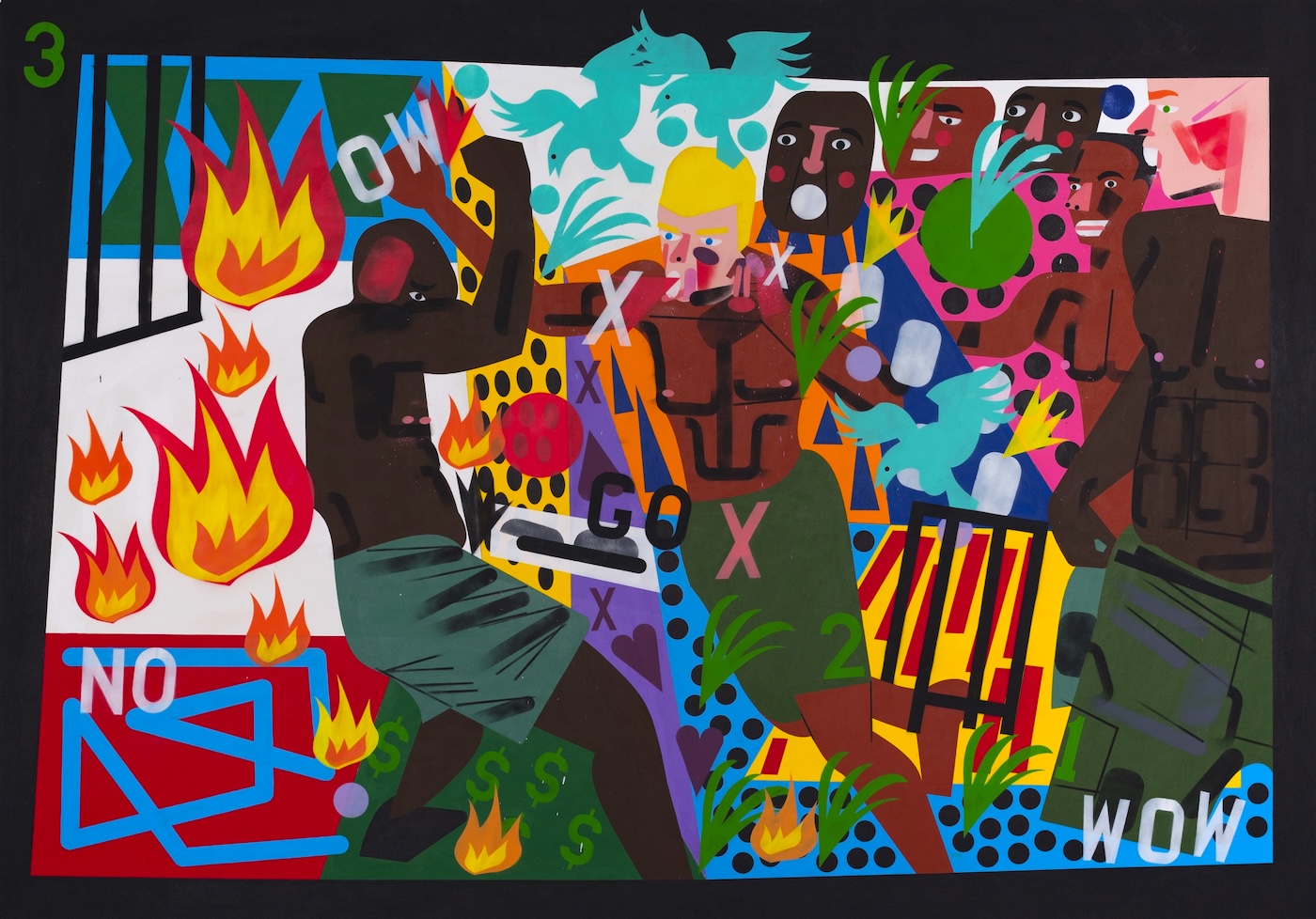
Royal Flush and the politics of scale
If Abney had already established herself as a painter of consequence before Royal Flush, that traveling survey crystallized the breadth of her project. Originating at the Nasher Museum of Art in 2017, the exhibition traveled to the Chicago Cultural Center, ICA Los Angeles and the California African American Museum jointly, and later the Neuberger Museum of Art. That itinerary matters. It marked institutional recognition, yes, but it also confirmed that Abney’s work could hold together across regions and audiences, speaking with equal force inside university museums, civic spaces, and contemporary art institutions. The Henry Art Gallery and other institutional summaries note that Royal Flush helped introduce wider museum publics to a practice already working at large scale and with large stakes.
The title itself, Royal Flush, suggested both chance and elimination, hierarchy and sweep. There is something apt about that for Abney, whose paintings often look like they are staging a contest among symbols, each one vying for attention, none able to fully dominate the field. Marshall N. Price, the Nasher curator, described the work as dealing with some of the most pressing issues of the moment through a seductively overloaded language. The phrase “seductive visual language” recurs in commentary on Abney because it gets at the formal intelligence of the work. Seduction here is not softness. It is an access point to harder truths. The monumental scale of many of the paintings deepens that effect. You do not merely look at them; you enter their weather. They can feel mural-like without becoming declarative, theatrical without becoming literal.
What Royal Flush also confirmed was that Abney’s paintings do not require a single subject to be strong. They can hold many things at once because the real subject is often social compression itself—the crowding of issues that American discourse prefers to isolate. Policing bleeds into celebrity culture. Consumerism shares a formal register with propaganda. Religion, sexuality, class aspiration, and racial anxiety coexist not because the artist is indecisive but because life is not sorted into curatorial categories. Abney has an instinct for the entanglement of forces, and her surfaces refuse the fantasy that one can think clearly about race without thinking about labor, media, sexuality, state power, and spectacle. That is part of what makes her one of the crucial painters of the post-Obama, post-Ferguson, permanently online era.
Beyond race-only readings
One of the more limiting habits of art writing around Black artists is the tendency to stabilize them around a single interpretive frame. Abney has often been read through race first, and understandably so; she has made searing work around police violence, anti-Blackness, and public power. But her practice has long exceeded that frame. Artsy’s 2020 profile noted that while her early work was understood as needing to focus on race, Abney herself described her practice as having shifted toward what was actually relevant to her lived experience in the moment. That evolution is not a retreat from racial analysis. It is a demand for fuller personhood. Blackness in Abney’s work is not a topic silo. It is a condition lived through gender, desire, pop culture, friendship, vulnerability, and absurdity.
That expansion becomes especially important in the work around queerness and Black masculine-of-center identity. In Big Butch Energy at ICA Miami and Big Butch Energy/Synergy at SCAD and moCa Cleveland, Abney turned toward coming-of-age narratives, cinematic references, and the textures of queer self-fashioning. SCAD described the series as examining Black identity and queerness through playful yet personal images centered on her experience as a masculine-of-center woman. ICA Miami emphasized the dynamic color and form through which Abney builds complex narratives from urgent social realities. What is striking in these projects is not simply representation—though representation matters—but the refusal to make queer Black life legible only through trauma. There is wit, erotic code, style, posture, interiority, and social choreography. The work understands the politics of being seen, but it also insists on the pleasures and ambiguities of self-presentation.
The significance of that turn should not be understated. In mainstream art institutions, Black queer and gender-nonconforming life has often been alternately fetishized, pathologized, or flattened into curatorial virtue. Abney resists all three outcomes. Her figures remain stylized and coded rather than surrendered to documentary transparency. She does not provide a sociological key for every image. Instead, she makes room for opacity—not as refusal for its own sake, but as a form of dignity. There are histories that need protecting even in visibility. There are selves that can only be represented indirectly. Abney’s pictures know that too much legibility can become another form of capture.
Public history, public art
A major test for any artist whose work thrives on painterly compression is what happens when the work enters civic space. In recent years, Abney has shown that her language can scale not only to museums but to public history. Her monumental façade commission San Juan Heal at David Geffen Hall honors San Juan Hill, the predominantly Black and Puerto Rican neighborhood displaced in the mid-twentieth century to make way for redevelopment, including Lincoln Center itself. Lincoln Center’s own description is admirably direct about that violent history, and Abney’s mural responds by creating a constellation of figures, symbols, and references to the people who lived there. It is both memorial and counter-archive, a brightly visible refusal of institutional amnesia.
That commission matters for reasons larger than prestige. Too often, public art near major cultural institutions functions as decoration for the very structures that displaced or excluded communities. San Juan Heal works differently. It does not soften the history of Lincoln Center; it complicates it in public. Public Art Fund’s description underscores the work’s composition of significant San Juan Hill figures and historical references on the façade itself. In other words, Abney’s mural does not merely beautify architecture. It annotates it. It forces passersby to confront what stood there before the polished cultural monument, and it does so through a visual syntax recognizable enough to invite broad engagement. This is public art not as consensus image but as civic revision.
It also reveals something critical about Abney’s long practice: she is not simply a commentator on media culture but an increasingly important maker of public memory. The same artist who once translated the fever of news and social imagery into canvases is now taking on the buried histories beneath major institutions. That arc is meaningful. It suggests a widening sphere of address without a loss of bite. Even in a commission setting, Abney retains her commitment to density, code, and visual tension. The mural is generous, but not innocent. It offers homage without sentimentality. It is history painted in a grammar of contemporary friction.
The breadth of the practice
A persistent mistake in writing about Abney is to speak as though painting alone contains the whole of the practice. In fact, her work has extended across collage, printmaking, installation, public commissions, design collaborations, and digital experiments. Artnet reported in 2020 on her first augmented-reality artwork, Imaginary Friend, released to mark the anniversary of the March on Washington. Whether one sees that project as central or peripheral, it demonstrates something consistent in Abney: a willingness to test how her visual language migrates across media without losing its immediacy. Likewise, her print projects, public interventions, and collaborations have shown that the core syntax of her work—sign, silhouette, wit, danger—can survive translation.
That plasticity is partly why Abney now occupies an unusual place in American art. She is legible to contemporary art insiders and to audiences who do not ordinarily move through art discourse. She can be discussed in relation to Matisse, Bearden, graphic design, and post-internet image culture, yet her work also communicates to viewers whose visual references come from album art, clothing graphics, television, and city walls. The Washington Post’s notice on a hip-hop-themed museum show singled out her collage Expensive Pain, made for Meek Mill’s 2021 album, as a pointed example of the tangled relationship between visual art, hip-hop, commerce, and misogyny. That is telling. Abney is one of the few painters working at her level who can move across those circuits without seeming to dilute her practice for accessibility.
Her public visibility has also not prevented formal growth. Recent coverage and CV materials show a practice still expanding through exhibitions, prints, and, more recently, sculpture. The point is not simply career momentum. It is that Abney has avoided the trap of becoming instantly recognizable and formally static. Recognition can harden style into brand. Abney has been careful to keep the language open enough to mutate—toward collage, toward queer narrative, toward public memorial, toward objecthood—while maintaining the underlying pressure that makes the work hers.
Why Abney matters now
To say that Nina Chanel Abney is “timely” would be accurate and insufficient. Timeliness is cheap; algorithms are timely. What Abney has achieved is something harder: she has made a body of work that explains why certain forms are necessary under current conditions. Ours is a time of fractured attention, accelerated outrage, flattening discourse, and image saturation so intense that moral response itself can become automated. Under those conditions, traditional history painting risks irrelevance and purely private formalism risks withdrawal. Abney’s work splits the difference in the most productive way possible. It is public-facing without being didactic, intelligent without becoming hermetic, emotionally charged without pleading for authenticity points. She paints for a world in which viewers know too much and understand too little, because information arrives detached from structures of feeling. Her art reconnects those structures.
She also matters because she has changed the expectation of what politically alert painting can look like. For generations, seriousness in art was too often coded as austerity—muted palette, grave tone, difficulty as moral credential. Abney exploded that equation. Her work argues that brightness is not frivolity, that humor is not evasion, that graphic clarity can carry immense conceptual weight. She belongs to a lineage of Black artists who have refused the discipline of solemn respectability in order to say harder truths. That lineage includes artists of very different temperaments, but Abney’s particular contribution has been to make speed itself into a usable form. She paints not despite the clipped, distracted, collision-heavy conditions of the twenty-first century, but through them.
For KOLUMN, that matters especially. In the magazine’s broader attention to Black cultural production, the most compelling figures are often those who refuse containment by genre, respectability, or institutional shorthand. Abney belongs in that company because she does not offer a tidy lesson about representation. She offers a method for seeing how representation breaks, mutates, and survives under pressure. Her paintings are not solutions to American contradiction. They are forms adequate to it.
And that may be the clearest way to understand her significance. Nina Chanel Abney has given contemporary American art a language for contradiction that does not depend on paralysis. The work is furious, but it is also funny. It is wounded, but it is not defeated. It is inviting, but it does not flatter the viewer. It wants to be seen widely and read carefully. It knows that audiences arrive fragmented and impatient; it meets them there and asks more of them anyway. That is no small thing. In a culture of endless images, Abney keeps making images that fight back.
The afterimage
Stand before an Abney painting long enough and a strange reversal occurs. At first, the work seems to compress the world into signs. Later, it begins to expand those signs back into lived complexity. A figure that looked emblematic starts to feel specific. A joke curdles into grief. A decorative rhythm becomes a record of social stress. The eye, having been captured by pleasure, is asked to stay for consequence. That is a difficult sequence to engineer. Abney has made a career of it.
The result is a body of work that does not merely document an era, but teaches viewers how that era feels in the body: the split-second assessment, the coded reading of danger, the simultaneous presence of spectacle and dread, the scramble to protect pleasure from politics and the impossibility of ever fully doing so. Her art does not promise release from that condition. It offers something better: form equal to experience. That is why she has become indispensable. Not because she paints the news, but because she paints the sensorium that news leaves behind.
By now, Nina Chanel Abney’s place in contemporary art is secure in the institutional sense: museum shows, public commissions, major collections, sustained criticism, an expanding international profile. But the more interesting fact is that the work still feels alive to risk. It still carries abrasion. It still moves with the unnerving quickness of thought under pressure. That is what keeps it from hardening into prestige. Abney has become canonical without becoming settled, and that is rare.
There will be many future attempts to summarize her legacy. Some will emphasize race and politics, others queer Black self-fashioning, others the public commissions, the collages, the career arc from Class of 2007 to San Juan Heal. All of them will be partly right. But perhaps the deepest legacy is formal and ethical at once. Nina Chanel Abney showed that an artist could make paintings calibrated to contemporary overload without capitulating to it; that one could court broad visibility without shrinking complexity; that the bright, the flat, the funny, and the popular could still carry the heaviest matters of American life. She made the surface smarter than most people thought surface could be.
That is not just accomplishment. It is intervention. And American art is different because of it.
More great stories
Afro Sheen, Wall Street, and the Architecture of Black Possibility
July 6, 2026
No Comments
The Fire Inside the Fourth
July 5, 2026
No Comments