

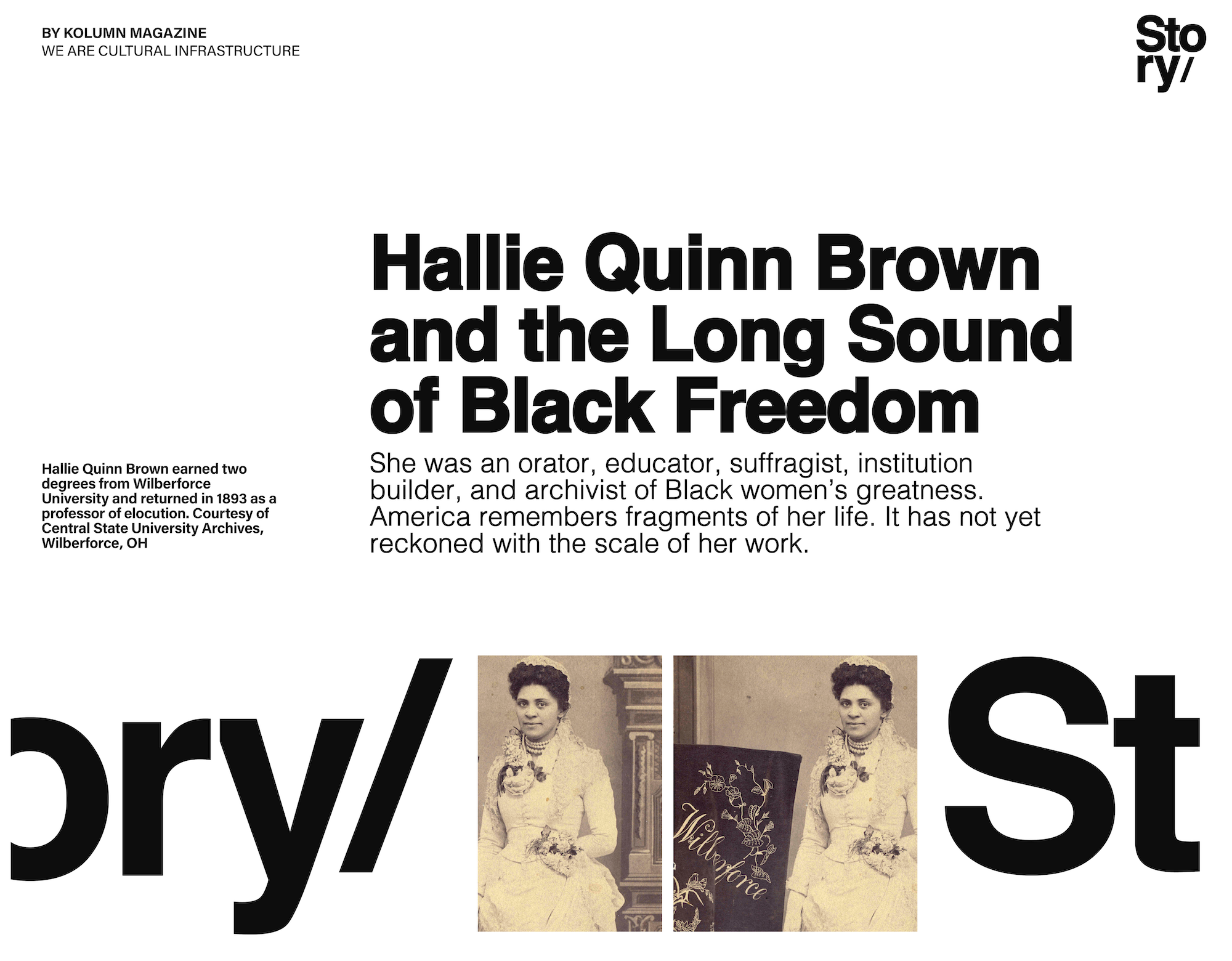
Hallie Quinn Brown was not merely a speaker in the movement. She was one of the people who taught the movement how to sound.
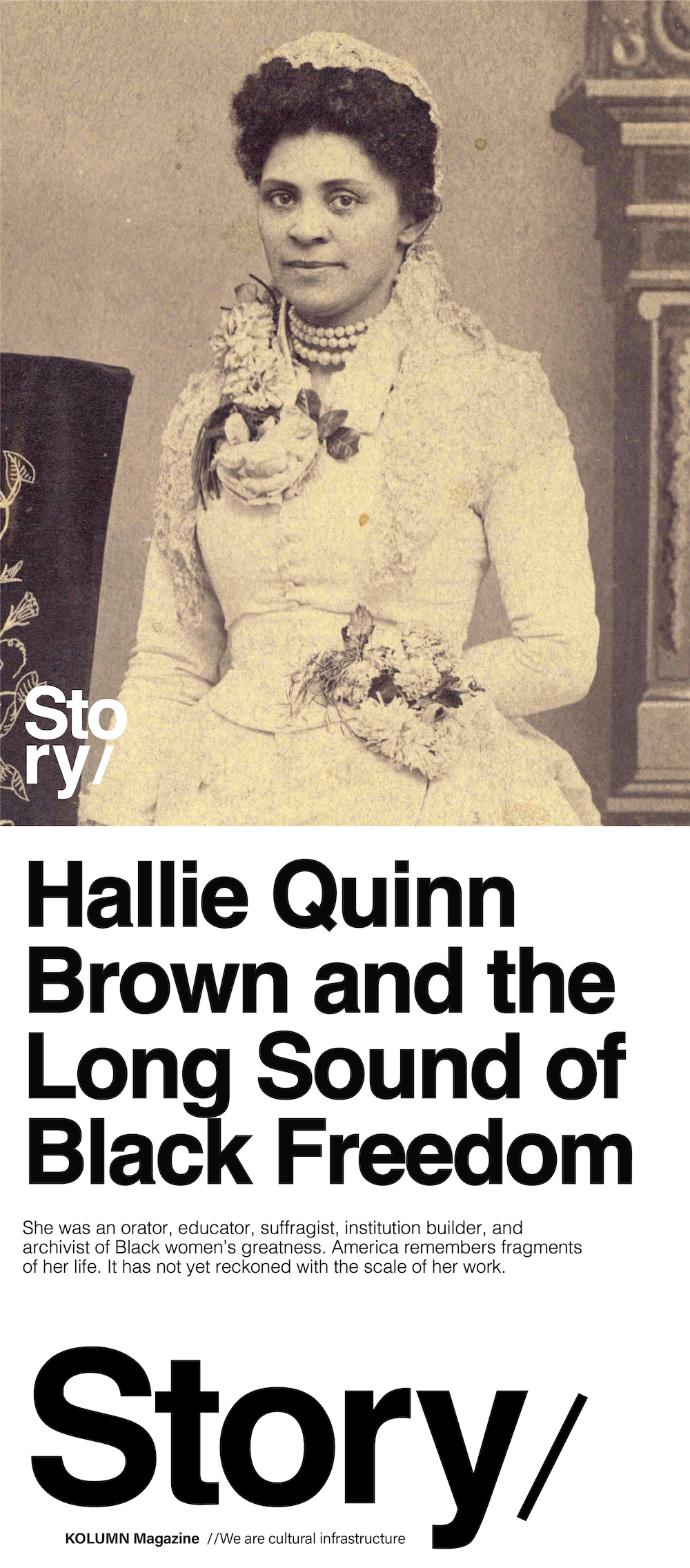
Hallie Quinn Brown was not merely a speaker in the movement. She was one of the people who taught the movement how to sound.
By KOLUMN Magazine
History has a habit of trimming Black women down to one usable identity at a time. It will allow one to be a teacher, but not a political strategist. It will tolerate a reformer, but not a rhetorician of national consequence. It will praise a dignified clubwoman, then ignore the institutional machinery she helped build. Hallie Quinn Brown does not fit inside any of those reductions. She was an educator, an elocutionist, a suffragist, a lecturer of international renown, an organizer in the Black women’s club movement, a Republican political operative in the fraught aftermath of women’s enfranchisement, and an author who understood that the archive itself was a battleground. Standard references identify her as born in Pittsburgh on March 10, 1850, though historical records and commemorative sources have also circulated 1845 and 1859, a discrepancy that says as much about the instability of Black historical recordkeeping as it does about Brown herself. Britannica, National Park Service, Ohio History Connection, and Arlington Public Library together sketch both the broad outline of her life and the documentary uncertainty that still shadows it.
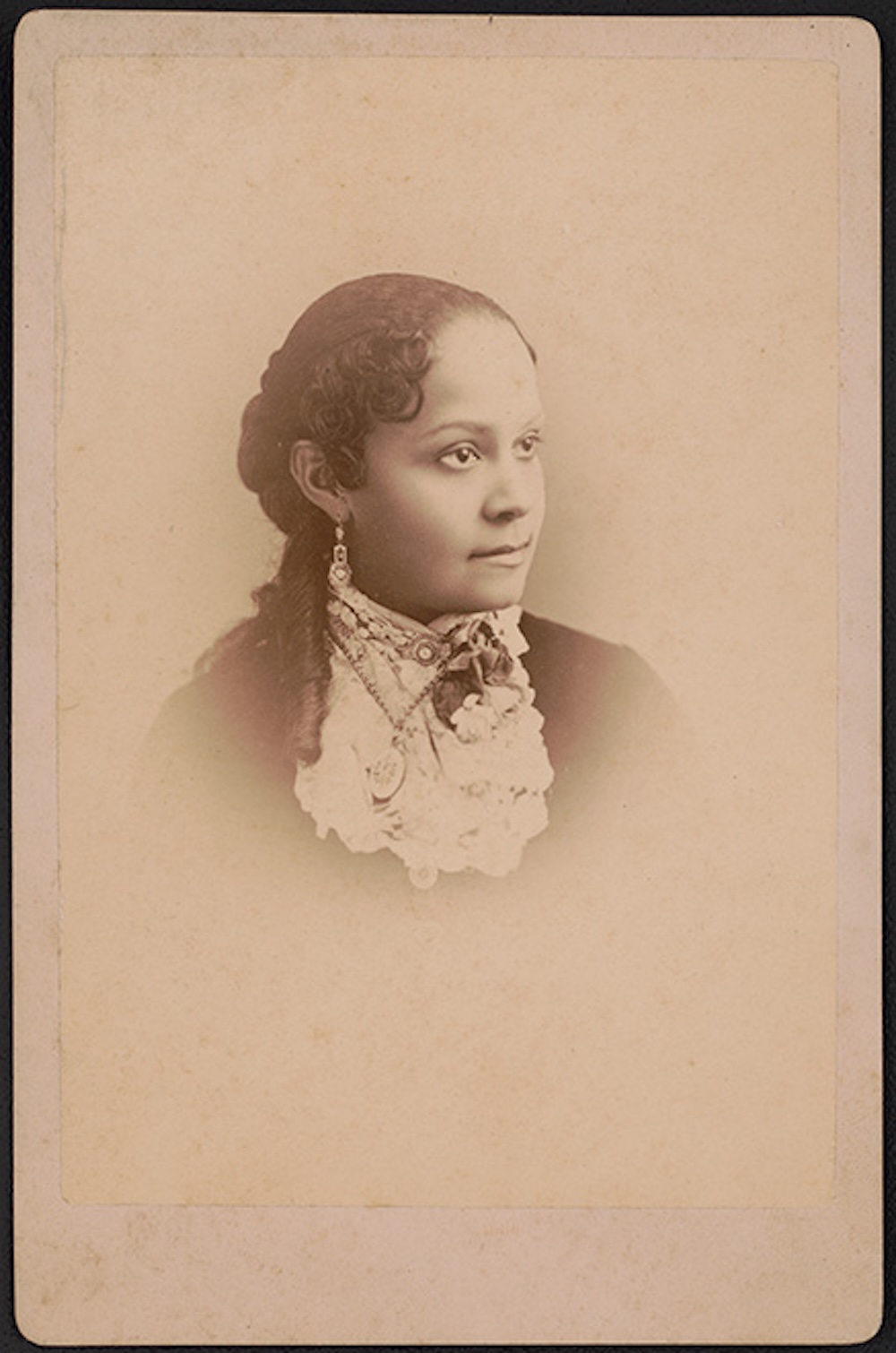
That uncertainty is not a side note. It is part of the story. Brown lived long enough to become famous in her own era and neglected in ours, a reversal so dramatic that the Ohio History Connection now frames her as a “forgotten legend,” while contemporaries once treated “Miss Hallie Q. Brown” as a name sufficient unto itself. The problem is not that she lacked achievement. It is that the nation still prefers Black women whose influence can be made symbolic over Black women whose influence was administrative, intellectual, and unapologetically public. Brown’s life forces a correction. She was not simply present in the age of Black women’s organizing. She helped give it form, voice, and memory.
A daughter of fugitivity, discipline, and ambition
Brown was born to parents who had both been enslaved and who later joined the larger Black struggle for self-determination in the North and across the border into Canada. BlackPast, Britannica, and the History of Speech-Language Pathology project at the University at Buffalo all place her family’s origins in the brutal afterlife of slavery and identify Chatham, Ontario, as a key site in her upbringing, part of the geography of Black refuge and reinvention in the mid-19th century. The Buffalo history project adds a detail that clarifies the depth of that inheritance: enslavement was not abstract family memory but intimate family structure, with Brown’s maternal grandfather and paternal grandmother tied directly to the ownership system that had governed her parents’ lives. BlackPast and Britannica both emphasize that she was the daughter of former slaves; the Buffalo project makes plain how close that violence sat to her household memory.
That matters because Brown’s later work never read like the politics of abstraction. She was not theorizing freedom from a comfortable remove. She came from a family that knew the line between bondage and escape, between legal status and human vulnerability, between a nation’s claims and its conduct. Her career would become one long refusal to let the republic hide from that contradiction. She would fight it in schools, in lecture halls, in women’s clubs, in print, and eventually in the archive itself.
Her formal education took her to Wilberforce University in Ohio, one of the crucial institutional homes of Black intellectual life in the postbellum period. Britannica states that she entered Wilberforce in 1870 and graduated in 1873. Arlington Public Library describes her as graduating salutatorian and notes later study at the Chautauqua Lecture School. The archival entry in Who’s Who in the Lyceum records both a B.S. in 1873 and an M.S. in 1890 from Wilberforce, evidence not just of attainment but of a sustained relationship to scholarship and public performance.
Wilberforce did not simply credential Brown. It helped position her within a Black institutional ecosystem that understood education as race work, leadership formation, and cultural production all at once. That world would remain central to her life. Brown would later return as professor of elocution, and Wilberforce would remain one of the places where her name still carried local weight long after the national memory thinned. The significance of that continuity is easy to miss. Brown did not move through institutions as a temporary guest. She helped build the traditions that allowed those institutions to matter.
Teaching in the broken republic
After graduating, Brown taught in Mississippi and South Carolina, including plantation and public schools, before later serving as dean at Allen University in Columbia, South Carolina, and in an administrative role at Tuskegee. Britannica, BlackPast, Arlington Public Library, and Who’s Who in the Lyceum all converge on these teaching years, though with slightly different emphases. The composite picture is clear: Brown’s early career was forged not in elite comfort but in the rough instructional conditions of the Reconstruction and post-Reconstruction South, where the classroom was often a frontline institution and literacy itself could feel like insurgency.
This period matters because it inoculated Brown against sentimental politics. She saw what Black education looked like when the nation offered freedom without infrastructure. She saw what it meant to work where public resources were thin, where the promise of emancipation collided with white neglect and violence, where teaching Black children and adults alike was bound up with the larger question of whether democracy would have any material meaning. National Park Service emphasizes that Brown lectured widely later on civil rights, women’s suffrage, and temperance, but those subjects were not detached moral themes. They were extensions of a life formed in places where vulnerability was immediate and policy failure was lived experience.
Brown’s administrative roles also complicate the way Black women reformers are too often remembered as inspirational but secondary. Who’s Who in the Lyceum records her as dean of Allen University from 1885 to 1887 and identifies her service at Tuskegee Institute in 1892–93. Britannica notes that she worked under Booker T. Washington at Tuskegee. These were not ornamental assignments. Administrative authority within Black educational institutions was a form of political labor. It required management, discipline, public trust, and strategic thought. Brown’s later public voice rested on more than talent. It rested on a demonstrated capacity to build and run things.
The making of a public voice
But Hallie Quinn Brown was not merely an educator who happened to speak well. She became one of the great Black public performers of her time. National Park Service describes her as one of the few who “performed speeches,” someone recognized across the United States and Europe as an exceptional elocutionist. Ohio History Connection goes further in popular terms, describing her as a woman who delivered performances and recitations to audiences in the tens of thousands and whose name alone once carried celebrity value. Who’s Who in the Lyceum places her squarely within the lecture circuit, listing lectures on Black education, Afro-American womanhood, Frederick Douglass, Negro folklore, and even her visit to Queen Victoria and Windsor Castle.
This is one of the places where Brown feels startlingly contemporary. She understood voice as both aesthetic form and political instrument. To say she was an elocutionist is not to place her in some quaint performance tradition. It is to recognize that she mastered the mechanics of public persuasion in an age when Black women were expected to be unheard, misheard, or heard only under white supervision. The University at Buffalo’s history of speech-language pathology project calls her an early scholar-activist in the field and explicitly links her legacy to the history of spoken expression and social justice. The National Park Service goes even further, suggesting that Brown’s legacy can be traced into later traditions of spoken-word artistry and speech-language work. That is an unusually long afterlife for a woman still missing from many broad historical summaries.
Brown also wrote instructional and literary works that confirm she was thinking not just about speech as performance, but about speech as transmission. The digitized edition of Homespun Heroines and Other Women of Distinction on Documenting the American South lists her previous authored works, including Bits and Odds, First Lessons in Public Speaking, Tales My Father Told, and Machile—The African. The titles alone tell a story. Brown was assembling a body of work concerned with oral culture, pedagogy, narrative inheritance, and Black historical representation. She was not simply using her voice. She was building texts that could train, preserve, and circulate voice.
Crossing the Atlantic, unsettling the room
Brown’s public significance expands once the story crosses the Atlantic. Britannica reports that her lectures on African American life and temperance were especially popular in Great Britain, where she appeared twice before Queen Victoria, and that she spoke at the 1895 convention of the World’s Woman’s Christian Temperance Union in London and represented the United States at the International Congress of Women there in 1899. Who’s Who in the Lyceum similarly lists extensive lecturing in Great Britain, Germany, and Switzerland from the mid-1890s onward, and includes “My Visit to Queen Victoria and Windsor Castle” among her noted lectures.
These details are often recited as markers of prestige, and yes, they are that. A Black American woman born to formerly enslaved parents appearing before Queen Victoria is no small thing. But the more important point is strategic. Brown understood international space as leverage. She recognized that racist national narratives could be embarrassed abroad, that Black women’s speech could travel around the gatekeepers who constrained it at home, and that transatlantic audiences could become witnesses to American hypocrisy.
A National Park Service “Ballot Blocked” transcript adds a vivid and politically useful detail: historian Noaquia Callahan Banks notes that Brown showed up at the International Council of Women’s Conference in London in 1899, effectively uninvited, and delivered an impromptu thirty-minute speech on the racial indignities inflicted on Black people by white Americans. Whether one emphasizes the spontaneity or the audacity, the incident reveals Brown’s political style. She did not wait passively for access. She converted openings into platforms and platforms into indictment.
That tactic places her in the same broad KOLUMN lineage that shaped the magazine’s recent reading of Frances Harper: Black women who refused the false choice between respectability and confrontation, between race work and woman-centered politics, between literary performance and political intervention. Brown’s version of that synthesis was distinctive because of the authority of her voice. She could enter a room coded as refined, even genteel, and use that room to force a reckoning with American racial violence. Prestige, in her hands, became a delivery system for dissent.
Club women, institution builders, and the politics of uplift
To understand Brown fully, one has to move beyond the romance of the stage and into the infrastructure of Black women’s organizing. National Park Service identifies her as one of the first women interested in establishing Black women’s clubs and notes her role, alongside Anna Julia Cooper, in helping establish the Colored Women’s League in Washington in 1893. Britannica describes her as a principal promoter of the organization, which soon joined others in the movement that became the National Association of Colored Women. BlackPast adds that she later served as president of the Ohio State Federation of Colored Women’s Clubs and then as president of the National Association of Colored Women from 1920 to 1924.
The club movement has long been flattened into a story of uplift so generic it can sound almost apolitical. Brown’s career exposes that flattening for what it is. Black women’s clubs were social welfare structures, yes, but they were also intellectual communities, political laboratories, and alternative public spheres. In the Ballot Blocked transcript, historian Noaquia Callahan Banks describes Black women’s clubs as spaces where members debated strategies for dismantling Jim Crow, built institutions like kindergartens and medical clinics, and expanded from local social service into national political agitation. That description helps explain Brown’s significance. She was not merely attached to club work. She was one of the people who helped make it a serious national force.
This is also where Brown must be treated with accuracy rather than nostalgia. The National Park Service explicitly notes that some of the organizations Brown helped build were shaped by what scholars call politics of respectability: a belief among Black elites that racial advancement required disciplined public conduct, moral reform, and distance from racist stereotypes. That framework can neither be ignored nor reduced to caricature. It was partly a strategy of survival in a nation eager to criminalize Black life; it was also a framework with real limits, especially for poorer Black women whose lives did not fit its ideals. Brown’s generation operated inside that tension. She helped build institutions that lifted Black communities while also participating in a moral language shaped by class aspiration and the constraints of Jim Crow respectability.
The serious reading of Brown, then, is not hagiographic. It is historical. She was a builder of Black women’s public power within the ideological conditions available to her. She expanded the field, even when some of the language of that expansion carried its own exclusions. That complexity does not diminish her importance. It places her squarely inside the difficult, unfinished work of Black feminist politics before the term existed.
Suffrage without illusion
Brown was a suffragist, but she was not naïve about suffrage. Library of Congress and the related Library of Congress exhibition page position her in the aftermath of the Nineteenth Amendment as a leading Black woman activist navigating the hard truth that formal enfranchisement did not erase anti-Black exclusion. Their summary notes that Brown supported Warren G. Harding and the Republican Party in 1920 but that the National Association of Colored Women withheld a formal endorsement because of the party’s weak anti-lynching stance. That distinction matters. Brown and her peers were participating in electoral politics without surrendering the right to moral and strategic critique.
This is one reason Hallie Quinn Brown deserves to be read alongside KOLUMN’s recent treatment of Ida B. Wells. Wells dramatized the brutality of exclusion inside the suffrage movement and exposed the lie that “women’s progress” automatically included Black women. Brown’s career traces another flank of the same truth: the post-ratification moment, when the vote existed on paper, party politics beckoned, and Black women still had to decide how, when, and whether electoral alignment could serve racial justice. Brown’s answer was not withdrawal. It was engagement under pressure, with demands intact.
The Library of Congress also notes that in 1924 Brown became director of Colored Women’s Activities for the Republican national campaign. Britannica adds that she addressed the party’s national convention and subsequently directed campaign work among African American women on behalf of President Calvin Coolidge. This is not a trivial footnote from the age of party machines. It is evidence that Brown understood the political importance of Black women as a constituency and the necessity of organizing them as such. She was not only a moral voice appealing to the nation’s conscience. She was engaged in the tactical work of constituency politics.
Writing Black women into permanence
If Brown had done only the speaking, she would still matter. But one of the most consequential acts of her life came in print. In 1926 she published Homespun Heroines and Other Women of Distinction, a book now digitized by Documenting the American South. Its introduction makes her purpose unmistakable. Brown writes that the book is offered “as an evidence of appreciation and as a token of regard to the history-making women of our race” and says one chief aim is to secure the interest of youth so they might understand “the struggles endured and the obstacles overcome by our pioneer women.” The book’s dedication honors “the many mothers who were loyal in tense and trying times” and is directed to the National Association of Colored Women of America and Canada.
This is archival politics in plain language. Brown understood that one of white supremacy’s deepest habits was selective memory: the nation could absorb Black women’s labor and discard their names. Homespun Heroines was her counterattack. It was not a neutral compilation. It was a deliberate intervention in who gets remembered, how, and for whom. She was building not only a book, but a usable Black women’s canon.
The form of the project is as significant as the content. Brown did not title it as a detached encyclopedia or a dry register of worthy persons. She called these women heroines. In a country that routinely denied Black women the status of complexity, let alone grandeur, she chose language of honor, struggle, and distinction. Documenting the American South preserves the book’s material evidence of intent: the foreword, the dedication, the framing, the emphasis on inspiration for younger readers. Brown was not waiting for mainstream publishers, textbook committees, or white historians to decide who deserved place. She was making the place herself.
That sensibility feels especially current now, in a time of curricular retrenchment and renewed fights over what histories belong in public education. Brown had already identified the problem nearly a century ago. Black women’s accomplishments would not defend themselves. They had to be curated, narrated, and delivered to the next generation with intention.
Why her fame faded
If Hallie Quinn Brown was so prominent in her lifetime, why did she recede? Part of the answer is familiar. American memory privileges a narrow set of movement archetypes: the singular prophet, the martyred victim, the courtroom hero, the charismatic male leader. Brown was something harder for the national mythology to process. She was multidisciplinary before that term had prestige. She was a public intellectual without the permanent institutional canonization granted to many male counterparts. She was a Black woman whose labor was distributed across education, speaking, clubs, politics, writing, and memorial work, which made her influence broad but easy to fragment.
The Ohio History Connection captures the irony with painful clarity: a woman once famous enough that her business card could function on name recognition alone now requires reintroduction. The National Park Service tries to remedy that by naming her an ancestor of Black voice traditions, speech work, and women’s activism. But the gap remains a measure of the nation’s habits. America likes Black women as moral scenery; it is slower to remember them as architects of civic life.
Brown’s partial disappearance also reflects the archival burden Black women have historically borne. She had to become her own commemorator because the culture around her was unlikely to do the work reliably. In that sense, the existence of Homespun Heroines feels almost prophetic. Brown seems to have understood that if she did not help secure the record of Black women’s distinction, posterity might treat them—and perhaps her—as marginal.
The unfinished argument of Hallie Quinn Brown
What, finally, does Hallie Quinn Brown mean now?
She means that Black women’s public speech has always been more than expression. It has been strategy, pedagogy, self-defense, and institution building. She means that the line between culture and politics is often artificial, especially in Black history, where performance has repeatedly carried arguments the state preferred not to hear. She means that internationalism was not a luxury add-on to Black women’s activism but one of its methods. She means that women’s clubs were not polite side rooms to “real” politics; they were part of the real politics. She means that archival work is movement work. She means that a woman can be refined without being accommodating, respectable without being silent, strategic without being reducible to any party.
And she means something else that feels especially urgent. Brown’s life rejects the modern tendency to outsource moral courage to the spectacular moment. She did not build her significance through one famous confrontation alone. She built it across decades: teaching where the republic had failed, speaking where the nation lied, organizing where exclusion hardened, writing where memory thinned, and insisting that Black women belonged in the historical record not as supporting figures but as history-making agents. That phrase—history-making women of our race—was Brown’s own formulation in the introduction to Homespun Heroines. It remains one of the cleanest statements of her mission.
There is a temptation, when recovering figures like Brown, to frame them as “ahead of their time.” Sometimes that is true. But it can also become a way of flattering the present. Brown was not simply ahead of her time. She was diagnosing patterns that still structure ours. Black women are still asked to save institutions that do not reliably honor them. They are still central to electoral coalitions and frequently peripheral in the stories told about those coalitions. Their cultural labor is still widely consumed while their intellectual labor is inconsistently credited. Their archives are still fragile, their memory still contested, their indispensability still too often followed by neglect.
Hallie Quinn Brown did not solve those contradictions. No single life could. But she confronted them with unusual range. She built language against erasure. She built institutions against exclusion. She built memory against disappearance.
The sharper way to say it is this: Hallie Quinn Brown spent her life making Black women legible to a nation committed to misreading them. She did it in classrooms and club meetings, on stages and across oceans, in campaign seasons and in books. She did it with polish, with discipline, with ambition, and with a clear understanding that gentility without power was a trap. She wanted power—not domination, but civic power, historical power, the power to name a people’s worth and insist the record hold it.
That is why she belongs not in the margins of Black women’s history, but near its center. Not because she was exceptional in some isolated, almost miraculous way, but because she illuminates the scale of Black women’s labor in making modern American democracy imaginable at all. She is one of the figures who reveal that the nation’s story has always depended on women it was willing to praise only incompletely.
To recover Hallie Quinn Brown, then, is not merely to rescue a neglected biography. It is to revise the terms of recognition. It is to admit that a woman born in the shadow of slavery could become an international speaker, a campus leader, a suffrage strategist, a club movement architect, a political organizer, and a curator of Black women’s historical greatness—and still be left too far outside the shorthand of American memory. It is to ask what else, and who else, has been misplaced by the same habit.
Brown herself left an answer in the work. She did not wait for proper memorialization. She practiced it. She assembled her heroines. She offered them to the young. She placed Black women’s names where time could not easily sweep them away.
America has not fully caught up to that gesture. But it should. And KOLUMN’s own recent attention to figures like Frances Harper and Ida B. Wells points toward the right corrective: a Black historical narrative that does not treat women like Brown as embellishment, but as structural. Brown belongs in that company. She belongs there because she understood a hard truth early and acted on it for the rest of her life: if Black women were to be heard, someone would have to build the acoustics.
Hallie Quinn Brown did. The country is still living inside the echo.
More great stories
Afro Sheen, Wall Street, and the Architecture of Black Possibility
July 6, 2026
No Comments
The Fire Inside the Fourth
July 5, 2026
No Comments