
John E. Dowell Jr. did not choose between formal mastery and Black historical consciousness. He built a practice in which each sharpened the other.
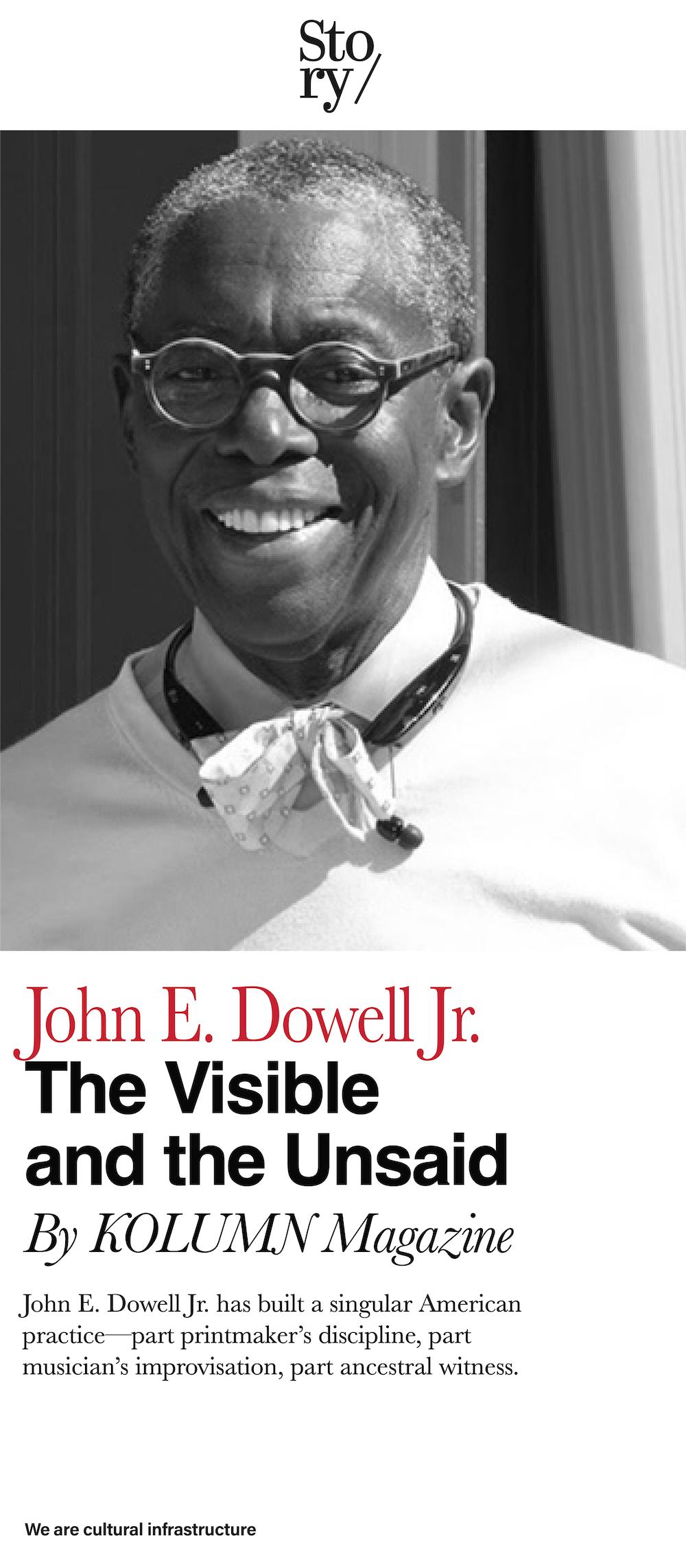
John E. Dowell Jr. did not choose between formal mastery and Black historical consciousness. He built a practice in which each sharpened the other.
By KOLUMN Magazine
In the long arc of American art, there are artists who master a medium, and there are artists who keep breaking their own vocabulary open. John E. Dowell Jr. belongs to the second category. Over a career that stretches from the ferment of the 1960s to the present, Dowell has been many things at once: printmaker, painter, photographer, teacher, collaborator, master printer, image-maker of jazz, excavator of buried histories, and one of Philadelphia’s most consequential cultural workers. He is the kind of artist whose résumé can tempt a writer into merely cataloging accomplishments. But the real story is deeper than institutional validation, and stranger than career summary. Dowell’s life work is, in essence, a study in how form can carry memory—how abstraction can hold Black life, how music can become image, how photography can become a ritual of return, and how beauty can be made to answer history.
That breadth is not incidental. It is the point. Across decades, Dowell has refused the idea that a Black artist must choose between formal innovation and historical consciousness, between lyricism and politics, between experimentation and responsibility. He has done the opposite: he has made them speak to one another. Early on, his lithographs and etchings pulsed with the influence of jazz and modernism. Later, his paintings pressed toward spiritual and symbolic reflection. In more recent decades, his large-scale photographs of cities, agricultural landscapes, and cotton fields have turned the camera into a vessel for ancestral thought. In that sense, Dowell’s oeuvre does not read like a series of disconnected phases. It reads like a single inquiry pursued through changing materials: What does it mean to make an image equal to the complexity of Black experience in America?
For KOLUMN, that makes Dowell especially resonant. His career sits in conversation with the magazine’s broader attention to Black artists whose work reshapes both visual language and cultural memory. As with KOLUMN’s recent artist-centered considerations of figures such as Ernest Crichlow and Cheryl Derricotte, Dowell’s significance is not only that he made arresting objects. It is that he built ways of seeing—ways of seeing the city, the archive, the wound, the spirit, and the afterlife of enslavement without flattening any of them into cliché. He belongs to that class of artists whose work enlarges the conversation around what Black art has been and what it is still becoming.
A Philadelphia beginning
John E. Dowell Jr. was born in Philadelphia in 1941, a fact that matters because Philadelphia is not just the place he comes from; it is one of the recurring subjects and structures of his imagination. Smithsonian American Art Museum identifies him as born in Philadelphia in 1941, and multiple institutional and biographical sources trace his formation through the city’s art education networks before he emerged as a nationally recognized artist and educator. Search summaries and institutional biographies identify his early study at the Art Students’ League of Philadelphia, his B.F.A. at Tyler School of Art in 1963, and later graduate study in printmaking and drawing at the University of Washington, where he earned an M.F.A. in 1966.
His own story, as later reported in regional coverage, carries the social geography of North Philadelphia with it. In a 2022 profile on Paths to Freedom, Penn Today noted that Dowell grew up in Philadelphia’s Richard Allen projects, attended Central High School, and graduated from Temple with a bachelor’s degree in 1963. That trajectory matters not merely as background, but as a reminder of how Black artistic achievement so often emerges from public worlds too frequently described only through lack. Dowell’s life complicates that script. He came out of a city and a community that made room for ambition, discipline, and artistic seriousness even under constraint.
There is a tendency, when writing about elder Black artists, to begin retrospectively—as though the significance were obvious from the start. It usually was not. What made artists like Dowell distinctive in the first place was precisely that they were inventing themselves inside institutions that were not built for them, absorbing the lessons that were available while revising the terms of their own inclusion. Dowell’s early training in printmaking and ceramics at Tyler, followed by advanced lithography work and his Tamarind experience, placed him inside some of the most technically rigorous channels available to an American printmaker of his generation. Art of the Print’s biographical chronology records his Tyler training, his advanced lithography study with Garo Antreasian, his artist-printer fellowship at Tamarind in 1963, and his return to Tamarind as a senior-printer fellow while completing his M.F.A.
That technical foundation is more than trivia. Tamarind mattered, and still matters, because it signaled excellence in lithography at the highest level. To say Dowell was Tamarind-trained is to say he entered American art through exacting craft rather than vague aspiration. Allan Edmunds, founder of Brandywine Workshop, later recalled that when he met Dowell in 1973, Dowell was already “a Tamarind-trained master printmaker,” someone whose sophistication in lithographic process shaped Edmunds’s own aesthetic development.
Learning how to hear an image
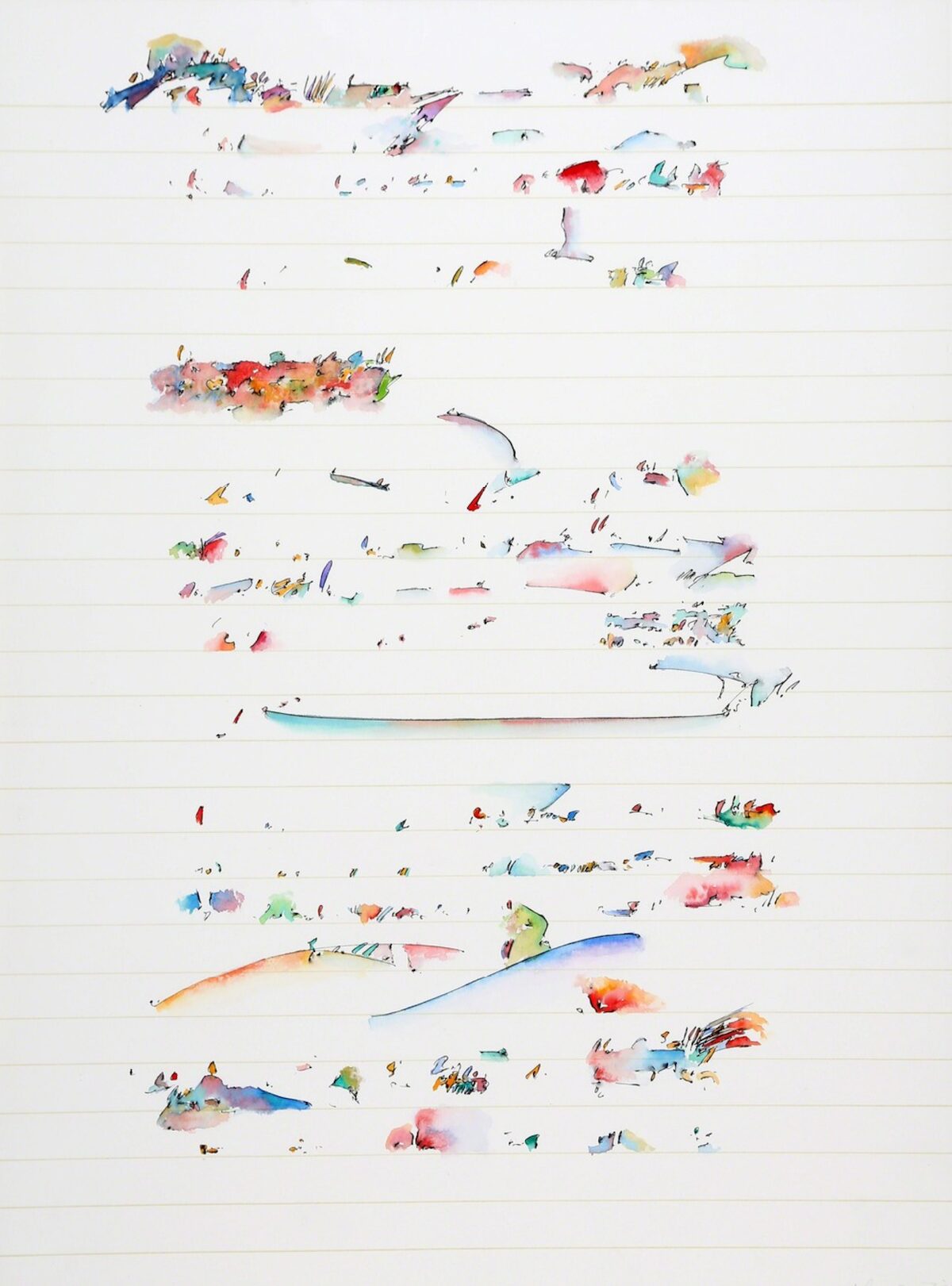
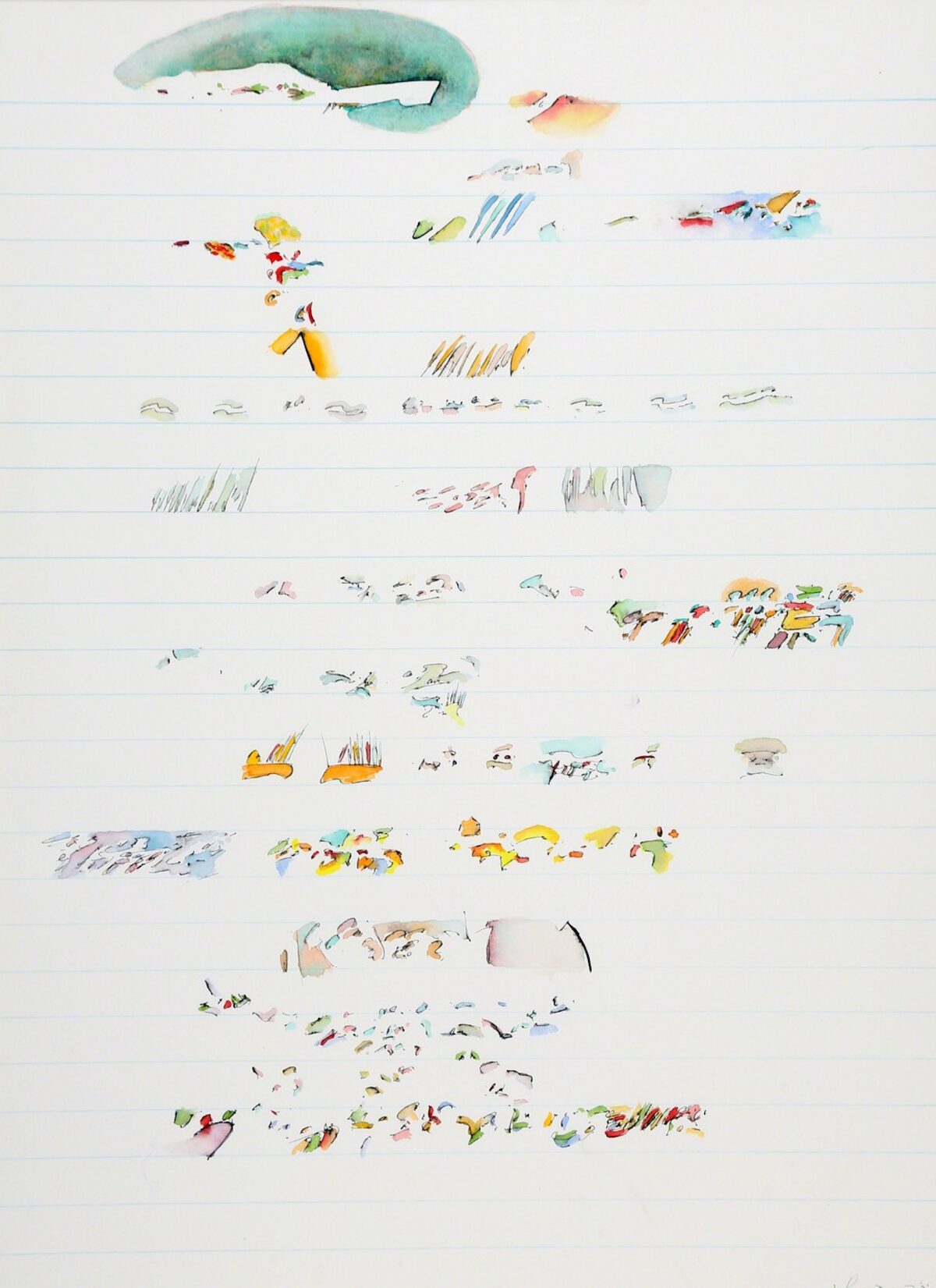
Dowell’s early work is often described through the language of music, and not by accident. MoMA’s holdings make visible the significance of his early print portfolios, especially Visual Poems from 1970–71, which includes works titled Love Vibrations, Just Heard Bessie, Coltrane Sonnet, Miles…, and Drownin on Dry Land. Even the titles tell the story: Dowell was not merely depicting musicians or scenes. He was trying to discover how sound, improvisation, and emotional velocity might be translated into visual structure.
That effort placed him in a rich postwar conversation. Jazz had long served Black artists as both method and metaphor: improvisation, syncopation, repetition, rupture, call-and-response. But Dowell’s commitment to music went beyond influence. By his own later account, music was a driving force in his work, moving him from blues to jazz and helping generate innovations across media. In a 2025 television profile, Dowell said, “Music has been the real driving force for me,” and described creating concerts for a decade using his artwork as musical scores—an extraordinary attempt, as he put it, to create audibly what one sees visually.
The Arthur Ross Gallery’s 2022 program notes similarly observe that in the 1980s Dowell used works on paper as scores for music concerts, while Brandywine Workshop’s writing on “Art in Music, Music in Art” places him inside a lineage of artists and musicians pushing against the limits of notation and conventional form. That history is crucial because it reveals something essential about Dowell’s practice: he does not treat mediums as sealed containers. Print can think like music. Photography can act like memory. Installation can function like ceremony. The borders are porous because the underlying question is always experiential. How do you make an image move? How do you make a surface sound?
In that respect, Dowell’s career also offers a useful correction to simplistic narratives about Black artists and figuration. He was never only interested in representation as likeness. He was interested in translation. A line could become rhythm. A field of marks could become atmosphere. A composition could become a score. Even when history would become more explicit in his later work, Dowell remained committed to the idea that art had to do more than illustrate. It had to activate.
The teacher as institution
Dowell’s career as an educator is impossible to separate from his significance as an artist. Penn Today reports that he spent 42 years on the faculty of Temple University’s Tyler School of Art, from 1971 to 2013. Earlier biographical materials document teaching appointments at Indiana State University, the University of Illinois, Temple’s Rome campus, and then Tyler in Philadelphia, where he rose from associate professor to full professor and chaired the printmaking department. Temple’s Tyler profile now lists him as Professor Emeritus.
Forty-two years is not a footnote. It is institution-building. In American art, especially in Black cultural history, some of the most enduring influence has occurred not only through exhibitions and collections but through pedagogy—through the classrooms, critiques, workshops, and informal mentorship structures where artists teach other artists how to persist. Dowell occupies that lineage. He helped shape Tyler’s printmaking culture across generations, and the ripples of that work move outward through students, colleagues, and Philadelphia’s wider arts ecology.
Edmunds’s recollection is revealing here too. He describes Dowell not simply as an admired senior artist, but as a first mentor-influence who challenged him technically and conceptually. That is often how artistic ecosystems actually develop: not through abstract “support,” but through concrete pressure, high standards, and the transfer of specialized knowledge. Dowell’s role in Brandywine Workshop’s development further underscores this. The Philadelphia Museum of Art notes that he played an instrumental role, with Allan Edmunds, in Brandywine’s transition from screenprinting to offset lithography. That is a material intervention into the history of Black printmaking in Philadelphia, not just a personal collaboration.
If one wants to understand Dowell’s significance, then, one has to look beyond singular objects and toward the infrastructures of practice he helped sustain: Tyler, Brandywine, museum conversations, artist communities, public memory projects. He did not simply make art in Philadelphia. He helped make Philadelphia possible as a city in which Black printmaking, Black experimentation, and Black visual intelligence could keep regenerating themselves.
Museums noticed, but the work was always larger than validation
Institutional recognition followed. Temple notes that Dowell’s work has appeared in more than 50 solo exhibitions and is represented in more than 70 museum and public collections. MoMA lists works and exhibitions dating back to the 1970s, including Recent Acquisitions, 1968–1973, Works on Paper, and Some American Drawings: Recent Acquisitions. Smithsonian American Art Museum identifies Dowell in its artist records and collection pages, while works by him are also held by the Philadelphia Museum of Art and the Metropolitan Museum of Art; Tyler’s official profile further names the Museum of Modern Art, the Met, the Museum of Fine Arts, Boston, and SFMOMA among the institutions holding his work.
Those facts matter, particularly because Black artists of Dowell’s generation were so often under-collected relative to their achievement. But the institutions alone do not explain what makes him singular. More useful is what those collections reveal about the range of his practice. MoMA’s holdings preserve the young Dowell of Visual Poems and late-1960s prints such as The White Wheel of W.T.H. Smithsonian holds works like C and W Duet and Letter to My Betty II, preserving the printmaker’s early energy and invention. The Philadelphia Museum of Art situates later work such as The Wonder in a vocabulary of spirituality, symbolism, and reflection, while also featuring To Weave through Time in its ongoing exhibition Expanded Painting in the 1960s and 1970s.
That Philadelphia Museum of Art placement is telling. In Expanded Painting in the 1960s and 1970s, Dowell’s To Weave through Time appears alongside artists such as Sam Gilliam, Lynda Benglis, Dorothea Rockburne, and Eva Hesse in a show devoted to artists who pushed painting’s conventions toward freedom, movement, material experimentation, and conceptual rethinking. Hyperallergic’s review of the exhibition singled out Dowell’s heavily textured white painting as a work suggestive of what lies beneath the surface, even reading its whiteness as alluding to a history dominated by whiteness. Whether or not one agrees fully with that interpretation, the point stands: Dowell belongs within the story of formal innovation, not outside it.
The same is true of his place in Philadelphia art history. Woodmere’s We Speak: Black Artists in Philadelphia, 1920s–1970s framed Black artists in the city as participants in a broad institutional and historical ecology, tracing the platforms that enabled Black artists to launch careers and have a voice. Dowell’s inclusion there underscores his role as part of a larger Black Philadelphia lineage while also reminding viewers that he bridges eras—connected to the city’s midcentury formations and still working decisively in the present.
When photography became an instrument of haunting
For many artists, a late-career turn to photography would read as departure. For Dowell, it reads as expansion. Temple’s profile describes his large-scale photographs as works that capture the pulse of cities and agricultural landscapes, often made from sunset until dawn and focused on surfaces, reflections, and interior glimpses. His own website similarly describes photographing urban nocturnal landscapes in order to capture the excitement of the city, emphasizing connection, spirit, and the transformed visibility of night.
This nocturnal sensibility matters. Night in Dowell’s photographs is not merely aesthetic mood. It is a condition of revelation. Darkness allows surfaces to loosen their daytime certainty. Reflections become unstable. Buildings begin to hold memory differently. Landscapes move from description toward apparition. In that sense, photography did not pull Dowell away from the concerns of his printmaking years; it gave him a new tool for the same search. He still wanted to make the unseen legible. He just found that the camera—especially in long exposure and low light—could register the threshold between material fact and psychological charge with a new intensity.
The public could see the civic dimension of that photographic practice in his work on the President’s House archaeological site in Philadelphia. A city- and park-supported project documented in the Philadelphia Archaeological Forum materials commissioned Dowell to photograph the excavation in 2007. The project text explicitly describes those photographs as documenting “the archaeology of freedom and slavery during the birth of our nation,” and notes both the commission from the Mayor’s Office and the exhibition of the photographs at the Independence Visitor Center.
That project is easy to underestimate. Yet it shows Dowell using photography not just to make art objects, but to intervene in public memory. The President’s House site is among the most charged historical locations in Philadelphia because it forces national mythology to confront the enslaved Africans held by George Washington. For Dowell to photograph that excavation was for an artist already attuned to layered history to place his eye at a scene where the American archive was literally being opened up. His photographs did not create the facts. They created a visual language adequate to the fact that those truths had been buried in the first place.
Cotton, danger, inheritance
If the President’s House work sharpened Dowell’s role as a maker of public historical memory, the cotton series pushed him toward something even more intimate and devastating. By the 2010s, Dowell had begun making photographs of cotton fields and manipulating cotton imagery into urban and historical sites, producing one of the strongest bodies of work of his later career. On his own website, he describes Cotton: The Soft, Dangerous Beauty of the Past as evoking remembrance, feeling, and wonder in relation to African American ancestral strategies of survival, while also engaging histories of slavery and the ongoing devaluation of Black life.
The title itself does a great deal of work. Cotton is soft, yes. Cotton is beautiful, sometimes even seductive in photographs. But as Dowell explained to The Philadelphia Inquirer, it is also dangerous: physically, because its spikes can tear the skin, and historically, because it carries “400 years of torture.” That doubleness—beauty and brutality in the same object—is one of Dowell’s central insights. He refuses sentimental pastoralism. The cotton boll is never just botanical. It is labor, terror, economy, ancestry, loss, and ghost.
Coverage of the exhibition at the African American Museum in Philadelphia repeatedly returned to the personal origin of the series: Dowell’s dreams of his grandmother, “Big Mommy,” whose childhood memory of becoming lost in a cotton field helped set the project in motion. WHYY reported that Dowell began dreaming of his grandmother in 2011, then connected those dreams to the cotton stories she had told the family. Broad Street Review likewise noted that the series arose from dreams of his grandmother, raised in South Carolina, and quoted Dowell saying the floating, near-spiritual beauty of cotton came to represent lost souls and his ancestral connection to slavery.
This is where Dowell’s work becomes impossible to reduce to either documentary or abstraction. The cotton photographs move through both registers at once. Hyperallergic observed that the exhibition ranged from sweeping field photographs to manipulated images that place cotton bolls into sites with under-recognized African American histories, including Trinity Church and Wall Street. The review argued that Dowell’s images function as “vivid signposts” of hidden stories, making incomplete histories suddenly feel unavoidable. That is a strong description of the series’ achievement. Dowell does not merely tell viewers what happened. He stages the return of what should never have been obscured.
In these works, cotton becomes a visual migrant. It appears where history insists it does not belong, and in doing so reveals that history’s official map was always dishonest. Dowell’s insertion of cotton into New York sites reminds viewers that slavery was not solely Southern, not solely plantation-bound, not solely a problem of elsewhere. Broad Street Review noted how works in the exhibition linked cotton to Wall Street and Seneca Village, while Hyperallergic emphasized the hidden labor, trade, and burial histories beneath present-day Manhattan. These are not decorative gestures. They are acts of counter-memory.
Paths to Freedom, or how an artist turns inheritance into environment
Dowell’s later series Paths to Freedom may be the clearest distillation yet of what his mature work can do. First shown at the Arthur Ross Gallery in 2022 and later presented at the Charles H. Wright Museum, the project includes photographs, an immersive installation, and a soundscape. Official exhibition materials describe the work as staged in cotton fields at night, conjuring the spirits of enslaved ancestors seeking freedom. Penn Today reported that Dowell had been photographing the same North Carolina cotton fields for more than a decade and, beginning in 2017, decided to work at night, making long exposures with minimal light in order to imagine the escape experience of enslaved people more truthfully.
The formal choices are inseparable from the historical imagination. Dowell understood that flight from slavery was not a daytime tableau. It happened in darkness, uncertainty, fear, instinct. In the Penn Today feature, he asked how someone could run in the dark without knowing where they were going and answered with the idea of ancestral connection, intuition, and “a knowing.” The works incorporate symbols associated with the Underground Railroad—a tree with moss on the north side, a river to mask scent, a safe house—while also remaining visually open, atmospheric, and dreamlike.
Feature Shoot’s 2024 interview extended that line of thought, describing Paths to Freedom as originating in dreams and in Dowell’s desire to imagine the courage, wisdom, and pursuit of freedom of enslaved ancestors in the deep South at night. Dowell himself explained there that the vision took time to understand and that realizing it required practical labor—contacting farmers, traveling to fields, and working through what the dreams were asking of him. That pragmatic detail is important. Spirituality in Dowell’s work is not a shortcut around craft. It is a demand that craft serve an encounter that feels ethically urgent.
The Arthur Ross Gallery and Penn coverage also make clear that Paths to Freedom is not just a photo series hung on walls. It is an environment. The hanging taffeta panels invite viewers to move physically through the work while listening to a soundscape that Dowell wrote, performed, and recorded, drawing partly from songs remembered through his grandmother. The result is a rare fusion of photography, installation, and sound—not a retrospective display, but a passage. The viewer does not merely look at the work; the viewer enters a sensory proposition about memory, fear, and survival.
Still working, still widening the frame
It is tempting to write about Dowell as though he belongs securely to art history. He does. But he also remains productively in motion. Regional reporting from late 2025 described his exhibition I Got Through It at James Oliver Gallery and noted that, at 84, he was still experimenting with texture, still making new work, and still challenging assumptions about what an elder artist is supposed to be doing. The piece also reiterated his long commitment to discovery: his desire to bring viewers something they had not seen before, something through which they might discover themselves.
Recent recognition confirms that the art world has not stopped paying attention. The Pew Center for Arts & Heritage’s materials identify him as a 2025 Pew Fellow, a significant marker of contemporary esteem in Philadelphia’s cultural landscape. That recognition lands not as nostalgia, but as acknowledgment that Dowell’s practice remains live—still asking questions the present has not answered.
There is something quietly radical in that persistence. Many artists achieve style. Fewer achieve elasticity. Dowell has remained elastic across media, across decades, across shifts in discourse. He can appear in narratives of Black Philadelphia art history, printmaking history, museum abstraction, public memory, photography, and sound-based experimentation without seeming misplaced in any of them. That is rare. It means his career has not merely survived change. It has metabolized it.
What John E. Dowell Jr. means now
So what is John E. Dowell Jr.’s significance, finally? It is not exhausted by the fact that major museums collected him, though they did. It is not exhausted by the fact that he taught for four decades, though he did. It is not exhausted by his mastery of lithography, his role in Brandywine, or his late-career photographic achievements, though all of those matter. His significance lies in having made a sustained artistic language for Black historical feeling without surrendering formal complexity.
He is a maker of thresholds. Between sound and sight. Between abstraction and witness. Between civic history and family memory. Between the city’s visible surfaces and the buried truths below them. Between the softness of cotton and the violence it encodes. Between what museums can hold and what ancestors still ask of the living. That threshold work is why Dowell matters beyond Philadelphia, beyond printmaking, beyond any single medium. He offers one answer to a question that remains urgent in American culture: how can art face history without becoming didactic, and how can beauty remain beauty after it has looked directly at terror? His answer, over and over, is not simplification. It is depth.
And perhaps that is the sharpest way to understand him. John E. Dowell Jr. is not an artist who decorated history. He entered it. He listened for its undertones, tested its textures, and kept changing his tools until they could bear the weight. In one era, that meant lithographs that moved like jazz. In another, paintings that pushed toward spiritual excavation. In another, photographs made at excavation sites, in cities at night, or in cotton fields haunted by ancestral motion. Through all of it, he has insisted that Black art need not choose between the experimental and the legible, between intellect and feeling, between innovation and inheritance. It can do all of it at once. His career is proof.
That is what makes him KOLUMN material in the fullest sense. Not merely because he is accomplished, but because he clarifies something essential about Black cultural production: the archive is alive, the form is never fixed, and the image can still carry what official memory refuses to hold. John E. Dowell Jr. has spent decades showing exactly that. The result is not only a body of work. It is a visual ethic—one in which making art is also a way of remembering, honoring, and pressing the nation toward a more truthful sightline.
More great stories
Afro Sheen, Wall Street, and the Architecture of Black Possibility
July 6, 2026
No Comments
The Fire Inside the Fourth
July 5, 2026
No Comments