


Alice Dunbar-Nelson was not simply adjacent to history. She was a producer of it.
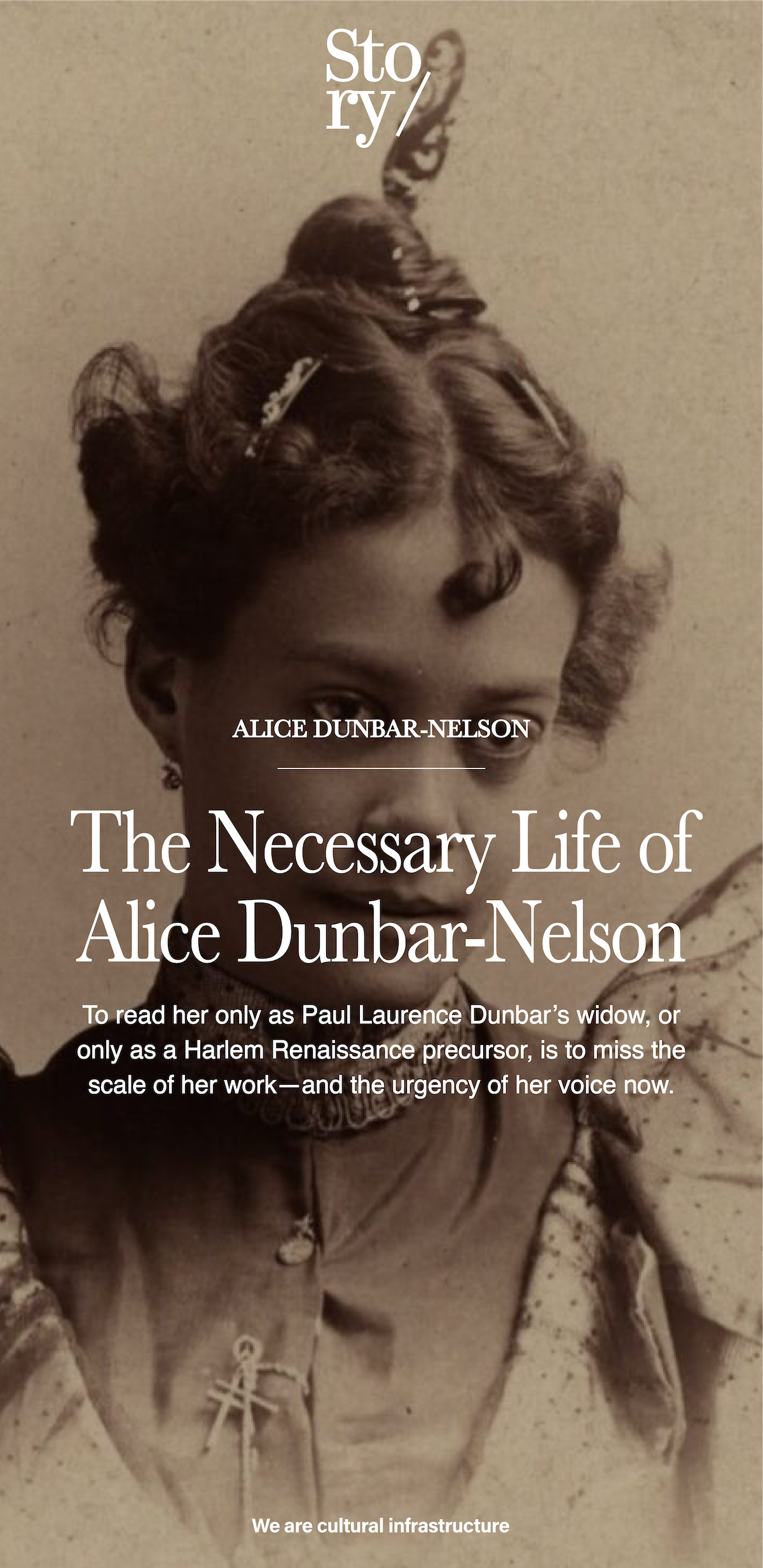
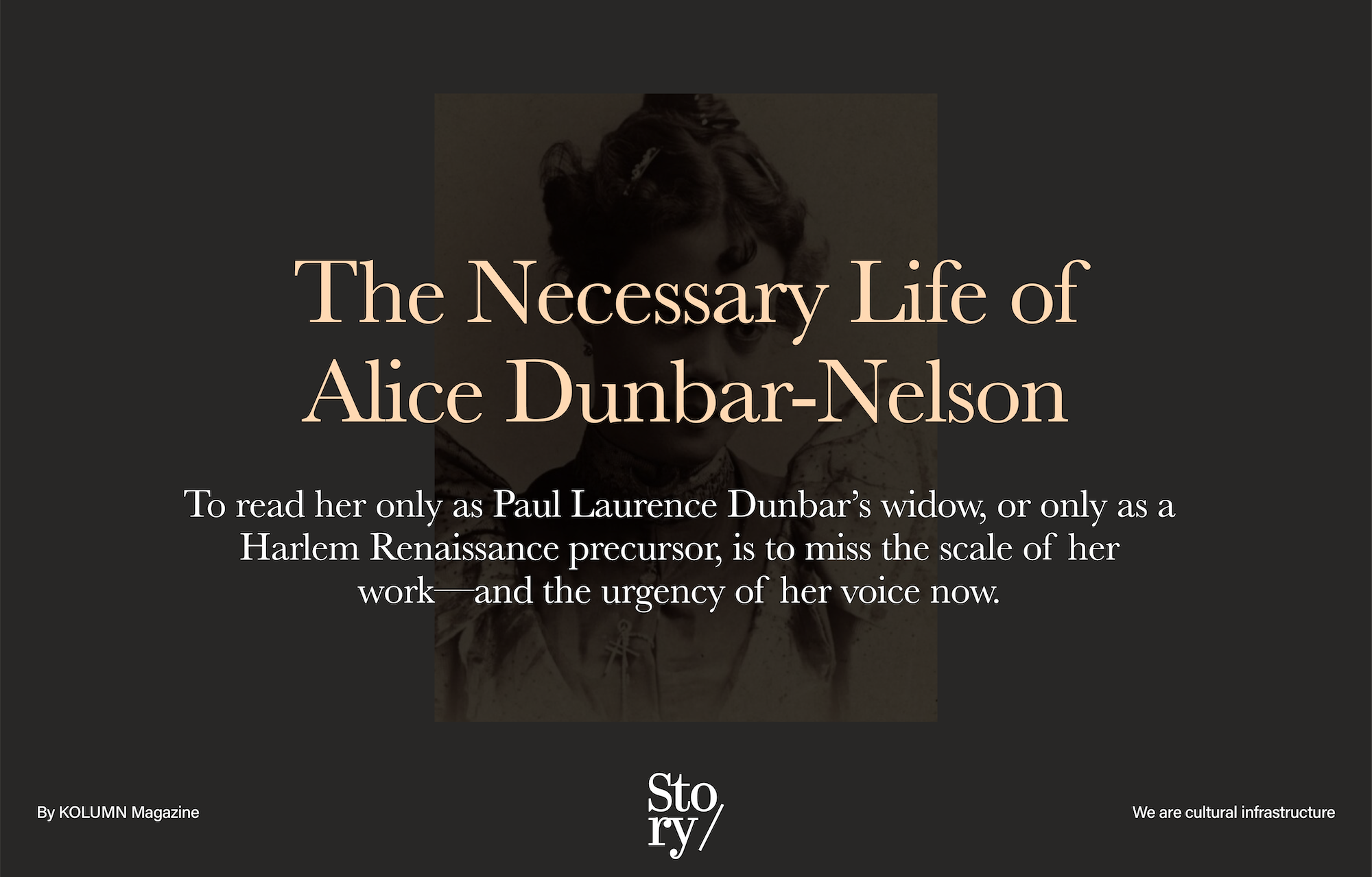
Alice Dunbar-Nelson was not simply adjacent to history. She was a producer of it.
By KOLUMN Magazine
There are certain Black women in American cultural history whom the archive never fully lost, but whom the culture repeatedly learned how to misplace. Alice Dunbar-Nelson is one of them. She remained visible just enough to be named, anthologized, and briefly admired, yet rarely centered with the force her life actually demands. She has often been treated as a literary satellite orbiting larger men, larger movements, or larger labels: Paul Laurence Dunbar’s wife and later widow, a minor Harlem Renaissance figure, a poet of promise, a diarist of interest. But that tidy summary collapses the scale of what she was. Alice Dunbar-Nelson was not simply adjacent to history. She was a producer of it. She wrote stories, poems, plays, reviews, essays, and columns. She taught generations of Black students. She campaigned for women’s suffrage and anti-lynching legislation. She edited and coedited Black publications. She moved between literary culture and political struggle with a fluency that now looks astonishingly modern. In both her life and her work, she refused singularity.
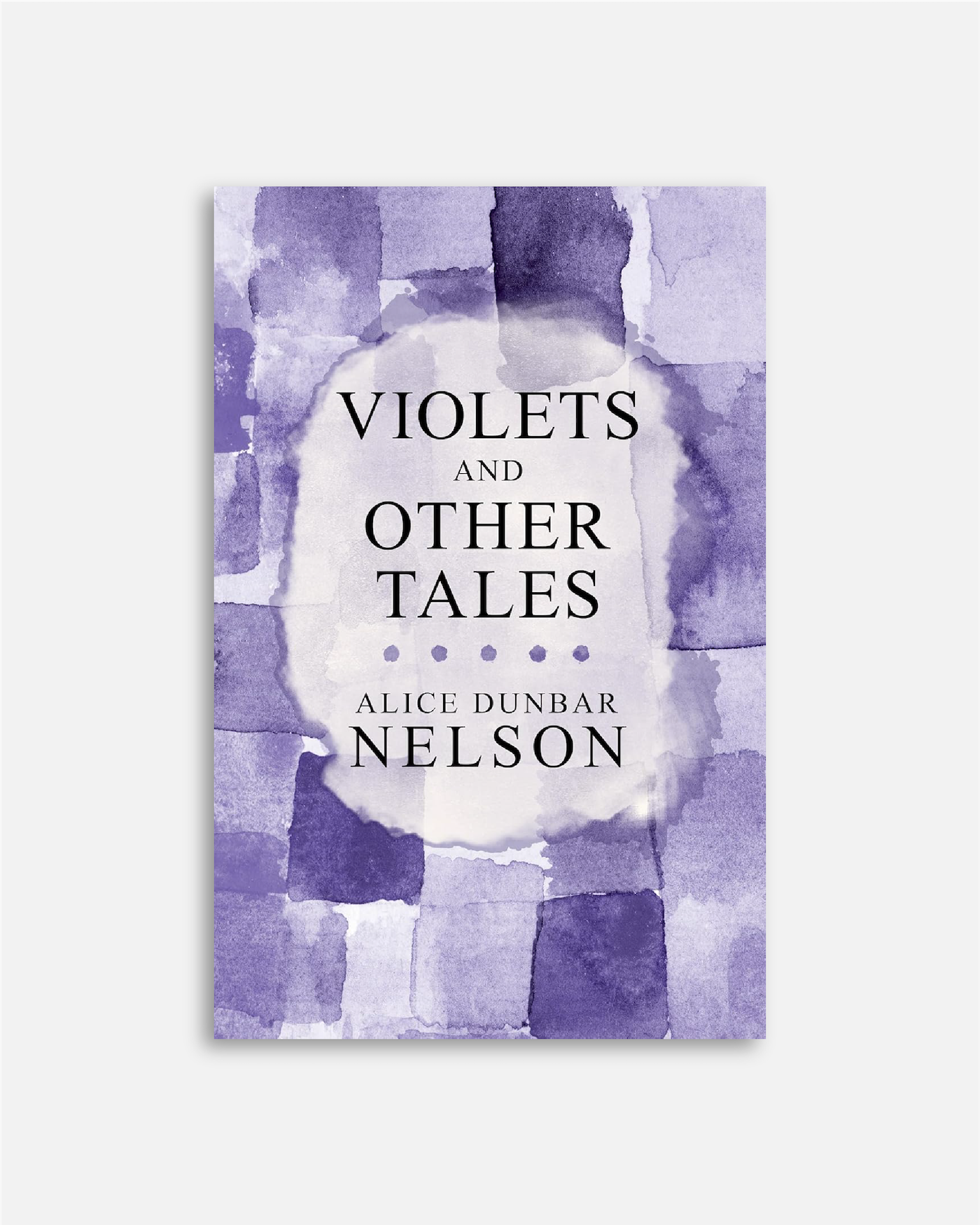
That refusal is precisely why she matters now. Dunbar-Nelson belongs to a lineage of Black women thinkers whose public roles were expansive before the culture had language generous enough to describe them. Born in New Orleans in 1875 to a mother who had been enslaved and into a complex Creole and mixed-race social world, she developed early the sharpened, double, and sometimes triple consciousness that would mark her writing: an eye for class, color, gender, performance, and the ways American institutions asked Black women to be legible only on terms that diminished them. She graduated from Straight University, taught in New Orleans public schools, and published her first book, Violets and Other Tales, in 1895 when she was only twenty. That early debut did not produce the effortless ascent American literary mythology likes to promise. It produced instead the harder thing: a career built in fragments, hustle, reinvention, and constant intellectual labor.
KOLUMN has recently shown, in pieces revisiting Black cultural builders such as Palmer Hayden, an interest in lives that do not fit neatly inside the reputational boxes history later builds for them. Dunbar-Nelson demands that same treatment, and then some. She was an artist, yes, but also a strategist. A lyric writer, yes, but also a working journalist. A literary woman, yes, but also a political organizer who understood that beauty, citizenship, labor, and racial terror were part of the same American argument. To recover her correctly is not just to enlarge the canon. It is to correct our understanding of what Black women intellectual life looked like at the turn of the twentieth century and what it cost to sustain it.
A New Orleans beginning, and the making of a complicated self
Alice Ruth Moore entered the world in post-Reconstruction New Orleans, a city where race was never simple, though power always was. The social texture of Louisiana Creole life, its layered distinctions and hard hierarchies, gave Dunbar-Nelson a vocabulary for contradiction long before she became famous for diagnosing it. The Poetry Foundation notes that her African American, Anglo, Native American, and Creole heritage shaped her understanding of race, ethnicity, and gender, all subjects that would recur across her work. Those formulations can sound tidy in retrospect, but what they point to is something more difficult: Dunbar-Nelson matured inside a social order where identity could be endlessly discussed yet brutally constrained, aesthetically elaborated yet politically weaponized.
That background mattered because it trained her to see social performance as both cultural inheritance and survival strategy. In New Orleans she studied, taught, and absorbed a world in which language, propriety, color, education, and class all carried meaning. Violets and Other Tales, the book she published at twenty, emerged from that atmosphere. The Smithsonian’s account of her life describes the volume as a mix of poetry and vignettes reflecting Creole life and experience. Its very existence announced Dunbar-Nelson as a precocious writer, but it also placed her in an American literary economy not built to reward Black women for nuance. The work was too refined to fit racist fantasies, too interested in interiority to satisfy those who wanted sociology dressed as art, and too distinctly hers to be easily marketed by the categories available at the time.
This is one of the earliest facts about Dunbar-Nelson that ought to change how we read her. She did not begin as a political writer who later discovered style. She began as a literary stylist whose understanding of politics was inseparable from social texture. Even her early work shows a consciousness attuned to atmosphere, affect, and the daily negotiations of race and gender. That sensitivity would later deepen into criticism, journalism, and activism. But the roots are already present in the New Orleans years: the sense that power lives in etiquette as much as law, in doors that open halfway, in names that grant partial passage, in the emotional tax of being looked at and interpreted.
Marriage, fame, and the trap of literary association
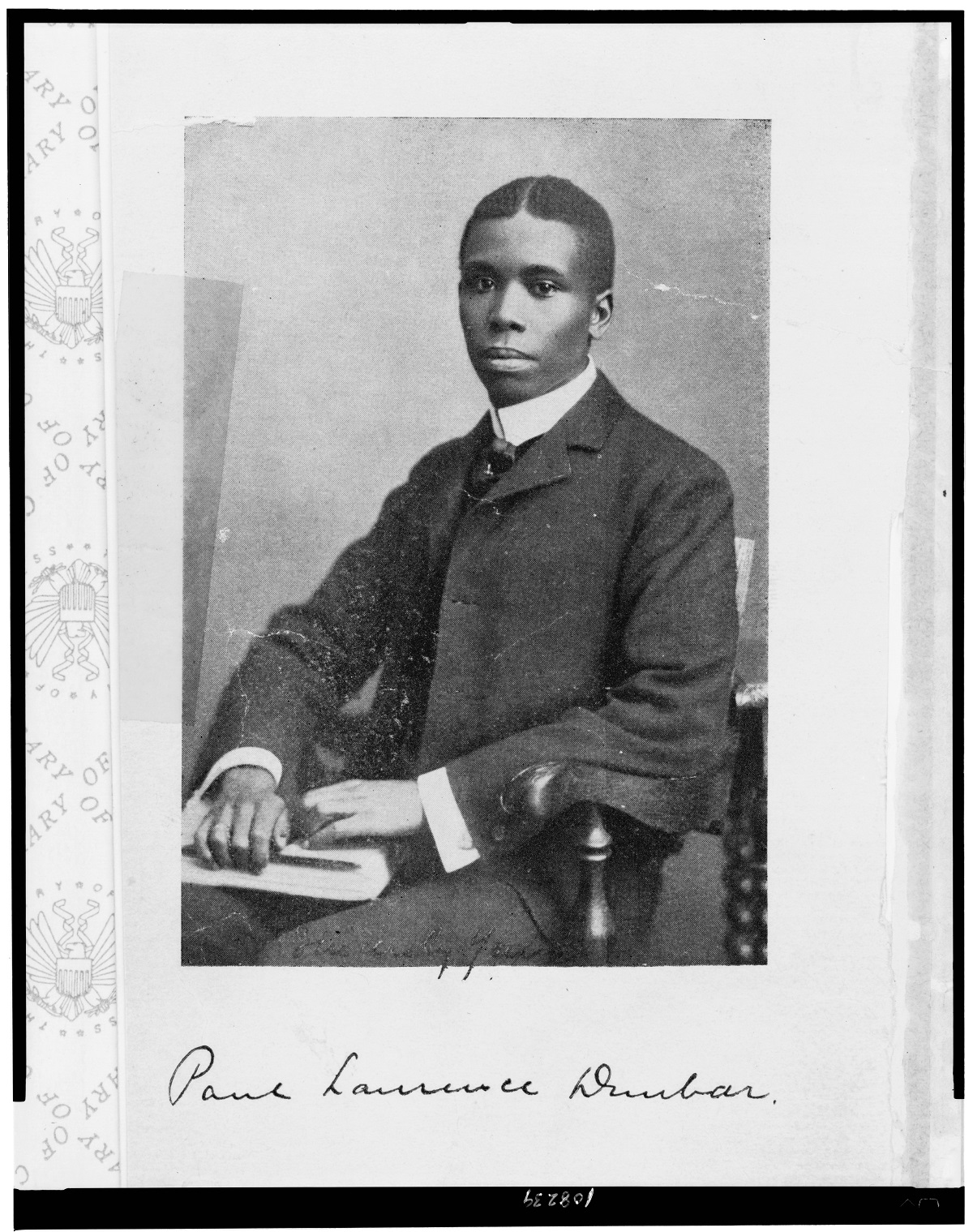
No discussion of Alice Dunbar-Nelson can honestly avoid Paul Laurence Dunbar. The problem is that too many discussions stop there. Their correspondence began in the 1890s, after she moved north and taught at the White Rose Mission in Brooklyn. They married in 1898 and lived in Washington, D.C. The marriage was troubled and abusive; by 1902 they had separated, though not legally divorced before his death in 1906. The Delaware historical profile notes that despite the abuse, Dunbar-Nelson often promoted herself publicly as Dunbar’s widow and also advocated for his literary reputation. To some readers, that sounds contradictory. It was also legible as strategy. In a literary world structured by sexism and racism, widowhood conferred a certain cultural access that Black woman authors were otherwise denied. She understood the market and its hypocrisies. She did what many gifted women have had to do: use the door that existed while building another one for herself.
There is a temptation, particularly in retrospective literary biography, to read the Dunbar marriage as either tragic romance or cautionary tale. Both frames flatten her. What matters more is how she emerged from the marriage with her ambitions intact and her range widened. She was not broken into silence. She rebuilt. After leaving Washington, she relocated to Wilmington, Delaware, where she took a teaching post at Howard High School, then the only high school in the state for Black students. There she became a formidable educator and, eventually, head of the English department. She incorporated classical literature, Black authors, and Black history into her teaching, insisting on a curriculum expansive enough to train students not only in language but in self-worth.
This phase of her life tends to be described as stability after turmoil, but that understates the ambition of the Delaware years. Dunbar-Nelson did not retreat from public life. She multiplied within it. She studied at Cornell for a period, continued writing, developed intellectual networks, and increasingly worked in the overlapping worlds of education, journalism, and civic organizing. The University of Delaware’s materials make clear the extent of her archive, including manuscripts, letters, diaries, scrapbooks, and journalism. That breadth is not incidental. It is evidence of a woman who treated life itself as production: literary, political, social, documentary. She was making a record because she was making a world.
Teacher, editor, critic, public thinker
Dunbar-Nelson’s significance becomes clearest once we stop splitting her into separate professional selves. The teacher and the critic were not different women. The journalist and the activist were not different women. She moved across those roles because she understood them as related instruments. At Howard High, she trained Black students in thought and expression. In print, she did something similar for a broader public. The University of Delaware exhibition on her work as a reader and critic emphasizes that she wrote numerous reviews of books, including the work of African American poets and novelists, and that her diaries and essays reveal her literary judgments as well as her opinions on the relationship between Black literature and social issues. That sentence alone should force a revision in how she is placed in literary history. She was not only a writer of texts. She was a shaper of Black literary discourse.
Her journalism made that public function explicit. From 1913 to 1914 she served as writer and editor for the A.M.E. Review, and later, with her husband Robert J. Nelson, she coedited the Wilmington Advocate, a progressive Black newspaper focused on Wilmington’s Black community. She also wrote columns such as “As in a Looking Glass,” published in the Washington Eagle, and later pieces for the Pittsburgh Courier. The surviving clippings and archival descriptions underscore the scale of that work. This was not occasional commentary from a literary celebrity. It was sustained, professional journalism. She entered the public sphere repeatedly and on purpose.
What made her journalism potent was its tonal flexibility. She could be witty, caustic, observant, formal, intimate, and sharply analytic. She understood that Black public writing required many registers because Black life itself was being argued over in many registers: in the classroom, in the church press, in party politics, in suffrage campaigns, in literary debates, in domestic spaces, and in the unglamorous everyday humiliations of segregation. Her prose moved accordingly. She was a social critic without giving up style. She was a stylist without evacuating politics. That combination is rarer than literary history often admits.
This is one reason Dunbar-Nelson feels startlingly contemporary. The twenty-first century has finally rediscovered the category of the Black woman public intellectual, but Dunbar-Nelson was already inhabiting it before the term had cultural prestige. She reviewed books, weighed social movements, interpreted current events, and linked aesthetic judgment to civic responsibility. She was not waiting for permission to be interdisciplinary. She simply proceeded as if Black life required nothing less.
Suffrage, anti-lynching politics, and the discipline of public action
If literary culture remembers Dunbar-Nelson incompletely, political history has also tended to understate her. Yet her activism was not ornamental to her writing. It was one of the major engines of her life. By the 1910s she was deeply involved in women’s suffrage work, and by 1915 she was serving as a field organizer for the movement. The Washington Post’s reassessment of the suffrage story, alongside Smithsonian’s treatment of the movement’s complexity, places Dunbar-Nelson among the Black women whose labor corrects the whitewashed textbook version of how women got the vote. Smithsonian also notes her argument that “pure patriotism” during World War I could help advance racial and gender equality, a position she elaborated in her piece “Negro Women in War Work.” Whether one agrees with that wartime faith in American reciprocity is almost beside the point. The important fact is that she was theorizing citizenship in real time, pushing at the question that haunted so many Black reformers: What, exactly, could Black loyalty expect from a nation that remained structurally hostile?
Her activism was equally sharp around lynching and state violence. The Delaware historical profile records that she was fired from Howard High in 1920 for “political activity,” largely in response to attending an anti-lynching rally in Marion, Ohio. Even that bureaucratic language tells a story. Political activity, for Black women like Dunbar-Nelson, often meant refusing the expectation that education should be morally uplifting but politically quiet. She would not separate respectable labor from urgent struggle. She also brought that commitment into party politics. In 1920 she became the first Black woman to serve on Delaware’s State Republican Committee, and in 1922 she helped organize a voter registration drive that added 12,000 new voters after Senator Caleb Layton refused to support the Dyer Anti-Lynching Bill. He lost his seat. This is not symbolic activism. It is electoral force.
What is remarkable here is her tactical fluency. Dunbar-Nelson understood speeches, columns, and organizing not as separate moral arenas but as connected technologies of persuasion. She knew the page mattered and the poll mattered. She knew public opinion had to be shaped and infrastructure had to be built. She knew legislation could fail and yet the agitation around it could educate, mobilize, and punish. She knew that anti-lynching politics and suffrage politics could not be disentangled for Black women, because racial terror and disenfranchisement were mutually reinforcing systems. The scrapbook historians who have reconstructed her suffrage work make exactly this point: Dunbar-Nelson saw Black women’s political participation as inseparable from the fight against racist propaganda and racist violence.
There is also a harder truth here. Dunbar-Nelson’s activism illuminates the limits of the patriotic bargain she sometimes hoped might hold. Black participation in American wars did not automatically dissolve racial subordination. Suffrage victories did not end Black disenfranchisement. Anti-lynching advocacy met Senate obstruction. Yet none of this pushed her toward passivity. It sharpened her diagnosis. Her writing from the 1920s shows a mind increasingly attentive to systemic hypocrisy. In the undated piece “Delaware Inconsistencies,” quoted by Delaware’s historical division, she described the state as full of “political and social contradictions,” friendly on the surface yet segregated in restaurants and public accommodations, progressive in image and repressive in fact. That sentence could have been written about half the republic, and arguably still applies to much of it.
The poems are better than the reputation lets on
One of the unfairest things literary history has done to Alice Dunbar-Nelson is to praise her importance while understating her art. This often happens to writers who are politically significant. They are granted seriousness but denied aesthetic magnitude, as if formal achievement and historical engagement occupy opposing sides of a ledger. Dunbar-Nelson’s poems reject that premise. The Poetry Foundation preserves some of her best-known work, including “Sonnet,” “If I Had Known,” and “To Madame Curie,” and the recent Guardian reading of “The Proletariat Speaks” makes plain how supple and modern her poetic intelligence could be. The Guardian calls the poem “a remarkable piece of oratory” and emphasizes the way its ordinary speech, social observation, and sensory detail render class inequality without flattening complexity. That is a useful formulation, because it captures a recurring feature of Dunbar-Nelson’s art: she could be lucid without being simple.
What strikes a contemporary reader is how often her poetry understands aspiration as material, not merely emotional. Beauty, labor, exhaustion, social ambition, and bodily discomfort all move through the same lines. Her speakers desire fragrance, coolness, elegance, or tenderness, but those desires are never detached from the architecture of inequality. That is part of what makes “The Proletariat Speaks” feel so contemporary: it understands class as sensorial, humiliating, atmospheric. Her poem “I Sit and Sew,” though not among the sources opened here, has likewise endured because it stages the frustration of constrained womanhood through repetition and pent-up motion. Dunbar-Nelson knew how to make a social condition audible.
She also understood that style could carry contradiction better than argument alone. In her work there is often a tension between elegance and abrasion, longing and critique, polish and fury. That tension mirrors her life. She was a woman who moved through literary circles, classrooms, club spaces, and newspaper offices while dealing with economic precarity, racism, sexism, and the exhausting demands of public respectability. Her poems do not merely state those conditions. They register their pressure. Read correctly, they are not minor ornaments surrounding her activism. They are among the places where her social thought becomes most distilled.
The canon’s old problem with Dunbar-Nelson was not simply that it forgot her. It did not know where to put a writer who could be formally alert, politically engaged, and generically restless all at once. The easiest solution was to fragment her. She became a poet in one room, a reformer in another, a diarist in another still. But the poems themselves argue against that partition. They insist that feeling is political knowledge, that social rank enters the body, that desire is historical evidence.
The diary, the archive, and the woman outside the frame
If the published work shows Dunbar-Nelson’s public mind, the archive shows the scale of the life carrying it. The University of Delaware’s finding aid describes one of the most substantial collections for an early African American woman writer, including literary manuscripts, correspondence, diaries, scrapbooks, clippings, and memorabilia. Surviving diary portions, especially from 1921 to 1931, offer what the archive calls a comprehensive look at one of the most productive periods of her career. That archive matters not only because it enlarges biography, but because it changes interpretation. It reveals Dunbar-Nelson as a relentless recorder of the conditions under which Black woman artistry was made: social obligations, money worries, health concerns, teaching schedules, political travel, emotional entanglements, literary ambition, and the attrition of public life.
It also reveals a deeply important dimension of her personal life. Delaware’s historical division, drawing on letters and diary evidence, documents her long relationship with educator Edwina Kruse and notes additional intimate relationships with women later in life. The surviving record shows not an anomaly but a life richer and more complicated than the public scripts available to her. This matters for more than identity labeling. It matters because secrecy, self-fashioning, public respectability, and private truth were not side issues for Dunbar-Nelson. They were part of the emotional weather in which she worked. They sharpened her sense of performance, disclosure, and constraint. The same woman who wrote publicly about American contradiction was living intimately inside contradiction’s demands.
The publication of her diary in the mid-1980s helped accelerate her recovery among scholars, but even now there is a tendency to treat the diary as scandalous supplement rather than interpretive key. It is more than that. It is evidence that Dunbar-Nelson was always more expansive than the institutional categories around her. She was neither reducible to her marriages nor fully legible through them. She was neither simply “respectable” nor secretly transgressive in some melodramatic sense. She was a Black woman intellectual making choices inside a narrow, punitive world and preserving a record of how it felt to do so.
There is a lesson here about archives themselves. The paper trail does not merely rescue Dunbar-Nelson from oblivion. It exposes the poverty of the frameworks that once confined her. Once you see the full record—letters, columns, speeches, diary entries, campaign work, literary reviews—it becomes impossible to keep calling her minor with a straight face. The archive embarrasses the old hierarchies.
Why Alice Dunbar-Nelson belongs at the center
To say Dunbar-Nelson was “ahead of her time” is both true and insufficient. Plenty of artists are ahead of their time and still belong mostly to the future. Dunbar-Nelson belonged decisively to hers. She was in the thick of the key Black arguments of the early twentieth century: about citizenship, education, gendered labor, respectability, war, violence, beauty, and political power. Britannica places her in the early Harlem Renaissance, and that is accurate as far as it goes. But the label can also be too small, because it suggests a literary period rather than a civic and intellectual life whose reach exceeded any single movement. She was not just a precursor to a renaissance. She was one of the people who helped make Black modernity imaginable.
Her afterlife tells its own story. The Guardian’s 2025 revival of “The Proletariat Speaks,” the Smithsonian’s inclusion of her in a fuller suffrage narrative, and the University of Delaware’s ongoing digitization of her papers all signal the same thing: institutions are still catching up to what Dunbar-Nelson had already achieved. Her work keeps returning because it still clarifies the present. She wrote about labor without sentimentality, inequality without abstraction, patriotism without naiveté, and race without surrendering complexity. She understood that Black women were required to carry beauty, duty, and representation all at once, and she refused to sentimentalize that burden.
She also complicates familiar literary lineages in productive ways. Too often the story of Black women’s writing runs from Frances E.W. Harper to Zora Neale Hurston to the later twentieth century, with only glancing attention to the women who sustained criticism, journalism, and movement writing between those pillars. Dunbar-Nelson disrupts that shortcut. She helps us see that Black women’s literary history was never only the history of novels and famous poems. It was also the history of columns, club speeches, teaching syllabi, anthology work, campaign literature, and privately kept records that later became public evidence. She widens the meaning of authorship itself.
That widening is perhaps her most radical legacy. She makes it impossible to insist on the old division between art and use, lyric and labor, literature and organizing. Her life says those divisions were luxuries afforded mostly to men, and not even to all of them. For Black women of her era, writing was often inseparable from institution-building, persuasion, teaching, and survival. Dunbar-Nelson did all of that while maintaining artistic seriousness. She did not dilute literature by tying it to public life. She proved literature could be one of public life’s most exacting forms.
The lesson of her survival
Alice Dunbar-Nelson died in Philadelphia in 1935, after her health had declined in the final years of her life. The University of Delaware archive notes that she moved there in 1932 when Robert Nelson joined the Pennsylvania Athletic Commission, and that she died at age sixty after a heart ailment. By then she had spent decades working across institutions that did not reliably reward her brilliance. She had taught, campaigned, published, edited, reviewed, spoken, and documented. She had outlived one literary world and helped build another. She had also lived long enough to know that American recognition is uneven and often belated.
But belated is not the same as unnecessary. The point of recovering Dunbar-Nelson now is not only to honor an overlooked figure. It is to acquire a sharper vocabulary for the Black intellectual tradition itself. She shows that some of its defining figures were hybrid not by exception but by design. They moved between genres because the world required range. They were called contradictory because the public preferred simpler symbols. They were underestimated because institutions often do not know how to measure women whose work spills across categories. Dunbar-Nelson’s life exposes all of that.
And she leaves behind a challenge. What would it mean to teach her not as supporting cast, not as literary spouse, not as recoverable curiosity, but as central architecture? What would it mean to read her poems alongside her columns, her activism alongside her criticism, her diary alongside her public prose, and to understand that each form explains the others? What would it mean to admit that the American canon did not merely overlook Alice Dunbar-Nelson, but repeatedly relied on ways of reading that made a woman like her easier to sideline? Those are not antiquarian questions. They are present-tense ones.
The answer, finally, is that Alice Dunbar-Nelson belongs not in the margins of literary history but in its load-bearing walls. She was one of the people who understood, early and with unusual clarity, that Black writing in America would have to do many jobs at once. It would have to sing, argue, document, persuade, mourn, and organize. It would have to testify to beauty and to power’s vulgarity. It would have to make room for selves the nation could not yet honor openly. Dunbar-Nelson did all of that. The question is not whether she deserves recovery. The question is why it took so long for so many readers to understand what, on the page and in the archive, she had already made plain.
More great stories

Afro Sheen, Wall Street, and the Architecture of Black Possibility
July 6, 2026
No Comments
The Fire Inside the Fourth
July 5, 2026
No Comments