





No policy that perpetuates poverty is ever going to sustain a society.
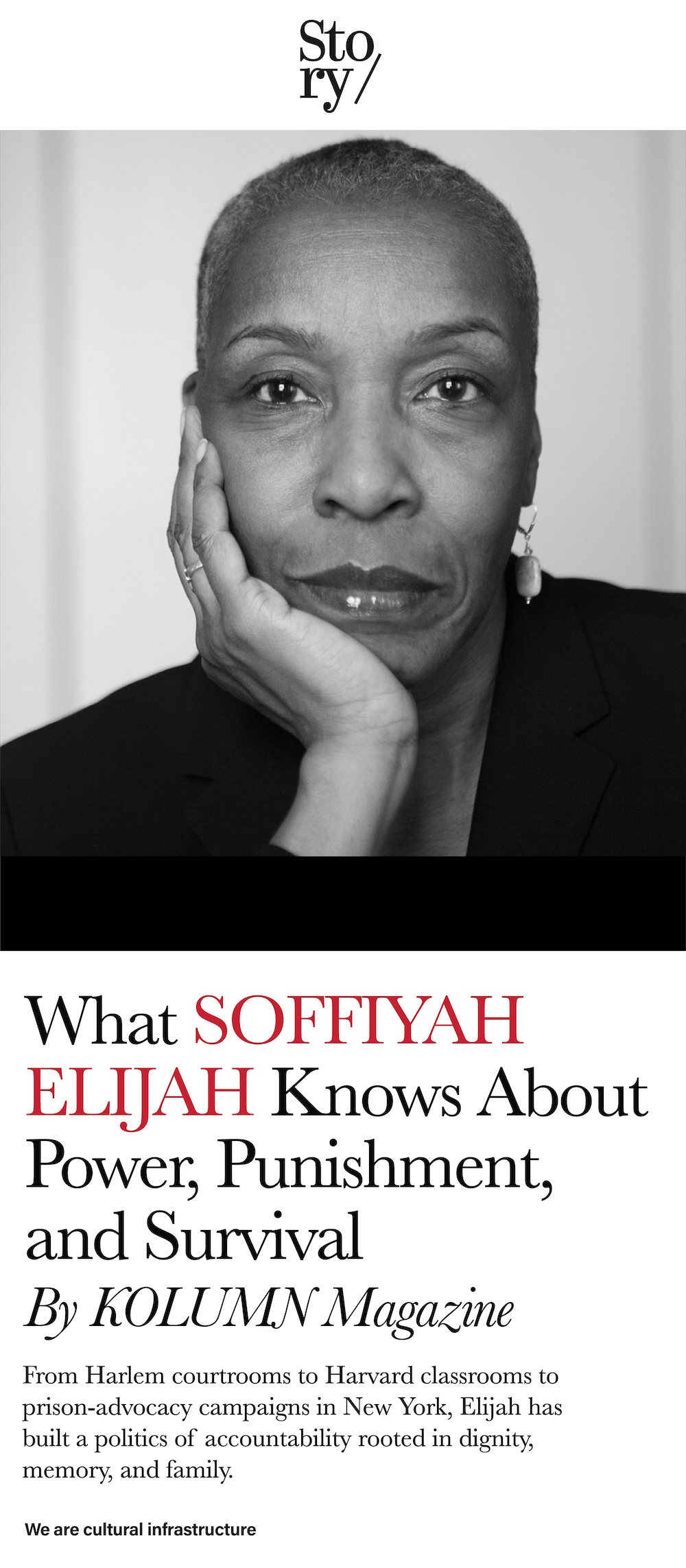
No policy that perpetuates poverty is ever going to sustain a society.
By KOLUMN Magazine
There are activists who become known for a single campaign, a single lawsuit, a single era-defining speech. And then there are figures like Soffiyah Elijah, whose public significance comes from something more cumulative and, in some ways, more difficult to package. Elijah is not easily reduced to one role. She has been a criminal defense lawyer, a clinical legal educator, a prison monitor, a public intellectual, a strategist for abolitionist-aligned reform, and the founder of an organization built around a stubborn and often neglected political insight: that the people most burdened by incarceration are not only the people behind bars, but the families forced to live around the bars, through the bars, and because of the bars.
That breadth matters because Elijah’s career has unfolded across several of the most consequential terrains in American criminal-justice politics. She worked in indigent defense in Harlem and in the Juvenile Rights Division of the Legal Aid Society. She taught in the Defender Clinic at CUNY School of Law. She later served as deputy director and clinical instructor at Harvard Law School’s Criminal Justice Institute. Then, in a role that made her visible to a broader reform public, she became the first woman and the first person of color to lead the nearly 170-year-old Correctional Association of New York, one of the rare organizations in the country with a statutory mandate to inspect prisons. In 2016, she founded the Alliance of Families for Justice, or AFJ, to organize relatives of incarcerated people and formerly incarcerated New Yorkers into a constituency with moral and political force.
What makes Elijah especially significant is not just the résumé, though the résumé is formidable. It is the through line. Again and again, across institutions and decades, Elijah has returned to the same core argument: punishment in the United States is sustained by distance—distance between the public and prisons, between lawmakers and the people they cage, between the official language of safety and the lived reality of cruelty. Her work has tried to close that distance. She has done it by representing clients who the system wanted forgotten, by pushing public attention toward notorious sites like Attica, by speaking in plain moral language about aging prisoners and state violence, and by insisting that families are not peripheral to criminal-justice policy but central to it.
In an era when criminal-justice discourse is often flattened into predictable categories—reform versus abolition, public safety versus decarceration, law-and-order rhetoric versus activist resistance—Elijah occupies a more textured space. She is unsparing about prison brutality and unapologetic about naming human-rights violations. But she is also deeply practical. She talks about visits, reentry, voting rights, legal support, parole, and the real consequences of idleness, poverty, and trauma. Her politics are radical in the old sense of the word: aimed at the root. And the root, in her telling, is not simply bad policy. It is a society that has normalized the management of Black life through punishment.
That sentence, delivered to The Guardian in 2015 in the context of prison education, sounds like a line about economics. It is also a line about Elijah’s whole worldview. Poverty, criminalization, disinvestment, family separation, disenfranchisement, and prison expansion are not separate stories in her work. They are chapters in the same one.
A Politics Formed Early
Some public biographies flatten activists into fully formed adults, as though they arrived on the scene already speaking in polished frameworks. Elijah’s story is more instructive than that. She has described growing up in New York and being shaped early by the brutal practicalities of segregation. In a 2017 profile by the Juvenile Justice Information Exchange, she recalled family road trips south during which her parents packed food and even a portable toilet because public accommodations were not reliably available to Black travelers. She said that only as an adult did she learn what it meant to simply stop at a rest stop and expect to be served. That memory is not incidental color. It helps explain the political logic in her work: systems of humiliation are learned first as ordinary routines.
Other accounts add more texture. An alumni profile notes that she was born in Queens. A separate biographical sketch identifies her as a native New Yorker whose legal education took her from Cornell University to Wayne State University Law School in Detroit. By the time she entered the legal profession, she had already absorbed something essential about American institutions: their violence is often procedural before it is spectacular. It is embedded in who gets believed, who gets protected, who gets monitored, and who gets discarded.
That sensibility seems to have shaped the work she chose. Rather than pursuing prestige in the abstract, Elijah moved into criminal defense, juvenile rights, and community-centered legal practice. She worked at the Neighborhood Defender Service of Harlem, defending poor New Yorkers, and at the Legal Aid Society’s Juvenile Rights Division, where the stakes were not only legal but developmental: the question of how early the state begins sorting young people, especially Black children, toward punishment. Later, at CUNY Law and Harvard, she taught generations of lawyers in clinical settings that foregrounded practice, client contact, and the moral messiness of defense work.
There is a revealing story from the 2017 JJIE profile. Elijah recalled that in 2001, one of her sons was arrested by Boston transit police on a graffiti charge. At court, she said, the defense lawyer assured her the case would end in six months’ probation. Elijah’s response was immediate and sharp: “Oh no, you’re not. You’ve got yourself the wrong little black boy.” She later said she was certain her son avoided a much harsher trajectory because he had a criminal defense lawyer for a mother. The point of the anecdote is not parental drama. It is structural clarity. Elijah understood in real time what the system could do to an ordinary Black teenager with less protection, less status, and less knowledge.
That experience deepened a theme already present in her career. She told JJIE that there is no way to fix mass incarceration without addressing juvenile justice, and no way to address juvenile justice without addressing education, because these are “feeder systems.” That phrase matters. Elijah’s work is not organized around isolated abuses; it is organized around pipelines. She thinks in sequences: school to policing, arrest to plea, incarceration to family destabilization, disenfranchisement to political stagnation. Her activism resists the habit of treating each crisis as self-contained.
The Lawyer, the Teacher, the Builder
It is easy to speak of lawyering and teaching as separate chapters, but in Elijah’s career they seem to have reinforced one another. At Harvard’s Criminal Justice Institute, she was part of a clinic that combined direct client representation with broader criminal-justice advocacy. The institute’s history notes that Elijah and social worker Chris Pierce worked for five years to secure the paroled release of a client who had spent 31 years in prison. Harvard also credits her coaching leadership in trial advocacy, including teams that won national honors. That combination—patient casework and rigorous pedagogical discipline—is consistent with the public image Elijah later developed: part movement lawyer, part strategist, part mentor.
At CUNY and Harvard alike, Elijah was not merely teaching legal technique. She was also shaping what kind of lawyers students might imagine becoming. Clinical education at its best treats law not as abstraction but as contact sport, and Elijah’s later public positions suggest that she carried forward the same ethos. The law could be used defensively, to keep someone from being crushed by the state. But it could also be used pedagogically, to expose what the state was doing, and organizationally, to help communities articulate demands in language institutions could not easily ignore.
That orientation helps explain why Elijah became such an important figure once she moved into institutional leadership. She was not a technocrat parachuting into reform. She had the credibility of someone who had already worked at multiple points in the system: representing clients, supervising young lawyers, confronting prison realities, and developing a vocabulary for rights that did not depend on official approval.
The Correctional Association Years
Elijah’s tenure at the Correctional Association of New York made her nationally visible in a different way. The organization is unusual: it has a legislative mandate to inspect New York state prisons. That gave Elijah a platform many advocates do not have—formal access paired with independent voice. It also placed her in a difficult position. To monitor prisons seriously is to become fluent in the bureaucracy of confinement while resisting the temptation to normalize it. By multiple accounts, Elijah did not normalize it.
The most famous example is Attica. In a 2012 City Limits essay, Elijah argued bluntly that Attica Correctional Facility should be shut down, not simply because of the prison’s iconic history, but because a present-day atmosphere of hostility, racism, intimidation, and abuse continued to define it. She pointed to the prison’s ranking near the top nationally for allegations of staff sexual misconduct, the stark racial imbalance between the incarcerated population and staff, and the persistent idleness and fear that incubate violence. Her argument was not nostalgic or symbolic. It was diagnostic: Attica’s history mattered because the culture that produced the 1971 catastrophe had not truly been uprooted.
That judgment was later reinforced in major reporting. In Attica’s Ghosts, published by The Marshall Project in partnership with The New York Times, reporters described a climate in which incarcerated men spoke of guard brutality as ordinary. The story quotes Elijah recalling a visit through the tiers during which “every person, bar none” talked about being brutalized by guards. The article says the Correctional Association began calling for Attica’s closure in 2012 and quotes Elijah saying, “I believe it’s beyond repair.” Years later, The Marshall Project’s founder Bill Keller would remember Elijah as the person who first brought the organization anonymized letters from incarcerated men that helped open the door to the investigation. That reporting became a finalist for the Pulitzer Prize and helped trigger wider scrutiny, including federal attention and the installation of more cameras.
This is one reason Elijah matters beyond New York. She helped turn what prison systems rely on most—opacity—into a public vulnerability. Her importance was not only that she condemned abuse. Many people condemn abuse. It was that she occupied a position from which she could help authenticate what incarcerated people were already saying, and then connect those accounts to journalists, legal advocates, and policymakers. In that sense, Elijah belongs to a tradition of activist intermediaries who do not speak over the marginalized so much as force institutions to hear them.
Her concern for aging prisoners and compassionate release fit the same pattern. In a 2013 City Limits piece on the failures of compassionate release, Elijah offered one of the memorable lines of her career, saying the standard was so harsh that a person needed “one banana peel next to the grave site” just to qualify. The mordant humor made the underlying point harder to ignore: release policies were so punitive and slow that many incarcerated people died before the state could muster compassion. On Democracy Now! that same year, Elijah pressed the case for elderly prisoners who posed little public-safety risk, tying the question not just to mercy but to rationality.
Family as a Political Category
If the Correctional Association years sharpened Elijah’s public profile, the founding of the Alliance of Families for Justice clarified her deepest strategic contribution. AFJ’s mission, as the organization states it, is to support, empower, and mobilize families and individuals impacted by the criminal-justice system so they can marshal their collective power to create a just world. The organization emphasizes family support, advocacy training, and the voting power of people affected by incarceration. Elijah’s own biography on AFJ-related pages describes the group as a project launched in 2016 to support families of incarcerated people and people with criminal records, empower them as advocates, and mobilize them for systemic change.
This was more than an organizational pivot. It was an argument about where political legitimacy comes from. American prison politics has often centered three kinds of voices: elected officials, legal experts, and formerly incarcerated people themselves. Elijah’s intervention was to insist that families belong in that central frame too. They bear the costs of prison through lost income, travel burdens, emotional trauma, childcare strain, interrupted relationships, and bureaucratic confusion. They also possess firsthand knowledge of how incarceration radiates into neighborhoods. AFJ takes that lived proximity and treats it as a source of civic power rather than private grief.
That focus is one reason Elijah’s work feels distinct even within prison-reform circles. Many organizations talk about communities. Elijah built one around the mundane, exhausting, unglamorous labor of remaining connected to someone inside. Visiting. Calling. Sending money. Navigating reentry. Learning voting rules. Seeking legal support. Her movement vocabulary is not abstractly communitarian; it is operationally familial. Families, in this view, are not merely collateral witnesses to incarceration. They are an organized public with standing.
In interviews and profiles, this emphasis recurs. A 2024 CUNY TV segment describes AFJ as working to end mass incarceration by empowering families with formerly incarcerated loved ones seeking legal support, skills, and voting rights. A 2022 Giving Compass interview highlights Elijah’s vision of a network of united families healed from trauma and transformed from pain into power. This is movement-building language, but it is also therapeutic language, and that matters. Elijah’s political imagination leaves room for healing without collapsing into self-help. The trauma of incarceration is real, but trauma is not the endpoint; it is the condition from which organizing begins.
The Moral Vocabulary of Prison Abolitionist Reform
Elijah’s politics are sometimes described with the broad label of criminal-justice reform, but that phrase can be too soft for what she has actually argued. She has long spoken in terms of human rights. She has served on people’s tribunals focused on subjects ranging from prison conditions to the government response to Hurricane Katrina and the bombing of Vieques, according to a CUNY Graduate Center profile. She has represented political prisoners and supported release efforts for figures including Marilyn Buck and Sundiata Acoli. A 2025 College of Marin event description framed her as a speaker on political prisoners and the prison abolition movement more broadly.
That language matters because it locates Elijah in a tradition broader than mainstream reform. She does not approach prisons as unfortunate institutions in need of marginal improvements. She approaches them as sites where state violence, racial hierarchy, and democratic failure converge. Yet she is also concrete enough to campaign on specific demands: close Attica, expand education, protect voting rights, improve health care, challenge solitary confinement, support reentry, release elders who pose little risk. The effect is to bridge the moral horizon of abolition with the tactical reality of campaign politics.
That bridging function is one reason Elijah has endured as a respected figure across multiple constituencies. Journalists see in her a reliable interpreter of prison conditions. Lawyers recognize her as a serious movement attorney. Organizers see someone who understands that narrative, family infrastructure, and political pressure all have to move together. Her significance lies partly in that synthesis. In a public culture that rewards purity tests and hot takes, Elijah’s career argues for something harder: durable institution-building without moral compromise.
Cases, Campaigns, and the Refusal to Forget
Elijah’s advocacy around political prisoners gives another measure of her significance. In mainstream discourse, political imprisonment in the United States is often treated as fringe language or historical residue. Elijah has never accepted that narrowing. She has represented or advocated for people whose cases remain entangled with the unfinished history of Black liberation movements, state repression, and punitive memory. When Sundiata Acoli was finally ordered released in 2022 after nearly five decades in prison, The Guardian quoted Elijah calling for him to spend the rest of his life in the care of his family and community, and hoping his case would draw attention to elders trapped in the New Jersey prison system. (The Guardian)
This part of her work can make establishment audiences uneasy because it asks them to revisit old state narratives and unresolved conflicts from the Black Power era. But that is precisely the point. Elijah’s activism refuses the comfort of historical closure. She treats many of these cases not as relics but as evidence that the American carceral state has a very long memory when the people involved are radicals, Black dissidents, or symbols of an earlier insurgent politics. Her insistence on age, illness, and time served is not an attempt to erase history. It is a demand that history not become an alibi for vengeance.
Why She Matters Now
There is a tendency, especially in media writing, to make every activist “timely.” But Elijah’s relevance right now is not superficial. It is structural. The United States remains a society in which incarceration is often discussed through abstractions—crime rates, budgets, capacity, risk scores—while the human architecture around it remains undertheorized. Elijah’s work offers a corrective. She has spent decades telling a different story: that incarceration reshapes entire family systems, that disenfranchisement weakens democracy, that aging behind bars is a policy choice, that prison abuse flourishes in darkness, and that the people closest to these harms are capable not only of testimony but of leadership.
She also matters because she represents a Black feminist kind of authority that American public life does not always know how to recognize. Elijah is not famous in the mass-cultural sense. She has not been turned into a cable-news brand or a social-media celebrity. Her power has been built differently: through competence, memory, networks, and the willingness to stay in hard fights long after national attention moves on. That kind of leadership is easy to underestimate precisely because it is not built for spectacle. But movements are often carried by such people—organizers and lawyer-educators who know the filings, the families, the buses to upstate prisons, the names of the sick elders, the frightened mothers, the young people one arrest away from a changed life.
If there is a defining feature of Elijah’s public life, it may be refusal. Refusal to let prisons remain hidden. Refusal to let family suffering count as private and therefore politically irrelevant. Refusal to accept that brutality is an administrative glitch. Refusal to allow age, remorse, illness, or rehabilitation to be swallowed by punitive theater. Refusal, too, of the comforting idea that the civil-rights movement belongs only to the past. When Elijah led the 2017 March for Justice from Harlem to Albany, timed near the anniversary of Attica, she was making exactly that point: the old movement vocabulary of witness, endurance, and public confrontation still had work to do.
The Legacy of Soffiyah Elijah
So what is Soffiyah Elijah’s legacy? It is still being written, which is exactly why it is worth naming carefully. She has helped redefine the field of prison advocacy in New York by moving families from the margins to the center. She has expanded the public’s understanding of what a prison-monitoring organization can do when led with moral clarity. She has linked clinical legal education to movement lawyering and movement lawyering to institution-building. She has kept political prisoners and aging prisoners inside the moral frame at a time when the state would prefer both categories disappear into obscurity. And she has modeled a language of criminal-justice politics that is at once radical, rigorous, and deeply human.
Her career suggests that the most serious challenge to mass incarceration will not come from policy white papers alone, or from rhetorical outrage alone. It will come from people and organizations capable of connecting the intimate and the institutional—what happens in the visiting room to what happens in the legislature; what happens in a parole hearing to what happens in the public imagination; what happens to one teenager in court to what happens to an entire generation. Elijah has spent her life making those connections visible
That may be her most durable contribution. She has insisted that justice is not proved by what a system says about itself, but by what it does to the people with the least power, and by whether the families tasked with surviving that harm are heard as more than an afterthought. In a country still learning how to talk honestly about prisons, punishment, and democracy, Soffiyah Elijah has done more than speak. She has built. And because she has built, she has changed the terms of the conversation.
That line appears on AFJ’s website as institutional language, but it also reads like the clearest summary of Elijah’s public significance. In her world, families are not sentimental props in a policy debate. They are the social fact that the prison state keeps trying to fracture, and the political fact that might yet help undo it.
More great stories

Afro Sheen, Wall Street, and the Architecture of Black Possibility
July 6, 2026
No Comments
The Fire Inside the Fourth
July 5, 2026
No Comments