




Black is a culture and not just a color.
Black is a culture and not just a color.
By KOLUMN Magazine
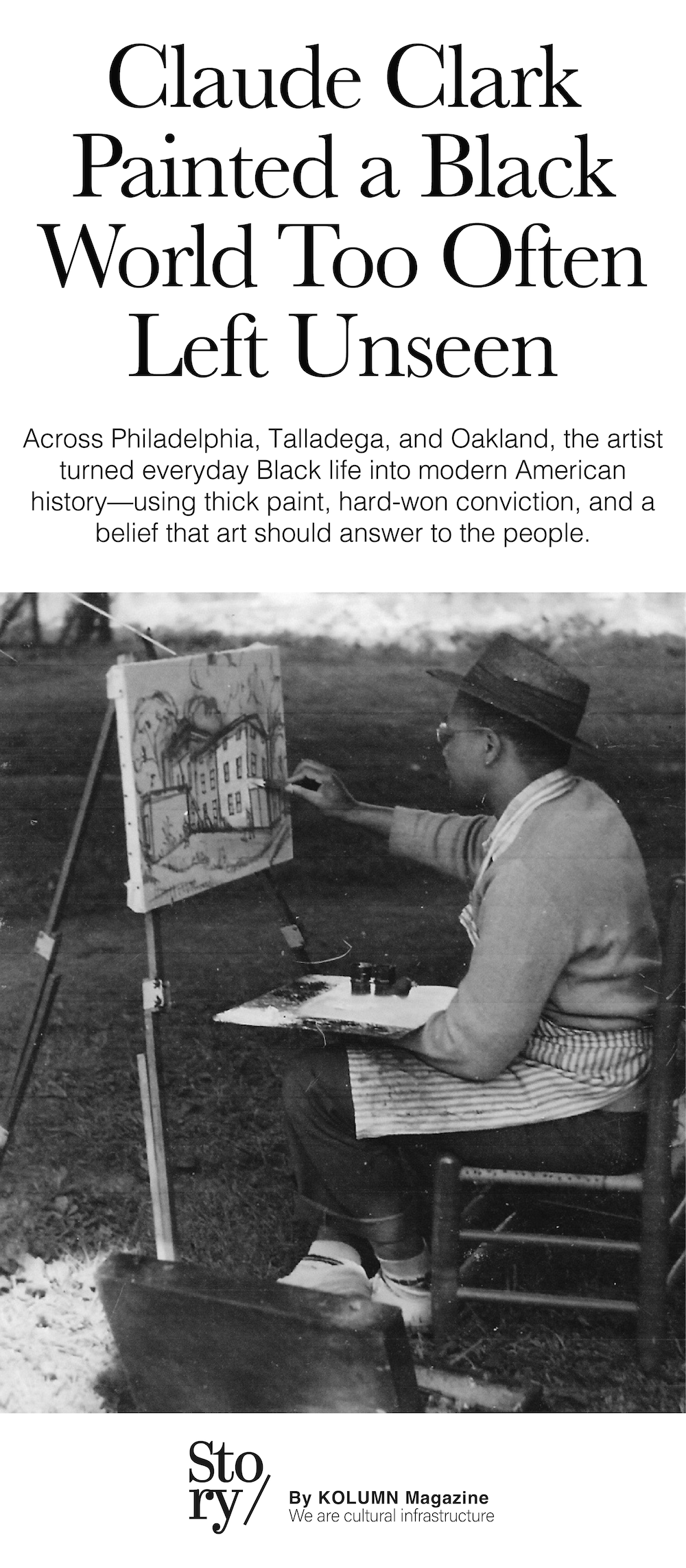
Claude Clark never became a household name in the way some 20th-century Black artists eventually did. He is not typically the first figure summoned in quick histories of American modernism, the Harlem Renaissance, or even the Black Arts Movement. And yet the deeper one looks, the harder it becomes to tell the story of Black American art without him. Clark was not just a painter. He was a printmaker, a teacher, a curriculum-builder, a mentor, an institutional agitator, and a cultural worker who spent decades insisting that Black life deserved to be rendered with intelligence, form, color, and full human seriousness. He made art about workers, children, church folk, dancers, field hands, dreamers, and everyday people. He also helped construct the intellectual scaffolding for how Black art could be taught, interpreted, and defended on its own terms.
That makes Clark significant in two overlapping ways. First, he mattered as an artist of real technical force: a painter who used thick impasto, dense color, palette-knife attack, and modernist structure to build images that were both expressive and legible. Second, he mattered as a cultural strategist: someone who understood that museums, schools, and syllabi were part of the same struggle as the canvas. In his world, representation was not only aesthetic. It was civic. It was historical. It was moral. His career stretched from Depression-era Philadelphia to Jim Crow Alabama to movement-era Oakland, and those geographies were not incidental. They shaped both his subject matter and his politics.
That line, preserved in a 1996 essay derived from an audio-taped interview with Clark, is as good a key as any to his life’s work. It explains why he painted ordinary Black people without apology. It explains why he resisted decorative emptiness. It explains why he wrote A Black Art Perspective: A Black Teacher’s Guide to a Black Visual Art Curriculum. And it explains why his legacy belongs not just to galleries and collectors, but to classrooms, community colleges, historically Black institutions, and every artist who has had to fight for the right to define Blackness outside the white gaze.
A Georgia birth, a Philadelphia formation
Claude Clark was born on November 11, 1915, in Rockingham, Georgia, and his early life was marked by the economic precarity and racial violence that shaped so many Black Southern families in the first half of the 20th century. Museum and collection records consistently place his birth in Rockingham and his death in Oakland, California, in 2001; that arc alone tells a familiar Great Migration story, from the rural South to the urban North and, ultimately, to the West Coast. Clark’s family moved to Philadelphia when he was still a child, and Woodmere Art Museum notes that he arrived in Manayunk at age eight. The move gave him access to institutions and training that would prove decisive, even as racism remained a constant fact of American life.
Philadelphia was where Clark’s artistic identity cohered. He attended Roxborough High School, where his gifts were visible early enough that later community histories would remember him as one of the school’s major artistic alumni. He earned a scholarship to what was then the Pennsylvania School of Industrial Art, later associated with the Philadelphia Museum School of Industrial Art. There, according to accounts drawn from later interviews and museum biographies, he encountered both rigorous training and racial hostility. He also encountered the possibility that painting could become a life. That mattered. Clark was not someone who floated into art as ornament. He arrived through persistence, talent, and a willingness to keep going under conditions that would have told many young Black students to choose something safer, smaller, or more permissible.
His Philadelphia years also placed him in dialogue with some of the biggest aesthetic questions of the moment. He studied design, drawing, and painting, but he also absorbed European modernism, especially through the orbit of Albert Barnes. Woodmere notes that Clark later studied at the Barnes Foundation, and the Black Art in America essay explains why that mattered so profoundly: Barnes’s collection placed African art, European modernism, and American work into close conversation, allowing Clark to see formal relationships rather than rigid cultural hierarchies. At Barnes, he studied art history and aesthetic philosophy through 1944. That experience sharpened his sense of structure and composition, but it also affirmed something that would become central to his mature worldview: African art was not peripheral to modernism. It was part of the grammar of modern seeing.
The Woodmere entry on Clark’s Brothers and Sister makes that synthesis concrete. The museum notes both Barnes’s encouragement of Black artists and the way the painting reflects the impact of French modernist brushwork, even suggesting the influence of Chaïm Soutine and other expressionists in Barnes’s collection. Clark’s work did not imitate European modernism so much as metabolize it. He took its lessons in structure, density, and movement, then redirected them toward Black subjects and Black social life. That redirection is one of the central facts of his career. He learned from institutions that had often excluded or marginalized Black artists, then used those lessons to paint a people those institutions had rarely centered.
The palette knife and the people
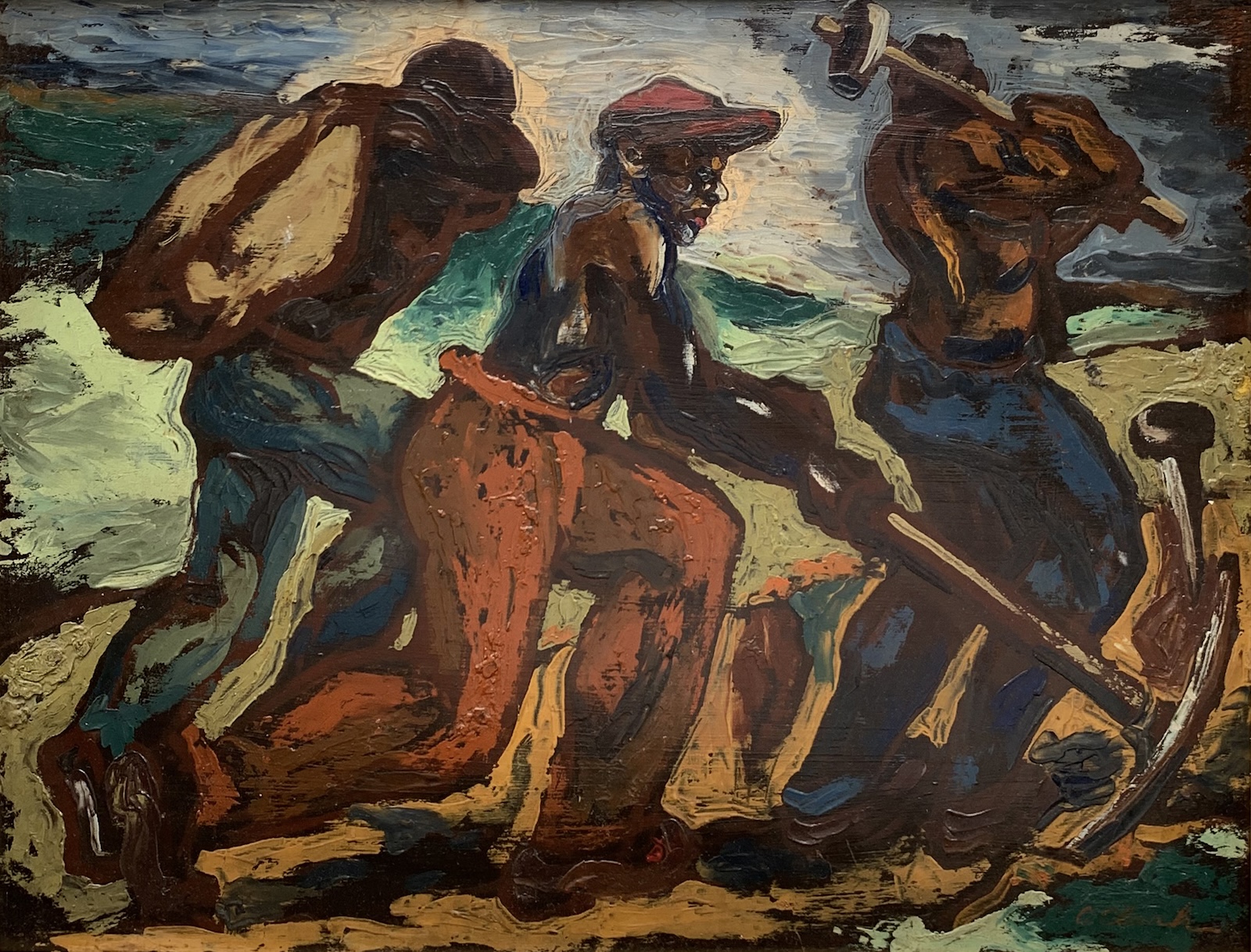
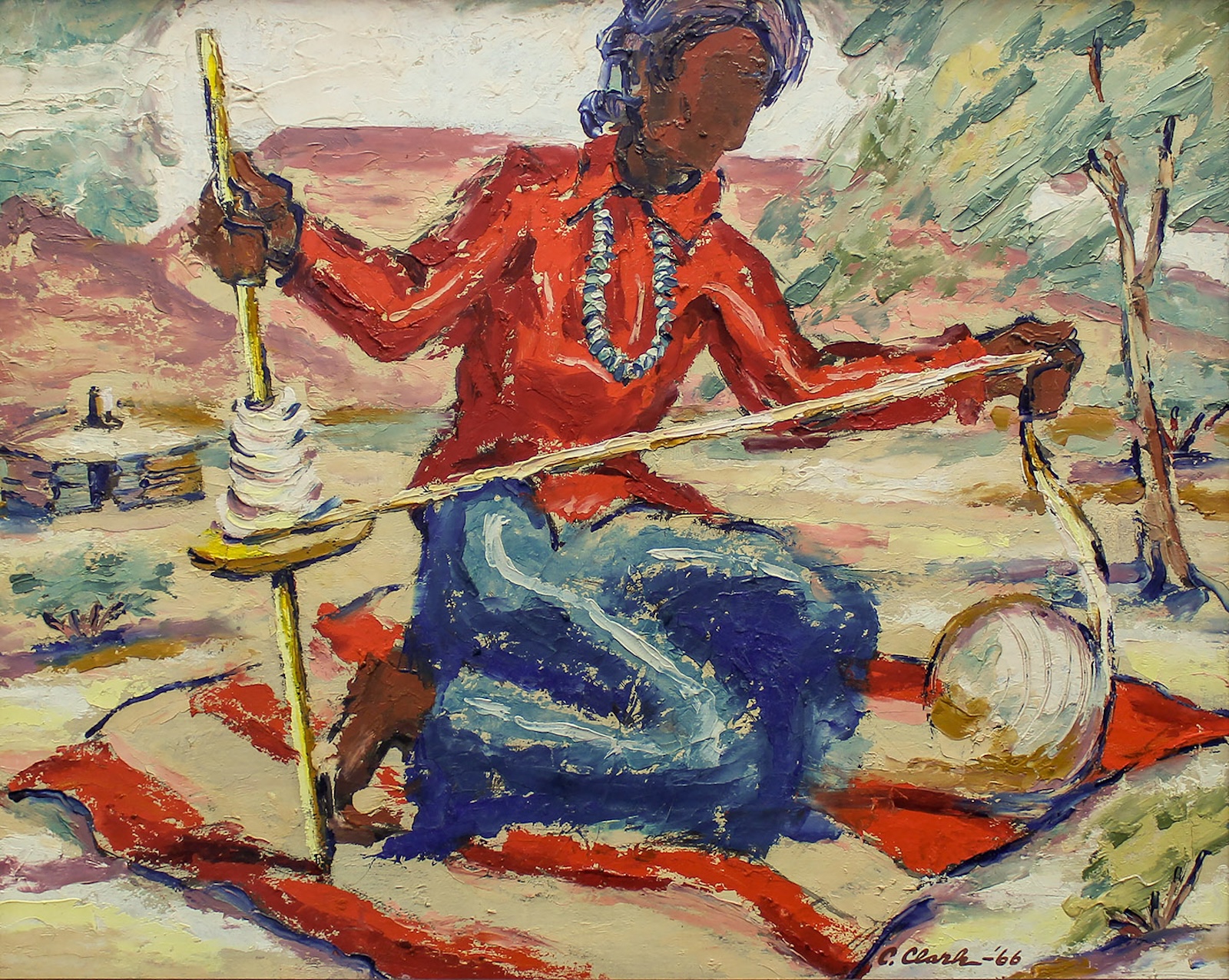
One of the most distinctive things about Claude Clark’s work is physical. You can almost feel it before you interpret it. The surfaces are worked, layered, pressed, scraped, and built up. The palette knife became central to his practice and, over time, practically synonymous with his style. A biographical page on Clark’s website describes the palette knife as his tool of choice and his “signature trademark,” while the Smithsonian American Art Museum’s description of Resting emphasizes how liberally the paint is laid down in ochres, blues, reds, and greens. The Johnson Collection similarly notes that Clark used broad, broken brushwork and palette-knife layering to produce highly textured surfaces.
That texture was never just flourish. It was part of how Clark built emotional and social weight into the image. Consider Resting, painted in 1944 and now in the Smithsonian American Art Museum. The painting shows a man seated in a field, barefoot, taking what appears to be a break from farm labor. The title suggests pause, maybe fatigue, maybe momentary reprieve. But the museum’s description also notices the figure’s alert face and the directness of his presence. This is not a sentimental peasant scene. It is a modern painting about a Black working person occupying the frame with dignity and psychic force. The texture of the paint helps produce that force. It does not prettify his labor; it materializes it.
The same can be said of Men and Magnets, his 1942 painting at Woodmere. The museum describes laborers guiding a massive overhead electromagnet in a steel mill, their bodies tense, coordinated, and energized. The vivid color and thick impasto intensify heat, effort, and solidarity. What might have been a simple industrial scene becomes, in Clark’s hands, a study of cooperation and human strain. The magnet becomes symbolic without ceasing to be real. A lesser painter might have used labor merely as subject matter. Clark uses it as social argument. He makes work visible as form, as pressure, as choreography.
That emphasis on labor runs through his Depression-era and wartime imagery. In a 1996 reminiscence based on interviews with Clark, Steven L. Jones writes that Clark deliberately joined the WPA graphic arts shop because he wanted a medium through which he could reach more people and “tell as much as he could of the story of the common man and of labor.” That phrase could serve as one of the clearest mission statements for Clark’s entire early career. He did not chase elite portraiture. He did not build his reputation on flattering patrons. He was after the emotional and economic reality of ordinary people, especially Black people, and the forms of work that structured their lives.
Clark wanted art to carry the weight of ordinary life without shrinking its beauty.
There is a political intelligence in that choice. Social realism is often described too narrowly, as if it merely depicts workers or hardship. In Clark’s case, it did something more subtle. It converted Black daily life into a site of formal seriousness. The worker, the farm laborer, the child, the neighborhood figure, the dancer—these were not marginal illustrations. They were modern subjects. The Amistad Research Center notes that Clark believed art should “benefit and speak to the common community,” and that his work charted “the emotional and economic crossroads experienced by black society.” That is a sharp description, because Clark’s paintings are rarely simplistic celebrations. They are textured morally as well as visually. They register burden, endurance, rhythm, aspiration, and sometimes dread.
WPA Philadelphia and the Black print world
Clark’s growth as an artist cannot be separated from Depression-era federal arts support and the Black artistic community in Philadelphia. During the late 1930s, he worked with the Works Progress Administration, and sources connect him to the WPA-funded Fine Print Workshop, where Dox Thrash and Raymond Steth were key figures. A Philadelphia Inquirer essay on Black artists in Depression-era Philly notes that the workshop helped cultivate the talents of Black printmakers including Claude Clark, and situates that shop inside a broader ecology of experimentation, solidarity, and Black artistic visibility.
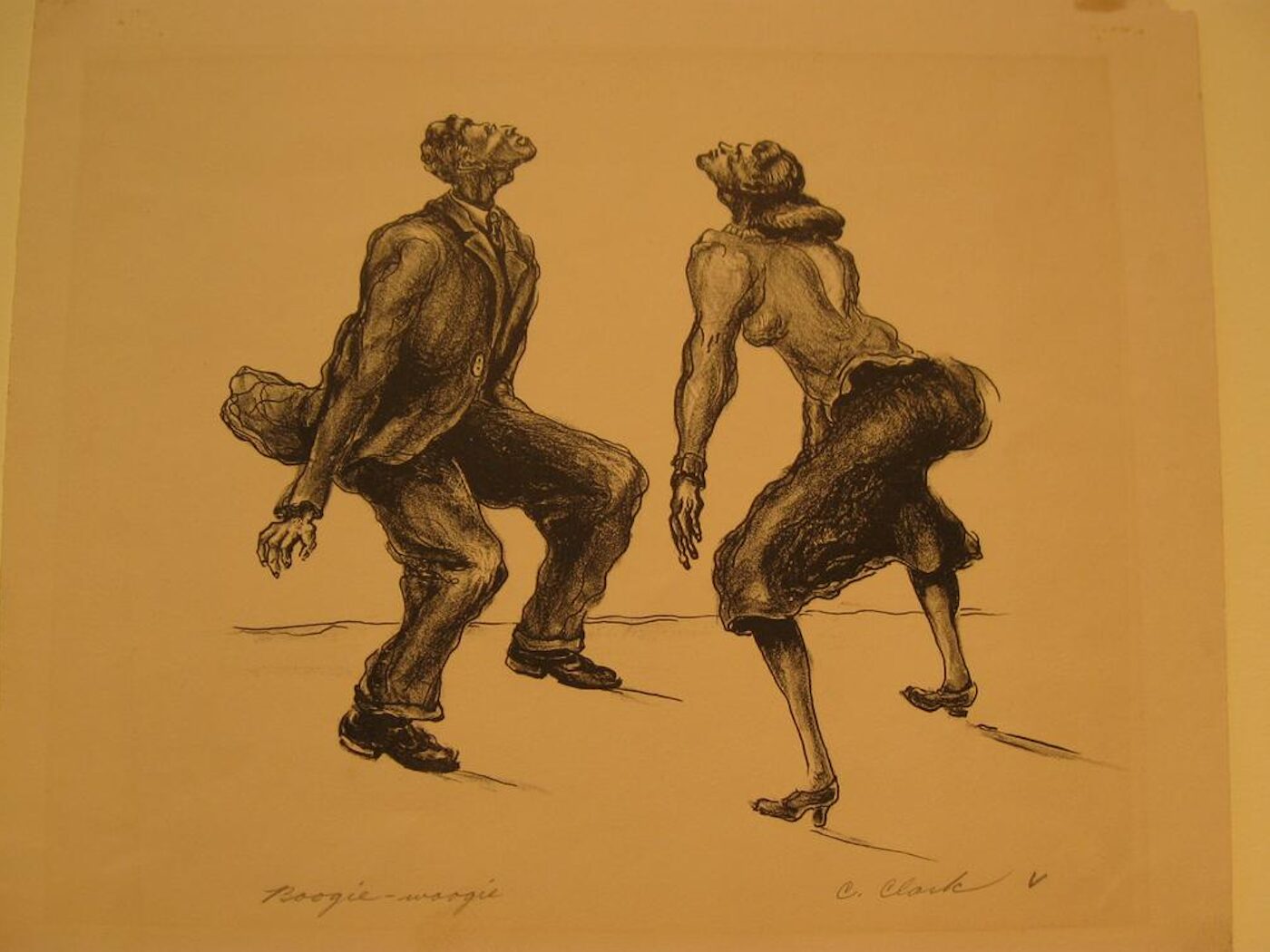
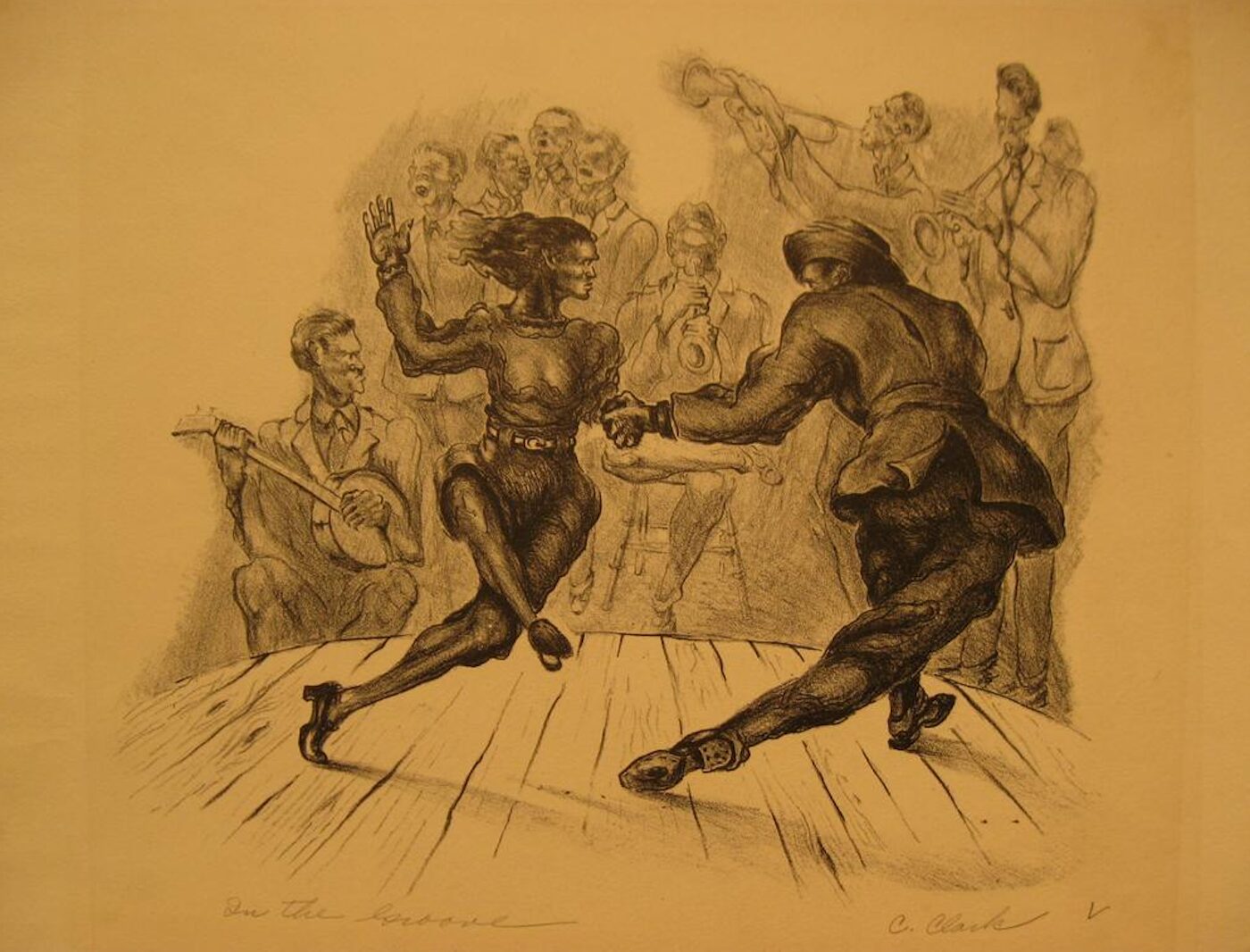
This mattered for more than employment. The workshop exposed Clark to printmaking as a democratic medium—reproducible, distributable, public-facing. That helps explain why some of his early work has a graphic directness even when it is painterly. It also helped place him in a network of Black artists who were thinking seriously about representation, modern technique, and political implication. The Met now holds works like Conversation and lists related pieces including Boogie-woogie, In the Groove, Refuse, and Workers United from the late 1930s and early 1940s. Even just the titles tell a story: sociability, music, urban motion, labor, and collective identity.
The Philadelphia Museum of Art’s description of Jam Session adds another dimension. The museum notes that the dancers are performing the Lindy Hop, an acrobatic jazz dance invented by African Americans, full of twists, splits, and airborne energy. That matters because Clark’s art was never narrowly grim. He painted work, yes, but he also painted movement, pleasure, improvisation, and communal life. Jazz and dance were not escapes from Black reality; they were part of it. In Clark’s hands, Black cultural expression becomes as worthy of modernist treatment as labor and struggle.
Philadelphia, then, gave Clark more than training. It gave him a Black public, Black institutions, Black peers, and a set of recurring subjects. It also gave him early exhibition opportunities. The Black Art in America essay notes that he showed in Pyramid Club exhibitions and major group shows, including the Albany Institute of History and Art’s 1945 The Negro Artist Comes of Age. It also records solo exhibitions in Philadelphia and New York during the 1940s, including at Bonestell Gallery and Roko Gallery. Black Art Auction’s summary, drawing on catalog and historical references, further places him in exhibitions like American Negro Art, 19th and 20th Centuries in 1942 and later landmark surveys of Black American art. Clark was not obscure in his own time. He was active, visible, and institutionally engaged, even if later mainstream art history did not always accord him his full due.
Talladega, courage, and the politics of being present
If Philadelphia formed Clark as an artist, Talladega revealed him as an intellectual and moral combatant. He went to Talladega College in 1948 and, according to multiple sources, helped establish a full-time art department there. Woodmere credits him with building the art department, and Amistad similarly notes that he established a full-time program before later moving west. This was not routine faculty labor. At a historically Black college in the heart of Jim Crow Alabama, building an art department meant building a visual future. It meant telling Black students that art belonged to them too—not as hobby, but as discipline and worldview.
Talladega also became the site of one of the most revealing episodes of Clark’s life. In the account preserved by Steven L. Jones and republished by Black Art in America, the University of Alabama invited Talladega’s white president and the presumed white head of the art department to a museum-related public event, explicitly excluding Clark because “Colored people did not appear at public (white) meetings.” Clark responded by writing to Albert Barnes, arguing that participation under such terms would amount to an endorsement of racial discrimination. Barnes took up the challenge; outside speakers withdrew; the event was embarrassed; and local whites retaliated with intimidation, including a Klan appearance on Talladega’s campus. Clark did not back down.
This episode matters because it clarifies what kind of artist Clark was. He was not political only in retrospect because curators later placed him under a “Black art” heading. He acted politically in real time, in defense of dignity, access, and institutional equality. And he did so not as an outsider heckling from beyond the walls, but as a teacher, artist, and intellectual asserting that Black people had the right to occupy the same public cultural space as anyone else. In that sense, Clark anticipated later arguments that representation in American art was never just a matter of who got painted. It was also about who got admitted, who got invited, who got cited, and who got to define culture in the first place.
His years at Talladega were also fertile artistically. Jones notes that Clark continued painting, won a Carnegie Fellowship in 1950, and spent time in the Caribbean, especially Puerto Rico, painting flowers. Other summaries of his career note that rural Southern and Caribbean life remained recurring themes in his work. That geographical widening deepened the range of his imagery. Claude Clark was a Black American painter deeply rooted in specific places, but he was never provincial. He understood Black life as diasporic, linked by migration, memory, colonial history, and recurring struggles over labor and freedom.
California, Oakland, and the turn toward institution building
In 1955, Clark moved to California, a transition that expanded rather than diluted his commitments. He finished his undergraduate degree at Sacramento State and later earned a graduate degree from the University of California, Berkeley; SFGATE and Woodmere both place those degrees centrally in his biography. He also worked teaching arts and crafts in Alameda County’s juvenile justice system, a role the Jones essay describes in vivid terms, noting his years at Juvenile Hall and his development of a “Scattershot” program meant to give detained young people mental stimulation through visual forms.
That phase of his career deserves more attention than it usually gets. Too often, art history treats work with young people, incarcerated people, or students outside elite settings as secondary to “real” artistic production. Clark’s life argues the opposite. His teaching in juvenile detention, like his work at Talladega and later Merritt College, was part of the same intellectual project as his painting. He believed visual culture shaped consciousness. He believed access mattered. And he believed Black people, especially young Black people, needed more than token inclusion. They needed frameworks that took their history seriously.
By the late 1960s, Oakland provided precisely the kind of political and cultural atmosphere in which those convictions could become more systematized. Jones notes that Clark began teaching at Merritt College on January 3, 1968, in a period when the Black Panther Party’s demands for relevant education helped open space for Black educators. Clark remained there until his retirement in 1981. Merritt was not just a workplace. It was part of a larger ecosystem of Black political thought, community self-determination, and curricular transformation in the Bay Area. Clark fit that world almost perfectly: disciplined, politically lucid, aesthetically serious, and committed to teaching Black culture from a Black point of view.
This is also where one of his most enduring contributions emerges. Working with his son Claude Lockhart Clark, who produced the illustrations, he wrote A Black Art Perspective: A Black Teacher’s Guide to a Black Visual Art Curriculum. Jones describes it as a 136-page annotated outline for teaching African and African American visual culture from a Black point of view, and Woodmere identifies it as the first curriculum of its kind. That is no small achievement. Before universities and museums widely embraced African American art history as a field, Clark was helping build its pedagogical architecture. He was not waiting for institutional permission to define the category. He was doing the work.
Long before diversity statements, Claude Clark was writing the syllabus.
What he painted, and why it still feels alive
A long career can tempt critics into flattening an artist into a single “style,” but Clark resists that simplification. The official Clark website describes his subject matter broadly: the diaspora, children, marine life, landscapes, and religious and political satire, much of it executed with a palette knife. His own catalog pages show the range even more concretely. In the 1937–1949 works alone, one finds titles like Blind African, Chained, The Plow, Freedom Morning, Students, I Am Proud, I Am a Warrior, and Madonna at Work. The titles move from labor to devotion, from racial consciousness to allegory, from everyday observation to history-laden symbolism.
What unifies all of that is not one narrow iconography, but a sensibility. Clark’s work remains accessible without being simplistic. The Johnson Collection notes that even while embracing hallmarks of modern abstraction—simplified forms, saturated color, structural design—he never abandoned representational art. He preferred “translatable” stories, accessible reflections of social values and ideals. That is important. Clark was not anti-modernist, but neither was he interested in abstraction as a removal from social reference. He used modern form to deepen social meaning, not to escape it.
That helps explain why his paintings can feel immediate decades later. The people in them are not generic symbols of “Blackness.” They have posture, mood, work, leisure, tension, and atmosphere. The best of Clark’s art carries the compression of lived experience. Resting does this through stillness. Men and Magnets does it through coordinated force. Jam Session does it through rhythm and motion. Brothers and Sister does it through kinship and tonal difference. Even when the subject is straightforward, the feeling is layered. His pictures are about social life, but they are also about interiority—how people inhabit history in their bodies.
It is also worth noting that Clark’s work does not accept the false divide between beauty and politics. His colors can be brilliant. His brushwork can be sensuous. His impasto can verge on exuberant. But that pleasure does not cancel the seriousness of the content. It heightens it. He knew that Black life had been too often rendered either as pathology or as cheerful stereotype. His paintings insist on something else: depth, contradiction, intelligence, pressure, and grace.
Why mainstream recognition lagged
Part of Claude Clark’s story is familiar for many Black artists of his generation: he was respected, exhibited, collected, and institutionally active, yet never fully canonized in the dominant mainstream narrative. The reasons are structural. American art history long privileged certain versions of modernism while minimizing Black artists whose work did not fit easy formalist scripts. If a Black painter was too representational, too socially explicit, too pedagogically engaged, or too rooted in Black institutions rather than white commercial galleries, critical prestige often came unevenly if it came at all. Clark checks several of those boxes. He was formally adventurous, but not in a way that made him easy to absorb into a depoliticized modernist lineage. He was intellectually serious, but much of that seriousness was spent in classrooms and community institutions rather than in the art-market machinery that manufactures fame.
And yet the institutions tell their own story if you listen. His work is in the Smithsonian American Art Museum. The Met holds his prints. The Philadelphia Museum of Art, the Saint Louis Art Museum, the de Young, and other collections preserve his presence. Black Art Auction’s career summary lists major group exhibitions across decades, including Two Centuries of Black American Art at LACMA, one of the most important survey exhibitions in the field. Woodmere included him in We Speak: Black Artists in Philadelphia, 1920s–1970s. These are not the traces of a minor figure. They are the record of an artist who kept surfacing wherever serious efforts were made to tell Black art history with breadth and honesty.
The lag, then, says at least as much about the institutions as it does about Clark. He does not need inflation or mythmaking. He needs placement. Once he is put back into the frame—next to Elizabeth Catlett, Dox Thrash, Beauford Delaney, Charles White, Hughie Lee-Smith, David Driskell, and the many others who made Black modernism too wide to fit a single style—his importance becomes easier to see. He belongs to that generation of artist-teachers whose impact exceeded the market and whose students, curricula, and example became part of the field’s inheritance.
The teacher as legacy
One of the great mistakes people make when talking about artists is to imagine that the canvas is the whole story. In Black cultural history especially, that is almost never true. The teacher, the organizer, the informal mentor, the department builder, the person who knows where to push and where to protect—these figures often shape the future as much as the marquee names do. Clark clearly belonged to that category. SFGATE’s 2001 remembrance quoted David Driskell calling him “a benevolent teacher, a cultural mentor and, importantly, one of the fine models for artists of all generations.” It is a generous line, but it also sounds precise. Clark modeled a way to be an artist without surrendering community obligation.
His own words help sharpen that legacy. Jones’s essay records Clark saying that to change anything, one has to “think Black and dream Black.” It also records his insistence that art should be “a record of the era,” showing the times in which people are living. Those are not slogans. They are working principles. They explain why he painted everyday Black subjects. They explain why he built curricula. They explain why he fought exclusion in Alabama and taught in Oakland during a period of radical educational change. Clark was not interested in Black art as boutique identity. He was interested in Black art as historical consciousness.
That may be why his life feels especially resonant now. Contemporary museums, publishers, and universities have spent the last decade trying—sometimes earnestly, sometimes awkwardly—to correct the historical neglect of Black artists. In that effort, Claude Clark looks less like a rediscovery than like a rebuke. He was there all along: painting, teaching, writing, exhibiting, mentoring, arguing for the field before the field was fashionable. The belatedness of the broader recognition is part of the story, but so is the steadiness of the work itself. Clark did not wait to be validated by the institutions that now find him useful for their revised narratives. He built his own lanes and helped others travel them.
A legacy larger than the market
Claude Clark died in Oakland in 2001. Major collection records list April 21 as his date of death; a contemporary SFGATE remembrance reported that he died at 85 from complications of diabetes and noted a memorial celebration at Allen Temple Baptist Church in Oakland. By then, he had spent decades making and teaching art across multiple regions of the country. He left behind a wife, children, students, paintings, prints, writings, and a reputation that was perhaps clearest among those who had actually encountered him: people who understood him not merely as a producer of objects, but as a cultural force.
The market will do what markets do. Certain paintings will rise in value. Catalog essays will expand. More institutions will rediscover him, and some will congratulate themselves for doing so. That is fine as far as it goes. But Clark’s real legacy is larger than market correction. It lives in the fact that he treated Black life as worthy of sustained formal attention. It lives in the curricula he helped write. It lives in the art departments he built. It lives in the students he taught in Talladega, Oakland, and even juvenile detention. It lives in his refusal to separate aesthetic rigor from social purpose.
And perhaps that is the right final measure of Claude Clark. He was not a side note to Black art history. He was one of the people who made it possible for that history to be written with seriousness in the first place. He painted the common man, but there was nothing common about the scale of his ambition. He wanted Black culture seen in its own complexity. He wanted art to remember what the country tried to ignore. He wanted teaching to become a form of liberation. And he worked long enough, and well enough, that the evidence is still here—on the walls, in the archives, in the museum records, and in the stubborn fact that once you see Claude Clark clearly, American art itself looks incomplete without him.
More great stories
Afro Sheen, Wall Street, and the Architecture of Black Possibility
July 6, 2026
No Comments
The Fire Inside the Fourth
July 5, 2026
No Comments