



His work is less interested in the past as museum matter than in the past as a live wire.
His work is less interested in the past as museum matter than in the past as a live wire.
By KOLUMN Magazine
Michael Ray Charles has spent much of his career painting the kinds of images many people would prefer never to see again. That is precisely the point. For more than three decades, the Louisiana-born artist has built a body of work around minstrel iconography, racist product packaging, blackface, and the commercial language that helped normalize anti-Black caricature in the American imagination. Rather than treating those images as dead artifacts from a shameful but finished past, Charles has insisted that they remain active—embedded in branding, entertainment, sports culture, nostalgia markets, and the soft-focus storytelling Americans tell themselves about progress. His work is less about resurrecting old stereotypes than proving they were never fully buried.
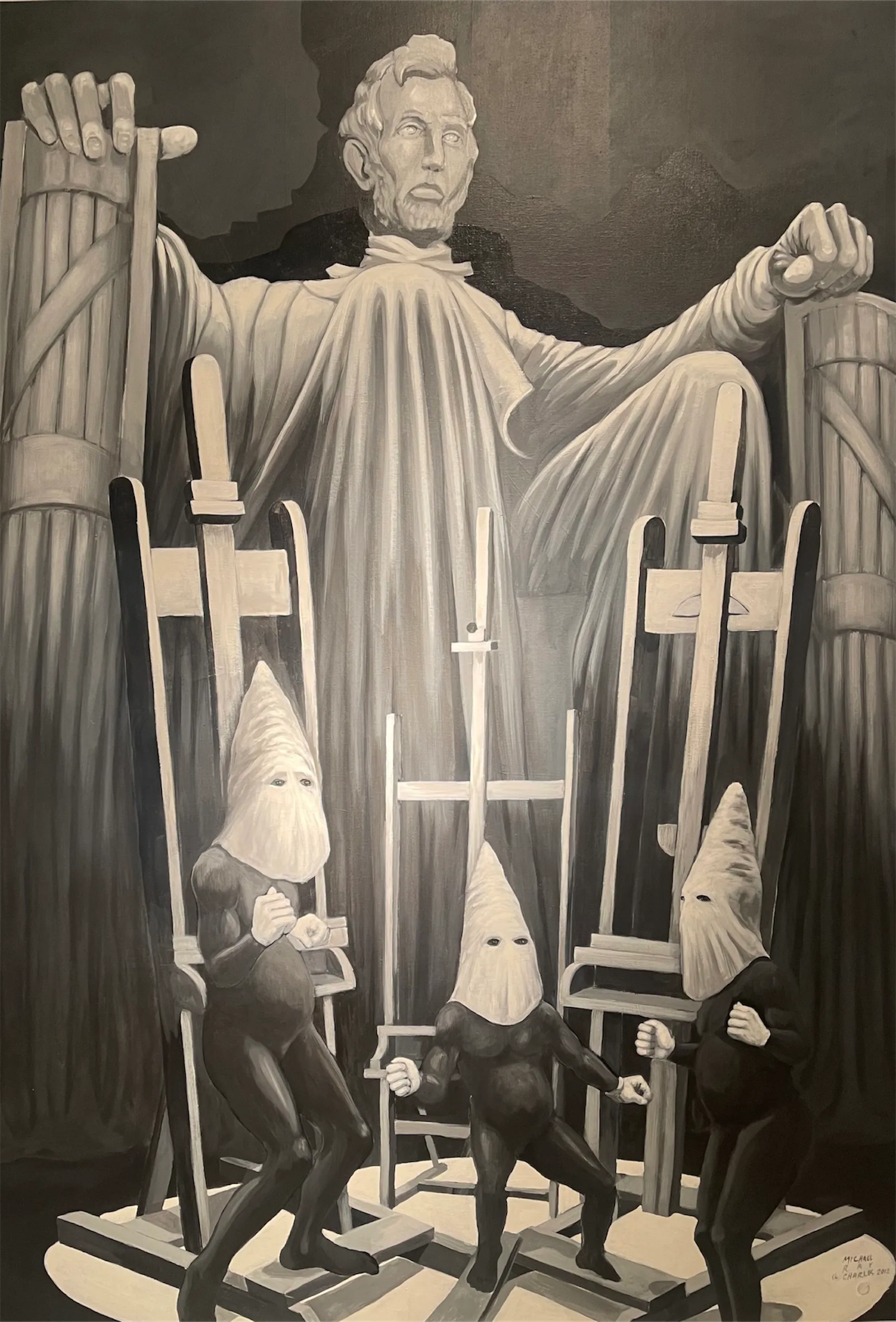
That insistence made Charles one of the most provocative painters to emerge in the 1990s. It also made him controversial almost immediately. Black viewers, white viewers, critics, curators, collectors, and other artists did not all read the work the same way. Some saw a necessary confrontation with the visual infrastructure of white supremacy. Others saw the risk of recirculating demeaning imagery under the banner of critique. The debate was not incidental to his career; it became one of the key conditions of it. Charles’s paintings did not merely enter the culture. They entered arguments—about representation, about irony, about audience, about the difference between exposure and repetition, and about whether art can metabolize racial violence without reproducing some portion of it.
What makes Michael Ray Charles so significant is not only that he made viewers uncomfortable. Plenty of artists do that. It is that he identified a specific American blind spot: the ease with which the nation relegates racist imagery to the archive, as though the visual systems that once sold soap, pancakes, tobacco, and entertainment through caricature have no real connection to the present. Charles understood early that advertising was not decorative background noise. It was pedagogy. It taught people who counted, who served, who performed, who smiled, who threatened, and who belonged. His paintings seize that lesson plan and turn it against itself.
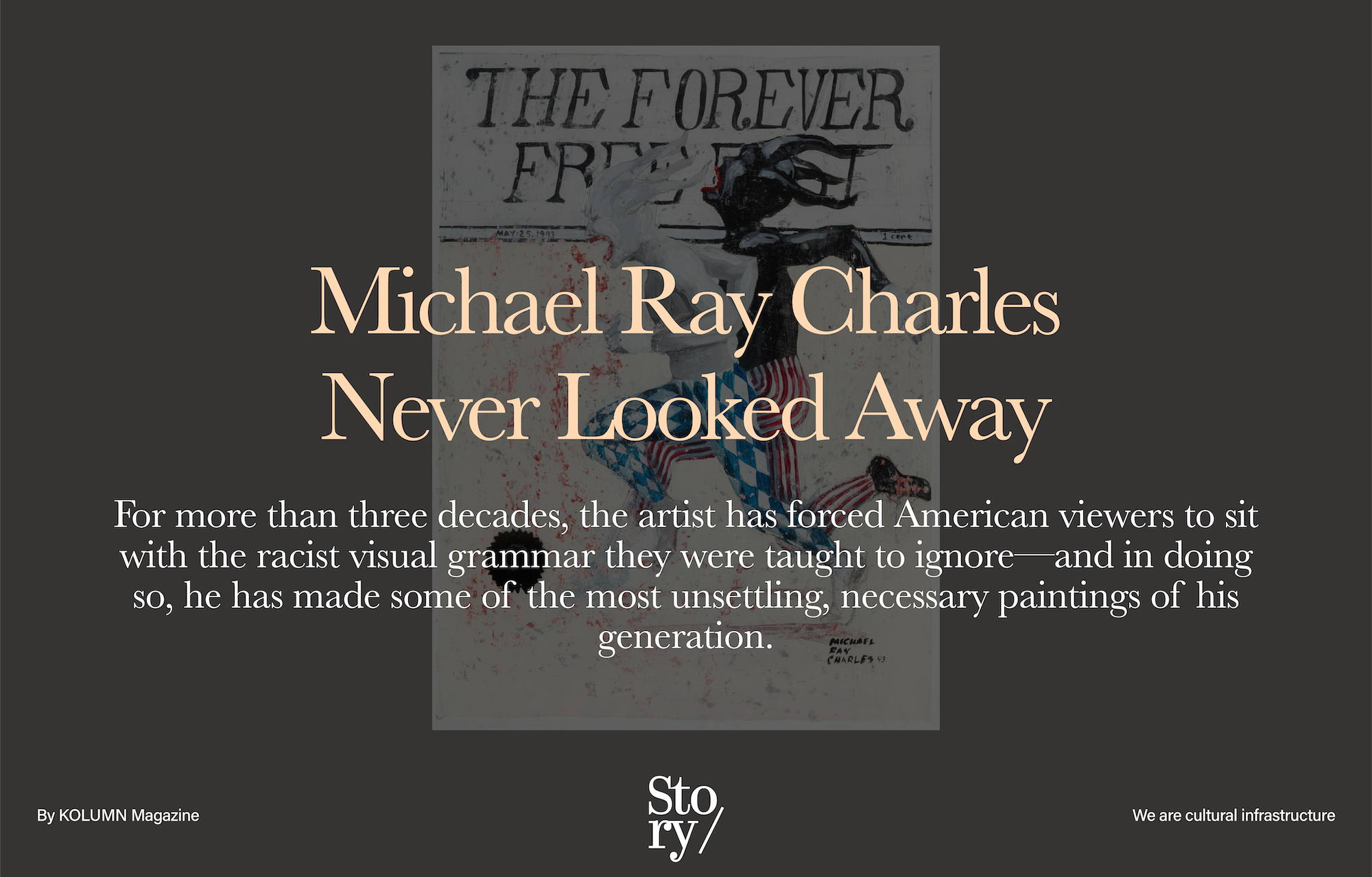
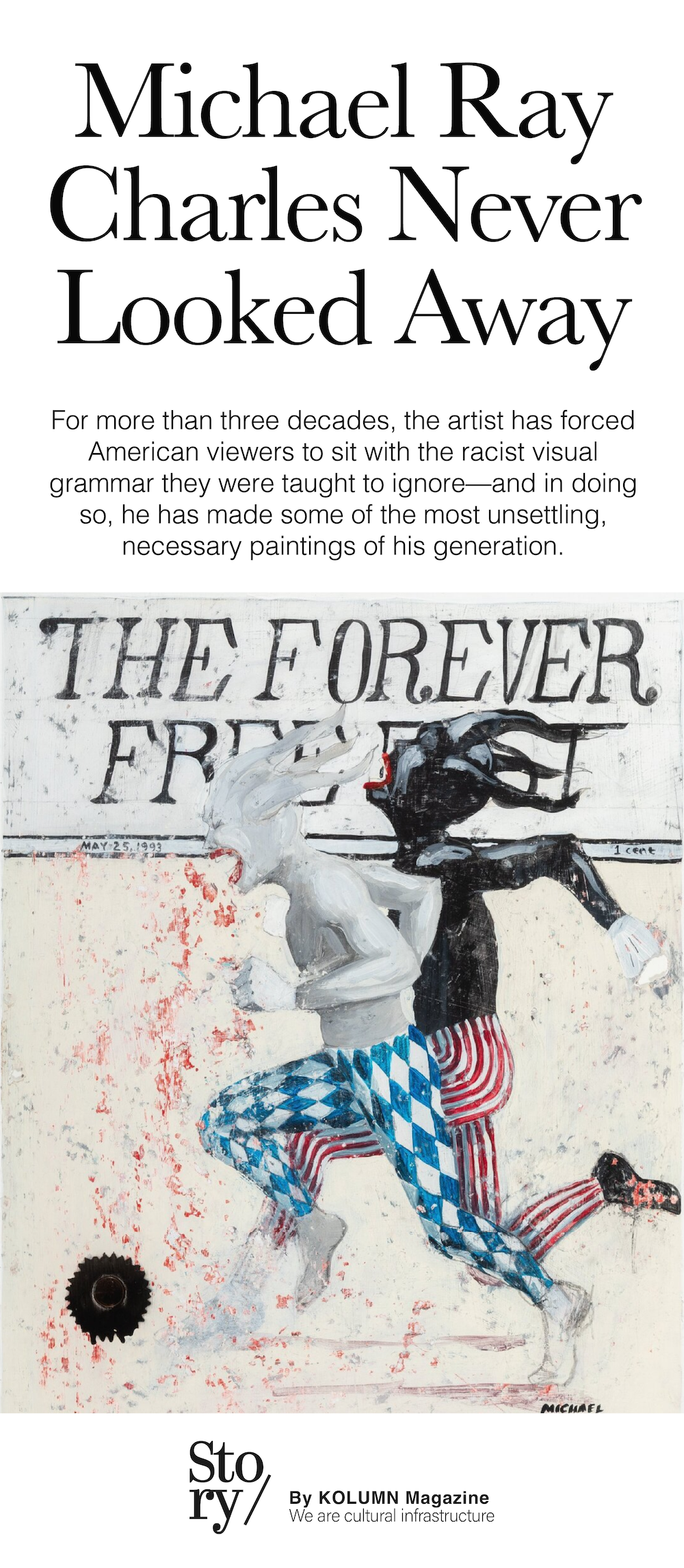
He has described his work as deeply tied to advertising and popular culture, and that matters because his paintings often look, at first glance, like damaged relics from an American commercial past—faded signs, distressed surfaces, billboard fragments, slogans for invented brands, fake campaign posters, and product pitches for freedom itself. The faux brand name “Forever Free,” recurring across his work, is among his sharpest devices: a tagline that sounds triumphant until you register the history beneath it. In Charles’s hands, “freedom” becomes not a settled national achievement but a compromised promise, a sales pitch with missing terms and conditions.
To write about Charles well requires resisting two lazy habits. The first is to flatten him into a controversy machine, as though his paintings exist only to scandalize polite viewers. The second is to neutralize him by speaking of his work in the abstract language of institutional approval, sanding off the risk that gave it force in the first place. Michael Ray Charles matters because he inhabits a harder territory. His art is aesthetically seductive and morally abrasive. It borrows from the polished visual confidence of commercial graphics while exposing the racial lies that commercial graphics helped distribute. It is rigorous, theatrical, unnerving, and frequently funny in a bitter way. And it has remained relevant because the culture it diagnoses has never been fully cured.
A visual education in America’s coded language
Michael Ray Charles was born in 1967 in Lafayette, Louisiana. He spent much of his youth moving between California and Louisiana, a biographical detail that feels relevant to the doubleness in his work: part Southern racial memory, part media-saturated American visual culture. He studied design and advertising before earning his undergraduate degree from McNeese State University in 1989, then received his MFA from the University of Houston in 1993. That early training in design is not some side note in his biography. It is foundational to how the work functions. Charles did not merely quote old racist images; he understood the persuasive mechanics behind them—the way layouts direct attention, the way slogans compress ideology, the way typography and color can make even the grotesque look familiar, purchasable, even cheerful.
That background helps explain why so many of Charles’s paintings feel like artifacts from an alternate advertising archive. He is not a painter who stumbled into graphic language; he is an artist who knows exactly how it disciplines perception. The visual syntax of his work—bold lettering, flattened forms, repetition, distressed surfaces, emblematic figures—comes from the same American mass-media ecosystem that once turned racist caricature into common sense. Charles understood that stereotype was not only a social attitude. It was a design solution. It reduced Black life into instantly legible signs that could move product, organize labor, and reassure white consumers about social order. His paintings expose that reduction by making it impossible to consume casually.
In interviews, Charles has spoken directly about the relationship between art and advertising, noting the hold that familiar popular images can exert on viewers. Art21’s early documentation of his practice is especially useful here because it captures a moment when his central concerns were already fully formed: the traffic between memory, commerce, and racial representation; the way disturbing visual material can continue to shape people even when they claim to have moved beyond it; and the uneasy power of collecting racist memorabilia as a way to study what mainstream culture would rather reframe as harmless nostalgia.
Charles’s collection of racist memorabilia has often been noted in profiles and documentaries, sometimes with a tone of fascination, sometimes with discomfort. But the collection is not a biographical curiosity. It is part of his research apparatus. He has treated those objects—Sambo dolls, blackface items, commercial knickknacks, household goods, and entertainment ephemera—not as camp relics but as evidence. They reveal how thoroughly anti-Black caricature saturated ordinary life. A nation did not need explicit legal doctrine in every room when it had figurines, labels, tins, posters, and cartoons doing the quieter work of instruction. Charles’s paintings are shaped by that evidentiary logic. They feel excavated because they are.
The breakthrough years and the burden of provocation
By the mid-to-late 1990s, Charles’s work had begun to attract serious institutional attention. Blaffer Art Museum mounted the first major museum exhibition of his work, emphasizing how his revisions of figures like Sambo, Buckwheat, and Aunt Jemima twisted racist stereotyping back upon itself in order to confront contemporary prejudice. That framing is important because it places Charles in a lineage of artists who do not treat racist iconography as taboo material to be avoided, but as ideological material to be dissected. Still, the dissection was never tidy. His paintings refused the kind of obvious moral labeling that would let viewers feel clean too quickly.
The Houston press captured that tension early. A 1997 Houston Press feature made clear that Charles’s rise was inseparable from the questions his imagery provoked: whether these paintings could heal by naming trauma, or whether they risked re-opening wounds without guarantee of repair. That tension has followed Charles for decades. It would be easy, in retrospect, to say the controversy proves the work’s seriousness. Sometimes that is true. But it is also worth taking the criticism seriously on its own terms. For many Black viewers, the problem was never that Charles had identified the wrong subject. It was that the subject itself—the visual history of humiliation—was so charged that even critical reuse could feel like a kind of violence.
This is where Charles’s career becomes especially instructive. He did not arrive in the art world with work that could be praised in purely formalist terms and then later politicized by critics. The politics were the form. The paintings were built to test what viewers could bear, what institutions would endorse, and what kinds of Black representation contemporary art was willing to frame as intellectually urgent. The response exposed fault lines not just between Black and white audiences, but within Black cultural discourse itself. Was reuse a way of seizing back visual power? Or could it be too easily mistaken for complicity, especially in a market that has long profited from the display of Black pain? Charles never fully resolved those questions, and perhaps could not. His work gains force precisely because it leaves them pressurized.
“Michael Ray Charles did not ask for comfort from his audience; he asked for honesty.”
One reason the paintings stayed potent is that Charles’s critique was never limited to simple historical retrieval. He did not present racist caricature as evidence of a barbaric period safely sealed off from the present. He linked those images to contemporary media habits, to consumer desire, to the stylization of Black bodies in sports and entertainment, and to the broader seductions of spectacle. That is part of why Spike Lee found his work resonant. Charles served as a consultant on Bamboozled, Lee’s 2000 film about the revival of minstrelsy as television satire, and Charles’s visual language clearly belonged in that ecosystem of critique. A 2023 UT publication recounts Charles explaining that Lee saw one of his paintings related to the phrase “bamboozled” and later contacted him, leading to a deeper connection between the artist’s imagery and the film’s world.
The relationship to Bamboozled is not trivial name-dropping. It clarifies Charles’s location in a broader Black intellectual and artistic argument at the turn of the millennium: how to satirize minstrelsy and anti-Black spectacle without being swallowed by them. Both Lee and Charles wagered that exaggeration, repetition, and citation could expose what polite multicultural language often concealed. Both were also criticized for asking viewers—especially Black viewers—to endure too much ugliness for the sake of critique. That parallel says a great deal about the era and about Charles’s place in it.
Why the paintings look the way they do
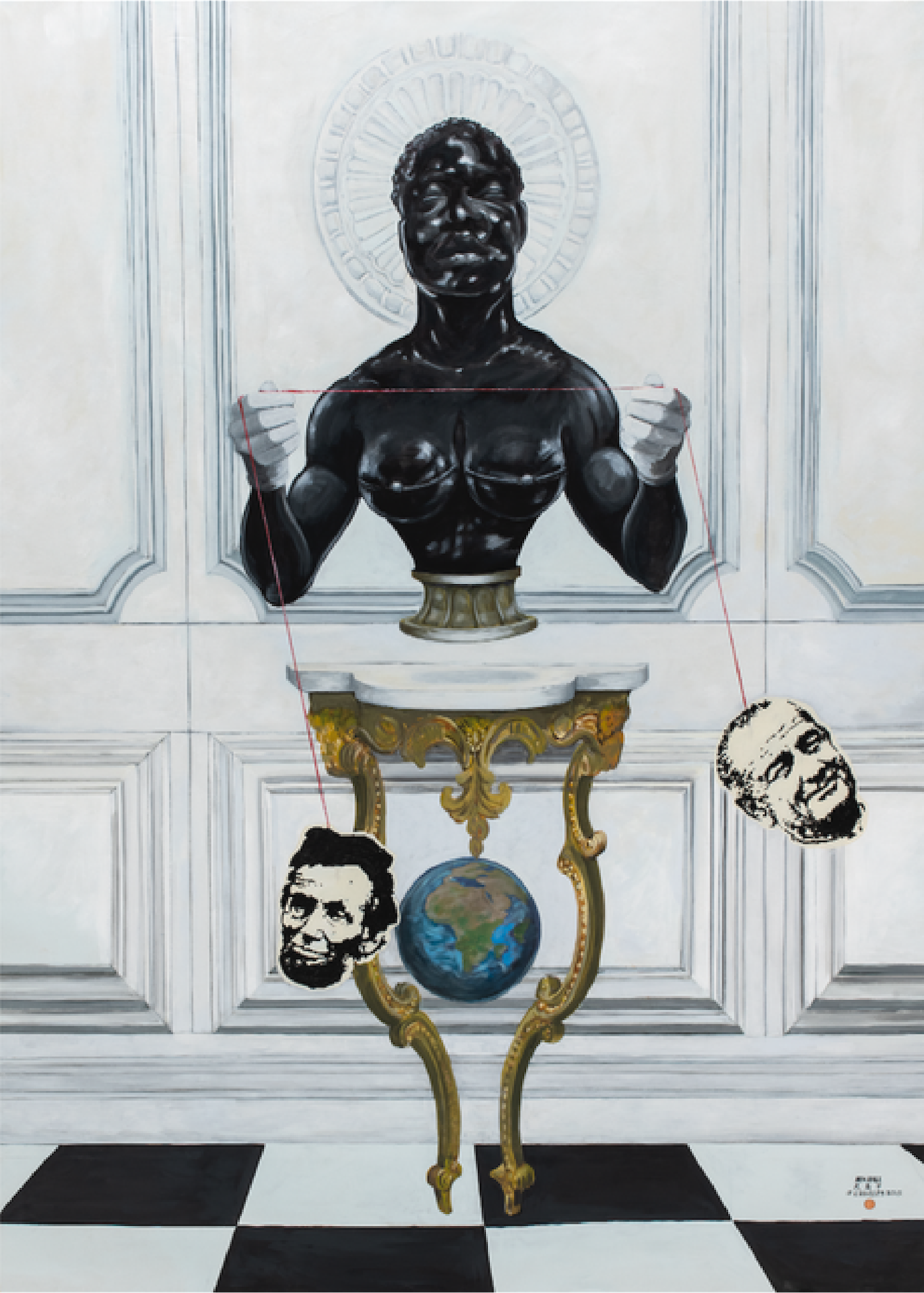
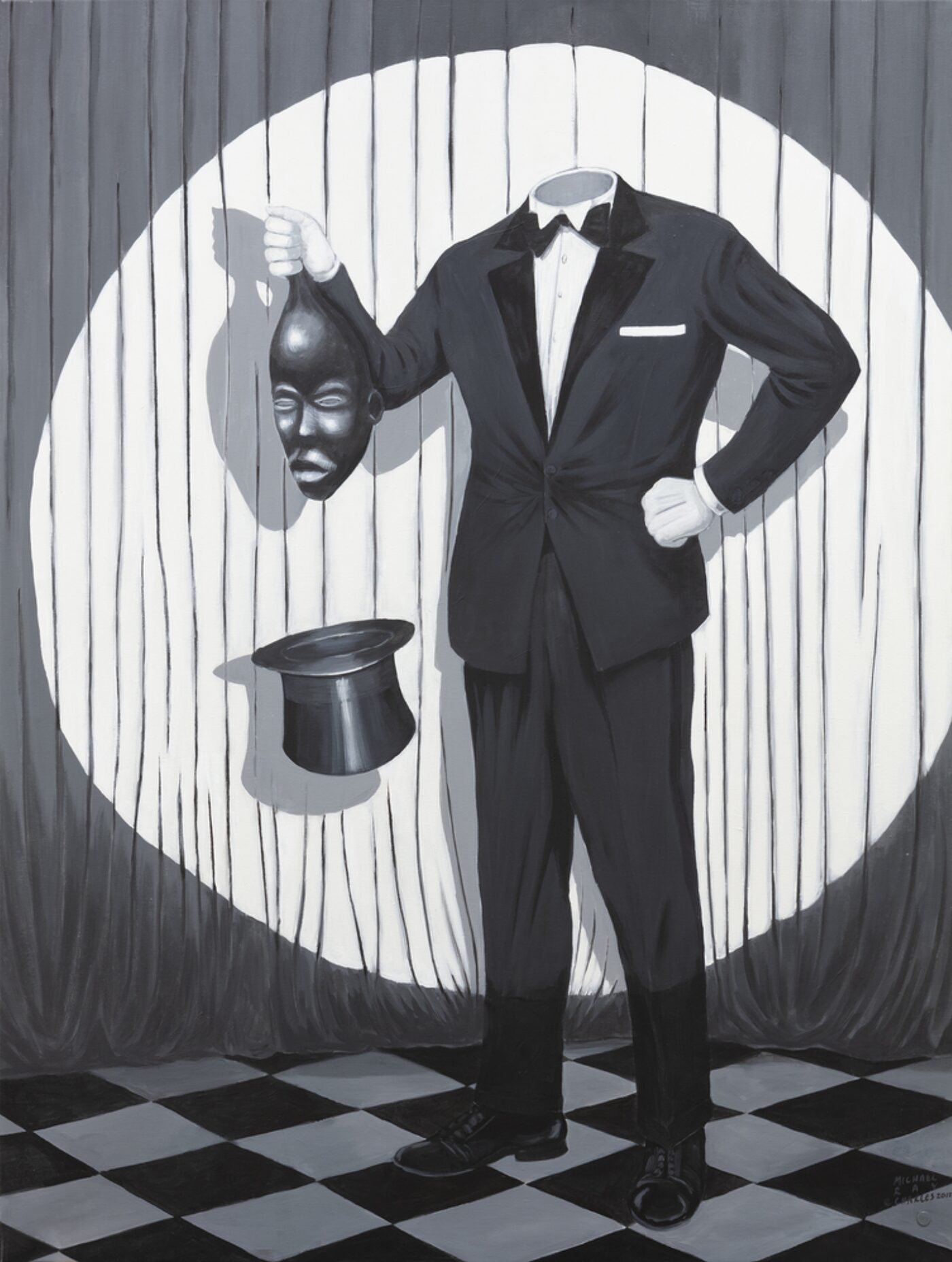
Much of Charles’s work carries a scraped, weathered, or antiqued surface, as if it has survived from another century and arrived damaged. That damaged look is not merely a stylistic flourish. It performs history. It suggests abrasion, exposure, handling, neglect, and persistence. These are not pristine modernist surfaces. They look worn because the ideas they carry are worn in—stitched into American culture through long use. The distressing also complicates the viewer’s position. You are not looking at a slick reproduction of racist imagery; you are looking at something that seems exhumed, rubbed raw, and still capable of staining the present.
Then there is the scale and theatricality. Charles often makes imagery that feels poster-like, public-facing, impossible to ignore. His figures can be clownish, monstrous, seductive, ridiculous, or regal, sometimes all at once. He repurposes slogans with a marketer’s ear and a satirist’s cruelty. In recent exhibitions, reviewers have noted how his work uses theatrical staging and minstrel-show references not to create historical tableaux, but to dramatize the persistence of racial performance in contemporary culture. A 2023 Frieze review of his New York exhibition VENI VIDI argued that the pictures, while ostensibly presenting caricatures, deploy “gut-churning symbolism” to articulate the violence embedded in white supremacist society. That is a sharp description of Charles’s best work: it can appear flat and graphic from afar, but it lands in the body with a visceral force.
His recurring invented brand, “Forever Free,” deserves special attention because it may be the clearest condensation of his project. The phrase sounds patriotic, almost triumphant, yet within Charles’s visual universe it becomes a taunt. Free for whom? Free from what? Free in law but not in image? Free in rhetoric but still trapped inside the commodity form? The brilliance of the phrase is that it sounds like the sort of slogan America would love to print on itself—an emancipatory declaration emptied into branding copy. Charles uses it to reveal how freedom, in American culture, is often stylized as an achieved product even when the historical record says otherwise.
That mixture of beauty and abrasion is central to his significance. Charles can paint. He can design. He knows how to seduce the eye before he disturbs the conscience. If the work were simply ugly, it would be easier to dismiss. If it were simply righteous, it would be easier to domesticate. Instead, it sits in a volatile middle register—compelling enough to draw you in, charged enough to make you wonder whether the act of looking is itself compromised. That is one of the reasons his work has remained discussable across decades. It never fully settles into a single moral or aesthetic lane.
The problem of audience
Any serious account of Michael Ray Charles has to deal with audience. Who is the work for? Who is being challenged, instructed, wounded, implicated, or perhaps even liberated by it? That question has followed him from the start. The artist himself has acknowledged that different audiences respond differently, and not always comfortably. PRINT Magazine quoted Charles in 2020 reflecting on how neither Black nor white viewers necessarily welcomed the images: some Black viewers did not want the pain reactivated; some white viewers felt embarrassment and shame. His rejoinder was blunt—ignoring the imagery does not erase what happened.
That statement helps explain why Charles has remained an important, if sometimes difficult, figure in conversations about Black representation. He belongs to a cohort of artists who rejected the idea that dignified counter-image alone could do all the work. There is enormous value, of course, in making art that restores beauty, complexity, intimacy, and grandeur to Black life. But Charles chose another route. He dragged the abject and the debased into the center of the canvas and asked what happens when the record of degradation is not hidden away but made monumental. The resulting discomfort is not a side effect. It is the engine.
The challenge is that discomfort does not distribute evenly. In practice, Black viewers often bear a different psychic cost than white viewers. A white collector or critic may encounter a Charles painting as intellectually bracing. A Black viewer may encounter it as a reminder that racist fantasy has always circulated under the cover of entertainment, commerce, and “collectible” Americana. That difference does not invalidate the work, but it does complicate any easy praise. Charles’s importance lies partly in how clearly his paintings force this asymmetry into view.
The institutional art world has often been more comfortable with discomfort than with accountability. That is another reason Charles matters. His career asks whether museums, galleries, universities, and collectors are willing to sit with racial critique when it is not flattering, not redemptive, and not instantly legible as progress. His work entered major collections, including the Museum of Modern Art, and he has exhibited nationally and internationally, yet the tension between critical acclaim and public unease has never entirely disappeared. That unresolved status is revealing. It suggests that Charles’s paintings still strike a nerve that institutions can frame but not fully neutralize.
Teacher, scholar, builder of discourse
It would be a mistake to narrate Charles only as a painter of controversy. He is also an educator whose academic career has mattered. After receiving his MFA from the University of Houston, he taught at the University of Texas at Austin before joining the University of Houston faculty in 2014 as the Hugh Roy and Lillie Cranz Cullen Distinguished Professor of Painting. That title is not mere institutional ornament. It signals the degree to which Charles, once seen primarily as an insurgent provocateur, has also become part of the formal training of younger artists.
There is an irony there, and a useful one. The same artist whose work unsettled audiences in the 1990s now occupies a role that helps shape the next generation’s understanding of image-making, race, and visual culture. Universities often sanitize the people they honor, but Charles’s career resists easy sanitization because the questions at the center of his work remain so thorny. To teach painting after Michael Ray Charles is not simply to teach technique. It is to teach students that images carry historical freight, that formal decisions are political decisions whether acknowledged or not, and that appropriation without analysis is just repetition.
His recognition has also expanded in ways that confirm his stature. In 2018 he won the Joseph H. Hazen Rome Prize from the American Academy in Rome, a highly competitive fellowship supporting advanced work in the arts and humanities. The Academy lists his project title as “Images of the blacks and crocodiles,” a phrase that sounds characteristically Charlesian—cryptic, provocative, and tethered to image systems rather than simple autobiography. The Rome Prize matters because it places him in an international scholarly-artistic context, acknowledging not only the power of his paintings but the seriousness of his research.
Texas has also honored him. The Texas Commission on the Arts notes that Charles’s work explores historic African American stereotypes from the antebellum South, drawing on advertising and pop culture to expose the racism that persists beneath contemporary surfaces. In the last few years, Texas arts coverage has highlighted his naming as the state’s 2024 two-dimensional artist, another marker of how thoroughly he has moved from controversial emergence to recognized importance—without abandoning the core concerns that made him difficult in the first place.
The return, or the proof he never left
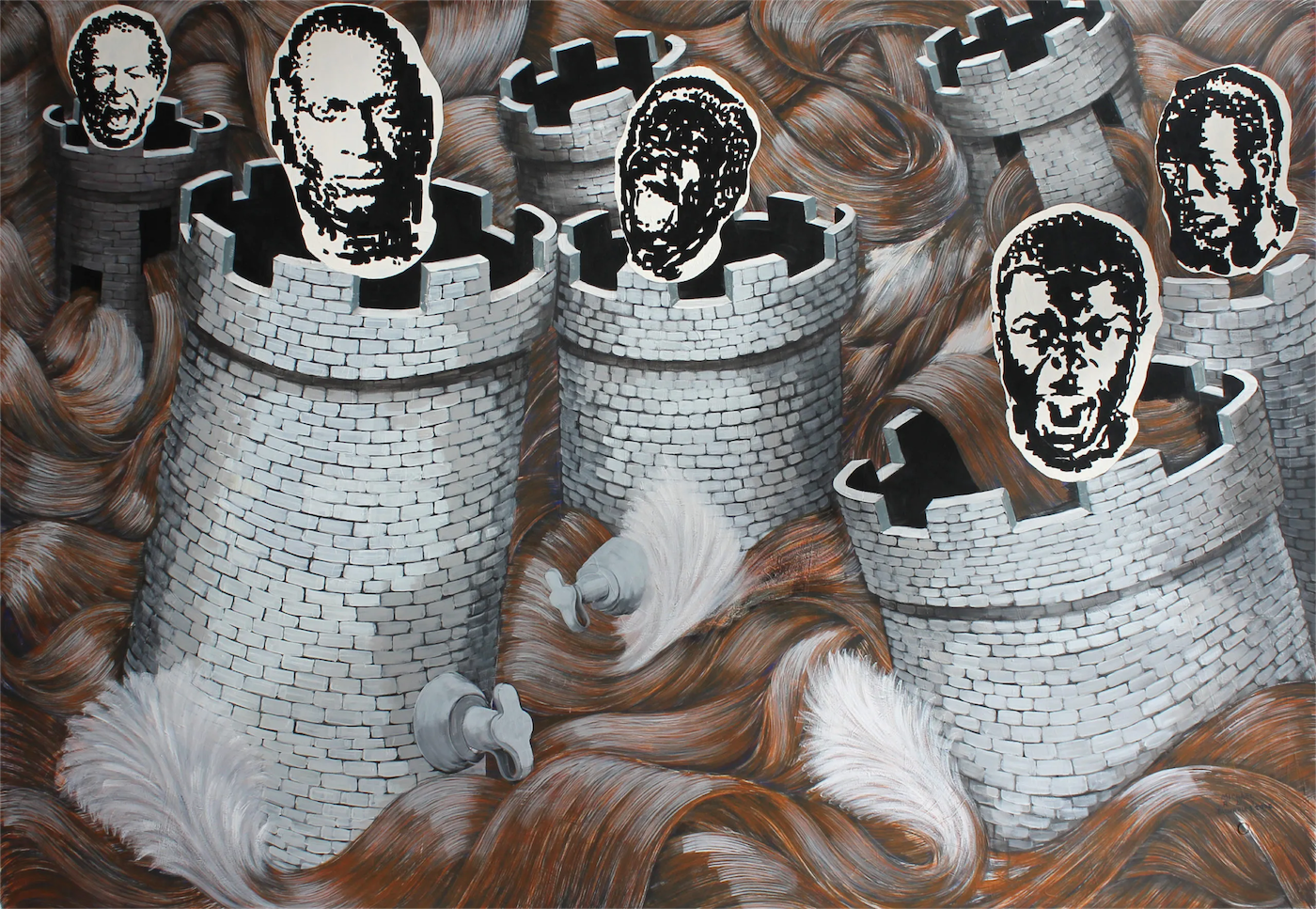
Recent years have brought renewed attention to Charles’s work, and not simply as a historical footnote from the 1990s multicultural-art debates. That renewed attention matters because it suggests his images now read less like artifacts of a particular controversy and more like prophetic diagnostics of a culture still organized by racial spectacle. Templon’s recent exhibitions, including In the Presence of Light and VENI VIDI, framed his newer work through theater, black-and-white palettes, minstrel-show references, and symbolic staging that connect nineteenth-century racial performance to contemporary forms of looking.
A Culture Type essay published in 2021 argued that the moment had finally caught up with Charles—that works once seen as excessively provocative now felt painfully apt. That may be slightly too neat; plenty of viewers still find the work difficult, and they should. But the broader point holds. In an era newly attentive to the politics of monuments, mascots, branding, and visual inheritance, Charles’s long obsession with how racist imagery survives in plain sight feels less like an eccentric specialization and more like a central cultural argument.
The 2023 Frieze review made a similar case by emphasizing that Charles’s caricatures are not simply reproductions of degraded imagery but mechanisms for showing the violence sustained by white supremacy. WNYC, discussing a rare U.S. exhibition, likewise positioned his new work as freshly urgent. What has changed is not the core subject. What has changed is the willingness of broader audiences to admit that images once dismissed as regrettable ephemera were part of the architecture of American racial order. Charles has been saying that for years. The culture is only intermittently ready to hear it.
There is also something else happening in the recent work: a seasoned artist’s confidence in compression. Charles no longer needs to announce every argument at maximum volume. The imagery remains confrontational, but there is an increased sense of stagecraft, symbolism, and tonal control. That is not softening. It is refinement. The mature Charles knows exactly how much to show, how much to imply, and how to let the viewer’s own historical knowledge—or historical ignorance—become part of the work’s charge. This is where his significance extends beyond representation politics into questions of pictorial intelligence. He is not simply making statements. He is constructing traps for the eye and conscience.
Michael Ray Charles in the story of Black art
Placing Charles within the broader history of Black art requires care. He is not easily assimilated to the more celebratory or reparative strains of contemporary Black figuration, nor does he fit comfortably into a purely conceptual genealogy. His work is representational but anti-illustrative, polemical but not didactic, historically grounded yet graphically synthetic. He shares with other major Black artists an insistence that representation is never innocent. But Charles’s particular contribution is his sustained focus on the afterlife of racist commercial imagery and the way that imagery conditions both white fantasy and Black self-perception.
That focus gives his work a distinct intellectual charge. He is not only painting Blackness; he is painting the machinery that manufactured counterfeit versions of Blackness for mass consumption. In that sense, Charles belongs as much to the history of media critique as to the history of painting. He understands that race in America has always been visualized, merchandised, and staged. The canvas, for him, becomes a place where those operations can be replayed under hostile scrutiny.
He also helped make space for more direct engagement with ugly archives inside mainstream contemporary art. Today, viewers are more accustomed to artists working with racist collectibles, appropriated caricature, and archival damage. In the 1990s, that terrain felt far less settled. Charles was one of the figures who helped force those questions into the open. Not alone, certainly, but decisively. If some of that work now appears easier to discuss, it is partly because artists like Charles absorbed the blowback first.
What remains difficult, and why that matters
The easiest way to honor a difficult artist is to overstate the consensus around him. Michael Ray Charles deserves something better than that. His work has never been universally embraced, and some objections to it remain intellectually serious. It is possible to believe that Charles is a major artist and still feel that certain images wound more than they clarify. It is possible to value his critique and still worry about how the market aestheticizes trauma. It is possible to admire the rigor of his confrontation while questioning whether all audiences meet the work on anything like equal footing. None of those reservations cancel his significance. They define the conditions under which it must be understood.
In fact, that may be the clearest measure of Charles’s importance. His art does not produce passive admiration. It produces argument, friction, self-interrogation, and, at its best, a more precise account of how racism survives not only in laws or institutions but in visual habits—in what seems familiar, collectible, laughable, decorative, and normal. That is a profound contribution because visual habit is one of the hardest things to break. People can denounce overt racism and still consume its descendants in softened, stylized form. Charles’s paintings refuse that innocence.
What he has done, over and over again, is force American spectatorship to become conscious of itself. Why does this figure look “old-fashioned” and yet somehow current? Why does this slogan feel both absurd and plausible? Why does the work offend, and what exactly is doing the offending—the image, the history behind it, the artist’s reuse of it, or the viewer’s own implication in its legibility? These are not comfortable questions. They are, however, the kinds of questions serious art should leave in its wake.
The legacy: not closure, but pressure
Michael Ray Charles’s legacy is not tidy because the country he paints is not tidy. He is important not because he resolved the problem of racist imagery, but because he demonstrated how unresolved it remains. He took the language of commercial America—its slogans, mascots, poses, and selling tactics—and revealed how much racial domination that language once carried, and still carries in altered forms. He built paintings that operate like false advertisements for a nation’s unfinished emancipation. He made memory abrasive again.
His stature now seems secure: museum exhibitions, major collections, academic appointments, international gallery representation, the Rome Prize, state honors, renewed critical attention. But the real test of his legacy is not whether institutions have embraced him. It is whether viewers continue to let the work do its harder job. Charles asks us to look at the pictorial debris of American racism without nostalgia, without denial, and without the fantasy that naming history is the same thing as overcoming it. That remains a radical demand.
Michael Ray Charles matters because he understood that America’s racial archive is not a warehouse; it is a circulation system. Images move. They mutate. They resurface. They become jokes, collectibles, logos, costumes, algorithms, mascots, and “heritage.” Charles met that circulation with counter-circulation. He took the images back into the studio, stretched them across canvas, damaged them, monumentalized them, and refused to let them pass as innocent Americana. In that refusal lies both the offense and the achievement.
And so the enduring value of his work may be this: Michael Ray Charles made art that treats seeing as an ethical act. Not a neutral one. Not a passive one. An ethical one. To look at his paintings seriously is to confront how a culture teaches itself through pictures, and how those pictures can outlive the eras that produced them. In a country still arguing over history, symbolism, race, and public memory, that is not an old subject. It is the subject.
More great stories
Afro Sheen, Wall Street, and the Architecture of Black Possibility
July 6, 2026
No Comments
The Fire Inside the Fourth
July 5, 2026
No Comments