


Apparently indefatigable, she, perhaps more than any other person, was active on every level of the protest.
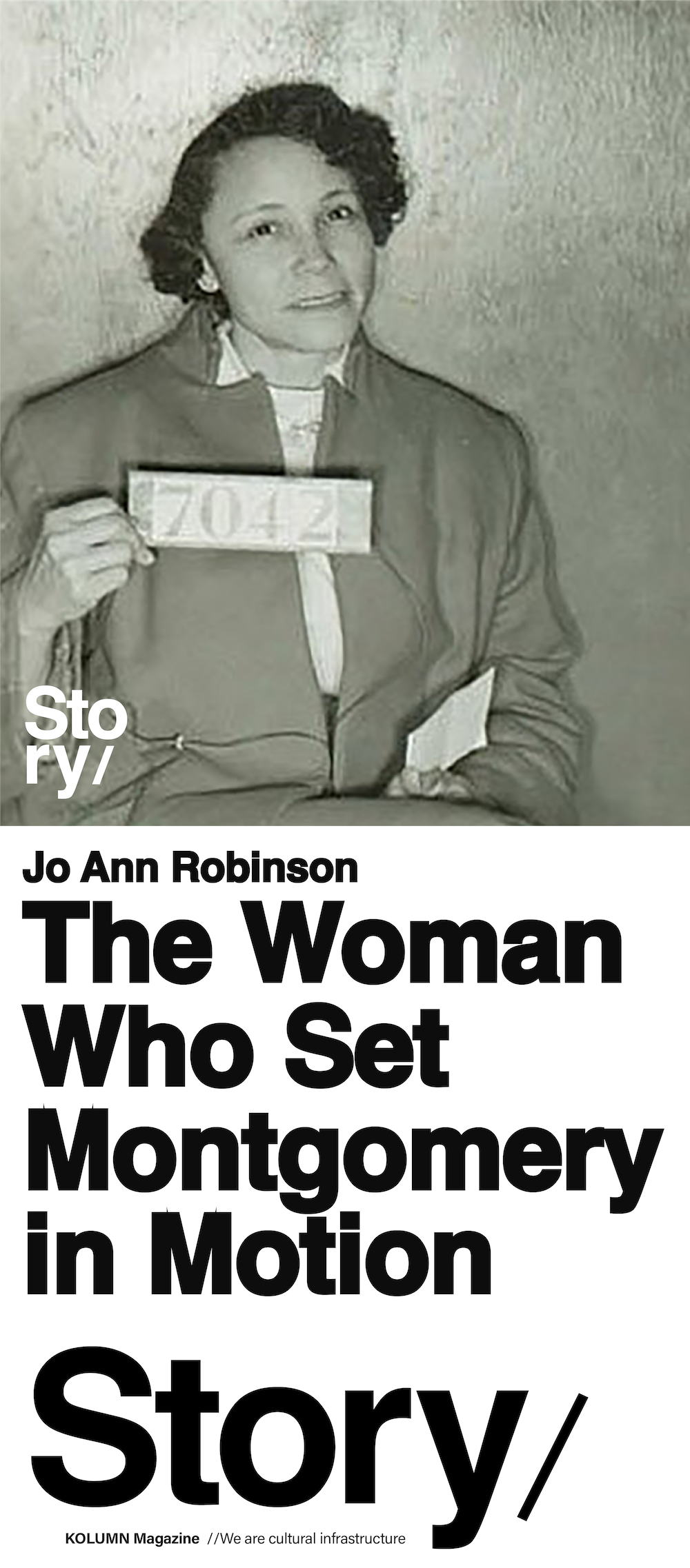
Apparently indefatigable, she, perhaps more than any other person, was active on every level of the protest.
By KOLUMN Magazine
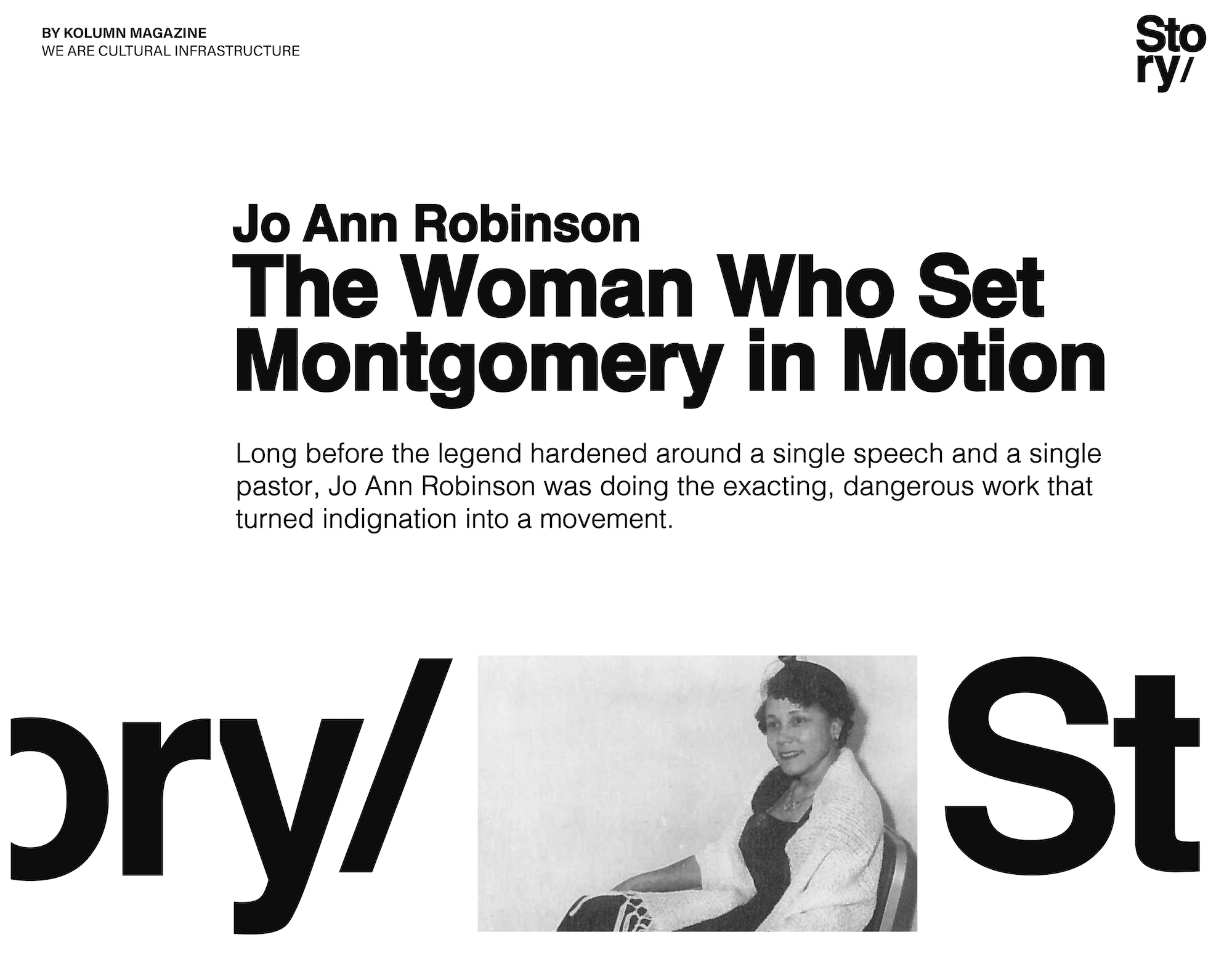
American history loves its clean myths. It prefers singular heroes, tidy turning points, and narratives that can fit on a plaque, in a schoolbook margin, or into a five-minute Black History Month assembly. The Montgomery Bus Boycott is often told that way: Rosa Parks sat, Martin Luther King Jr. rose, and a movement was born. It is not exactly false. It is just nowhere near complete. At the center of what gets omitted stands Jo Ann Gibson Robinson: professor, organizer, strategist, editor, political worker, and one of the most important people in the making of the modern civil rights movement.
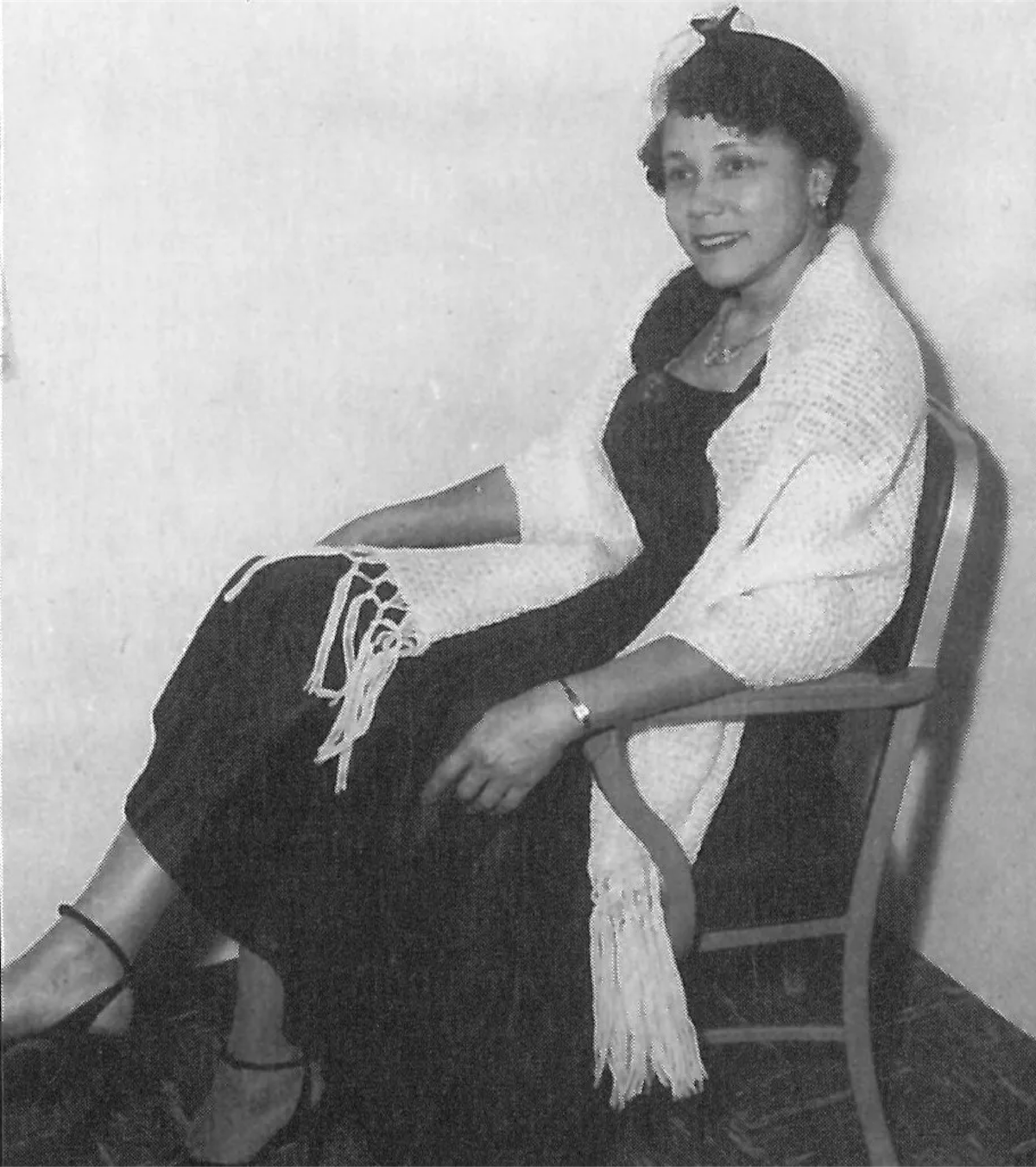
Robinson matters not only because she helped launch the boycott, though she absolutely did. She matters because her life exposes how social movements actually work. They are not conjured by charisma alone. They are built by people with mailing lists, institutional ties, emotional discipline, clear political analysis, and the nerve to act when the opening arrives. In Montgomery, Robinson had been preparing for that opening for years through the Women’s Political Council, long before Rosa Parks’s arrest made national headlines and long before King became the movement’s most recognizable face.
That is part of why Robinson’s story feels so modern. She was not merely reacting to injustice in a burst of righteous emotion. She was engaged in what today would be called infrastructure building. She understood that bus segregation was not a minor inconvenience but an everyday technology of humiliation, discipline, and economic extraction. She also understood something else that the city’s white leadership failed to grasp: Black riders were the system’s customer base. If that community acted collectively, it could put pressure on Montgomery where it hurt.
And yet Robinson was, for a long time, pushed to the margins of the public story. Part of that was strategic. She deliberately stayed behind the scenes to protect her teaching position at Alabama State College. Part of it was structural. Mid-century America, including the civil rights movement’s own public-facing culture, was more comfortable elevating male ministers as movement symbols than recognizing Black women’s organizational labor. Robinson understood that imbalance perfectly well, and later said so. Her memoir and later interviews helped correct the record, but the correction has never quite caught up to the original distortion.
That line came from Martin Luther King Jr., and it is striking for two reasons. First, because it is unusually direct praise from the movement figure who became most associated with Montgomery. Second, because it underscores how much later retellings have flattened what even contemporaries knew: Jo Ann Robinson was not incidental to the boycott. She was central to it.
A teacher before she was a symbol
Robinson was born on April 17, 1912, in Culloden, Georgia, the youngest of 12 children. After her father died, the family moved to Macon. She excelled academically, graduated as valedictorian of her high school class, became the first person in her family to finish college, earned a bachelor’s degree from Fort Valley State College, later completed a master’s degree in English at Atlanta University, and also pursued further study at Columbia University. Before Montgomery ever entered the picture, Robinson had already assembled the résumé of a serious educator and disciplined intellectual.
That educational trajectory matters because it shaped the kind of activist she became. Robinson was not a celebrity organizer. She was a thinking organizer. She arrived in Montgomery in 1949 to teach English at Alabama State College, bringing with her the habits of an academic: observation, language precision, planning, and a respect for institutions even while recognizing their limits. She was also a Black woman entering one of the South’s most rigidly segregated urban environments, where education did not insulate her from humiliation. It may have sharpened her sensitivity to it.
Soon after arriving in Montgomery, Robinson experienced the kind of degrading bus encounter that would become routine in the city’s Black memory. She boarded a bus that was nearly empty and sat in a section reserved for white passengers. The driver stopped the bus, came toward her, and demanded that she move. In later recollections, she described the experience in searingly human terms. “I felt like a dog,” she said. It was not simply embarrassing. It was clarifying.
There is something bracing about the starkness of that sentence. It cuts through the sanitized language that often surrounds discussions of segregation. Segregation was not just a legal arrangement; it was a system designed to school Black people in abasement. Robinson’s bus encounter radicalized her. According to the Encyclopedia of Alabama, she had not initially shown much interest in the Women’s Political Council, but after sharing her experience and finding that others regarded it as commonplace, she resolved to do something about conditions on Montgomery’s buses.
The Women’s Political Council was already doing the work
Any serious account of Jo Ann Robinson also has to be a serious account of the Women’s Political Council, or WPC. Founded in 1946 by Mary Fair Burks, the WPC brought together Black professional women in Montgomery and worked on civic participation, voter registration, public safety, and women’s welfare. The National Museum of African American History and Culture notes that the group also aided women who were victims of rape or assault, a reminder that Black women’s political work in the Jim Crow South was often expansive, practical, and rooted in community defense.
This is one of the most important correctives to the over-simplified Montgomery story. The boycott did not emerge from nowhere in December 1955. There was already an organized women’s network in place. There were already grievances, meetings, strategies, and institutional memory. There were already people trying to negotiate with the city and measuring its intransigence. Robinson rose to the WPC presidency in 1950 and made bus conditions a top priority. That meant repeated complaints to the city commission about seating arrangements, driver abuse, and unequal service in Black neighborhoods.
The demands the WPC raised were tellingly modest by later standards. They were not initially demanding full social revolution. They wanted no one standing over empty seats, stops in Black neighborhoods as regular as those in white areas, the ability for Black riders to board at the front after paying, and greater courtesy from drivers. In other words, they were asking for a degree of basic dignity within a violently unequal system. Even that proved too much for Montgomery’s white leadership.
That failure of reform is central to understanding Robinson. She was not a romantic who jumped immediately to maximal confrontation. She and the WPC tried conventional channels. They met with Mayor William A. Gayle and city officials. They warned them. Robinson even wrote that there was discussion among “twenty-five or more local organizations” about a citywide boycott if conditions did not improve. When the city refused meaningful change, it helped prove the point that a lot of Black activists across the South were learning in the 1950s: polite petitioning without leverage had narrow limits.
This is where Robinson’s political intelligence comes into focus. She recognized the bus system as a site where everyday Black dependency on public transit could be turned into collective power. Britannica notes that African Americans made up roughly 75 percent of the bus company’s ridership. That meant a boycott was not symbolic theater. It was an economic weapon. Robinson saw that well before the country was ready to remember her for seeing it.
Rosa Parks was the spark, not the first thought
The standard version of Montgomery also obscures how much groundwork preceded Rosa Parks’s arrest. By the time Parks refused to surrender her seat on December 1, 1955, Robinson and the WPC had spent years turning bus segregation into an organizing issue. The King Institute notes that Claudette Colvin had already been arrested in March 1955, and King, Robinson, Parks, and others later met with officials around the bus issue. Montgomery was not waiting for consciousness; it was waiting for a catalytic moment that could unify existing anger, organization, and timing.
This does not diminish Parks. It restores her to the context she deserves: not a random tired seamstress in a fairy tale of spontaneous history, but a seasoned activist whose arrest became legible to a prepared movement. Robinson immediately understood that Parks’s arrest was the opening the WPC had anticipated. That night, she moved. With two students and John Cannon, a department chair at Alabama State, she used the college’s mimeograph equipment to produce about 52,500 leaflets calling for a one-day boycott on Monday, December 5.
That leaflet operation is one of the great feats of rapid-response organizing in American history. Robinson was not sending a press release into the void. She was activating an already-existing Black communication network: teachers, students, churches, beauty parlors, barber shops, stores, civic organizations, ministers. The Washington Post’s archival account describes Robinson working through the night and then helping distribute the notices across the city by the next morning. This was not glamorous work. It was logistical brilliance under risk.
What is so remarkable is how little hesitation there seems to have been once the decision was made. In Robinson’s memoir, excerpted by the National Humanities Center, she describes ministers realizing that the masses were prepared to support the one-day protest “with or without” their leadership. That line flips the familiar story on its head. Too often Montgomery is told as though ministers bestowed a movement upon the people. Robinson’s telling suggests something more democratic and more combustible: the people were already moving, and the ministers had to catch up.
The genius of working behind the scenes
One of the reasons Robinson’s story has often been under-told is that she intentionally occupied a partially hidden role. She feared, with good reason, that taking a formal office in the newly formed Montgomery Improvement Association could cost her job at Alabama State. So she did not take an official public-facing position. But not taking a title is not the same thing as lacking power. Robinson served on the MIA executive board because of her WPC role, wrote and edited the weekly MIA newsletter at King’s request, and participated in the carpool system that kept the protest functional.
That distinction matters beyond biography. Social movements are littered with public figures whose speeches are remembered and operational figures whose labor is not. Robinson was the latter kind of indispensable actor. The boycott required communication, message discipline, morale management, fundraising, transportation, coordination with clergy, and a steady stream of narrative reinforcement. The MIA newsletter, mass meetings, and carpool system were not side operations. They were the infrastructure that prevented a one-day protest from collapsing into a brief gesture.
The National Humanities Center excerpt is especially useful here because it captures the texture of the boycott as a collective organism. Robinson details Friday-night planning, Monday mass meetings, pickup systems for workers, outside loudspeakers, fundraising women’s clubs, and the emotional discipline required to keep anger from spilling into violence. The picture that emerges is not of one leader animating followers, but of a dense civic ecosystem under strain and purpose. Robinson was one of the people most capable of seeing that whole system at once.
“Women’s leadership was no less important to the development of the Montgomery Bus Boycott than was the male and minister-dominated leadership.”
That observation, preserved by the Smithsonian’s NMAAHC story, reads almost like a rebuke to decades of public memory. Robinson was not denying the importance of ministers. She was insisting that the story be told honestly. The boycott had male spokesmen, yes. But it also had female architects, carriers, editors, fundraisers, drivers, strategists, church workers, cooks, and civic organizers. The movement’s camera-facing hierarchy and its labor hierarchy were not the same thing.
The boycott was mass action, not moral pageantry
One of the most compelling parts of Robinson’s account is her insistence that the boycott belonged to ordinary people. The NMAAHC article preserves her later statement that “That boycott was not supported by a few people; it was supported by 52,000 people.” That number is less important as an exact census than as a political argument. Robinson wanted posterity to remember that the victory was collective. It was maids, students, churchgoers, laborers, teachers, and families making a daily choice, often at significant personal inconvenience or danger.
The National Park Service notes that by December 2 Robinson had delivered 50,000 protest leaflets, and Britannica reports that roughly 90 percent of Black Montgomery residents stayed off the buses on the first day. That is astonishing social cohesion. It was not produced by rhetoric alone. It reflected the credibility of the women and institutions that had carried the message, and it reflected how thoroughly bus humiliation had been woven into Black life. The boycott succeeded because it translated private grievance into public unanimity.
Robinson’s memoir also conveys how the first day transformed Black psychological life in Montgomery. In the National Humanities Center excerpt, she describes people holding their heads higher, feeling “reborn,” experiencing a new kind of race pride, and becoming “free inside.” This language matters because it points to one of the boycott’s deeper effects: it did not just pressure a bus company. It altered the emotional landscape of a city. It taught thousands of people what coordinated refusal felt like.
That inner shift helps explain why the campaign lasted 13 months, from December 5, 1955, until December 20, 1956, when desegregation of the buses was finally enforced after the Supreme Court upheld the lower court ruling in Browder v. Gayle. The length of the struggle is itself a rebuke to simplistic retellings. The boycott was not a quick moral victory. It was a long campaign of endurance, adaptation, legal strategy, fundraising, and emotional maintenance. Robinson was there at each level of that effort.
The price Robinson paid
Robinson’s relative invisibility did not protect her from retaliation. Stanford’s King Institute records that in February 1956 a local police officer threw a stone through her window and, two weeks later, another officer poured acid on her car. She was also among the boycott leaders arrested, though never brought to trial. The Smithsonian similarly notes that despite her efforts to stay out of the limelight, she became a target of intimidation serious enough that Alabama’s governor eventually ordered state police to guard boycott leaders’ homes.
This violence is important for another reason: it reminds us that there was no true backstage in Montgomery. Black women who worked “behind the scenes” were not somehow safe because they were not on podiums. White authorities understood very well who was making things happen. Robinson’s professional status did not shield her; if anything, it made her threatening in a different register. She was educated, organized, female, Black, and unafraid to turn institutional resources against Jim Crow. For a segregationist order built on deference, that combination was intolerable.
The pressure extended into academia. The Encyclopedia of Alabama reports that Alabama State faculty suspected of participating in the boycott were investigated, and state evaluators routinely observed classes to intimidate instructors. By 1960, after student sit-ins at Alabama State, Robinson resigned rather than continue under those conditions. Stanford records her description of the atmosphere as “a constant threat to our peace of mind.” This, too, belongs in her legacy: she did not simply survive the movement’s glory; she endured the institutional revenge that followed it.
A life after Montgomery, and a memoir that corrected the record
After leaving Alabama State, Robinson taught for a year at Grambling College in Louisiana, then moved to Los Angeles, where she taught in the public school system until retiring in 1976. Sources from Stanford, the Smithsonian, and the Encyclopedia of Alabama all agree that she remained active in community and women’s organizations after leaving the South. That post-Montgomery period matters because it resists the temptation to freeze Robinson in 1955 like an artifact rather than understand her as a whole political person.
Her most enduring intervention in public memory may have come in 1987, when her memoir, The Montgomery Bus Boycott and the Women Who Started It, was published, edited by historian David J. Garrow. The title alone is a kind of thesis statement. Robinson was not being coy. She was naming the absence in the historical record and correcting it. The memoir did more than recount events. It re-centered women as makers of the boycott, not auxiliaries to it.
“The boycott was the most beautiful memory that all of us who participated will carry to our final resting place.”
That sentence, quoted by Stanford from Robinson’s memoir, carries both pride and collectivity. She does not frame the boycott as her private triumph. She frames it as a shared inheritance among those who risked and endured. That choice is consistent with the rest of her life. Robinson was never especially interested in the celebrity model of leadership. Even in claiming women’s central role, she tended to emphasize the mass character of the protest. That is one reason her story continues to feel fresh: it resists the culture of heroic individual branding that dominates so much contemporary politics.
Why Jo Ann Robinson still feels under-recognized
Jo Ann Robinson’s under-recognition is not accidental. It reflects the broader way American memory handles Black women’s leadership. The Atlantic’s reporting on the civil-rights era’s “hidden women” explicitly identifies the Women’s Political Council and Robinson as the first to call for the boycott. Word In Black, in a 2024 piece on overlooked Black women in politics, went even further, describing Robinson as a source of the “brains, vision, and organizing genius” behind the boycott. The Root, meanwhile, has argued that Black women’s essential labor has too often been eclipsed by a “superman” narrative centered on men.
Those modern reassessments matter because they show Robinson’s legacy is not static; it is part of an ongoing historiographical repair job. In other words, this is not just about giving one deserving person her flowers. It is about changing the interpretive frame. Once Robinson is restored to Montgomery, the entire event looks different. It becomes less a story of spontaneous uplift around one preacher and more a story of Black women’s civic institutions, preexisting political analysis, and disciplined local organizing converging at the right time.
That shift also has implications for how we understand political leadership now. Robinson exemplifies a type of leadership that is methodical rather than performative. She built networks, tested institutions, anticipated windows of action, moved information quickly, and did not confuse public prominence with strategic importance. In an era obsessed with virality, there is something almost defiant about the Robinson model. She suggests that the people most responsible for changing history are often not the people best remembered for it.
The enduring significance of Jo Ann Robinson
So what, exactly, is Jo Ann Robinson’s significance? It is larger than the fact that she printed the leaflets, though that fact alone would make her historically consequential. Her significance lies in the way she demonstrates that movements require preparation before they require icons. She turned local indignity into organized leverage. She helped convert churches, schools, and women’s civic networks into a protest infrastructure. She understood both the moral and material stakes of bus segregation. And she helped sustain a struggle long enough for it to produce national consequence.
She also expands the geography of courage. Courage is not only what happens when a person refuses to stand up on a bus. It is also what happens when someone spends the night at a mimeograph machine, risks her livelihood, absorbs state harassment, edits movement communications week after week, and keeps working without guarantee of recognition. Robinson’s kind of courage is administrative, tactical, and durable. Histories that miss that are not merely incomplete. They misunderstand how change is made.
There is another layer to her importance. Robinson helps collapse the false divide between intellectual work and movement work. She was an English professor, a writer, and an organizer. Language mattered to her. Messaging mattered to her. Narrative mattered to her. It is no accident that one of her lasting contributions was the weekly newsletter, or that one of her greatest later interventions was a memoir. Robinson understood that movements are fought in the arena of story as much as in the street or the courtroom. Whoever writes the story shapes who counts.
When she died in Los Angeles on August 29, 1992, Robinson left behind more than a biography. She left a framework for re-reading the civil rights movement from the ground up and from the women outward. Institutions like the Smithsonian, Stanford’s King Institute, the National Park Service, and contemporary Black media have helped bring her back into wider public view, but her name still does not circulate with the ease her importance warrants. That is partly because her legacy makes demands on us. To truly honor Jo Ann Robinson, one has to let go of the easy version of Montgomery.
And maybe that is exactly why she matters now. Jo Ann Robinson forces a more adult reading of democracy. She reminds us that political transformation does not arrive as a miracle. It is assembled by people who study the terrain, build the network, trust the community, and move fast when history cracks open. Montgomery did not just produce a famous boycott. It revealed a woman who had been preparing, quietly and rigorously, for the moment when a city’s daily humiliations could be turned into a mass refusal. America remembers the refusal. It still has some catching up to do on the woman who helped make it possible.
More great stories
Afro Sheen, Wall Street, and the Architecture of Black Possibility
July 6, 2026
No Comments
The Fire Inside the Fourth
July 5, 2026
No Comments