


I am inspired by Black people and Mexican people, my two peoples.
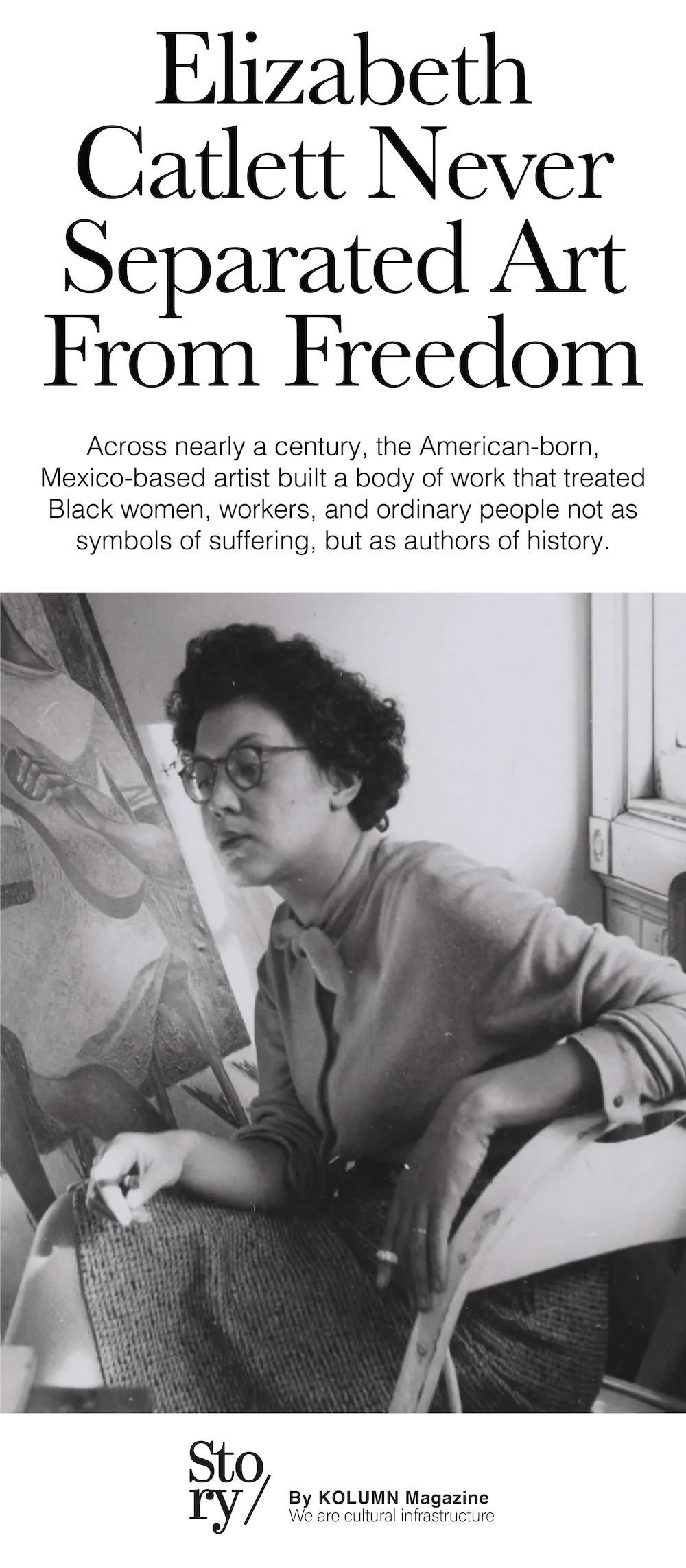
I am inspired by Black people and Mexican people, my two peoples.
By KOLUMN Magazine
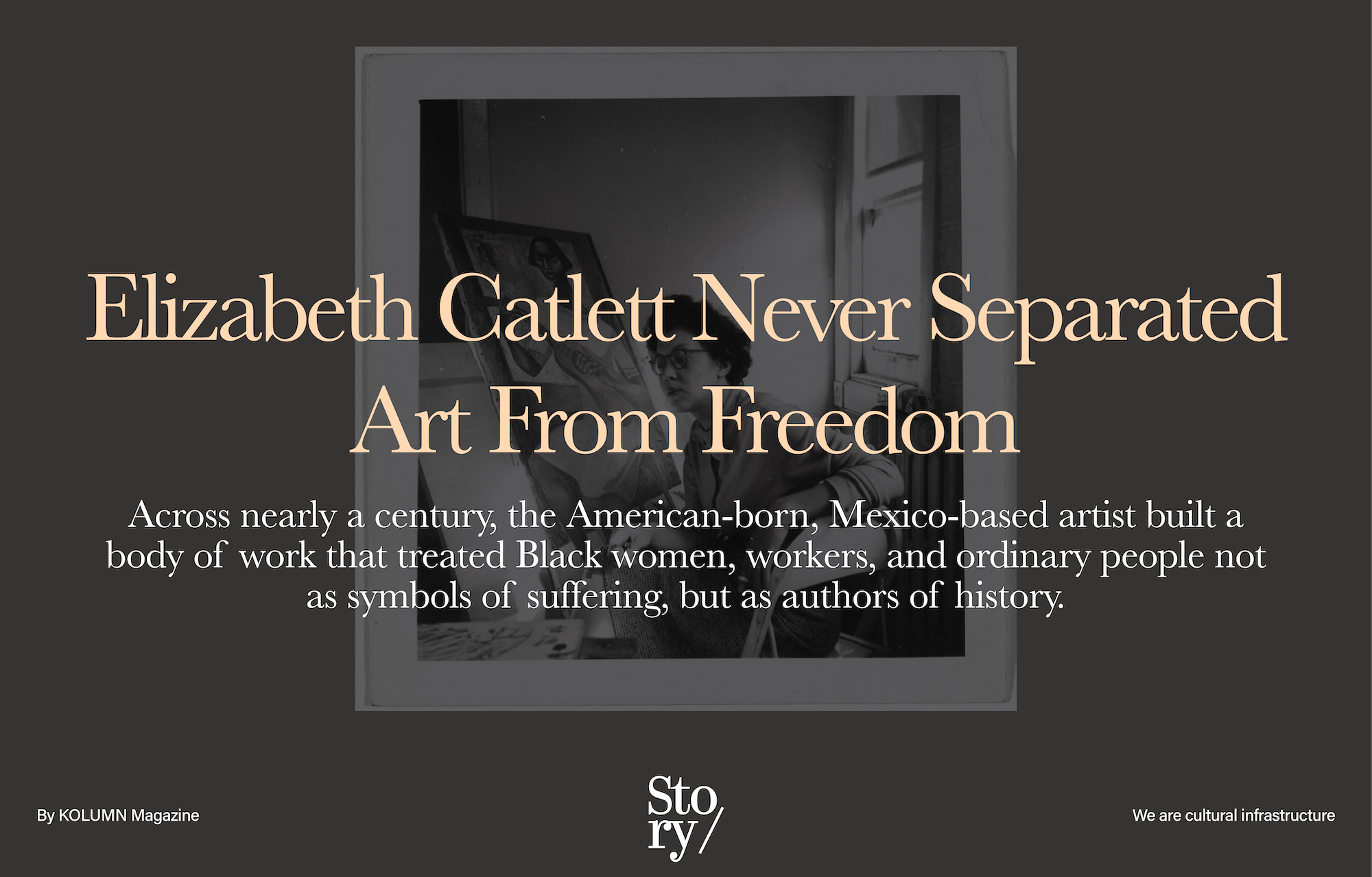
Elizabeth Catlett spent a lifetime refusing one of the art world’s favorite evasions: the idea that beauty and politics should keep a polite distance from one another. For her, art was not a decorative side project to history. It was history’s witness, argument, and sometimes its blunt instrument. Across prints, sculptures, drawings, and teaching, Catlett made a career out of rendering people usually treated as background material into the central fact of the image. Black women, workers, mothers, children, organizers, the poor, the sturdy and the overlooked all moved into focus in her work with a seriousness that still feels corrective. That seriousness is one reason her reputation has endured and, lately, expanded, as major museums and scholars have worked to give her the fuller accounting she was long denied
Catlett’s renewed visibility is not just a matter of overdue acclaim, though there is certainly some of that. The Brooklyn Museum and the National Gallery of Art have framed her as “a Black revolutionary artist,” while the Art Institute of Chicago has carried that same retrospective forward, a signal that institutions now understand her not as a niche figure or a specialist’s favorite but as a defining twentieth-century artist. That framing matters because Catlett herself spent decades naming the problem: she was not merely overlooked, but structurally sidelined as a Black woman artist whose formal brilliance was too often discussed as secondary to her politics, or worse, ignored because of them.
That tension between mastery and marginalization runs through almost every telling of her life. Born in Washington, D.C., in 1915, Catlett grew up in a family shaped by the long afterlife of slavery; her maternal and paternal grandparents had been enslaved, and that inherited memory of dispossession, endurance, and racial violence never sat at a comfortable distance from her art. It was part of the substrate. The artist who would later produce some of the twentieth century’s most powerful images of Black womanhood did not arrive at that subject through abstraction. She knew intimately what it meant to come from a people whose humanity had to be asserted again and again against institutions built to deny it.
The exclusions began early and plainly. Carnegie Institute of Technology admitted her, then rescinded the acceptance once it learned she was Black. That kind of humiliation can become a scar or a lens; in Catlett’s case, it seems to have become both. She went instead to Howard University, graduating with honors in 1935 and studying under figures like Loïs Mailou Jones and Alain Locke, two intellectual presences whose importance to Black cultural life can hardly be overstated. At Howard, Catlett encountered a model of Black artistic seriousness that rejected the notion that excellence required detachment from community. The education she received there was aesthetic, philosophical, and political at once.
That foundation mattered when she moved on to the University of Iowa, where she studied with Grant Wood and became the first Black woman to earn an MFA there; Iowa has also said she was among the first three people to receive the degree. The encounter with Wood is often noted because he encouraged her to work from what she knew. In lesser hands, that advice could sound provincial. In Catlett’s hands, it became radical. What she knew were Black families, Black labor, Black tenderness, Black beauty, and Black struggle. What she knew were people who rarely appeared in American art with dignity intact. Her 1940 thesis sculpture, Negro Mother and Child, won first prize at the American Negro Exposition in Chicago, an early sign that her commitment to Black subject matter was not a limitation but a formal and moral strength.
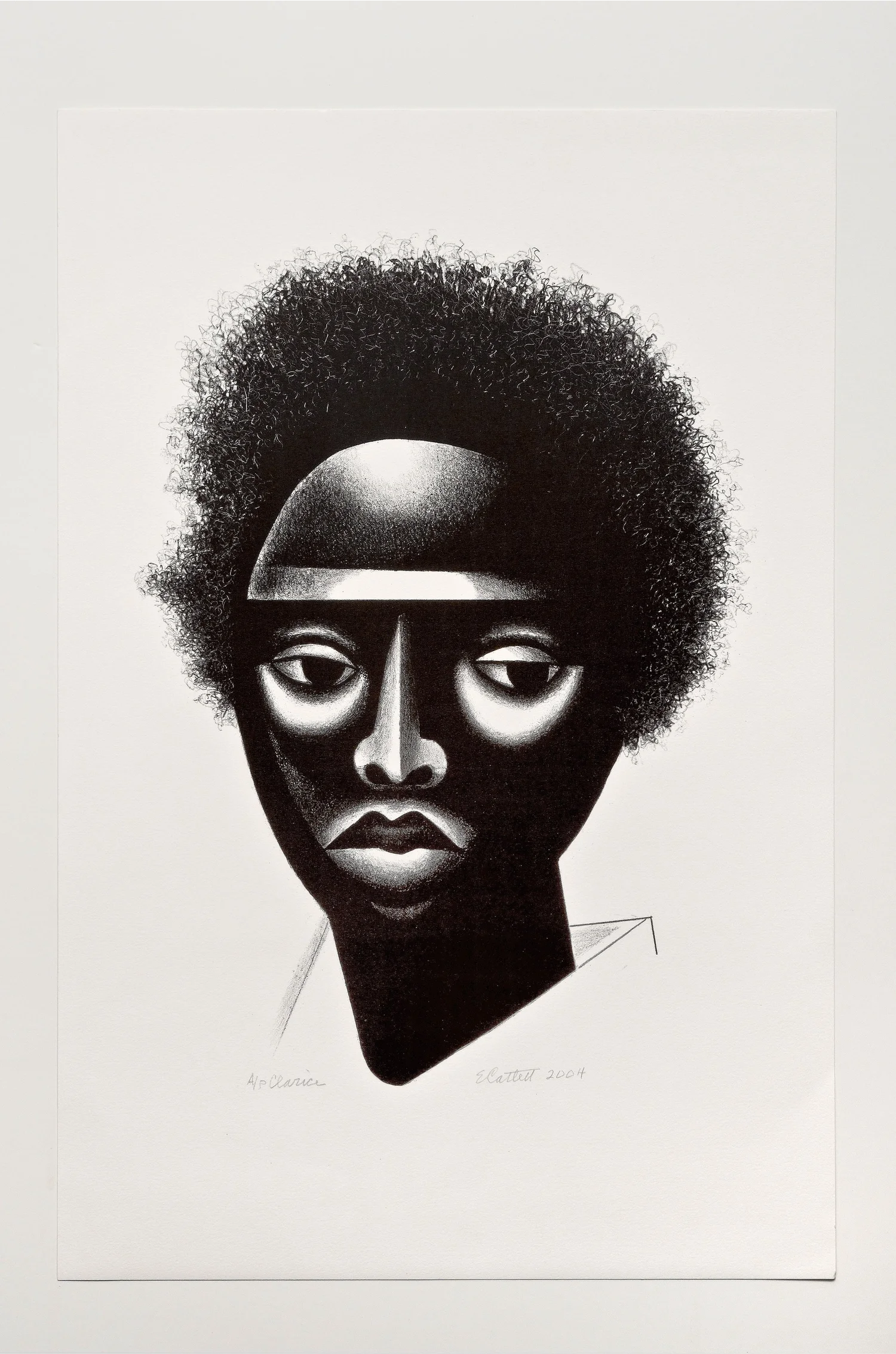
From the beginning, Catlett’s art refused caricature and pity. That is one of the most striking things about her early work and one of the reasons it still feels fresh. She did not traffic in uplift as sentimentality, nor did she present Black suffering as spectacle for liberal consumption. She gave her figures mass, poise, and self-possession. Even when the subject was hardship, the image did not collapse into victimhood. There was always an interior life, an insistence on personhood. Her mature style across sculpture and print would sharpen that instinct until it became unmistakable: Catlett’s people do not ask to be seen. They command it.
If one wants to understand Catlett fully, though, one has to move past the overly neat frame of “African American artist” and reckon with the transnational life she deliberately built. After teaching at Dillard University in New Orleans and later at the George Washington Carver School in Harlem, Catlett moved to Mexico in 1946. There she joined the Taller de Gráfica Popular, the legendary print collective committed to socially engaged art, public education, and left politics. Mexico did not erase her Black American commitments; it deepened and expanded them. In that workshop culture, she found a model of art tied explicitly to ordinary people, labor struggles, literacy campaigns, and anti-fascist, anti-elitist public purpose.
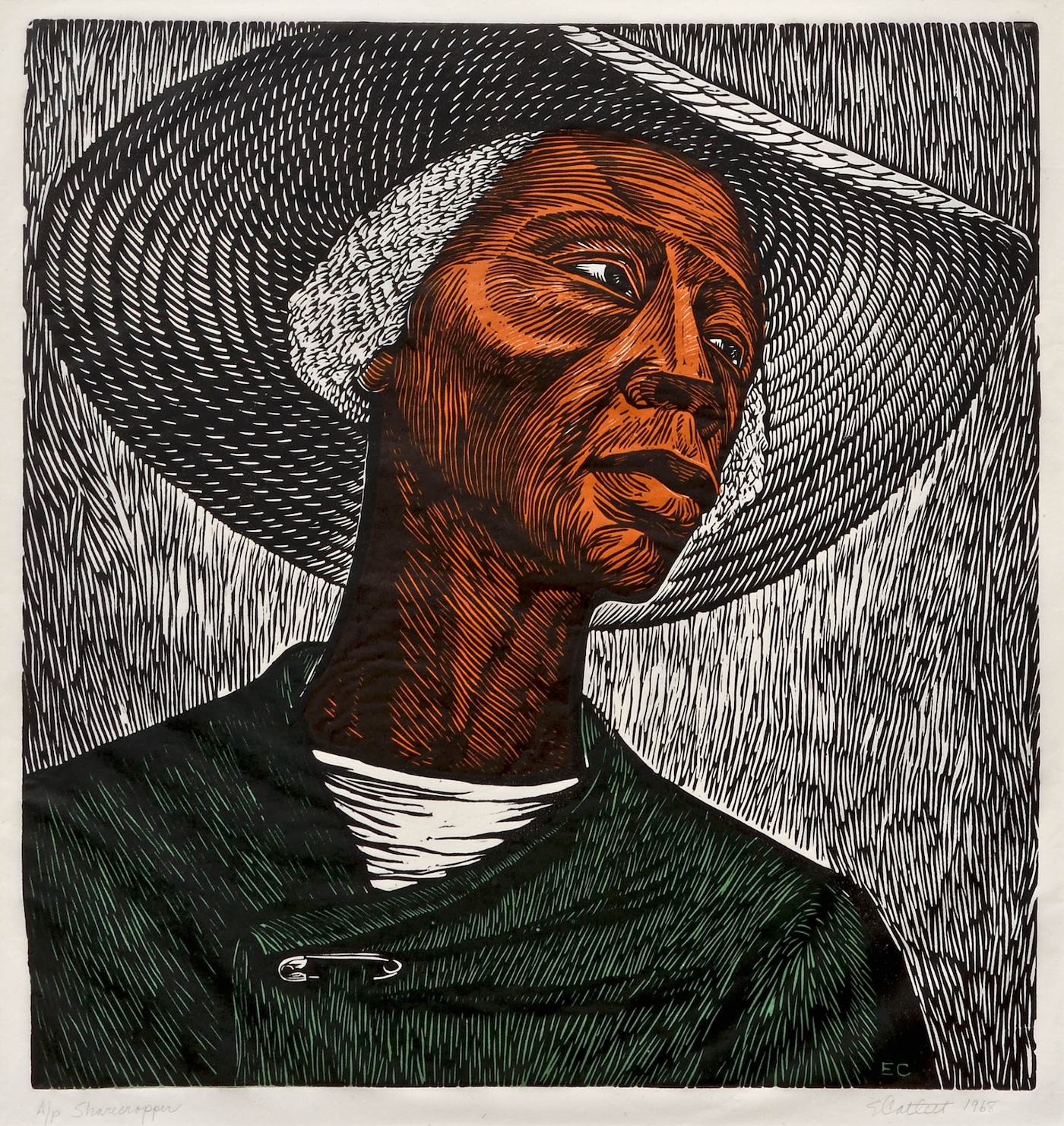
The move was aesthetic as much as ideological. Printmaking gave Catlett a medium suited to both clarity and circulation. A print can travel. A print can be reproduced. A print can get out of the gallery and into hands, classrooms, walls, movements. Catlett understood that medium and message were related. Her work at the Taller de Gráfica Popular, including posters, educational materials, and images of Black historical figures, aligned with a broader belief that art should function in public life rather than hover above it. Her famous print Sharecropper is exemplary here: its bold lines and monumental composition elevate a poor agricultural worker into an icon without emptying the image of hardship. The safety pin holding together the garment remains. So does the grandeur.
Mexico also sharpened Catlett’s political commitments in ways that came with real cost. She became active in union and leftist circles, and in the late 1950s she was arrested in Mexico City during a railroad workers’ strike. The United States later treated her as an “undesirable alien,” effectively barring her from returning for years. In 1962, she became a Mexican citizen. This is the sort of biographical detail that can be flattened into Cold War trivia, but it was far more consequential than that. Catlett’s life reveals what happened when a Black woman artist took political solidarity seriously enough that both art institutions and nation-states had to respond. Exile was not metaphorical for her. It had paperwork attached.
There is a temptation, especially in American writing, to narrate that exile as pure loss. It certainly contained loss. But it also clarified Catlett’s worldmaking. She did not become less American by living in Mexico, and she did not become less Mexican by remaining devoted to Black life in the United States. Instead, she operated in a double register, identifying kinships between Black Americans and Mexican workers, between racial oppression and class exploitation, between maternal care and political labor. The National Museum of African American History and Culture has described her as an African American Mexican artist and activist, a phrase that captures something essential: Catlett belongs to more than one national story, and her art resists being reduced to either.
That duality helped produce some of the most memorable themes in her work. Black women sit at the center of the Catlett universe not as ornamental muses but as historical engines. Her sculptures and prints repeatedly return to women carrying children, women in conversation, women standing firm, women laboring, women remembering, women looking back at the viewer with a steadiness that feels almost accusatory in its refusal to perform. The National Museum of Women in the Arts notes that her art centers the Black female experience, and that is true in ways both obvious and subtle. She did not merely depict Black women; she built a visual grammar in which they were the shape of endurance, intellect, erotic power, tenderness, and political resolve.
This is one reason Catlett’s work still lands so forcefully now. In a culture that often alternates between fetishizing Black women’s strength and ignoring their full humanity, Catlett made images that did neither. Strength is present, yes, but it is not hollow branding. It comes with weight, fatigue, history, sensuality, and relation. Her mothers are not saintly abstractions detached from material conditions. Her workers are not flattened into slogans. Her children are not symbols deployed for easy emotional effect. Catlett’s art insists that ordinary life contains formal grandeur and political meaning without needing to be translated into somebody else’s idiom.
“Art for me must develop from a necessity within my people.”
That sentence is among the best keys to her work because it states, without apology, the terms of her practice. Art, in Catlett’s view, did not emerge from market trends or the pressure to innovate for innovation’s sake. It emerged from necessity. The Smithsonian’s Archives of American Art preserves a version of her broader formulation: art should answer a question, wake somebody up, give a shove in the right direction. The line is famous because it is direct, but its real significance lies in how completely Catlett lived by it. Even her most serene works contain that shove. They are beautiful, yes, but never neutral.
This is where some art writing has historically done Catlett a disservice. Too often, artists whose work is explicitly political are treated as if message and form exist in inverse proportion, as if commitment automatically diminishes complexity. Catlett’s career is a standing rebuke to that assumption. Her sculptures can be spare to the point of near-abstraction, with smooth planes and distilled contours that feel modernist in their compression. Her prints show a master’s control of line, contrast, and rhythm. The work persuades aesthetically before one even begins discussing subject matter. The politics are not pasted on. They are carried through composition, material, and scale.
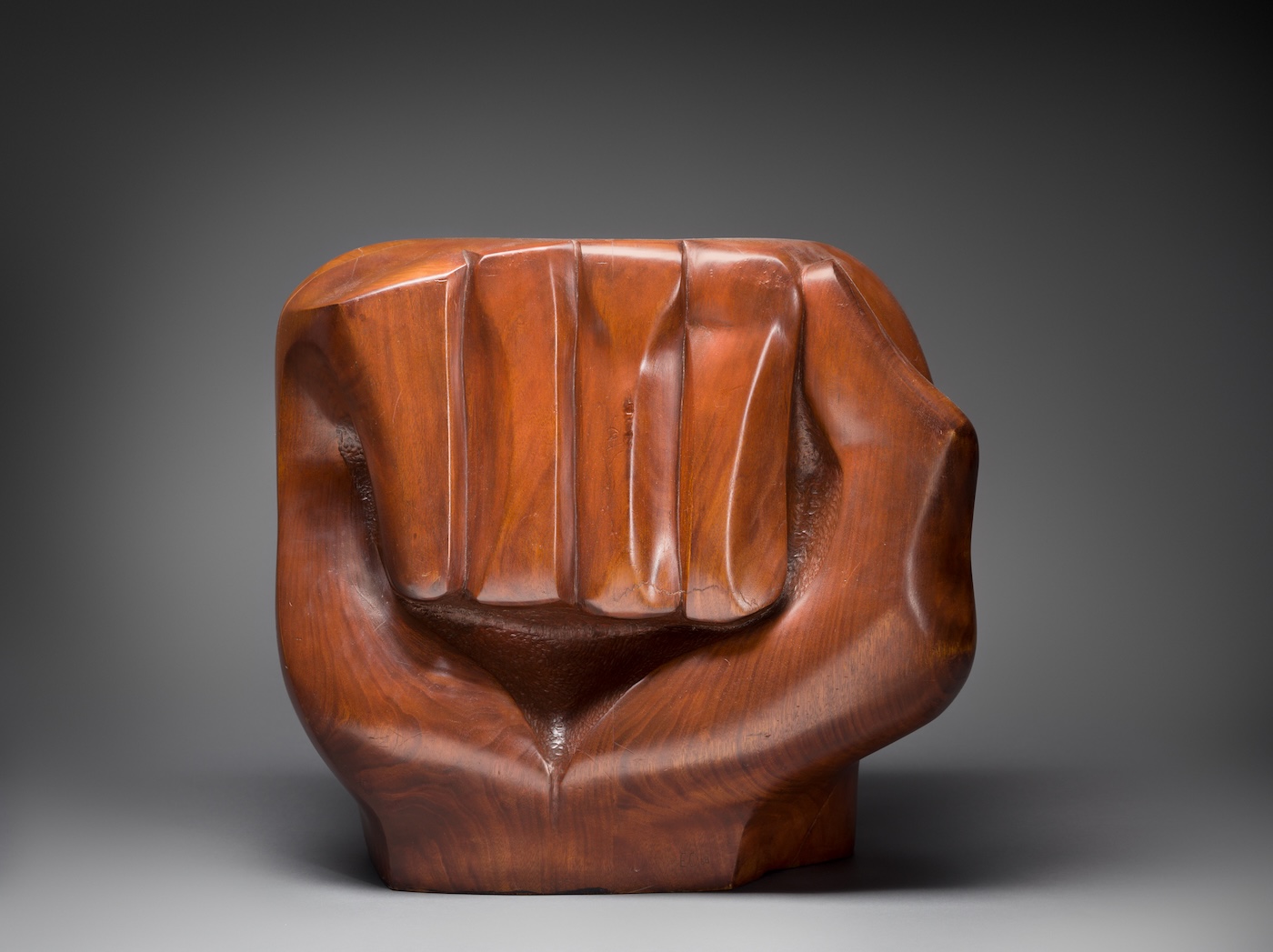
Look, for instance, at the range of her visual language. In woodcuts and linocuts, she could achieve a tough, declarative clarity; in bronze and wood sculpture, she could produce a rounded lyricism that still carried tremendous force. Some works are intimate, almost hushed. Others are openly confrontational. Black Unity, with its clenched fist and conjoined faces, is perhaps the clearest example of her ability to merge symbol and complexity. As the Washington Post observed in writing about Black Power art, the work stages revolution not only as refusal but as the remaking of identity and relationship. That is classic Catlett: militancy and humanism fused rather than opposed.
Her political imagination also widened over time without losing coherence. Catlett made work related to Harriet Tubman, Malcolm X, Angela Davis, and the Black Panthers, but she was never only a maker of iconic movement images. She was just as interested in unnamed women, domestic scenes, collective memory, and the daily textures of survival. This balance matters. Some artists document movements from the outside; Catlett seemed to understand political life as something woven through domestic life, labor, kinship, and self-fashioning. Liberation, in her hands, was not only a march or a fist. It was also a mother bending, a worker standing, a child carried, a community held together.
Her long teaching career reinforces that broader vision. Catlett taught in the United States and Mexico, and in 1958 became a professor of sculpture at the National School of Fine Arts at the National Autonomous University of Mexico. Sources also note that she became the first female professor of sculpture there and later led the sculpture department. Teaching was not incidental to her studio practice. It was one more way of participating in the making of a public. An artist committed to liberation could not be satisfied merely producing objects; she also had to help build conditions in which other artists, especially those shut out elsewhere, might work and endure.
This helps explain Catlett’s importance to later Black artists and scholars. She was mentor, model, and proof of concept. Samella Lewis, the formidable artist and historian of African American art, was among those shaped by her. The archival and museum record repeatedly situates Catlett in a lineage of Black artistic institution-building rather than just individual achievement. That distinction is critical. The story of modern art is often told through solitary genius, but Catlett’s life argues for another framework: collective labor, intergenerational teaching, and communities of practice. Her importance lies not just in what she made but in the worlds of making she sustained.
And yet the mainstream canon lagged badly behind that reality. The Brooklyn Museum’s description of its retrospective was blunt in saying that Catlett had not received the mainstream attention afforded many peers. That sentence should land as an indictment, not merely a curatorial premise. Catlett was never obscure to Black artists, serious scholars, students of Mexican print culture, or collectors attentive to the field. What she lacked was the full institutional embrace that often follows white male modernists as a matter of course. That embrace is arriving more visibly now, but it arrives carrying a history of delay.
Part of that delay had to do with Cold War politics. Part of it had to do with American museums’ long discomfort with work that joins Blackness, left critique, feminism, and craft across media. Part of it had to do with the routine underestimation of printmaking relative to painting and the routine underestimation of Black women artists relative to almost everyone else. Catlett stood at the intersection of all those biases. She was too political for easy formalism, too formally accomplished for patronizing identity reading, too transnational for narrow American categories, and too committed to ordinary people for a market that often prefers detachment to solidarity.
But delay is not disappearance. By the early 2000s, recognition was coming more publicly. NPR profiled her as an expatriate sculptor finally receiving belated U.S. tributes, and institutions continued to honor her in the years before and after her death in 2012. The Washington Post obituary described her as one of the twentieth century’s most important artists of African American life; the Los Angeles Times likewise placed her among the top Black artists of the century. These are broad claims, but in Catlett’s case they do not feel inflated. If anything, they catch up late to what the work had been saying all along.
Catlett died in Cuernavaca, Mexico, at 96, having remained active deep into old age. That longevity matters because it means her career touched multiple eras usually taught apart from one another: Jim Crow, the New Deal arts world, World War II, Mexican postrevolutionary print culture, McCarthyism, the civil rights movement, Black Power, second-wave feminism, the multicultural museum turn, and the current era of canon revision. Few artists provide such a long and coherent bridge across those histories. Fewer still manage to remain artistically alive rather than merely historically useful across them. Catlett did.
Her present relevance is not difficult to explain. We are living through another period in which arguments over history, race, labor, citizenship, and public memory have become newly explicit. In that environment, Catlett’s work looks less like a relic than a manual for how art can carry political conviction without collapsing into propaganda. She understood that images matter because they shape the terms on which people recognize themselves and one another. To make Black women monumental was not simply to celebrate them. It was to contest the visual order that had minimized them in the first place.
She also offers a sharp lesson about representation itself. Catlett did not seem interested in “visibility” as a thin metric. Mere appearance in the frame was not enough. The deeper question was how one appeared, under whose terms, with what dignity, and for what public. That distinction feels especially contemporary. We have plenty of images now. We do not always have images that alter the moral scale of the world around them. Catlett’s do. They slow the eye down. They correct its habits. They make viewers confront the fact that the people history treated as incidental were, all along, the ones holding it together.
Catlett’s great subject was not simply injustice. It was human worth under pressure.
That may be why her work resists dating even when it is anchored in specific struggles. The images are historically literate, but they are not trapped in their moment. A sharecropper from the 1950s can read as an emblem of labor under racial capitalism more broadly. A Black mother can register at once as intimate portrait, social document, and sculptural study of form. A fist can hold both militancy and tenderness. Catlett’s art remains open because she understood that the local and the universal are not enemies when an artist is precise enough. She was precise enough.
It is worth lingering, too, on the matter of joy, because political artists are often discussed only through anger and resistance. Catlett knew anger intimately and used it well, but joy is present in her work as well, though usually in disciplined form. There is pleasure in the rounded shoulders of a figure, in the fullness of a face, in the quiet music of repetition, in the sensual polish of sculpture. Her art does not merely document oppression; it records the persistence of life beyond it. That is one reason viewers often experience the work as both grounding and galvanizing. It gives no easy consolation, but it does not surrender delight either.
For KOLUMN readers especially, Catlett’s significance sits at the intersection of culture, politics, and historical memory. She belongs to a Black artistic tradition that never accepted the false choice between excellence and responsibility. She understood that form could be rigorous and accessible, that art could be intellectually serious and publicly legible, that Black women could be both specific subjects and expansive symbols without becoming abstractions. She also understood that internationalism was not a fashionable accessory but a lived ethic. Her work binds Washington to Iowa, Harlem to Mexico City, Black freedom struggle to global anti-oppression politics.
The museum world’s current embrace of Elizabeth Catlett is welcome, but it should not let anyone off the hook. The real question is not whether institutions now know how to praise her. The question is whether they understand the challenge her life poses. Catlett asks us to take seriously an artist who made no peace with disposability, who refused to prettify inequality, who believed ordinary people deserved difficult, beautiful art made in their image. She asks us to imagine a canon less frightened of conviction. She asks us to remember that the distance between aesthetics and justice is often enforced, not natural.
By the end of her life, Catlett had become what the art world sometimes calls a “major artist,” though the phrase can feel a little bloodless here. Major does not quite capture the moral voltage of her career. Elizabeth Catlett was not simply important because she was skilled, prolific, or influential, though she was all of those things. She was important because she made a body of work that helped re-describe who counted as fully human in public culture. She made art that could stand in a museum and still remember the street, the workshop, the classroom, the strike, the mother, the worker, the child. That is a rare achievement. It is also, in the deepest sense, a democratic one.
And that, finally, is why Elizabeth Catlett continues to matter. Not because she fits neatly into current conversations, but because she exceeds them. She offers a model of the artist as maker, teacher, witness, organizer, and formal innovator all at once. She reminds us that representation is a material practice, that solidarity can be sculpted, and that a print can carry a politics as durable as bronze. Long before the broader culture caught up, Catlett had already answered the question of what art was for. It was for her people. And by refusing to make that category small, she enlarged the possibilities of American art itself.
More great stories

Afro Sheen, Wall Street, and the Architecture of Black Possibility
July 6, 2026
No Comments
The Fire Inside the Fourth
July 5, 2026
No Comments