




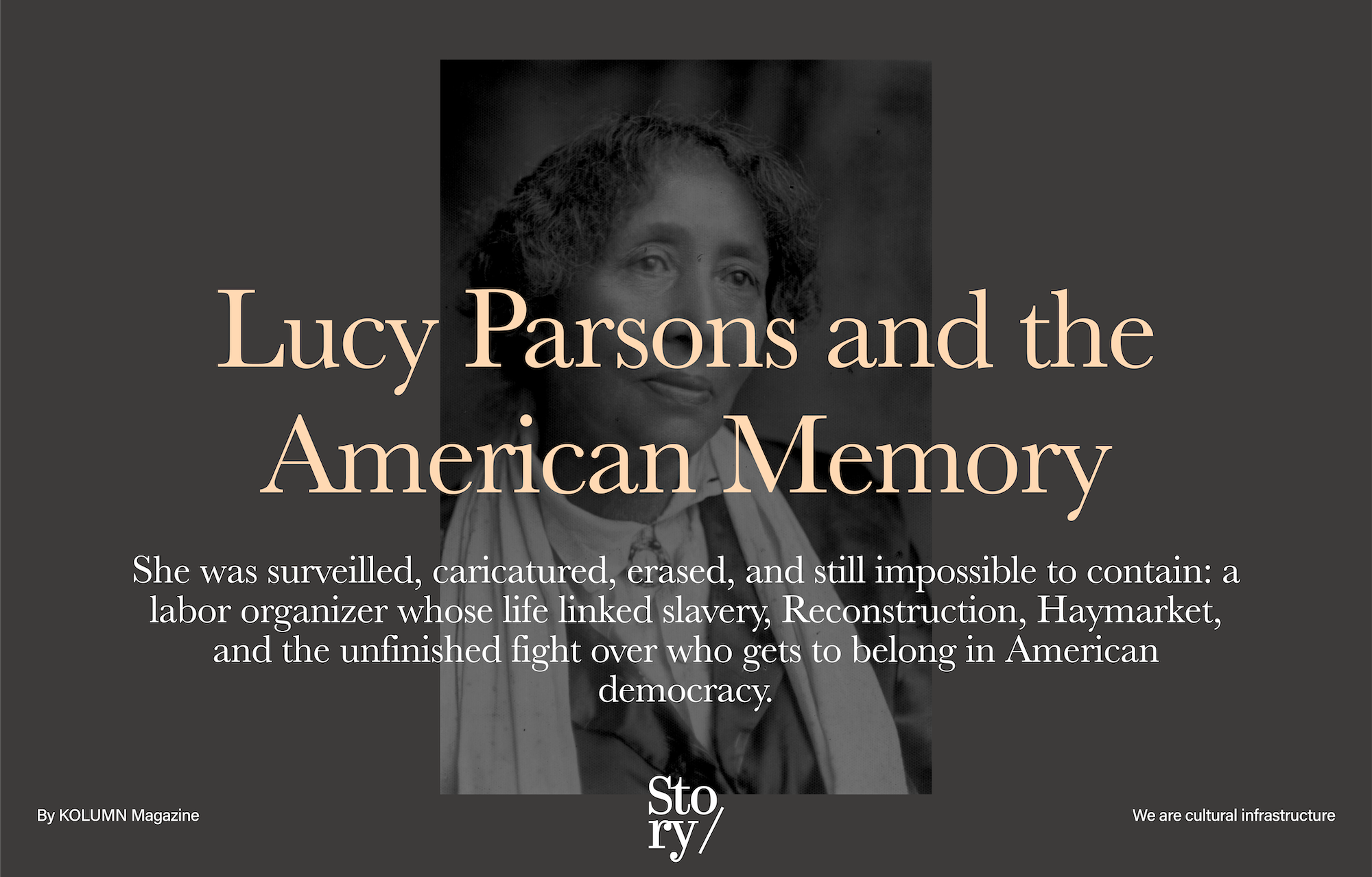
We are the slaves of the slaves.
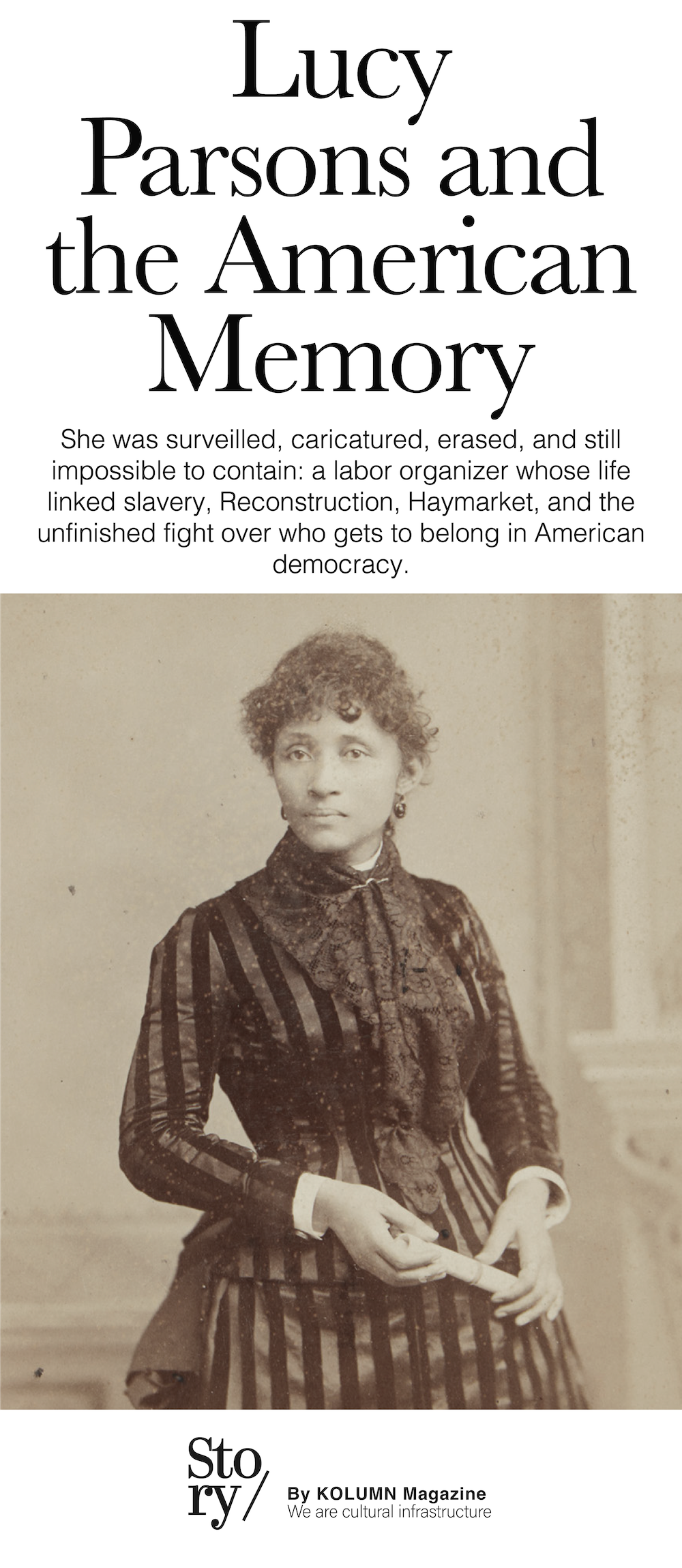
We are the slaves of the slaves.
By KOLUMN Magazine
Lucy Parsons is one of those American figures whose life seems to resist neat packaging on purpose. She was a labor organizer, writer, editor, public speaker, anarchist, widow of a Haymarket defendant, and one of the most formidable street-corner radicals of her era. She was also a person around whom facts, myths, and reinventions gathered almost immediately. Her early life remains contested. Her racial identity remains debated. Her politics remain difficult for liberal memory to domesticate. And maybe that is exactly why she still matters. Parsons does not fit the patriotic script in which reform arrives through moderation, respectable petition, and eventual national gratitude. She belongs instead to the harsher American tradition: the one forged by people who understood that capital, the police, the courts, and the press were often coordinated instruments of discipline, not neutral referees.
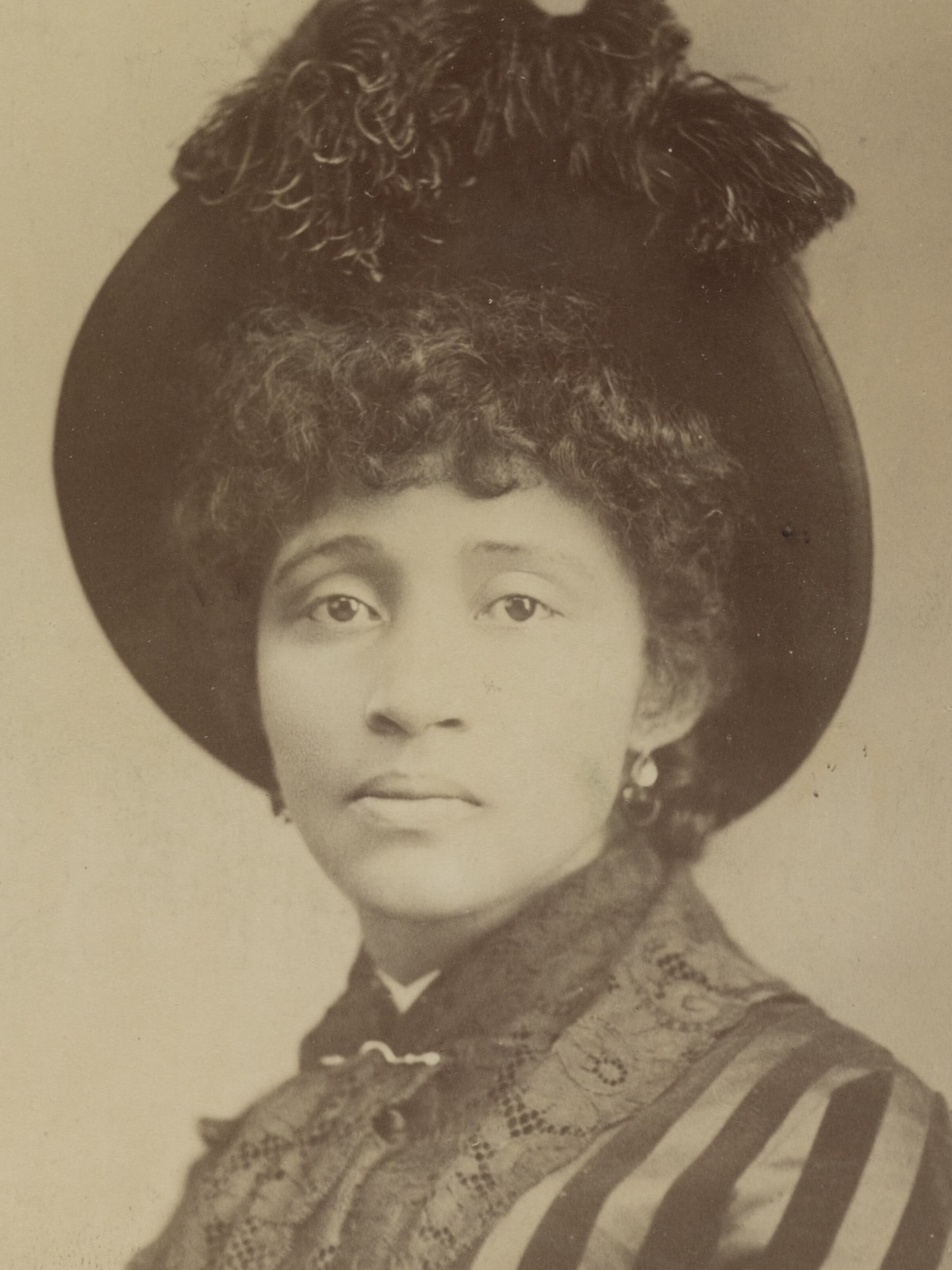
To write about Parsons honestly is to begin with uncertainty, not certainty. Historians broadly agree that she was born around 1851 or 1853 and that she spent at least part of her early life in slavery. Jacqueline Jones, writing for the Texas State Historical Association, traces her as Lucia Carter Parsons, born to an enslaved woman named Charlotte in Virginia, then forcibly moved west to Texas during the Civil War. Yet Parsons herself later offered different origin stories, often insisting she was of Mexican and Indigenous descent and not publicly foregrounding any Black ancestry. The Chicago History Museum notes that her race became the subject of public debate in her own lifetime, weaponized by opponents trying to discredit both her and the politics she represented. In other words, Lucy Parsons was not only fighting class war. She was also navigating the racial taxonomy of a violently hierarchical country that wanted to classify her before it listened to her.
That ambiguity is not a side note. It is central to the story. Parsons lived in a world where interracial relationships were criminalized, anti-Blackness structured everyday life, and political legitimacy was filtered through race and gender. Scholars still dispute how to interpret her self-presentation: whether it was strategic self-protection, personal reinvention, internalized racism, or some unstable combination of all three. What is clear is that Parsons grasped, with unusual sharpness, that identity in America was never merely descriptive. It was policed. It was assigned. It could be used to shrink or disqualify a person before she spoke a single sentence. That she insisted on controlling her own public persona, even when later historians would question or criticize the choice, tells us something about the brutal conditions under which radical women of color or possibly of mixed Black ancestry had to operate in the late nineteenth century.
From Reconstruction Texas to radical Chicago
Before Chicago made her famous, Texas made her. Jones’s account places Parsons in Waco after emancipation, working as a seamstress and domestic laborer, briefly attending school for freed children, and living inside the unstable possibilities of Reconstruction. There she became attached to Albert Parsons, a former Confederate soldier who had undergone one of the more improbable ideological turns of the era, becoming a Republican organizer among newly enfranchised Black voters. Their relationship was politically and socially dangerous. The IWW’s historical sketch notes that anti-miscegenation law and racial terror made their union precarious from the start, and by the early 1870s they left Texas for Chicago amid the retrenchment of white Democratic power. Parsons’s journey from the aftershocks of slavery in the South to the furnace of industrial capitalism in the North is not incidental. It is the bridge that made her politics legible. She had seen one labor regime collapse and another rise.
Chicago in the 1870s was a city of smoke, speed, inequality, and recurring misery. The Chicago History Museum describes the Parsons family arriving in a city still struggling after the Great Fire and in the grip of a national depression. Industrial expansion produced wealth, but it also produced crowded tenements, labor instability, and a swelling class of workers whose lives were treated as expendable. Albert found work as a printer until political organizing got him blacklisted. Lucy, meanwhile, opened a dress shop to keep the family afloat. That detail matters because Parsons’s radicalism was never abstract. She understood labor from the shop floor, from the sewing table, from the household budget, from the gendered expectation that women absorb economic catastrophe without recognition as political actors. Her socialism and later anarchism did not descend from theory alone. They came from the daily mechanics of survival.
The 1877 railroad strike radicalized her further. Jones calls the Great Railroad Strike a turning point for Lucy Parsons, who watched mass worker mobilization challenge concentrated power on a national scale. The IWW biography similarly places the strike at the center of her political evolution, locating her within a moment when Chicago workers were colliding directly with police and state force. Here Parsons seems to have recognized something that would define her for the rest of her life: the wage system was upheld not simply by market logic, but by organized violence. Once that premise was clear, so too was the inadequacy of polite appeals. Labor, in her view, needed not sympathy but power.
A politics shaped by women’s work
Too often, Parsons is flattened into “Albert Parsons’s widow,” as though her political life only begins with his death. That misses the Lucy Parsons who was already organizing women workers in Chicago before Haymarket made her internationally visible. The Chicago History Museum credits her with helping organize the Working Women’s Union, a body that brought together seamstresses, domestic workers, homemakers, and other women often marginalized even inside labor politics. The union advocated equal pay and women’s suffrage, though Parsons herself remained skeptical of electoral remedies. Even here, early, one can see the shape of her worldview: women’s labor was central to capitalism, but women themselves were routinely treated as secondary within movements supposedly devoted to liberation.
Her rhetoric on this subject could be blistering. Speaking at the founding convention of the Industrial Workers of the World in 1905, Parsons declared, “We are the slaves of the slaves.” In the same speech she urged male organizers to “organize the women,” insisting that women were exploited with particular ruthlessness whenever employers wanted to push wages down. Those lines endure because they compress an entire class-and-gender analysis into language no one could mistake for mild reformism. Parsons did not treat women’s oppression as a decorative add-on to labor politics. She treated it as structural, economic, and immediate.
Yet Parsons was never a straightforward fit for any single ideological camp. She could champion women workers while also frustrating later feminists. She could denounce exploitation with fierce clarity while leaving a more uneven record on Black freedom than many admirers would prefer. Jones, in particular, presses hard on this contradiction, arguing that Parsons and Albert largely focused on white urban workers and showed limited sustained interest in Black Chicagoans or Southern Black life for much of their careers. That tension should not be sanded down. It should be confronted. Parsons’s life is not useful because it is spotless. It is useful because it reveals how radical politics can be visionary and constrained at once.
Haymarket and the making of a public radical
If Parsons’s life had ended before 1886, she would still merit historical attention. But Haymarket transformed her from local organizer into national symbol. The eight-hour movement had become a massive labor uprising by May 1886. The Illinois Labor History Society and the National Park Service both place Lucy and Albert Parsons among the key organizers orbiting those demonstrations. Lucy organized sewing workers and participated in marches; Albert spoke at labor rallies. After police killed workers at the McCormick plant, a protest meeting was called for Haymarket Square. The gathering on May 4 was already winding down when police moved in and an unknown person threw a bomb. In the chaos that followed, police opened fire. The event became one of the most consequential flashpoints in U.S. labor history.
The state’s response was swift, punitive, and political. The Chicago History Museum notes that Albert Parsons and other anarchist leaders were sentenced to hang not because authorities proved they had thrown the bomb, but because prosecutors argued their speeches had incited violence. In the version of justice that followed, radical speech itself became prosecutable contagion. Parsons saw clearly what was happening: Haymarket was not just a criminal case, but a public pedagogy. It was meant to teach workers what happened when they organized too effectively and spoke too boldly.
Her husband’s execution in 1887 could have sealed Lucy Parsons inside the role of bereaved widow. Instead, it accelerated her political career. Jones writes that after Albert’s death she launched her own long public life as writer, editor, and agitator-orator, condemning capitalism and denouncing the judge and jury she held responsible. Eric Foner, reviewing Jones’s biography, observed that Parsons in her own time was as celebrated a radical orator as Eugene V. Debs and other better-remembered figures. That is an important corrective. Parsons was not simply adjacent to history; she was one of the voices helping narrate it.
Haymarket did not end Lucy Parsons’s political life. It gave her a larger, harsher stage.
She toured the United States and England, sold publications, edited radical newspapers, and kept Haymarket alive not as a museum artifact but as living indictment. Jones notes that she resisted being reduced to the sentimental “widow of a martyr.” Instead, she used Albert’s death to widen the attack: not only on courts and police, but on capitalism itself. Chicago officials and police, in turn, regarded her as a recurring problem. Her fame grew partly because authorities kept trying to quiet her. Repression, in Parsons’s case, often functioned as publicity.
Speech, scandal, and the American fear of radical women
Lucy Parsons understood spectacle. She was theatrical in the most serious political sense: she knew how to occupy public space, how to turn a confrontation with police into an argument about rights, how to make herself visible in a culture eager to dismiss working-class women as background noise. Jones describes municipal officials trying to suppress her speeches in the 1890s by insisting she display the American flag, an attempt at patriotic discipline that often backfired by enhancing her notoriety. Police followed her, monitored her, and periodically arrested her. The state recognized what posterity sometimes forgets: Parsons could move a crowd.
She also wrote with the same willingness to provoke. Jones notes that for the first issue of The Alarm in 1884, Parsons published the essay “To Tramps,” a text urging the unemployed toward vengeance against the wealthy who profited from their misery. The IWW biography emphasizes that the piece embraced “propaganda by the deed,” making clear that Parsons’s political language could veer toward revolutionary militancy rather than moral suasion. This is one reason she remains hard to assimilate into standard commemorative history. She did not merely expose inequality. She challenged the legitimacy of the order producing it.
At the same time, it is worth resisting the caricature that turns Parsons into nothing but a prophet of violence. Her 1905 IWW speech argued not simply for insurrection, but for labor organization on a vast scale. “We have our labor,” she said, stressing that workers’ real power lay in production itself. In another speech from the convention, preserved in the proceedings, she described the “general strike” as the future method by which workers would take possession of what they produced. The point was not random destruction. It was collective control. Parsons’s radicalism was incendiary, yes, but it was also strategic. She believed the people who made the world should run it.
That distinction matters because American memory often knows how to celebrate labor only when labor is mournful, noble, and nonthreatening. Parsons offered none of those comforts. She spoke to the unemployed, the precarious, the overworked, the criminalized, and the politically unhousebroken. She did so not in the language of uplift but in the language of antagonism. Her public life exposed how much the republic depended on keeping such voices outside the bounds of legitimate citizenship.
Beyond Haymarket: IWW, unemployment, and the long radical century
Parsons’s significance lies partly in her longevity. She did not belong only to one dramatic episode. She linked multiple eras of dissent. The New-York Historical Society’s educational profile notes that she helped found the Industrial Workers of the World in 1905 and continued lecturing on workers’ rights well into old age. The American Yawp transcript of her IWW speech shows her intervening directly in debates about labor structure, women’s representation, and revolutionary strategy. She was not a relic invited for symbolic value. She was an active participant in shaping the politics of industrial unionism.
The IWW mattered because it tried to organize workers across craft lines, across nationalities, and in principle across the divisions capitalism exploited to keep labor weak. Parsons fit that project because her politics had long pushed beyond conventional trade unionism. She distrusted narrow reform and electoral gradualism. She wanted a labor movement large enough to challenge ownership itself. In one of her 1905 interventions, she imagined a society in which “the land” belonged “to the landless,” “the tools” to “the toiler,” and “the products” to “the producers.” It is classic Parsons: unsentimental, sweeping, and materially grounded.
Her activism also kept pace with the emergency of hunger and unemployment. Chicago History Museum resources and Princeton’s African American Studies program both highlight Parsons’s 1915 arrest during an unemployment protest at Hull House. She remained the kind of organizer who showed up where desperation was thickest, not merely where history would later shine a brighter light. Even in her sixties, she was still colliding with police power in the streets. That continuity is part of what makes her extraordinary. Some radicals become more acceptable with age. Parsons remained dangerous to authority because she did not retire into harmlessness.
Later accounts also connect her to the International Labor Defense and campaigns including the fight around the Scottsboro Boys, placing her within the broader radical legal activism of the Depression era. Some of these later episodes are less richly documented in the public-facing sources than Haymarket or the IWW, but the pattern is consistent: Parsons kept gravitating toward cases where class domination, racial terror, and state power overlapped. Even where her own record on race was complicated and sometimes disappointingly thin, she was not indifferent to the machinery of criminal injustice.
The contradictions are part of the story
It would be easy to overcorrect the old erasure by turning Parsons into a flawless icon. That would be another kind of distortion. Jones’s work, along with commentary in the American Historical Association and Black intellectual history circles, insists on a more demanding approach. Parsons could be charismatic and withholding, brilliant and severe, deeply committed to the oppressed while uneven in how she understood race, family, and movement politics. Jones writes candidly about the challenge of confronting aspects of Parsons’s life that were cruel or hard to explain, including her treatment of her son and her studied distance from Black politics.
That harder portrait does not diminish her significance. It sharpens it. Parsons forces historians and readers alike to resist two temptations: the urge to erase radicals because they are inconvenient, and the urge to canonize them because they are useful. She should be approached instead as a major American political thinker formed by trauma, labor, repression, and relentless self-invention. She was never simple, and the movements she inhabited were never simple either. The late nineteenth- and early twentieth-century left was full of brilliance, chauvinism, strategic insight, sectarianism, courage, and contradiction. Parsons stood at the center of that mess, not outside it.
Death, confiscation, and attempted erasure
Parsons died in a house fire in Chicago on March 7, 1942. Her longtime companion George Markstall was fatally injured trying to save her. Even her death, however, did not end the state’s anxiety about her. Jones states that law-enforcement authorities, probably local police working with the FBI, confiscated her substantial library of history, literature, and political theory after the fire. The IWW account similarly says her books and papers disappeared, and later efforts to recover them failed. A MuckRock report on the FBI’s record trail adds a grim modern coda: even the bureau’s files related to Parsons became difficult to trace, as if the archival afterlife of surveillance echoed the broader historical attempt to blur or bury her.
That posthumous seizure feels almost too perfect as metaphor, except it was not metaphor. It was literal. Parsons spent a lifetime speaking against a political order that relied on suppression, and when she died, authorities moved on her books. The gesture said everything. They feared not just the woman, but the continuity of her ideas. That is one reason the line often attributed to Chicago police calling her “more dangerous than a thousand rioters” has endured. Whether repeated exactly as folklore or not, it captures a larger truth about how officials regarded her: not as an eccentric, but as a durable threat.
The state did not merely monitor Lucy Parsons in life. It moved against her archive in death.
Why Lucy Parsons still matters
So what, finally, is the significance of Lucy Parsons? It is not just that she was there at Haymarket, though that would be enough to guarantee a place in labor history. It is that her life ties together some of the deepest American conflicts: slavery and emancipation, Reconstruction and reaction, labor insurgency and police repression, women’s work and political invisibility, free speech and state discipline, radical memory and archival theft. She offers a way to read the United States from below, through the people who made its wealth and suffered its discipline while being told they were disorderly for objecting.
She also matters because she disrupts the false chronology that treats American radicalism as imported, episodic, or somehow alien to national life. Parsons was not an outside contaminant. She was a product of American institutions at their most intimate and brutal: slavery, racial terror, industrial exploitation, criminalized dissent. Her anarchism emerged from inside that experience. To remember her properly is to admit that revolutionary critique is not foreign to the American story. It is one of the story’s native languages.
And then there is the question of labor itself. Parsons understood that a society can celebrate work while degrading workers, praise freedom while criminalizing collective power, and sentimentalize democracy while ensuring that wealth sets the terms. That analysis still lands. The vocabulary has changed; the underlying arrangements often have not. Wage suppression, gendered labor, anti-union hostility, criminalized poverty, the policing of protest, public suspicion toward radical women, all of it remains recognizable. Parsons does not belong to the past in the way monuments prefer. She belongs to the present in the way unfinished arguments do.
Maybe that is why she has been repeatedly rediscovered and repeatedly left at the margins. Lucy Parsons is difficult to market as civic inspiration because she never asked to be inspirational in the approved sense. She asked harder things. She asked who owned the tools, who profited from hunger, who controlled speech, who benefited when women were underpaid, who gained when workers were divided by race, and what exactly people were supposed to do when every legal avenue was designed to preserve someone else’s power. Those questions are not antiques. They are live wires.
In the end, Parsons’s legacy is not reducible to sainthood or scandal. It is something more useful: pressure. She pressures the labor movement to remember women workers and the unemployed. She pressures feminist history to reckon with class conflict and political militancy. She pressures Black history to consider the unstable, contested ways race was lived and narrated under terror. And she pressures American history itself to stop pretending that dissent becomes legitimate only once it is softened, simplified, and stripped of its threat. Lucy Parsons should be remembered not because she was easy to admire, but because she is impossible to understand America without.
More great stories
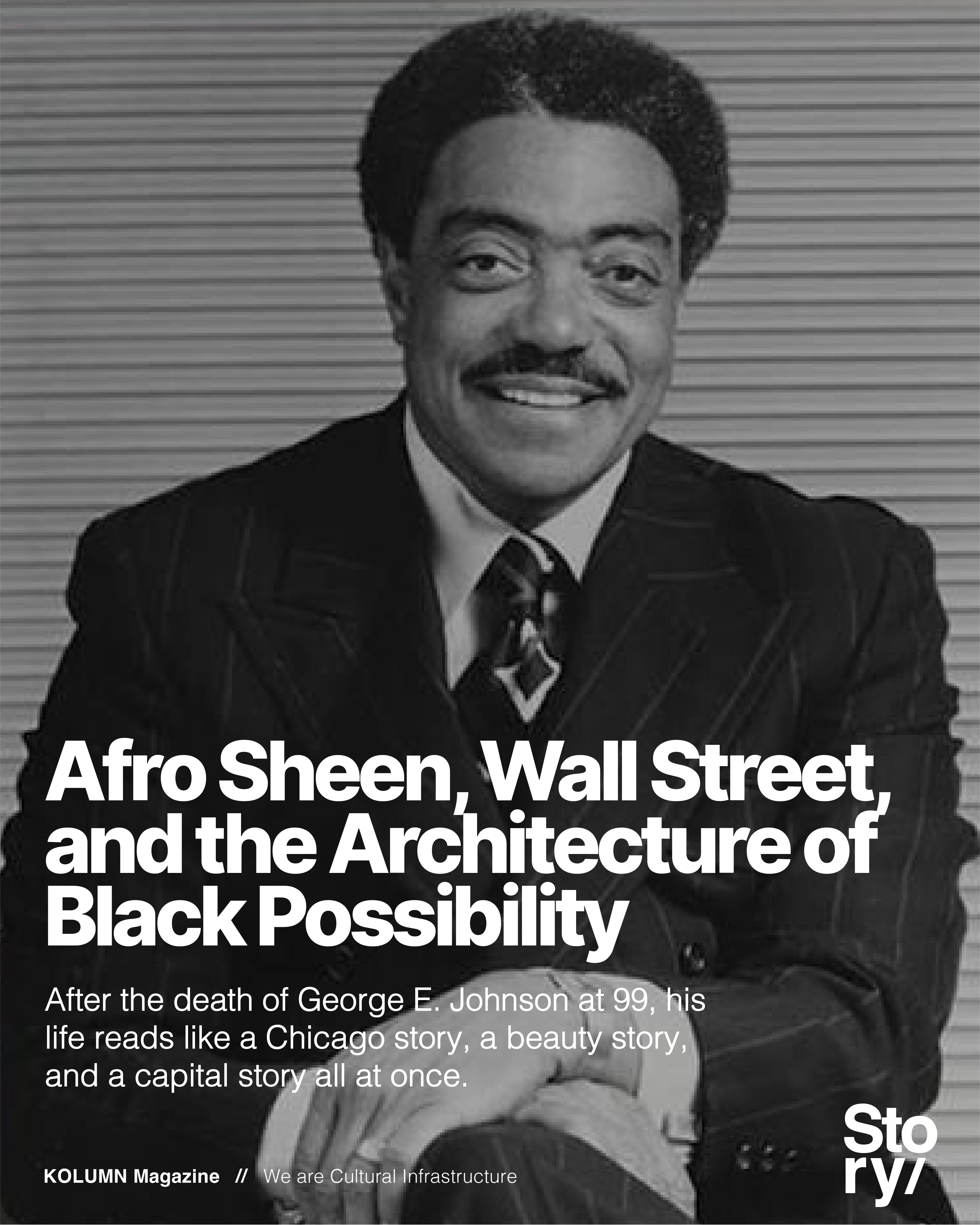
Afro Sheen, Wall Street, and the Architecture of Black Possibility
July 6, 2026
No Comments
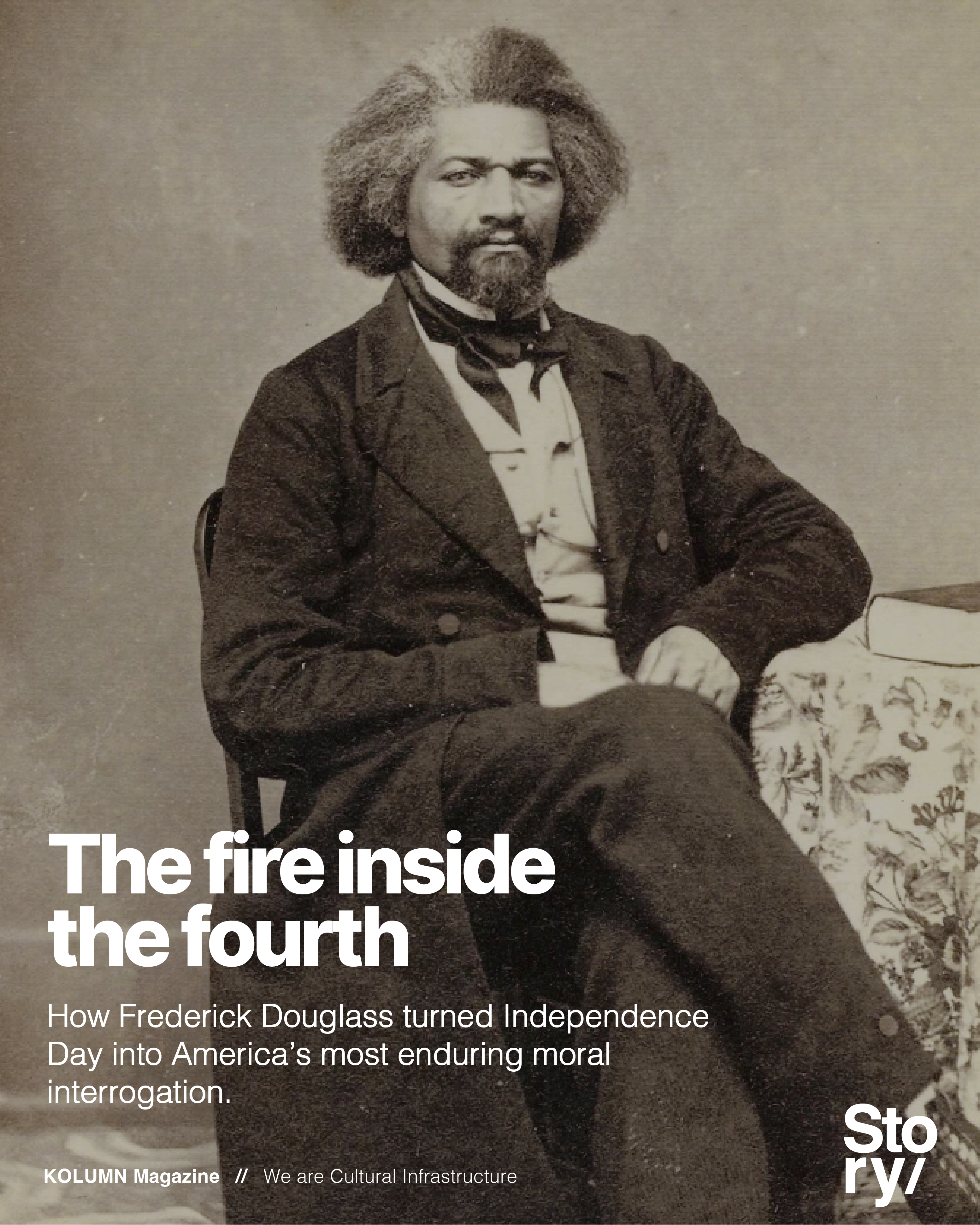
The Fire Inside the Fourth
July 5, 2026
No Comments