




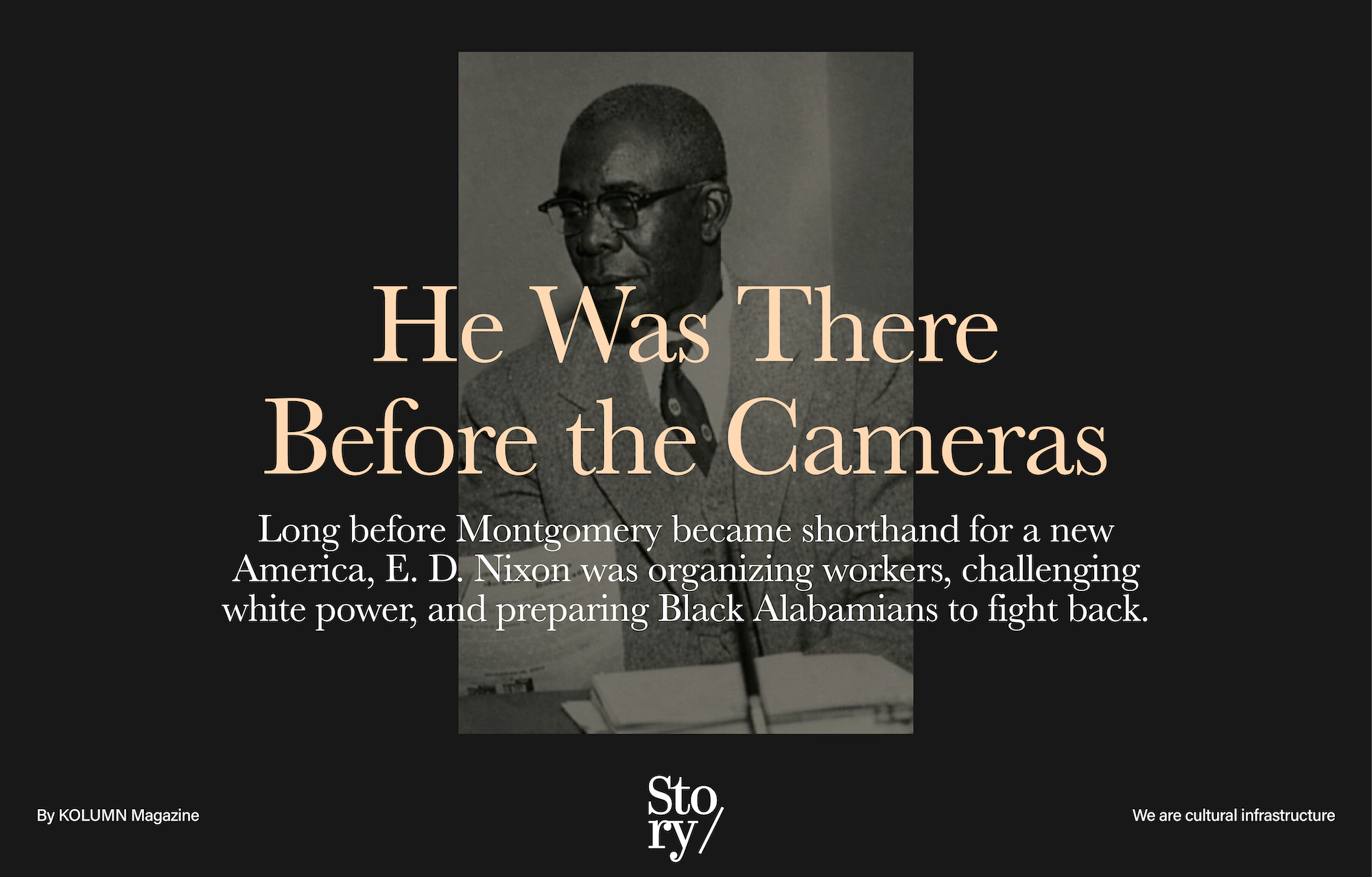
One of the chief voices of the Negro community in the area of civil rights.
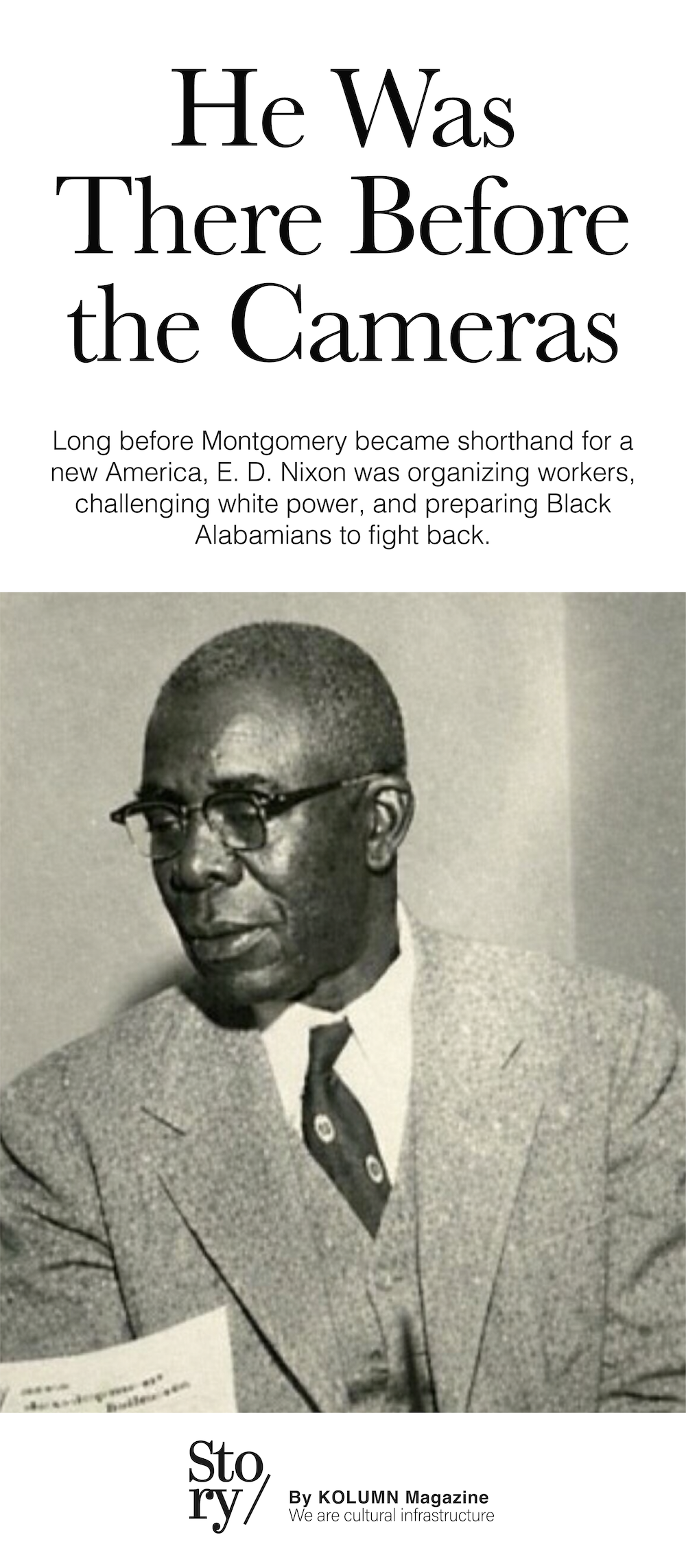
One of the chief voices of the Negro community in the area of civil rights.
By KOLUMN Magazine
The story of Edgar Daniel “E. D.” Nixon is often told in passing, as if he entered American history for a single scene: Rosa Parks is arrested, Nixon posts bond, Martin Luther King Jr. is called, and the Montgomery Bus Boycott begins. That version is not exactly wrong. It is just too small. Nixon was not merely present at one of the hinge points of the civil rights movement. He was one of the people who made that hinge possible. Long before the cameras, long before Montgomery became moral shorthand, Nixon had been doing the unglamorous work that movements require: organizing workers, registering Black voters, building local leadership, studying white power, and teaching ordinary Black residents that the system was not invincible.
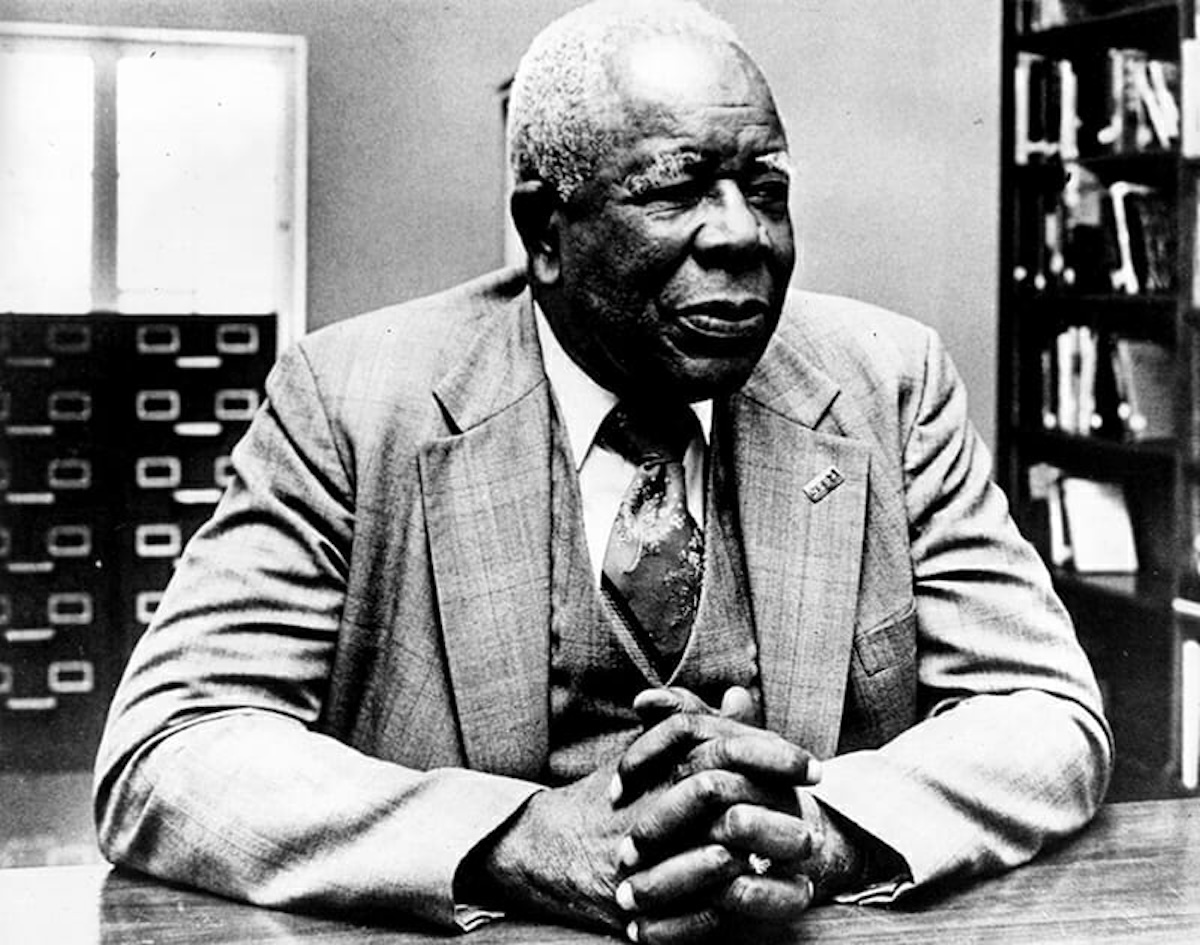
He matters because he helps correct one of the most persistent distortions in how the civil rights movement is remembered. American memory loves symbols. It prefers a bus seat to a union hall, a single speech to a decade of organizing, a charismatic minister to the rough-edged strategist who knew how to pressure a city. Nixon was that strategist. A Pullman porter with little formal schooling, he became one of the most consequential local organizers in Alabama through grit, travel, discipline, and a political education forged inside Black labor organizing. Martin Luther King Jr. later described him as “one of the chief voices” of the Black freedom struggle in Alabama, and that description still feels apt because Nixon’s voice was rarely polished, but it was nearly always clear.
To understand Nixon is to understand that the movement in Montgomery did not start in December 1955. It started years earlier in courthouse lines, union meetings, NAACP branch work, and the accumulated anger of Black residents who paid fares into a system designed to humiliate them. Nixon’s real legacy lies there. He represents a class of local Black organizers whose names are too often eclipsed by the national icons they helped bring forward. In that sense, Nixon is not just a figure in the civil rights story. He is a lesson in how civil rights history actually works.
Born into Jim Crow, trained by necessity
Nixon was born on July 12, 1899, in Lowndes County, Alabama, the son of Wesley Nixon, a Baptist preacher, and Sue Chappell Nixon, who worked as a maid. He had very little formal education; Library of Congress materials note that he had little schooling, and Stanford’s King Institute similarly emphasizes how limited those early opportunities were under segregated Alabama. That fact matters, not because it makes for an inspirational cliché, but because it shaped his political style. Nixon was not produced by elite institutions. He educated himself in the practical school of work, travel, race politics, and survival.
The Alabama Nixon was born into was not simply segregated. It was a place where Black life was tightly managed through law, custom, economic retaliation, and violence. Formal emancipation had long since given way to a regime that narrowed Black movement, Black voting, Black wages, and Black safety. For Black men like Nixon, leadership was rarely something bestowed by title. It was something tested in public conflict: who could speak plainly, who would take a risk, who would return after a threat. Nixon developed that reputation early.
His path into organizing ran through railroad work. Beginning in the 1920s, Nixon worked as a Pullman porter, one of the most visible Black occupations in the country. The job carried a kind of contradictory status. It was steady work and relatively respected within Black communities, but it was built on service, deference, punishing hours, and a racial order that expected Black laborers to be efficient, invisible, and grateful. Porters traveled widely, saw the country beyond their hometowns, exchanged information across regions, and often became politically sophisticated because the job forced them to read people, systems, and power.
That world helped make Nixon. The Brotherhood of Sleeping Car Porters, founded in 1925 by A. Philip Randolph, became the first African American labor union affiliated with the American Federation of Labor. It was not just a union; it was a training ground in discipline, fundraising, leadership, and collective bargaining. Nixon joined that world and eventually founded the Montgomery division of the Brotherhood in 1938. Randolph’s influence on him was profound. Nixon learned that dignity was not an abstraction and that Black workers, when organized, could force institutions to negotiate.
This is one of the essential keys to his significance. Nixon stood at the intersection of labor and civil rights at a time when those histories are too often taught separately. But for him, they were inseparable. The same society that underpaid Black workers also denied them the vote, humiliated them on buses, and expected them to accept second-class citizenship. Union organizing taught Nixon methods that civil rights campaigns would later use: communication networks, member discipline, fundraising, local chapters, leadership development, and the idea that ordinary people can sustain pressure longer than the powerful expect.
The organizer Montgomery already knew
By the 1940s, Nixon had become a central figure in Montgomery’s Black political life. The Library of Congress notes that he organized the Alabama Voters League and served as president of the Montgomery NAACP branch as well as the state conference. Encyclopedia of Alabama similarly describes him as a tireless voting-rights activist who worked to increase Black registration in Montgomery. These were not ornamental posts. In a city where white authorities used registrars, intimidation, and procedural discretion to keep Black citizens from the polls, voter work required stamina and nerve.
Nixon understood something that would define the coming movement: buses mattered, but votes mattered too. He spent years helping Black residents navigate registration rules and confront officials who preferred they stay politically absent. Accounts of his work describe him organizing drives, encouraging Black Alabamians to test the system, and serving as an unofficial advocate for people who needed help dealing with white officeholders, police, and public institutions. He was one of those local leaders whose office, home, and phone line became part grievance center, part strategy room, part emergency response network.
That work also made him a particular kind of leader: not genteel, not always diplomatically smooth, but trusted by working-class Black residents because he did not seem overly concerned with white approval. In many movement histories, respectability politics sits quietly in the background, shaping who is deemed a suitable plaintiff, a good spokesman, a manageable Negro leader. Nixon knew that world well, and he often pushed against it. He wanted results. He was willing to use pressure. He understood that too much caution could become collaboration.
Rosa Parks worked closely with him in the Montgomery NAACP. Library of Congress materials note that under the leadership of Parks and Nixon, the branch focused on voter registration and cases of racial discrimination and violence. That detail helps complicate the flattened schoolbook version of Parks as a tired seamstress acting alone. By 1955, Parks and Nixon were not strangers accidentally thrown together by history. They were seasoned local activists operating inside the same political ecosystem, already thinking about how to confront segregation more directly.
The long road to December 1955
The bus boycott did not spring from a single burst of moral outrage. It emerged from planning, prior incidents, and a shared understanding that Montgomery’s buses were both a daily insult and a strategic point of leverage. Black riders made up the majority of the ridership on the city system, yet they were forced into degrading seating arrangements and routine abuse. Nixon and Jo Ann Robinson of the Women’s Political Council had already concluded that a legal challenge and a coordinated boycott could expose the system’s vulnerability.
This is where Nixon’s reputation as an organizer becomes especially important. He did not simply react to events; he prepared for them. Sources from Stanford and the National Park Service indicate that local activists had been looking for the right case to challenge bus segregation. The movement had seen earlier acts of resistance, including Claudette Colvin’s arrest in March 1955, but movement leaders knew that the legal and political conditions around a case mattered. They needed not just outrage, but a plaintiff the wider Black community and the courts could rally around under the harsh standards of the time.
When Rosa Parks was arrested on December 1, 1955, Nixon moved immediately. The Library of Congress records that he helped bail Parks out of jail, joined by Clifford and Virginia Durr. Britannica notes that Nixon and Jo Ann Robinson quickly printed and distributed leaflets calling for a one-day boycott on December 5, the date of Parks’ trial. This rapid response was not improvisation in the loose sense. It was improvisation made possible by years of preparation, relationships, and political instinct. Nixon knew that history rarely announces itself politely. When the opening came, he recognized it.
“On the morning of December the 5th, I hung him to the stars.”
That memorable Nixon line, recalled in a later interview, referred to his role in helping elevate King into the presidency of the Montgomery Improvement Association. It is a boast, yes, but also a revealing one. Nixon recognized that movements need messengers as well as mechanics. He had organizational experience and local credibility, but he also understood that a young minister, new enough to town to be less compromised by local white power, could become an effective public leader. Stanford’s King Institute notes that Nixon helped launch the MIA and that King’s emergence happened through these behind-the-scenes calculations.
What followed has entered American civic mythology: the one-day boycott succeeded, mass meetings swelled, carpools formed, and the Montgomery Improvement Association became the formal vehicle of a longer struggle. But even within that story, Nixon’s role is often compressed. He was not just the man who made the phone calls. He brought labor discipline, community contacts, fundraising competence, and a working-class urgency to the effort. King later wrote to Nixon thanking him for the “very fine service” he rendered as treasurer, especially when national donations began pouring in. The letter is a reminder that moral drama still requires bookkeeping, transportation, and administrative trust. Nixon handled those realities.
The boycott’s backbone, not just its spark
The Montgomery Bus Boycott lasted 381 days, far longer than many expected, and it required a scale of endurance that no single speech could produce. Black residents walked, shared rides, reorganized workdays, and absorbed harassment. Bus segregation was eventually struck down through Browder v. Gayle, the federal case that dismantled the city’s bus seating regime. Nixon’s contribution here was strategic and structural. He understood from labor organizing that solidarity is not a mood. It is logistics.
He also knew the danger was real. During the boycott, white retaliation escalated beyond rhetoric. King’s home was bombed in January 1956, and Nixon’s home was bombed on February 1, 1956. The Encyclopedia of Alabama and other sources note that Nixon was not at home when the explosion occurred. The point of the bombing was not only physical destruction. It was political theater meant to restore fear. Nixon stayed in the struggle anyway.
This willingness to remain public under threat is part of what made Nixon formidable. He did not perform moderation for comfort. He had spent years in confrontation with Alabama’s racial order and understood that white violence was not an exceptional response but a routine instrument of governance. That realism made him useful and, at times, difficult. He was less interested in graceful symbolism than in effective pressure, and that could create friction inside a movement increasingly centered around ministers, public respectability, and national media narratives.
Those tensions mattered. Encyclopedia of Alabama notes that although Nixon was widely recognized as the de facto leader of Montgomery’s Black community, he was named treasurer, not president, of the MIA, and his relationship with King remained strained. Stanford’s King papers preserve Nixon’s later frustration at “being treated as a newcomer” despite his foundational role. This is not a minor side note. It reveals a deeper pattern in movement history: the people who initiate struggle are not always the ones most rewarded by the public memory of it.
Why Nixon was sidelined in memory
There are several reasons Nixon’s name is less familiar than it should be. One is narrative convenience. American civic storytelling prefers the clean arc of Rosa Parks, Martin Luther King Jr., and a city awakened by conscience. Nixon complicates that story because he brings class, labor, planning, internal movement tension, and local political realism into view. He reminds us that great public moments often depend on people who are not especially camera-friendly.
Another reason is style. Nixon was not polished in the way midcentury America found reassuring. He could be blunt, impatient, and openly critical of ministers and middle-class caution. He did not always speak in cadences meant to soothe. But movements need people like that. They need organizers who can force a room to make a decision, who understand that institutions rarely yield because they have been eloquently asked. Nixon’s labor background sharpened precisely that sensibility.
There is also the question of national mythology. King became, for obvious reasons, the symbolic center of Montgomery in American memory. Parks became the moral catalyst. Both deserve their place. But the focus on national icons often leaves local organizers in the footnotes. In that sense, Nixon belongs to a larger gallery of undercredited Black movement workers whose labor was essential but whose stories were less convenient for textbook heroics. Restoring Nixon to fuller view is not about diminishing other figures. It is about telling the truth about collective action.
“Again, let me express my personal appreciation to you.”
That line from King’s 1957 letter to Nixon carries more than courtesy. It reads, in retrospect, like an acknowledgment of debt. Even amid strain, King recognized that Nixon had rendered indispensable service to both the organization and Montgomery itself. It is one of the clearest documentary reminders that Nixon was not an extra in the boycott story. He was one of its principal engineers.
Beyond the boycott
Nixon’s life did not end with the buses, and neither did his activism. Stanford notes that in his later years he continued civil rights work focused on housing conditions and programs for African American children. After retiring from railroad work in 1964, he remained a civic presence in Montgomery, still oriented toward the material dimensions of freedom rather than a purely commemorative politics. He received the NAACP’s Walter White Award in 1985, and his home was placed on the Alabama Register of Landmarks and Heritage in 1986.
That later chapter is worth lingering over because it reflects a continuity too often missed. Nixon’s politics were never confined to one issue. Voting rights, labor rights, transportation, housing, education, children’s opportunities: these were not separate boxes to him. They were interlocking dimensions of Black citizenship. His activism reads, even now, as insistently material. He wanted Black people to be able to vote, travel with dignity, work with leverage, live decently, and move through public institutions without abasement.
He died in Montgomery on February 25, 1987, at age 87. Encyclopedia of Alabama notes that people from many walks of life came to his funeral at Bethel Baptist Church. Even in death, the record suggests a man who was deeply known in the city he helped change, even if the broader nation had not fully caught up. Recognition has grown slowly since then, through school namings, preservation efforts, documentary work, and the continued recovery of local civil rights histories. But “slowly” is the key word. Nixon has often been honored as a supporting character in other people’s stories, rather than as a major historical subject in his own right.
What E. D. Nixon teaches now
- D. Nixon’s life matters in the present because it clarifies what organizing is and what it is not. It is not merely spontaneous outrage, though outrage has its place. It is not branding. It is not the assumption that visibility equals leadership. Nixon’s life points instead to infrastructure: unions, local chapters, trusted relationships, political education, tactical flexibility, and a willingness to keep working after the cameras leave.
He also complicates easy distinctions between labor justice and racial justice. The Brotherhood of Sleeping Car Porters was not incidental to the civil rights movement; it was one of its schools. Nixon embodied that overlap. He learned from Randolph’s unionism that Black dignity had to be organized, funded, defended, and made legible to institutions that preferred exploitation. That lesson did not stop at wages. It ran all the way to buses, ballots, and public citizenship.
And perhaps most importantly, Nixon reminds us that movements need different kinds of leadership. They need prophetic voices, yes, but they also need practical strategists. They need people who can inspire and people who can execute. Nixon belonged firmly to the second category, though he could inspire in his own rough-edged way. Without people like him, the moral witness of a movement never becomes institutional pressure. Without people like him, symbolic acts remain symbols.
The civil rights movement is often narrated as if history turned because the nation suddenly saw the light. Nixon’s life tells a sterner and more useful truth. History turned because Black people in places like Montgomery prepared for years, argued with one another, built organizations, made tactical choices, endured retaliation, and forced a segregated order into crisis. Nixon was one of the people who understood that before many others did. He knew that freedom was not granted to the patient. It had to be organized.
That is why E. D. Nixon deserves a larger place in the story. Not as a correction for the sake of novelty, and not because history needs yet another rediscovered man to stand behind a more famous one. He deserves it because the record shows he earned it: a porter who became a union leader, a local organizer who became a statewide force, a movement mechanic who recognized a catalytic moment and helped turn it into a campaign that changed the country. America remembers the bus. It should remember the builder, too.
More great stories
Afro Sheen, Wall Street, and the Architecture of Black Possibility
July 6, 2026
No Comments
The Fire Inside the Fourth
July 5, 2026
No Comments