





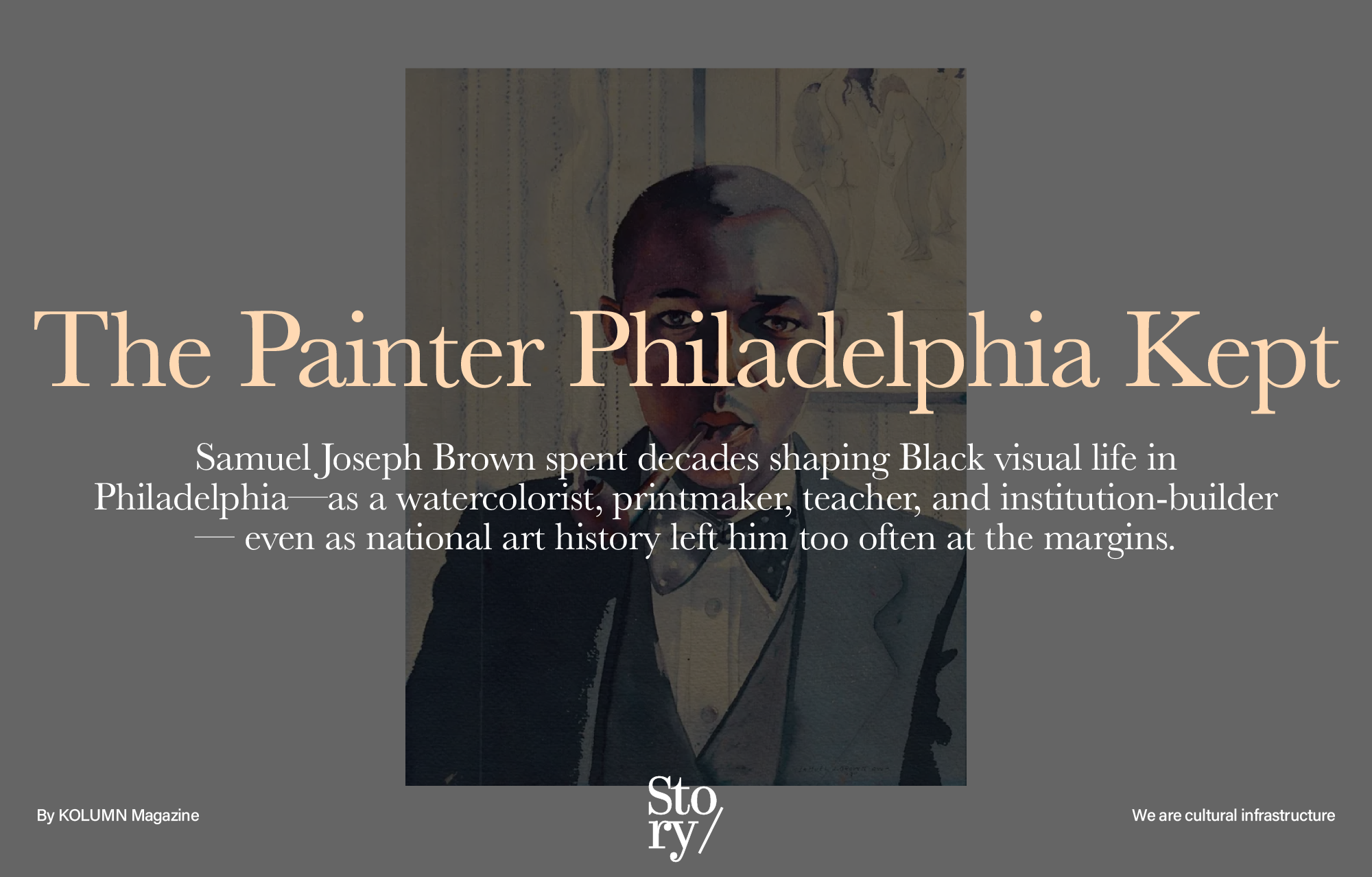
Brown’s art insisted that Black life was not peripheral subject matter. It was central material for American modernity.
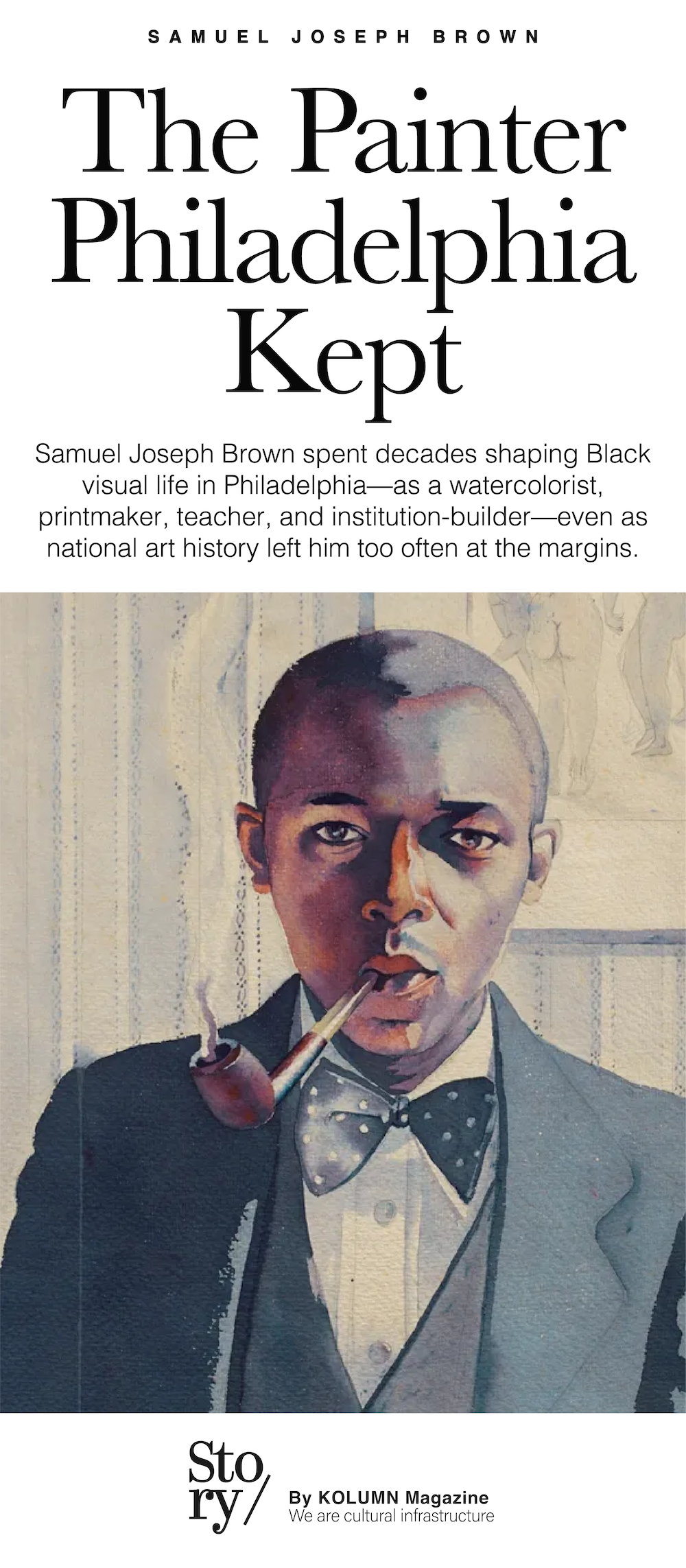
Brown’s art insisted that Black life was not peripheral subject matter. It was central material for American modernity.
By KOLUMN Magazine
There are artists who become famous because the market decides they are useful symbols, and there are artists who become essential because they keep showing us how a culture actually survived. Samuel Joseph Brown belongs in the second category. He was not the kind of artist whose name became shorthand in introductory textbooks, at least not in the way it should have. But the deeper you look into twentieth-century American art—especially Black art, especially Philadelphia art, especially the art shaped by the New Deal, public education, and Black civic institutions—the harder it becomes to tell the story honestly without him. Brown was a watercolorist, printmaker, painter, educator, and community figure whose life ran through nearly every important corridor of Black artistic development in Philadelphia. He was born in Wilmington, North Carolina, in 1907, moved to Philadelphia as a child in 1917, studied at the Pennsylvania Museum and School of Industrial Art, earned a graduate degree from the University of Pennsylvania, and went on to teach art in the Philadelphia public schools for more than three decades. Museums including the Metropolitan Museum of Art, the Philadelphia Museum of Art, Woodmere Art Museum, PAFA, and the Smithsonian American Art Museum hold his work or biographical records.
That résumé alone would be enough to secure a place in regional history. But Brown’s importance is larger than résumé. He mattered because of what he painted, because of when he painted, because of the institutions he inhabited, and because he kept returning his gaze to Black people not as symbols of crisis alone, but as full human beings occupying homes, streets, classrooms, neighborhoods, and fragile private worlds. He worked in watercolor with a confidence that could look both tender and severe. He made prints during the era of the Works Progress Administration, when Black artists were often required to navigate a strange contradiction: the federal government opened doors, but the larger culture still insisted on narrowing how Black life could be seen. Brown stepped into that contradiction and made art that was neither obedient propaganda nor detached formalism. It was grounded, observant, and morally alert.
One of the most striking facts about Brown’s career is that he is widely identified as the first African American artist hired for the Public Works of Art Project, the federal relief initiative that preceded the WPA’s Federal Art Project. That distinction matters not as trivia, but as an index of what he represented in the early 1930s. Federal art programs were not simply jobs programs; they were engines of cultural legitimacy. To be chosen meant that one’s work could be understood as part of the nation’s visual record. For a Black artist in that moment, especially in Philadelphia, that recognition carried unusual force. Brown was not merely entering a program. He was crossing a line that the American art world had spent decades drawing around Black participation.
What also sets Brown apart is that he was never only a studio artist. He shared a studio with Dox Thrash, one of the great Black printmakers of the era. He led the Tra Club, an informal association of African American artists in Philadelphia. He was a member of the Pyramid Club, one of the city’s most important Black professional and cultural institutions. He later served on the board of the Brandywine Workshop and Archives, a major Philadelphia printmaking center, and a scholarship was created in his name at the University of the Arts. In other words, Brown’s importance was distributed across objects, classrooms, exhibitions, friendships, and institutions. He was not an isolated genius waiting to be rediscovered. He was part of a Black artistic ecosystem, and in many ways he helped sustain it.
A Southern birth, a Philadelphia formation
Samuel Joseph Brown’s biography begins in the South and matures in the North, which places him in a familiar but still powerful twentieth-century Black American arc. Born in Wilmington, North Carolina, in 1907, he moved with his family to Philadelphia in 1917. That move matters. Philadelphia was not free of anti-Black exclusion, far from it, but it was a city with dense Black institutional life: schools, churches, clubs, newspapers, fraternal organizations, and eventually art spaces that created room—however constrained—for a Black artist to imagine a career. Brown came of age in that environment and studied at the Pennsylvania Museum and School of Industrial Art, later known as the University of the Arts. Woodmere notes that he also earned a master’s degree from the University of Pennsylvania. The Met’s collection text similarly situates him as a highly trained artist who entered federal art work after graduate study.
That educational path is worth lingering over, because it complicates an old stereotype about Black artists of the early twentieth century as either “folk” figures or permanently under-credentialed outsiders. Brown was technically trained. He learned design, composition, drawing, and the disciplines of art education. His work shows that training everywhere: in the careful structure of his portraits, in the control of line in his prints, in the way he balanced intimacy with formal rigor. Yet the polish of his technique never made the work feel stiff. Brown’s best pictures do something harder. They preserve the touch of a person looking slowly, and looking with care.
Philadelphia also gave Brown access to artistic fellowship. His long association with Dox Thrash is not a footnote; it is part of the social history of Black art. Thrash, a major printmaker, and Brown shared studio space and, according to Woodmere, remained linked through creative and communal circles. Scholarship on Black printmaking in the WPA years places Brown and Thrash within a broader network of artists using print media to depict labor, urban conditions, and Black life through the social realist demands of the period, even as they retained distinct personal vocabularies.
This context helps explain Brown’s double fluency. He could work within public art systems, school systems, and exhibition systems, but he never reads like an artist swallowed by bureaucracy. His art is too intimate for that. Even when the subject is public, the feeling is personal. Even when the medium is reproducible, the sensibility is singular.
The New Deal and the politics of being seen
Brown’s entrance into federal art work in the early 1930s placed him at a decisive historical crossroads. The Public Works of Art Project, followed by the WPA’s Federal Art Project, opened employment opportunities to artists during the Depression. But for Black artists, the door was never fully open. Federal sponsorship existed alongside segregation, exclusion, and an art establishment that often treated Black makers as ethnographic curiosities, social problems, or occasional novelties. To say Brown was the first African American artist hired under Philadelphia’s PWAP is to say he entered a space where representation itself was contested.
That is one reason his 1930s work feels so consequential. The decade was not merely “productive” for him; it was formative for the public role of Black art in Philadelphia. The Met holds Brown’s Self-Portrait from around 1941 and his linocut Wash Girl, published by the WPA and given to the museum by the Pennsylvania WPA in 1943. Those details matter because they show Brown not at the margins of New Deal art, but inside its circulatory system. His work was printed, distributed, collected, and preserved by major institutions. Yet he remained a distinctly Black observer of Black life, not a generic regional painter stripped of social location.
The scholarship around Black printmakers of the WPA era helps sharpen the point. In Panorama, Erin Benay places Brown and Dox Thrash among artists whose prints addressed labor, urban squalor, and facets of Black life while also responding to the accessible social realist idiom encouraged by WPA structures. That framework is useful because Brown’s significance is not just that he painted Black subjects. Plenty of artists did. His significance is that he helped define how Black life could appear in a federally supported visual language without being flattened by it.
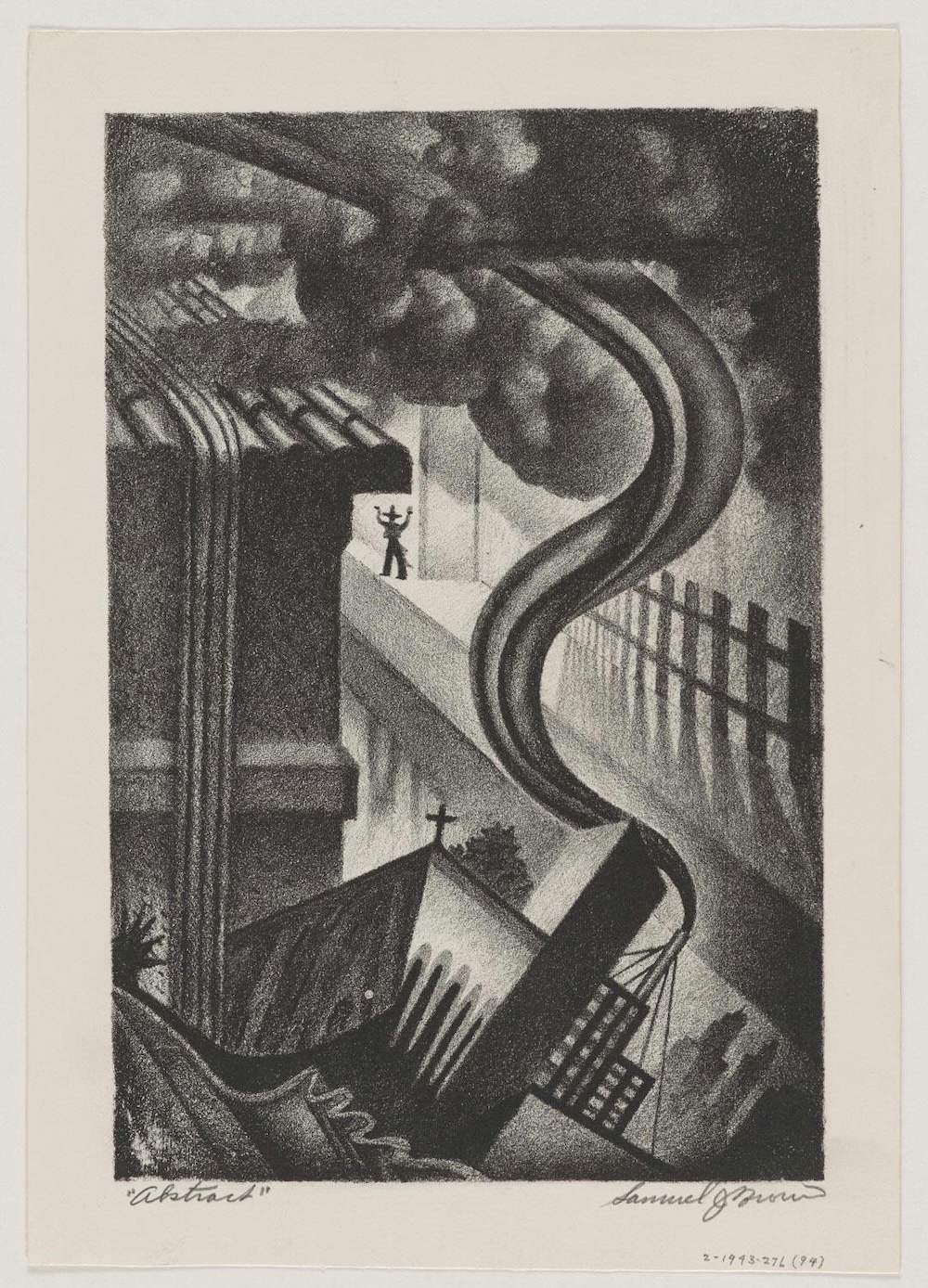
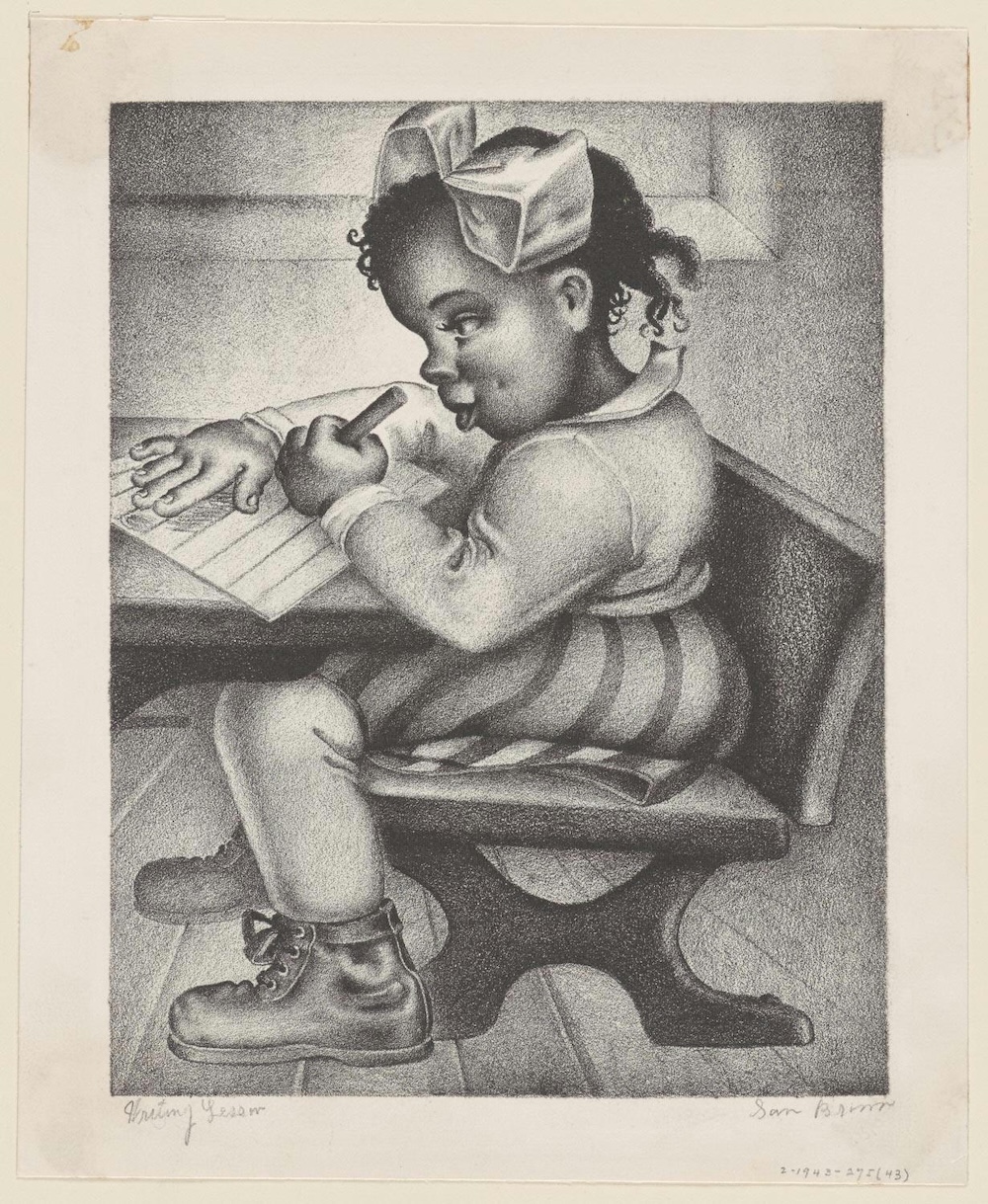
This balancing act becomes even clearer when one looks at works like Wash Girl and Writing Lesson. Wash Girl, dated 1935–43, is a linocut published by the WPA. Writing Lesson, a 1937 lithograph now at PAFA, also comes directly out of Brown’s printmaking period. These are not grand allegories. They are scenes of labor and learning, everyday life and formation. The choice of subject is itself ideological, but not heavy-handedly so. Brown understood that the ordinary life of Black people—washing, studying, sitting, looking, existing—deserved aesthetic seriousness. That may sound obvious now. It was not obvious in a culture determined to turn Black people into caricatures or abstractions.
The self-portrait as argument
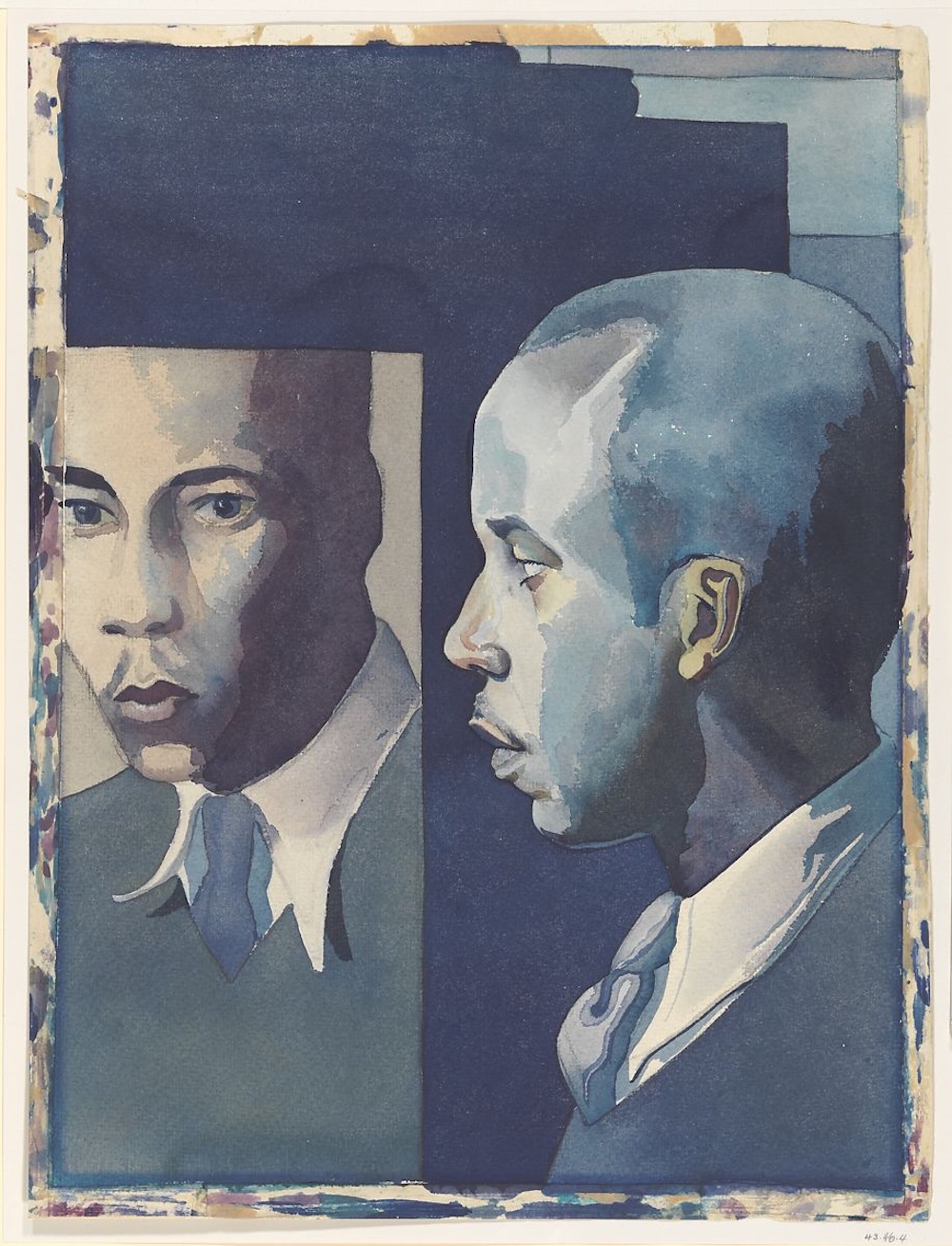
Brown’s Self-Portrait at the Met is one of the clearest windows into his artistic intelligence. The museum describes the watercolor as using flattened forms and matte surfaces to create a pensive mood, with the artist seen both in profile and in three-quarter view through a mirror arrangement that generates what the Met calls an “echo chamber of dualities.” That is a museum phrase, but it gets at something real. The work is not simply a likeness. It is an argument about self-perception, self-construction, and the instability of how Black artists are seen.
A lesser painter might have used self-portraiture as proof of skill. Brown uses it as a meditation. The deep blues, the inward concentration, the doubled image—all of it suggests a man who understands that the self is always partly social and partly withheld. For a Black artist working in the first half of the twentieth century, that formal choice resonates beyond psychology. It touches the politics of recognition. Who gets to look? Who gets to define the terms of looking? Who is the subject, and who is the audience?
This is where Brown’s art starts to feel startlingly contemporary. Much current writing on Black portraiture emphasizes agency, opacity, and self-fashioning. Brown was already there. He was not theorizing those ideas in academic prose, but he was painting them. His self-portrait does not surrender the self for easy consumption. It stages access, then complicates it. It invites us close, then reminds us that closeness is not ownership.
His later 1985 Self-Portrait, held by the Philadelphia Museum of Art and Woodmere, offers another register entirely. Woodmere notes that Brown appears to look thoughtfully past the viewer, “as if reflecting on the trajectory of life,” and connects the print to his work with the Brandywine Workshop and Archives, where he served on the board after retiring from the public school system. The older Brown in this image is no longer a young man negotiating entry. He is a senior artist surveying a lifetime. The technical means are different, but the insistence on self-definition remains.
Portraits, children, and the moral force of tenderness
One of the recurring misunderstandings about socially engaged Black art is that it must always arrive in a raised voice. Brown’s work offers another possibility. Sometimes the radical act is tenderness. Sometimes the political refusal lies in painting Black children with dignity, precision, and emotional range. Sometimes the argument is made through care.
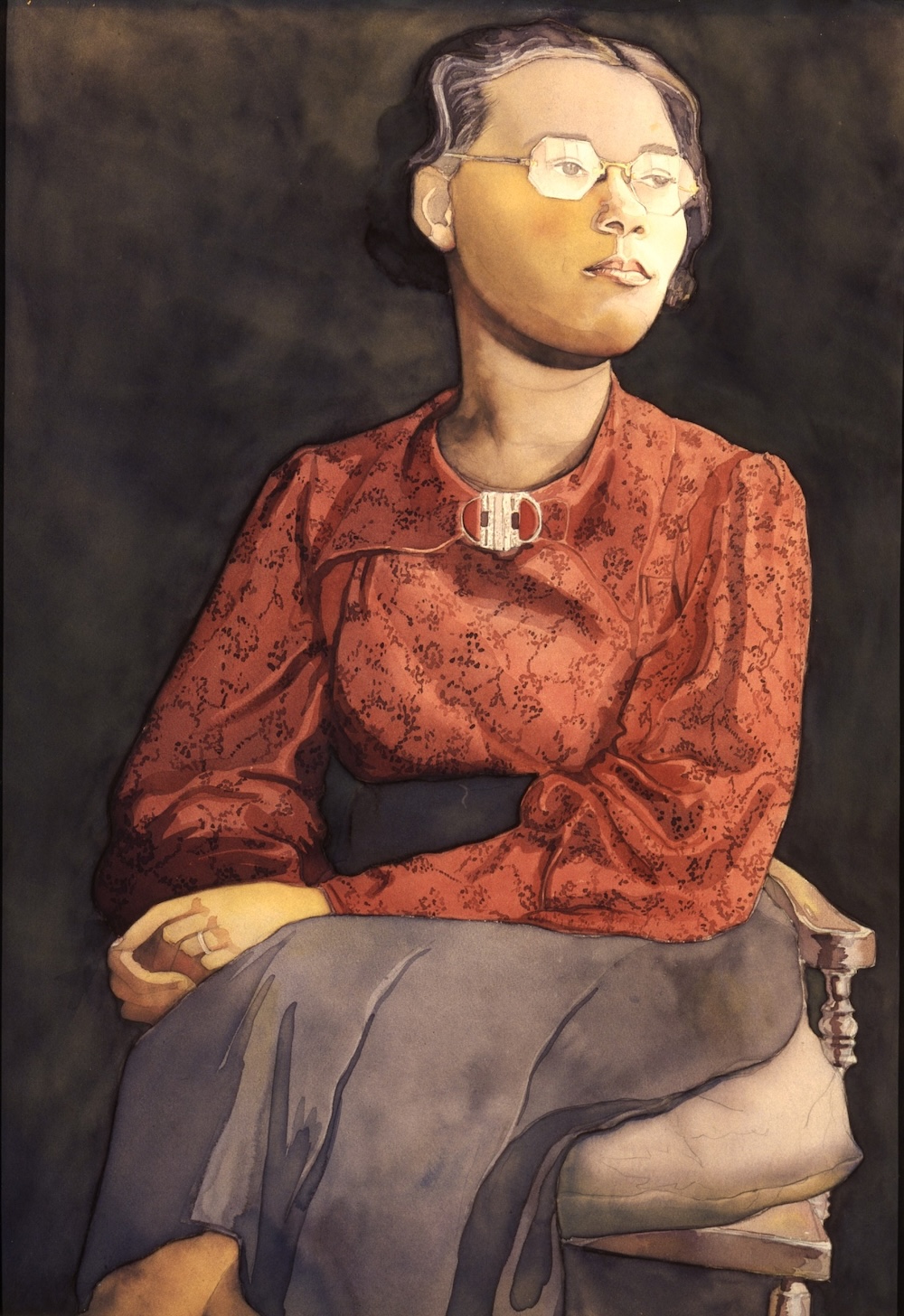
Woodmere’s description of Urlene, Age Nine is devastatingly simple. The 1956 watercolor depicts Brown’s daughter. The museum calls it “tender” and “delicately painted,” noting the large eyes, soft purple light, and details of her shirt and pink bow, while also explaining that she died at a young age. Brown turns private grief into portraiture without exploiting it. The work does not dramatize sorrow; it holds memory still. That restraint is part of its power.
It also reveals something crucial about Brown’s practice. He was not only a documentarian of public Black life. He was an artist of family feeling, private loss, and emotional atmosphere. In a field where Black representation was often forced toward either uplift or protest, Brown made room for vulnerability. He understood that portraiture could be a site of mourning as well as celebration.
The same is true, in a different register, of Brown’s images of children and students. Writing Lesson centers schooling. His later “One World” poster series, produced while he was teaching at Dobbins High School, was described as a project devoted to “the glorification of the Negro child” and to fostering interracial goodwill through scenes of children from different racial backgrounds. That language survives in accounts of the work because it captured Brown’s own stated ideal. Eleanor Roosevelt purchased a set and donated it to a school in Hyde Park. Whether one reads the phrase “One World” as liberal optimism, postwar pedagogy, or aspirational pluralism, the deeper point is that Brown saw children as subjects worthy of beauty and ethical seriousness.
There is a temptation, especially now, to treat such work as naïve because it sought common humanity in an unequal society. That would be too easy. Brown was not unaware of racial violence. One of his notable early works was The Lynching, which drew attention in the 1930s. He knew perfectly well what America was. The remarkable thing is that he refused to let that knowledge become the only visual grammar available to him. He painted terror when necessary, but he also painted learning, reflection, flowers, selfhood, and childhood. That breadth is a kind of artistic sovereignty.
The classroom as studio, the teacher as cultural worker
Brown taught art in the Philadelphia public schools for more than thirty years. That fact should not be filed away as the practical day job of an artist who really lived elsewhere. For Brown, teaching was part of the work. Woodmere states plainly that he taught in the Philadelphia school system for over three decades, and other biographical accounts place him in the district beginning in 1938 and continuing until retirement in 1971. His later role at Brandywine, and the scholarship created in his name, underline how central education was to his legacy.
This matters because Black art history is full of figures whose institutional labor has been undervalued. The teacher is too often treated as secondary to the “real” artist, as though mentoring, curriculum-building, and cultivating younger makers were somehow separate from cultural production. In Black artistic communities, that division rarely holds. Schools, workshops, clubs, and informal networks are part of how the art exists at all.
Brown taught commercial art and public-school students while making his own work. That means he lived at the intersection of fine art, vocational instruction, and community formation. He was not perched above ordinary life; he was embedded in it. Generations of students encountered art through him not in museums, but in classrooms. That may be one reason his pictures retain such lucidity. He knew what it meant to make images legible without making them simplistic. He understood communication as craft.
There is another angle here, too. Teaching gave Brown a form of stability that many artists never get. But stability came with cost. Time spent in schools is time not spent courting dealers or building myth. The American art market tends to reward self-promotion, geographic mobility, and elite institutional absorption. Brown’s life moved differently. He stayed local in ways that were artistically rich but commercially limiting. The result is that he became foundational without becoming loudly canonical.
That tension—between centrality and under-recognition—is the key to his legacy. Brown helped make a Black Philadelphia art world that later institutions could claim as heritage. Yet the broader national canon has often treated such builders as supporting characters in other people’s stories. Recovering Brown means rejecting that hierarchy.
Philadelphia, clubs, and Black institution-building
To understand Brown, you have to understand Black Philadelphia not just as a backdrop, but as infrastructure. He was head of the Tra Club, an informal art association for African Americans in the city. He was also a member of the Pyramid Club, which became a major site for Black professional and artistic exchange. These affiliations tell us that Brown’s career was not organized around individual ambition alone. It was organized through Black civic life.
The Tra Club deserves more attention than it usually gets. Informal artist associations are often where careers are tested, friendships made, criticism offered, and exhibition habits formed. For Black artists excluded from many mainstream institutions, such spaces were not marginal. They were essential. Brown’s leadership role suggests that he was trusted not just for his talent but for his steadiness, seriousness, and capacity to anchor a collective.
The Pyramid Club carried another kind of significance. Founded as a Black professional men’s club in Philadelphia, it became an important venue for exhibitions and cultural affirmation. Brown’s presence there located him within a wider Black middle-class and intellectual milieu—one invested in art as a marker of civic achievement and racial self-definition. A photograph record at Temple’s digital collections places Dox Thrash and Brown in a Pyramid Club setting, reinforcing how these artistic and social networks overlapped. Even without every archival detail, the outline is clear: Brown was woven into the institutions that enabled Black cultural life to endure.
This institutional embeddedness is one reason Brown’s career resists the romantic narrative of the lonely misunderstood genius. He was misunderstood, perhaps, by the broader canon. But he was not alone. He belonged to a matrix of Black artists, teachers, clubs, and workshops. In today’s language, we might call him an ecosystem figure. He made work, yes, but he also maintained conditions under which work could be made.
Why the canon lagged behind
If Brown was this important, why is he still not widely known outside specialist circles? The answer is not singular, but several forces seem clear.
First, Brown occupied genres that the mainstream canon has historically undervalued. Watercolor, printmaking, school-based art education, regional exhibition circuits, club-based art communities—none of these automatically generate the kind of prestige machinery attached to oil painting, Manhattan galleries, or market-driven retrospective culture. Yet those supposedly secondary spaces are often where Black artistic innovation survived. Brown’s career exposes the bias in the canon rather than a limitation in the work.
Second, Brown’s art was deeply tied to Philadelphia. That was a strength aesthetically and historically, but the art world often treats regional rootedness as provincial unless it can be packaged as myth. Brown was not provincial. He exhibited, traveled, and was collected. But he remained identified with a local Black art world that national narratives have too often skimmed. The renewed attention from institutions like Woodmere, the Philadelphia Museum of Art, PAFA, and the Delaware Art Museum suggests that the correction is underway, though still incomplete.
Third, Brown’s mode of significance was cumulative rather than sensational. He did not produce one easily marketable icon that swallowed the rest of his career. Instead, he built a body of work and a civic role over decades. That kind of legacy often requires curators, scholars, and journalists to do slower, more careful work. There is no shortcut. One has to look across museum holdings, institutional biographies, scattered exhibition histories, and the social record of Black Philadelphia to see the full picture.
And finally, Brown suffered from a problem familiar to many Black artists of his generation: he was important enough to influence history, but not always important enough, in the eyes of elite institutions, to control how history narrated him. That imbalance is precisely what revisionist art history is supposed to fix.
The work that remains
One of the strongest arguments for Brown’s lasting relevance is simple: the work still holds. It does not feel like dutiful historical homework. The images retain pressure.
Wash Girl remains compelling because of its economy. The linocut medium suits Brown’s interest in form stripped to essentials: labor, gesture, posture, the dignity of a figure engaged in ordinary work. Writing Lesson still reads because it understands education not as abstraction but as embodied action. Self-Portrait endures because it stages introspection without sentimentality. Urlene, Age Nine lasts because it transforms grief into delicacy. Even the still lifes cataloged by PAFA, like Untitled [Flower vase] from 1958, hint at a painter attentive to arrangement, color, and balance beyond overt social narrative. Brown was not trapped in one mode. He moved among portraiture, genre scenes, still life, landscape, and print.
That range is important. It means Brown should not be reduced to a single historical function, whether “Black New Deal artist” or “Philadelphia teacher-painter.” He was those things, but he was also more. His art asks to be seen on formal terms as well as social ones. The color in the watercolors, the structure of the compositions, the measured expressiveness of his faces—these are painterly achievements, not merely documentary data.
At the same time, it would be a mistake to separate the formal from the historical too aggressively. Brown’s touch means more because of who he painted and in what climate. His restraint matters because American visual culture was so often noisy with stereotype. His tenderness matters because Black humanity was so often denied tenderness altogether.
Brown’s significance now
Samuel Joseph Brown matters now because he helps correct several distortions at once. He expands the map of American modernism beyond the usual capitals. He clarifies the role of Philadelphia in Black art history. He demonstrates that New Deal art history cannot be honestly told without Black participation at the center. He reveals how much cultural labor happened through public schools and community institutions, not just galleries. And he reminds us that Black portraiture and printmaking in the twentieth century were not occasional side streams, but foundational currents.
He also offers a more expansive model of artistic success. Brown’s life suggests that an artist can be historically major without becoming market mythology in his own time. He can teach, mentor, serve institutions, lead clubs, and still make work of durable beauty. That may be a less glamorous story than the usual art-world script, but it is arguably a truer one.
There is something else, too. Brown’s work helps answer a recurring question in Black cultural history: what does it mean to make art that records life without surrendering it to surveillance? Brown looked at Black people carefully, but not invasively. He made them visible without making them available for easy consumption. That balance feels newly valuable in an era obsessed with exposure.
His late-life connection to the Brandywine Workshop and Archives also links generations. Brandywine’s mission has long centered collaboration, printmaking, and the support of artists across communities. Brown’s involvement there after retirement suggests continuity rather than nostalgia. He was not just a surviving elder from the WPA years. He was part of an ongoing Black print culture in Philadelphia.
The case for a fuller remembrance
The deeper case for Samuel Joseph Brown is not merely that he deserves more attention, though he does. It is that our understanding of American art remains thinner, poorer, and less honest when figures like Brown are left in the background.
He forces several truths into view. The first is that Black art in the twentieth century was not built only by a handful of nationally famous stars. It was also built by regional masters, teacher-artists, printmakers, club leaders, and civic participants whose influence moved horizontally through communities rather than vertically through the market. The second is that representation is not just about being included in a museum collection. It is about who gets written into the central story. Brown has long been in important collections. The lag has been narrative, not only institutional.
The third truth is that Black ordinary life was never ordinary in the eyes of artists like Brown. It was charged with aesthetic possibility. A child learning to write. A woman washing. A daughter remembered. A man regarding himself in a mirror. A vase of flowers. These are not small subjects. In Brown’s hands they become evidence that beauty, sorrow, labor, and selfhood were always present in the worlds Black Americans made, even when official culture tried not to see them.
That may be the simplest way to say why he endures. Samuel Joseph Brown painted as though Black life was already worthy of the fullest attention. He did not wait for permission from the canon. He proceeded as if the truth were obvious, and then he left the rest of us to catch up.
Today, museums and scholars are slowly doing that catching up. Brown’s works circulate through exhibitions, online collections, and renewed research. His self-portraits have become touchstones. His prints continue to teach. His biography—born in the South, formed in Philadelphia, first through a federal door, then through decades of teaching and making—reads less like a side note and more like a missing spine in the story of American art.
The right way to honor Samuel Joseph Brown is not to describe him as overlooked and stop there. It is to take him seriously enough that “overlooked” no longer functions as an excuse. His work deserves sustained criticism, broader exhibition, deeper archival retrieval, and a firmer place in the teaching of American art. Not because recovery is fashionable, but because the paintings and prints can bear the weight.
And maybe that is Brown’s final lesson. Not every major artist arrives wrapped in spectacle. Some arrive through steadiness. Through classrooms. Through clubs. Through federal workshops. Through family portraits. Through one city loved long and worked hard. Through an eye disciplined enough to see dignity where the country kept trying to erase it.
Samuel Joseph Brown was never minor. The history around him was.
More great stories
Afro Sheen, Wall Street, and the Architecture of Black Possibility
July 6, 2026
No Comments
The Fire Inside the Fourth
July 5, 2026
No Comments