
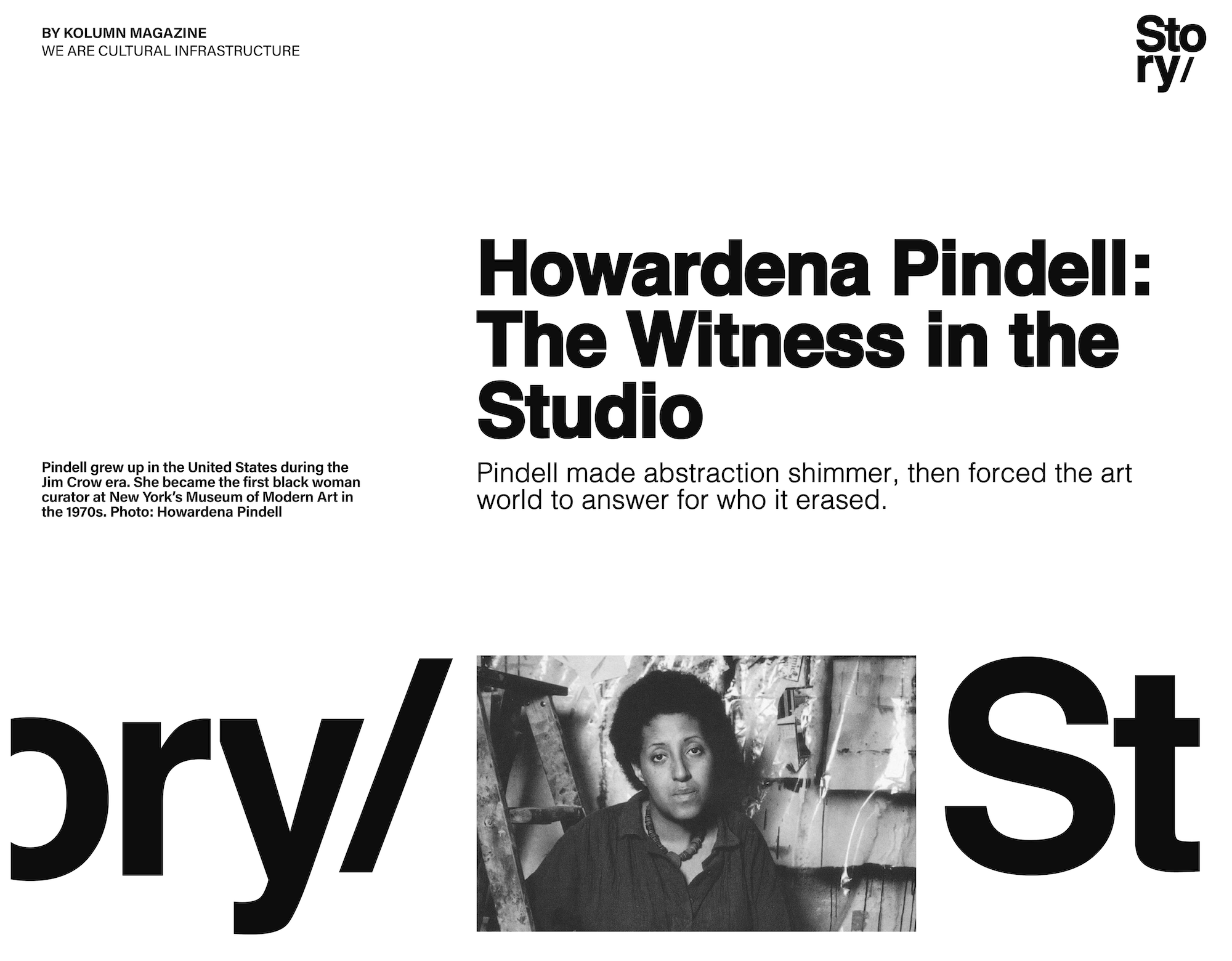
Pindell did not abandon beauty for politics. She proved that beauty itself could become evidence.
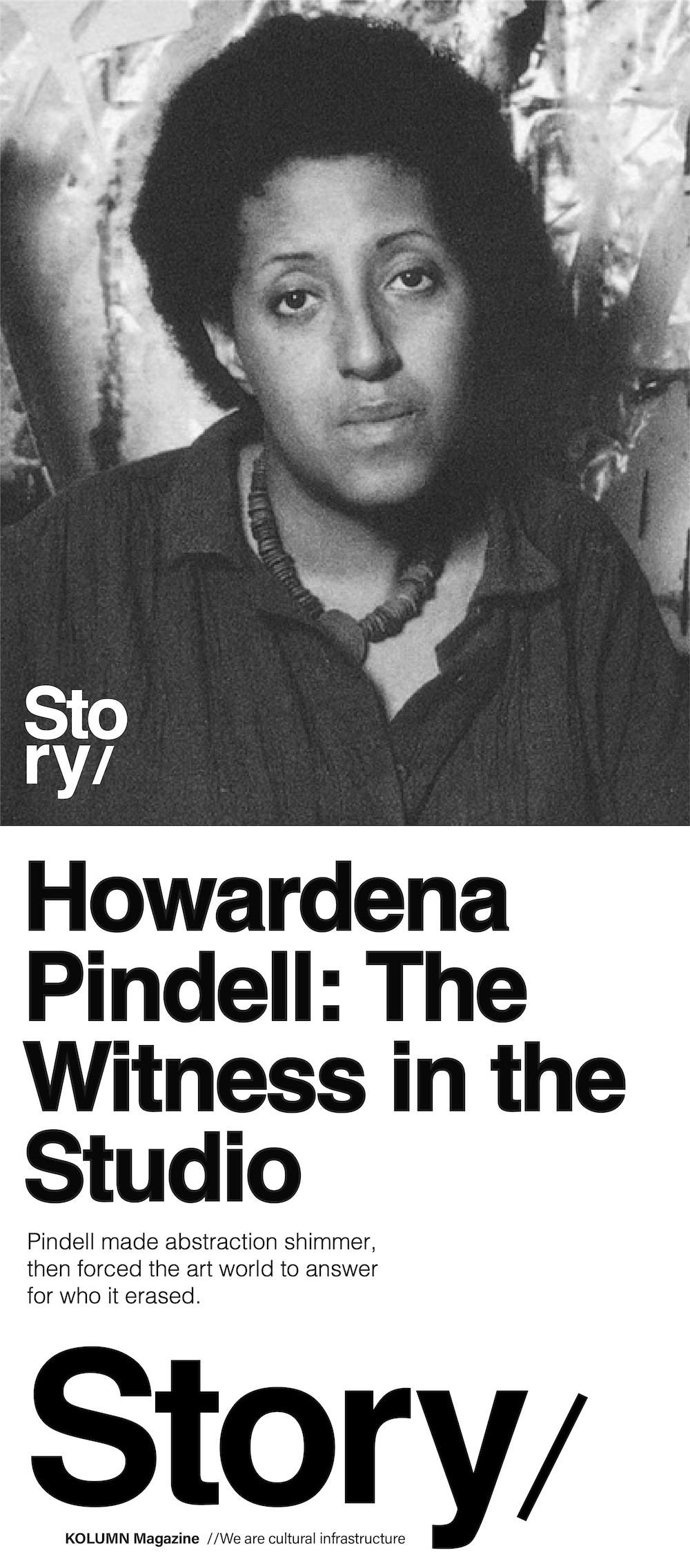
Pindell did not abandon beauty for politics. She proved that beauty itself could become evidence.
By KOLUMN Magazine
Howardena Pindell’s art often begins with a small act of pressure: a hole punch biting into paper, a dot placed against a field of color, a number written by hand, a body traced into memory, a fact spoken without ornament. From those gestures, she has built one of the most rigorous and morally demanding bodies of work in American art. Born in Philadelphia in 1943, Pindell became a painter, curator, critic, educator and video artist whose career now spans more than five decades, a range documented by the Museum of Contemporary Art Chicago in its 2018 retrospective, Howardena Pindell: What Remains To Be Seen, described by the museum as the first major survey of her work.
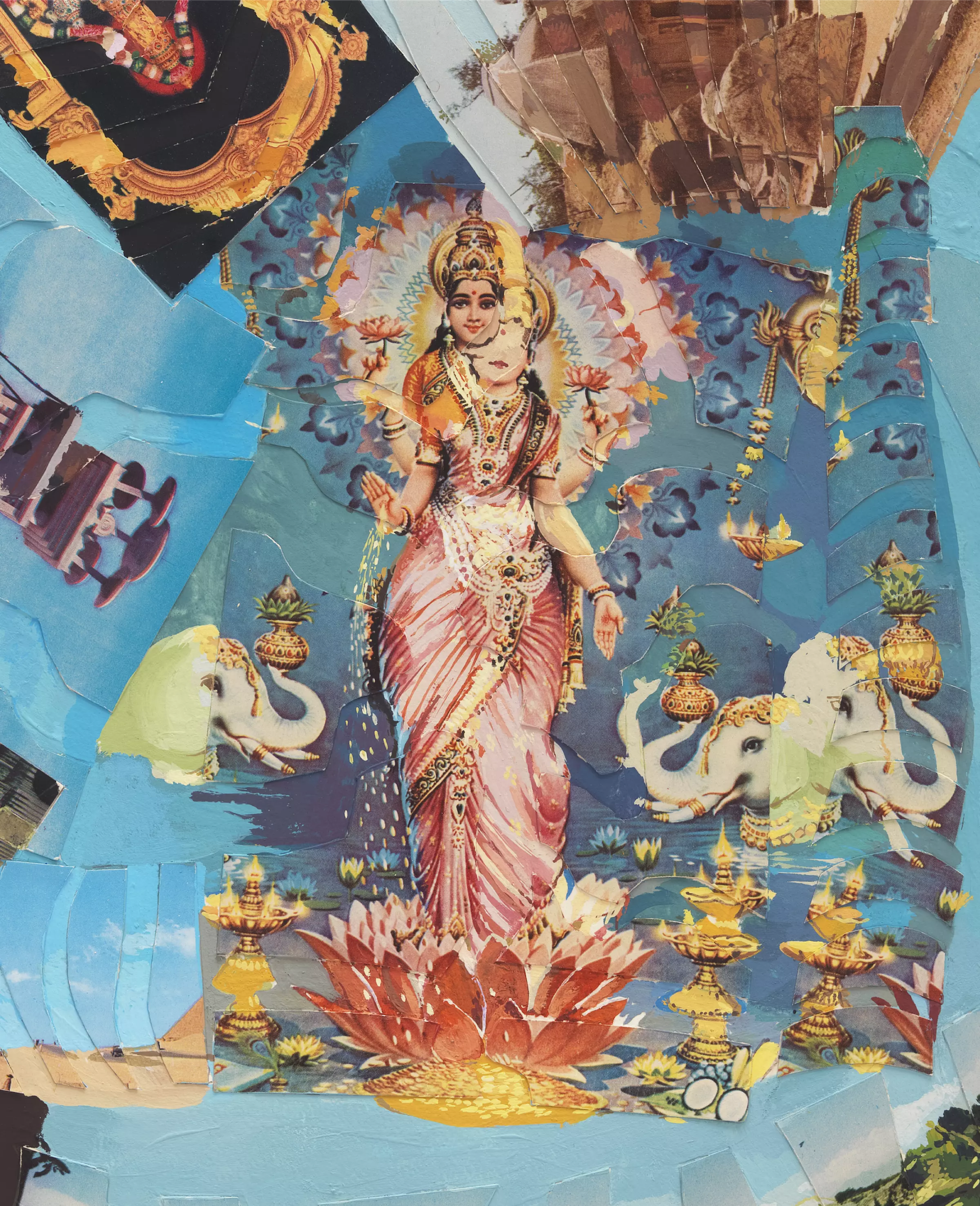
Pindell’s significance is not simply that she crossed boundaries between abstraction and political art. It is that she made those categories collapse. Her early paintings and collages used grids, circles, punched paper, numbers, glitter, acrylic and labor-intensive surfaces to test what abstraction could hold. Later, especially after a life-threatening 1979 car accident, she turned more explicitly toward autobiography, racism, sexism, historical violence and institutional exclusion. The Smithsonian American Art Museum notes that after the accident, which caused partial memory loss, postcards helped her recover fragments of memory and became part of her work.
Her biography reads like a map of pressure points in American cultural life. She studied painting at Boston University and Yale, then worked at the Museum of Modern Art from 1967 to 1979, a period Garth Greenan Gallery identifies as making her MoMA’s first African American curator. She co-founded A.I.R. Gallery, the pioneering women’s cooperative gallery, and was its only Black founding member, according to the National Museum of Women in the Arts. She has taught at Stony Brook University since 1979, where the university’s Zuccaire Gallery identifies her as a Distinguished Professor of Art.
But the deeper story is not institutional ascent. It is confrontation. Pindell worked inside major art institutions while documenting their exclusions. She made abstract paintings that glowed like constellations while keeping ledgers of racism and sexism. She used data not as bureaucratic language but as indictment. In her 1988 essay “Art (world) & racism: Testimony, documentation and statistics,” published in Third Text, Pindell assembled evidence about the marginalization of artists of color in galleries and museums.
Philadelphia, Yale and the Making of a Formalist
Pindell’s early formation matters because it complicates any easy reading of her later political work. She did not arrive at the art world as an outsider to craft, theory or discipline. She trained deeply in painting, earning a BFA from Boston University in 1965 and an MFA from Yale in 1967, according to the MCA Chicago biography. At Yale, she entered a world shaped by formalism, color theory, abstraction and the authority of the studio. That training never left her work. Even when her art became more overtly political, it retained a severe visual intelligence: grids, repetition, surfaces, accumulation, rupture.
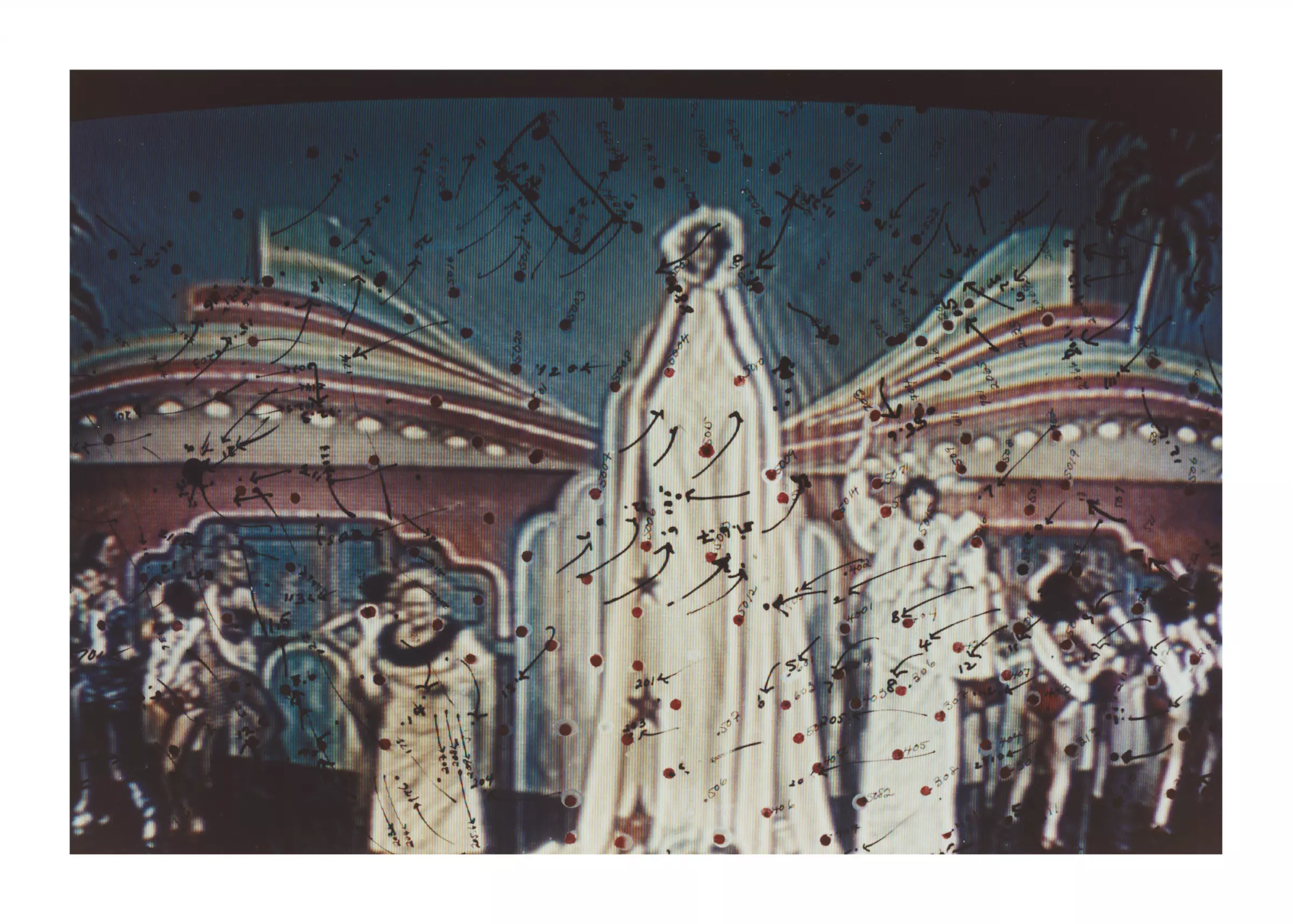
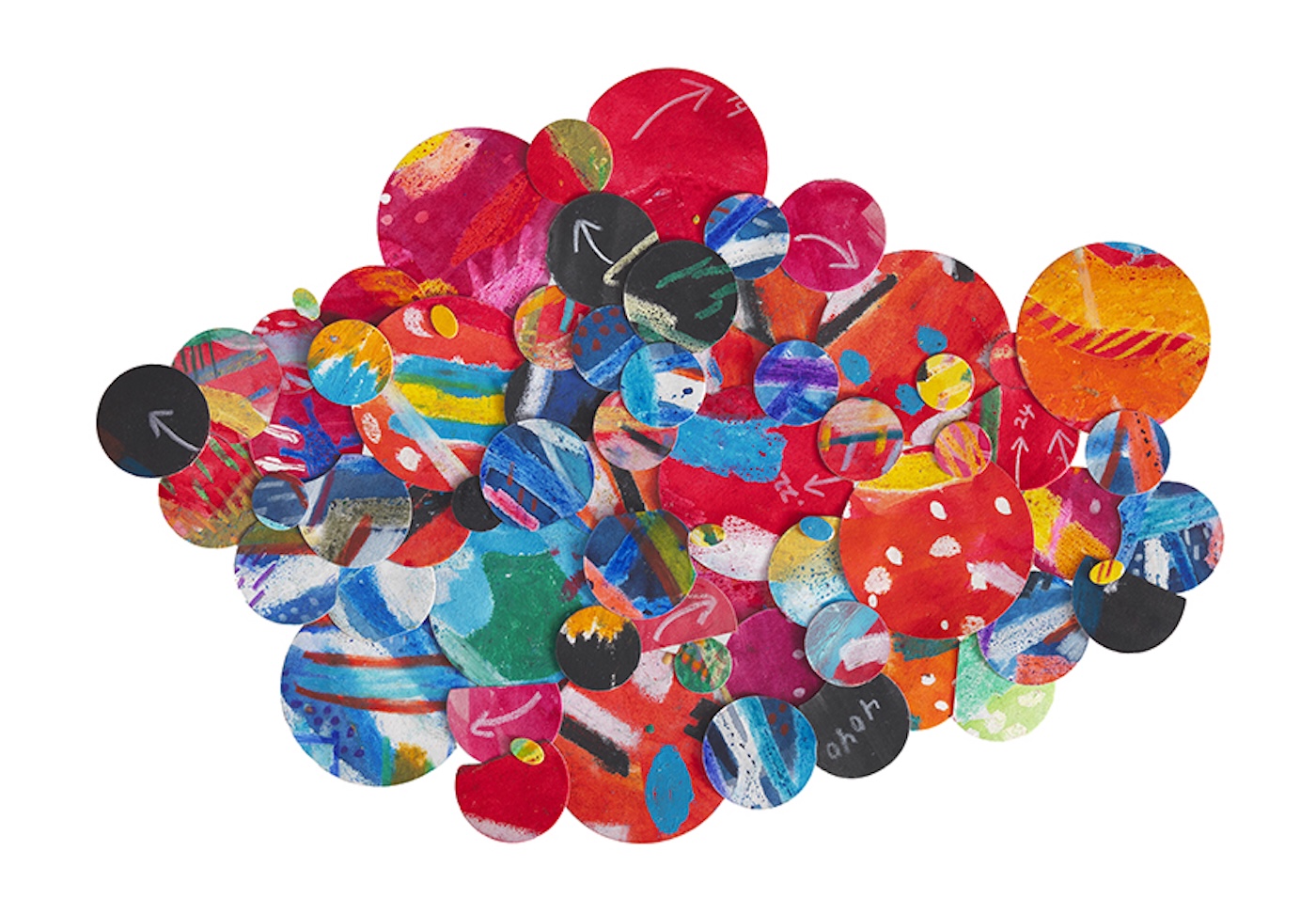
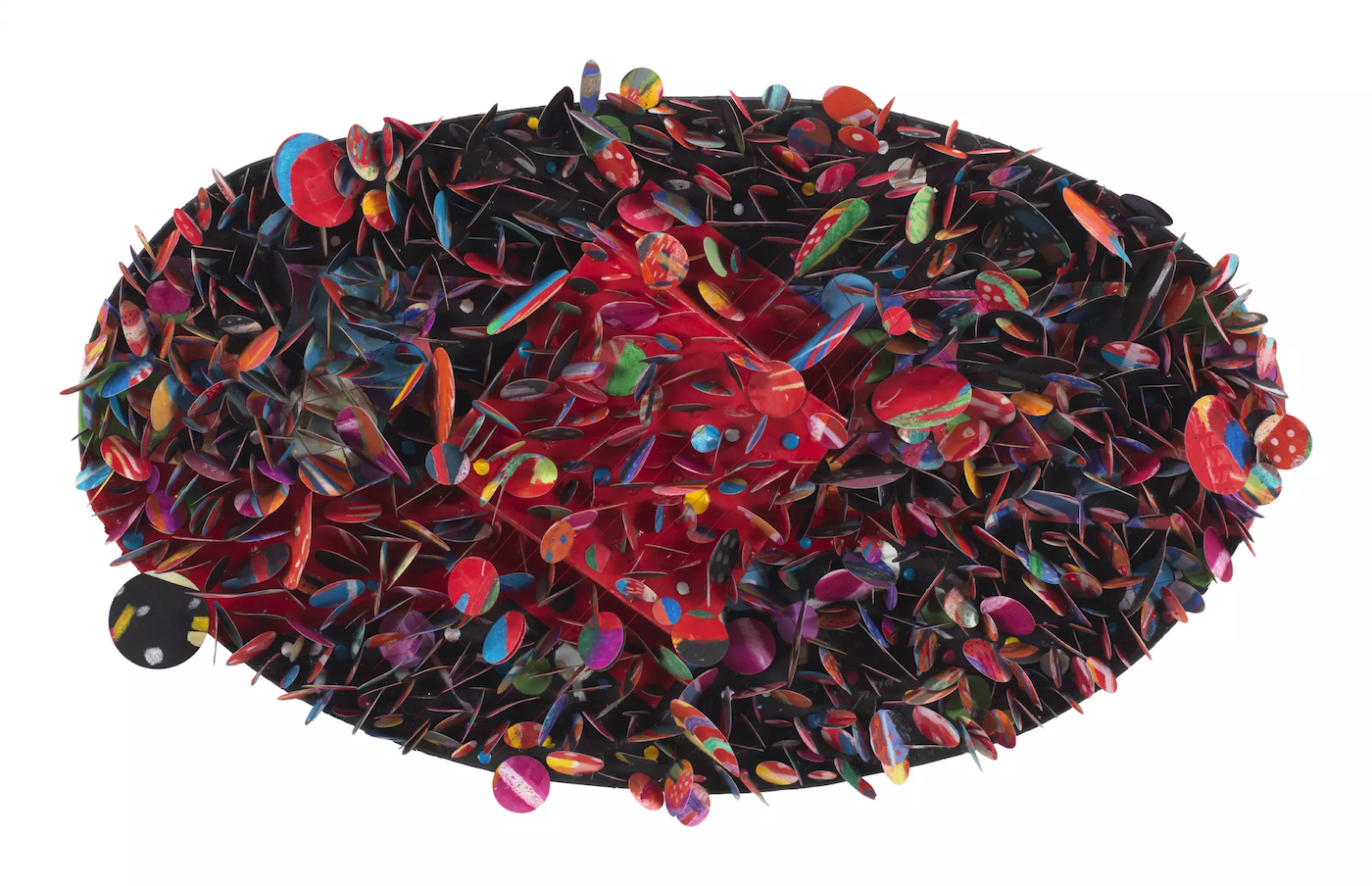
In the 1970s, Pindell began making works that appeared, from a distance, almost atmospheric. Up close, they revealed enormous labor. She punched thousands of paper circles, sometimes numbering them by hand, then affixed them to canvases and paper fields. Dia Art Foundation describes her practice as fusing “formal abstraction, social critique, and self-reflection” through unconventional materials and labor-intensive techniques.
That labor is central. Pindell’s dots are not decoration. They are units of time. They are marks of repetition. They are particles of a system. They suggest cells, stars, wounds, maps, votes, bodies, absences. The circular form becomes both formal device and metaphor: the hole, the whole, the record, the refusal to disappear.
Inside MoMA, Outside the Canon
Pindell’s years at MoMA placed her at the center of American modernism’s institutional machinery. Yet that proximity did not guarantee belonging. MCA Chicago’s biography states that she worked in the Department of Prints and Illustrated Books and remained at the museum for 12 years before beginning her teaching career at Stony Brook. Garth Greenan Gallery’s account adds that she moved through several roles, including exhibition assistant, assistant curator, associate curator and acting director in Prints and Illustrated Books.
The contradiction is stark: Pindell helped steward the canon while the canon barely made room for artists like her. That tension shaped her practice. She was an insider with institutional knowledge and an outsider with lived evidence of exclusion. Her position gave her access to collections, exhibitions and art-world structures; it also gave her a clear view of how those structures sorted value by race, gender and power.
“She had proximity to the canon, but proximity is not the same thing as power.”
This double consciousness runs through Pindell’s work. She was making abstractions at night while working in the museum by day. The New York Times, in a review excerpted by Garth Greenan Gallery, described her as having “climbed the ladder as a curator at MoMA for over a decade while developing her style of abstract, pointillist collage.” That sentence contains the tension of a career: the ladder and the studio, the résumé and the resistance.
The Politics of the Dot
Pindell’s dots have often been discussed in relation to pointillism, minimalism and process art. But they also belong to a Black feminist politics of accumulation. A dot can be counted. A dot can be moved. A dot can be erased. A dot can stand for a person, a statistic, a scar. In Pindell’s hands, the dot became an argument against the singular heroic gesture associated with male modernist painting. It was humble, repeated, handmade, obsessive and communal in feeling.
Her materials mattered. Paper, punched circles, glitter, string, paint, postcards and photographs pushed against the rigid hierarchy of “major” and “minor” media. The Philadelphia Museum of Art notes that Pindell has worked across painting, printmaking, collage, video, film and process art, and that her early-1980s “Autobiography” series explored her experiences as an African American woman, scholar, traveler and political activist.
This is where Pindell’s work speaks directly to KOLUMN’s ongoing attention to Black cultural memory and the artists who preserve it. Like KOLUMN’s recent editorial attention to figures such as Frank Calloway and Pauline Powell Burns, Pindell’s story asks how Black artists make archives when institutions are late, indifferent or hostile. The archive, in Pindell’s case, is not merely a file cabinet. It is a painted surface. It is a video. It is a scar tissue of data.
The Accident and the Turn Toward Autobiography
In 1979, Pindell left MoMA and began teaching at Stony Brook. That same year, she was seriously injured in a car accident. The Smithsonian American Art Museum records that she suffered partial memory loss and used old travel postcards during recovery to help reconstruct memory. TIME reported that the accident left her with a hip injury and a head injury, and that the experience pushed her toward more overtly issue-based work. (TIME)
The accident did not create her politics. The politics were already there. But it intensified the urgency. Afterward, memory became both subject and material. Pindell’s “Autobiography” works often include traces of her body, travel, ancestry and trauma. They treat the self not as confession but as historical site.
Her use of postcards is especially important. A postcard is a souvenir, a document of elsewhere, a portable image, a fragment of travel and memory. In Pindell’s work, postcards become tools of reconstruction. They stand against the violence of forgetting. They also widen autobiography beyond the private self. Her travels across Africa, Asia, Europe, Latin America and the Caribbean appear not as cosmopolitan ornament but as a diasporic mapping of relation, memory and displacement, a scope noted by the Philadelphia Museum of Art.
“Free, White and 21”
In 1980, Pindell made Free, White and 21, one of the defining works of American video art. MoMA identifies the work as a 12-minute, 15-second color video in which Pindell appears both as herself and as a white woman, dramatizing the stark divide between Black and white Americans. The Studio Museum in Harlem describes the video as beginning with Pindell recounting racism and sexism faced by herself and her mother, interrupted by another figure—Pindell disguised as a white woman—who voices dismissive responses.
The video is devastating because it is plain. Pindell sits before the camera and speaks. She does not soften the testimony. She does not aestheticize the wound. The white alter ego interrupts, invalidates, patronizes. The structure is familiar to anyone who has named racism only to be told they misunderstood, exaggerated, invented, politicized or personalized the injury.
Pindell later wrote, in an essay published on the MCA Chicago retrospective site, that she made Free, White and 21 after “yet another run-in with racism in the art world and the white feminists,” adding that she felt isolated as a token artist and that white women wanted her limited to their agenda. That statement is not ancillary to the work. It is the work’s weather system.
“In Free, White and 21, Pindell made disbelief itself the antagonist.”
The video remains bracing because the art world it indicts has never fully disappeared. Institutions now use the language of diversity more fluently, but Pindell’s work asks harder questions: Who is collected? Who is reviewed? Who is promoted? Who is protected? Who is considered difficult for telling the truth? Who is invited into feminism and who is asked to wait outside?
A.I.R. Gallery and the Limits of White Feminism
A.I.R. Gallery, founded in 1972, is often celebrated as the first artist-run gallery for women artists in the United States. Pindell’s place in that history is essential and complicated. The National Museum of Women in the Arts notes that she was the only Black founding member of A.I.R. Gallery and that she advocated for artists of color while also helping establish MoMA’s labor union.
That history forces a more honest reading of feminist art spaces in the 1970s. Pindell supported women’s self-determination in the arts, but she also saw how white feminist spaces could reproduce racial exclusion. Her critique was not a rejection of feminism. It was a demand that feminism tell the truth about race.
The same demand resonates across Black feminist intellectual history, from the Combahee River Collective to contemporary museum activism. Pindell’s work belongs in that lineage because she insisted that race and gender could not be separated for institutional convenience. Before “intersectionality” became a widely adopted term in universities and museums, Pindell was already making art from the pressure of intersecting exclusions.
Counting the Excluded
Pindell’s statistical work is among her most important contributions to American art criticism. She did not merely say the art world was racist. She counted. She gathered evidence. She named patterns. Her 1988 Third Text essay, “Art (world) & racism: Testimony, documentation and statistics,” brought together testimony and quantitative documentation.
“Pindell counted because institutions had learned to make exclusion look accidental.”
MCA Chicago’s archive of Pindell’s art-world surveys shows how she continued updating and contextualizing the numbers, including commentary on galleries, museums and the underrepresentation of artists of color. This matters because Pindell understood that institutions often absorb moral critique by asking for proof. So she brought proof.
The statistics were not neutral. They were political because the absence they measured was political. Pindell’s data exposed what taste often hides. “Quality,” “fit,” “excellence,” “programming priorities” and “market demand” can all become polite masks for exclusion. Pindell’s surveys stripped away the politeness.
This is one reason her work remains urgent in 2026. Museums have diversified some acquisitions and exhibitions, but the structures of valuation remain uneven. Pindell’s career insists that representation is not charity. It is evidence of whether an institution understands the culture it claims to preserve.
Beauty After Violence
Pindell’s work can be visually ravishing. That fact should not be treated as separate from its politics. The beauty is often part of the challenge. Her surfaces seduce the eye, then implicate it. Glitter, color and pattern can coexist with histories of racist violence, medical neglect, colonialism, slavery and erasure. The viewer is not allowed the comfort of choosing between pleasure and indictment.
This is clearest in the relationship between her abstract works and her videos. Free, White and 21 speaks directly; the paintings often speak through accumulation. But both are forms of testimony. One uses voice; the other uses surface. One confronts disbelief; the other records persistence.
White Cube describes Pindell’s practice as spanning more than five decades and encompassing painting, collage, drawing and film, while delivering a “diaristic account” of biography and interrogating broader issues of social justice. That description captures the breadth, though the deeper point is that Pindell made the diary public. She turned private injury into shared evidence.
“Rope/Fire/Water” and the Refusal to Look Away
In 2020, Pindell returned to video with Rope/Fire/Water, her first video work in 25 years, according to Time’s reporting on the exhibition at The Shed. The work addressed lynching, racist violence and historical terror through a stark recitation of facts. Oklahoma Contemporary describes the short video as a “haunting distillation” of historical data and statistics related to lynching and racist attacks.
The work begins from a childhood memory: Pindell encountering an image of a lynched Black man in Life magazine, a traumatic moment Time reported left her unable to eat meat for a year. From there, the video moves into historical record. The effect is chilling because Pindell refuses melodrama. She trusts the facts to indict.
Rope/Fire/Water belongs to the same moral universe as Free, White and 21, but its scale is broader. The earlier video stages interpersonal and institutional disbelief; the later video stages national atrocity. Both ask what happens when America’s violence is presented without euphemism.
In the Time interview, Pindell said, “I put myself—the Black body—in the work,” a statement that clarifies the stakes of her practice. The Black body in Pindell’s work is not spectacle. It is witness. It is archive. It is the site upon which American systems have written violence and the site from which Pindell writes back.
The Retrospective That Arrived Late
The 2018 MCA Chicago retrospective, Howardena Pindell: What Remains To Be Seen, marked a major institutional recognition of her career. The museum described the exhibition as spanning five decades and including early figurative paintings, abstraction, conceptual works and political art emerging after the 1979 accident. The accompanying publication, edited by Naomi Beckwith and Valerie Cassel Oliver with contributions by Grace Deveney, Charles Gaines and Lowery Stokes Sims, celebrated five decades of work across paper, collage, photography, film and video.
That the first major survey came so late is itself part of the story. Pindell had long been important. The institutions took time to catch up. Her recognition follows a familiar pattern in Black art history: sustained innovation, delayed canonization, retrospective correction.
But Pindell’s career resists the neat redemption arc. The question is not simply whether museums now honor her. The question is what they do with the critique her work contains. To exhibit Pindell without absorbing her challenge would be to aestheticize dissent while preserving the systems she opposed.
Awards, Collections and the Problem of Recognition
Pindell’s work is now held in major collections, including MoMA, the Smithsonian American Art Museum and other institutions. MoMA’s collection page lists her as an American artist born in 1943 and includes Free, White and 21 in its holdings. The Smithsonian American Art Museum also includes her in its collection and summarizes the autobiographical turn in her work after 1986.
She has received significant honors. The Smithsonian Archives of American Art lists Howardena Pindell among its 2019 Medal honorees. (Archives of American Art) Garth Greenan Gallery also notes honors including the College Art Association’s Distinguished Artist Award for Lifetime Achievement, the Artists’ Legacy Foundation’s 2019 Artist Award and the 2019 Archives of American Art Medal.
Recognition matters. It changes what students study, what museums preserve and what markets value. But in Pindell’s case, recognition also exposes the lag between artistic importance and institutional acknowledgment. Her work was not waiting to become relevant. It was relevant when the art world was unwilling to fully receive it.
Teacher, Critic, Builder
Pindell’s importance extends beyond objects. She has been a teacher, critic and institutional conscience. Stony Brook identifies her as a Distinguished Professor who has taught there since 1979. The Archives of American Art’s oral history interview with Pindell, conducted in 2012, spans more than four and a half hours and 101 transcript pages, evidence of a life deeply documented in her own voice.
This matters because Pindell’s career is pedagogical. She teaches viewers how to look at surfaces and systems. She teaches artists that formal experimentation and political clarity need not be enemies. She teaches institutions that inclusion cannot be measured by press releases. It must be measured by acquisitions, exhibitions, leadership, scholarship, budgets and sustained commitment.
For younger artists, especially Black women artists, Pindell offers a model of endurance without accommodation. She did not wait for permission to critique the art world. She made the critique part of the work.
Why Howardena Pindell Matters Now
Howardena Pindell matters because she saw the relationship between beauty and bureaucracy, between abstraction and exclusion, between memory and evidence. She understood that the art world was not merely a place of objects but a system of decisions: who gets shown, who gets collected, who gets reviewed, who gets funded, who gets remembered.
Her art is significant because it refuses simplification. It is formally sophisticated and politically direct. It is autobiographical without being narrow. It is beautiful without being escapist. It is data-driven without being cold. It is angry without surrendering to spectacle.
At a time when cultural institutions continue to debate diversity, censorship, restitution, public memory and the politics of representation, Pindell’s work remains less like a historical artifact than a live charge. She forces the question: What does an institution do after it has been shown the numbers? What does a viewer do after testimony has been spoken plainly? What does a nation do when its violence is no longer hidden by euphemism?
Pindell’s dots still shimmer. Her videos still accuse. Her statistics still unsettle. Her surfaces still hold memory like sediment. Across six decades, she has made art that does not ask whether beauty can survive violence. It asks whether beauty can help expose it, document it and refuse its erasure.
That is Howardena Pindell’s enduring significance: she made the invisible count.
More great stories
Afro Sheen, Wall Street, and the Architecture of Black Possibility
July 6, 2026
No Comments
The Fire Inside the Fourth
July 5, 2026
No Comments