
The Wall of Respect made a proposition that still feels radical: Black communities did not need permission to picture their own greatness in public.
The Wall of Respect made a proposition that still feels radical: Black communities did not need permission to picture their own greatness in public.
By KOLUMN Magazine
Jeff Donaldson is not as widely known in the popular imagination as some of the writers, musicians, and public intellectuals who came to define the Black Arts Movement. He is not a household name in the way that Amiri Baraka is, or Gordon Parks, or Romare Bearden. But once you begin to trace the infrastructure of Black cultural thought in the late 20th century—once you follow the lines between murals, manifestos, classrooms, museums, conferences, festivals, and institutions—Donaldson keeps appearing. He is there at the start of AfriCOBRA. He is there in Chicago as the Wall of Respect changes what public art can do. He is there in essays and manifestos, trying to give language to a new Black aesthetic. He is there at Howard University, reshaping an art department and influencing generations of artists and scholars. He is there in the longer arc of Black cultural production, insisting that art is not a luxury item but a tool for consciousness, identity, and power.
To write about Jeff Donaldson is to write about more than one career. He was a painter, yes, and a striking one—an artist of vibrating color, layered text, rhythmic pattern, and what he and his collaborators called “superreal” imagery. But he was also an art historian, critic, organizer, curator, teacher, dean, and public thinker. The range matters because Donaldson understood something that many artists know intimately: images alone do not transform culture unless there are institutions, audiences, theories, and communities ready to receive them. He did not simply make work; he helped build a way of seeing.
That is part of why his legacy feels bigger now than it once did. As museums, scholars, and younger artists continue to revisit the Black Arts Movement and the history of AfriCOBRA, Donaldson’s role looks less like a footnote and more like a central architecture. The first museum retrospective devoted to him, Jeff Donaldson: Dig, opened at the Everson Museum in 2018 and later traveled to the Akron Art Museum, framing his four-decade career not as an aside to a better-known movement, but as a major artistic and intellectual project in its own right. Critics and curators have increasingly treated him as one of the key figures in the making of modern Black art.
“Donaldson didn’t just ask what Black art should look like. He asked what it should do, who it should serve, and what kind of world it should help make.”
What makes Donaldson so compelling, even now, is that he refused the soft version of cultural inclusion. He was not interested in merely getting Black artists admitted into existing white frameworks on slightly better terms. He wanted a redefinition of the terms themselves. His work was grounded in Black self-determination and in a diasporic imagination that linked African American experience to Africa and the wider Black world. He promoted what he called a “TransAfrican” aesthetic, and he helped give AfriCOBRA its visual and philosophical coherence at a moment when Black artists were trying to answer a basic but urgent question: what should an art for Black people, made in Black communities, under Black political pressure, actually be?
A boy from Pine Bluff with a wider horizon
Jeffrey Richardson Donaldson was born on December 15, 1932, in Pine Bluff, Arkansas. Several biographical accounts note that he began drawing very early, inspired in part by watching his older brother. That detail matters less as a cute origin story than as a clue to the continuity between childhood image-making and the mature artist Donaldson would become. He did not arrive at art accidentally or late. He grew toward it. He earned his bachelor’s degree in studio art from what is now the University of Arkansas at Pine Bluff in 1954, served briefly in the U.S. Army, and then continued the long dual practice that would define his life: teaching while deepening his own artistic and scholarly training.
In Chicago, Donaldson moved through the city’s educational and artistic worlds with unusual intensity. He taught in public schools and at Marshall High School, while also pursuing further study. By 1963 he had earned a graduate degree from the Institute of Design at Illinois Institute of Technology. Later, while teaching and organizing, he pursued doctoral work at Northwestern University, receiving a Ph.D. in art history in 1974. Multiple institutional sources describe that degree as pioneering, with the Toledo Museum noting that he was the first person in the United States to receive a doctorate in African American art history as a field of study. Even without leaning too hard on “firsts,” the point is clear: Donaldson was helping create the academic ground beneath Black art history even as he was making the art itself.
Chicago in the 1960s was a decisive crucible. It was a city alive with civil rights struggle, Black cultural nationalism, urban unrest, and artistic experimentation. Donaldson’s generation of artists was dealing with segregation, with the narrowness of museum culture, with the insult of racist imagery, and with the demand—coming from the street as much as from the studio—that Black art be useful, legible, and accountable to Black people. The Organization of Black American Culture, or OBAC, emerged from that context. Donaldson helped found it, and its importance cannot be overstated. It was one of the formations through which Black artists in Chicago began developing a collective answer to invisibility.
The Wall of Respect, unveiled in 1967 on Chicago’s South Side, became one of the era’s defining expressions of that answer. Donaldson contributed to the mural, which featured more than 50 Black heroes and cultural figures and is widely understood as a landmark in community muralism. It did not merely decorate a wall. It declared a canon in public. It shifted authority away from mainstream institutions and into the neighborhood. The mural’s influence rippled through inner cities across the United States and beyond, helping catalyze a broader mural movement. Donaldson’s involvement placed him at the center of a new model for art: public, collective, political, and unmistakably Black.
AfriCOBRA and the argument for a Black visual language
If the Wall of Respect announced a new public Black iconography, AfriCOBRA helped theorize it. Founded in Chicago in 1968 by Donaldson along with Wadsworth Jarrell, Jae Jarrell, Barbara Jones-Hogu, and Gerald Williams, the group began as COBRA before becoming the African Commune of Bad Relevant Artists—AfriCOBRA. The name itself was a manifesto in miniature: African, communal, relevant, assertive, playful, serious. Donaldson was one of the movement’s principal theorists and public voices. His writing helped turn a gathering of artists into an articulated aesthetic project.
AfriCOBRA was never just a style, though it certainly had one. Its artists embraced dazzling color, repeated forms, text within images, symmetry, radiating patterns, and images meant to be immediately available to Black audiences rather than obscurely coded for elite viewers. But behind the look was a social program. Donaldson and his collaborators wanted art that preached positivity to Black people without becoming naïve, art that recognized oppression without centering Black suffering as the only truth worth depicting. In this, Donaldson was both strategist and philosopher. He argued for “superreal” images and for what the Whitney later summarized as an intense, layered realism rooted in everyday Black life.
That emphasis on positivity is easy to misread if taken out of context. Donaldson was not making decorative optimism. He was participating in a disciplined rebuttal to the racist visual order of American life. Mainstream culture had long trafficked in humiliating caricature, symbolic deprivation, and the flattening of Black complexity. Donaldson wanted to replace that economy of image-making with another one. As Hyperallergic put it in a review of his 2017 New York solo exhibition, his work aimed to replace a history of demeaning stereotypes with an alternative history rooted in Africa and struggle. That formulation is useful because it gets at the doubleness of his project: affirming beauty while refusing amnesia.
Look at a work like Victory in Zimbabwe, now in the Smithsonian American Art Museum. The museum describes it as part of Donaldson’s continued practice in Washington after his foundational role in AfriCOBRA. The title alone signals one of his lasting commitments: to situating Black American art within a broader African and diasporic field. Donaldson’s “TransAfrican” concept was not just a stylistic label. It was an argument that Black creative people across geographies were engaged in related acts of cultural definition, whether or not they knew one another personally. The local and the global were not opposites for him; they were mutually intensifying scales.
The Guardian’s coverage of Donaldson and AfriCOBRA, published years after his death, captured how enduring this framework remains. In one piece, the group’s 1969 manifesto is described as having historically reshaped Black art communities, with Donaldson writing that the goal was “to preach positivity to the people” through a combination of geometric abstraction and realistic imagery. In another, curator Marc Wehby observed that Donaldson’s works remained relevant not only to Black history but to American history and art history more broadly. Those are contemporary readings, but they echo what Donaldson believed while living: that Black visual culture was not peripheral to modern art; it was central to understanding it.
The paintings: bright, rhythmic, argumentative
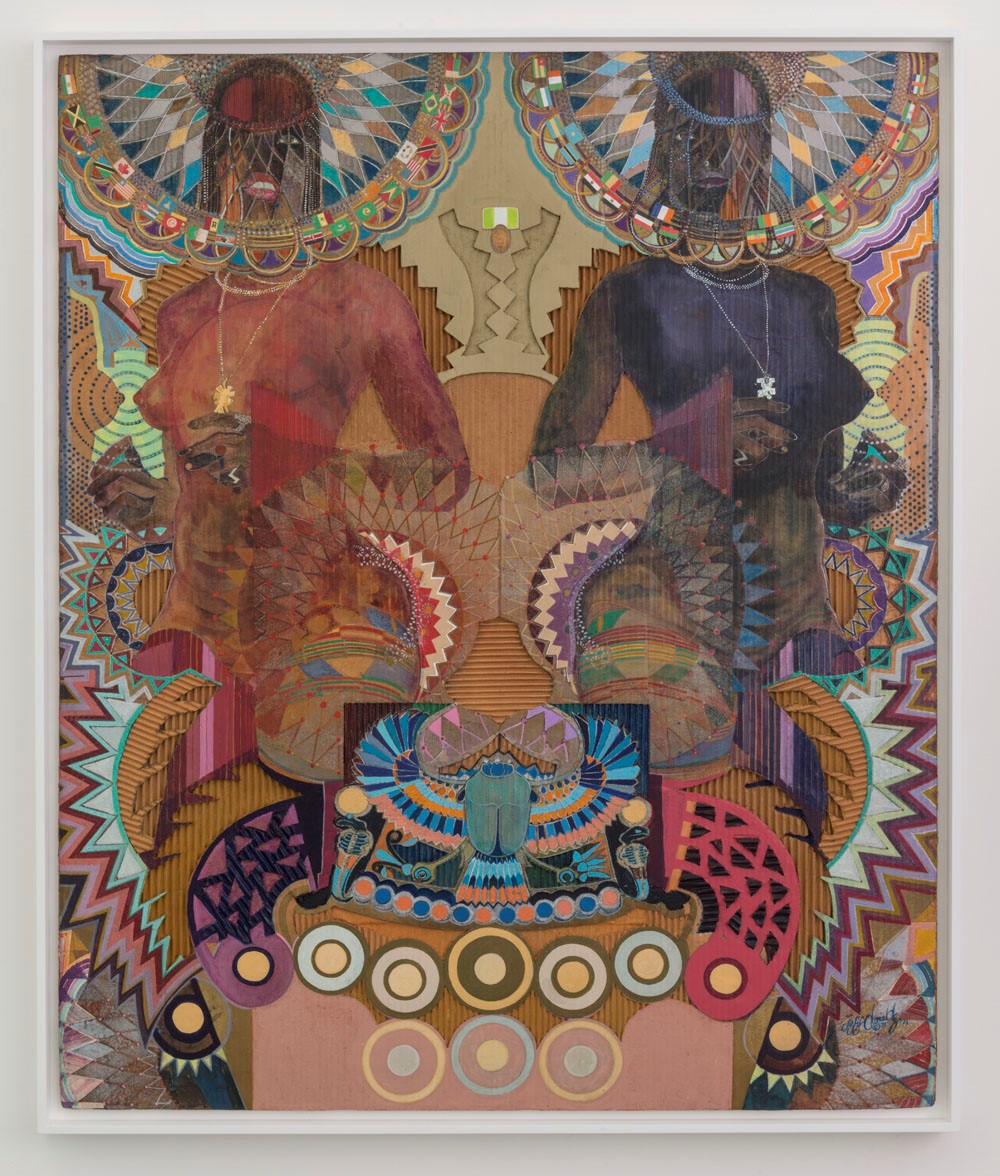
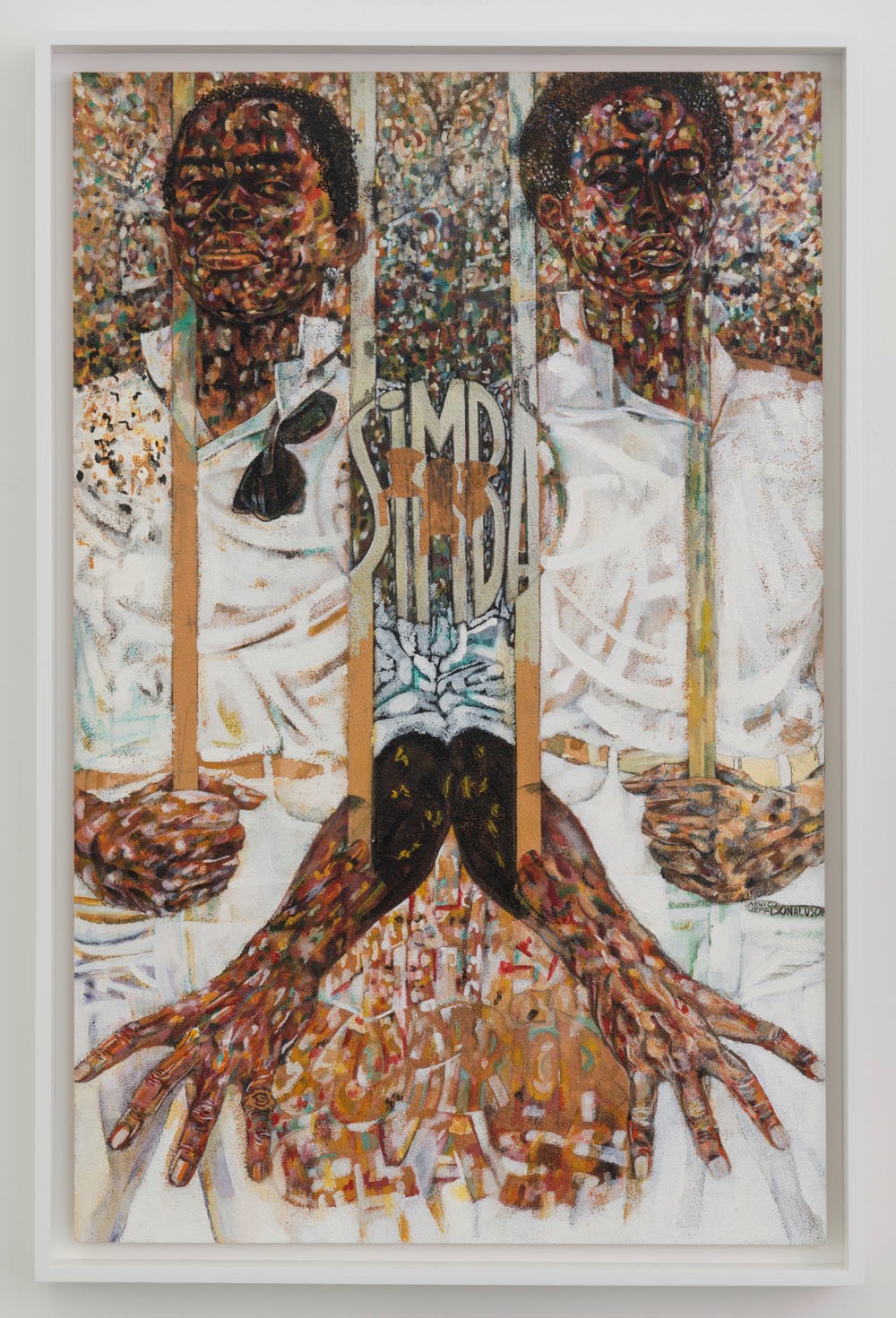
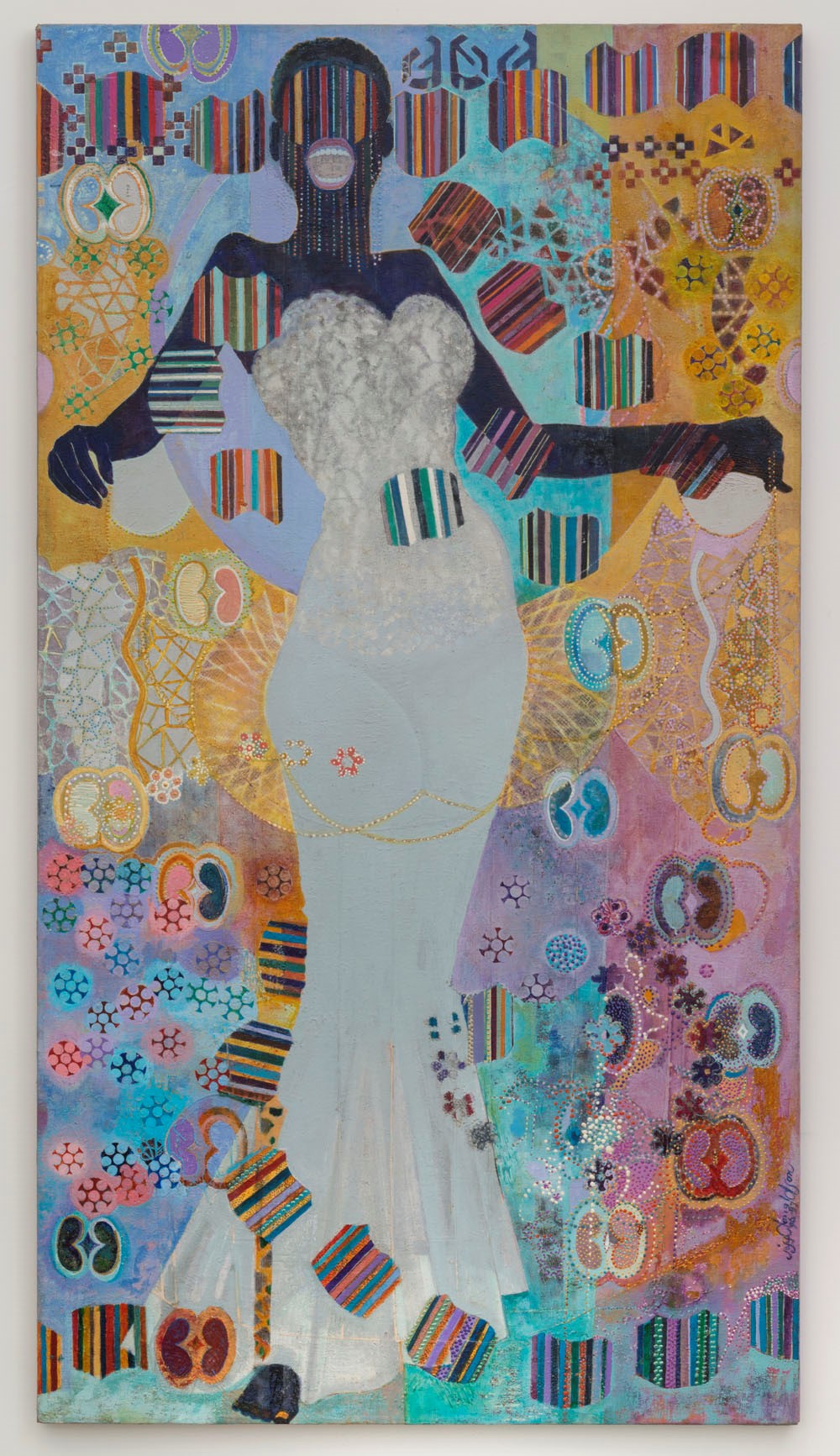
Donaldson’s paintings do not sit quietly. Even when reproduced on a screen, they feel in motion. They pulse. The Everson Museum, in describing his early work, referred to a high-energy “Kool-ade” palette and to images that weave lettering and text throughout the composition to create rhythm and visual vibration. That description is apt because Donaldson’s work often seems to operate on several channels at once: pictorial, musical, rhetorical, and political. He wanted you to see, but he also wanted you to feel a beat, to register a signal, to be spoken to.
This is one reason Donaldson’s art resists the old oppositions that sometimes flatten discussions of Black art. He was neither simply a figurative painter nor simply an abstractionist. The Block Museum’s discussion of his Study for the Wall of Respect (Miles Davis) is especially useful here, noting how the figure merges into energetic daubs of color and how Donaldson’s own manifesto reframed mimesis as the place where abstraction and the concrete meet. His practice, the museum suggests, moved across both realms. That matters because Donaldson understood realism not as literal transcription, but as a heightened relation to Black life as lived, imagined, remembered, and desired.
In his work, text is not an afterthought or a captioning device. It is part of the picture’s force. Letters can chant. Words can become ornament, slogan, testimony, or syncopation. This made sense for an artist formed amid the Black Arts Movement, when poetry, theater, music, visual art, and political speech were in constant conversation. Donaldson painted as someone who knew language was a material. He knew that the eye does not merely observe; it reads, scans, repeats, recalls. His canvases often insist on that hybrid activity.
Then there is the matter of image choice. Donaldson repeatedly returned to Black people as worthy of magnificence, complexity, and symbolic charge. Even in works that register violence or pressure, there is often a refusal to submit to degradation as the final note. The Guardian’s 2019 preview of a Donaldson exhibition described Aunt Jemima and the Pillsbury Doughboy as a painting of a Black woman being battered by a white police officer, rooted in the aftermath of the 1963 March on Washington. That is not “positive” in any shallow sense. But it does reveal Donaldson’s larger method: confronting racist power while insisting that Black visual language not be confined to victimhood.
“Donaldson’s paintings don’t ask to be politely appreciated. They ask to be entered—through color, text, memory, and political feeling.”
The cardboard works, highlighted in reviews of his 2017 New York exhibition, make this even clearer. Hyperallergic noted his layered use of corrugated cardboard, painted and cut into concentric or rhythmic structures. These pieces complicate any assumption that Donaldson was only a manifesto-driven propagandist or only valuable as a movement figure. He was formally adventurous. He was interested in surface, structure, improvisation, and material tension. If anything, the rediscovery of his work in recent years has clarified that his formal intelligence was as strong as his ideological clarity.
Donaldson the thinker: manifestos, conferences, and cultural infrastructure
One of the most remarkable things about Donaldson is how often his career forces a broader definition of artistry. He wrote manifestos. He organized conferences. He conducted interviews with dozens of artists. His papers at the Archives of American Art include writings, teaching files, exhibition materials, sound recordings, research files, and documentation of his leadership role in the Black Arts Movement. That archive alone suggests the scale of his ambition. Donaldson was not content to leave fragments behind. He built records, arguments, and intellectual pathways.
The archives and exhibition materials also show how deeply he cared about connecting Black artists to one another. Donaldson initiated or helped shape gatherings such as CONFABA—the Conference on the Functional Aspects of Black Art—at Northwestern in 1970. He later played a major role in FESTAC ’77, the Second World Black and African Festival of Arts and Culture in Lagos, chairing the North American committee. These were not side projects. They were expressions of his conviction that Black art required organized exchange across disciplines and borders. You can feel in them his resistance to isolation: no single city, campus, or gallery was enough.
His concept of the “TransAfrican” aesthetic belongs in that same frame. It was not simply an art-historical label; it was a theory of affiliation. Donaldson recognized related energies among artists of African descent working in different settings, often under similar political pressures. The term allowed him to speak across national boundaries without collapsing all differences. In the 1990s, he continued developing that framework, guest editing a TransAfrican-focused issue of the International Review of African American Art tied to an exhibition he curated at the Orlando Museum of Art. He kept thinking institutionally and internationally long after the shorthand histories of the Black Arts Movement might have expected him to stop.
There is something instructive here for the present. Donaldson understood that Black art could be celebrated by the market and still be underserved by the culture. Visibility was not enough. Neither was fame. What mattered was whether Black artists had the language, networks, archives, and institutional presence necessary to define their own terms. In that sense, he was practicing cultural infrastructure before the phrase had much currency. He was doing the patient, often under-credited work of making a field durable.
Howard University and the making of generations
If Chicago forged Donaldson the cultural militant, Howard University helped reveal Donaldson the institution-builder. He became chairman of the art department and director of the gallery at Howard in 1970. He later served as associate dean and then dean of the College of Fine Arts, leading until his retirement in 1998. Across official accounts and obituaries, the portrait is consistent: Donaldson used Howard not as a resting place but as a laboratory for Afrocentric curricular and institutional change.
This is one of the most consequential parts of his life, and one of the least easy to dramatize, because pedagogical transformation rarely produces one iconic image. But its effects can be enormous. Donaldson broadened the study of art to include African and African American traditions in ways that helped dislodge older hierarchies. He recruited people. He mentored students. He reframed what counted as serious study. He made Black art history and criticism thinkable as central, not supplementary. The Everson retrospective and related institutional accounts credit him with influencing future generations of artists as a professor and administrator at Howard. That phrasing may sound generic, but in Donaldson’s case it points to a real transfer of worldview.
He also appears to have been the kind of educator who understood the ecology of talent. The WorldCat entry for Wadsworth Jarrell’s oral history notes that Donaldson recruited Jarrell to teach at Howard in 1971. That small detail illuminates something larger: Donaldson was extending movement relationships into the academy, creating channels through which Black artists could teach, influence, and sustain one another. In another era, these kinds of moves might be described simply as networking. In Donaldson’s hands, they were acts of institution-making.
And Howard mattered for another reason. Historically Black institutions have long functioned as intellectual sanctuaries and engines of Black professional formation, especially when mainstream institutions lag or exclude. Donaldson’s work there places him in that broader story. He was not just bringing Black aesthetics into the university; he was helping an HBCU art program become a serious node in the national and international conversation about African diasporic art. The Washington Post obituary and museum retrospectives alike emphasize his stature as both artist and educator, a pairing that says something essential about how he wanted his labor to be understood.
Why he was overlooked, and why he is harder to overlook now
For all his accomplishments, Donaldson never became a mainstream celebrity artist. Part of that is structural. The art world for much of his career had limited room for Black artists, especially those whose work was overtly political, communal in emphasis, or suspicious of white institutional validation. Part of it is also disciplinary. Donaldson’s importance is spread across too many categories for the lazy version of fame. He was not only a painter. He was also a critic, theorist, and dean. People who build fields often get remembered less vividly than those who occupy them after the groundwork has been laid.
But that has changed. The 2017 New York solo exhibition, the 2018 Everson retrospective, the Akron presentation, the renewed attention to AfriCOBRA’s 50th anniversary, and the broader scholarly return to the Black Arts Movement have all helped restore Donaldson to clearer view. Museums and critics now talk about him not as an ancillary figure but as a central articulator of Black artistic modernity. Even the mere existence of his expansive papers at the Archives of American Art has mattered; archives can change reputations because they reveal the scale of a life’s work.
This reevaluation also reflects a change in the questions the art world is willing to ask. Donaldson looks especially relevant in a moment when scholars and curators are more interested in collectives, publics, pedagogy, and transnational Black exchange. His career becomes newly legible when you stop asking only which artists sold, or which entered a narrow modernist canon, and start asking who built durable Black cultural frameworks. On that score, Donaldson’s résumé is formidable. He helped shape AfriCOBRA. He wrote its ideas. He connected Chicago to Washington, D.C., to Lagos, to broader diasporic discourse. He made classrooms and conferences matter.
There is also the simple matter of the work itself. Once seen, it is difficult to forget. Donaldson’s images have too much voltage for that. They carry movement history without becoming museum-flat. They remain aesthetically alive—still strange, still propulsive, still unembarrassed by beauty. That last point is crucial. Donaldson and AfriCOBRA believed that beauty could be political, that radiance could be corrective, that brightness was not an escape from struggle but a counterattack against degradation. In an age still saturated with reductive images of Black life, that proposition has hardly lost force.
The meaning of Jeff Donaldson now
Jeff Donaldson died in Washington, D.C., on February 29, 2004, at 71. Obituaries noted his retirement as dean of Howard University’s College of Fine Arts and his survival by family, students, and colleagues. But obituaries, by design, compress. They report the end of a life more easily than the afterlife of its ideas. Donaldson’s afterlife has been widening.
His significance now is not merely that he was present at important moments. It is that he understood those moments as connected. He saw no contradiction between painting and organizing, between scholarship and advocacy, between institutional work and aesthetic experimentation. He understood that Black art needed theory and visibility, but also durability. It needed not just singular genius, but collective structure. That insight may be one of his greatest gifts to contemporary artists and cultural workers.
Donaldson also remains instructive because he rejected the smallness that often gets imposed on Black cultural production. He did not argue for a merely American Black art cut off from Africa. He did not argue for a purely academic Black art cut off from the people. He did not argue for a protest art stripped of pleasure, beauty, rhythm, or invention. He wanted something harder and fuller: art that could hold politics and sensuality together, memory and futurity together, local struggle and global Blackness together. That ambition is visible in his paintings, yes, but also in the way he moved through the world.
In that sense, Donaldson belongs to a lineage of Black cultural workers who refused fragmentation. He was one of those figures who seemed to know that the battle over representation was never just about images. It was about who gets to define reality, who gets to teach history, who gets to build institutions, who gets to imagine a people as expansive and beautiful rather than damaged and derivative. That is why his work still matters. He did not simply paint Black life. He argued, in color and in prose, that Black life required its own sovereign terms of visibility.
And maybe that is the clearest way to understand him. Jeff Donaldson was not just an artist of the Black Arts Movement. He was one of the people who helped explain what the movement was trying to see.
More great stories
Afro Sheen, Wall Street, and the Architecture of Black Possibility
July 6, 2026
No Comments
The Fire Inside the Fourth
July 5, 2026
No Comments