




UNCF did not invent Black educational ambition. It invented a national infrastructure sturdy enough to fund it.
UNCF did not invent Black educational ambition. It invented a national infrastructure sturdy enough to fund it.
By KOLUMN Magazine
When Americans hear the phrase “A mind is a terrible thing to waste,” many recognize the slogan before they can name the institution behind it. That is one measure of the United Negro College Fund’s success. The line became so deeply embedded in American culture that it outgrew the fundraising campaign that launched it. But the slogan’s durability can also obscure the scale of the actual enterprise. UNCF is not simply a catchphrase, not simply an annual gala, not simply a scholarship clearinghouse. It is one of the central institutions in the financial, political, and symbolic life of Black higher education in the United States: a body that has spent eight decades converting philanthropic persuasion into tuition dollars, institutional stability, and intergenerational mobility. Since 1944, UNCF says it has raised more than $6 billion, helped more than half a million students earn college degrees, and supported 37 member colleges and universities. Today it also describes itself as the nation’s largest private provider of scholarships and other educational support to underrepresented students, a claim echoed in UNCF leadership materials.
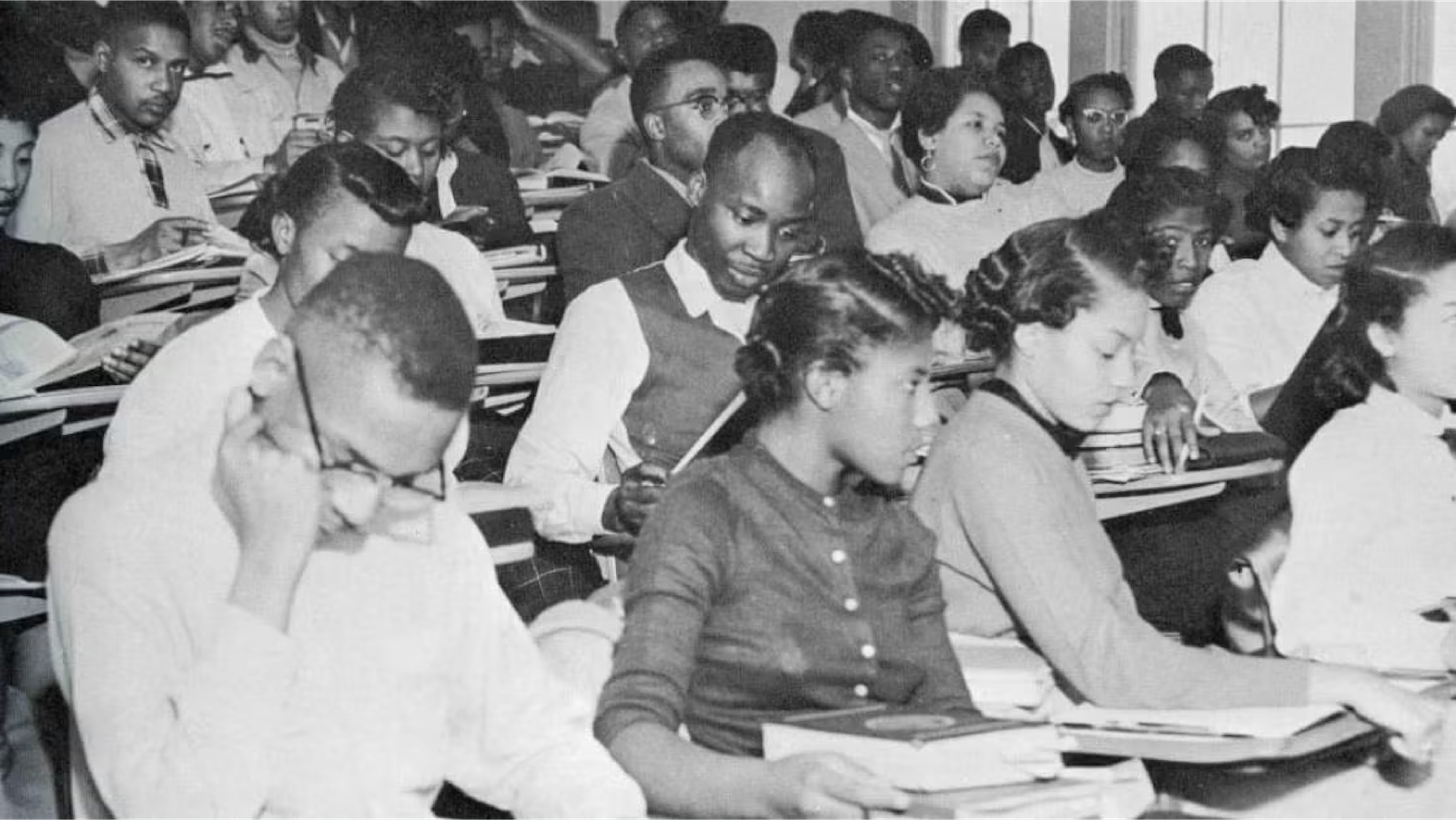
To understand why UNCF matters, it helps to begin with what it was built against. Historically Black colleges and universities were founded in an America that either barred Black students from white institutions outright or admitted them in numbers too small to alter the structure of exclusion. Even after desegregation, HBCUs continued to operate with thinner endowments, weaker access to capital, and deeper exposure to the economic fragility of the families they served. As NCES reported from the latest available data, there were 99 HBCUs in the United States in 2022, spread across 19 states, the District of Columbia, and the U.S. Virgin Islands. Pew Research Center notes that those institutions enrolled just under 290,000 students in fall 2022. Within that landscape, UNCF’s role has always been specific: it is not the voice of every HBCU, nor the umbrella for the entire sector, but rather the fundraising and advocacy institution historically tied to a network of private Black colleges whose survival often depended on collective action. That distinction matters because it clarifies UNCF’s genius. It did not solve the structural inequity of American higher education. It built a durable mechanism for Black institutions to survive inside it.
Born from scarcity, built through coalition
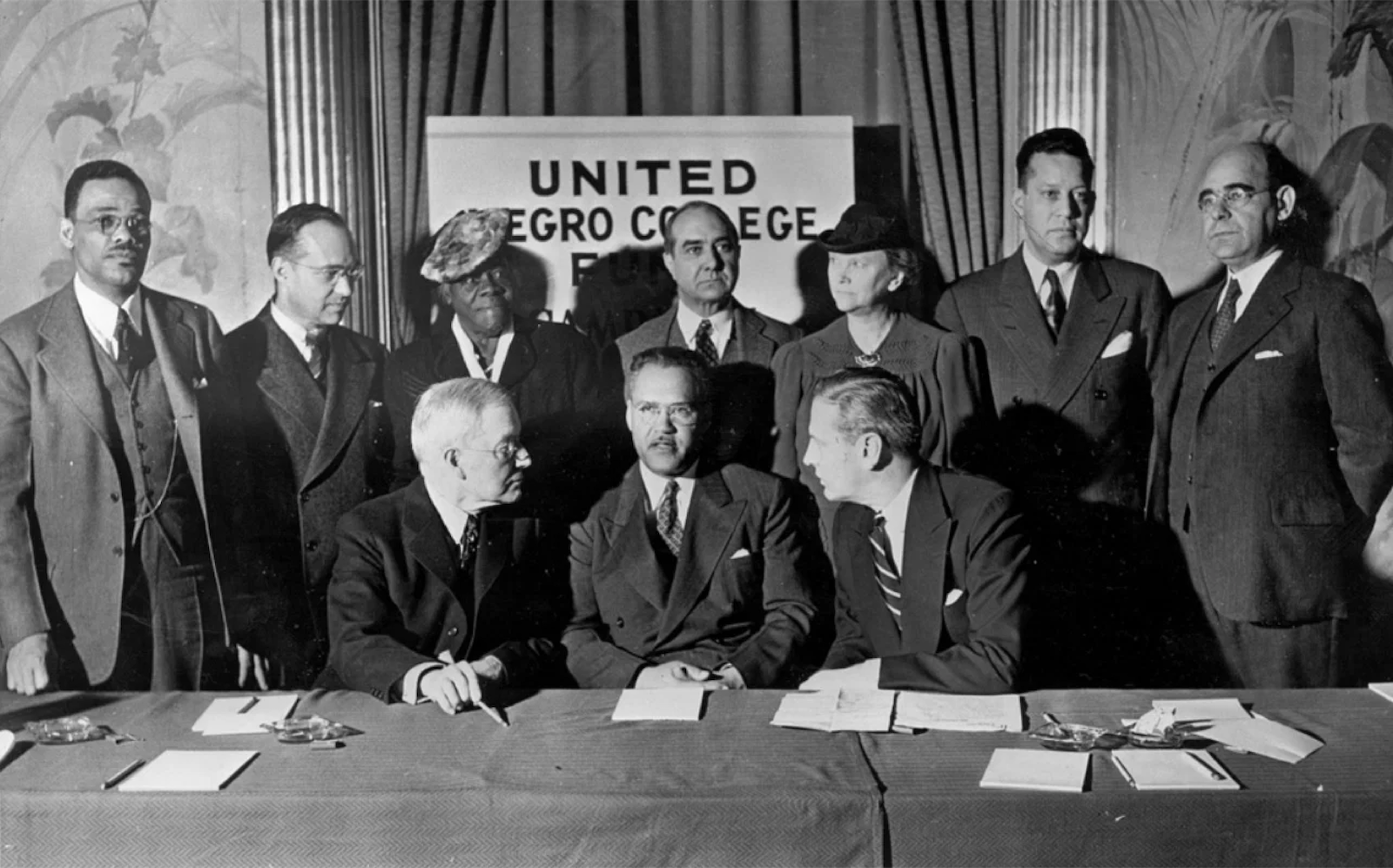
UNCF was incorporated in April 1944, in the middle of a war and in the shadow of a segregated domestic order that still treated Black education as a matter of managed limitation. UNCF’s own retrospective history says Frederick D. Patterson, Mary McLeod Bethune, John D. Rockefeller and other civic, business, and education leaders came together that year to create an organization designed to support historically Black colleges for the long haul. Other UNCF historical materials and affiliated timelines identify Patterson, Bethune, and educator William Trent as key founders, while the Rockefeller Brothers Fund describes the new organization as an interracial effort created for the joint benefit of 27 private African American colleges. Even in the language of its founding, one can hear the problem it was trying to solve. Individual Black colleges had missions. What they lacked was scale. UNCF gave them pooled strategy, pooled fundraising, pooled legitimacy, and a way to speak to donors not as isolated campuses in constant emergency but as a shared national cause.
That origin story matters because it was as much financial engineering as moral appeal. Frederick D. Patterson understood that many Black colleges were trapped in a cycle that would become painfully familiar across the 20th century: too underfunded to build strong balance sheets, too financially weak to attract major gifts, too dependent on tuition and denominational support to plan ambitiously, and too essential to be allowed to fail quietly. What UNCF created was a fundraising architecture that could aggregate need without reducing Black colleges to a charity case. It asked donors to invest not in pity, but in national capacity. It also linked college support to democratic legitimacy: if the United States claimed itself as a meritocratic nation, then starving Black institutions of educational capital was both hypocrisy and sabotage. The organization’s early structure made clear that Black higher education was not merely a private matter for Black communities. It was a public test of American seriousness. UNCF still describes support for its member institutions as the core of its work, and UNCF’s member-college materials emphasize that operating support helps keep tuition at member schools nearly 30 percent lower than comparable institutions.
The quiet revolution of collective fundraising
There is a tendency in American philanthropy to celebrate singular benefactors and dramatic gifts. UNCF’s deeper accomplishment was collective discipline. It persuaded donors that many Black colleges, taken together, represented not a fragmented set of local appeals but a coherent national project. That was not a given in 1944. Private Black colleges were geographically dispersed, denominationally distinct, and often competing for the same limited pool of support. UNCF’s model made cooperation materially useful. The point was not that all of its member institutions were identical; the point was that all of them were structurally disadvantaged in similar ways and could benefit from a common financial and public-relations machinery. The Chronicle of Higher Education noted years ago that private Black colleges had long relied on UNCF for scholarship support and portions of operating expenses. That observation remains essential. UNCF became the institution behind the institutions, a backstage engine whose labor often disappeared behind the public faces of the campuses it helped keep afloat.
In practical terms, this meant more than fundraising campaigns. It meant donor cultivation, scholarship administration, brand management, research, convening power, and eventually policy advocacy. UNCF’s current public-facing materials describe a three-part mission: supporting students through scholarships and programs, strengthening member colleges, and advocating for college readiness and educational opportunity. UNCF ties that approach to measurable outcomes, including a 70 percent six-year graduation rate for its African American scholarship recipients, which it says is higher than the national average overall and markedly higher than the national average for African American students. Word In Black also highlighted that 70 percent figure in 2024 while summarizing UNCF’s impact. The exact numbers have evolved over time, but the strategic insight remains constant: financial aid alone is not enough; institution-building alone is not enough; public argument alone is not enough. UNCF’s staying power comes from combining all three.
How a slogan became an institution
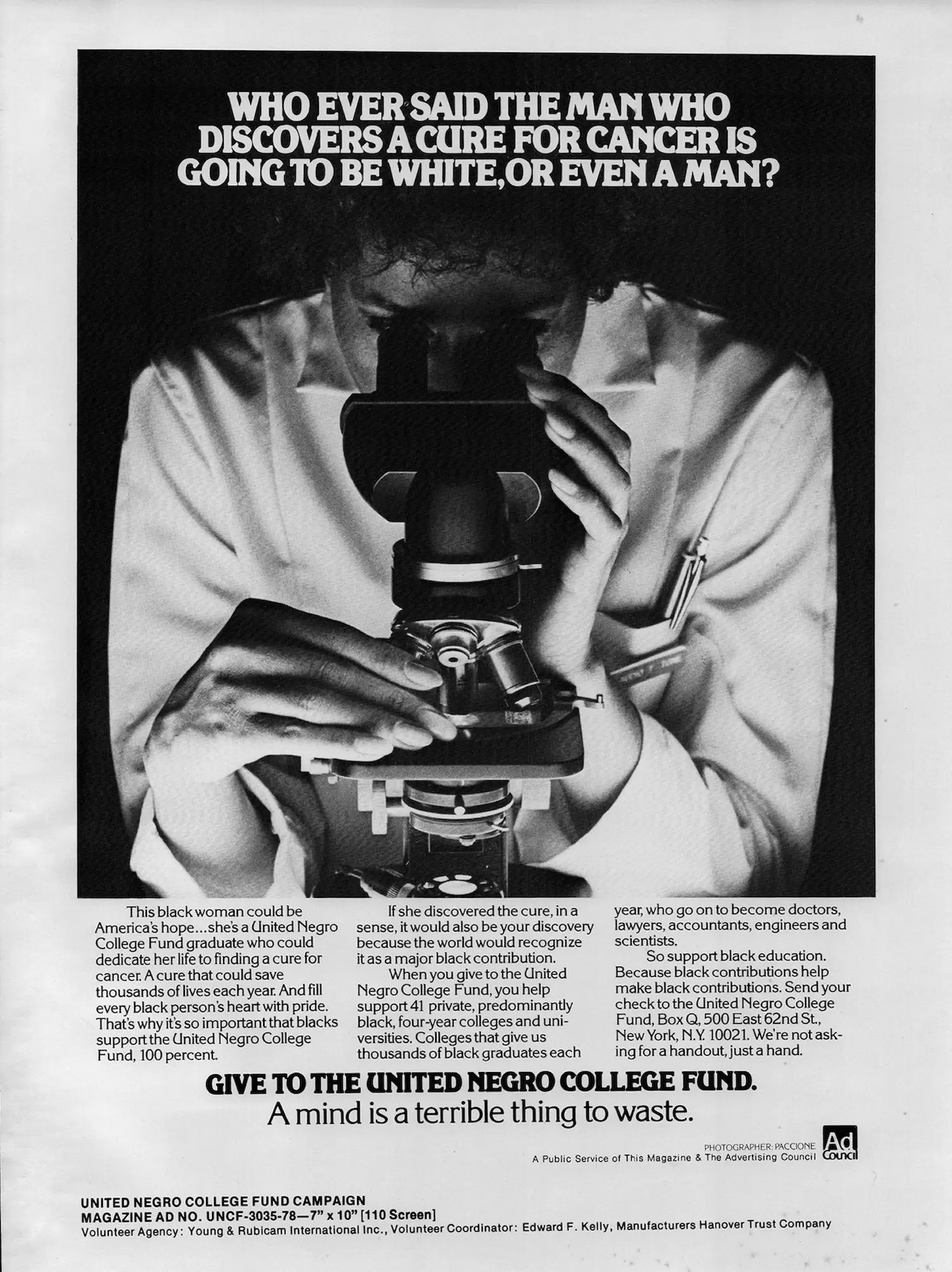
The phrase that made UNCF famous did not arrive at the organization’s birth. It emerged in 1972, and it transformed not just public awareness but the grammar of Black educational fundraising. UNCF’s memorial tribute to Vernon Jordan credits Jordan, working with friends at Young & Rubicam and the Ad Council, with helping launch “A mind is a terrible thing to waste” in newspapers and on television nationwide. The Ad Council’s history describes the 1972 campaign as the start of a decades-long effort that eventually raised more than $2.2 billion and helped more than 350,000 minority students graduate from college or beyond. More than an advertising victory, the slogan was a rhetorical repositioning of Black education itself. It told donors that the loss at stake was not only individual. A wasted Black mind was a wasted national asset, a squandered civic resource, a theft from the future.
What made the slogan powerful was its elegant inversion. Much American discourse had long framed Black educational aspiration as demand, complaint, or special pleading. UNCF reframed it as common-sense stewardship. Who, after all, would argue for waste? The line gave Americans a way to support Black higher education while feeling that they were endorsing efficiency, morality, and national progress. It was one of the rare campaigns that managed to be emotionally resonant, politically palatable, and ideologically expansive all at once. It also made UNCF legible to people who might never set foot on an HBCU campus. That mattered. Institutions that rely on philanthropy must first become imaginable to donors outside their immediate constituency. The slogan did that work. It translated the stakes of Black college funding for a broad public without flattening the mission into sentimentality.
Still, the phrase’s familiarity has sometimes overshadowed the hard facts underneath it. HBCUs do not exist simply because they are beloved symbols. They endure because they perform. UNCF’s 2024 economic impact report states that HBCUs generate 136,048 jobs and $16.5 billion in total economic impact across local and regional economies. The report also says an HBCU graduate working full-time over a career can expect more than $1 million in additional income because of a college degree. Ebony underscored the same 2024 report’s finding that HBCUs generate $16.5 billion in direct economic impact. The slogan was memorable because it was morally true. It endures because the institutions behind it are economically consequential.
The telethon years and the theater of Black giving
If the slogan made UNCF recognizable, the telethon era made it visible as a ritual of Black aspiration. Beginning in 1980, Lou Rawls’s “Parade of Stars” turned fundraising into appointment television and reintroduced Black philanthropy to itself on a national stage. The format mattered as much as the money. Telethons are theatrical by design; they turn donation into spectacle, sentiment into momentum. But for UNCF the annual event did something more specific: it made Black generosity, Black achievement, and Black institutional need legible as a shared public culture rather than a series of private obligations. UNCF’s materials now place the organization’s brand growth in the post-1972 era, while outside historical accounts, including UPI and longstanding coverage summarized in public archives, documented Rawls’s repeated hosting of the annual telethon through the 1980s. Public historical summaries of Rawls’s role consistently describe the event as a major fundraising pillar for UNCF across decades.
The deeper significance of the telethon lies in what it challenged. Black communities have always given, often sacrificially, to schools, churches, mutual-aid organizations, and local causes. What mainstream America often refused to see was Black giving as philanthropy rather than survival practice. The telethon altered that optics. It placed donors, celebrities, graduates, students, and institutional leaders in the same televised frame, creating a visual grammar of Black investment. Education was not just something Black families wanted for their children. It was something the community financed, celebrated, and insisted upon in public. The telethon also extended UNCF’s emotional bandwidth. It could speak in the sober language of policy and the aspirational language of uplift at once. That duality would become one of its enduring strengths.
UNCF and the politics of respectability, survival, and scale
No institution that lasts eight decades remains uncomplicated. UNCF’s history is not only one of uplift; it is also a story about strategic moderation, donor navigation, and the politics of acceptability. Organizations that depend on broad philanthropy often learn to speak in languages donors find reassuring. For UNCF, that meant presenting Black higher education as excellent, pragmatic, nation-serving, and worthy of investment. Much of that is undeniably true. Yet it also placed the organization in a position familiar to many Black institutions: needing to secure resources from power structures that had helped create the scarcity in the first place. Its public message had to persuade not only the converted but the cautious. That brought access. It also brought tension.
One clear example came in 2014, when a $25 million gift connected to Koch philanthropy generated substantial criticism. Time described the gift as one of the largest in the organization’s history at the time, with most of the money slated for scholarships and the rest for general support of historically Black colleges. The Root captured the backlash around the partnership and the perception that UNCF had grown too comfortable with conservative donors whose broader political projects were often at odds with Black communities. The dispute was not a side story. It illuminated a permanent challenge in Black institutional life: how to accept transformative money without surrendering moral clarity, and how to distinguish strategic resource acquisition from reputational concession. UNCF was hardly alone in that problem. It was, however, visible enough that the contradiction could not be hidden.
That tension does not nullify UNCF’s accomplishments. It explains some of the conditions under which those accomplishments were made. Black educational institutions have rarely been afforded the luxury of ideological purity detached from financial consequence. They must keep students enrolled, payroll met, roofs repaired, accreditation intact, and futures believable. A clean moral narrative is easier to tell from the outside than to live inside a budget. The sharper question, then, is not whether UNCF has ever made controversial choices. It is whether its core mission remained legible through them. On balance, the answer is yes. The organization’s central commitments—to student access, member-college stability, and educational advocacy—have remained recognizable even when its donor portfolio stirred criticism.
Why UNCF still matters in the age of “Do we still need HBCUs?”
This question reappears with tedious regularity, often posed by people who mistake formal desegregation for substantive equity. The answer is not sentimental. It is empirical. HBCUs remain vital because the structures that made them necessary have not disappeared; they have changed form. They still serve disproportionate numbers of first-generation, low-income, and Pell-eligible students. They still operate with far less accumulated capital than many predominantly white institutions. They still produce outsized returns in mobility, professional formation, and civic belonging. The Atlantic highlighted UNCF research showing that within a decade of graduation, the average HBCU graduate earns $71,000 annually. The Root noted that nearly three in five HBCU students come from low-income families and cited UNCF reporting that just 45.9 percent of Black students at public four-year institutions complete degrees in six years. Even The Atlantic’s earlier reporting on graduation rates stressed that HBCUs often succeed under conditions that make simple comparisons misleading.
UNCF matters inside this conversation because it keeps pressing an uncomfortable truth: the debate over HBCU relevance is often a disguised debate over whether Black institutions should be allowed to be fully resourced. Once that question is put plainly, the answer becomes harder to evade. In 2024, AP News reported that private non-HBCU endowments are about seven times the size of private HBCU endowments on a per-pupil basis, citing The Century Foundation, while public non-HBCUs average about three times the per-pupil endowment of public HBCUs. Brookings framed the disparity even more starkly: the 10 largest HBCU endowments in 2020 totaled about $2 billion, compared with roughly $200 billion across the top 10 predominantly white institutions. KOLUMN itself has already argued in “The Endowment Gap Is a Story About Power” that the issue is not simply donor preference but structural inequity reproduced over generations. UNCF’s continued existence is a practical answer to that inequity. It is a mechanism designed to narrow, however incompletely, the distance between institutional performance and institutional wealth.
The advocacy turn
UNCF is often remembered as a fundraising organization, but it is also a policy actor. That shift is not incidental. Once an institution has spent decades financing students and campuses, it eventually confronts the limits of charity. Scholarships can help an individual student bridge a gap. They cannot by themselves correct chronic public underinvestment, federal policy changes, or capital market disparities. UNCF’s public materials now explicitly include advocacy for K-12 education and federal investment in Pell Grants and other aid. That orientation reflects a matured analysis: the pathway to Black college completion starts long before college and is shaped by policy decisions long after a fundraising campaign ends. UNCF says as much in its own history pages, and recent annual-report materials emphasize both student support and advocacy work.
This advocacy role became especially visible during fights over federal higher-education priorities. In 2017, The Washington Post reported on fears that a key HBCU capital financing program might be threatened after President Donald Trump questioned a funding provision as potentially unconstitutional. The U.S. Department of Education describes that program as a means of providing low-cost capital for infrastructure such as classrooms, libraries, laboratories, dormitories, and research equipment; a related department page states that the statutory authority covers up to $1.1 billion in bond guarantees. UNCF’s role in these debates is not abstract. Black colleges need philanthropy, yes, but they also need functioning public finance. They need the state not to behave as though private generosity can substitute for public obligation.
The lesson here is straightforward. Fundraising can save a semester. Policy can alter a generation. UNCF’s significance lies partly in recognizing that the two cannot be cleanly separated.
The modern giving boom, and what it reveals
In the wake of the racial-justice uprisings of 2020, philanthropy toward HBCUs surged. Some of it was sincere institutional correction. Some of it was reactive corporate conscience. Some of it was a search for visible racial-equity investments that were legible to the public and difficult to attack. Whatever the motives, UNCF emerged as one of the major beneficiaries and strategic distributors of that renewed attention. In 2024, AP News reported that Lilly Endowment gave UNCF $100 million, the largest unrestricted private gift in the organization’s history, to support a pooled endowment for its 37 member HBCUs. The same report noted that the gift was part of a larger $1 billion capital campaign, with a goal of raising $370 million for a shared endowment intended to bolster long-term institutional stability. That is not merely a donation story. It is a strategy story. UNCF is trying to convert episodic generosity into permanent assets.
Then, in 2025, AP News reported that MacKenzie Scott gave another $70 million to UNCF, also tied to the pooled endowment vision. AP described the fund’s target structure as roughly $10 million for each member HBCU, with annual payouts designed to stabilize budgets. That same article highlighted the broader funding gulf: a 2023 Candid and ABFE study found that the eight Ivy League institutions received $5.5 billion from the 1,000 largest U.S. foundations, compared with just $45 million for the nation’s 99 HBCUs in 2019. Word In Black later framed Scott’s 2025 gift as part of a growing recognition that endowment-building, not just emergency relief, is central to HBCU sustainability. KOLUMN’s own “Scholarships Under Fire” made a related point from the student side, arguing that organizations like UNCF are vital precisely because they combine direct aid with broader ecosystem support.
The recent wave of gifts has two meanings. The first is hopeful: major philanthropies are finally treating HBCUs as investment-worthy rather than nostalgia-worthy. The second is less flattering to the nation: it should not take racial crisis, celebrity donors, or billionaire attention to persuade America to finance institutions that have been producing disproportionate value for generations. UNCF’s current capital push is significant precisely because it tries to escape the emotional volatility of this cycle. Outrage surges. Attention spikes. Donors arrive. Headlines bloom. Then the country moves on. Endowment, by contrast, is an argument that stays.
The name, the brand, and the burden of history
The organization’s name carries its own historical pressure. In 2008, as The Chronicle of Higher Education reported, UNCF redesigned its logo to emphasize the acronym rather than the full “United Negro College Fund” name, even as it kept the famous slogan at the center of the brand. Inside Higher Ed explained that officials wanted to honor the organization’s heritage without leaning too heavily on a term that had long ceased to be the normal descriptor for Black people or Black institutions. It was a small change that revealed a larger truth: legacy organizations are always negotiating between historical continuity and contemporary intelligibility. UNCF had to carry the name history gave it while speaking to the present tense.
That branding evolution was not cosmetic. It reflected the challenge of remaining rooted without becoming trapped in archival amber. UNCF’s core constituency is still deeply shaped by Black institutional memory. But its actual work now extends to underrepresented students more broadly, to policy advocacy, to research, and to a donor environment vastly more complex than the one its founders knew. The brand needed to say: we are old enough to remember what exclusion looked like when it was explicit, and modern enough to fight its updated forms.
What UNCF symbolizes now
There is a temptation, especially around anniversaries, to turn institutions into monuments. UNCF resists that reduction because it remains operational. It still moves money. It still underwrites degrees. It still props up campuses navigating enrollment pressure, infrastructure needs, donor skepticism, and the long tail of historical undercapitalization. It still participates in public argument over who deserves educational investment and how that investment should be structured. The organization’s importance is therefore not only historical. It is administrative, material, and contemporary.
Its significance also lies in the way it has helped preserve a particular idea of Black higher education. HBCUs are often described in the language of refuge or cultural affirmation, and both descriptions contain truth. But UNCF’s history insists on another register: Black colleges are economic engines, civic anchors, professional pipelines, and institutional producers of national value. UNCF’s 2024 economic-impact work quantified that argument in jobs, earnings, and regional output. The Guardian, in pandemic-era reporting, quoted a UNCF research executive explaining how HBCUs were balancing public health with the reality that many students lacked the material conditions for seamless remote learning. Ebony framed the economic argument more recently by emphasizing the outsized national returns produced by HBCUs. UNCF’s genius has been to help make all of those truths visible at once.
If there is a sharper way to say it, it is this: UNCF has spent 80 years refusing the idea that Black colleges should be measured by scarcity. It has insisted, over and over, that they should be measured by output, by intellectual consequence, by community function, by survival under unequal conditions, and by the futures they make possible.
The unfinished work
And yet the work remains unfinished. The persistence of the endowment gap, the fragility of many campuses, the volatility of philanthropic attention, and the disproportionate economic precarity of the students HBCUs serve all make clear that UNCF’s mission has not been completed by its longevity. Longevity is not victory. It is proof of necessity. The same country that celebrates HBCU graduates, recruits HBCU talent, and praises HBCU culture has still not built a financing system that treats Black institutions as if their permanence were nonnegotiable. That is why UNCF remains relevant. It exists because admiration has never been enough. Someone still has to organize the ask, build the case, manage the flow, defend the institutions, and convert belief into balance-sheet reality.
KOLUMN has been circling this question in different forms across its own coverage, whether in “A College Built for the Work”, which traced the mixed funding streams and historical tensions inside an HBCU’s life, or in “The Endowment Gap Is a Story About Power”, which argued that Black institutional undercapitalization is not accidental residue but ongoing design. UNCF belongs in that conversation not as an abstraction, but as one of the country’s most consequential counter-designs. It does not erase structural inequity. It answers it, repeatedly, in the language institutions understand best: money raised, students retained, campuses stabilized, arguments won, futures extended.
In the end, the story of UNCF is not only about Black colleges. It is about what Black institutions have had to invent in order to endure a nation that routinely consumes their output while underfunding their existence. It is about how a coalition born in 1944 translated exclusion into infrastructure. It is about the marketing brilliance that turned a slogan into a household phrase, and the administrative discipline that turned a phrase into generations of degrees. It is about the fact that philanthropy, however celebrated, was never meant to excuse public neglect. And it is about why the United Negro College Fund, even now, remains one of the clearest mirrors of American contradiction: a beloved institution made necessary by an enduring failure to finance justice at the scale justice requires.
UNCF’s history is therefore larger than organizational history. It is part of the history of Black survival through institution-building. It is part of the history of American education, because American education cannot be honestly told without the colleges created for Black students when the rest of the country refused them. It is part of the history of philanthropy, because it forced donors to recognize Black educational aspiration as a national claim. And it is part of the history of language, because few lines have better captured the stakes of squandered talent than the one UNCF sent into the culture more than half a century ago.
A mind is a terrible thing to waste, yes. But UNCF’s longer argument has always been broader and more radical than the slogan alone. A college is a terrible thing to starve. A generation is a terrible thing to underfund. A nation is a terrible thing to build on unequal terms and then call fair. For eighty years, UNCF has worked in the breach between those truths and the America that still struggles to face them. That is why its history matters. That is why its significance endures. And that is why the institution behind the institutions remains, even now, one of the most important stories in Black America.
More great stories
Afro Sheen, Wall Street, and the Architecture of Black Possibility
July 6, 2026
No Comments
The Fire Inside the Fourth
July 5, 2026
No Comments